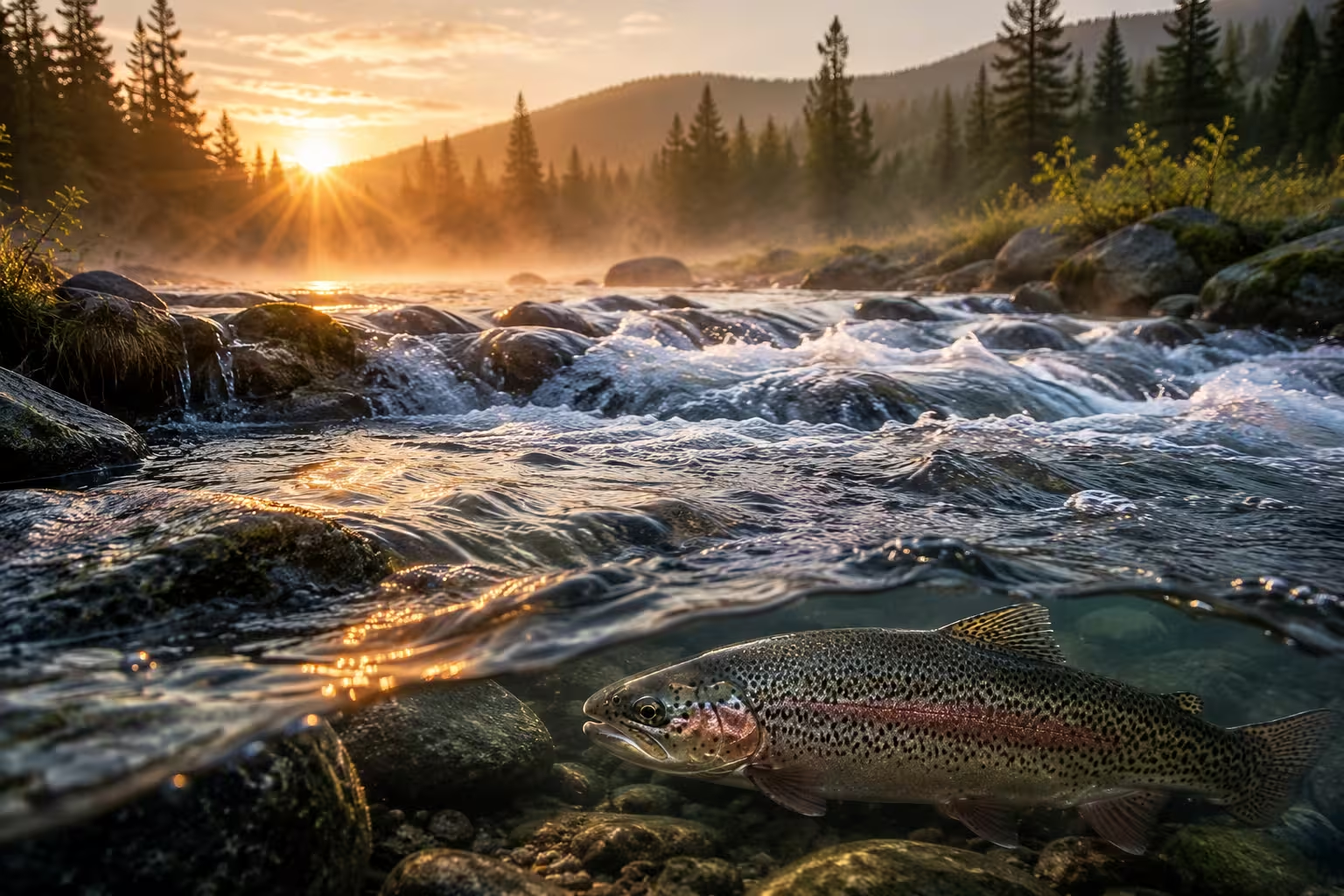
Rainbow vs Brown vs Brook vs Cutthroat Trout: ID, Behavior & How to Fish Each
You are standing knee-deep in a cold run, a fish has just eaten your lure, and when it finally slides into the net you pause. Is that a brown trout or a rainbow? Is that faint orange mark under the jaw a cutthroat slash, or just blood from the hook? Learning how to identify trout species begins with recognizing differences in body coloration, spotting patterns, fin markings, and other distinctive physical features. And why did this fish hammer a streamer when the one upstream refused everything but a tiny mayfly?
Those questions are not trivia. Telling trout species apart matters for regulations, for conservation, and, most importantly, for catching more fish. Rainbows, browns, brook trout, and cutthroats look similar to a beginner, but they differ in biology, in the water they prefer, in how they feed, and in how they respond to your presentation. An angler who understands those differences stops fishing “for trout” and starts fishing for a specific animal.
This guide covers the four trout species most anglers catch in North America. For each one you will get field marks you can use in seconds, the biology that explains the behavior, and practical tactics for lures, bait, and flies, plus timing by season. We finish with a side-by-side checklist, a note on hybrids, and a detailed FAQ.
This post is part of our trout species and behavior series, and it connects to our complete guide on how to catch trout. That article is the full system for finding and catching trout of any kind. This one narrows the focus: who is on the end of your line, and what that tells you about where to cast next.
A quick note on terminology before we start. “Trout” is a loose label for several fish in the salmon family, the salmonids. Rainbow and cutthroat are true trout in the genus Oncorhynchus, the same genus as Pacific salmon. Brown trout belong to the genus Salmo, which also includes Atlantic salmon. Brook trout are not trout at all in the strict sense. They are char, in the genus Salvelinus, alongside lake trout and Arctic char. That one fact explains a lot about why brook trout look and behave the way they do.
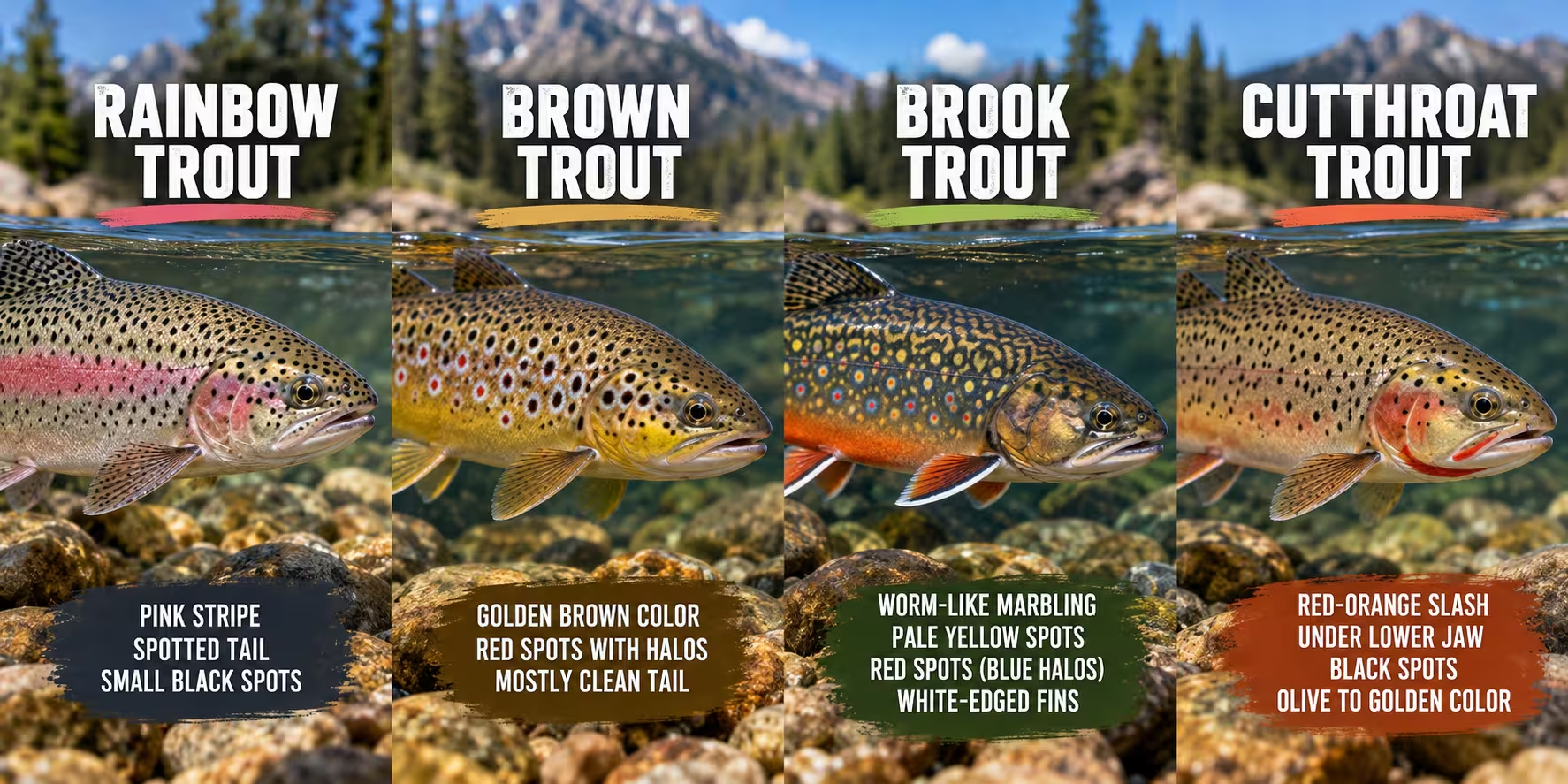
Rainbow vs Brown vs Brook vs Cutthroat Trout: Quick Comparison Chart
| Feature | Rainbow | Brown | Brook | Cutthroat |
|---|---|---|---|---|
| Scientific name | Oncorhynchus mykiss | Salmo trutta | Salvelinus fontinalis | Oncorhynchus clarkii |
| Group | True trout (Pacific) | True trout (Atlantic) | Char | True trout (Pacific) |
| Native range | Pacific drainages of North America and Asia | Europe and western Asia | Eastern North America | Western North America |
| Body color | Silvery to olive, pink-red side stripe | Golden brown to olive | Dark olive-green | Olive to golden, varies by subspecies |
| Spots | Small black spots, including across both tail lobes | Black and red spots, many with pale halos | Pale yellow spots on a dark back, red spots with blue halos | Black spots, usually denser toward the tail |
| Best ID mark | Heavily spotted tail, pink band | Red spots with halos, mostly clean tail | Worm-like marbling on back, white-edged fins | Red-orange slash under the lower jaw |
| Spawning season | Late winter to spring | Fall | Fall | Spring to early summer |
| Feeding sweet spot | About 50 to 65°F | About 50 to 65°F, tolerates warmer | About 45 to 60°F | About 45 to 60°F |
| Personality | Energetic, aerial, aggressive | Wary, nocturnal, predatory | Eager, opportunistic | Trusting, surface-oriented |
| Top tactic | Drifted baits, jigs, spinners, nymphs | Streamers and minnow lures in low light | Small spinners, attractor dries | Dry flies and terrestrials |
Use the chart as a starting point. Every species has exceptions, and color in particular is unreliable because trout change shade with environment, diet, and spawning condition. Spots, fin edges, mouth structure, and tail shape are far more dependable.
Rainbow Trout (Oncorhynchus mykiss)
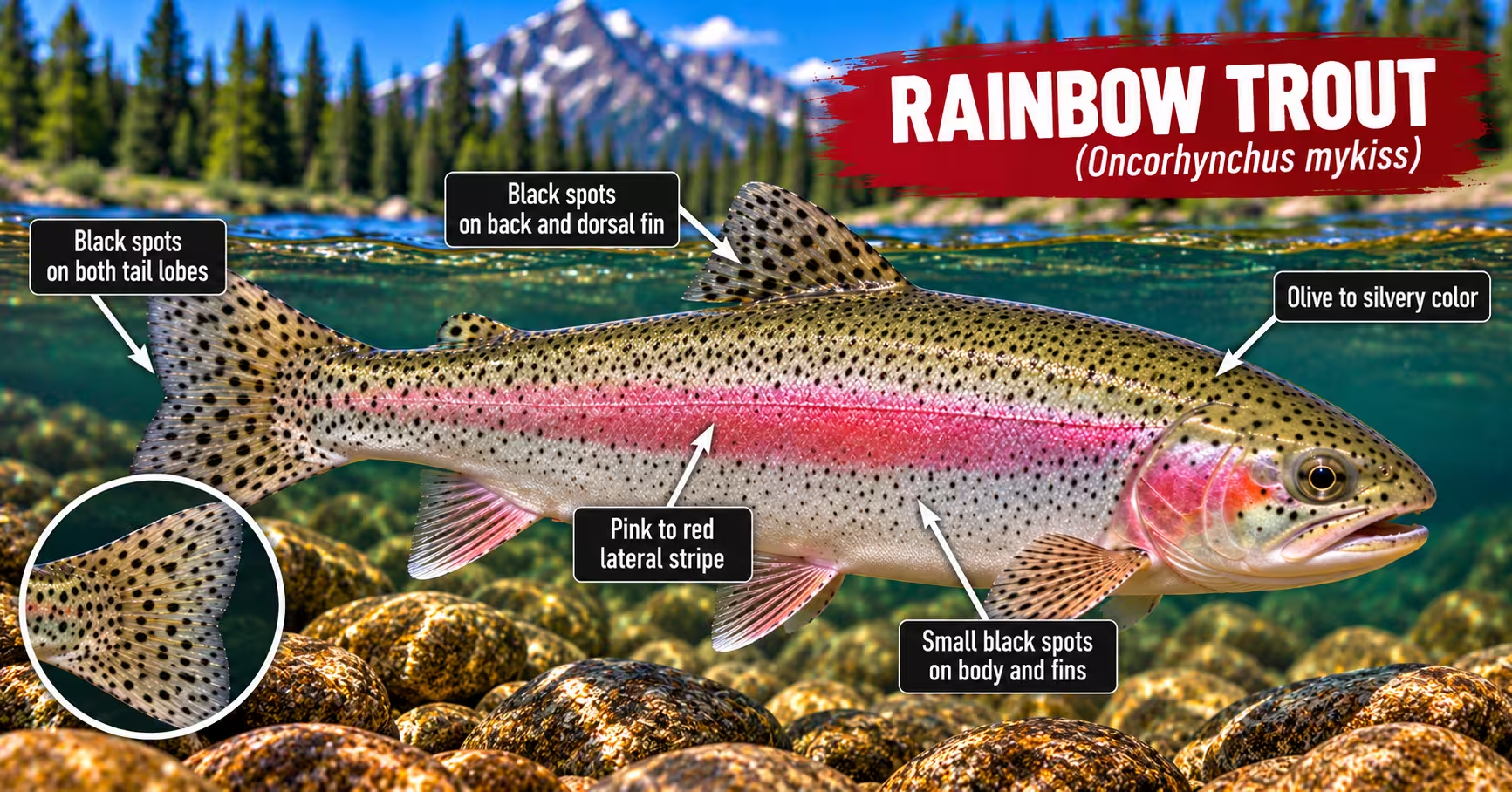
How to Identify a Rainbow Trout
Rainbows are the most widely distributed trout on the planet because humans have stocked them almost everywhere there is cold water. Start with these field marks:
- A pink to red stripe along the lateral line. It is brightest on spawning fish and stream-resident males, and often faint on silvery lake-run fish.
- Small, dense black spots over the back, sides, and dorsal fin. Look at the tail. Rainbows carry well-defined black spots across the whole tail fin, on both the upper and lower lobes. This is one of the most reliable ways to separate a rainbow from a brown trout, which usually has a nearly clean tail.
- No red spots with pale halos. If you see red spots ringed in light blue or white, you are not holding a rainbow.
- A mouth that ends at or just behind the eye on fish of average size.
- No red slash under the jaw. A faint pink wash on the gill plate and cheek is normal, but the sharp slash belongs to the cutthroat.
Color varies enormously. A freshly stocked hatchery rainbow may look pale and stubby with worn fins. A river fish after weeks of feeding on aquatic insects can be strongly olive with a ruby side. A lake or sea-run fish can be chrome silver with hardly any visible stripe.
Steelhead deserve a mention. A steelhead is simply a rainbow trout that migrates to the ocean and returns to freshwater to spawn. Same species, same aggression and acrobatics, but much larger because of ocean feeding. In the interior West, resident rainbows called redband trout include distinct native populations that are managed as native fish.
Native Range and Distribution
Rainbow trout evolved in Pacific drainages of North America, from Alaska south into Mexico, and in parts of far-eastern Russia. Starting in the late 1800s they were stocked across the continent and then the world, in part because they tolerate hatchery conditions and warmer water better than cutthroats or brook trout. Today you can catch rainbows in the Great Lakes tributaries, the Appalachians, the Rockies, New Zealand, Patagonia, Europe, and southern Africa.
Rainbow Trout Biology and Behavior
Rainbows are spring spawners. Depending on elevation and latitude they spawn from roughly February through June, building nests called redds in clean gravel, usually at the tail of a pool or in a riffle. This matters to anglers because spawning rainbows are vulnerable and because loose eggs drifting downstream trigger one of the best bites of the year. Our article on why trout eat eggs covers the biology, and our guide to redd spawning gravel shows you how to recognize a nest so you can fish around it instead of on it.
Rainbows are the most energetic of the four. They tend to hold in faster, more oxygenated water than browns: pool heads, seams where fast and slow currents meet, and riffles and runs. They are drift feeders that stay lined up with the current and pick off food as it passes, which is why a well-drifted bait, jig, or nymph is so effective. They are also eager surface feeders during a hatch.
A hooked rainbow often leaps, runs, and cartwheels in ways a brown rarely does. That aerobatic reputation is why many anglers consider it the benchmark sport fish of the trout world.
Diet is varied. Juvenile rainbows eat mostly midges, mayflies, caddisflies, and stoneflies. Adults add scuds, sculpins, small fish, crayfish, worms, and eggs. In big lakes and reservoirs, rainbows feed heavily on zooplankton, kokanee, and forage fish like shad or smelt. If you want the full menu by season, see our breakdown of trout diet by season.
Temperature matters for every trout, and the rainbow has a slightly wider comfort range than the others. They feed best between roughly 50 and 65°F, and stress begins above about 68 to 70°F. In summer heat they concentrate in riffles, below springs, near cold tributary mouths, and in deeper pools.
How to Fish Rainbow Trout
Spinning tackle
Rainbows are the classic spinner and jig fish. Small inline spinners and spoons in the 1/16 to 1/8 ounce range work well in streams and lakes. Cast upstream or across, and retrieve just fast enough to keep the blade turning. A small jig with a soft plastic or marabou tail fished with a steady or twitching retrieve will catch rainbows in nearly every setting. If you are new to lures, start with our guide to the best trout lures for beginners.
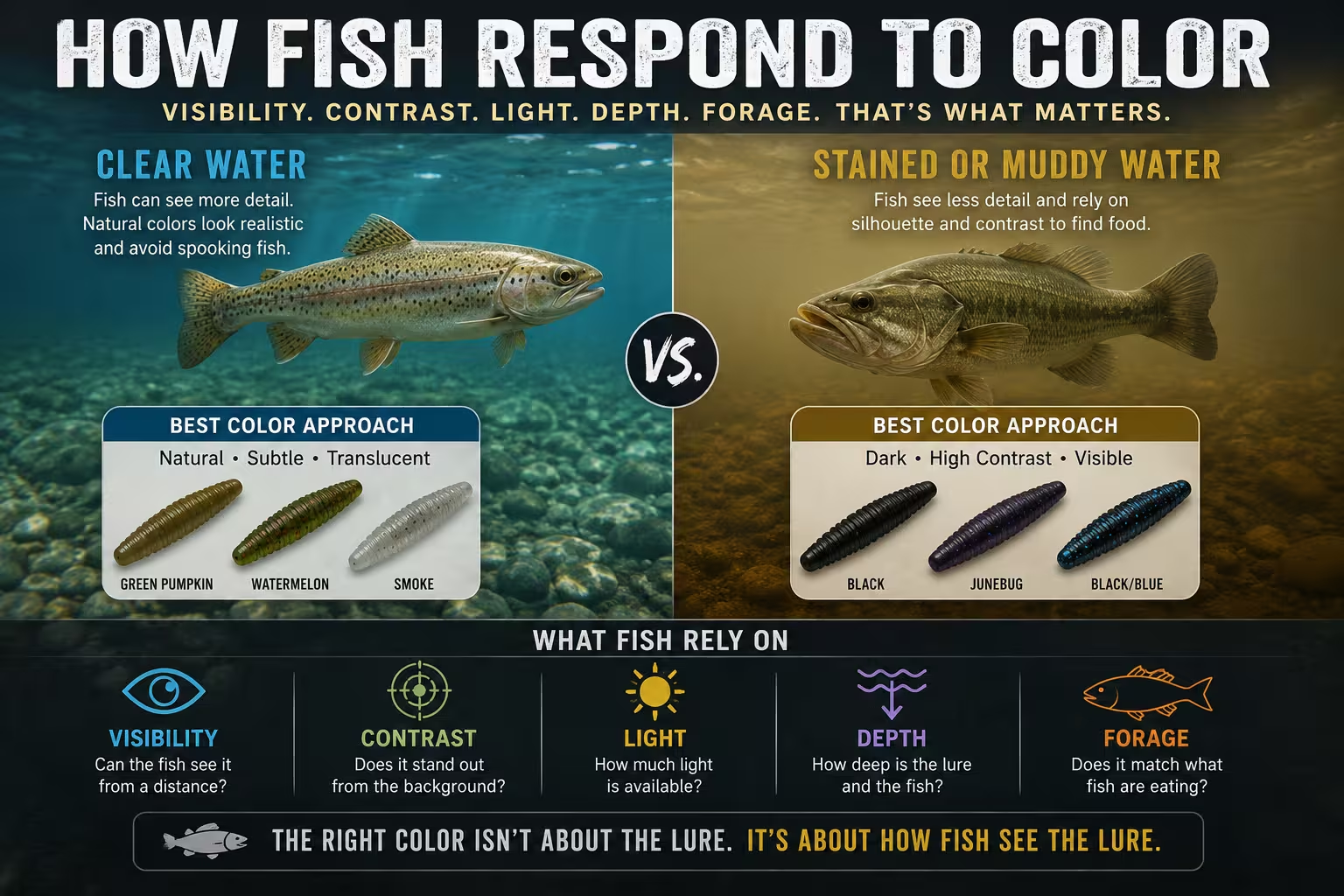
Stocked rainbows add a twist. Hatchery fish are raised on pellets, so small, round, brightly colored baits and worm-like soft plastics are extremely effective right after stocking. A thick, solid-bodied worm like our 2.95″ Round Trout Worm can be fished full length in stained water or trimmed down for clear ponds and pressured fish.
Bait
Nightcrawlers, salmon eggs, and dough baits are classic rainbow offerings where bait is legal. Float dough bait off the bottom on a slip-sinker rig in ponds, and drift worms or single eggs on a split-shot rig in streams. Many trout waters are artificial-only, so check your regulations first.
Fly fishing
Nymphing is the most dependable fly approach because rainbows feed below the surface most of the time. A weighted nymph under an indicator, or a tight-line rig in pocket water, will catch fish in every season. Reliable patterns include Pheasant Tails, Hare’s Ears, Zebra Midges, scuds, stonefly nymphs, and, during the spring spawn, San Juan Worms and egg patterns. When fish rise, an Elk Hair Caddis or Parachute Adams is hard to beat. A dry-dropper rig, with a buoyant dry fly and a nymph hanging 18 to 30 inches below it, is a smart searching rig in riffles and runs. Our guide on why trout eat caddisflies explains why caddis patterns are so productive.
Timing and reading water
- Spring: Focus on runs below spawning areas. Fish eggs and nymphs below the redds, and never wade through them.
- Summer: Fish early and late. Concentrate on riffles, oxygenated pocket water, and shaded runs.
- Fall: Feeding windows stretch through midday. Streamers and small spinners shine.
- Winter: Slow, deep pools and tailwater runs hold fish. Go small and slow in the warmest part of the afternoon.
A rainbow tip that matters: When a rainbow jumps, drop your rod tip and point it toward the fish. Keeping slack out of the line without putting pressure on a jumping fish reduces the leverage it has to throw the hook.
Brown Trout (Salmo trutta)
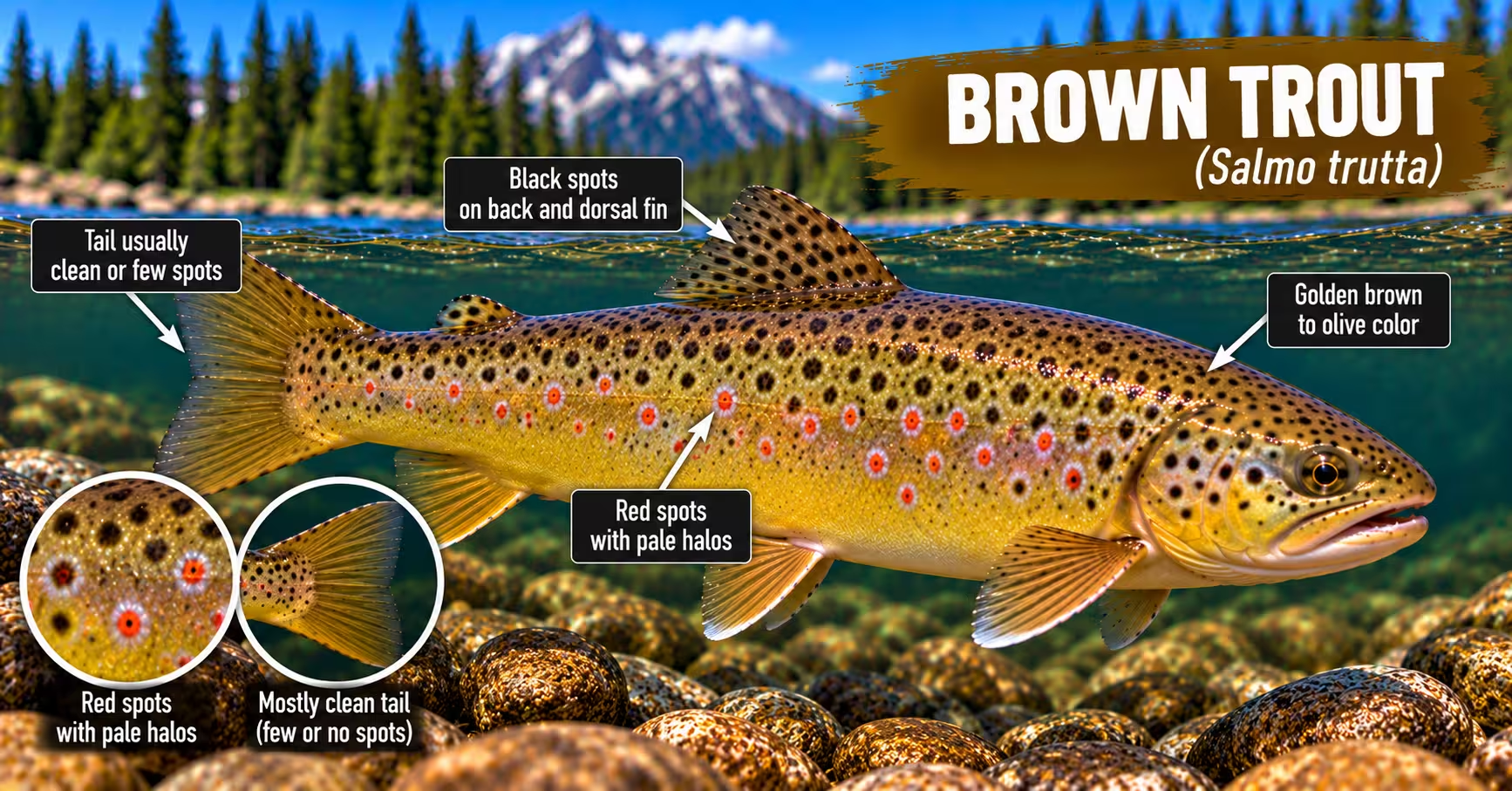
How to Identify a Brown Trout
Browns are the most variable-looking of the four, but they have several consistent features:
- Golden-brown to buttery yellow flanks with an olive-brown back and a pale cream belly. Some fish in big rivers or lakes are silvery.
- Both black and red or orange spots on the sides, with many spots surrounded by pale halos. This halo effect is the most diagnostic mark. A rainbow’s spots are black and unhaloed.
- Few or no spots on the tail. A brown’s tail is typically clean or has only a few faint spots on the upper lobe, and it is squared off rather than forked, especially on older fish.
- Black spots on the gill cover. Browns often have them, and rainbows rarely do.
- An orange or buttery adipose fin, sometimes with a dark margin. The adipose fin is the small fleshy fin between the dorsal fin and the tail.
- A larger mouth on mature fish, where the upper jaw extends well past the eye. Older male browns develop a hooked lower jaw called a kype, especially in the fall.
Brown trout also exist as sea trout, lake-run fish, and stream residents, and their color changes with each. Sea-run browns are chrome silver with small X-shaped spots and can be mistaken for Atlantic salmon. Lake-run browns in the Great Lakes are often silver with bold black spots and little visible red.
Native Range and Distribution
Browns are native to Europe, North Africa, and western Asia. They were introduced to North America in the 1880s, with some of the earliest stockings coming from German stock in 1883 and Scottish Loch Leven fish soon after. Today they are established in nearly every state with cold-water habitat and in many parts of South America, Australia, New Zealand, and Africa.
Because browns are non-native in North America, they occupy an unusual position. They anchor blue-ribbon fisheries on many famous rivers, but biologists also note that in some western streams they displace native cutthroat and brook trout. Browns spawn in the fall, and their fry emerge earlier than those of spring-spawning species, which gives them a growth advantage. Their larger size also lets them prey on small trout. That is one reason agencies manage brown trout very differently from region to region.
Brown Trout Biology and Behavior
Browns are the wariest and most predatory of the four. They grow large, and big browns eat other fish, crayfish, mice, frogs, and large insects. They are also more tolerant of warm and degraded water than the other three. Browns can feed in water approaching the low 70s°F, although stress begins around 70°F and prolonged exposure to the mid-70s can kill them.
Behavior differs from rainbows in several important ways:
- Browns are structure-oriented. They hold near cover: undercut banks, logjams, boulders, overhanging branches, deep cut banks, and docks. A brown wants a hiding place with a view of food passing by. Our article on how trout use current breaks explains why those spots work, and it is covered in our guide to how to catch trout.
- Browns are crepuscular and nocturnal. The biggest browns feed heavily at dawn, dusk, and night. In clear, pressured water they may rarely feed in bright midday sun.
- Browns are territorial. The largest fish claim the best lies and chase off smaller fish. That is why a big brown can be caught repeatedly from the same pocket over a season.
- Browns are aggressive during the fall spawn. Males color up and develop a kype, and they will attack anything that invades their territory. It is a great time to fish them, and also a time to avoid disturbing redds and spawning fish.
Brown trout also feed selectively during hatches. When a mayfly or caddis emergence is on, a big brown may sip a single tiny insect for an hour. That selectivity is why they have a reputation as “smart” fish. In reality, their caution is a strategy: they sit where predators and anglers cannot easily see them, and they feed in the low-light windows when it is safest.
Larger browns also shift toward fish. Minnows, shiners, and bottom-dwelling sculpins are all on the menu, and that changes your lure choice.
How to Fish Brown Trout
Lures: the trophy approach
If you want a big brown, throw something that looks like a meal. Minnow-style hard baits (2 to 3 inches) in brown trout, rainbow, or gold patterns are a standard choice. Inline spinners and spoons also work. Fish them tight to cover, undercut banks, and the edges of deep pools, and retrieve with a slow, steady pull or a twitch-and-pause cadence. Many strikes happen when the lure pauses or when it swings tight at the end of the drift.
Small jigs with marabou or soft plastic tails are also effective, particularly in cold water or on pressured fish. When browns are focused on sculpins, a slow, bottom-hugging jig is hard to refuse. When nothing is moving, dead sticking can catch reluctant fish that will not chase.
Bait
Nightcrawlers drifted along the bottom, minnows where legal, and crayfish tail pieces in rocky streams all tempt browns. Keep your leader light and your hook small, because a big brown that has seen heavy line will not eat. Many catch-and-release streams restrict bait, so check the rules. Our guide to the best fishing line for trout covers how to pick line that stays invisible.
Fly fishing
Streamers are the answer if you want a trophy. A Woolly Bugger, sculpin pattern, or articulated streamer in olive, black, or brown will provoke strikes from large fish that ignore small nymphs. Cast across or slightly downstream toward the bank and strip back with short, erratic pulls and pauses. Use a sink-tip line or add split shot in deeper pools.
Small nymphs and dry flies still work, especially during hatches. Baetis (blue-winged olive), pale morning duns, caddis, and midges produce good fishing, and overcast spring and fall days can bring big browns to the surface. Use long fluorocarbon leaders and 5X or 6X tippet for rising fish.
In western rivers, fishing a mouse pattern at night in summer is a proven big-brown strategy. Use heavy tippet, cast across and slightly downstream, and strip the mouse in short pulls along the bank. Wait to feel the weight of the fish before you set the hook. Scout the water in daylight, wear a headlamp, and wade conservatively.
Timing and reading water
- Early morning and dusk: The best windows in every season.
- Overcast and rainy days: Browns become more active and less cautious.
- Rising or slightly stained water: Lures and streamers can produce fish that would not move in clear, low water.
- Fall: Pre-spawn browns are aggressive, but treat spawning fish and redds with respect.
- Summer: Look for deeper pools, undercut banks, and shaded water. Fish early, late, or at night when daytime temperatures are high.
A brown trout tip that matters: Spend time looking before you cast. Walk the bank slowly, study shadows under overhangs, and watch for subtle rise forms. Big browns often sit within a foot or two of the bank, so wading into the middle can spook the very fish you want.
Brook Trout (Salvelinus fontinalis)
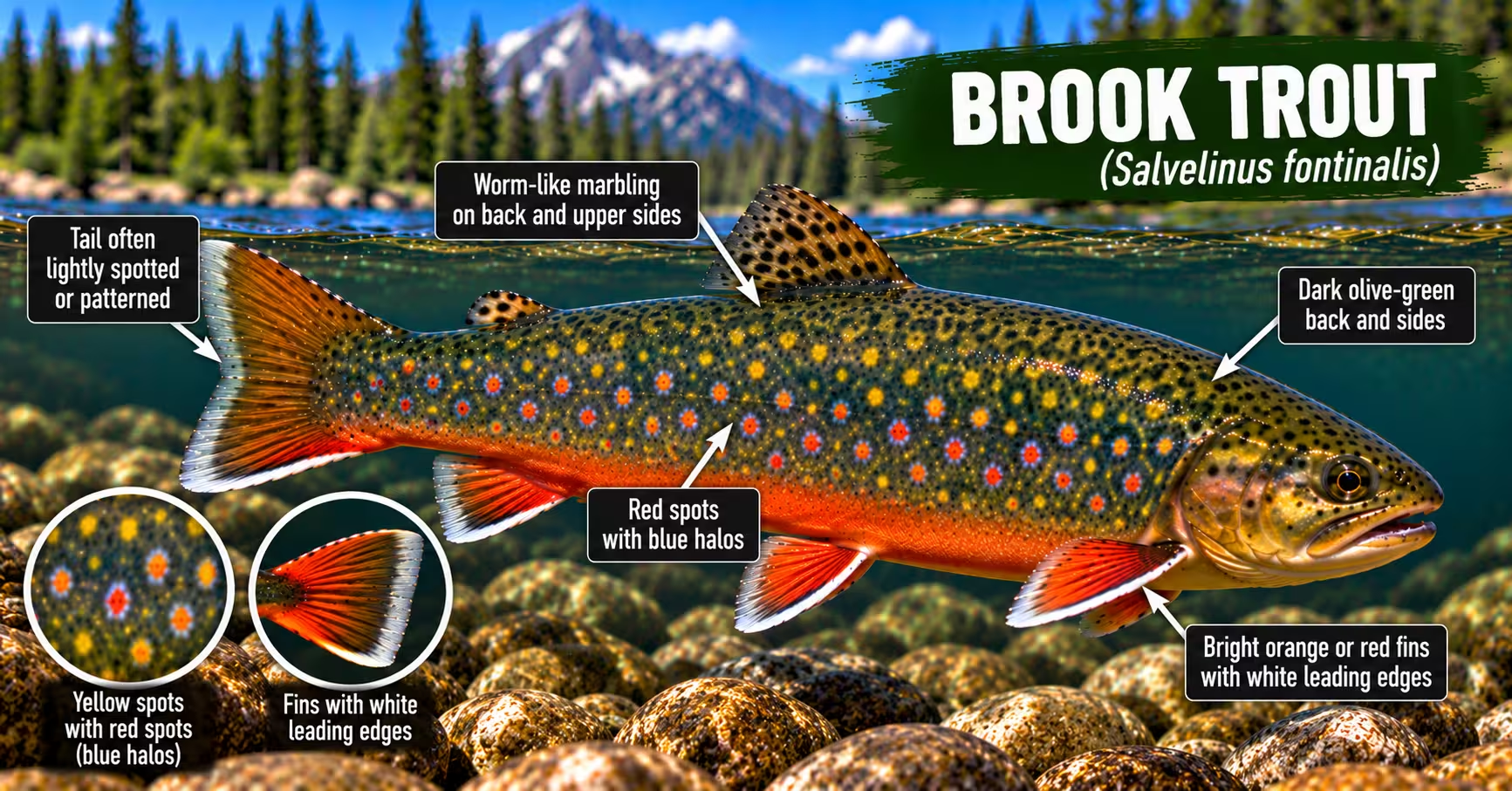
How to Identify a Brook Trout
If the brown is the thoughtful strategist of the trout world, the brook trout is the jewel. Brookies are among the most beautiful freshwater fish in North America, and their field marks are distinctive:
- White leading edges on the lower fins. The pectoral, pelvic, and anal fins have a bold white edge bordered by black, then red-orange. This is the single fastest way to identify a brookie.
- Worm-like, wavy markings called vermiculations on the back and dorsal fin. The pattern looks like marbling or worm tracks, pale cream on dark olive. No rainbow, brown, or cutthroat has this.
- Pale yellow spots on a dark body, plus red spots surrounded by blue halos. The pale-on-dark pattern is the reverse of rainbows and browns.
- A dark olive to nearly black back, with sides that fade to orange or red on the belly, especially in autumn.
- A squared or very slightly forked tail, usually with mottling instead of spots.
- No black spots on the body. If a fish has brook trout features plus bold black spots, look more closely. It may be a hybrid.
In fall spawning colors, male brook trout develop deep orange or crimson bellies with black lower fins edged in bright white. They are easy to identify from across a stream. Sea-run brook trout, called salters in parts of the Northeast and Atlantic Canada, are more silvery but retain the fin edges and some marbling.
Native Range and Distribution
Brook trout are native to eastern North America, from northern Canada south down the Appalachians to Georgia, and west through the Great Lakes region. They have been introduced across the western United States and Canada, and to Europe and South America. In the West, introduced brook trout are often considered invasive because they can displace native cutthroat in small headwater streams.
In their native East, brook trout face a different problem. Habitat loss, warming water, logging, development, and competition with non-native browns and rainbows have reduced their historic range substantially, and many conservation groups work to protect and restore wild brook trout streams.
Brook Trout Biology and Behavior
Brook trout are cold-water specialists. They are the least tolerant of warm water among the four species, thriving around 45 to 60°F and suffering when temperatures climb past about 68°F. They prefer clean, well-oxygenated streams with plenty of spring seeps, groundwater, shade, and gravel, which is why they thrive in small high-elevation creeks, beaver ponds, and spring-fed lakes. Our deep dive on the best water temperature for trout explains why temperature controls where and when they feed.
Their fall spawn is the most dramatic. Brookies spawn from about September through November, building redds in gravel near spring seeps, where upwelling groundwater keeps eggs supplied with cold, oxygen-rich water.
Behaviorally, brookies are bold and opportunistic. In small streams they are often the easiest of the four to catch, and they will attack almost any properly presented lure or fly. Food in headwater streams is limited, so they cannot afford to be picky. They rarely grow large in tiny streams, and an 8-inch brookie in a headwater creek can be a mature adult. In larger rivers, lakes, and especially northern Canada, brook trout can reach several pounds. The all-tackle world record is 14 pounds 8 ounces, caught in the Nipigon River in Ontario in 1916, and the migratory Lake Superior form is known as the coaster brook trout.
Diet is broad: aquatic and terrestrial insects, small crustaceans, leeches, salamanders, and small fish. In northern lakes and rivers they feed heavily on mayfly hatches (including the big Hexagenia hatch), sculpins, and minnows.
How to Fish Brook Trout
Spinning tackle
Ultralight gear is perfect for brook trout water. A 5 1/2 to 6 1/2 foot ultralight rod, a 1000-size reel, and 2 to 4 pound line let you cast tiny lures and feel every bite. Inline spinners in size 0 or 1, small spoons, tiny crankbaits in the 1.5-inch range, and 1/32 to 1/16 ounce jigs all work. Cast upstream or across and retrieve with the current. For small-water tactics, see our guide to the best baits and techniques for creek fishing.
Brookies in small creeks are often keyed on worms washed in by rain. A small soft-plastic worm rigged on a light jig head and drifted through pockets and plunge pools can be deadly. The Ribbed Trout Worm was designed for exactly this kind of ultralight finesse fishing.
Bait
Small worms fished on a tiny hook with little or no weight are the traditional favorite where bait is allowed. Let the worm drift naturally through pools and along undercut banks.
Fly fishing
Small stream brookies are a delight on a lightweight rod, ideally a 2- to 4-weight, 7 to 8 feet long. Approach quietly and keep a low profile, because even eager brook trout spook when they see you. Effective flies include Royal Wulffs, Stimulators, Elk Hair Caddis, and Parachute Adams in sizes 12 to 16, plus ants, beetles, and small hoppers in summer. Small bead-head nymphs work when fish are not looking up.
Fish upstream, since trout face into the current and are less likely to see you approaching from behind. Target pockets behind rocks, plunge pools at the base of small falls, and undercut banks. A brookie will often hit on the first good drift, and if it does not rise in two or three casts, move on.
Timing and reading water
- Spring: As snowmelt recedes, fish pools and deeper runs where fish recover after winter.
- Summer: Brook trout concentrate in cold pockets, near spring seeps, and in headwater sections. If water temperature rises beyond about 68°F, consider not fishing for them at all.
- Fall: Pre-spawn brookies feed hard and show their brightest colors. Stay away from redds and leave fish on beds alone.
- Winter and ice: In lakes and ponds, brook trout are a popular ice-fishing target using small jigs, minnows, or spoons.
A brook trout tip that matters: Because brook trout live in cold, clear, low-productivity water, they are fragile. If you plan to release them, use barbless hooks, keep them wet, and never squeeze the belly. Our guide to trout catch-and-release covers what actually keeps these fish alive.
Cutthroat Trout (Oncorhynchus clarkii)
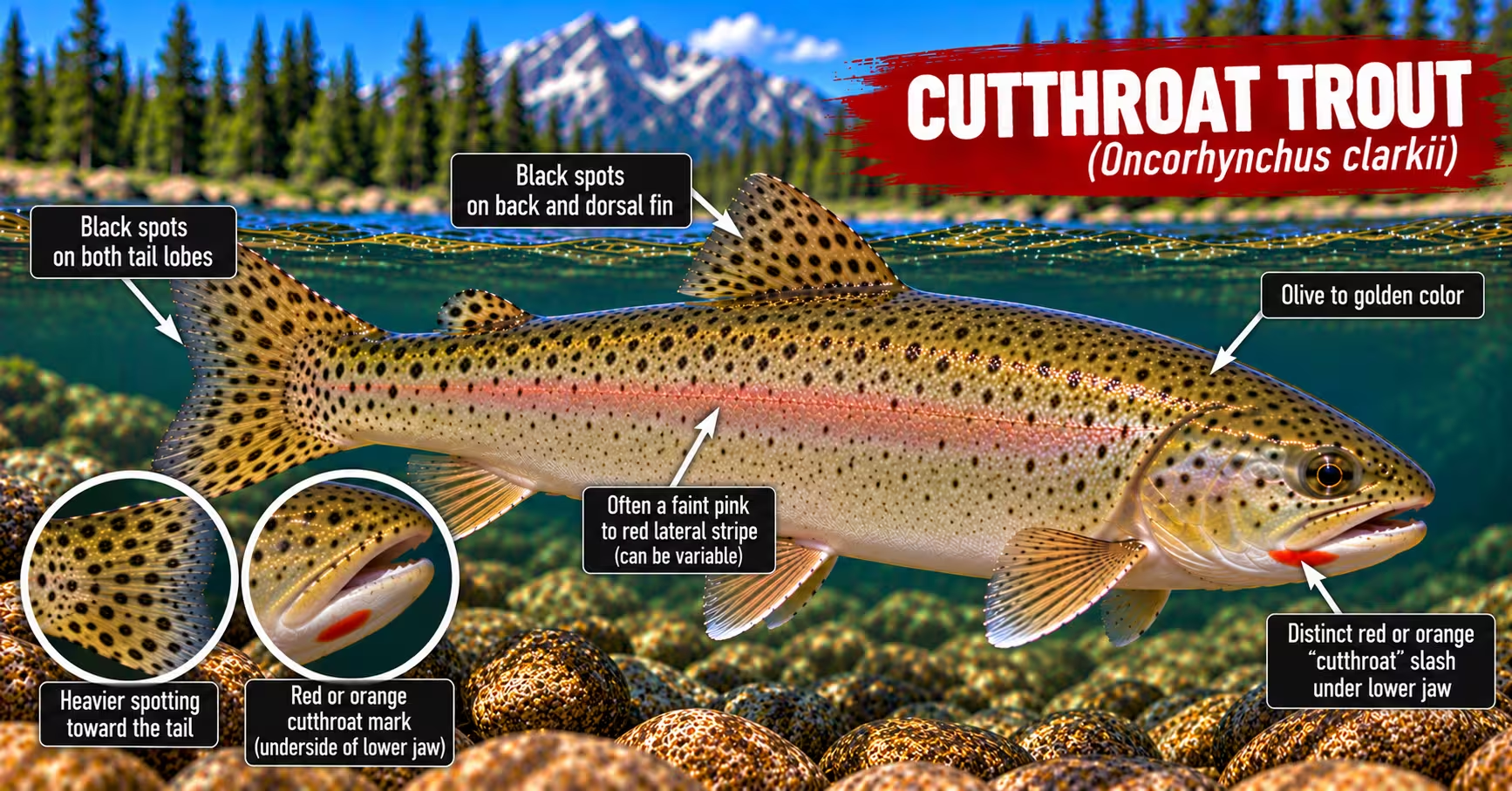
How to Identify a Cutthroat Trout
Cutthroats are named for a single obvious mark:
- A red, orange, or pinkish slash on each side of the lower jaw, in the fold along the inside of the lower jaw bone. It can be bright crimson on spawning fish and very faint in some populations, so check carefully by gently lifting the lower jaw while the fish is in the water.
- Black spots on an olive to golden body, usually concentrated toward the tail and the back half of the body. Some subspecies, like the Yellowstone and Rio Grande cutthroat, have heavy rear spotting, while the Snake River fine-spotted cutthroat has many tiny spots across the body.
- Basibranchial teeth. Cutthroats have a small patch of teeth on the plate at the base of the tongue, which rainbows lack.
- Color that varies by subspecies and habitat. Coastal cutthroat are silver to bronze. Westslope cutthroat often show a coppery or pinkish flush. Lahontan and Bonneville forms can be silver or olive. Colorado River cutthroat can be vivid orange on spawning fish.
- A moderately forked tail with spots across the lobes.
Cutthroats are the most diverse of the four. Biologists recognize a number of subspecies, each adapted to its own drainage: Westslope, Yellowstone, Lahontan, Bonneville, Colorado River, Rio Grande, Greenback, Snake River fine-spotted, and the coastal cutthroat of the Pacific Northwest, among others.
Native Range and Distribution
Cutthroat trout are native across a huge area of western North America, from the coastal streams of southeast Alaska and British Columbia down to northern California, across the interior Rockies and Great Basin, and into the Southwest. Because they evolved in isolated drainages, each subspecies adapted to a particular watershed.
Today many cutthroat populations have declined sharply because of habitat degradation, overharvest, climate change, and competition and hybridization with introduced rainbow, brown, and brook trout. Several subspecies are listed or are the focus of intense restoration, with the greenback cutthroat in Colorado the best-known example. Agencies often manage cutthroat waters as catch-and-release, and some require special permits or gear restrictions. Always check current rules.
Cutthroat Trout Biology and Behavior
Cutthroats are spring spawners, like rainbows, and that is exactly why the two interbreed. Where rainbows have been introduced into cutthroat water, the species can produce fertile hybrids, often called cutbows, and over generations the genetic integrity of the native fish can be lost. A cutthroat with spots all over the body and a rainbow-like silver shine may carry rainbow ancestry. Biologists treat this genetic swamping as one of the biggest threats to native cutthroat.
Cutthroats are often less wary than browns and sometimes less wary than rainbows. In remote streams they see little fishing pressure and respond with trusting enthusiasm, particularly to surface offerings. In pressured waters they can become more selective, but they are generally the most surface-oriented of the four.
They prefer cold, clean water, and many populations live in high-elevation streams and lakes where growing seasons are short and growth is slow. A 12-inch cutthroat in a headwater creek may be many years old. In large lakes, such as Pyramid Lake in Nevada or Yellowstone Lake in Wyoming, cutthroat can grow big. The all-tackle record for cutthroat, a Lahontan cutthroat from Pyramid Lake, weighed 41 pounds and was caught in 1925.
Stream-dwelling cutthroat feed mostly on drifting insects. In late summer, terrestrials like grasshoppers, beetles, and ants become an important food source, and cutthroat will leave cover to rise confidently to a well-presented hopper. Lake cutthroat may feed heavily on forage fish and chironomids.
How to Fish Cutthroat Trout
Fly fishing
If there is one species where the dry fly takes center stage, it is the cutthroat. A high-floating dry such as a Stimulator, Chubby Chernobyl, Parachute Adams, or foam hopper is often all you need. Effective approaches include:
- Dry-dropper rigs: A large visible dry with a small bead-head nymph suspended below it.
- Attractor dries like Royal Wulffs and Humpies in sizes 8 to 14 in rough water.
- Hoppers, beetles, and ants from July through September along grassy banks.
- Streamers in lakes and big rivers, especially olive Woolly Buggers and leech patterns.
- Chironomid and callibaetis patterns in high-elevation lakes.
In streams, cutthroat often hold in slower water than rainbows. Look for deep pools, eddies, soft water along banks, and the edges of faster currents. A drag-free drift is vital, but cutthroat are usually more forgiving than browns when your presentation is imperfect.
Spinning tackle
Small spinners, spoons, and minnow lures are effective, particularly in lakes and bigger rivers. Gold, copper, and rainbow patterns draw strikes. Small jigs fished slowly near the bottom work in cold water and high lakes. Many cutthroat waters are artificial-lure only, so confirm what is allowed before you rig up.
Bait
Where legal, worms and salmon eggs catch cutthroat. But because many cutthroat waters are catch-and-release or lure-restricted, and because deeply hooked fish suffer, lures and flies are the better choice.
Timing and reading water
- Spring and early summer: Runoff can limit access. Fish the clearing edges and the tails of pools, and use nymphs, jigs, and streamers when water is high.
- Midsummer: Surface action peaks. Terrestrials, caddis, stoneflies, and mayflies bring cutthroat up.
- Late summer to early fall: Hopper season is prime time. Target grassy banks and meadow streams.
- High lakes: Ice-out and early summer are best. Cruise the shoreline and fish structure with chironomids or small streamers.
A cutthroat tip that matters: Do not take a fish’s willingness to bite as permission to be careless. Cutthroat are often trusting, and many populations are fragile. Land them quickly, keep them in the water, photograph them briefly with wet hands, and release them promptly.
How to Identify Trout Species: Field Marks Checklist
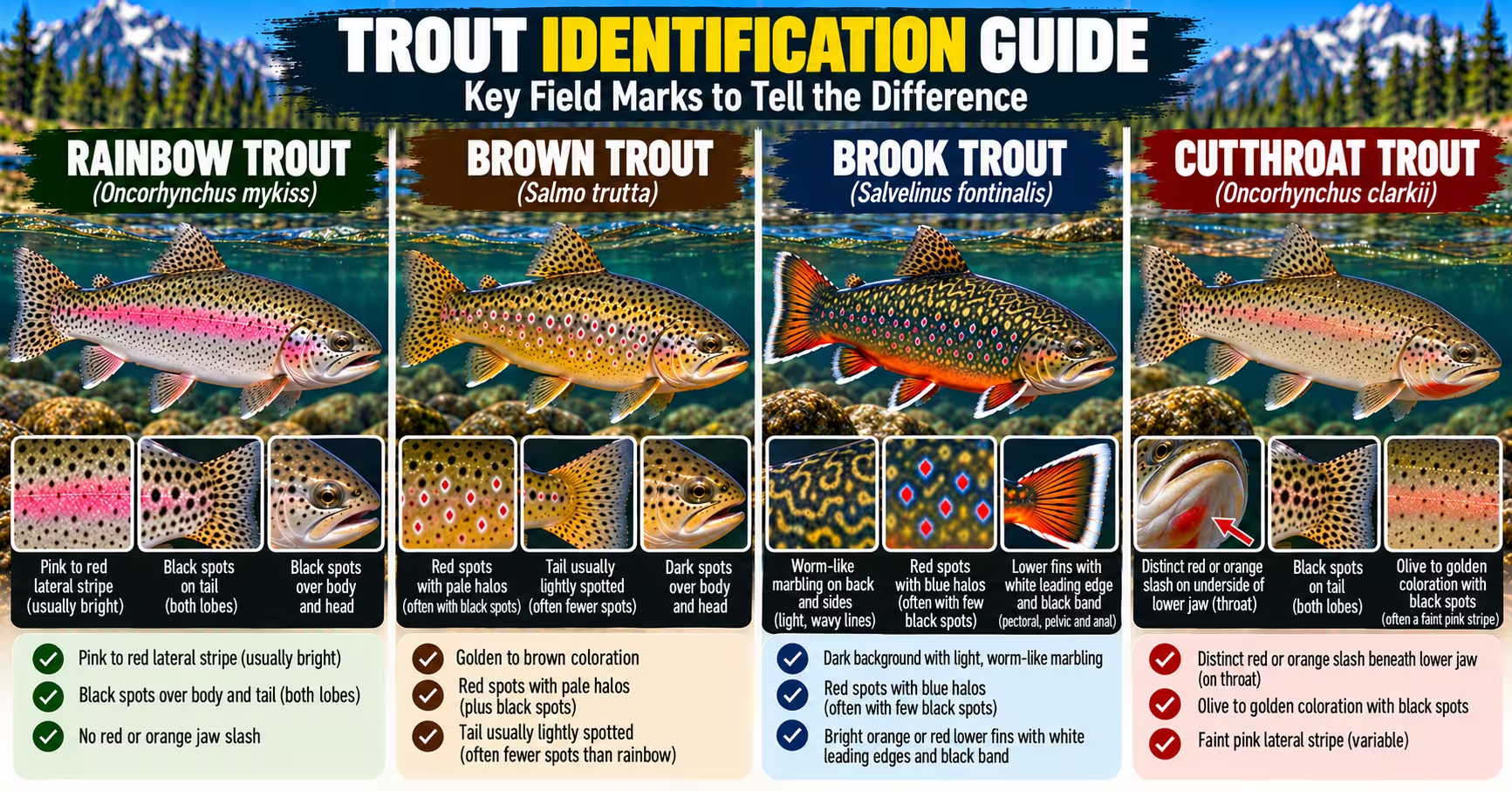
When you have a fish in the net and only a few seconds before you release it, check these features in order.
Step 1: Look at the lower fins. If the leading edges are bright white with a black stripe behind them, it is a brook trout. If you also see a marbled back, you have your answer.
Step 2: Check under the jaw. A red, orange, or pink slash under the lower jaw means cutthroat. A faint red wash only on the gill plate suggests a rainbow or hybrid.
Step 3: Look at the tail. A tail covered with black spots on both lobes points to a rainbow. A tail that is clean or nearly clean points to a brown. Cutthroat tails are usually spotted too, but cutthroat also carry the jaw slash.
Step 4: Look at the spots and halos. Red or orange spots with pale halos on a golden-brown body mean brown trout. Pale spots on a dark body with blue-ringed red dots mean brook trout.
Step 5: Look for the stripe. A broad pink-red lateral band suggests a rainbow.
Step 6: Consider the season and the water. An aggressive, colored-up fish caught in fall may belong to a fall spawner like a brown or brook. A fish from a tiny cold headwater stream in the East is probably a brookie. A fish from a high Rocky Mountain creek could be a native cutthroat or a stocked rainbow.
Common Mix-ups
- Rainbow vs brown: Check the tail and the halos. Rainbows have a spotted tail and no halos. Browns have a mostly clean tail and haloed spots.
- Brook vs brown: Both can have red spots with pale halos. Brook trout have the marbled back and white-edged fins. Browns have neither.
- Rainbow vs cutthroat: Check the jaw slash. Rainbows lack it, though hybrids may show a faint one.
- Brown trout vs Atlantic salmon: In parts of the Northeast and Atlantic Canada, a small silvery trout can look like a young salmon. Salmon parr have large oval parr marks on the sides and a deeply forked tail.
Trout Hybrids and Tricky Fish
Not every trout fits neatly into one category.
Cutbows (rainbow x cutthroat). Where the two share water they interbreed. Cutbows show a faint jaw slash combined with heavy spotting. Many are healthy, hard-fighting fish, but they represent a loss of native genetics.
Tiger trout (brown x brook). A rare natural hybrid, widely produced by hatcheries because they are sterile. They have bold worm-like markings across the body that look like tiger stripes. Several states stock them in lakes, and they are aggressive predators.
Splake (lake trout x brook trout). A hatchery hybrid in some northern lakes that combines features of both parents.
Palomino and golden color morphs. Palomino trout are hatchery-selected rainbows with a yellow-gold color. Albino and leucistic fish are genetic color variations that still belong to their parent species.
Why does this matter? Regulations sometimes apply by species, and if you catch a fish that looks like a pure native, careful release and a report to your state fisheries agency can help biologists.
Water Temperature and Habitat by Trout Species
Trout are cold-blooded, so water temperature controls metabolism, feeding, and survival. Rainbows and browns feed best around 50 to 65°F. Brook trout and cutthroats prefer a few degrees cooler, around 45 to 60°F. Stress begins around 68 to 70°F for rainbows, browns, and cutthroat, and a little lower for brook trout, and fish caught in water that warm suffer much higher mortality after release. Browns tolerate marginal water better than the others, which is why they persist in streams where rainbows and brookies have faded out.
A few practical rules follow:
- Carry a thermometer. A simple stream thermometer costs a few dollars. If water climbs past the upper 60s, fish early in the morning or move to cooler water.
- Stop fishing when it is too warm. Trout can die after being caught even if they swim away. When water hits the upper 60s to 70°F, end the day.
- Look for cold-water refuges. Spring seeps, cold tributaries, deep pools, and shaded stretches provide relief in summer.
- Match species to habitat. Small, cold, high-gradient streams favor brook trout and cutthroat. Mid-sized, fertile rivers favor rainbows and browns. Larger, slower, warmer rivers favor browns.
Habitat by species:
- Rainbow trout: Riffles, runs, pool heads, tailwater stretches, large lakes, and reservoirs.
- Brown trout: Undercut banks, deep pools, logjams, boulder fields, tailwaters, spring creeks, and marginal water.
- Brook trout: Small headwater streams, beaver ponds, spring-fed lakes, and cold northern rivers.
- Cutthroat trout: Mountain streams, meadow creeks, high lakes, big western rivers, and coastal estuaries for the coastal form.
Catch-and-Release and Conservation for Wild Trout
Identifying the fish is only half the responsibility. How you handle it determines whether it survives.
- Use barbless or pinched-barb hooks. They are easier to remove and cause less injury.
- Wet your hands before touching a fish. Dry hands strip the protective slime layer.
- Keep fish in the water. Net them in the water, unhook them in the water, and keep photos to a few seconds.
- Use a rubber net. It protects slime and fins better than knotted nylon.
- Do not squeeze the belly. Support the fish gently under the belly and near the tail.
- Revive the fish. Hold it facing upstream until it swims away under its own power.
- Avoid redds. A redd looks like a clean, light patch of gravel with a pit upstream and a mound downstream. Walk around it, not through it.
- Check regulations. Rules on gear, bait, size, and species vary by water, and some waters require you to release all native fish.
- Do not move fish or bait between waters. It spreads disease and invasive species.
- Clean, drain, and dry your gear between waters to prevent spreading invasive species like didymo and New Zealand mud snails.
If you plan to keep fish for the table, stick to species and waters where harvest is allowed and sustainable. Stocked rainbows in put-and-take lakes and invasive brook trout in western headwater lakes are often encouraged harvest, while native cutthroat and wild eastern brook trout generally deserve release.
Gear Recommendations for Each Species
You do not need a separate setup for each species, but matching your tackle to the fish and water improves your results.
Spinning gear
- Ultralight (small streams, brook trout, small cutthroat, ponds): 5 1/2 to 6 1/2 foot ultralight rod, 1000-size reel, 2 to 4 pound line.
- Light (rainbows and browns in bigger rivers and lakes): 6 1/2 to 7 foot light-power rod, 2000 to 2500-size reel, 2 to 6 pound line.
Fly gear
- Small streams: 7 to 8 foot, 2- to 4-weight rod, floating line, 5X to 7X leader.
- Medium rivers: 9 foot, 4- to 5-weight rod, floating line, 9-foot 4X to 7X leader. The best all-around choice.
- Big rivers, lakes, and streamers: 9 foot, 6- to 7-weight rod, sink-tip or intermediate line, short heavy leaders for streamers.
Essentials for every trout angler
- Polarized sunglasses to see fish and structure
- Nippers, forceps, and a rubber net
- A stream thermometer
- Split shot, small hooks, and light line or tippet
- Layers, because mountain weather changes quickly
A Simple Game Plan When You Don’t Know What’s in the Water
- Observe first. Look for rises, bugs on the water, and fish holding in clear lies.
- Start with a versatile search lure. A small inline spinner or a jig with a soft plastic tail covers water quickly and shows you what is there. On a fly rod, a dry-dropper does the same job.
- Read the water type. Fast, bubbly runs hold rainbows. Deep, shaded banks hold browns. Tiny, cold pocket water holds brookies. Meadow stretches and slower pools in the mountains hold cutthroat.
- Adjust to the response. If you are catching small fish, stay shallow and keep moving. If you are getting nothing, slow down, go smaller, and fish the structure, especially in low light.
- Identify every fish. Take a quick look at the tail, jaw, and fins, then release it carefully.
- Keep notes. Record temperature, flows, hatch, and what worked. Over a season those notes teach you the rhythm of the water.
Frequently Asked Questions About Rainbow, Brown, Brook, and Cutthroat Trout
What is the easiest way to tell a rainbow trout from a brown trout?
Look at the tail and the spots. Rainbows have small black spots across the whole tail fin and no halos around their spots. Browns have a mostly clean tail and spots that include red or orange dots with pale halos. Rainbows also tend to show a pink stripe along the side, while browns are more golden-brown.
Is a brook trout really a trout?
Technically, no. Brook trout are char, in the genus Salvelinus, and are more closely related to lake trout and Arctic char than to rainbow or brown trout. Anglers call them trout because they look and behave like trout in similar habitat. The white-edged lower fins and light spots on a dark body are char characteristics.
How can I identify a cutthroat trout if the red slash is faint?
Look for other clues. Check for spots concentrated toward the tail and basibranchial teeth at the base of the tongue, and consider where you are fishing, because pure cutthroat live in specific western drainages. Hybrids with rainbows can show a faint or incomplete slash. If the fish may be a native cutthroat, release it carefully and follow local regulations.
Which trout species is the hardest to catch?
Most experienced anglers say large brown trout. They are cautious, spend much of their time in cover, feed at low light, and become selective during hatches. Any trout in clear, heavily fished water can be difficult, though, and a stocked trout that has been caught a few times can be just as demanding.
Which trout species fights the hardest?
Rainbow trout generally fight with the most acrobatics, with fast runs and jumps. Brown trout fight with powerful, dogged runs and head shakes, often diving for cover. Brook trout are scrappy for their size, and cutthroat fight steadily with less aerial display. Fight quality depends on size, water temperature, and current.
What is the best bait for each trout species?
For rainbows, dough baits, salmon eggs, and nightcrawlers are classic in stocked waters. Browns respond to nightcrawlers, minnows, and crayfish. Brook trout take small worms and tiny spinners. Cutthroat take worms, salmon eggs, and small spinners, though many cutthroat waters are restricted to artificial lures. Always check local bait rules.
What is the best lure for trout if I don’t know which species I’m targeting?
A small jig with a soft plastic or marabou tail is the most versatile choice, because it works at any depth and speed and imitates minnows, leeches, insects, and worms depending on how you fish it. Small inline spinners are the best search lure for covering water. See our guide to the best trout lures for beginners.
What time of day is best for trout fishing?
Early morning and evening are usually best, especially in summer, when trout feel safer in low light and temperatures are cooler. In spring and fall, midday can be productive. In winter, the warmest part of the afternoon is typically best. Overcast days can produce fish all day.
What water temperature is too warm for trout fishing?
When water reaches about 68 to 70°F, trout are stressed and the risk of death after release rises sharply. Brook trout and cutthroat are the most sensitive. If your thermometer shows temperatures in this range, fish earlier in the day, move to cooler water, or stop for the day.
When do each of the four species spawn?
Rainbow and cutthroat trout spawn in spring, typically from late winter through early summer depending on elevation. Brown and brook trout spawn in the fall, usually from September through December. Avoid wading through redds, and consider avoiding spawning fish altogether.
Can different trout species interbreed?
Yes, some can. Rainbow and cutthroat trout hybridize readily and produce cutbows. Brown and brook trout can produce tiger trout, which are rare in the wild and common in hatcheries. Brook trout and lake trout can produce splake. Hybridization becomes a conservation problem when it dilutes native fish populations.
Is it legal to keep native trout?
It depends on the state, province, and water. Many native cutthroat and wild brook trout waters are catch-and-release or have strict limits. Stocked waters often allow harvest. Read the current regulations for the specific water you are fishing, since rules can change from year to year.
How big do these trout get?
Size depends on food and water. In small streams, an adult brookie or cutthroat may be only 8 to 12 inches. In productive rivers and large lakes, rainbows and browns can reach 20 to 30 inches or more. Record fish come from large lakes and specialized fisheries, such as the Nipigon River for brook trout and Pyramid Lake for Lahontan cutthroat.
Do I need a license to fish for trout?
Almost always, yes. Many states also require a separate trout stamp. Check your state wildlife agency for license requirements, limits, gear restrictions, seasonal closures, and stocking schedules before you fish.
Final Thoughts: Learn the Fish, Then Fish the Fish
Rainbow, brown, brook, and cutthroat trout share a family tree and a love of cold, clean water, but they are four different animals with four different personalities. The rainbow is the energetic athlete of fast water. The brown is the cautious, structure-hugging predator. The brook trout is the colorful cold-water specialist of small streams. The cutthroat is the trusting, surface-feeding native of the West.
Learn the field marks and you can identify your catch in seconds. Learn the behavior and you will know where to cast, when to fish, and what to tie on. Add careful handling and respect for regulations, and you will help keep these fish in the water for the next angler.
Bookmark this page, and use our complete guide to how to catch trout to go deeper on location, bait, lures, and presentation.
Tight lines.
About Family Fishin
Family Fishin is a family-owned fishing tackle company dedicated to designing, testing, and producing high-quality fishing lures, inspired by generations of fishing tradition and driven by a passion for innovation. Every product is developed with one goal in mind: helping anglers spend more time doing what they love, catching fish and creating memories on the water.
#rainbow trout #brown trout #brook trout #cutthroat trout #trout identification #trout behavior #how to catch trout #trout species