Sculpins Explained: Why These Bottom-Dwelling Baitfish Are an Important Trout Food Source
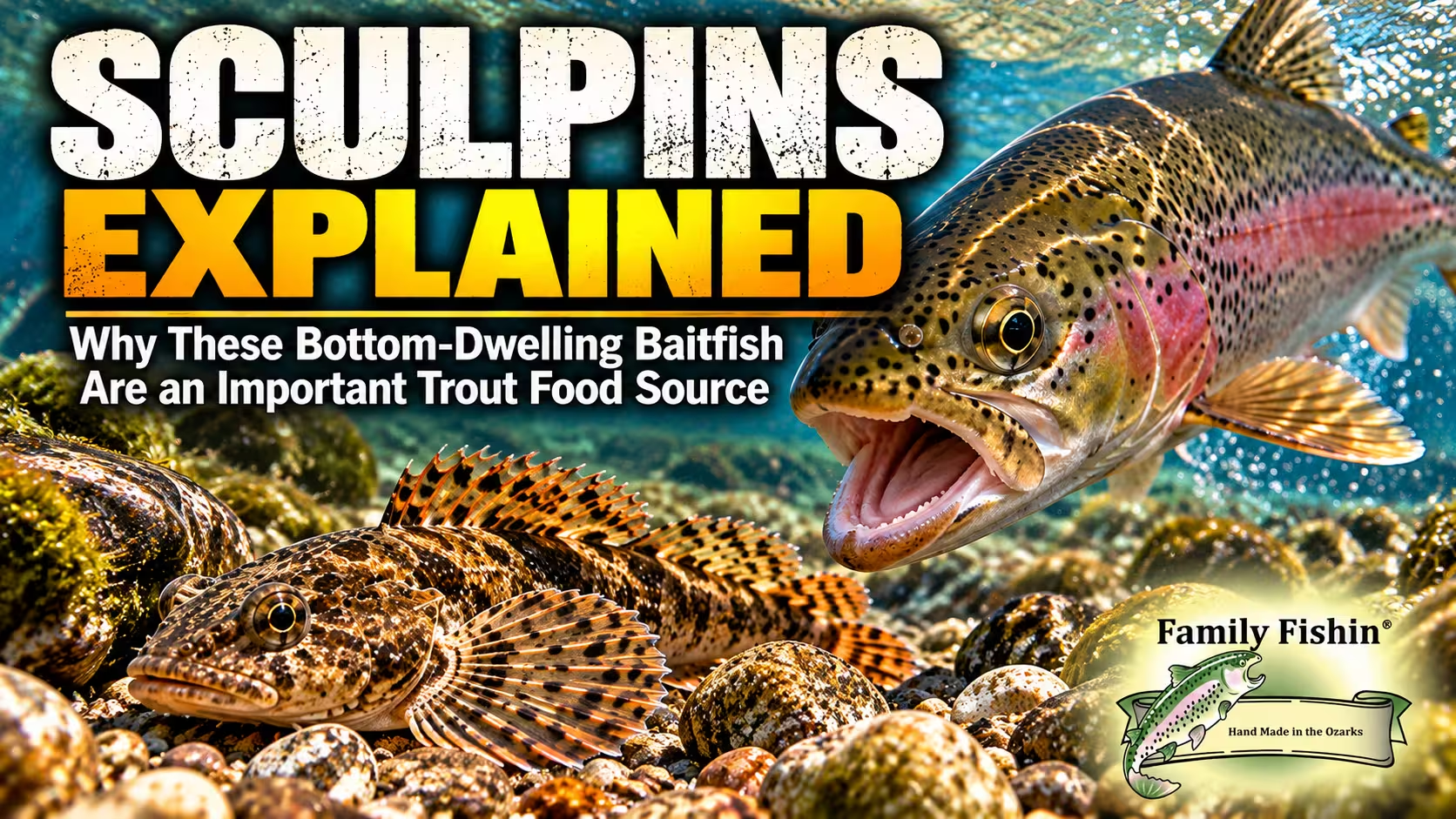
Sculpins for trout can be an important food source, especially in cold, rocky streams where these bottom-dwelling baitfish live alongside trout. When anglers think about trout food, aquatic insects usually get most of the attention. Mayflies, caddisflies, stoneflies, midges, scuds, worms, and other small foods can certainly make up an important part of a trout’s diet. But trout are opportunistic predators, and once they are large enough to handle bigger prey, small fish can provide something tiny invertebrates cannot: a substantial meal in a single capture.
Sculpins are one of those meals.
These small, bottom-dwelling fish live in many of the same cold, rocky streams and rivers that support trout. Their broad heads, large pectoral fins, tapered bodies, mottled coloration, and bottom-oriented behavior make them remarkably well suited for life among rocks.
They also make them vulnerable to trout.
A sculpin that remains tucked against the bottom may be difficult for a trout to capture. But one that moves across exposed gravel, gets displaced by current, leaves cover, or makes a short burst between rocks can suddenly become an opportunity.
Understanding sculpins as a trout food source requires looking beyond the simple idea that trout eat small fish. Sculins behave differently from many of the minnows anglers commonly imitate. They use different parts of the water column, move differently, and rely heavily on the stream bottom for protection.
Those differences matter.
They help explain where trout encounter sculpins, how trout attack them, and why a lure intended to imitate a sculpin often works best when it behaves like a bottom-dwelling fish rather than a conventional swimming minnow.
What Is a Sculpin?
Sculpins are fishes belonging primarily to the family Cottidae, a diverse group containing marine and freshwater species.
For trout anglers, the important members of this group are the small freshwater sculpins found in streams, rivers, lakes, and other suitable habitats.
Depending on species and location, freshwater sculpins may include names such as:
- mottled sculpin
- slimy sculpin
- prickly sculpin
- riffle sculpin
- shorthead sculpin
- other regional species
The exact species matters biologically, but an angler does not necessarily need to identify every sculpin species before understanding its importance as trout forage.
Most freshwater sculpins share a recognizable body plan.
They commonly have:
- a relatively broad, flattened head
- a large mouth for their body size
- prominent pectoral fins
- a body that tapers toward the tail
- mottled or cryptic coloration
- a bottom-oriented body shape
Rather than being built primarily for prolonged swimming in open water, sculpins are well adapted to living on or very near the bottom.
That distinction becomes extremely important when we compare them with other small fish eaten by trout.
Sculpins Are Built for Life on the Bottom
Look closely at a typical freshwater sculpin and its body tells you quite a bit about how it lives.
The head is broad.
The body becomes progressively narrower toward the tail.
The pectoral fins are large.
Its coloration often blends with gravel, cobble, rock, sand, and other bottom material.
This is a fish designed around the benthic environment—the ecological zone associated with the bottom.
Sculpins commonly spend much of their time close to rocks and other structure rather than suspended several feet above the bottom.
That provides several advantages.
The streambed creates countless small areas of reduced current. Water flowing across a rocky bottom is not moving at exactly the same velocity everywhere. Behind stones, along irregular surfaces, inside crevices, and immediately adjacent to the bottom are areas where water velocity can be substantially reduced.
A small fish that uses those areas efficiently can live in water that appears surprisingly fast from the surface.
This is closely related to something we have discussed elsewhere at Family Fishin: trout themselves use differences in current speed to conserve energy.
Related Family Fishin guide:
How Trout Use Current Breaks (And Why It Matters for Where You Cast)
Sculpins exploit the bottom version of that same physical principle.
They don’t need to fight the full velocity of the current every second. Rocks, bottom roughness, crevices, and other structure create tiny hydraulic shelters.
Why Sculpins Don’t Behave Like Typical Minnows
One of the easiest mistakes anglers can make is treating every small fish as though it were essentially the same prey item.
It isn’t.
A small minnow swimming through the water column and a sculpin moving between rocks may both be forage fish, but they present very different targets to a trout.
Many common baitfish regularly swim in open water. Some form schools. Some cruise shorelines. Some suspend. Others move through pools and current seams.
Sculpins are much more strongly associated with the bottom.
Another important anatomical difference is that sculpins generally lack the gas-filled swim bladder used by many fishes to help control buoyancy.
That doesn’t mean a sculpin cannot swim.
It absolutely can.
But it helps explain why sculpins are so closely associated with the bottom rather than maintaining a suspended position in the water column like many other small fishes.
A sculpin can make quick movements and short bursts when necessary. It can cross exposed areas and move from one piece of structure to another.
What it generally doesn’t resemble is a small baitfish casually suspending in open water for long periods.
That distinction gives anglers an important clue:
A sculpin imitation does not always need to swim like a conventional minnow imitation.
Often, its relationship with the bottom is just as important as its appearance.
Where Do Sculpins Live?
Sculpin habitat varies among species, but freshwater sculpins are strongly associated with bottom structure and are common in many cool and coldwater environments.
Good sculpin habitat can include:
- rocky streams
- cold rivers
- riffles
- runs
- cobble
- gravel
- boulder fields
- rocky shorelines
- spring-influenced waters
- areas with abundant bottom cover
Notice how much of that overlaps with good trout habitat.
That overlap is one reason sculpins can be important forage.
Trout don’t have to travel into some completely different ecosystem to encounter them. Predator and prey can occupy the same stream and sometimes the same relatively small section of it.
But they may use that section differently.
A trout might hold beside a current seam, behind a boulder, along the edge of a run, or near the transition between fast and slow water.
A sculpin may be down among the rocks below it.
That creates an interesting predator-prey relationship.
The trout doesn’t necessarily need to chase sculpins continuously.
It can wait for an opportunity.
Why You May Rarely See Sculpins
An angler can fish a stream containing sculpins for years and hardly ever notice them.
That doesn’t necessarily mean there aren’t many present.
Their lifestyle makes them easy to overlook.
Their mottled coloration helps them blend into the stream bottom. Their flattened shape keeps them close to structure. They can occupy spaces among rocks that are difficult to see from above.
They are especially easy to miss in:
- broken water
- deep runs
- shaded water
- cobble bottoms
- algae-covered rock
- turbulent riffles
Compare that with a school of minnows flashing along a shallow bank.
Minnows can advertise their presence.
Sculpins often do the opposite.
Their survival depends partly on not being noticed.
That camouflage may work on anglers, but trout have a much closer view of what is happening underwater.
Why Sculpins for Trout Are an Important Food Source
The simplest explanation is that sculpins provide trout with a relatively large package of food.
But that needs some qualification.
Trout don’t calculate calories like humans. Nor should we assume that a trout always chooses the prey item containing the most energy.
Feeding decisions involve several interacting factors:
- prey availability
- prey size
- capture difficulty
- water temperature
- current
- competition
- trout size
- habitat
- previous feeding success
- risk
- energy required to capture the prey
A tiny food item can be extremely profitable when thousands are available and require almost no movement to capture.
A larger prey item can be profitable when it provides substantially more food per successful capture.
This is why trout can feed heavily on tiny midges at one time and attack a fish several inches long at another.
The important concept isn’t simply:
Big food is better.
It is closer to:
The value of food depends partly on what the trout must spend to obtain it.
This balance between food gained and energy spent is a major part of how trout conserve energy while feeding.
A vulnerable sculpin passing within striking distance can offer a trout a considerable meal for one short burst of acceleration.
That can be a very favorable opportunity.
Sculpins and the Energy Economics of Trout Feeding
Imagine a trout holding behind a large rock.
The main current is moving quickly only a short distance away, but the trout is positioned in slower water.
Food is delivered past the holding position.
If the trout moves a few inches or perhaps a foot to intercept something and then returns to slower water, the energetic cost may be relatively small.
Now imagine two possible prey items.
One is extremely small.
The other is a sculpin.
The sculpin represents substantially more tissue in a single successful capture.
That doesn’t mean the trout will automatically attack it. The prey must be appropriately sized, detectable, reachable, and vulnerable enough to justify the attempt.
But when those conditions line up, larger forage fish can be valuable prey.
This becomes especially relevant with larger trout.
As trout grow, their ability to capture larger prey increases. Larger trout certainly continue eating insects and other small organisms, but fish and other relatively large foods can become increasingly important components of their feeding opportunities.
That is one reason a large sculpin-style presentation can sometimes produce a trout that ignores much smaller offerings.
It isn’t necessarily because the trout has decided it wants a “sculpin pattern.”
It may simply be responding to an opportunity that looks worth pursuing.
How Trout Find Sculpins
Trout have several sensory systems that help them detect prey.
Vision is obviously important.
A moving sculpin crossing exposed bottom can create a strong visual target, especially when its silhouette separates from the background.
But underwater prey detection isn’t limited to sight.
Fish also possess a lateral-line system capable of detecting water movement and nearby disturbances.
A struggling or rapidly moving prey fish changes the water around it.
The combination of:
- movement
- vibration
- contrast
- silhouette
- proximity
can make prey detectable even when visibility isn’t perfect.
This helps explain why a lure doesn’t need to reproduce every scale, fin ray, and color marking of a real sculpin to generate a strike.
A trout has to recognize the presentation as a potential food opportunity.
That recognition can involve several cues at once.
How Sculpins Move
This may be the most important section for anglers.
If we want to imitate an animal, we need to understand how the animal behaves, not simply what it looks like in a photograph.
Sculpins are capable swimmers, but their normal behavior is strongly tied to the bottom.
They commonly move in short bursts.
A fish may leave one protected position, move quickly across a small exposed area, and settle near another rock.
Think:
hold → burst → settle
rather than:
continuous open-water swimming
That difference should influence lure presentation.
A sculpin imitation that races continuously several feet above the bottom may still catch trout, but its behavior isn’t necessarily taking advantage of the characteristics that make a real sculpin distinctive.
Often, a more convincing presentation involves:
- bottom contact
- pauses
- short hops
- short bursts
- controlled drifts
- brief accelerations
- irregular movement
The exact technique depends on water depth, current, tackle, bottom composition, and the lure being used.
What Happens When a Sculpin Is Displaced?
This is where the predator-prey interaction becomes especially interesting.
A sculpin protected among rocks is relatively difficult to capture.
A sculpin swept away from that protection is a different situation.
Current can expose prey.
The moment a bottom-oriented fish becomes displaced, it may have to swim to regain contact with suitable structure.
During that movement, it becomes:
- more visible
- more exposed
- easier to intercept
A trout holding downstream doesn’t necessarily need to dig through rocks looking for sculpins.
The water can occasionally deliver vulnerable prey toward it.
This is similar to the broader feeding strategy trout use with aquatic insects.
Current is not simply something trout endure.
It is also a food-delivery system.
The difference is that a displaced sculpin is a much larger package than a drifting nymph.
Current Breaks Matter
This is where sculpin biology and trout behavior overlap.
Imagine a boulder sitting in moderate current.
Several different things are happening around that single rock.
There is faster current around its sides.
There is reduced current behind it.
There may be turbulence downstream.
There are small areas of reduced velocity near the bottom.
There may also be seams where water of different speeds meets.
A sculpin can use the bottom and the rock itself for protection.
A trout can use the larger current break to conserve energy while watching for food.
That means the same structure can provide:
habitat for the prey + an ambush position for the predator.
For an angler, that is a valuable combination.
Instead of simply casting toward “good-looking water,” think about where a bottom-dwelling fish could live and where a trout could wait nearby to intercept one.
Sculpins vs. Minnows: What’s the Difference to a Trout?
Both are fish.
Both can be eaten by trout.
But they don’t necessarily represent the same feeding opportunity.
Typical minnow-type forage
Depending on species, minnows and other small baitfish may:
- swim higher in the water column
- school
- cruise
- suspend
- move considerable distances
- use shoreline or open-water habitat
Sculpins
Sculpins are more likely to:
- remain near the bottom
- associate with rocks and structure
- use camouflage
- make short movements
- exploit spaces between rocks
- cross exposed bottom in short bursts
That means anglers should be cautious about using the word “minnow” as though it describes every small fish a trout eats.
Our earlier Family Fishin article explains the broader importance of forage fish:
Related Family Fishin guide:
Why Trout Eat Minnows
Sculpins belong in the same general discussion of trout eating fish, but they deserve separate treatment because their bottom-oriented behavior creates a very different presentation problem.
Sculpins vs. Scuds
The names sound somewhat similar, but these are completely different organisms.
A sculpin is a fish.
A scud is a small crustacean, commonly an amphipod.
Scuds can occur in enormous numbers and provide trout with repeated small feeding opportunities.
Sculpins generally represent fewer but much larger individual prey items.
That creates two very different feeding strategies.
A trout feeding on abundant scuds may repeatedly intercept small prey.
A trout attacking a sculpin may make one much more substantial capture.
Neither strategy is universally better.
It depends on what food is available and how easily the trout can obtain it.
Related Family Fishin guide:
Scuds for Trout: Why These Tiny Crustaceans Matter
This is exactly why understanding the complete trout food web is more useful than searching for one universal “best bait.”
Sculpins vs. Crawfish
Sculpins and crawfish also share an important characteristic:
both spend much of their lives associated with the bottom.
That means they can occur around some of the same rocky structure.
But they move differently.
A crawfish has a completely different body plan and escape response from a fish. Sculpins use their fins and body to make short swimming movements, while crawfish walk along the bottom and can use rapid tail-driven escape movements.
A trout may encounter both around:
- rocks
- cobble
- boulders
- ledges
- bank structure
Understanding which forage is present can help an angler decide what type of presentation makes biological sense.
Related Family Fishin guide:
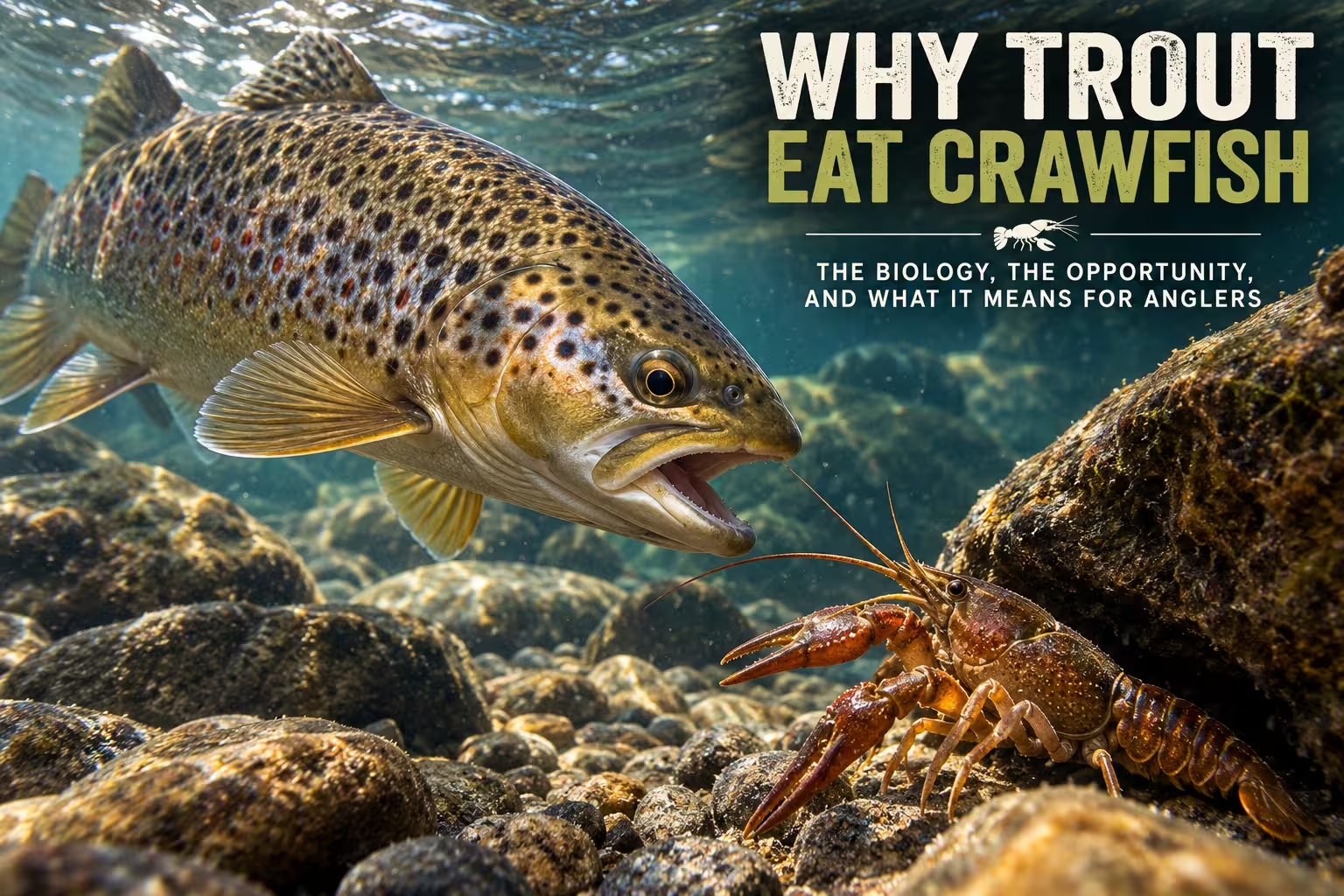
Why Trout Eat Crawfish
When Do Trout Eat Sculpins?
It would be convenient if there were one “sculpin season.”
Nature usually isn’t that simple.
Where sculpins and trout coexist, the potential predator-prey relationship can exist throughout much of the year.
What changes is opportunity.
Water temperature changes.
Stream flow changes.
Trout metabolism changes.
Other food sources become more or less abundant.
Aquatic insects hatch.
Small fish move.
Water levels rise and fall.
Spawning behavior changes.
All of those factors can alter what prey is easiest for a trout to capture at a particular moment.
This is why trout diet should be viewed as dynamic rather than fixed.
Related Family Fishin guide:
Trout Diet by Season: What Trout Eat From Winter to Fall
A sculpin does not need to become the trout’s exclusive food source for a sculpin imitation to work.
It only needs to represent a believable feeding opportunity.
Low Light Can Change the Equation
Sculpins often use cover and bottom structure, which means they aren’t always highly exposed.
Reduced light can change predator-prey interactions.
Early morning, evening, shade, deeper water, cloudy conditions, and stained water all alter visibility.
That does not mean trout only eat sculpins at night or that low light automatically makes sculpin imitations superior.
It means the balance between concealment and detection changes.
Larger trout may also become more willing to leave secure holding positions when conditions provide additional cover.
This is one reason anglers often associate larger forage presentations with:
- dawn
- dusk
- cloudy weather
- stained water
- elevated flows
But these are tendencies and opportunities, not rigid rules.
A trout can certainly attack a sculpin in bright daylight.
Size Matters—but Bigger Is Not Always Better
A real sculpin can represent a substantial meal, but that doesn’t mean anglers should automatically choose the largest imitation possible.
Predator and prey size have to make sense together.
A small trout may attack a surprisingly large lure, but the probability that a particular prey item is practical changes with predator size.
The goal should be to imitate a plausible prey size, not simply maximize lure length.
Smaller sculpin imitations can also represent juvenile sculpins.
That gives anglers a wide usable size range.
Rather than thinking:
“What is the biggest sculpin a trout could possibly eat?”
a more useful question is:
“What size prey would look natural in this water and be easy for this trout to capture?”
Sculpin Color: Don’t Overcomplicate It
Real sculpins often display mottled, subdued coloration that helps them blend into the bottom.
Depending on species, individual fish, habitat, and lighting, they may appear in combinations of:
- brown
- olive
- tan
- gray
- dark brown
- black
- cream
- muted green
The exact shade can vary.
For anglers, the broader lesson is more important than matching a paint chip.
Sculpins are generally cryptically colored bottom fish.
Natural colors can therefore make excellent starting points.
But a lure has a different job than a real sculpin.
A real sculpin benefits from avoiding detection.
A lure must be detected before a trout can attack it.
That means contrast can sometimes be useful even when the lure isn’t an exact color match.
In clear water with good visibility, subdued natural colors may provide all the contrast necessary.
In stained water, deeper water, or low light, a stronger silhouette may help the trout locate the presentation.
This is why color selection should consider both:
what the prey looks like
and
what the trout can actually see under the conditions being fished.
Profile May Matter More Than Perfect Color
If you had to choose between a perfect color and convincing behavior, behavior would often deserve more attention.
A sculpin has a recognizable general profile:
broad front → tapered rear
The head is substantial relative to the body.
The pectoral region is visually prominent.
The tail is comparatively narrow.
A lure that creates that basic impression while staying near the bottom and moving appropriately may provide several important cues simultaneously.
This relationship between lure shape, silhouette, and visibility is explored in more detail in Lure Profile and Silhouette: Why Shape Matters More Than Color in Clear Water.
That doesn’t mean detail is useless.
It means anglers should not become so focused on matching color that they ignore:
- depth
- speed
- profile
- bottom position
- movement
- pauses
A beautifully painted sculpin imitation swimming unnaturally five feet above the bottom may be less convincing than a simple brown lure moving naturally among the rocks.
What Should a Sculpin Imitation Do?
A good sculpin presentation should usually communicate several things to the trout:
I am small enough to eat.
I belong near the bottom.
I am moving like vulnerable prey.
That doesn’t require one specific lure design.
Sculpin-like presentations can include:
- soft plastics
- jigs
- streamer-style flies
- hair jigs
- feather jigs
- other bottom-oriented baitfish imitations
The exact lure matters less than whether the entire presentation makes sense.
A soft plastic with a broad head and tapered body can be excellent.
So can a jig with material that creates bulk toward the front.
The important point is that the lure should be fished as a sculpin, not merely look like one while sitting in the tackle box.
Fishing a Sculpin Imitation Near the Bottom
Depth control is critical.
This is the same principle discussed in Lure Depth and Strike Zone Explained: Why Positioning Matters More Than Color or Action: a lure cannot effectively imitate available prey if it consistently travels outside the part of the water column where that prey is expected.
If the sculpins are living around rocks, an imitation that never enters that part of the water column is missing one of the strongest biological cues.
That doesn’t mean the lure must drag continuously across the bottom.
Constant dragging can cause:
- snags
- unnatural movement
- debris accumulation
- loss of sensitivity
Instead, try maintaining close contact with the bottom while allowing controlled movement.
Depending on the water, that might mean:
touch → lift → move → settle
or:
drift → touch → pause → drift
or:
short burst → pause → short burst
Those sequences resemble the intermittent movement expected from a bottom-oriented fish much better than constant high-speed retrieval.
Short Hops
A short hopping retrieve is one of the simplest ways to create sculpin-like movement.
Allow the lure to reach the bottom.
Move it a short distance.
Let it settle again.
The movement doesn’t have to be dramatic.
A few inches may be enough.
Remember what you’re trying to represent:
a small fish moving from one safe position to another.
Not every movement needs to cover three feet.
In fact, overly aggressive hops can move the lure completely out of the feeding zone.
Controlled Drifting
Current provides another option.
Instead of making the lure perform all the movement, allow the current to help.
A sculpin imitation can be allowed to move downstream while periodically contacting the bottom.
This can resemble a fish that has been displaced from its position.
The key word is controlled.
Too little weight and the lure may rise well above the bottom.
Too much weight and it may wedge into every crack.
The correct weight depends on:
- current velocity
- depth
- lure size
- line diameter
- casting angle
- bottom composition
Choosing enough weight to maintain control without overpowering the presentation is the same balancing problem discussed in How to Choose Jig Head Weight for Trout.
The goal is not simply “use a heavy jig.”
The goal is to use enough weight to control the lure without destroying its movement.
Dead Sticking a Sculpin Imitation
Movement attracts attention, but movement doesn’t have to be constant.
A sculpin-style lure can also be allowed to sit briefly.
That pause can accomplish several things.
First, it keeps the lure in the strike zone.
Second, current may continue moving soft appendages, feathers, or other flexible material even while the lure itself remains relatively stationary.
Third, the pause can create the impression that the prey has reached temporary cover.
A following trout may also close the distance during the pause.
Then a short movement can trigger the strike.
Dead sticking is therefore not necessarily the absence of presentation.
Sometimes the pause is part of the presentation.
Fish the Edges of Fast Water
Because both trout and sculpins can use current breaks, transitions between fast and slow water deserve attention.
Look for:
- downstream sides of boulders
- edges of riffles
- heads of pools
- seams beside fast runs
- rocky banks
- submerged ledges
- pockets among boulders
- transitions from cobble to deeper water
Think about the geometry from the trout’s perspective.
Where can it remain relatively protected from the strongest current?
Where can food pass close enough to intercept?
Where could a sculpin become exposed?
The best location often satisfies all three conditions.
Don’t Automatically Retrieve Upstream or Downstream
There is no universal direction that makes a sculpin imitation correct.
Real prey can move in multiple directions.
Current can displace prey downstream.
A sculpin can intentionally move upstream or across current.
It can move laterally between rocks.
Therefore, casting direction should be chosen according to the water and the presentation you are trying to achieve.
A downstream drift may be useful when imitating displaced prey.
A cross-current presentation may allow the lure to sweep from exposed water toward structure.
An upstream cast can help keep a lure close to the bottom as it approaches a trout.
The important question is:
What is the lure doing when it reaches the trout?
Common Mistake #1: Fishing Too High
If your goal is specifically to imitate a sculpin, keeping the lure well above the bottom for the entire retrieve removes one of the prey’s defining characteristics.
Get the presentation into the correct zone.
That may require:
- additional weight
- a different casting angle
- thinner line
- a slower retrieve
- allowing more sink time
But don’t confuse bottom-oriented with permanently snagged.
The lure needs to remain fishable.
Common Mistake #2: Moving Too Fast
A fast retrieve can trigger reaction strikes, so speed isn’t automatically wrong.
But continuous high-speed swimming does not take advantage of the sculpin’s characteristic bottom-oriented behavior.
Try mixing speeds.
A short fast burst followed by a pause can look very different from a lure retrieved at one constant speed.
Irregularity can suggest vulnerability.
Common Mistake #3: Never Pausing
Anglers often feel that if the lure isn’t moving, it isn’t working.
That isn’t necessarily true.
A pause can allow a trout to inspect, approach, or reposition.
It also creates contrast with the next movement.
The transition:
still → sudden movement
can be powerful.
Common Mistake #4: Using Too Much Weight
We want bottom contact.
That doesn’t mean we want an anchor.
An excessively heavy presentation may:
- wedge between rocks
- kill subtle action
- move unnaturally
- reduce the effect of current
- increase snagging
Use the minimum weight necessary to maintain useful control under the conditions.
Common Mistake #5: Obsessing Over Exact Color
Color matters, but it is only one variable.
An angler may spend considerable time deciding between olive-brown and dark brown while ignoring the fact that the lure is being retrieved at the wrong depth.
Start with natural bottom-oriented colors.
Then adjust contrast according to water clarity and light.
But keep location and behavior at the center of the presentation.
Common Mistake #6: Assuming Every Trout Is Feeding on Sculpins
Sculpins are an important potential food source where they occur.
That does not mean every trout in every stream is actively hunting them.
If trout are positioned to intercept emerging insects and feeding repeatedly near the surface, forcing a sculpin imitation along the bottom may not be the most efficient way to catch them at that moment.
Match your strategy to what the fish and the water are telling you.
Understanding trout food isn’t about finding one bait that replaces everything else.
It is about understanding the menu of opportunities available to the fish.
Sculpins and Larger Trout
Sculpins for trout become particularly interesting when discussing larger fish because larger trout are capable of efficiently capturing larger prey.
That doesn’t mean large trout stop eating insects.
A big trout may still feed heavily on mayflies, caddisflies, scuds, midges, worms, and other small foods when those foods are abundant.
But larger body size expands the range of prey that can be captured efficiently.
A sculpin that might be a difficult meal for a very small trout can be a practical target for a larger fish.
This is one reason anglers targeting larger trout often incorporate fish-shaped presentations into their approach.
They’re not necessarily trying to imitate a specific prey species perfectly.
They’re presenting the trout with a large, believable food opportunity.
Sculpins in the Trout Food Web
The more we examine trout feeding, the clearer one principle becomes:
There is no single trout food source.
A trout stream contains a network of potential foods.
Depending on the water, these may include:
- mayflies
- caddisflies
- stoneflies
- midges
- scuds
- worms
- leeches
- crawfish
- minnows
- sculpins
- fish eggs
- terrestrial insects
- other aquatic organisms
Availability changes constantly.
Some foods are seasonal.
Some are present throughout much of the year.
Some become available only during particular flows.
Some become vulnerable during reproduction.
Others are exposed when water conditions change.
A successful trout survives by taking advantage of those changing opportunities.
That is why Family Fishin’s trout-food series isn’t intended to identify the one thing trout eat.
The purpose is to understand why each food source becomes important and what that teaches us about trout behavior.
What Sculpins Teach Us About Trout
Sculpins demonstrate several broader principles of trout feeding.
Trout feed throughout the water column
Surface activity attracts attention because anglers can see it.
But a tremendous amount of feeding occurs below the surface.
Some of it occurs directly along the bottom.
Bigger prey can change the energy equation
A larger prey item can provide a substantial meal from one successful capture.
That can make it worth attacking when the opportunity is favorable.
Habitat connects predator and prey
Rocky structure isn’t valuable only because trout can hide there.
The same structure can support organisms trout eat.
Current creates opportunities
Moving water can expose prey, transport prey, and create predictable interception points.
Behavior matters as much as appearance
A lure doesn’t become a convincing sculpin simply because it has the correct color.
Where it travels and how it moves are equally important.
How Sculpins Fit Into the Family Fishin Trout Food Series
Looking at the food sources together reveals how flexible trout feeding really is.
Worms can become particularly available when soil and water interact through rain, runoff, flooding, and bank erosion.
Leeches provide slow-moving prey in suitable habitats.
Crawfish provide a substantial bottom-oriented food source around rocky structure.
Minnows provide fish-based forage and can become increasingly important as trout become capable predators.
Scuds provide small crustacean prey that can occur in tremendous abundance in suitable waters.
Sculpins provide something different again: a relatively large, bottom-oriented forage fish living directly among the rocks and current breaks trout frequently use.
None makes the others irrelevant.
Together they explain why trout can successfully inhabit such a wide range of environments.
Practical Takeaways for Trout Anglers
You don’t need to become a fisheries biologist to apply sculpin biology on the water.
Remember these basic ideas:
- Sculpins are fish, not insects or crustaceans.
- They spend much of their time on or near the bottom.
- Rocky structure provides important sculpin habitat.
- Their broad-headed, tapered profile differs from many conventional minnows.
- They can swim, but their normal behavior is strongly bottom-oriented.
- Short bursts and pauses can be more sculpin-like than constant swimming.
- A displaced sculpin can become vulnerable to a waiting trout.
- Current breaks can benefit both the sculpin and the trout hunting it.
- Larger trout are physically capable of taking advantage of relatively large forage fish.
- Presentation depth and movement may matter more than matching an exact shade of brown.
The central lesson is simple:
Don’t just imitate what a sculpin looks like. Imitate where it lives and how it moves.
Frequently Asked Questions About Sculpins and Trout
What is a sculpin?
A sculpin is a fish. Freshwater sculpins commonly encountered in trout waters belong primarily to the family Cottidae. They typically have broad heads, large pectoral fins, tapered bodies, mottled coloration, and a strong association with bottom habitat.
Do trout eat sculpins?
Yes. Where trout and appropriately sized sculpins occur together, sculpins can become part of the trout’s diet. They can provide a considerably larger individual meal than many aquatic insects and small crustaceans.
Are sculpins the same thing as minnows?
No. “Minnow” can be used loosely by anglers for many small baitfish, but true minnows and sculpins are different fishes. Sculpins are particularly notable for their broad heads, bottom-oriented lifestyle, and association with rocky structure.
Are sculpins the same as scuds?
No. The similar names can cause confusion.
A sculpin is a fish.
A scud is a small crustacean, usually an amphipod.
Both can be important trout foods, but they are completely different animals.
Where do sculpins live?
Freshwater sculpin habitat varies by species, but many occur in streams, rivers, and lakes with suitable bottom structure. Rocky areas, gravel, cobble, boulders, riffles, runs, and coldwater habitats can all provide suitable conditions.
Why are sculpins difficult to see?
Their coloration often blends with the bottom, and they spend much of their time close to rocks and other structure. Their bottom-oriented behavior makes them far less obvious to an angler looking into the water than a school of minnows swimming in the open.
Can sculpins swim?
Yes.
The idea that sculpins cannot swim is incorrect. They can make quick swimming movements and move between pieces of structure. What makes them different from many baitfish is their strong association with the bottom and tendency toward shorter movements rather than prolonged open-water swimming.
Do sculpins have swim bladders?
Sculpins generally lack the gas-filled swim bladder found in many other fishes. Their anatomy is well suited to a bottom-oriented lifestyle rather than maintaining neutral buoyancy and prolonged suspension in open water.
What colors are freshwater sculpins?
Color varies among species, individuals, habitats, and conditions, but freshwater sculpins commonly show subdued combinations of brown, olive, gray, tan, black, cream, and other mottled natural tones that help them blend into the bottom.
What color sculpin lure should I use?
Natural brown, olive, tan, gray, and darker combinations are logical starting points. However, water clarity, depth, available light, and bottom color can affect visibility. A lure needs to be detectable by the trout, so exact color matching isn’t always necessary.
Should a sculpin imitation stay on the bottom?
A sculpin imitation generally makes biological sense when fished near the bottom, but it doesn’t have to drag continuously. Short hops, pauses, bottom contact, and controlled drifts can all create a bottom-oriented presentation while reducing snagging.
How should I retrieve a sculpin imitation?
Try a combination of short movements and pauses.
A useful sequence can be:
settle → short hop → pause → short movement → settle
In current, a controlled drift with occasional bottom contact can also imitate a displaced sculpin.
Are sculpin imitations only for large trout?
No.
Trout of different sizes can eat appropriately sized forage fish. A smaller sculpin imitation can represent a juvenile sculpin and may appeal to trout that could not efficiently handle a much larger prey fish.
Larger trout, however, are capable of consuming larger prey, which makes sculpin-style presentations particularly interesting when targeting bigger fish.
Are sculpins only important during one season?
Not necessarily.
Where sculpins and trout coexist, sculpins can potentially be available during much of the year. Their importance relative to other foods can change with water temperature, stream flow, trout behavior, seasonal insect activity, and other ecological conditions.
Are sculpin patterns only for fly fishing?
No.
The biological principle applies regardless of tackle type.
Fly anglers can use streamer-style sculpin patterns. Conventional anglers can use soft plastics, jigs, hair jigs, and other bottom-oriented fish imitations.
The trout doesn’t know which tackle category the lure came from.
What matters is whether the presentation resembles a believable food opportunity.
Are sculpins more important than aquatic insects?
There is no universal answer.
Aquatic insects can dominate trout feeding when they are abundant and easily captured. Sculpins provide a much larger individual prey item but may be encountered less frequently.
The relative importance of each depends on the particular stream, season, trout, and feeding conditions.
Where should I fish a sculpin imitation?
Good starting locations include:
- rocky runs
- boulder fields
- current seams
- riffle edges
- pool heads
- submerged ledges
- rocky banks
- current breaks
- transitions between shallow rocky water and deeper holding water
Look for places that provide both sculpin habitat and nearby trout holding water.
Why would a trout attack a sculpin instead of eating easier insects?
It depends on the opportunity.
A trout may consume huge numbers of insects when they are abundant. But an appropriately sized sculpin can provide much more food in a single successful capture.
If the sculpin is close, vulnerable, and easy to intercept, the potential reward can justify the short burst required to capture it.
Final Thoughts: Think Like the Prey
Sculpins illustrate one of the most useful lessons an angler can learn about trout fishing.
Catching trout isn’t simply about finding a lure that looks like something trout eat.
It is about understanding how that food behaves in the environment where the trout encounters it.
A sculpin is not just a small fish painted brown.
It is a bottom-dwelling predator and prey species adapted to living among rocks, gravel, current breaks, and the complex hydraulic environment near the streambed.
Its broad head and large pectoral fins fit that lifestyle.
Its mottled coloration helps it disappear against the bottom.
Its movements can be short and purposeful.
And when it leaves the protection of the rocks or becomes displaced into the current, it can suddenly change from a difficult target into a vulnerable meal.
That is the moment an angler should be trying to reproduce.
Not necessarily the exact number of spots.
Not the precise shade of olive.
Not every anatomical detail.
Instead, reproduce the opportunity:
A small bottom-dwelling fish leaves cover.
It moves across exposed water.
It pauses.
It moves again.
And a trout waiting nearby has a chance to turn one short burst of speed into a substantial meal.
Once you understand that relationship, a sculpin imitation stops being simply another lure pattern.
It becomes a way to imitate one of the natural feeding opportunities trout encounter in the rocky waters they call home.