Midges Explained: Why These Tiny Flies Are an Important Trout Food Source
Ask most anglers to name the foods trout depend on and they will say mayflies, caddisflies and stoneflies. But when you look at the importance of midges for trout, especially in tailwaters, spring creeks and cold-water fisheries, these tiny insects deserve far more attention. Ask a trout biologist who has spent time looking at what is actually inside trout stomachs, or a guide who fishes the same tailwater three hundred days a year, and you will often hear a different answer: midges.
Midges are small. They are easy to overlook. A single adult can be smaller than a grain of rice, and a larva can be thinner than a piece of sewing thread. But what they lack in size, they make up for in sheer numbers, in availability across all four seasons, and in the way they put food in front of a trout at almost no energy cost. In many trout waters, midges are not a backup food. They are the main meal.
This guide is part of our trout food series, and it covers what midges are, how they live, why they matter so much to trout, where and when trout eat them, and how to put that knowledge to work whether you fish a fly rod, an ultralight spinning rod, or a bobber and a tiny jig. If you have ever watched trout rising steadily on a cold, gray afternoon while nothing you threw seemed to matter, there is a good chance you were looking at a midge hatch.
What Midges Are (and What They Are Not)
When anglers talk about midges, they almost always mean members of the family Chironomidae. These are true flies in the order Diptera, the same large order that includes house flies, crane flies and mosquitoes. The name Chironomidae is a mouthful, so most people just call them chironomids or midges. There are thousands of species worldwide, and they live on every continent, including Antarctica.
A few clarifications clear up a lot of confusion:
- They do not bite. Adult chironomids do not feed on blood, and most do not feed at all. The tiny biting insects people call “no-see-ums” or biting midges belong to a different family. They are not what trout are eating in the rise.
- They are not mosquitoes. Adult midges can look a lot like mosquitoes at a glance, but they lack the long piercing mouthpart and they hold their bodies and legs differently. Many people mistake the mating swarms they see over water for mosquitoes.
- They are not mayflies or caddisflies. A midge has only two wings, where a mayfly or caddisfly has four. Its life cycle is also different, which matters a great deal for how you fish it.
Because midges are so small and so common, anglers often lump every tiny fly into one group and call it a “gnat.” Most of the time that is fine. But it helps to remember that trout see three distinct midge forms, a larva, a pupa and an adult, and they treat each one differently.
Why Midges for Trout Matter So Much
It is easy to assume that a trout would rather eat one big meal than a thousand tiny ones. That is true in some situations, but trout behavior follows an energy budget, not a preference for size. We covered that idea in our guide to trout energy conservation, and midges are one of the best examples of it in action.
They are everywhere, and they are always there
Midges can make up a huge portion of the insect life in a stream, a spring creek, a tailwater or a lake. Midge larvae live in the bottom sediment, in weed beds, on rocks and in the silt of slow water. In some waters, midge larvae outnumber every other aquatic insect combined. Biologists who sample trout stomachs in tailwaters and spring creeks routinely find midge larvae and pupae at the top of the list by count.
Unlike many mayfly and caddisfly species that hatch during a particular window and then disappear for months, midges emerge during every month of the year. In cold water they are often the only insects active at all. This makes them one of the most reliable foods a trout can count on.
They cost the trout almost nothing
A trout in a steady current is constantly weighing the calories it spends against the calories it takes in. A midge pupa drifting slowly through the water column or hanging in the surface film is helpless. It cannot swim away. It does not dart. A trout can tilt up, open its mouth and take it with barely any effort. When thousands of those pupae are drifting overhead, the trout does not need to chase anything. It simply holds its position and feeds.
That is why you often see trout in a midge hatch feeding in a slow, steady rhythm rather than the splashy, aggressive style they show when a large insect or a baitfish is present. The rhythm tells you the fish are doing the math and finding it favorable.
They matter most when other food is scarce
In winter, when water temperatures fall, most aquatic insects slow down or finish their life cycles. Midges keep going. Many species are adapted to cold water and will emerge on days when the air is barely above freezing. A mild afternoon in January can produce a surprising midge hatch, and trout that have been sluggish all morning will move up and feed when it begins.
This is one reason midges are so important in the story of how a trout’s diet changes through the year. We cover that wider picture in Trout Diet by Season: What Trout Eat From Winter to Fall.
Trout can be extremely selective on them
The same smallness that makes midges easy for a trout to eat also makes them frustrating for the angler. When a trout has thousands of real midges drifting past, a big, bushy imitation looks wrong. Fish that eat midges all day become very particular about size, profile and depth. That selectivity is what makes midge fishing a test of skill, and it is also why understanding the insect gives you such an edge.
The Midge Life Cycle: Four Stages, Three of Them Matter to Trout
Midges go through complete metamorphosis. That means four stages: egg, larva, pupa and adult. Trout feed on the larva, the pupa and the adult, and each one calls for a different approach.
Stage 1: The egg
Adult females deposit eggs in a gelatinous mass on or near the water surface. The eggs sink and attach to the bottom or to plants. Trout do not feed on eggs in any meaningful way, so this stage is mostly a matter of biology rather than fishing.
Stage 2: The larva
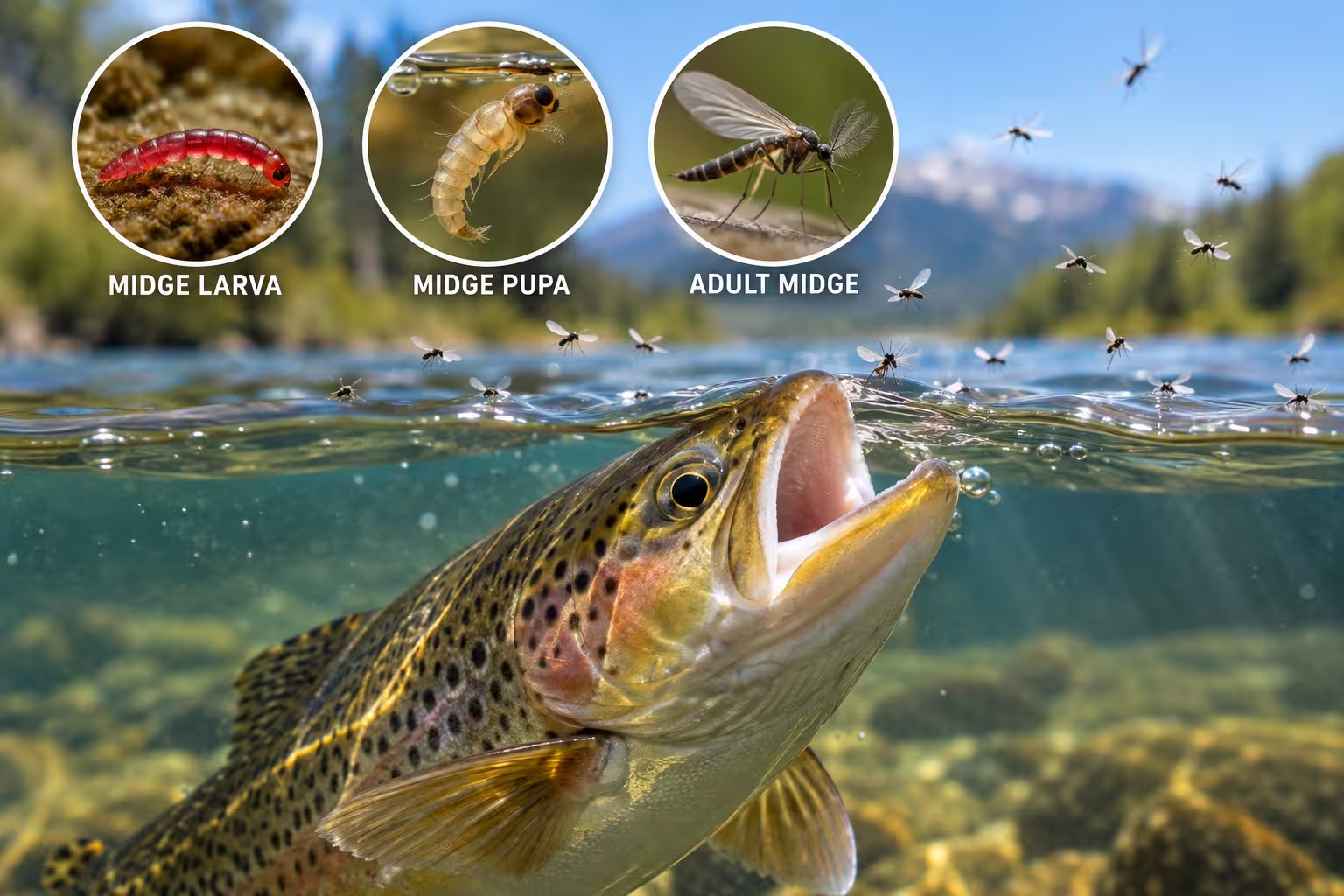
The larva is the longest stage of the midge’s life, often lasting weeks or months. Midge larvae are slender, worm-like and soft-bodied, with a small head and a segmented body. They are found almost everywhere there is soft sediment, algae, aquatic plants or organic debris.
Color varies widely by species and habitat. Larvae can be cream, tan, olive, green, gray, brown, black or red. The red ones, commonly called bloodworms, get their color from hemoglobin in their blood. That pigment helps them survive in low-oxygen water, such as the silty bottoms of ponds and slow stretches of streams. Larvae vary in size too, from barely visible to about half an inch or more in some species.
Many larvae build small tubes of silk and mud on the bottom, and they extend out of those tubes to feed. When they need to move, they wiggle or thrash. Larvae get into the drift in several ways: they let go of the bottom, they get knocked loose by changes in flow, or they leave their tubes in preparation for pupating. Trout feed on drifting larvae throughout the day, but especially when flows rise or when a lot of larvae start moving before a hatch.
What this means for you: a larva imitation is a bottom-oriented, slow-drift pattern. It belongs near the bed of the stream or lake, and it should move naturally with the current. Small, slim, and sometimes red or olive.
Stage 3: The pupa
When a larva is ready to transform, it forms a pupa. The pupa is a different animal in appearance. It has a swollen thorax, visible wing pads and a thin abdomen, and it often shows a bright or silvery band caused by gas building up beneath the skin. That gas helps the pupa rise.
The pupa begins to ascend slowly from the bottom toward the surface. This is the stage that matters most to trout. The pupa is moving up through the whole water column, which exposes it to trout at every depth, and it is vulnerable and slow. When it reaches the surface film, it may hang there for a while, trying to break through the surface tension and shed its pupal skin. This stage can take seconds or much longer, and during this time it is almost helpless.
Many experienced anglers and guides will tell you that in a midge hatch, more trout are feeding on pupae and emergers than on adults on top. That is why a trout may appear to be rising yet refuse your dry fly. It is eating something right under or in the film.
What this means for you: pupa and emerger patterns are often the most productive midge imitations. They can be fished deep during the ascent, mid-depth through the water column, or right in the surface film.
Stage 4: The adult
Once the pupa breaks through, the adult emerges, dries its wings and flies off. Adult midges are slender, with long legs, a humped thorax and a pair of clear or lightly colored wings held over the body. Many have feathery antennae, especially the males. Colors run to black, gray, olive, cream, tan and brown.
Adults mate in swarms over the water or along the bank. Females return to lay eggs, and both sexes die soon after. Trout take adults from the surface, and they especially like clusters of adults that clump together on the water. A few midges stuck together look like a single larger bug, which makes them an easier target.
What this means for you: adult imitations are tiny dry flies. They can be effective during a heavy hatch or a mating swarm, but they are often overpowered by pupae and emergers in the fish’s diet.
Where Midges Live
Midges are among the most widely distributed aquatic insects on earth. That means you can find them in almost any trout water, but some places produce them in remarkable numbers.
- Tailwaters. Rivers below dams have cold, stable flows and nutrient-rich water. These conditions favor midges, and in many tailwaters they are the dominant food source year-round.
- Spring creeks. Stable temperatures and rich weed growth give midges habitat all year. Spring creeks are famous for technical midge fishing.
- Lakes and ponds. Chironomids are a central part of stillwater trout fishing. Larvae live in the soft bottom, and pupae rise through the water column in large numbers, sometimes in the same area day after day. Stocked trout in lakes and ponds often feed heavily on them.
- Slow, silty sections of any stream. Even freestone streams have midges. Look for soft bottoms, eddies, slow runs, the edges of pools and weed beds.
You will find the fewest midges in fast, scoured riffles with a clean cobble bottom. But even there, midge larvae and pupae drift down from slower water above. A trout holding in a riffle tail or a seam can intercept a steady stream of them.
Midges and water quality
Midges have a reputation among biologists for tolerating a wide range of conditions. Some species thrive in water with low oxygen or moderate pollution where other insects cannot survive. That does not mean midges are a sign of bad water, because many species live in pristine streams too. But it does mean that in water that is warm, enriched or slow, midges may be the only major insect food available, which helps explain why they matter so much for trout in marginal habitat.
When Trout Eat Midges
Because midges are available every month of the year, trout can feed on them any time. But some times and conditions are better than others.
By season
- Winter. Midges are the headline food. On mild afternoons, hatches can bring trout up from deep winter holding water.
- Early spring. Midges continue to hatch before the larger mayfly and caddis hatches begin. Trout, hungry after a lean winter, take advantage.
- Summer. Midges are still present, though trout may focus on larger food when it is available. In warm, slow water, early morning and evening midge activity can be strong.
- Fall. Midge hatches pick up again as water cools, and they can be reliable on overcast days.
By time of day
In cold seasons, the warmest part of the day, usually late morning through mid-afternoon, brings the most activity. In warm seasons, early morning and late evening can be better. Midges often hatch in cycles, so you may see a burst of surface feeding that tapers off and then returns.
By weather
Overcast, calm, humid days tend to produce excellent midge hatches. Light rain or drizzle can help too. Strong wind can scatter adults and make surface feeding harder, but it can also blow clusters of midges into corners, eddies and backwaters where trout cruise to feed on them. A sudden drop in barometric pressure often triggers a burst of activity just before a front arrives.
Stocked trout and midges
Stocked trout are raised on pellets, and when they first hit the water they will often eat nearly anything. But they adapt fast. After a few days in the wild, stocked fish begin feeding on the natural foods present, and in many stocked waters, midges are among the first. If you fish stocked ponds or put-and-take streams, slim, subtle presentations that look like midge larvae and pupae often work when bigger lures stop producing. For more on that shift, see our guide on how to adjust for pressured trout.
How Trout Feed on Midges
Midge feeding looks different from other kinds of trout feeding, and learning to read it makes you a better angler.
The sip, the dimple and the head-and-tail rise
Fish feeding on pupae and adults in the surface film often make very quiet rises. You might see a tiny dimple, a gentle bulge on the surface, or a slow “head and tail” rise where the trout’s head breaks the surface, followed by its dorsal fin and tail rolling over. There is rarely a splash. These are the rises of a fish that is taking its time and feeding in a rhythm.
If you see a trout making the same quiet rise again and again, repeating every few seconds, it is almost certainly feeding on small insects in or just under the film. That is the signal to think midge.
Subsurface feeding
Not every midge-feeding trout shows itself. Trout that are feeding on larvae and rising pupae below the surface may only show a flash of their sides as they turn, or a slight movement of the water. Sometimes you can see a trout holding in clear water, opening and closing its mouth, moving a few inches to the side to take something and returning to its spot. That is a nymphing fish, and it could well be eating midges.
Where trout position themselves
Look for trout in the places where midges concentrate:
- Seams and foam lines where currents meet
- Back eddies where floating insects circle and collect
- Slow tailouts at the end of pools
- Edges of weed beds and drop-offs
- Shallow flats in lakes where pupae rise to the surface
These are places where food comes to the fish, so the fish can save energy while eating well.
Figuring Out What the Trout Are Actually Eating
You do not have to guess. A few minutes of observation will tell you most of what you need to know.
- Watch the water. Look at the surface for adults, shucks and clusters. Look at the foam and slow water edges, where insects collect.
- Look at the bank. Spider webs near the water often catch adult midges, and you can tell their size and color.
- Check your waders and your net. Adults frequently land on you.
- Use a small fine-mesh net or a seine. Hold it in the current for thirty seconds and look at what collects. Larvae and pupae are easy to see in a white dish with a little water.
- Match the size first. If you take away one rule, make it this one. Size matters more than color for midge fishing.
Many trout anglers also like to look at the spent insects on the surface. A grayish or black shuck, which is the empty pupal skin left behind after emergence, tells you the hatch is underway.
Midge Imitations: Larvae, Pupae and Adults
There are hundreds of midge patterns, but they fall into three groups.
Larva patterns
Slim, segmented bodies tied on small curved or straight hooks. Common colors are red, olive, cream, black and tan. Patterns like the bloodworm and the simple thread-bodied larva work well fished near the bottom.
Pupa and emerger patterns
These are the workhorses. The classic zebra midge, a slim black body ringed with silver or white wire and finished with a bead, imitates a pupa on its way up. Other emerger patterns ride in the film with a trailing shuck. Gas bubble and silvery highlights are important features of real pupae, so many imitations include a bit of flash or white.
Adult patterns
Tiny dry flies in black, gray, olive and cream. A cluster pattern, such as the well-known Griffith’s gnat, imitates several adults stuck together, and it is often easier for both trout and angler to see than a single adult.
Sizes and colors
Midge flies are usually tied on hook sizes 18 through 26, and larvae and pupae can run a little larger. The most important colors are black, olive, cream, gray, tan and red. In clear, pressured water, go smaller and more natural. In stained or off-color water, a little more flash or contrast helps the fish find the fly.
What about spin fishing and soft plastics?
You do not need a fly rod to take advantage of midge feeding. Anglers who fish ultralight gear can use a tiny soft plastic on a light jig head, around 1/80 ounce, fished slowly with 2 to 4 pound line. Slim, small profiles in natural colors can imitate the larva stage, and a slim red or pink worm can stand in for a bloodworm. A small bobber or slip float can suspend a tiny jig at the depth where pupae are rising. No lure is a perfect replica of a real midge, but the same principles apply: small, slim, natural and slow.
If you want a simple finesse setup for stocked or pressured water, our Pressured Trout Starter Kit was built around that approach, with light jig heads and slim ribbed worms that fish naturally on light line.
How to Fish Midges
With a fly rod in moving water
- Use a long, light leader. Tippet in the 6X to 7X range is common for tiny flies. Lighter tippet gives the fly a more natural drift and helps in clear water, but it breaks more easily, so play fish carefully.
- Dead drift is the rule. Midges cannot swim against the current. A drag-free drift is more important than any pattern choice.
- Use a two-fly rig. A common setup is a larger, easier-to-see fly on top, such as a cluster or a small indicator, with a smaller pupa or larva dropper below it. If a trout takes the dropper, you will see the top fly twitch or stop.
- Control your depth. If the fish are on the bottom, add a little weight. If they are taking pupae near the top, fish the pupa higher, or switch to an emerger in the film.
- Set the hook gently. Tiny hooks and fine tippet do not forgive hard hooksets. A firm lift of the rod is usually enough.
With the surface film in mind
When you see fish rising but refusing your dry, change to an emerger pattern fished in or just under the film. Grease the leader if needed, but not the fly. If you see a trout rising to the same spot again and again, put your cast a few feet upstream, and let the fly drift down the lane the fish is feeding in.
In lakes and ponds
Stillwater chironomid fishing is a specialty, and it is very productive. The classic method is to suspend a pupa pattern under a strike indicator, adjusted so the fly hangs at the depth where the pupae are rising. Let it sit nearly motionless, or retrieve it with a very slow hand twist. If you are not getting bites, change the depth before you change the fly. In many cases the right depth is the entire secret.
Look for fish cruising in the shallows early and late, and for areas where wind pushes the surface layer toward a bank, as those spots collect floating pupae and adults.
With ultralight spinning gear
- Use 2 to 4 pound line.
- Choose a small jig head and a slim soft plastic, and rig it straight so it does not spin.
- Cast and let it sink, then retrieve slowly with a low rod tip, adding small pauses.
- If you use a float, set it so the jig hangs at a depth where fish are feeding, and let wind or current drift it.
Common Mistakes When Fishing Midges
- Fishing too big. Midge feeding trout are comparing your offering to thousands of tiny naturals. If your fly or lure is too large, it will look wrong.
- Ignoring depth. The fish may be on the bottom, in the middle or at the surface. Your fly needs to be in the same zone.
- Adding drag. A fly that skates or drags will be refused immediately.
- Using heavy tippet. In clear water, thick line spooks wary trout.
- Switching patterns too often. Changing flies every five minutes keeps you from fishing the water thoroughly. Change depth, size or presentation before you swap patterns.
- Striking too hard. Light hooks and light tippet need a gentle hookset.
- Missing the pupa. Anglers who fish only dry flies during a hatch often miss the fish that are feeding just below the film.
Midges and Pressured Trout
Pressured trout, whether stocked fish that have seen a lot of lures or wild fish in a heavily fished river, have learned to refuse things that look wrong. A fast, flashy lure gets ignored. A natural-looking tiny offering drifting slowly often does not.
That is part of why midges are such a strong choice on crowded water. They are the food the fish are already eating, and a small, subtle presentation does not trigger the avoidance behavior that heavy pressure creates. If you are struggling on pressured trout, going smaller and slower, and imitating a midge larva or pupa, is one of the first things worth trying.
It also fits with what we know about stocked fish adapting to the wild. For more on how stocked and wild trout differ in their responses, see our trout diet and behavior articles in the Learning Center.
Midges in the Bigger Picture of the Trout Diet
Midges are one piece of a larger menu. Trout eat scuds in spring creeks and tailwaters, as we explained in Scuds Explained. They eat sculpins and other baitfish when they grow large enough, which we covered in Sculpins Explained. They eat grasshoppers and other terrestrial insects that fall into the water in late summer and fall, described in Why Trout Eat Grasshoppers. And they eat worms, minnows, crawfish and leeches.
The pattern across all of these is the same. A trout uses the best available balance between energy gained and energy spent. When large, easy meals are around, they take them. When the best option is thousands of tiny, slow, defenseless midges, they feed on those instead. Your job as an angler is to figure out which situation you are in, and then to present something that fits it.
Quick Reference: The Three Midge Stages
| Stage | What it looks like | Where trout find it | How to fish it |
|---|---|---|---|
| Larva | Slim, worm-like, often red, olive, cream or tan | On or near the bottom, in the drift | Small, slim patterns near the bottom with a slow dead drift |
| Pupa | Swollen thorax, wing pads, often a silvery gas bubble | Rising through the water column, hanging in the film | Mid-depth or just under the surface; dropper rigs and indicators |
| Adult | Tiny fly with two wings, black, gray, olive or cream | On the surface, often in clusters | Small dry flies or cluster patterns, dead drifted |
Key Takeaways
- Midges are true flies in the family Chironomidae, and they are among the most abundant insects in trout water.
- They are available all year, and they are especially important in winter and early spring.
- Trout feed on midge larvae, pupae and adults, and the pupa is often the most important stage.
- Quiet, repeated rises usually mean trout are feeding on pupae, emergers or tiny adults in the film.
- Size and depth matter more than exact color.
- A dead drift and light tippet are essential, and a gentle hookset saves fish.
- You can imitate midge feeding with spinning gear by using slim, small, natural-colored baits on light jig heads and light line.
Frequently Asked Questions About Midges
What is a midge in trout fishing?
In trout fishing, a midge is a small fly in the family Chironomidae. The term covers the larva, the pupa and the adult stages. Midges are one of the most important trout foods in tailwaters, spring creeks, lakes and many other waters.
Do midges bite people?
No. The midges trout feed on do not bite. The tiny biting insects called no-see-ums or biting midges are in a different family. Adult chironomids do not have the mouthparts to bite, and many do not feed at all.
What is the difference between a midge and a gnat?
The word “gnat” is a loose, everyday term for many small flies, and anglers often use it to refer to midges. A pattern like the Griffith’s gnat is a midge imitation. In fishing, the two terms are often used interchangeably.
What size hook should I use for midges?
Most midge patterns are tied on hooks from size 18 to size 26. Larger larvae and pupae may be tied a bit bigger. As a starting point, match the size of the naturals you see, and when in doubt, go smaller.
What color are midges?
Midges come in black, gray, olive, cream, tan, brown, green and red. Red midge larvae are called bloodworms. In a hatch, the color of the adults and pupae can vary from day to day, but size and profile are usually more important to the fish than exact color.
When do midges hatch?
Midges hatch throughout the year. They are especially important in winter and early spring when few other insects are active. Hatches are often best on overcast, calm days, and in cold seasons they tend to peak in the warmest part of the afternoon.
Why do trout rise but refuse my dry fly during a midge hatch?
Often the fish are feeding on pupae and emergers in or just below the film, not on adults on the surface. Try an emerger pattern fished in the film, or a pupa fished just underneath it. Check your drift, too, because even slight drag is enough to make a selective trout refuse.
What tippet should I use for midge fishing?
Many anglers use 6X or 7X tippet for tiny flies, especially in clear water. Lighter tippet gives a more natural presentation, but it needs a softer touch when setting the hook and playing fish. On heavier water or with larger patterns, 5X can be enough.
Can I fish midges without a fly rod?
Yes. Ultralight spinning gear with 2 to 4 pound line, a small jig head and a slim soft plastic can work well, especially for stocked trout in ponds, lakes and small streams. Fish slowly, keep the offering small, and rig it straight. A small float can help you hold the bait at the right depth.
Are midges important in stocked waters?
They can be. Stocked trout start feeding on natural foods within days of release, and in many ponds and lakes, midge larvae and pupae are among the most abundant. Slim, subtle presentations often outperform larger, flashier ones, particularly after the first few days of stocking.
What is a bloodworm, and is it the same as a midge larva?
A bloodworm is the red larva of certain midge species. The red color comes from hemoglobin, which helps the larva live in low-oxygen water. Bloodworms are a favorite trout food in ponds, lakes and slow, silty water, and red or pink slim patterns often imitate them.
What is the best way to tell what trout are eating during a midge hatch?
Watch the surface for rise forms, look for shucks and clusters, check spider webs and your clothing for adults, and use a small fine-mesh net to sample the drift. Size is the first thing to match, followed by profile, depth and color.
Final Thoughts
Midges do not get the attention that the big hatches do. They do not make for dramatic photographs, and they do not bring crowds of anglers to a river the way a famous mayfly hatch does. But they quietly feed trout all year, in nearly every kind of water, and the fish know it.
If you take one idea from this guide, let it be this: when trout seem to be eating something and you cannot figure out what, think small, think slow and think about the whole life cycle, not just the adult fly. A trout that is sipping in a seam may be feeding on pupae you cannot see. A trout that ignores your lure may be waiting for something that looks like a larva drifting past. Pay attention to the water, and the midges will tell you what to do.
Related Reading
- Scuds Explained: Why These Tiny Crustaceans Are an Important Trout Food Source
- Sculpins Explained: Why These Bottom-Dwelling Baitfish Are an Important Trout Food Source
- Why Trout Eat Grasshoppers
- Trout Energy Conservation Explained
- Trout Diet by Season: What Trout Eat From Winter to Fall
- Pressured Trout Fishing: The Simple System That Works