Trout Energy Conservation Explained
Trout energy conservation is really an energy budget. Every trout you’ve ever cast to is constantly balancing the calories it spends against the calories it can gain. Every twitch of a fin, every dash after a mayfly, every minute spent fighting current costs the fish energy it has to earn back through feeding. Understand that budget, and you understand why trout sit where they sit, why they eat what they eat, and why they behave completely differently in July than they do in January.
This isn’t abstract fish biology for its own sake. Trout energy conservation is the single most useful lens for reading water, picking a retrieve speed, and understanding why the “perfect” cast to the “perfect” seam sometimes gets ignored. Once you see a river the way a trout’s metabolism sees it, blank days start making a lot more sense — and so do the good ones.
The Trout Is a Cold-Blooded Machine — And That Changes Everything
Trout are ectotherms. Their body temperature tracks the water around them almost exactly, which means their metabolic rate — the speed at which every cell in their body burns fuel — is dictated by water temperature, not by internal thermostats the way it is in a bird or a mammal.
This matters more than most anglers give it credit for. In warm-blooded animals, metabolism stays in a fairly narrow range regardless of the weather. In trout, metabolic rate can shift by a factor of two, three, or more across the temperature ranges they experience in a single season. A trout’s chemistry, quite literally, runs faster when the water is warmer and slower when the water is colder, up to the point where things start breaking down.
Fisheries scientists describe this relationship with something called a Q10 coefficient — a measure of how much a biological rate changes for every 10°C (18°F) shift in temperature. For trout metabolism, that Q10 typically runs somewhere in the range of 2 to 3, meaning metabolic rate roughly doubles or triples for every 10°C the water warms, within the fish’s tolerable range. Cool the water back down and the reverse happens — the trout’s engine idles down to match.
That single fact explains an enormous amount of trout behavior. A trout in 40°F water isn’t lazy. It isn’t uninterested in your fly. Its entire biochemical machinery is running at a fraction of the speed it runs at in 58°F water, and every decision it makes — whether to move six inches for a nymph or fifteen feet for a streamer — gets filtered through that reduced energy budget.
How Trout Energy Conservation Depends on Aerobic Scope
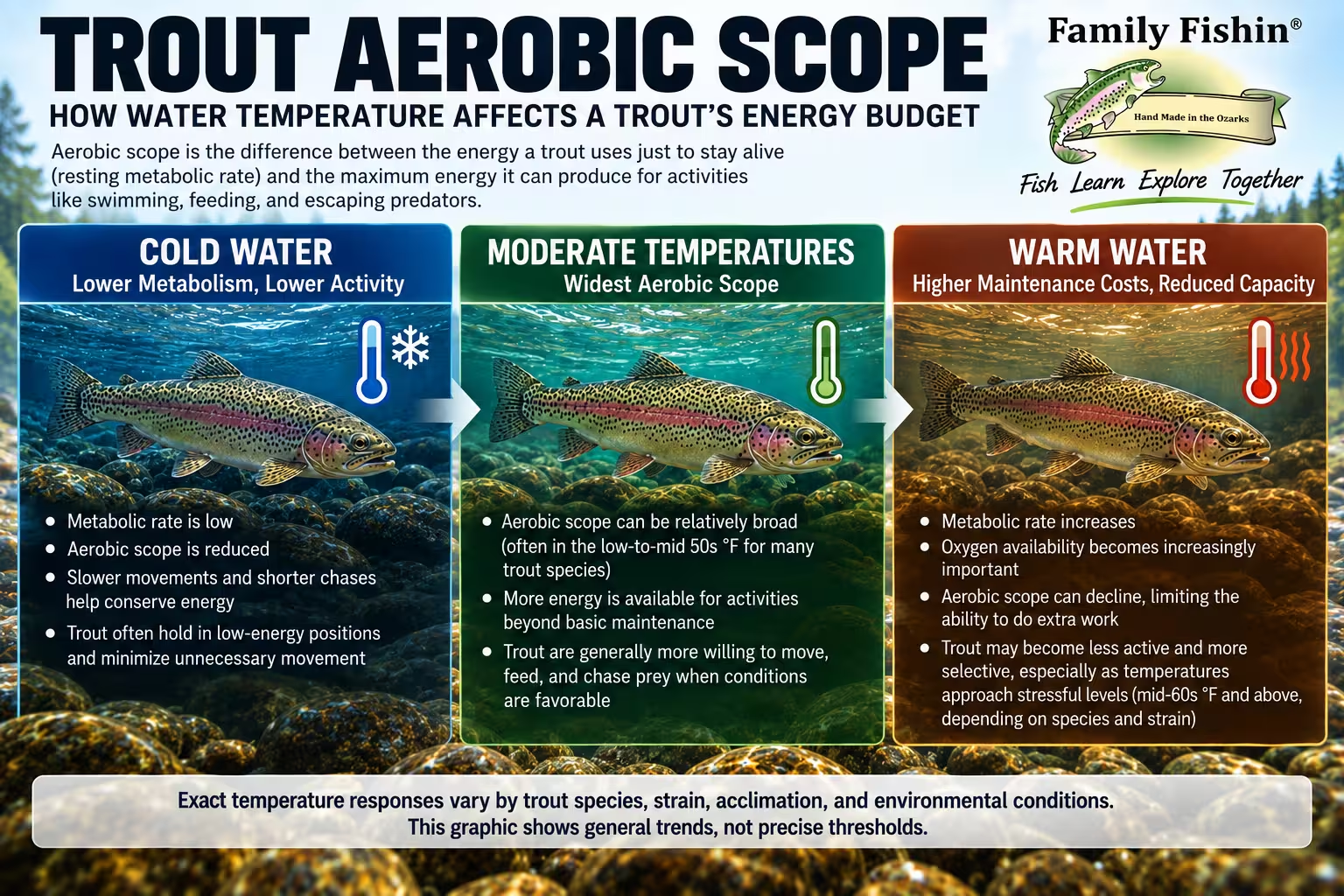
To understand energy conservation, it helps to understand the concept of aerobic scope — the difference between a trout’s resting metabolic rate (the energy it burns just to stay alive, doing nothing) and its maximum metabolic rate (the most energy it can generate when swimming flat-out or fighting for its life).
Everything a trout does above resting metabolism — swimming, digesting a meal, fighting current, evading a heron, fighting your line — draws down that aerobic scope. And critically, aerobic scope isn’t fixed. It changes with water temperature, and it changes with dissolved oxygen levels.
Here’s the part that surprises a lot of anglers: aerobic scope doesn’t just shrink in cold water — it also shrinks in water that’s too warm. There’s a sweet spot, generally in the low-to-mid 50s°F for most trout species, where aerobic scope is at its widest. Push water temperature too far past that — into the mid-60s and beyond, depending on species and strain — and the fish’s capacity to do extra work starts collapsing, even though its resting metabolic rate keeps climbing. The trout is burning more fuel just to exist, while simultaneously losing its ability to do anything extra with the energy it has left. That’s the biological definition of thermal stress, and it’s why summer trout in marginal water become almost impossible to move, while trout in the same river during a 52°F October afternoon will chase a streamer across the pool.
This is also why “match the hatch” thinking only tells half the story. A trout’s willingness to expend energy chasing a meal is governed as much by its available aerobic scope as by what’s drifting past its nose.
Three Ways a Trout Swims — And Why It Matters to You
Trout don’t swim with a single gear. Fish physiologists generally describe three distinct modes of swimming, each powered by a different type of muscle and each with a radically different energy cost.
Sustained swimming is slow, steady cruising — the kind of movement a trout uses to hold gentle position in a current seam for extended periods. This is powered almost entirely by red muscle, sometimes called slow-twitch or aerobic muscle. Red muscle is loaded with mitochondria and myoglobin (which is what gives it its color), and it’s built for efficiency and endurance rather than speed. A trout holding in a soft seam, making minor postural corrections, is running almost entirely on red muscle and burning very little fuel per minute.
Prolonged swimming is a step up — faster, more sustained effort that can be held for minutes but not indefinitely. This draws on a mix of red and white muscle and starts to accumulate metabolic byproducts faster than the fish can clear them, meaning it can’t be sustained forever.
Burst swimming is the explosive stuff — the strike on a fleeing baitfish, the dash from a predator, the acrobatics after you set the hook. This is powered by white muscle, or fast-twitch muscle, which makes up the majority of a trout’s body mass and generates enormous force very quickly. The catch is that white muscle runs largely anaerobically, meaning it doesn’t need oxygen delivered in real time, but it produces lactate and other byproducts as a result. That’s metabolic debt, and the fish has to pay it back afterward through a recovery period, breathing hard and burning oxygen at an elevated rate to clear the buildup and restore its chemistry.
This is precisely why a hard-fought trout needs real recovery time before release, and why holding a tired fish facing into current until it kicks free on its own isn’t just tradition — it’s giving the fish’s aerobic system the oxygen flow it needs to clear that anaerobic debt. A trout released before it’s ready hasn’t finished paying off the loan it took out fighting you, and it’s now trying to evade predators and resume normal life while still deep in metabolic debt.
Why Trout Hold Where They Hold
Once you understand that every unit of swimming effort has a caloric price tag, trout lie selection stops looking random and starts looking like an efficiency calculation.
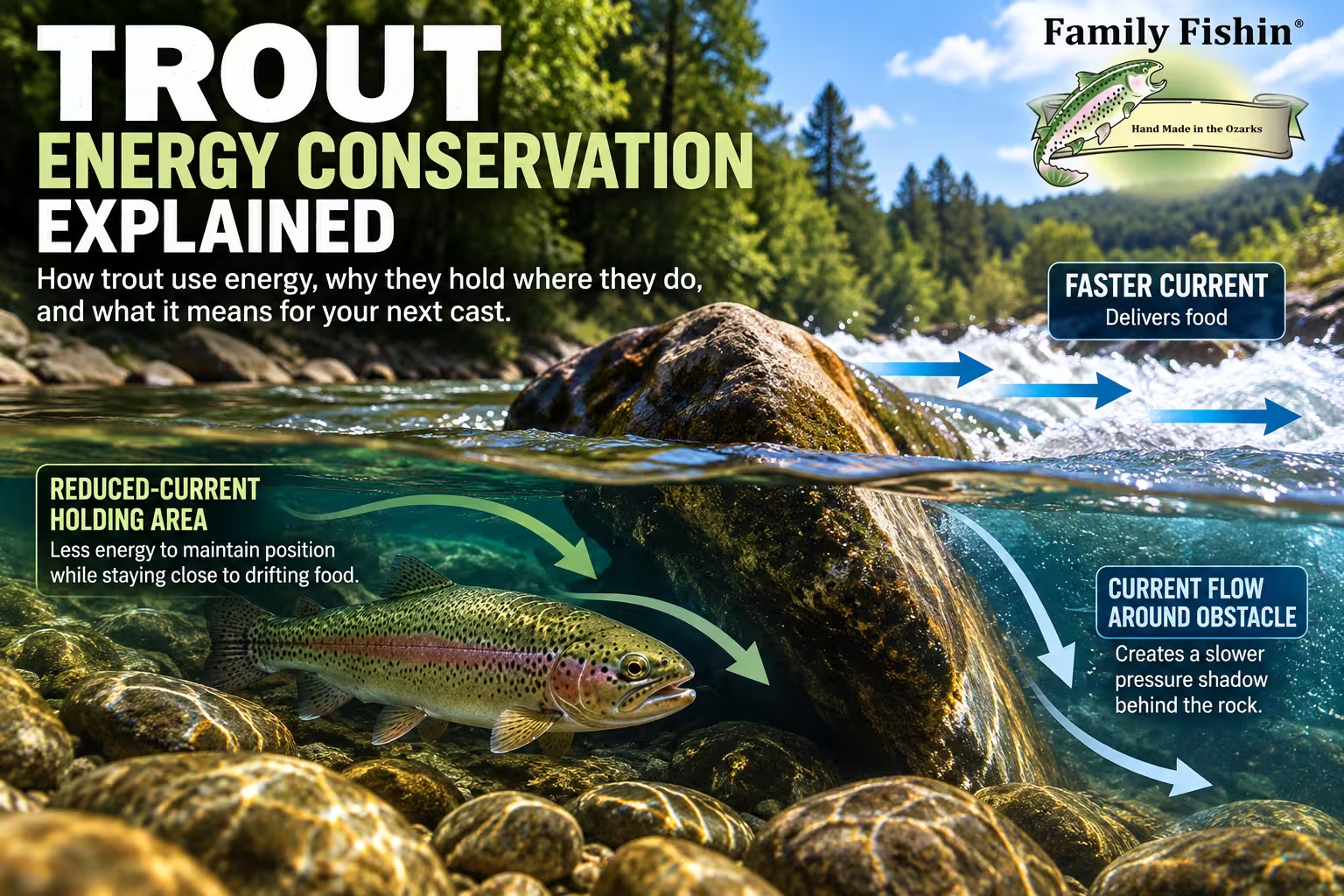
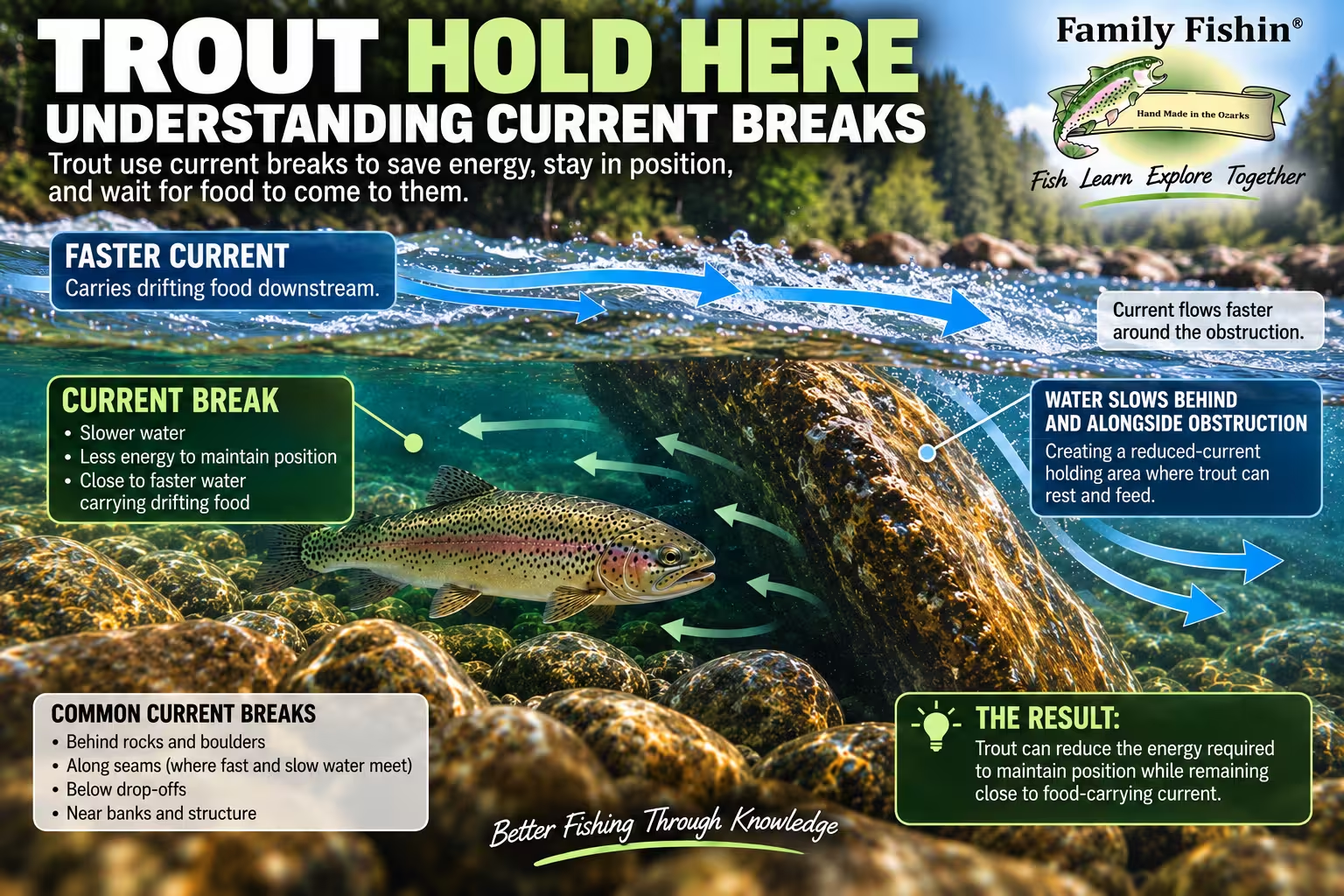
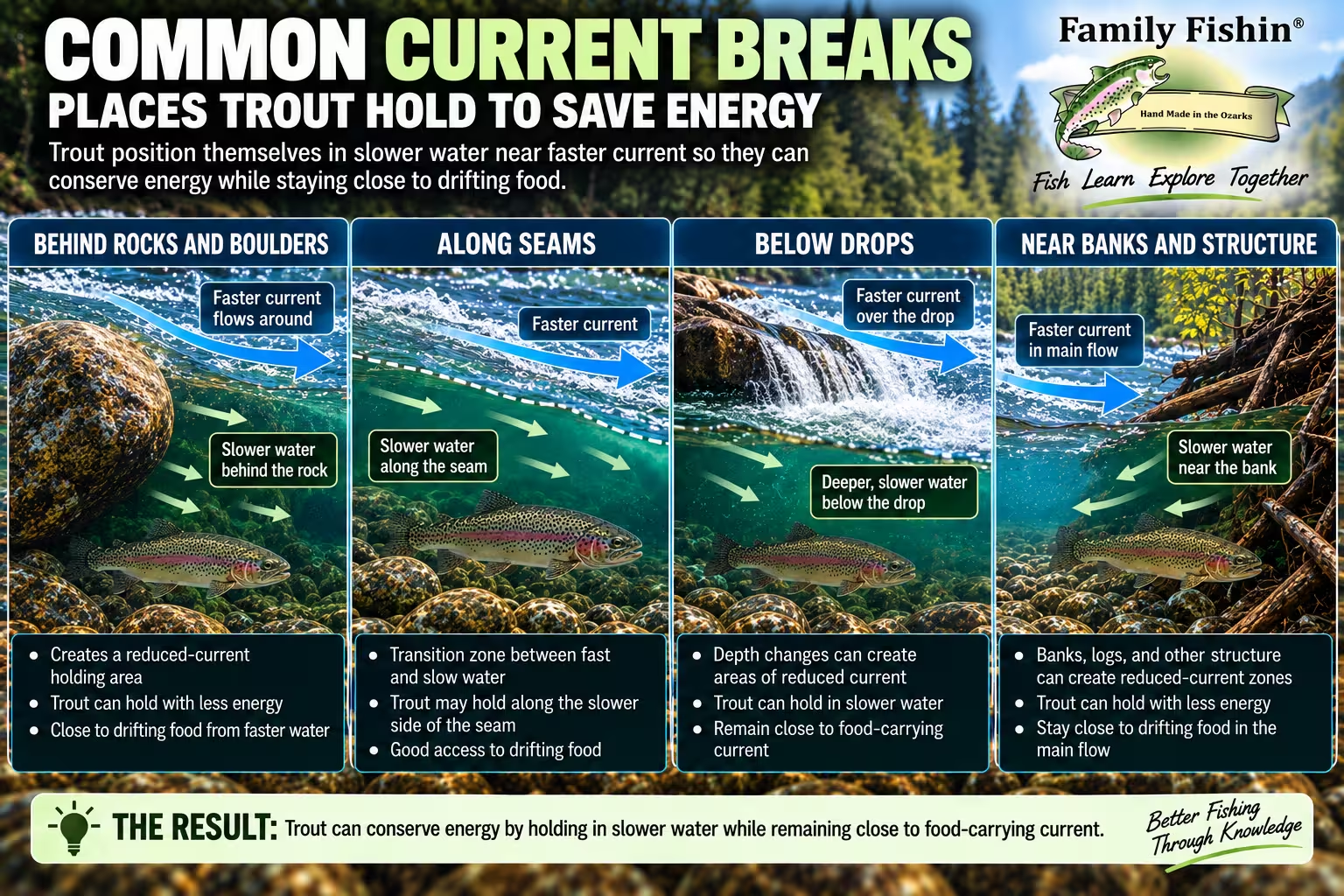
Trout consistently position themselves at the seam between fast water and slow water — a classic feeding lie. The mechanism is straightforward: the fish holds in the slower water, where the cost of maintaining position is low, while the faster water beside or above it acts as a conveyor belt, delivering drifting insects and other food within a quick dart’s reach. The trout gets the benefit of the current’s delivery system without paying the current’s full metabolic toll to stay in it.
This is why current breaks matter so much — boulders, ledges, logs, and any structure that creates a pocket of slack water. The trout tucked behind a rock isn’t hiding from you; it’s hiding from the current. Water velocity drops sharply in the pressure shadow behind an obstruction, sometimes to a fraction of the velocity just a foot or two away, and that differential is exactly what a trout is exploiting. It’s the fish equivalent of drafting behind a semi-truck on the highway.
Depth plays a similar role. Water velocity is lowest near the streambed due to friction against the substrate, which is part of why trout often hold deep in a run even when surface currents look aggressive. The bottom few inches of a fast run can be moving at a fraction of the surface speed.
Energy conservation also explains seasonal lie shifts. In summer, trout often move into faster, better-oxygenated riffles and runs, partly because warm water holds less dissolved oxygen and faster water re-aerates more efficiently — worth the higher current cost for the oxygen benefit. In winter, with metabolism idled down and insect drift sparse, trout shift into the slowest, deepest water available, sometimes stacking in pools and barely moving for days, because there’s little metabolic payoff to justify spending energy anywhere else.
The Feeding Economics of a Trout
A trout doesn’t eat everything that drifts by, and energy accounting explains why. Every prey-capture attempt costs energy — the burst of white muscle to intercept a drifting nymph, the return to the holding lie, the postural correction afterward. If that cost exceeds the caloric payoff of the prey item, taking it is a losing trade, and a trout that consistently makes losing trades doesn’t survive to spawn.
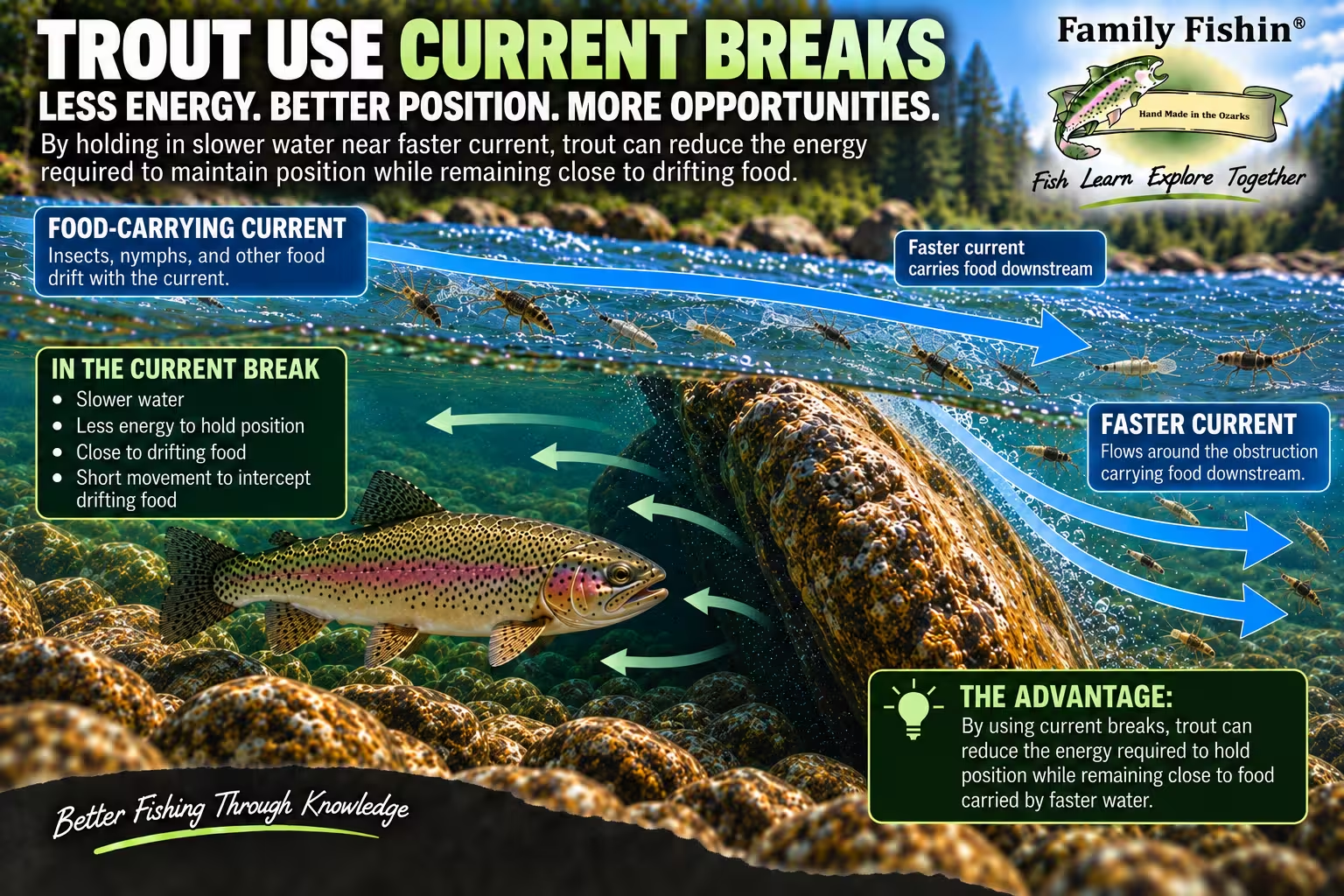
This is why trout in heavy hatches often become selective feeders, keying on the most abundant or most calorically efficient prey item rather than eating opportunistically. When thousands of a single insect are drifting by every minute, the cost of intercepting any individual one is tiny relative to the caloric reward, and a feeding rhythm develops where the fish barely has to move — a sip here, a sip there, minimal positional cost, steady caloric return. That’s about as close to free food as a trout ever gets, and it’s also why a fish locked into a heavy hatch can be maddeningly hard to pull off it with an offering that doesn’t match the rhythm; from the trout’s perspective, your fly is a worse trade than what’s already drifting past for free.
Conversely, this same logic explains why trout will expend enormous energy chasing a single large prey item — a big streamer imitating a sculpin or juvenile baitfish, for instance. One big meal can deliver more calories than a hundred small nymphs, which can justify a burst-swimming chase across a pool that would never make sense for a size 20 midge. The energy math still has to work out in the trout’s favor, but the threshold for “worth chasing” scales with the size of the reward.
Digestion itself carries a metabolic cost too, known as the specific dynamic action of feeding — the energy required to digest, absorb, and process a meal. This cost rises with water temperature, meaning a trout in warm water spends more of its already-stressed energy budget just processing what it eats, on top of everything else competing for that limited aerobic scope.
Winter Dormancy: The Trout’s Version of Hibernation
Trout don’t truly hibernate, but in cold water they enter a state that functions similarly — often called winter dormancy or torpor-like behavior. As water temperatures drop into the high 30s and low 40s°F, metabolic rate falls dramatically, activity drops to a minimum, and feeding slows to a crawl.
This isn’t the fish being stubborn. It’s the fish running the numbers. In near-freezing water, a trout’s aerobic scope shrinks and available food — mostly small midges and scattered nymphs — offers a marginal caloric return at best. Add the fact that swimming in cold water requires more effort per unit of thrust because muscle contraction speed itself slows down at low temperature, and the rational move for the trout is to do almost nothing. Hold in the slowest, most sheltered water available, let metabolism idle, and wait for spring.
This is why winter fishing tactics that work with trout biology — small flies, dead-slow drifts, presentations right in a fish’s face rather than expecting it to move — consistently outperform anything that asks a winter trout to expend meaningful energy. It’s not that winter trout can’t be caught. It’s that you have to bring the meal to a fish that has, correctly, decided moving for food is a bad trade.
Spawning: The Biggest Energy Expenditure of a Trout’s Year
If winter is about minimizing outflow, spawning is the opposite extreme — the single largest planned energy expenditure in a trout’s life. Redd construction, competition for mates, the physiological cost of producing eggs or milt, and the defense of a spawning territory all draw heavily on energy reserves that were built up over the preceding months of feeding.
This is part of why pre-spawn trout often feed aggressively — they’re stocking up for an expense they can’t avoid — and why post-spawn trout, especially males that have spent weeks aggressively guarding a redd, often look gaunt and fight less energetically than their condition earlier in the season would suggest. They’ve spent down the account. Catch-and-release handling matters most during and immediately after this period, precisely because the fish’s energy reserves and aerobic scope are already committed elsewhere, leaving very little margin for the additional stress of a fight and release.
Oxygen: The Currency Behind the Currency
Calories only matter if a trout can burn them, and burning them requires oxygen. This is the piece that ties temperature, current, and energy conservation together into one system rather than three separate ideas.
Trout extract dissolved oxygen from water across their gills, and that extraction process is itself energy-intensive — pumping water across gill filaments costs muscular effort, just like any other movement. Two things work against a trout at once as water warms: the water physically holds less dissolved oxygen (warm water is a worse solvent for gases than cold water), and the trout’s metabolic demand for oxygen rises because its metabolism is running faster. That’s a pincer effect. Supply drops while demand climbs, and the gap between what the fish needs and what the water can deliver is exactly what defines the upper edge of a trout’s thermal tolerance.
This is why you’ll often find trout stacked at the mouths of cold tributaries, near spring seeps, or in the plunge and riffle water below a dam during the warmest stretch of summer, even when slower, seemingly more comfortable-looking water is available nearby. They’re not there for comfort in a general sense — they’re there because that’s where oxygen supply still meets or exceeds metabolic demand. Riffles and broken water aerate more efficiently than smooth flat pools because turbulence increases the surface area of water in contact with air, which is part of why fast, choppy runs can hold more active trout in summer than a glassy, warm pool even though the smooth pool requires less swimming effort to hold in.
It also explains why a trout caught and released in warm water is at meaningfully higher risk than the same fight in cool water. The oxygen debt built up during a hard fight has to be repaid through elevated gill ventilation and oxygen uptake, and in warm water that repayment has to happen against a backdrop of already-reduced oxygen availability and already-diminished aerobic scope. The margin for error the fish has is simply smaller, which is a big part of why many fisheries agencies recommend avoiding catch-and-release trout fishing altogether once water temperatures climb into the mid-60s°F and beyond — not as an arbitrary rule, but as a direct reflection of the physiology described above.
What This Means for How You Fish
None of this is trivia. Once you start reading water and behavior through the lens of energy conservation, a handful of practical principles fall out naturally.
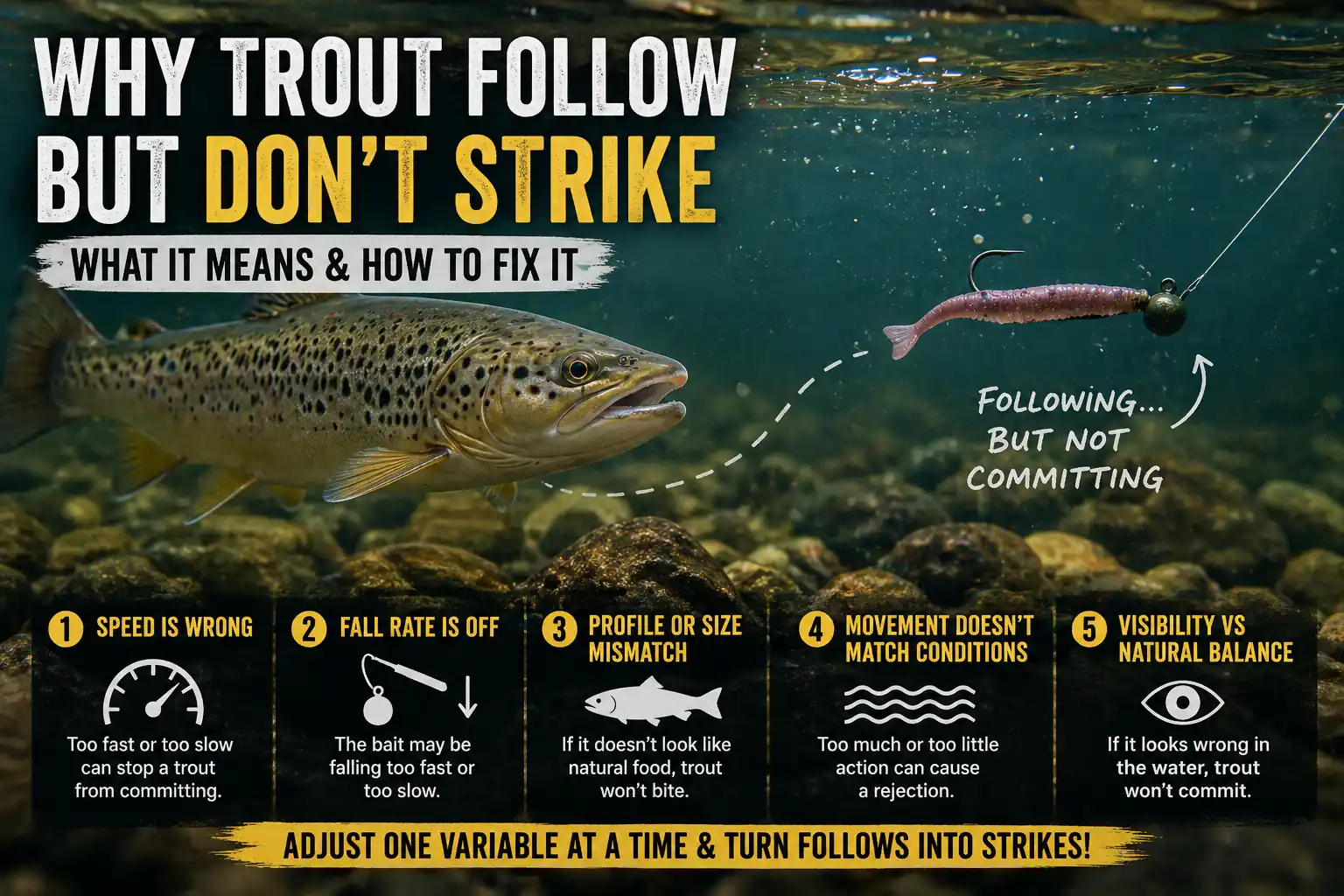
Match your retrieve to the thermal reality of the water. In cold water, a trout’s muscle contraction speed and metabolic rate are both reduced — an aggressive, fast retrieve is asking a fish to make a decision it’s often not physiologically inclined to make. Slow down, and give the fish a target it can intercept without spending burst energy it doesn’t have a good reason to spend.
Target the edges of current seams, not the middle of the fast water. You’re not just looking for structure — you’re looking for the exact spot where a trout gets maximum food delivery for minimum holding cost. That seam, current break, or depth transition is where the energy math works out best for the fish, which means it’s where the fish actually is.
Respect the caloric threshold on presentation size. A drab, small offering fished with a natural drift can out-produce a flashy one, because it fits the low-cost, low-reward feeding rhythm trout default to most of the time. Save the large, energy-intensive profile — the streamer, the big articulated pattern — for situations where you’re deliberately trying to trigger a chase response, typically in warmer, more oxygenated water where the trout actually has the aerobic scope to spend on a burst-swimming decision.
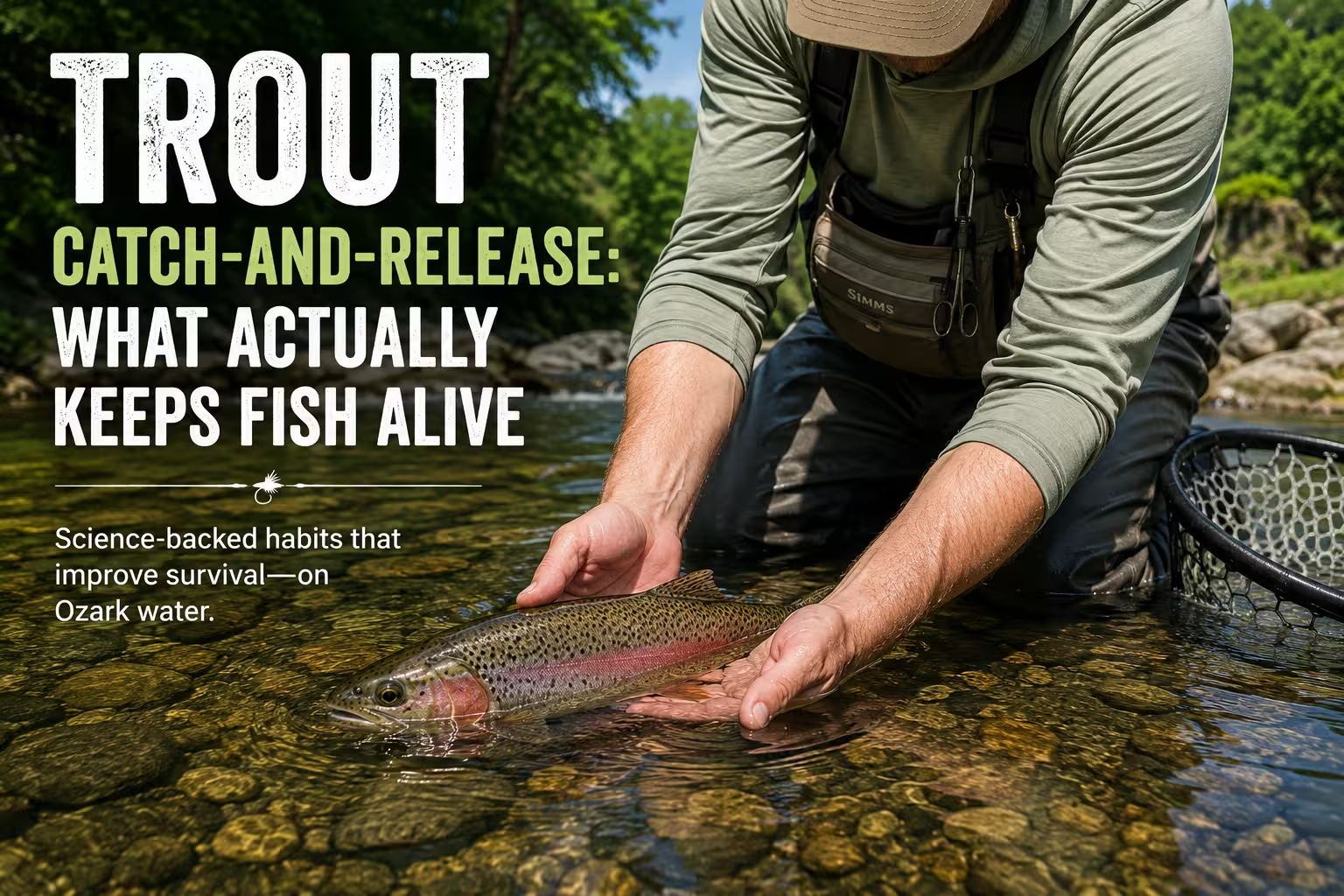
Handle fish with their energy budget in mind. A trout you’ve just landed is deep in anaerobic debt from burst-swimming against your rod. Minimize fight time when you can, keep the fish in the water, and let it recover in current — facing upstream, gills working — until it swims off under its own power rather than releasing it the moment it looks upright. You’re giving its aerobic system time to clear the debt before it has to face the rest of its day.
Adjust your summer strategy around oxygen, not just temperature. Once water temperatures push a trout’s aerobic scope toward its ceiling, the fish’s capacity to expend extra energy on feeding collapses even though its resting cost keeps rising. Fishing the coolest, most oxygenated water available — early morning, deep runs, spring-fed tributary mouths — isn’t just about comfort for the fish. It’s fishing the water where the trout still has energy left to spend on you.
The Bigger Picture
Trout aren’t lazy, and they aren’t picky for the sake of being difficult. Every holding position, every refusal, every explosive take is the output of a running calculation: does this cost less than it delivers? Understanding that calculation doesn’t just make you a more successful angler — it makes you a better steward of the fish you’re targeting, because you start to see catch-and-release, seasonal timing, and even where you choose to wade in terms of the energy budget you’re asking a cold-blooded animal to work with.
The river hasn’t changed. But once you see it as a landscape of caloric costs and rewards instead of just current and structure, you’ll start reading it the way the trout already does.
Frequently Asked Questions:
Why do trout hold behind rocks instead of out in the open current?
The water directly behind a rock or other obstruction moves much slower than the surrounding current because the obstruction blocks the flow. Holding there lets a trout maintain position with minimal effort while staying close enough to dart into the faster water for drifting food — maximum feeding opportunity for minimum energy cost.
Does water temperature really change how trout behave that much?
Yes. Trout are cold-blooded, so their metabolic rate is directly tied to water temperature rather than regulated internally. Metabolic rate can roughly double or triple across a 10°C (18°F) temperature swing, which is why the same fish can seem aggressive in 55°F water and almost motionless in 40°F water.
Why won’t trout chase my lure in cold water?
In cold water, a trout’s muscle contraction speed and overall metabolic rate are both reduced, which lowers both its inclination and its physical capacity to burst-swim after a fast-moving target. A slower presentation, fished closer to the fish, asks less of an energy budget that’s already running on low.
Why do trout seem to stop biting in the middle of summer?
Warm water holds less dissolved oxygen, and a trout’s aerobic scope — its capacity to do anything beyond baseline survival — shrinks as water temperature pushes toward the upper end of its tolerance. The fish is spending more energy just to exist and has less capacity left over to spend chasing food, so activity often drops even though the fish are still present.
Is it true that fighting a trout too long can kill it even if I release it?
Yes, this is well documented. Fighting a fish relies heavily on burst, anaerobic swimming, which builds up lactate and other metabolic byproducts faster than the fish can clear them in real time. A prolonged fight, especially in warm water where recovery capacity is already reduced, can leave a fish without enough reserve to recover, even if it swims away initially.
Why do trout key in on tiny insects during a hatch instead of eating bigger, more filling prey?
When a hatch delivers huge numbers of one insect, the energy cost of intercepting each one is very low relative to the reward, since the fish barely has to move. That steady, low-cost, low-risk feeding rhythm is a better caloric trade than chasing scattered, larger prey that requires more energy per attempt.
Why do trout go deep and slow down in winter?
As water temperature drops toward freezing, metabolic rate falls dramatically and food availability drops with it. Moving and feeding actively no longer pays off calorically, so trout shift to the slowest, most sheltered water available and minimize activity until warmer water and better feeding opportunities return in spring.
Does spawning affect how trout feed and fight?
Substantially. Spawning is one of the largest energy expenditures in a trout’s year, covering redd construction, competition, and egg or milt production. Pre-spawn trout often feed heavily to build reserves, while post-spawn fish — especially territorial males — are frequently depleted and fight or recover less vigorously than they would earlier in the season.
How should I release a trout so it survives?
Keep fight time as short as the tackle allows, keep the fish in the water rather than lifting it into the air, and hold it gently facing into current until it kicks away on its own rather than the moment it looks upright. That recovery time lets its aerobic system clear the anaerobic byproducts built up during the fight before it has to face predators or resume normal activity.
Why do big streamers sometimes trigger strikes when small flies get ignored?
A large prey item offers a much bigger caloric payoff than a small one, which can justify the energy cost of a burst-swimming chase that wouldn’t make sense for a tiny nymph. This kind of reaction strike is most likely when water conditions give the trout enough aerobic scope to spend on the pursuit — generally cooler, well-oxygenated water rather than the extremes of summer heat or winter cold.