Why Trout Eat Grasshoppers: How Terrestrial Insects Become an Important Trout Food Source
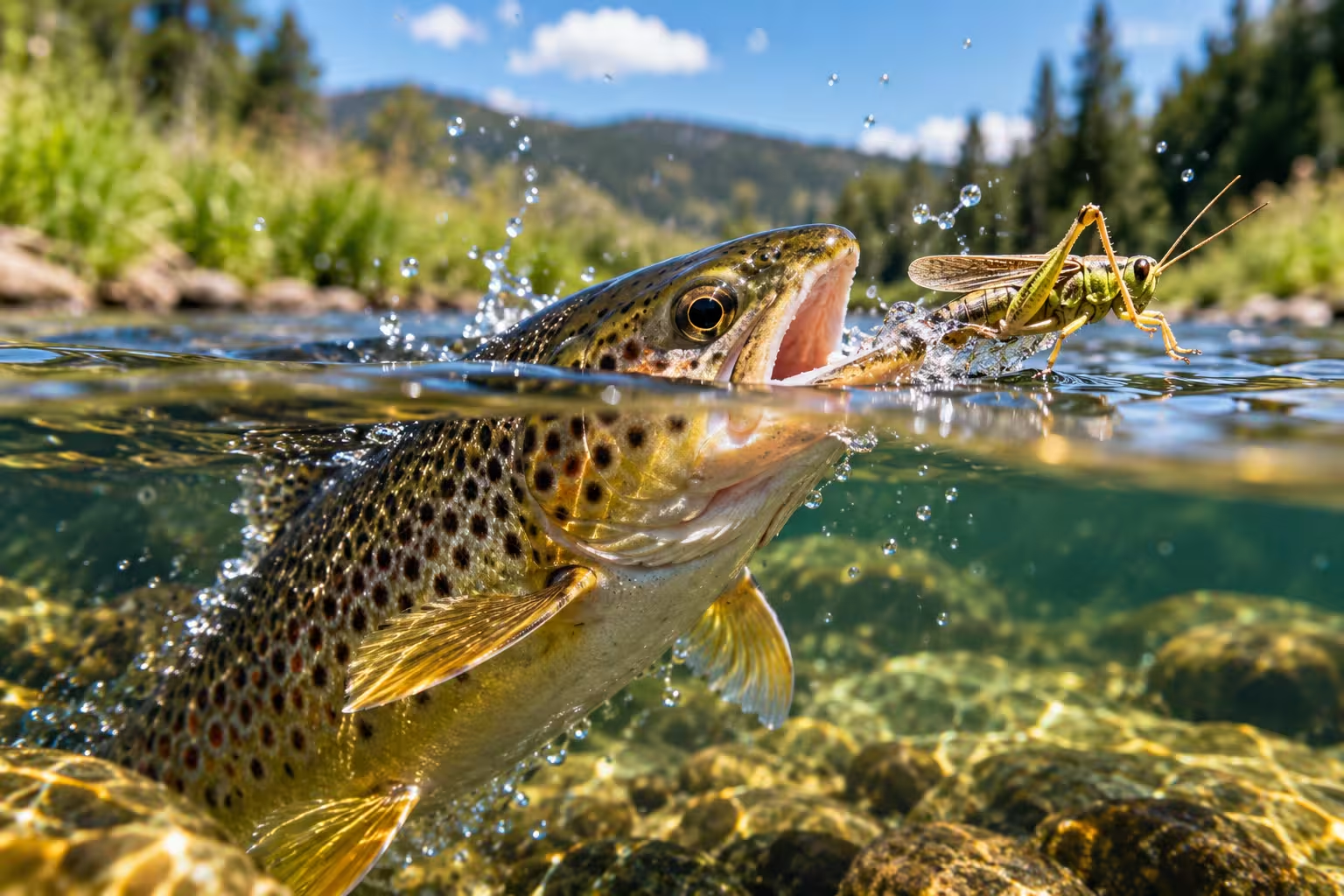
Why trout eat grasshoppers is an interesting question because a grasshopper doesn’t live underwater.
It doesn’t hatch from the stream bottom. It doesn’t spend months crawling between rocks like a hellgrammite. It doesn’t drift through riffles as an aquatic nymph, and it doesn’t swim through pools like a minnow.
Yet drop a grasshopper into the right trout stream during the right time of year and the reaction can be immediate.
A trout rises.
The surface erupts.
And the grasshopper disappears.
That raises an interesting biological question:
Why would a fish that lives its entire life underwater become so interested in an insect that lives almost entirely on land?
The answer is one of the best examples of how closely a trout stream is connected to the land surrounding it.
Grasshoppers are terrestrial insects. They normally live among grasses, weeds, agricultural vegetation, streamside plants, and other land-based habitat. But streams don’t exist independently of their surroundings. Wind, rain, jumping insects, collapsing banks, overhanging vegetation, animals, and simple mistakes constantly move terrestrial organisms into the water.
Once a grasshopper lands in a trout stream, its ecological role changes instantly.
It goes from terrestrial insect to potential trout food.
And because a grasshopper can represent a relatively large prey item compared with many aquatic insects, a trout may receive a substantial meal from a single successful surface strike.
Understanding why trout eat grasshoppers therefore requires more than knowing that hopper patterns catch fish.
We need to understand how grasshoppers reach the water, when they are most available, where trout expect to encounter them, how trout position themselves to intercept them, and how anglers can reproduce that natural sequence.
That biology explains why hopper fishing can sometimes be spectacular—and why the same grasshopper imitation can produce almost nothing under different conditions.
What Is a Grasshopper?
Grasshoppers are insects belonging to the order Orthoptera, which also includes crickets and katydids.
They are terrestrial insects characterized by powerful hind legs adapted for jumping. Most anglers recognize them immediately by their:
- Large hind legs
- Elongated bodies
- Prominent heads
- Antennae
- Wings in mature individuals
- Brown, tan, green, yellow, olive, or mottled coloration
Unlike many of the insects commonly associated with trout fishing, grasshoppers do not have an aquatic larval or nymphal stage.
That distinction matters.
Mayflies, stoneflies, caddisflies, and hellgrammites spend significant portions of their life cycles associated with water.
Grasshoppers don’t.
They develop on land.
Their connection to trout occurs primarily when they accidentally enter the aquatic environment.
This places grasshoppers within a larger category trout anglers sometimes overlook:
terrestrial food sources.
Aquatic Food vs. Terrestrial Food
Trout obtain food from both aquatic and terrestrial environments.
Aquatic foods can include:
- Mayfly nymphs
- Stonefly nymphs
- Caddisflies
- Hellgrammites
- Scuds
- Leeches
- Crawfish
- Minnows
- Sculpins
Terrestrial foods can include:
- Grasshoppers
- Crickets
- Beetles
- Ants
- Caterpillars
- Spiders
- Cicadas
- Other insects and arthropods that fall into the water
This distinction is important because the delivery mechanism changes.
A hellgrammite may become available when current dislodges it from rocks.
A mayfly becomes vulnerable during parts of its aquatic development and emergence.
A minnow may become vulnerable because it is injured, isolated, or pursued.
A grasshopper becomes available primarily because something moves it from land to water.
That changes where and when trout are likely to encounter it.
For a broader examination of aquatic prey, see Best Aquatic Insects for Trout.
Why Trout Eat Grasshoppers That Fall Into the Water
Because trout are opportunistic predators.
A trout does not require every food item to originate underwater.
What matters is whether the potential prey:
- Enters the trout’s environment.
- Can be detected.
- Appears edible.
- Can be captured at an acceptable energetic cost.
A grasshopper can satisfy all four conditions.
Once it lands on the water, the trout doesn’t care that the insect spent the previous hour sitting on a weed.
The trout encounters a struggling prey item on the surface.
More importantly, that prey item may be considerably larger than many of the aquatic insects available at the same time.
That can make a grasshopper worth investigating.
Grasshoppers Can Be a Large Meal
One of the most obvious differences between grasshoppers and many aquatic insects is size.
A trout feeding on tiny aquatic insects may need to capture numerous individuals.
One grasshopper can represent considerably more biomass.
This creates a potentially favorable energetic relationship.
The trout gains a relatively large food item from one capture attempt.
This doesn’t mean trout always prefer larger food.
Trout feeding behavior is more complicated than:
larger prey = better prey.
Abundance matters.
Vulnerability matters.
Recognition matters.
Competition matters.
Current matters.
Fishing pressure matters.
The trout’s own size matters.
But when relatively large prey becomes easily available, it can offer an attractive feeding opportunity.
This connects directly with Trout Energy Conservation Explained.
A trout benefits from obtaining useful energy without spending excessive energy acquiring it.
A grasshopper drifting directly overhead can provide exactly that opportunity.
The Stream Bank Is Part of the Trout’s Food Supply
When anglers study a trout stream, they naturally look at the water.
But when considering terrestrial insects, you also need to look beside the water.
Ask what is growing along the banks.
Is there:
- Tall grass?
- Weeds?
- Meadows?
- Agricultural vegetation?
- Brush?
- Overhanging plants?
- Undercut banks?
- Low branches?
- Dense summer vegetation?
Those features can influence the amount of terrestrial food entering the stream.
A trout stream bordered by thick summer vegetation has a different terrestrial food supply than a stream running through bare rock.
That doesn’t automatically mean one is better.
It means the food web is different.
The surrounding landscape contributes biological material to the water.
Grasshoppers are one example.
How Do Grasshoppers Get Into Trout Streams?
Grasshoppers don’t enter trout streams for one single reason.
Several mechanisms can put them on the water.
Jumping
A grasshopper’s primary escape mechanism can also get it into trouble.
A startled hopper may jump away from a predator, angler, livestock animal, vehicle, or other disturbance and land in the water.
Once there, its powerful jumping legs are much less useful.
Wind
Wind can knock or carry terrestrial insects from vegetation.
This becomes especially important where grass, weeds, or brush grow close to the stream.
A windy afternoon can therefore alter food availability without changing anything happening underneath the water.
Rain and Storms
Rain can disturb streamside vegetation.
Heavy rainfall and runoff can wash terrestrial organisms from banks and plants into streams.
The important point is not that every storm creates excellent hopper fishing.
It is that weather can change the connection between terrestrial habitat and aquatic food availability.
Animals and People
Livestock, wildlife, anglers, hikers, and other animals moving through streamside vegetation can disturb insects.
Anyone who has walked through tall grass during summer has seen grasshoppers jumping in every direction.
If that grass borders a trout stream, some of those jumps end in water.
Simple Accidents
Sometimes an insect simply makes a mistake.
It jumps.
It flies.
It loses its footing.
It lands on water.
For the grasshopper, that may be a serious problem.
For a trout, it may be lunch.
Why Summer Is Closely Associated With Hopper Fishing
Grasshopper fishing is strongly associated with summer for a biological reason.
Grasshopper populations develop through the warmer months.
Early in their development, grasshoppers are smaller immature nymphs. As the season progresses, they grow through successive molts and eventually become larger adults.
At the same time, streamside vegetation may become increasingly developed.
That can create a seasonal convergence:
more terrestrial insects + larger insects + abundant streamside vegetation = greater potential terrestrial food input.
This is why “hopper season” isn’t simply a fishing tradition.
It reflects changes occurring in the terrestrial ecosystem surrounding the stream.
However, local timing varies considerably with:
- Latitude
- Elevation
- Climate
- Weather
- Grasshopper species
- Vegetation
- Land use
There is no universal date when every trout stream suddenly enters hopper season.
Observe the environment.
If you walk through streamside grass and grasshoppers are jumping everywhere, that is meaningful information.
Why Late Summer Can Be Particularly Interesting
By later summer, many grasshoppers have reached substantial size.
That can make them particularly noticeable prey.
At the same time, trout may have had repeated opportunities to encounter terrestrial insects entering the water.
This is important because trout feeding behavior is influenced by experience.
A trout that has successfully eaten terrestrial insects can learn that certain surface disturbances represent feeding opportunities.
That does not mean every splash triggers an attack.
Trout still evaluate potential prey.
But repeated natural encounters can establish terrestrial insects as familiar food.
This connects with a broader principle discussed in Do Trout Learn to Avoid Lures?
Learning doesn’t only help trout avoid danger.
Experience also helps animals identify profitable feeding opportunities.
Why Wind Can Improve Grasshopper Fishing
Anglers often dislike wind because it makes casting difficult.
Biologically, however, wind can be useful.
Imagine a grassy bank containing hundreds of terrestrial insects.
On a calm day, most remain on land.
Now add a moderate breeze blowing toward the water.
Vegetation moves.
Insects are disturbed.
Some lose their grip.
Some jump.
Some are blown or knocked onto the stream.
The food supply has changed.
This produces an important fishing lesson:
Weather can change prey availability without changing prey abundance.
The grasshoppers were already there.
Wind simply made some of them available to trout.
This is the same distinction we discussed with other trout foods:
Presence is not the same as availability.
For an angler, a windy grassy bank can therefore deserve special attention.
Wind Direction Matters
Not all wind affects the stream equally.
Suppose one bank is covered with grasshoppers.
If the wind blows strongly away from the water, relatively few may be carried toward the stream.
If the wind blows across that same vegetation toward the water, the probability of terrestrial insects entering the stream can increase.
That means an angler shouldn’t merely ask:
Is it windy?
Ask:
What is the wind blowing toward the water?
That is a more biologically useful question.
The same principle applies to other terrestrial insects.
Where Do Trout Expect Grasshoppers?
Because grasshoppers enter from land, the highest-probability feeding areas are often associated with banks.
That immediately distinguishes hopper fishing from many bottom-oriented aquatic food presentations.
Look particularly at:
- Grassy banks
- Undercut banks
- Overhanging vegetation
- Brush-lined edges
- Meadow streams
- Agricultural edges
- Current seams near shore
- Banks downstream from terrestrial insect habitat
The best location isn’t necessarily directly beneath the vegetation.
Remember that current transports food.
A grasshopper falling beside a grassy bank can drift downstream.
A trout may intercept it several yards from where it entered the water.
That makes current an important part of terrestrial feeding too.
Current Still Controls the Delivery
Grasshoppers originate on land, but once they enter moving water, the stream takes control.
Suppose a hopper lands near an upstream grassy bank.
The current begins transporting it.
It passes:
- Along the bank
- Through a seam
- Around a boulder
- Past an undercut
- Across a pocket
- Into a run
Every one of those locations can contain trout.
The angler’s job is to determine where a trout can intercept that drifting insect efficiently.
That is why How Trout Use Current Breaks applies just as strongly to grasshopper fishing as it does to many aquatic food sources.
Current doesn’t care whether the food originated under a rock or in a meadow.
Once the prey enters the water, current becomes the delivery system.
Why Undercut Banks Can Be Excellent Hopper Water
An undercut bank can combine several valuable trout features.
It can provide:
- Shade
- Cover
- Reduced exposure to predators
- Relatively protected holding water
- Access to current
- Terrestrial food input
Now add grass or weeds above that bank.
A trout holding underneath may be positioned directly below a source of terrestrial prey.
This is one reason blindly casting into the middle of a stream can miss some of the most productive hopper water.
Sometimes the important water is only inches from shore.
Why Trout Rise So Aggressively to Grasshoppers
A trout taking a tiny insect from the surface may rise with surprisingly little disturbance.
A hopper strike can look completely different.
Large terrestrial prey can trigger aggressive surface attacks.
Several factors contribute.
First, the prey is relatively large.
Second, it is conspicuous.
Third, a floating grasshopper can move unpredictably.
Fourth, another trout may also be able to see it.
Competition can favor decisive feeding.
The result can be a violent-looking surface strike.
But anglers should not assume every trout always attacks hoppers aggressively.
Pressured fish can inspect them.
Clear-water trout can refuse them.
Some trout may follow without committing.
Others may rise and turn away at the last moment.
What Does a Grasshopper Look Like From Below?
This is one of the most important questions when designing or choosing an artificial hopper.
Anglers usually examine lures from above or from the side.
Trout often see floating prey from underneath.
From below, several characteristics can matter:
- Overall silhouette
- Body width
- Leg profile
- Contrast against the sky
- Movement
- Surface disturbance
Fine coloration may be less important than anglers sometimes assume.
A trout looking upward toward a bright sky can receive a strong silhouette from a terrestrial insect sitting on the surface.
This doesn’t mean color never matters.
It means profile and contrast can become extremely important.
Grasshopper Color Varies
There is no single universal grasshopper color.
Depending on species, developmental stage, habitat, and individual variation, grasshoppers may appear:
- Green
- Olive
- Tan
- Brown
- Yellowish
- Gray
- Mottled
- Nearly black in portions of the body
Therefore, asking for the single “best hopper color” oversimplifies the biology.
A better approach is to observe the local insects.
Catch one from the vegetation if appropriate.
Look at:
- Body size
- General body color
- Underside
- Leg color
- Contrast
- Wing coloration
Then choose an imitation that reproduces the important visual characteristics.
Exact photographic matching is usually unnecessary.
Size May Matter More Than Exact Color
During hopper season, size can be particularly important.
Early-season grasshoppers may be relatively small.
Later individuals can become substantially larger.
An artificial hopper dramatically larger than anything naturally entering the stream can still catch trout, but it may also receive more inspection—particularly in clear, heavily pressured water.
Matching the general prey size can therefore be more useful than obsessing over tiny differences in shade.
Start by asking:
How large are the grasshoppers actually living beside this stream?
That gives you a biologically defensible starting point.
How a Real Grasshopper Behaves on Water
This is where many artificial presentations go wrong.
A natural grasshopper that falls into water does not behave like a motorized lure.
It generally floats or struggles at the surface.
Movement can include:
- Leg kicking
- Small body movements
- Brief bursts of disturbance
- Periods of relative stillness
- Drifting with current
That last point is extremely important.
The current does most of the transportation.
A grasshopper doesn’t normally race upstream.
It doesn’t continuously skate sideways.
It doesn’t repeatedly leap several feet across the surface.
If your imitation is moving much faster than the surrounding current, the presentation may begin looking less natural.
The Dead Drift Is So Effective for a Reason
Fly anglers frequently use a dead drift with hopper patterns.
The biological reasoning is straightforward.
A grasshopper falling into moving water is largely at the mercy of the current.
Therefore, allowing an imitation to drift at approximately the same speed as the surrounding water reproduces an important natural cue.
This doesn’t mean absolutely zero movement is always required.
An occasional small twitch can imitate struggling.
But the sequence should often be closer to:
drift → drift → slight twitch → pause → drift
rather than:
jerk → jerk → jerk → retrieve
Let the stream move the bait.
Don’t Confuse a Struggling Hopper With a Swimming Lure
A little movement can attract attention.
Too much can destroy realism.
This is especially true with heavily pressured trout.
A real grasshopper may kick hard after hitting the water, but those movements occur within the larger context of downstream drift.
Think about what the trout sees:
A terrestrial insect has fallen into the stream.
It is trapped on the surface.
It struggles briefly.
Current carries it downstream.
That is the biological sequence your presentation should imitate.
Low Fishing Pressure: Start Bold
Under low fishing pressure, trout may respond readily to large terrestrial presentations.
Start with:
- A reasonably large hopper
- Natural coloration
- Accurate bank casts
- A clean dead drift
- Occasional subtle movement
You can cover water efficiently because you’re looking for trout willing to move toward a substantial surface meal.
Don’t immediately reduce your presentation to something tiny.
Give the fish an opportunity to show you how willing they are to feed.
Moderate Fishing Pressure: Improve the Drift
As pressure increases, presentation often becomes more important.
Try:
- More accurate size matching
- Finer leaders where appropriate
- Longer casts
- Less line landing near the fish
- Cleaner drag-free drifts
- Fewer unnecessary twitches
One of the biggest mistakes is blaming the hopper pattern when the actual problem is drag.
If the current pulls your fly unnaturally across the surface, the trout receives information that does not match natural prey.
Fix the presentation before replacing the fly.
Heavy Fishing Pressure: Reduce the Information
Heavily pressured trout may have seen dozens or hundreds of artificial hopper patterns.
At that point, exaggerated movement can work against you.
Try:
- Smaller hopper profiles
- More natural colors
- Longer leaders
- Accurate casts
- Minimal disturbance
- Completely natural drift
- Fewer casts over the same fish
This is another example of how fishing pressure changes presentation strategy.
The objective isn’t necessarily to make the lure more exciting.
Sometimes the objective is to give the trout fewer reasons to reject it.
Where Should You Cast a Hopper?
This is where understanding the food source becomes practical.
Instead of casting everywhere, identify the locations where a real grasshopper would logically enter the stream.
Grassy Banks
This is the obvious starting point.
Cast close to shore and allow the imitation to drift naturally downstream.
Undercut Banks
Place the hopper near the edge rather than several feet away from it.
A difference of two feet can determine whether the lure passes through the trout’s feeding window.
Overhanging Vegetation
Trees, weeds, brush, and grasses can all contribute terrestrial insects.
Cast beneath or immediately downstream.
Current Seams Along Shore
Food entering near shore may become concentrated along current boundaries.
Trout can hold in slower water and watch faster water deliver prey.
Behind Structure
A trout behind a rock may still rise for a large surface meal drifting overhead.
The fish gets the energetic advantage of protected holding water plus access to food.
Foam Lines
Foam lines deserve attention because floating material can reveal where surface currents concentrate objects.
If leaves, foam, seeds, and debris are following a particular path, terrestrial insects may follow the same surface hydraulics.
Accuracy Can Matter More Than Distance
Hopper fishing often rewards accurate casting.
A 60-foot cast into unproductive water may accomplish less than a 20-foot cast placed six inches from a grassy undercut bank.
This happens because terrestrial prey input is often spatially concentrated.
Grasshoppers don’t rain evenly across the entire stream.
They usually enter from the edges.
That means a trout can learn to monitor those edges.
Put the imitation where natural prey occurs.
Grasshoppers and Water Clarity
Clear water gives trout more opportunity to inspect an artificial presentation.
That can make:
- Accurate size
- Silhouette
- Leader visibility
- Drift
- Casting disturbance
more important.
In stained water, trout may have less time or visual distance to evaluate the offering.
A stronger silhouette or slightly larger presentation may help the fish locate it.
For the larger principles involved, see How Water Clarity Affects Trout Fishing.
Again, there isn’t one universal rule.
Adjust based on what the fish are telling you.
Grasshoppers and Water Temperature
Hopper season often overlaps with warm weather.
That creates an important caution.
Excellent terrestrial food availability does not eliminate trout’s physiological temperature limits.
A hot summer afternoon may produce abundant grasshoppers while simultaneously producing water temperatures stressful to trout.
Best Water Temperature for Trout: The Science Behind Why Temperature Controls Everything explains this relationship in detail.
This means the best hopper fishing isn’t automatically the hottest part of the hottest day.
Always consider the fish’s physiology alongside prey availability.
Grasshoppers and Dissolved Oxygen
Warm water generally holds less dissolved oxygen than colder water.
That can influence where trout position themselves during summer.
Cool tributaries, springs, riffles, deeper water, and other thermal or oxygen refuges can become increasingly important depending on the stream.
This creates a potential conflict:
The best grasshopper habitat may be along a sunny meadow bank.
The best trout habitat at that moment may be somewhere else.
That is why prey abundance alone doesn’t determine where trout will feed.
How Dissolved Oxygen Affects Trout: The Science Behind the Bite Window explains the oxygen side of the equation.
The successful angler has to find the overlap between:
available food + suitable trout habitat.
Fly Fishing With Grasshopper Patterns
Grasshopper flies are among the classic terrestrial trout patterns.
They range from realistic imitations to highly simplified foam patterns.
Regardless of design, the same biological principles apply.
The fly should:
- Float appropriately
- Present a believable silhouette
- Land reasonably naturally
- Drift with the current
- Remain visible enough for the angler to track
- Support occasional subtle movement when desired
Presentation often matters more than anatomical perfection.
A beautifully tied hopper dragging sideways across conflicting currents can be less convincing than a simple foam pattern drifting naturally.
Hopper-Dropper Fishing
One reason hopper patterns are so useful is that they can sometimes support a subsurface fly beneath them.
This creates the classic hopper-dropper system.
The hopper serves two functions:
- It represents terrestrial food.
- It acts as a strike indicator for the subsurface fly.
The dropper might imitate a:
- Mayfly nymph
- Stonefly
- Caddis larva
- Other aquatic insect
This allows the angler to test two feeding zones simultaneously.
A trout willing to rise can take the hopper.
A trout unwilling to reach the surface may take the subsurface offering.
This is especially useful when you’re unsure how strongly trout are keyed into terrestrial food.
Can You Fish a Real Grasshopper?
Where legal, natural grasshoppers can be effective trout bait.
Their advantages are obvious:
- Correct shape
- Correct texture
- Correct size
- Natural movement
- Natural chemical cues
However, bait regulations vary significantly among waters.
Some trout streams are artificial-lures-only.
Some prohibit live bait.
Others restrict collection or transport of organisms.
Always check the regulations for the specific water you are fishing.
Do Stocked Trout Eat Grasshoppers?
Yes, stocked trout can eat terrestrial insects.
However, recently stocked fish may initially behave differently from trout that have spent significant time feeding naturally in the stream.
Hatchery fish arrive with previous feeding experience shaped by an artificial environment.
As they remain in natural water, they encounter:
- Aquatic insects
- Terrestrial insects
- Minnows
- Crustaceans
- Worms
- Other naturally occurring food
Their feeding behavior can change as they acclimate.
This is part of the larger process covered in Stocked vs Wild Trout: How to Adjust Your Presentation.
Do Wild Trout Eat More Grasshoppers?
It isn’t accurate to simply say wild trout always eat more grasshoppers.
Diet depends heavily on the environment.
A wild trout living beneath a meadow bank filled with grasshoppers may encounter them frequently.
A wild trout living in a stream with little terrestrial insect input may encounter very few.
Likewise, a stocked trout that has lived in productive natural water long enough may readily exploit terrestrial food.
The habitat determines the opportunity.
Do Big Trout Eat Grasshoppers?
They certainly can.
A large grasshopper can provide a substantial meal, making it appropriate prey for a larger trout.
But don’t assume large trout always feed on large prey.
Large trout can consume surprisingly small organisms when those foods are abundant and efficiently captured.
The important question remains:
What feeding opportunity does the environment provide?
Why Hopper Fishing Sometimes Suddenly Stops
You may catch several trout on grasshoppers one day and struggle the next.
That doesn’t necessarily mean the trout suddenly stopped liking grasshoppers.
The delivery system may have changed.
Perhaps:
- The wind stopped.
- Wind direction changed.
- Air temperature changed.
- Grasshopper activity declined.
- Trout moved because water temperature changed.
- Flow changed.
- Fishing pressure increased.
- The fish shifted to another abundant food source.
This is why fishing should be treated as a dynamic biological system rather than a collection of permanent lure rules.
The successful lure yesterday tells you what worked yesterday.
The stream today tells you what to fish today.
Watch the Banks Before You Choose the Lure
Before tying on a hopper, spend a few minutes observing.
Walk through the vegetation.
Look at the bank.
Watch the surface.
Ask:
Are grasshoppers actually present?
What size are they?
What color are they?
Is the wind pushing toward the water?
Are terrestrial insects landing on the stream?
Are trout rising near the banks?
Those observations can tell you more than a generic fishing report.
You are examining the food supply directly.
The Bigger Lesson: A Trout Stream Extends Beyond the Water
Grasshoppers reveal something important about trout ecology.
A stream is not an isolated pipe containing fish and aquatic insects.
It is connected to the surrounding landscape.
Trees shade the water.
Leaves enter it.
Roots stabilize banks.
Terrestrial insects fall into it.
Animals disturb vegetation around it.
Rain washes organic material into it.
The terrestrial and aquatic ecosystems constantly exchange energy and organisms.
Grasshoppers are simply one highly visible example.
For trout, the edge between land and water isn’t an ecological wall.
It is a feeding boundary.
Frequently Asked Questions About Trout and Grasshoppers
Do trout really eat grasshoppers?
Yes. Trout consume terrestrial insects that enter streams, and grasshoppers can become particularly attractive because they provide a relatively large prey item.
Are grasshoppers insects?
Yes. Grasshoppers are terrestrial insects belonging to the order Orthoptera.
Are grasshoppers aquatic insects?
No. Grasshoppers develop on land. They become available to trout when they accidentally enter the water.
What time of year do trout eat grasshoppers?
Grasshopper fishing is generally associated with the warmer months when hopper populations are active and mature. Exact timing depends on local climate, elevation, weather, vegetation, and grasshopper species.
Is August good for hopper fishing?
In many temperate trout regions, late summer can provide excellent hopper opportunities because grasshoppers may be abundant and mature. Local conditions are more important than the calendar alone.
What weather is best for hopper fishing?
Warm conditions with active grasshopper populations can be productive. Wind blowing from grass or vegetation toward the stream may increase the number of terrestrial insects entering the water.
Is windy weather good for hopper fishing?
It can be. Wind can disturb vegetation and move terrestrial insects into streams. Wind direction is particularly important because a breeze blowing toward the water can increase terrestrial food input.
Where should I cast a grasshopper for trout?
Start close to grassy banks, undercut banks, overhanging vegetation, current seams, and other areas where a real grasshopper could naturally enter the water.
Should I cast a hopper into the middle of the stream?
Sometimes, but don’t overlook the edges. Because grasshoppers originate on land, bank-side water can be particularly productive.
Should a hopper float?
A grasshopper imitation is normally presented on or very near the surface because a natural grasshopper entering a stream commonly remains at the surface while struggling and drifting.
Should I twitch a hopper?
Occasional subtle movement can imitate a struggling insect. Avoid excessive continuous movement. Allow the current to produce most of the drift.
What is the best color grasshopper for trout?
There is no universal best color. Green, olive, tan, brown, yellowish, and mottled patterns can all imitate natural grasshoppers. Observe the insects living beside the stream and use their general appearance as your starting point.
What size hopper should I use for trout?
Match the approximate size of local grasshoppers when possible. Smaller patterns may be appropriate earlier in the season or under heavy fishing pressure, while larger patterns may match mature late-season insects.
Do rainbow trout eat grasshoppers?
Yes. Rainbow trout can consume terrestrial insects, including grasshoppers, when they become available.
Do brown trout eat grasshoppers?
Yes. Brown trout are opportunistic predators and can readily exploit terrestrial insects entering their habitat.
Do brook trout eat grasshoppers?
Yes. Brook trout consume terrestrial insects when those foods are available in their streams.
Do stocked trout eat grasshoppers?
Yes. Stocked trout can learn to exploit natural terrestrial food after entering streams and lakes, although newly stocked fish may initially show feeding behaviors influenced by hatchery conditioning.
Do large trout eat grasshoppers?
Yes. A mature grasshopper can represent a substantial prey item for a large trout. However, large trout also consume small prey when it is abundant and profitable.
Are real grasshoppers good trout bait?
They can be highly effective where natural bait is legal. Always check local fishing regulations because some trout waters prohibit live bait or restrict bait collection.
Why do trout hit hopper patterns so hard?
Grasshoppers can represent large, conspicuous surface prey. A trout may need to move decisively to capture the insect before current carries it away or another fish takes it.
Are grasshoppers better than aquatic insects?
Neither is universally better. Their importance depends on availability. During a strong aquatic insect emergence, aquatic prey may dominate trout feeding. During periods of heavy terrestrial insect input, grasshoppers and other land-based insects can become important.
Do grasshoppers work in clear water?
Yes, but clear water can give trout more opportunity to inspect an artificial pattern. Accurate size, silhouette, leader presentation, casting disturbance, and natural drift can therefore become especially important.
Can you use grasshoppers in stained water?
Yes. A larger or higher-contrast profile may help trout locate a terrestrial imitation when visibility is reduced, although conditions and trout behavior should determine the final presentation.
Do trout remember grasshoppers?
Trout can modify feeding behavior through experience. Fish repeatedly encountering profitable terrestrial prey can learn to respond to relevant feeding cues, while heavily pressured trout can also become more cautious around artificial presentations.
Why do trout sometimes look at a hopper but refuse it?
The trout may detect something inconsistent with natural prey. Possible causes include drag, excessive movement, unnatural size, leader visibility, casting disturbance, or previous exposure to artificial flies.
Before changing patterns, check the drift.
What is a hopper-dropper rig?
A hopper-dropper rig uses a floating grasshopper imitation on the surface with a subsurface fly suspended beneath it. The hopper functions both as potential food and as a strike indicator for the dropper.
Do grasshoppers sink?
A struggling grasshopper can remain at the surface for some time, but insects can eventually become waterlogged or submerged. For most hopper fishing, however, the surface presentation represents the primary natural scenario anglers are attempting to imitate.
Final Takeaway
Grasshoppers don’t need to live underwater to become important trout food.
They only need to enter the water.
That distinction explains almost everything about hopper fishing.
Grasshoppers develop in the terrestrial environment surrounding the stream. As populations increase through the warmer months, trout may gain access to increasingly large terrestrial prey.
Wind knocks insects from vegetation.
Rain disturbs the banks.
Animals move through grass.
Hoppers jump in the wrong direction.
And occasionally a terrestrial insect suddenly finds itself floating on a trout stream.
From that moment forward, current determines where it goes.
A trout positioned near a grassy bank, undercut, current seam, or downstream feeding lane may need to make only a short movement to capture a substantial meal.
That is why successful hopper fishing isn’t simply about buying a grasshopper-shaped lure.
Start with the biology.
Look at the vegetation.
Look for the insects.
Watch the wind.
Find where terrestrial food enters the water.
Follow the current downstream.
Find where a trout can intercept that food efficiently.
Then place your imitation into the same pathway.
Grasshoppers demonstrate one of the most important principles in the entire Trout Food Sources series:
To understand what trout eat, sometimes you have to stop looking at the water and start looking at the world around it.