Best Aquatic Insects for Trout: What Trout Eat and Why It Matters
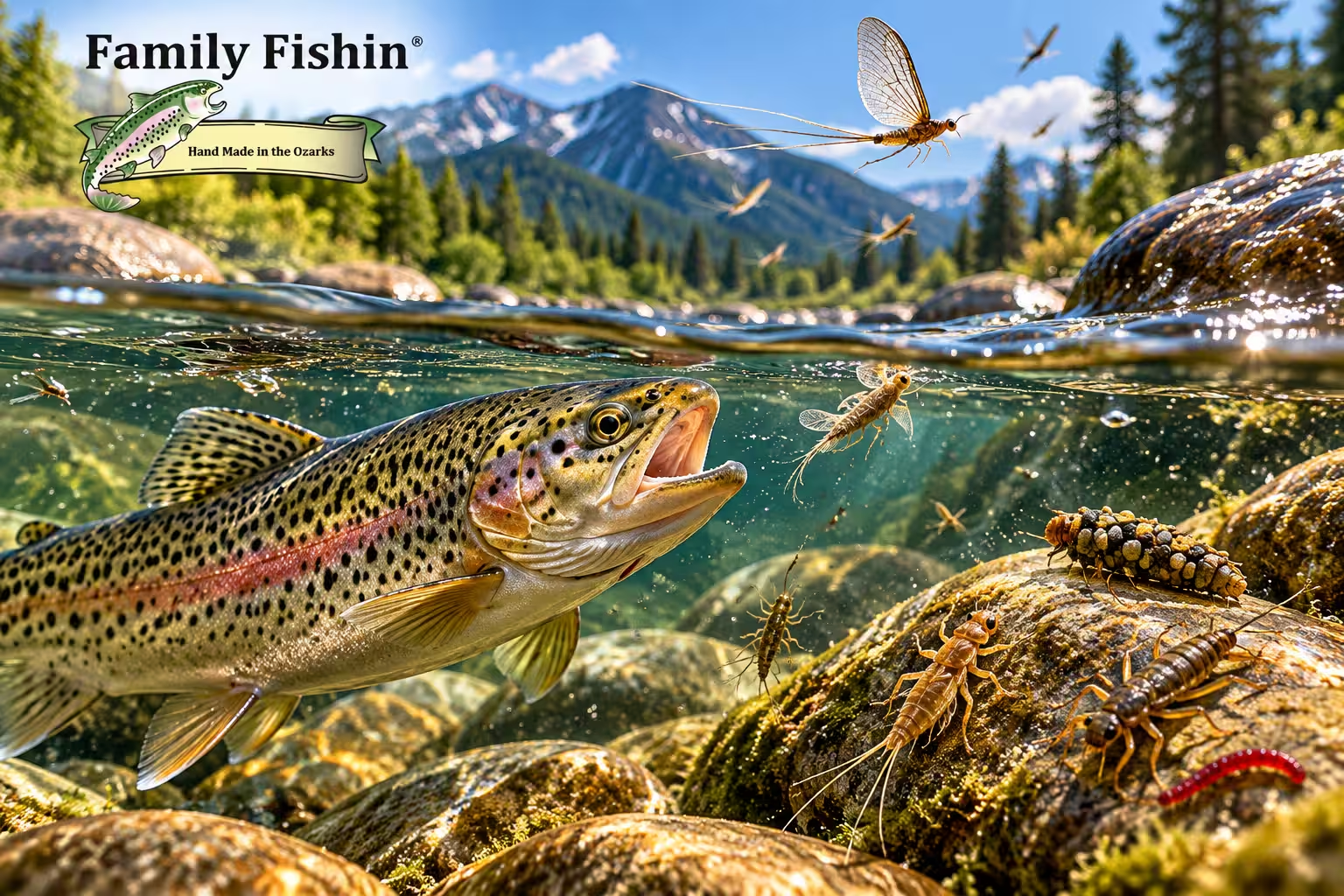
Aquatic insects for trout are one of the most important food sources in healthy streams and rivers. Walk along a healthy trout stream, turn over a few submerged rocks, and an entire food system becomes visible. Small nymphs cling to stone surfaces. Caddisfly larvae hide inside cases built from sand, gravel, or plant material. Midge larvae occupy sediment and slower water. Other insects crawl, swim, burrow, drift, emerge, mate, and eventually return to the water.
To a trout, this is not simply a collection of bugs. It is a constantly changing supply of food.
Aquatic insects are among the most important natural foods available to trout in streams and rivers. Mayflies, caddisflies, stoneflies, and midges are especially important because much of their development occurs underwater.
That means trout do not have to wait for a visible hatch to eat aquatic insects.
Depending on the insect, trout can feed on nymphs, larvae, pupae, emerging insects, adults, egg-laying adults, and dead or spent insects.
That distinction matters.
When anglers see insects flying above the water and trout rising, the connection between insects and feeding trout is obvious. What is much easier to overlook is the enormous amount of insect feeding that occurs below the surface.
In many situations, the most important question is not:
What insect is hatching?
It is:
What aquatic insects are available to the trout right now, where are they in the water column, and how are they moving?
Understanding those three things can tell you considerably more about how trout are likely to feed.
Why Aquatic Insects for Trout Matter So Much
A trout living in moving water faces a basic energy problem.
It must consume enough food to replace the energy it spends maintaining position, avoiding predators, competing with other fish, growing, reproducing, and surviving changes in its environment.
Current can help solve that problem.
Instead of swimming around continuously searching for individual prey, a trout can occupy a position where current transports food toward it. Aquatic insects that become dislodged from rocks, vegetation, sediment, woody material, or other structure can enter the drift and pass directly through a trout’s feeding lane.
This is one reason trout frequently hold near current transitions. A fish may remain in relatively slower water while watching faster water carrying potential food past its position.
Aquatic insects are particularly well suited to this feeding system because many spend months—and for some species considerably longer—in the aquatic portion of their life cycle.
During that time, they occupy rocks, gravel, vegetation, woody material, sediment, riffles, runs, pools, stream margins, and other underwater habitats.
Eventually, some of those insects become exposed.
They may be dislodged by current.
They may intentionally enter the drift.
They may begin moving before emergence.
They may rise through the water column.
They may struggle at or near the surface while transforming into adults.
Adults may later return to the water to lay eggs.
Finally, dead or dying adults may end up back on the water.
Every one of those events can create a feeding opportunity.
This is why understanding aquatic insects requires more than knowing what the adult insect looks like.
For trout fishing, behavior and life stage can be just as important as appearance.
The Four Major Aquatic Insect Groups Trout Anglers Should Know
Trout eat many aquatic organisms, and their diets are certainly not restricted to four groups of insects.
However, four groups deserve particular attention:
- Mayflies — Ephemeroptera
- Caddisflies — Trichoptera
- Stoneflies — Plecoptera
- Midges — primarily Chironomidae
These insects differ considerably in size, habitat, life cycle, movement, and the ways they become available to trout.
That means there is no scientifically meaningful answer to:
Which aquatic insect is always best for trout?
The better question is:
Which insect is most available to the trout under the conditions being fished?
A trout cannot eat an insect simply because anglers consider it excellent trout food. The insect must occur in that water and become accessible to the fish.
That principle—availability before reputation—is one of the most useful concepts for understanding trout feeding.
1. Mayflies: A Major Trout Food Source
Mayflies are probably the aquatic insects most closely associated with trout fishing.
There is good reason for that.
Mayflies occur in many freshwater environments, their nymphs can be abundant, and emergence can temporarily place large numbers of insects in positions where trout can capture them.
But the dramatic surface hatch represents only part of the story.
A mayfly begins as an egg and develops underwater as a nymph. Depending on the species and environmental conditions, this aquatic stage can occupy a substantial portion of the insect’s life.
When development is complete, the insect eventually transitions from its aquatic nymphal form into a winged stage.
Mayflies are unusual among insects because they possess a winged subadult stage—commonly called the dun by anglers—before molting again into the sexually mature adult.
This life cycle creates several different opportunities for feeding trout.
Mayfly Nymphs
For most of the period when a trout encounters a developing mayfly, the insect is underwater.
Different mayfly nymphs use different habitats and behave differently.
Anglers and aquatic entomologists commonly recognize broad behavioral or body-form groups that include:
- clingers,
- crawlers,
- swimmers,
- burrowers.
Those differences matter because they affect where trout encounter the insects.
A nymph adapted to clinging tightly to rocks in fast current does not behave exactly like a swimming nymph. A burrowing species living in soft sediment creates another completely different situation.
Even insects adapted to remaining on the bottom can become available when they are disturbed or enter the current.
Once a nymph begins drifting, a trout does not necessarily need to search among rocks to find it.
The current delivers the insect.
That makes natural drift an important part of understanding how trout feed on mayfly nymphs.
Mayfly Emergence
Emergence creates another feeding opportunity.
As mature nymphs leave their normal habitat and transition toward the surface, they can become much more exposed than they were while concealed among rocks, vegetation, or sediment.
This can change where trout feed.
A trout that had been intercepting insects close to the bottom may begin taking them higher in the water column.
Eventually, feeding may become visible near or at the surface.
This progression is important because seeing trout rise does not necessarily mean the fish suddenly started feeding.
They may have been feeding on the same insect well before the angler noticed any surface activity.
Adult Mayflies
Adult mayflies are relatively short-lived compared with their aquatic juvenile stage.
After reproduction, adults may return to the water, and dead or spent insects can accumulate on the surface.
When enough are available, trout may feed selectively on them.
This is the classic mayfly event many anglers recognize, but it represents only one portion of the mayfly’s importance as trout food.
The larger lesson is simple:
Do not think of mayflies only as surface insects.
For trout, much of the feeding opportunity begins underwater.
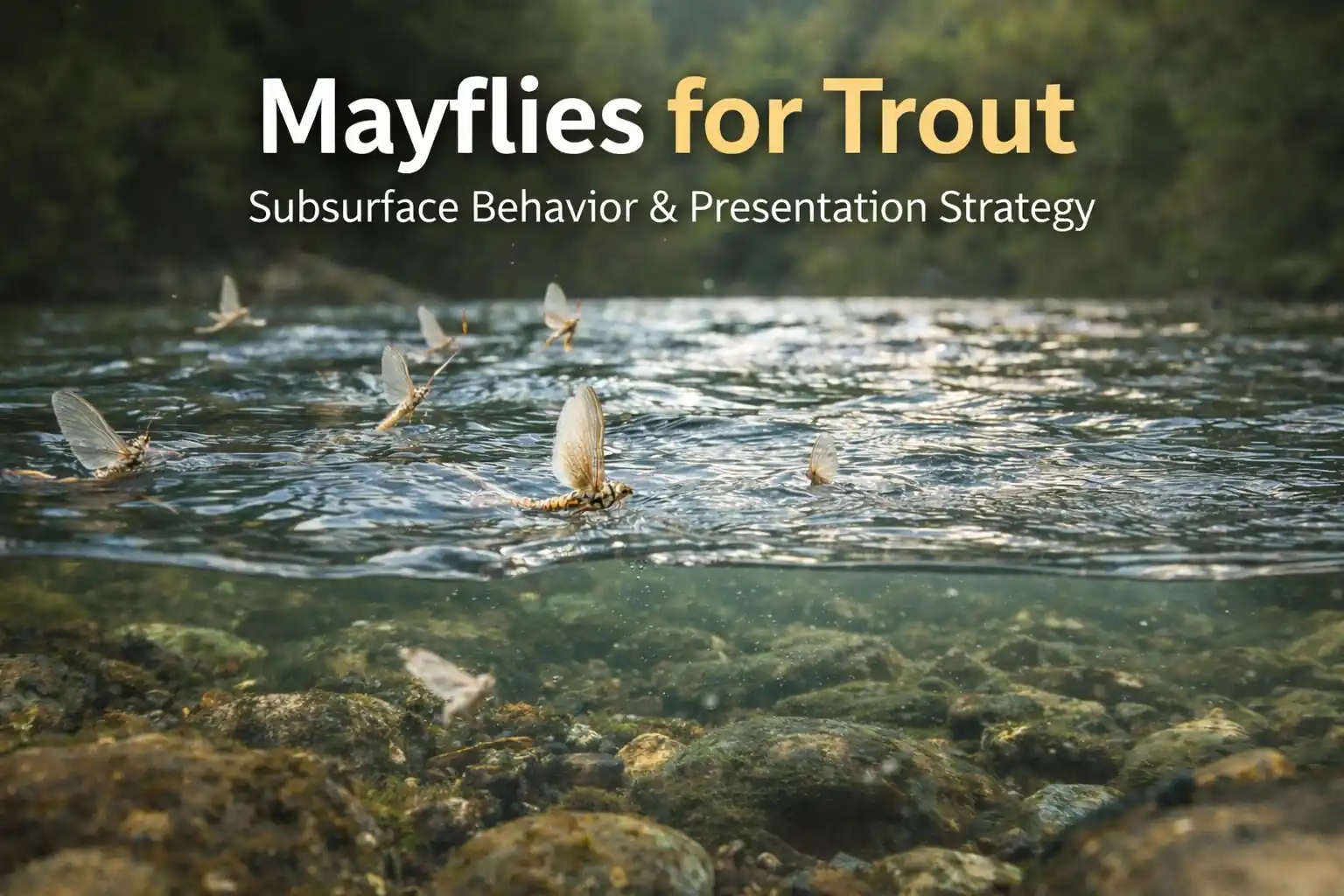
Want to go deeper into mayfly behavior? Read our Mayflies for Trout: Subsurface Behavior & Presentation Strategy guide for a detailed look at nymph behavior, emergence, trout feeding, and presentation.
For spin anglers who want to imitate the underwater nymph stage, the Family Fishin 1″ Mayfly Soft Plastic provides a small mayfly-profile presentation that can be fished where trout are feeding on aquatic nymphs.
2. Caddisflies: One Insect, Several Very Different Feeding Opportunities
Caddisflies are another major component of many trout-stream food webs.
They differ from mayflies in an important biological way.
Caddisflies undergo complete metamorphosis:
Egg → Larva → Pupa → Adult
The addition of a distinct pupal stage creates a different sequence of feeding opportunities for trout.
Caddisfly Larvae
Caddisfly larvae are often recognized because many species construct protective cases.
Depending on species and the materials available, those cases may incorporate:
- sand,
- tiny stones,
- pieces of leaves,
- twigs,
- other plant material.
But not every caddisfly builds a portable case.
Some construct fixed retreats or capture nets, while others are more mobile.
That diversity is important.
“Caddisfly” does not describe one identical prey item behaving the same way in every trout stream.
Different caddis larvae occupy different habitats and use different feeding strategies.
For trout, larvae can become available when they move, become dislodged, leave protective structures, or enter the drift.
This makes the larval stage important even when there is no obvious caddis hatch occurring.
Caddisfly Pupae
The pupal stage is especially interesting because it changes the insect’s behavior.
A mature caddisfly eventually must transition from its underwater existence to becoming an aerial adult.
During emergence, the insect can move through the water column toward the surface.
That creates something different from an insect simply tumbling downstream with the current.
There can be directed movement.
That difference matters to presentation.
When trout are feeding on relatively passive drifting organisms, excessive movement from an imitation may appear unnatural.
When insects are actively emerging, however, some upward or swimming movement may more closely resemble what trout are encountering.
That does not mean an imitation should be jerked violently through the water.
It means the natural behavior of the prey should help determine how the imitation is presented.
Adult Caddisflies
Adult caddisflies are often recognizable by the tent-like manner in which their wings are held over the body when at rest.
Adults can be encountered around streamside vegetation and above the water, and egg-laying activity can bring them back within reach of feeding trout.
At times, this can produce aggressive surface feeding.
But focusing only on adult caddisflies misses much of their importance.
Larvae and pupae can provide trout with feeding opportunities long before anglers notice adults above the stream.
What Caddisflies Teach Us About Trout Feeding
Caddisflies demonstrate why life stage matters.
The same insect group can present trout with prey that:
- lives near the bottom,
- becomes dislodged into the current,
- moves during emergence,
- appears near the surface,
- later returns as an egg-laying adult.
The appropriate presentation can therefore change even though the trout are technically feeding on caddisflies throughout the sequence.
3. Stoneflies: Substantial Prey From Moving Water
Stoneflies are another important trout food, particularly in streams containing suitable rocky habitat and well-oxygenated water.
Stoneflies undergo incomplete metamorphosis:
Egg → Nymph → Adult
There is no pupal stage.
That makes their life cycle fundamentally different from caddisflies and midges.
Stonefly Nymphs
Stonefly nymphs spend their aquatic lives largely associated with the bottom.
Many species live among rocks, gravel, and crevices where they can remain within suitable current and oxygen conditions while receiving some protection from predators.
Some stonefly species are relatively large compared with many midges and smaller mayflies.
That can make an individual stonefly nymph a substantial prey item.
Size matters because trout operate within an energy budget.
Capturing one larger prey item may provide more energy than capturing one extremely small organism.
But that does not mean trout automatically choose the largest available insect.
The fish must also deal with how abundant the prey is, how vulnerable it is, where it is located, and how much energy is required to capture it.
A large insect hidden beneath a rock may be less useful to a trout than smaller insects drifting directly past its nose.
This leads to an important principle:
Most abundant does not always mean most frequently selected, and largest does not always mean best.
How Stoneflies Become Available to Trout
Stonefly nymphs are generally associated with bottom habitat rather than continuously swimming through open water.
They can still become dislodged and enter the drift.
Once that happens, they become much more vulnerable to feeding trout.
Stonefly emergence also differs from the classic image of a mayfly rising through the water and emerging at the surface.
Many stonefly nymphs crawl out of the water onto exposed rocks, woody material, banks, or vegetation before completing their transformation into adults.
Before emergence, movement toward shallower water or stream margins can change where the insects are concentrated and where trout may encounter them.
That biology matters to anglers.
An imitation of a stonefly nymph does not necessarily need to behave like an insect rapidly swimming toward the surface.
A bottom-oriented presentation may often make considerably more sense.
Adult Stoneflies
Adult stoneflies spend their terrestrial period around the stream.
Females eventually return to deposit eggs, bringing the insects back within reach of trout.
Large stonefly species can create obvious feeding opportunities, but anglers should not overlook smaller members of the group.
What Stoneflies Teach Us
Stoneflies reinforce another important principle:
Where an insect lives determines how trout encounter it.
If natural prey spends most of its aquatic life crawling among rocks, an imitation behaving like an aggressively swimming minnow is reproducing a very different signal.
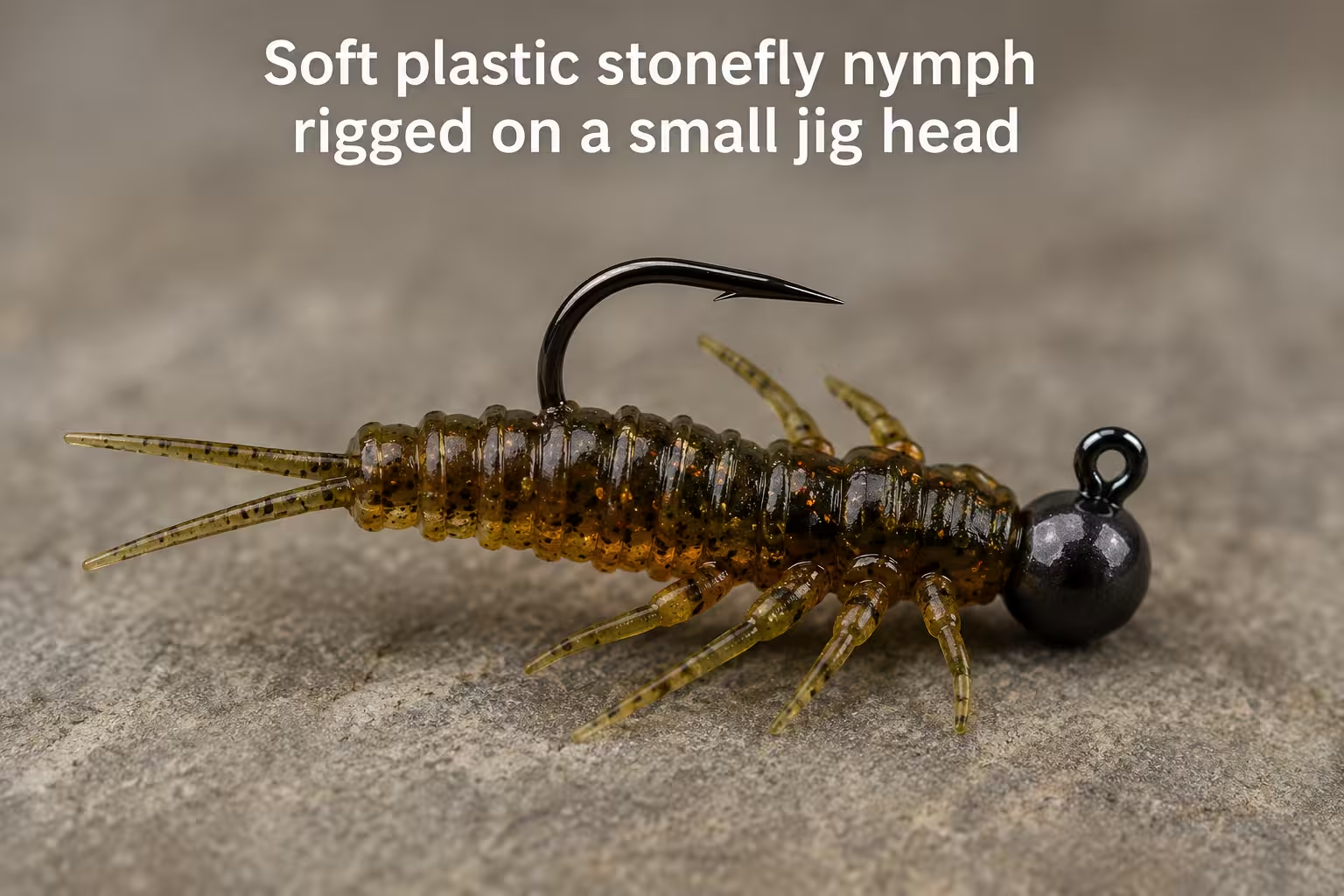
For spin anglers using small plastics, micro jigs, or other insect-profile lures, a controlled bottom-oriented presentation can better resemble stonefly nymph behavior.
The Family Fishin 1″ Soft Plastic Stonefly provides a small insect-profile option for this type of presentation and can be worked near the bottom or allowed to move naturally with the current where stonefly nymphs would normally be available to trout.
You can read more about the stone flies in our guide Stoneflies for Trout: Lifecycle, Behavior & Fishing Strategy
4. Midges: Tiny Insects With Outsized Importance
Midges are easy to overlook.
They are small.
They are not as visually dramatic as a large mayfly hatch or a big stonefly.
But in some trout waters—and particularly during certain parts of the year—they can become extremely important.
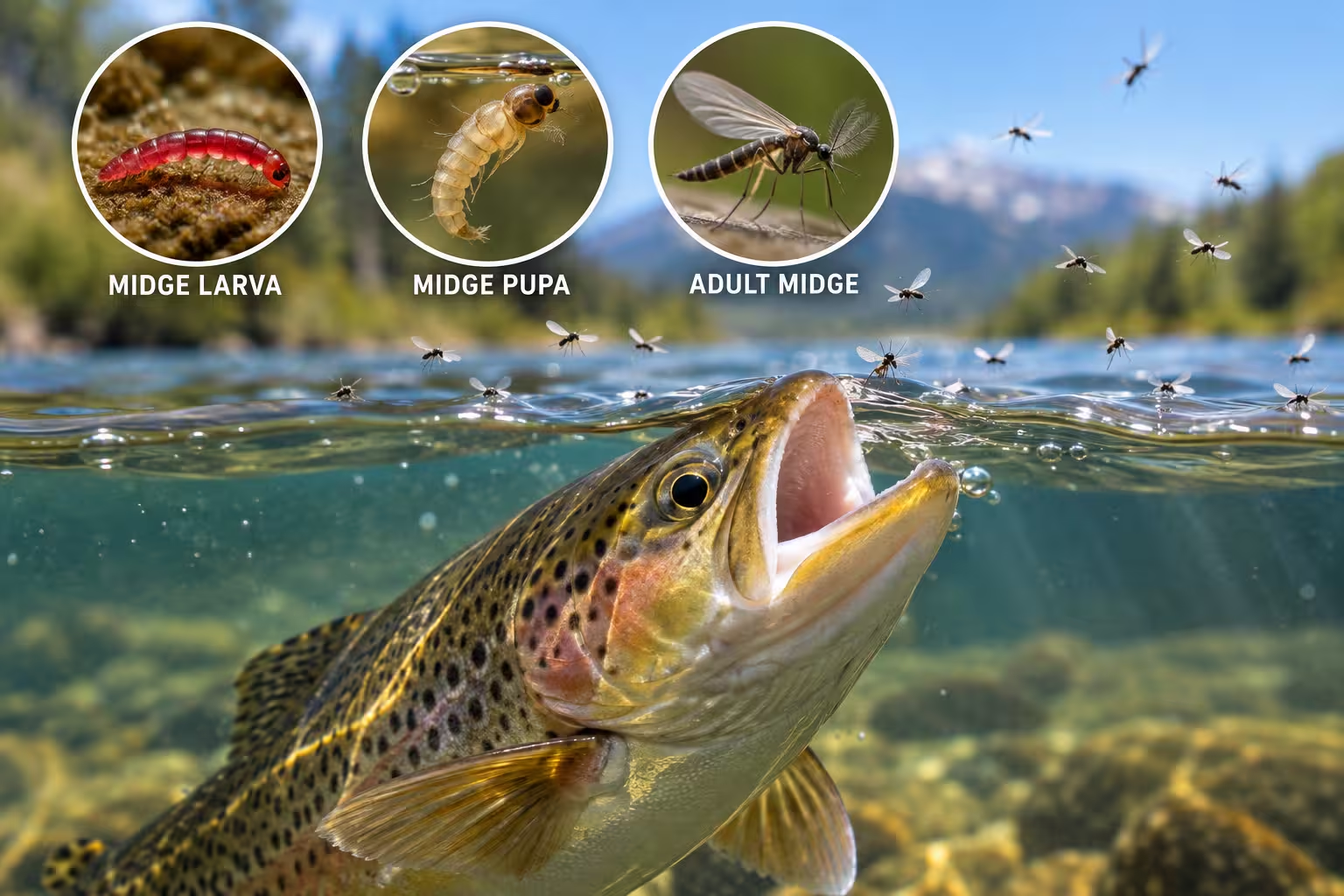
The midges most commonly discussed by trout anglers are chironomids, non-biting midges whose immature stages develop in water.
Their life cycle is:
Egg → Larva → Pupa → Adult
Midge Larvae
Midge larvae can occupy sediment and other bottom habitats.
Their small size creates an interesting feeding situation.
One midge larva does not provide the same amount of food as a large stonefly nymph or another substantial prey item.
But abundance can change the equation.
If tiny prey is continuously available and requires relatively little additional energy for a trout to capture, feeding on it can still be worthwhile.
This becomes especially important when larger prey is scarce or inaccessible.
Midges in Cold Water
Midges can remain particularly relevant during colder periods when the activity or availability of some other prey changes.
This helps explain why anglers should not dismiss extremely small food simply because larger prey would theoretically provide more energy.
Trout cannot eat food that is unavailable.
If a stream is consistently delivering small midges through a trout’s feeding lane, those insects can become the practical food source.
The lesson is not that trout always prefer tiny prey.
It is that abundance and availability can sometimes overcome the disadvantage of small size.
Midge Pupae and Emergence
Like caddisflies, midges possess a pupal stage.
When pupae move toward the surface during emergence, they become exposed in the water column.
Trout can intercept them before they become adults.
This can produce feeding at different depths as emergence progresses.
A trout rising near the surface therefore is not necessarily eating a fully emerged adult.
It may be intercepting pupae or emerging insects immediately beneath the surface.
That distinction can completely change the effective presentation.
Adult Midges
Adult midges can gather around water in very large numbers.
Individually they are tiny, but concentrated availability can produce concentrated feeding.
Once again, prey size alone does not determine what trout will eat.
Availability matters.
So Which Aquatic Insect Is Best for Trout?
There is no universal winner.
That may be the most important conclusion in this guide.
It would be convenient if trout always preferred:
Mayflies → Caddisflies → Stoneflies → Midges
or any other fixed order.
Natural trout feeding does not work that way.
The importance of individual prey groups changes between streams, seasons, habitats, and even different times of the same day.
The same trout might feed heavily on drifting mayfly nymphs during one period and switch to emerging caddisflies when their availability suddenly increases.
A different trout in another stream may rely heavily on midges because that is what the ecosystem consistently provides.
Another may encounter large numbers of stonefly nymphs.
The trout’s feeding opportunity depends on several interacting variables:
Availability + Abundance + Size + Vulnerability + Position + Energy gained + Energy required to capture it
This is why the “best” aquatic insect changes.
Availability Is More Important Than Matching a List
Imagine a stream containing all four major insect groups.
There might be thousands of midge larvae in one area, mayfly nymphs concentrated in another, caddis larvae attached to rocks in a riffle, and stoneflies hidden beneath larger substrate.
Those numbers alone do not tell us what a trout is eating.
The insects must become available.
An insect concealed beneath a rock is much harder for a drift-feeding trout to capture than an insect tumbling directly toward its holding position.
Then something changes.
Perhaps increasing flow dislodges insects.
Perhaps nymphs enter the drift.
Perhaps an emergence begins.
Perhaps pupae start moving upward.
Suddenly one prey type becomes easier to capture.
Trout can respond to that changing opportunity.
This is why observing what is actually happening in the stream is often more useful than memorizing a generalized hatch calendar.
A calendar tells you what might happen.
The water tells you what is happening.
Insect Drift: The Food Conveyor Belt
One of the most important concepts for understanding aquatic insects and trout is drift.
Aquatic insects do not remain permanently attached to one rock or hidden in one patch of vegetation.
Some lose their grip.
Some are disturbed by changing flow.
Some move between habitats.
Some intentionally enter the current as part of normal behavior.
Once an insect enters flowing water, the current transports it downstream.
For a trout, this creates a food-delivery system.
The trout does not necessarily need to chase insects around the stream.
Instead, it can select a holding position where drifting prey regularly passes close enough to capture.
This explains why seemingly small differences in trout position can matter.
A fish may hold behind a rock, beside a seam, near the bottom, or along the edge of faster current.
The trout gains two advantages:
Reduced current where it holds and access to food moving through nearby faster water.
That is an efficient feeding position.
It also explains why presentation matters so much when imitating aquatic insects.
If the natural insects are drifting downstream at approximately the speed of the surrounding current while an artificial lure races across that current, the two objects are behaving very differently.
The imitation does not need to be motionless.
Natural insects move.
But the movement should make sense for the prey being represented.
The Underwater Stages Deserve More Attention
Surface feeding attracts attention because anglers can see it.
Subsurface feeding is much easier to miss.
A trout holding near the bottom and moving several inches sideways to intercept drifting nymphs may appear almost inactive from above.
It isn’t.
It may be feeding continuously.
This is one reason anglers should not conclude that “nothing is hatching” simply because insects are not covering the surface.
Look underwater.
Carefully examine submerged rocks without unnecessarily disturbing the habitat.
Look at aquatic vegetation.
Watch the current.
Look for insect cases or empty emergence skins on rocks.
Watch for occasional rises or unusual feeding movements.
The stream may reveal what trout are eating long before a major hatch becomes obvious.
Why Insect Size Matters—but Isn’t Everything
Matching prey size can matter because trout encounter natural food within a particular range of dimensions.
But size cannot be separated from behavior.
Imagine a natural insect drifting downstream.
Its downstream movement is largely controlled by the surrounding water.
Now imagine an artificial imitation being retrieved rapidly across that same current.
The shape might be excellent.
The color might be nearly exact.
The size might be perfect.
But the movement identifies it as something very different.
For insect-oriented trout feeding, presentation can be more important than extremely precise color matching.
An angler should consider:
- depth,
- drift speed,
- orientation,
- movement,
- size,
- silhouette,
- color.
Color can still matter, particularly in clear water and at close range, but it is only one component of the entire presentation.
Why Depth Is Critical When Trout Feed on Aquatic Insects
An imitation cannot effectively resemble available food if it never enters the feeding zone.
Suppose mayfly nymphs are drifting close to the bottom.
A lure traveling two feet above feeding trout may repeatedly pass outside their primary feeding lane.
The lure itself may not be the problem.
Its location is wrong.
The reverse can occur during emergence.
As insects begin moving upward, trout may shift higher in the water column.
Continuing to drag an imitation along the bottom can now place it beneath the active feeding zone.
This is why changing depth should often come before changing color.
Watch the trout when possible.
Are they holding close to the bottom?
Are they moving vertically?
Are they feeding in the middle of the water column?
Are they completely breaking the surface?
Are they taking something immediately beneath the surface?
These clues can help determine not only what trout may be eating but also where the feeding is occurring.
How Changing Water Conditions Affect Aquatic Insects
Aquatic insects do not exist independently of the stream around them.
Flow, temperature, oxygen, light, and other environmental conditions affect their behavior and availability.
Changes in flow can be particularly important.
Increasing current can disturb bottom habitat and dislodge organisms that had previously been protected.
Changing water levels can alter which areas are accessible to trout and where insects are concentrated.
Temperature also influences insect development and activity, although the response varies greatly among species.
This is one reason two trips to the same stream can produce very different feeding behavior.
The insect community may be similar.
The availability of those insects to trout may be completely different.
That distinction is important.
What lives in the stream and what is currently drifting past a trout are not necessarily the same thing.
What Aquatic Insects Mean for Spin Anglers
Aquatic-insect knowledge is often presented as though it belongs exclusively to fly fishing.
It doesn’t.
The trout does not know whether an imitation was constructed from feathers and thread, molded from soft plastic, or attached to a tiny jig head.
The biological question is the same:
Does this object resemble something worth eating?
A spin angler can apply aquatic-insect principles using small soft plastics, micro jigs, insect profiles, larvae, compact creature shapes, and other appropriately sized presentations.
The important part is understanding what the natural prey is doing.
If trout are feeding on bottom-oriented nymphs:
- get the presentation near the bottom,
- keep movement controlled,
- allow current to contribute to the action.
If insects are drifting:
- avoid fighting the current unnecessarily,
- control excess slack,
- let the presentation travel naturally through the feeding lane.
If pupae are emerging:
- experiment higher in the water column,
- consider subtle upward movement.
If trout are feeding on tiny midges:
- consider reducing the size of the presentation before assuming the trout simply are not feeding.
This is not about converting spin fishing into fly fishing.
It is about applying the same trout biology to a different tackle system.
How to Determine Which Aquatic Insects Matter in Your Trout Water
You do not need to identify every insect to species.
For most anglers, recognizing the major group, approximate size, and life stage provides enough information to make much better presentation decisions.
Start with the habitat.
Rocky, Fast, Oxygenated Water
Look for mayfly nymphs, stonefly nymphs, and caddisflies adapted to moving water.
Turn over a few rocks carefully and look at what is actually living there.
Moderate Riffles and Runs
Mayflies and caddisflies can be particularly important, depending on the stream.
These areas can also deliver drifting insects to trout holding immediately downstream or along current transitions.
Slower Water and Sediment
Midges and burrowing forms of other aquatic insects may become more important.
Do not assume that slower water contains less food simply because the insect community is less visible.
Aquatic Vegetation
Plants can support their own communities of insects and other invertebrates.
Edges of vegetation can also create feeding opportunities when organisms become exposed to current.
But never assume.
Check the actual water you are fishing.
The most useful insect is the one trout are encountering—not the one a generalized chart says they should be eating.
Season Changes the Aquatic Insect Menu
Aquatic insect activity changes throughout the year.
However, statements such as “spring is mayfly season” are too broad to be universally reliable.
Species, latitude, elevation, water temperature, stream type, and local conditions all affect timing.
Still, there are useful general principles.
For a broader look at how trout food changes throughout the year, see our Trout Diet by Season: What Trout Eat Year-Round guide.
Winter
Cold water can reduce the activity of many organisms, but feeding does not stop.
Midges can remain important, while nymphal forms of mayflies, stoneflies, and other insects remain underwater.
Slower or smaller presentations may become useful because both trout metabolism and prey activity can differ from warmer periods.
Spring
Increasing temperatures and changing flows can increase aquatic insect activity.
Mayflies, caddisflies, midges, and stoneflies can all become important depending on the water.
Spring runoff can also disturb bottom habitat and change the number and type of organisms entering the drift.
Summer
Aquatic insects remain important, although terrestrial insects and other prey can become increasingly available in some streams.
Warm water can also change where trout are able to hold safely, meaning food availability alone does not determine trout location.
Fall
Aquatic nymphs and larvae continue developing, and various emergence events remain possible.
As terrestrial insect input eventually declines, subsurface aquatic food can again represent a larger portion of what is readily available.
The important point is that aquatic insects do not simply disappear because a famous hatch has ended.
The underwater life stages remain part of the stream.
Let the Trout Help Identify the Food
Sometimes identifying the insect first is difficult.
In that situation, reverse the process.
Watch the trout.
A fish repeatedly moving sideways near the bottom may be intercepting drifting nymphs or larvae.
A trout making deliberate upward movements through the water column may be feeding on emerging insects.
Repeated rises can indicate surface or near-surface feeding.
Very subtle rises may indicate tiny prey or insects being taken within or immediately beneath the surface film.
Aggressive splashing rises can indicate a very different feeding situation.
None of these observations identifies an insect with certainty.
But they narrow the possibilities.
Trout behavior is evidence.
Use it.
Match Behavior Before Obsessing Over Color
Aquatic insect fishing is often reduced to matching an exact insect pattern.
But from the trout’s perspective, several characteristics arrive together.
The fish receives information about:
- size,
- shape,
- contrast,
- movement,
- speed,
- direction,
- depth.
An imitation does not necessarily need to reproduce every microscopic feature of an insect to trigger feeding.
But behaving completely differently from the available prey can create a much larger problem.
This leads to a useful sequence:
Find the trout → determine the feeding depth → identify the likely prey type → match approximate size and profile → reproduce natural movement → refine color if necessary.
That approach works whether you fish flies, soft plastics, micro jigs, or another artificial presentation.
Final Takeaway
Mayflies, caddisflies, stoneflies, and midges are all important trout foods.
But asking which one is “best” misses how trout feeding actually works.
The best aquatic insect for a trout is generally prey that is available, vulnerable, energetically worthwhile, and positioned where the trout can capture it efficiently.
Sometimes that means a relatively large stonefly nymph.
Sometimes it means drifting mayflies.
Sometimes it means emerging caddis pupae.
And sometimes a trout will repeatedly eat tiny midges because that is the food the stream is delivering.
The angler who understands that system gains something more useful than a list of recommended insects.
You begin to understand why the trout is feeding where it is, what food is reaching it, and how your presentation needs to behave to become part of that food supply.
That is the real value of understanding aquatic insects.
Frequently Asked Questions
What aquatic insects do trout eat most?
Mayflies, caddisflies, stoneflies, and midges are four of the most important aquatic insect groups in many trout waters. Which group matters most changes with the stream, season, habitat, insect life cycle, and what prey is actually available to the trout.
What is the best aquatic insect for trout?
There is no single best aquatic insect for every trout fishery. The most important insect is generally one that is abundant, vulnerable, and available where the trout is feeding. A plentiful insect drifting directly through a trout’s feeding lane may be more important than a larger insect hidden beneath rocks.
Do trout eat aquatic insects mostly on the surface?
No. Much of a trout’s insect feeding can occur underwater. Trout eat aquatic nymphs, larvae, pupae, and emerging insects before those insects ever reach the surface. Surface feeding is simply easier for anglers to see.
Do trout eat aquatic insects year-round?
Yes. Trout can consume aquatic insects throughout the year, although species, life stages, abundance, and activity change seasonally. Even when no obvious hatch is occurring, immature aquatic insects remain in the stream and can become available to feeding trout.
Which is more important when imitating an aquatic insect: size, color, or movement?
All can matter, but they should not be considered separately from depth and presentation. An imitation with approximately the right size and profile presented at the correct depth and moving naturally can be more convincing than a perfectly colored imitation behaving unlike the natural prey.
How can I tell what aquatic insects trout are eating?
Look at both the stream and the trout. Examine submerged rocks, vegetation, stream margins, and other habitat for nymphs, larvae, cases, pupae, or empty emergence skins. Then watch where trout are feeding in the water column. You usually do not need to identify the insect to species; determining its general group, approximate size, life stage, and behavior can be enough to make a better presentation decision.
Are aquatic insects important for spin fishermen?
Yes. Aquatic-insect biology applies regardless of fishing method. Spin anglers can use small soft plastics, micro jigs, and other compact presentations to imitate the size, profile, depth, and movement of aquatic insects. The trout responds to the characteristics of the potential prey, not the type of tackle used to present it.
What four aquatic insect groups should a trout angler learn first?
Start with mayflies, caddisflies, stoneflies, and midges. Rather than memorizing dozens of species, learn where each group lives, its major life stages, when it becomes vulnerable to trout, and how it moves through the water. That foundation is much more useful than simply memorizing insect names.
Conclusion: Learn the Food, Understand the Trout
Understanding aquatic insects is not really about memorizing dozens of bug names. It is about understanding the food system trout live in every day.
Mayflies, caddisflies, stoneflies, and midges can all be important trout food, but none of them is universally the “best.” Their importance changes with the stream, season, life stage, water conditions, and—most importantly—what is actually available to the trout.
That is why the most useful question is not simply “What insect should I imitate?”
Ask:
What food is available, where is it in the water column, and how is it moving?
Those three questions connect nearly everything covered in this guide.
A mayfly nymph drifting near the bottom presents a different feeding opportunity than an emerging caddis pupa moving upward through the water column. A stonefly nymph crawling among rocks requires a different approach than tiny midges concentrated near the surface. Even when trout are feeding on the same insect, a change in life stage can change the depth, movement, and presentation that looks natural.
For anglers, that means presentation should begin with the trout and its environment—not with a favorite lure or color.
Find where the trout are holding. Determine where they are feeding. Look at the insects and other food available in that water. Match the approximate size and profile, then present the imitation at the correct depth with movement that makes sense for the natural prey.
Only after those pieces are right should small adjustments such as color become the primary concern.
You do not need to become an entomologist to use aquatic insects to catch more trout. Learn to recognize the four major groups, understand their basic life stages, and pay attention to what the stream is showing you.
Turn over a rock. Watch the current. Look for emerging insects. Observe how the trout are moving.
The answer is often already in the water.
The better you understand what trout eat and how that food reaches them, the less you have to guess about how to fish for them.
About Family Fishin
Family Fishin is a family-owned fishing tackle company dedicated to designing, testing, and producing high-quality fishing lures — inspired by generations of fishing tradition and driven by a passion for innovation. Every product is developed with one goal in mind: helping anglers spend more time doing what they love, catching fish and creating memories on the water.