Scuds Explained: Why These Tiny Crustaceans Are an Important Trout Food Source
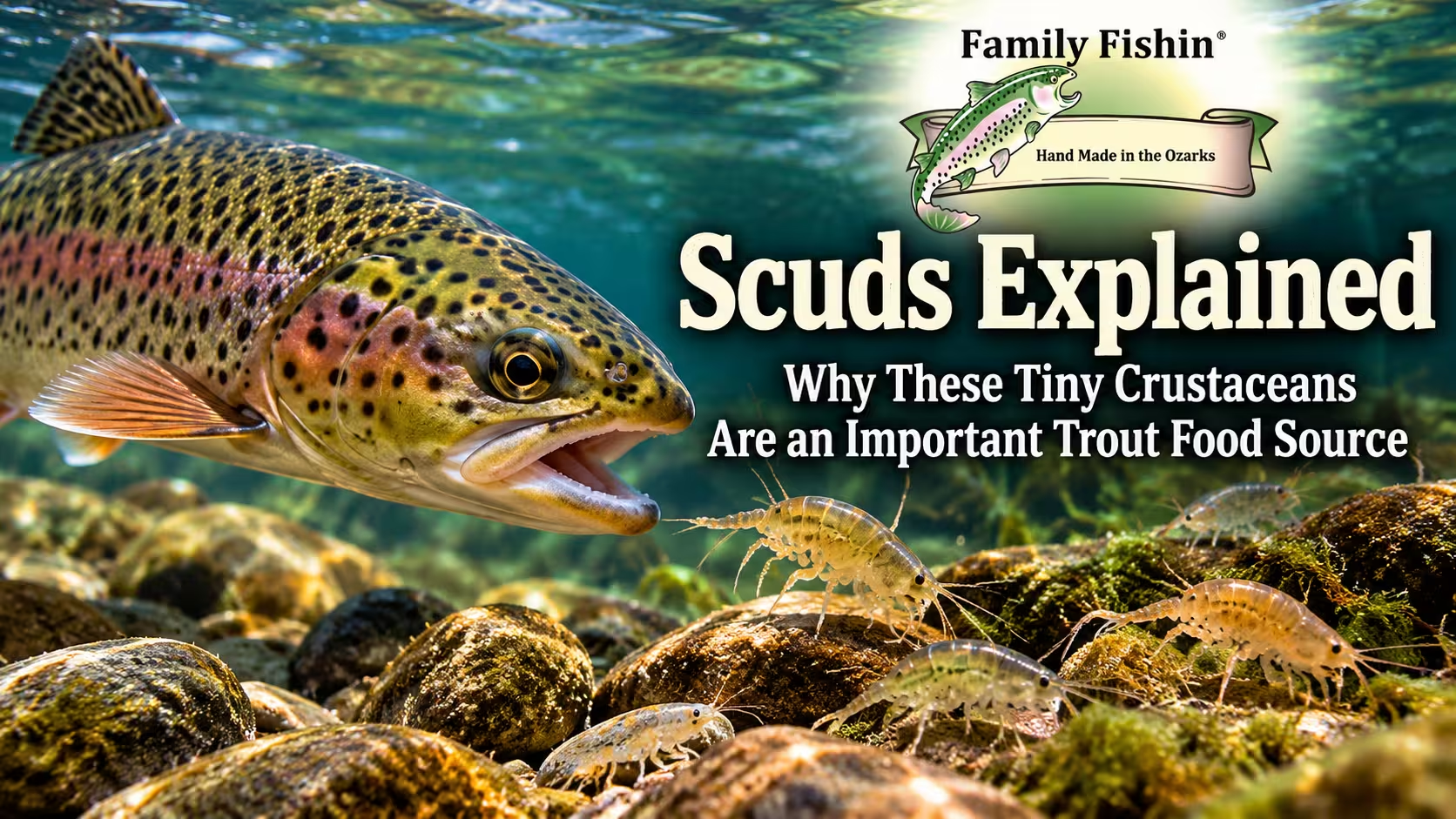
Scuds for trout can be an extremely important food source, even though aquatic insects usually receive much more attention from anglers. Mayflies, caddisflies, stoneflies, and midges receive enormous attention because their hatches can produce some of the most visible feeding activity on a trout stream.
But trout do not build their diet around insects alone.
In some waters, one of the most important trout foods is a small freshwater crustacean commonly called a scud.
Scuds can live in enormous numbers in productive lakes, spring-fed streams, tailwaters, ponds, and other waters containing the habitat they need. Unlike many aquatic insects, they do not need to hatch into a flying adult. They spend their entire lives in the water, which means they can provide trout with a relatively dependable food source throughout much—or sometimes all—of the year.
Their importance can be substantial.
In a study of brown and rainbow trout in a spring-fed Minnesota stream, Gammarus pseudolimnaeus accounted for approximately 75% of the brown trout diet and 60% of the rainbow trout diet by biomass during the study period. The trout also showed a preference for larger invertebrate prey.
That does not mean scuds make up that percentage of trout diets everywhere. Far from it. Scud abundance varies dramatically among waters.
But it demonstrates something important:
Where scuds are abundant, they can become a major part of the trout food web.
Understanding scuds therefore gives anglers another way to understand where trout position themselves, what they are looking for, and why certain presentations work even when there is no obvious insect hatch occurring.
What Is a Scud?
A scud is a small aquatic crustacean belonging to the order Amphipoda.
That distinction matters.
Scuds are sometimes casually grouped with aquatic insects because anglers encounter both as small invertebrates living underwater. Biologically, however, a scud is not an insect.
Scuds are crustaceans, making them distant relatives of animals such as shrimp, crabs, crayfish, and other crustaceans.
Trout also eat their much larger crustacean relatives. Crawfish offer trout a very different kind of crustacean meal, providing considerably more food per capture but requiring a different feeding strategy than tiny scuds.
This is also why anglers sometimes hear scuds called:
- freshwater shrimp
- sideswimmers
- amphipods
- freshwater amphipods
“Freshwater shrimp” is descriptive rather than a precise taxonomic name, but anyone who examines a scud closely can understand where the comparison comes from.
A scud typically has a laterally compressed body. Instead of being flattened from top to bottom, its body is compressed from side to side. It has multiple pairs of legs, segmented appendages, antennae, and a curved or arched body shape.
Many swim with a distinctive sideways or irregular movement, which helps explain the old name sideswimmer.
Two names anglers may encounter frequently in North America are Gammarus and Hyalella. These are not the only amphipods found in freshwater, and the species present varies by location and habitat.
For the trout angler, identifying the exact species usually matters less than answering a more practical question:
Does this water contain enough scuds for trout to regularly feed on them?
How Big Are Scuds?
Scud size varies by species, age, food availability, and environmental conditions.
Many of the scuds encountered by trout anglers are relatively small, but some Gammarus species can grow surprisingly large.
Sexually mature male Gammarus pseudolimnaeus can reach about 17 mm, with mature females reaching about 14 mm, although females may mature at considerably smaller sizes.
That puts larger individuals well within a size range that trout can exploit efficiently.
This is worth considering because trout feeding is not simply about eating the greatest number of prey organisms. Trout also respond to the energetic value of individual prey.
In the spring-fed stream study mentioned earlier, trout selected larger invertebrates, particularly prey measuring approximately 7.0–12.9 mm.
A productive scud population can therefore offer trout something valuable: small prey that may occur in large numbers but is still large enough to provide a worthwhile food reward.
Where Do Scuds Live?
Finding scuds begins with understanding their habitat.
They are not distributed evenly through every lake or stream.
Different amphipod species tolerate different conditions, but many thrive where they have some combination of:
- aquatic vegetation
- algae
- organic debris
- leaf litter
- rocks and gravel
- stable water conditions
- suitable dissolved oxygen
- food-rich bottom habitat
- protection from current and predators
Some species are strongly associated with vegetation.
Gammarus fasciatus, for example, occurs in lakes and rivers and can be particularly abundant in shallow, well-oxygenated areas with dense aquatic vegetation.
Hyalella azteca occupies a somewhat different range of conditions. It occurs in permanent lakes, ponds, and streams across much of the Americas and can reach extremely high densities in favorable habitat. It is commonly associated with productive waters capable of supporting aquatic plants.
Those numbers illustrate why scuds can become important forage.
One scud is a tiny meal.
Thousands of scuds living across a productive weed bed represent an entirely different food resource.
These same food-rich areas can support several other trout prey species. Leeches are another important trout food associated with vegetation, rocks, and slower bottom habitat, although their behavior and nutritional value differ considerably from scuds.
Why Spring Creeks Can Be Excellent Scud Water
Springs and spring-fed streams deserve special attention.
Groundwater can provide relatively stable water temperatures compared with streams that depend primarily on surface runoff. Springs may also contain the water chemistry and habitat needed by certain amphipods.
Gammarus pseudolimnaeus has a particular association with springs and cool-water streams across parts of its range.
The species is relatively common in springs in areas including east-central Missouri and northern Arkansas, as well as parts of Iowa and Illinois.
That regional connection is especially relevant to Ozarks trout fishing.
A spring-fed trout stream can combine several things trout need:
cold water, suitable oxygen, stable habitat, and a productive aquatic food web.
When amphipods become part of that food web, trout may have access to them for long periods rather than waiting for a short seasonal hatch.
The Ozarks Connection: Scuds and Trout
Scuds have an interesting history in Missouri trout water.
Research involving Gammarus pseudolimnaeus in the Table Rock Dam tailwater reported that the amphipod was introduced there in 1961 specifically to provide food for stocked trout.
That is a remarkable example of just how valuable amphipods can be considered within a trout food web.
The goal was not simply to add another organism to the river.
It was to increase the forage available to trout.
Historical fisheries information concerning Lake Taneycomo has also associated abundant Gammarus pseudolimnaeus with periods of exceptional rainbow trout growth, although trout growth in any fishery depends on many interacting factors rather than a single prey species.
For Ozarks anglers, scuds are therefore more than something encountered in distant western spring creeks.
They are part of the biological story of local trout fishing.
What Do Scuds Eat?
Understanding what scuds eat helps explain where they live.
Many freshwater amphipods feed on combinations of:
- decaying plant material
- algae
- microorganisms
- fungi
- fine organic material
- biofilms
- decomposing leaves and other detritus
Calling them simply “leaf eaters” misses an important part of the story.
A decomposing leaf underwater becomes colonized by fungi, bacteria, and other microorganisms. That microbial conditioning can substantially change its value as food.
Research on Gammarus has demonstrated the importance of microorganisms associated with decomposing plant material. Studies have found better survival or growth on conditioned leaves than on sterile or unconditioned material, emphasizing the connection between amphipods, microbes, and decomposing organic matter.
This creates an important food-web connection.
Leaves fall into a stream.
Algae grow.
Plants produce organic matter.
Microorganisms process that material.
Scuds consume portions of this organic and microbial production.
Trout eat the scuds.
Energy that began with plants, algae, and organic material is transferred upward through the aquatic food web.
A trout eating a scud is participating in a much larger ecological system.
Why Scuds for Trout Are an Important Food Source
From a trout’s perspective, food has to be worth obtaining.
Every feeding movement requires energy.
A trout may need to leave a holding position, accelerate, intercept an object, determine whether it is edible, capture it, and return to its position. In moving water, leaving a low-energy holding location may also expose the fish to stronger current.
The ideal prey therefore offers a useful combination of:
availability + capture probability + nutritional reward.
Scuds can satisfy all three.
They can occur in high densities.
They are large enough to represent meaningful prey.
They cannot fly away.
And currents, vegetation disturbance, changing flows, wave action, feeding fish, and normal scud movement can expose them to trout.
That makes them potentially efficient prey.
That same energy equation helps explain why trout sometimes shift toward larger prey. Minnows provide a much larger individual meal, particularly for larger trout, while scuds can compensate for their smaller size through abundance and ease of capture.
Scuds Are a Year-Round Aquatic Food
One of the biggest differences between scuds and many aquatic insects is their life cycle.
Mayflies, caddisflies, stoneflies, and midges eventually undergo transformations associated with emergence. Their aquatic stages may be abundant for long periods, but the famous feeding events anglers notice are often tied to particular hatches.
Scuds remain aquatic.
They reproduce, grow, feed, and die underwater.
For some amphipod populations, reproduction can occur over extended periods. Egg-bearing females of some species have been collected during every season, demonstrating that continuous reproduction can occur in suitable environments.
That does not mean scud abundance remains exactly the same throughout the year.
Population density, individual size, reproduction, water temperature, vegetation, dissolved oxygen, flows, and food availability can all change.
But trout do not need a “scud hatch” before scuds become available.
If the habitat supports them, the food source is already in the water.
Scuds are only one part of that changing food supply. As water temperature, insect activity, forage availability, and trout metabolism change throughout the year, the relative importance of different foods changes too. Our Trout Diet by Season: What Trout Eat From Winter to Fall guide explains how those seasonal changes affect the larger trout diet.
How Trout Encounter Scuds
Most scuds are closely associated with structure rather than spending all their time drifting through open water.
They may crawl and swim through:
- weed beds
- algae
- rocks
- gravel
- leaf litter
- woody debris
- bottom vegetation
- organic material
For a trout to eat one, the scud has to become accessible.
That can happen several ways.
Natural Movement
Scuds move while feeding, mating, changing locations, or responding to their environment.
A trout working slowly along productive bottom habitat may simply pick off exposed individuals.
Current
In streams, an amphipod that loses its grip or leaves cover can enter the current.
Once it does, the current can carry it directly toward a waiting trout.
This is the same fundamental advantage trout exploit when feeding on drifting aquatic insects: the water delivers food.
Vegetation Disturbance
Current, waves, animals, anglers, feeding fish, or changing water levels can disturb vegetation.
When that happens, organisms hiding inside the vegetation can become exposed.
Flow Changes
Tailwaters add another variable.
Generation changes can alter current velocity, depth, available habitat, and the amount of bottom material being disturbed. Changes in flow can therefore change when and where aquatic invertebrates become available.
The exact response depends on the individual river, but the general principle remains:
Anything that moves scuds out of protective habitat can increase their vulnerability to trout.
Why Weed Beds Matter
A thick weed bed is more than underwater vegetation.
It is habitat.
Plants dramatically increase the amount of usable surface area available to small aquatic organisms. Their stems and leaves collect algae, microorganisms, detritus, and other potential food.
Vegetation also provides protection.
For a scud, the spaces between leaves and stems can make it more difficult for a trout to capture it.
For a trout, however, that same weed bed can function almost like a grocery store.
The important feeding zones are often not simply “in the weeds.”
Pay attention to edges and transitions:
- the outside edge of a weed bed
- open pockets within vegetation
- channels through vegetation
- the downstream edge of plants
- transitions between gravel and weeds
- changes from shallow vegetation to deeper water
- current lanes beside submerged plants
These locations can concentrate prey while still allowing trout enough room to feed efficiently.
This is a recurring principle in trout behavior:
The best feeding location is often where food-rich habitat meets an efficient interception point.
Scuds in Lakes and Stillwaters
Scuds are not limited to streams.
Productive lakes and ponds can support very large amphipod populations, particularly where aquatic vegetation provides food and habitat.
In stillwater, there is no continuous downstream conveyor belt delivering prey to trout. Trout may instead cruise along weed edges, shoals, drop-offs, and other productive zones searching for exposed food.
That changes the feeding strategy.
A stream trout may hold in one position and allow current to bring prey.
A lake trout may need to move through the feeding area.
This means finding the food-producing habitat becomes especially important.
If scuds are concentrated around vegetation, fishing featureless open water may put a lure or fly away from the primary food source.
Find the habitat first.
Then look for the trout using it.
Scud Color: Why There Is No Single Correct Color
Ask an angler what color a scud is and you may hear:
Olive.
Tan.
Gray.
Brown.
Green.
Orange.
The confusing part is that all of those answers can be correct.
Scud coloration varies.
Species matters, but so do diet, habitat, age, maturity, the material visible through the body, and other biological conditions.
Many amphipods can appear somewhat translucent. That means internal structures and recently consumed food may contribute to their apparent coloration.
Diet can matter as well. Carotenoid pigments found in plants, algae, fungi, and microorganisms can enter amphipods through their food.
For the angler, the practical lesson is simple:
Do not assume the scuds in your water match the color printed on a package.
Look at the actual organisms.
Turn over rocks.
Inspect vegetation.
Scoop some aquatic plants into a light-colored container filled with water and watch what crawls or swims out.
You may discover that the dominant scuds are olive-green, gray, tan, cream, brownish, or some combination of colors.
Local observation beats assumption.
Why Some Scuds Appear Orange
Orange scuds deserve special mention because anglers frequently encounter orange scud patterns.
The simple explanation that “all dead scuds turn orange” is too broad.
Color in amphipods can be influenced by pigments, diet, physiological condition, maturity, internal tissues, and decomposition. Carotenoid pigments can produce orange-to-red coloration in crustaceans and are obtained through diet rather than manufactured by the amphipod itself.
The important fishing lesson is not that orange is always correct or always wrong.
It is that natural scud color is variable.
An orange imitation may work extremely well under certain conditions, but anglers should not assume orange represents every living scud in every water.
Again, inspect the local population whenever possible.
Scuds and Water Quality
Scud populations can also tell us something about habitat.
Different amphipod species have different tolerances for temperature, oxygen, pollution, water chemistry, and other environmental conditions.
Some species thrive in shallow, well-oxygenated habitat with abundant aquatic vegetation.
Dissolved oxygen can be particularly important in tailwaters.
Research involving Gammarus pseudolimnaeus below Table Rock Dam examined how low dissolved oxygen affected the species and found physiological and behavioral effects as oxygen declined.
This creates another connection between trout habitat and trout food.
Water quality does not affect only the trout.
It affects the organisms trout depend upon.
A river could theoretically remain cool enough for trout while changes in oxygen, sediment, vegetation, pollution, or habitat reduce important invertebrate populations.
Understanding trout therefore requires understanding the ecosystem supporting them.
Scuds and Trout Growth
It is tempting to say that abundant scuds automatically produce large trout.
The relationship is not that simple.
Trout growth depends on many factors, including:
- total food availability
- food quality
- water temperature
- dissolved oxygen
- competition
- trout density
- genetics
- spawning demands
- disease and parasites
- habitat
- fishing mortality
- age
However, abundant forage certainly helps create the conditions necessary for growth.
A trout cannot convert food into body mass if the food does not exist.
A productive amphipod population can represent a substantial supply of available animal biomass.
The spring-stream study showing Gammarus pseudolimnaeus making up approximately 75% of brown trout diet biomass and 60% of rainbow trout diet biomass demonstrates how heavily trout can use this resource when conditions allow it.
Scuds are small.
Their ecological contribution does not have to be.
Do Rainbow Trout Eat Scuds?
Yes.
Rainbow trout are opportunistic feeders and readily consume amphipods where they are available.
The spring-fed stream study found Gammarus pseudolimnaeus represented about 60% of rainbow trout diet biomass during the study.
The amount eaten depends on availability.
A rainbow trout cannot specialize on scuds in water where scuds are rare or absent.
Where amphipods are abundant, however, rainbows can make extensive use of them.
Do Brown Trout Eat Scuds?
Yes.
Brown trout are famous for becoming increasingly piscivorous as they grow, but that does not mean larger browns abandon aquatic invertebrates.
Their feeding behavior is flexible.
Where scuds offer an efficient food source, brown trout can consume them heavily.
In the spring-fed stream study, Gammarus pseudolimnaeus represented approximately 75% of brown trout diet biomass during the study period.
That is an important reminder not to assume that every good brown trout must be hunting minnows.
The fish will use the food resources available to it.
Do Cutthroat Trout Eat Scuds?
Yes.
Research from Yellowstone Lake has documented amphipods as an important component of Yellowstone cutthroat trout feeding ecology.
Again, availability determines importance.
Scuds are not equally important in every cutthroat trout water, but where amphipods are abundant they can become significant prey.
When Should Anglers Think About Scuds?
You should begin thinking seriously about scuds when several clues occur together.
You Are Fishing Spring-Fed Water
Many Gammarus populations thrive in springs and spring-fed streams.
There Is Abundant Submerged Vegetation
Vegetation provides both habitat and food-producing surfaces.
The Stream or Lake Has Productive, Relatively Stable Water
Scuds can become extremely abundant where conditions remain favorable.
Trout Are Feeding Near the Bottom Without an Obvious Hatch
The fish may be eating amphipods, midge larvae, caddis larvae, snails, worms, or other benthic organisms.
You Find Scuds Yourself
This is the strongest clue of all.
Do not guess when you can look.
How to Check a Trout Stream for Scuds
You do not need sophisticated sampling equipment.
Start with a shallow area containing submerged vegetation, rocks, leaf litter, or other likely habitat.
Carefully lift some vegetation and inspect it.
Place a small amount in a white or light-colored container filled with stream water.
Wait.
Tiny organisms that were almost invisible against the vegetation will begin moving.
You can also carefully lift rocks and inspect their undersides and the surrounding material.
Do not unnecessarily tear apart habitat, and return rocks and vegetation as close as possible to their original position.
If scuds are present, pay attention to:
- approximate size
- color
- abundance
- habitat
- depth
- amount of current
- vegetation type
Those observations can tell you far more than simply knowing that “scuds live here.”
You are learning what the trout actually see.
How Scud Biology Should Influence Presentation
Understanding the natural animal gives anglers clues about presentation.
Scuds are not baitfish.
They do not normally make long, high-speed runs through open water.
They crawl, swim in short movements, hold around structure, and can be displaced into current.
That suggests several presentation principles.
Stay Near the Food-Producing Zone
If the scuds are living near the bottom and in vegetation, an imitation several feet above them may not represent the natural food source particularly well.
Get the presentation into the zone where trout encounter scuds.
Avoid Excessive Speed
A scud imitation generally does not need to race through the water.
Small movements, short pulses, natural drift, and occasional movement can better represent small crustacean prey.
Use Current When Fishing Streams
If natural scuds are being displaced and drifting downstream, allowing an imitation to move naturally with the current can be extremely effective.
Fish Edges
Weed edges, current seams, bottom transitions, and pockets provide trout with opportunities to intercept exposed prey.
Understanding where the food comes from is often more useful than obsessing over a specific lure or fly pattern.
Scuds Versus Sowbugs
Scuds and sowbugs are frequently confused.
Both are small aquatic crustaceans, and both can occur in trout water.
But they are different animals.
Scuds belong to Amphipoda.
Aquatic sowbugs belong to Isopoda.
A scud is generally compressed from side to side.
A sowbug is flattened more from top to bottom and often resembles the terrestrial pill bugs or sowbugs people find beneath rocks and logs.
Their movement is also different.
Scuds can swim actively.
Aquatic sowbugs are generally more closely associated with crawling along the bottom and through debris.
For anglers, both can be valuable trout food, but distinguishing them improves your understanding of what trout are actually eating.
Scuds Versus Mysis Shrimp
Scuds are also sometimes confused with mysis shrimp.
They are not the same animal.
Both are crustaceans, but they belong to different taxonomic groups and have different body forms and ecological roles.
Mysis often look more like what most people picture when they hear the word “shrimp.”
Scuds have the characteristic laterally compressed amphipod body.
This distinction matters when trying to understand a particular fishery.
A lake known for mysis is not automatically a “scud lake,” and a stream full of Gammarus is not necessarily supporting mysis.
Identify the food source before trying to imitate it.
Why Scuds Matter Even If You Never Fish a Scud Pattern
The biggest lesson from scuds has little to do with choosing a particular fly.
It is about understanding trout.
Scuds demonstrate that trout feeding is built around energy and opportunity.
A trout does not care whether anglers consider a food source famous.
It cares whether that food is available and worth eating.
That principle applies to nearly every trout food source.
When scuds are abundant, trout use them.
When minnows become abundant and vulnerable, trout eat minnows.
During an insect emergence, trout may switch toward the insects.
When terrestrial insects begin falling into the water, trout can take advantage of them.
The food supply changes, and trout behavior changes with it.
Good trout fishing therefore begins before choosing a lure.
It begins by asking:
What food is available here right now, where is it located, and how are trout likely encountering it?
Scuds are an excellent example of why that question matters.
The Bottom Line
Scuds may be tiny, but they can occupy a major position in a trout food web.
They are freshwater amphipod crustaceans that can thrive in productive lakes, spring creeks, tailwaters, ponds, and streams. They frequently live around vegetation, organic debris, rocks, algae, and other bottom habitat.
Most importantly, they remain underwater.
There is no brief scud hatch that an angler must wait for.
Where the habitat supports a healthy population, scuds can provide trout with a dependable supply of animal prey across long periods of the year.
Scientific studies demonstrate just how important that food source can become. In one spring-fed stream, Gammarus pseudolimnaeus represented roughly three-quarters of brown trout diet biomass and more than half of rainbow trout diet biomass during the study.
Here in the Ozarks, the connection is especially interesting. Gammarus pseudolimnaeus occurs naturally in springs across parts of Missouri and Arkansas, and the species was historically introduced below Table Rock Dam specifically as trout forage.
But the most useful lesson is broader than any one species or river.
Find the food and you are one step closer to finding the trout.
Scuds are only one part of that food web. Depending on the water and season, trout may shift among aquatic insects, crustaceans, worms, leeches, minnows, crawfish, and other available prey. Understanding those changes is the reason we built our Trout Diet by Season: What Trout Eat From Winter to Fall guide.
Look beneath the surface.
Examine the vegetation.
Turn over a rock.
Watch what is living along the bottom.
The small crustacean crawling through those weeds may explain far more about the trout in front of you than anything happening on the surface.
Frequently Asked Questions About Scuds and Trout
What is a scud?
A scud is a small freshwater crustacean belonging to the order Amphipoda. Scuds are often called freshwater shrimp or sideswimmers, although they are amphipods rather than true shrimp. Common freshwater groups include Gammarus and Hyalella.
Are scuds insects?
No. Scuds are crustaceans, not insects. They are more closely related to other crustaceans than to mayflies, caddisflies, stoneflies, or midges.
Do trout eat scuds?
Yes. Rainbow trout, brown trout, cutthroat trout, and other salmonids can consume scuds. Their importance depends primarily on how abundant amphipods are in the particular water.
Are scuds an important trout food?
They can be extremely important. In one spring-fed stream study, Gammarus pseudolimnaeus accounted for approximately 75% of brown trout diet biomass and 60% of rainbow trout diet biomass during the study period.
That does not mean scuds make up the same percentage everywhere. Their importance varies greatly among waters.
Where do scuds live?
Scuds can live in lakes, ponds, rivers, streams, springs, spring creeks, and tailwaters. Depending on species, they are often associated with aquatic vegetation, algae, rocks, gravel, leaf litter, organic debris, and other bottom habitat.
Do scuds live in Missouri trout streams?
Yes. Gammarus pseudolimnaeus is associated with springs in portions of Missouri and northern Arkansas. The species was also introduced into the Table Rock Dam tailwater in 1961 as forage for stocked trout.
Are there scuds in Lake Taneycomo?
Gammarus pseudolimnaeus has an established historical connection with the Table Rock Dam/Lake Taneycomo trout fishery and was introduced below the dam as trout forage.
Scud populations, like other aquatic invertebrate populations, can change substantially over time as habitat and environmental conditions change.
What color are scuds?
Scuds can appear olive, greenish, gray, tan, brown, cream, translucent, orange, or combinations of those colors. Species, diet, habitat, maturity, internal tissues, and physiological condition can influence appearance.
The best way to determine the appropriate color is to examine scuds from the water you are fishing.
Why are some scuds orange?
Orange or reddish coloration can be influenced by carotenoid pigments obtained through diet, as well as other biological and physiological factors.
It is too simplistic to assume every orange scud is merely a dead scud.
How large are scuds?
Size varies considerably. Gammarus pseudolimnaeus, for example, can reach more than 10 mm, with mature males reported up to about 17 mm. Many scuds encountered by trout are smaller.
What do scuds eat?
Depending on species and habitat, scuds consume algae, microorganisms, fungi, decomposing vegetation, fine organic material, and other detritus. Microorganisms growing on decomposing plant material can be particularly important to some Gammarus species.
Do scuds hatch?
Not in the sense anglers use the word when discussing mayflies or caddisflies.
Scuds spend their entire lives in the water and do not emerge into winged terrestrial adults.
That is one reason they can provide trout with a dependable food source.
Are scuds available to trout during winter?
Yes, they can be.
Scuds remain aquatic year-round, although their abundance, activity, reproduction, and availability can vary with environmental conditions.
When is the best time to fish a scud imitation?
A scud imitation can be useful whenever trout are feeding on scuds.
Rather than choosing a date on a calendar, look for evidence: abundant aquatic vegetation, spring-fed water, scuds under rocks or among plants, and trout feeding close to productive bottom habitat.
Should a scud imitation be fished near the bottom?
Often, yes.
Scuds frequently live around bottom structure and vegetation. Presentations near those habitats can therefore represent the natural food source well.
However, scuds can also enter the drift in moving water, so the correct depth depends on how trout are encountering them.
Do scuds swim?
Yes.
Scuds can crawl and swim. Their laterally compressed body and swimming behavior contribute to the common name “sideswimmer.”
Are scuds the same as sowbugs?
No.
Scuds are amphipods. Aquatic sowbugs are isopods.
Scuds are generally compressed from side to side and can swim actively, while sowbugs are more flattened from top to bottom and commonly crawl along substrate and debris.
Are scuds the same as freshwater shrimp?
“Freshwater shrimp” is a common angling nickname for scuds, but it is not taxonomically precise.
Scuds are amphipods.
Are scuds the same as mysis shrimp?
No.
Scuds and mysis are different groups of crustaceans. Both can be important fish food, but their body forms, habitats, and behavior differ.
Can scuds help trout grow?
Abundant scuds can contribute substantially to the forage available to trout.
Trout growth, however, depends on the entire ecosystem, including total food availability, temperature, oxygen, fish density, competition, genetics, age, and other factors.
Scuds should therefore be viewed as one potentially important component of the trout food web rather than a guarantee of large trout.
How can I tell whether my trout stream has scuds?
Inspect submerged vegetation, rocks, leaf litter, and other likely habitat.
Placing vegetation into a light-colored container filled with stream water can make small aquatic organisms much easier to see.
If scuds are present, record their size, color, abundance, and the habitat where you found them.
Why should trout anglers learn about scuds?
Because understanding trout food helps explain trout behavior.
Scuds can reveal why trout concentrate near weed beds, why fish continue feeding when there is no visible hatch, why bottom presentations work in certain waters, and why some spring-fed fisheries can support highly productive trout populations.
Understanding what trout eat is ultimately about understanding where trout are likely to be and what they are trying to accomplish when they feed.