Bullhead vs Catfish: What’s the Difference? Complete Species Guide, Identification, Biology & Records
Deep dive: bullhead vs catfish, complete species guide with biology, records, venom, and identification
Catfish
The complete breakdown — taxonomy, species, biology, records, venom, habitat, diet, and how to tell them apart in the dark.
Order: Siluriformes Family: Ictaluridae Sources: USGS, Smithsonian, MN DNR,
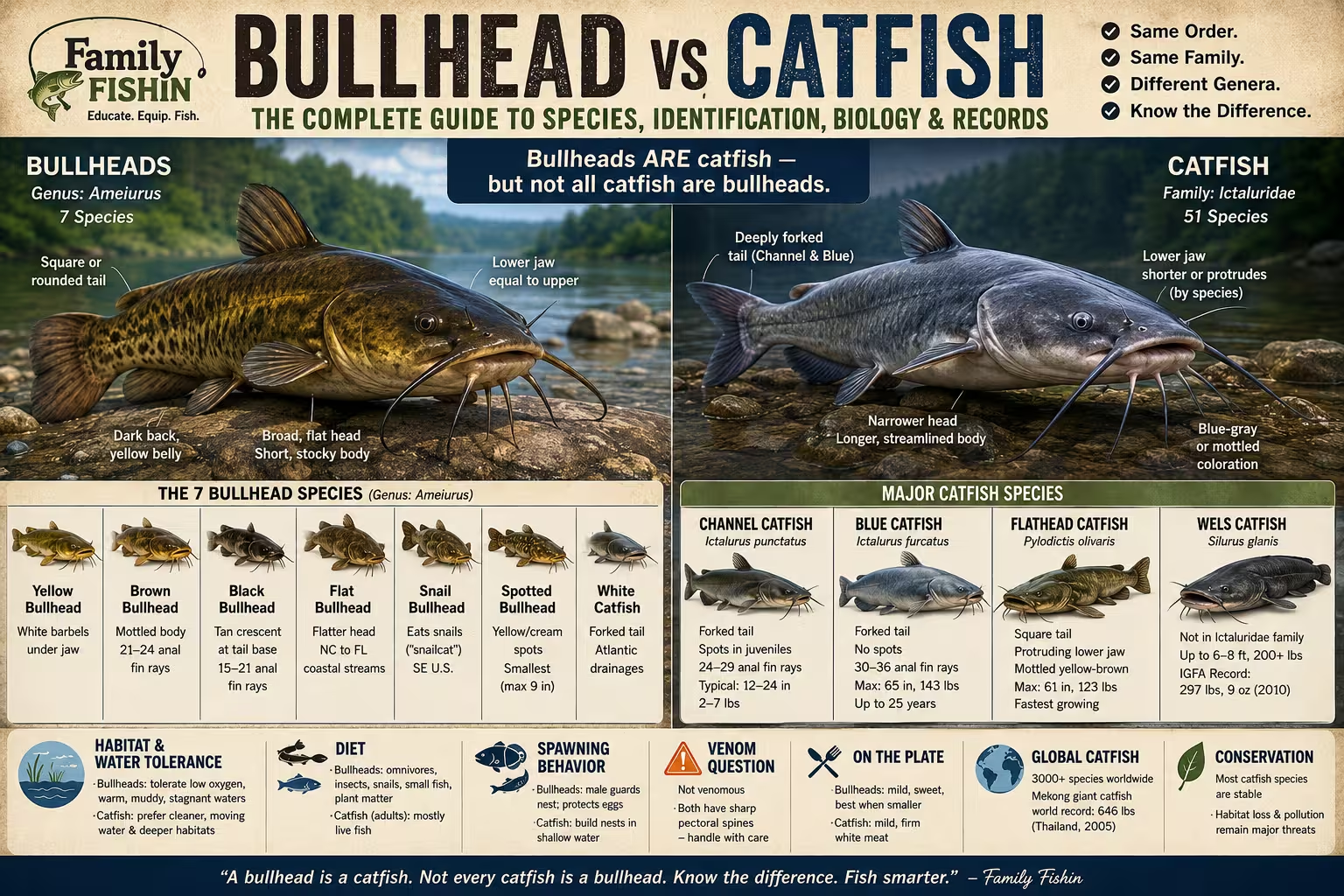
Most people use “bullhead” and “catfish” interchangeably. That’s wrong. A bullhead IS a catfish — but not all catfish are bullheads. Here’s every difference that matters, species by species, fact by fact.
What’s inside
- The taxonomy — what they actually are
- All 7 bullhead species
- The major catfish species
- World records by species
- Physical ID guide
- Habitat & water tolerance
- Diet differences
- Spawning behavior
- The venom question
- On the plate
- Global catfish — how big it gets
- Conservation status
01 — The Taxonomy
Both bullheads and the catfish most anglers target belong to order Siluriformes — the global catfish order. Within that order, North American species belong to family Ictaluridae. The family contains 51 species total. Bullheads are in genus Ameiurus. Channel and blue catfish are in genus Ictalurus. Flatheads are in their own genus: Pylodictis. Same family, different genera — that’s the relationship.
“Bullhead is to catfish what a terrier is to dog. A terrier is a dog. Not every dog is a terrier.”
02 — Bullhead vs Catfish: Species Comparison
There are 7 recognized bullhead species in genus Ameiurus. Most people only know 3. Here’s the full picture:
Yellow Bullhead
Ameiurus natalis
ID tellWhite barbels under jaw
Max size~18 in, 4 lbs
TailRounded
RangeEast of Rockies
Brown Bullhead
Ameiurus nebulosus
ID tellDark barbels, mottled body
Anal fin rays21–24
TailSquare
RangeEast of Rockies
Black Bullhead
Ameiurus melas
ID tellTan crescent at tail base
Anal fin rays15–21
Max size~15 in, 1.8 kg
RangeMississippi valley
Flat Bullhead
Ameiurus platycephalus
ID tellFlatter head profile
RangeNC to Florida coastal streams
StatusNative; less common
TailSquare
Snail Bullhead
Ameiurus brunneus
Max size11–18 in (reservoirs)
RangeSE United States
ThreatInvasive flatheads
DietSnails (vernacular: “snailcat”)
Spotted Bullhead
Ameiurus serracanthus
ID tellYellow/cream spots on body
Max size9 in (smallest species)
SpineStrongly serrated, 6–20 serrae
RangeFL, AL, GA
White Catfish
Ameiurus catus
NoteOften grouped with bullheads
TailSlightly forked (distinguishes it)
RangeAtlantic coast drainages
Max size~22 in, 8 lbs
Quick ID: Black vs. Brown vs. Yellow Bullhead
Yellow bullhead = white barbels under the lower jaw. Black bullhead = dark barbels + tan crescent at tail base + uniform dark coloring. Brown bullhead = dark barbels + mottled brown-green pattern + slightly higher anal fin ray count (21–24 vs. 15–21). These are the three diagnostic tells.
03 — The Major Catfish Species
Channel Catfish
Ictalurus punctatus
TailDeeply forked
SpotsPresent in juveniles; fade in adults
MouthSubterminal, narrow
Anal fin rays24–29
Typical size12–24 in, 2–7 lbs
Lifespan15–24 yrs; oldest on record: 40 yrs (Canada)
ColorBlue-gray back, silvery-white belly
Unique factOnly spotted N. American catfish with forked tail
Blue Catfish
Ictalurus furcatus
TailDeeply forked
Lower jawDoes NOT protrude
ColorUniform blue-gray, no spots
Typical size20–60 lbs common
Max length65 inches
LifespanUp to 25 years
Unique factLargest catfish species in N. America
Anal fin rays30–36 (higher than channel cat)
Flathead Catfish
Pylodictis olivaris
TailSquared — like a bullhead’s
Lower jawProtrudes forward (underbite)
ColorMottled yellow-brown
Typical size10–40 lbs; can exceed 100 lbs
LifespanUp to 28 years
Growth rateFastest of any N. American gamefish (ages 3–8)
DietAdults eat live fish ONLY
VenomNot venomous
Wels Catfish
Silurus glanis
FamilySiluridae (not Ictaluridae)
Typical size (modern)Up to 6–8 ft, 200+ lbs
IGFA record297 lbs, 9 oz (Italy, 2010)
RangeEurasia; invasive in W. Europe
NoteHistorically reported to 4.6 m (15 ft)
04 — World Records by Species
Blue Catfish
143 lbs
Kerr Lake, VA/NC border, 2011. 57 inches long.
Flathead Catfish
123 lbs
Elk City Reservoir, Kansas, 1998. 61 inches.
Channel Catfish
58 lbs
Santee-Cooper Reservoir, SC, 1964. Still stands.
Mekong Giant
646 lbs
Thailand, 2005. Guinness World Record: largest freshwater fish ever recorded.
No official IGFA world record exists for bullheads because they are rarely targeted as trophy fish. Black bullheads reach a documented maximum of about 47.8 cm and 1.8 kg (USGS).
05 — Physical ID Guide
| Feature | Bullhead (Ameiurus) | Channel/Blue Catfish | Flathead Catfish |
| Tail | Square to rounded | Deeply forked | Square/slightly notched |
| Lower jaw | Roughly equal to upper | Slightly shorter than upper | Protrudes forward (underbite) |
| Head shape | Broad, flat, wide | Narrower, tapered | Very flat, wide |
| Body build | Short, stocky | Long, streamlined | Long, flattened |
| Spots | None | Channel cat: yes (juveniles) | Mottled, not spots |
| Max size | ~18 in, ~4 lbs | Blue: 65 in, 143 lbs | 61 in, 123 lbs |
| Coloring | Dark brown back, yellow belly | Blue-gray back, white belly | Mottled yellow-brown |
| Scales | None | None | None |
The one exception that trips people up
Flathead catfish have a squared tail just like bullheads. The size difference is usually obvious — but on a juvenile flathead, check the jaw: flatheads have a protruding lower jaw. Bullheads do not. Also check color: flatheads are mottled yellow-brown; bullheads are darker with a yellow belly.
06 — Habitat & Water Tolerance
Bullheads
Stagnant ponds, slow rivers, muddy bottoms. Tolerant of low-oxygen, high-CO₂, acidic, and brackish water. Black bullheads are “incredibly hardy” per fisheries biologists — dominant in warm, eutrophic waters where other species winter-kill. They can gulp air at the surface if oxygen runs out. They can absorb limited oxygen through their skin. Non-migratory. Stay in fixed territory.
Channel & Blue Catfish
Prefer cleaner, moving water — rivers, large lakes, faster currents. Channel cats are found across the widest range: Montana and Wyoming east to the Atlantic, south into northern Mexico. Blue catfish are the apex predator in large river systems. Both can be stocked in still-water lakes but grow faster in rivers. Neither tolerates the oxygen-poor water bullheads routinely inhabit.
Flathead Catfish
Prefers large rivers with deep pools and woody cover. Heavily associated with log piles, undercut banks, and bridge structures in fast-moving reaches. Increasingly invasive outside its native range.
Wels Catfish (Europe)
Native to Eurasia, now most common in Italy, France, and Spain as an invasive species. Inhabits large slow-moving rivers and reservoirs. The largest specimens are now more common outside its native range than within it.
07 — Diet Differences
All species are primarily nocturnal feeders. All use barbels loaded with taste receptors to locate food — channel catfish also have taste receptors distributed across their entire body surface. The differences are in what they target.
| Species | Primary diet | Notable detail |
| Bullheads | Insects, larvae, crayfish, snails, clams, aquatic plants, fish eggs | Less carnivorous than channel cats; more omnivorous and opportunistic |
| Channel Catfish | Insects, crayfish, snails, algae, seeds, small fish | Fish become up to 75% of diet in adults over 18 inches. Birds documented eaten. |
| Blue Catfish | Fish, crustaceans, mussels | Apex predator in large rivers; targets larger prey as they grow |
| Flathead Catfish | Live fish almost exclusively in adults | Most restricted diet of any catfish. Will not take pellets — channel cats will. This is why flatheads aren’t commercially farmed. |
08 — Spawning
All North American Ictaluridae spawn in late spring to early summer. Both parents guard the nest. The methods differ significantly:
| Species | Nest type | Location |
| Bullheads | Saucer-shaped depression | Gravelly or sandy river/stream bottom |
| Channel Catfish | Tunnel / excavated cavity | Under logs, embankments, rock crevices |
| Flathead Catfish | Cavity in hollow logs or rootwads | Deep, heavily sheltered structure |
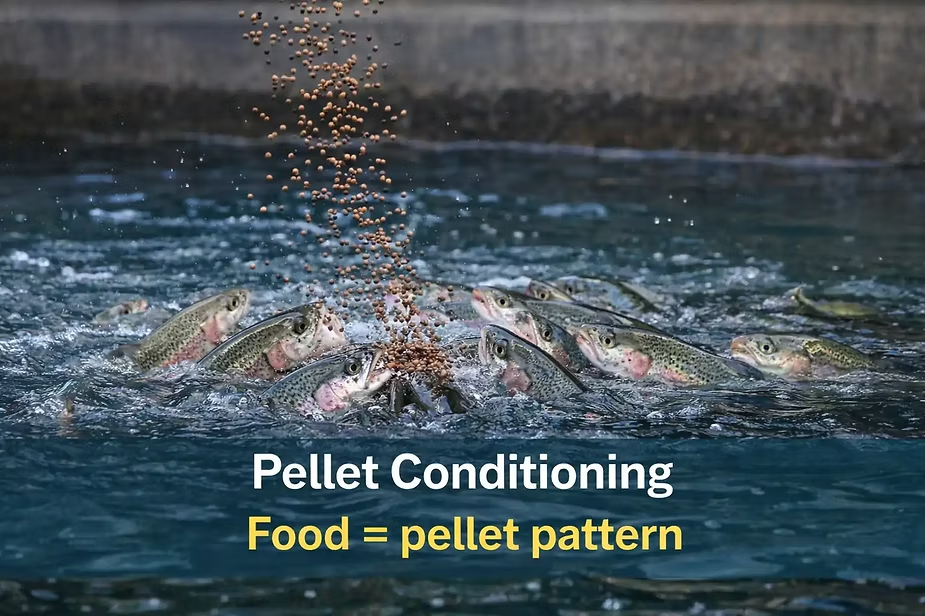
Channel cats are easier to raise in hatcheries than flatheads. They thrive on pellets. The DNR (Minnesota) raises approximately 30,000 yearling channel cats annually for stocking. Flathead hatchery production is minimal by comparison.
09 — The Venom Question
This is the most misunderstood thing about both fish. The barbels do not sting. That is a myth. The spines do.
All Ictaluridae have three spines: one at the leading edge of the dorsal fin and one on each pectoral fin. These can be locked into place when the fish is threatened. When a spine punctures skin, venom glands in the surrounding membrane tear open, releasing toxin directly into the wound.
Venomous species in North America
Brown bullhead, channel catfish, blue catfish, and white catfish are venomous. Flathead catfish are NOT — once they reach large size, they have no natural predators and lost the need for chemical defense. Bullhead venom causes localized pain and swelling. Madtom catfish (genus Noturus) — small, often overlooked — have the most potent venom in North American freshwater catfish.
The venom contains hemolytic, dermonecrotic, inflammatory, and vasoconstrictive toxins depending on species. The real danger from North American species isn’t the initial venom — it’s secondary bacterial and fungal infections introduced through the puncture, which can persist for months. Serrated spines (especially on spotted bullheads) can break off inside the wound and require surgical removal.
“Bullheads occasionally sting each other and may have developed natural resistance. The science on this is not confirmed.”
10 — On the Plate
| Species | Flavor | Commercial value | Notes |
| Channel Catfish | Mild, firm, white flesh | Highest — dominant U.S. farm-raised fish | Most widely available in restaurants |
| Blue Catfish | Mild to slightly sweet | Growing commercial market | Invasive in some East Coast waters; actively harvested to control population |
| Flathead Catfish | Firmer, slightly sweeter | Limited commercial production | Preferred by dedicated catfish anglers for taste |
| Bullheads | Edible, slightly stronger flavor | Minimal | Smaller fillets; best pan-fried; popular in the Northeast |
All Ictaluridae are scaleless — no descaling required. None have intramuscular bones in the fillet. Both factors make them straightforward to clean and cook.
11 — Global Catfish: How Big It Gets
Once you leave North American Ictaluridae, the scale changes dramatically. Siluriformes is a global order with thousands of species across every continent except Antarctica.
Mekong Giant Catfish
646 lbs
Thailand, 2005. Guinness World Record for largest freshwater fish ever recorded. Up to 3m (10 ft) long.
Wels Catfish
297 lbs 9 oz
IGFA all-tackle record. River Po, Italy, 2010. Historical reports claim 4.6 m (15 ft) specimens.
Piraíba (Amazon)
~330 lbs
South American giant catfish. Brachyplatystoma filamentosum. One of the world’s three largest catfish species.
Redtail Catfish
123 lbs 7 oz
Amazon River, 2010. IGFA all-tackle record. Recognizable by red-orange fins.
The Mekong giant catfish (Pangasianodon gigas) is critically endangered per the IUCN. Population has declined an estimated 90% in a decade. It is listed in Annex 1 of CITES — illegal to fish, trade, or transport. Unlike most catfish, adult Mekong giants are toothless and feed almost entirely on algae and phytoplankton.
12 — Conservation Status
| Species | IUCN Status | Trend |
| All Ameiurus bullheads | Least Concern | Stable; abundant |
| Channel Catfish | Least Concern | Most numerous catfish in N. America |
| Blue Catfish | Least Concern (native range) | Invasive and expanding in Atlantic drainages |
| Flathead Catfish | Least Concern (native range) | Invasive pressure on other species (incl. snail bullhead) |
| Snail Bullhead | Least Concern — but declining | Threatened by invasive flathead catfish |
| Mekong Giant Catfish | Critically Endangered | ~90% population decline in last decade |
The Final Verdict
Bullheads and catfish are family — literally. The separation is genus and size, not a different type of fish. Bullheads (Ameiurus) are compact, hardy, pollution-tolerant, and stay small. The catfish most anglers mean — channel, blue, flathead — are larger, faster-growing, prefer cleaner water, and are more carnivorous as adults. The tail is still the fastest field ID: square = bullhead or flathead, forked = channel or blue. To tell a flathead from a bullhead, check the jaw. Flathead protrudes. Bullhead does not. That’s it.
Sources: USGS Nonindigenous Aquatic Species Database · Minnesota DNR Biology Guide · Smithsonian National Zoo · The Fish Site (SRAC) · Wired2Fish Channel Catfish Species Guide · Britannica · NC Wildlife Resources Commission · West Virginia DNR · LiveScience / BMC Evolutionary Biology (Wright, 2009) · IGFA World Records · WWF Mekong Giant Catfish · Guinness World Records
Bullhead vs Catfish Frequently Asked Questions
Question: What is the difference between a bullhead and a catfish?
Answer: Bullheads are a type of catfish, but not all catfish are bullheads. Bullheads belong to the genus Ameiurus, while channel catfish belong to Ictalurus and flathead catfish belong to Pylodictis. Bullheads are generally smaller, have broader heads, rounded or square tails, and tolerate low-oxygen water better than most other North American catfish.
Question: Are bullheads considered catfish?
Answer: Yes. Every bullhead is a catfish because all bullheads belong to the catfish family (Ictaluridae). The confusion comes from anglers often using the term “catfish” to describe only larger species such as channel, blue, and flathead catfish.
Question: How can you identify a bullhead?
Answer: Bullheads can usually be identified by their broad, flattened heads, rounded or square tails, compact bodies, and whisker-like barbels. Unlike channel and blue catfish, bullheads do not have a deeply forked tail. Different bullhead species can also be identified by barbels, body coloration, and fin ray counts.
Question: How do you tell a bullhead from a flathead catfish?
Answer: Both species have square tails, but flathead catfish have a noticeably protruding lower jaw, grow much larger, and have a more elongated body. Bullheads have a shorter, stockier body with upper and lower jaws that are nearly equal in length.
Question: Which catfish species grow the largest?
Answer: In North America, blue catfish grow the largest, with an official record exceeding 140 pounds. Flathead catfish can exceed 120 pounds, while channel catfish have reached nearly 60 pounds. Worldwide, the Mekong giant catfish and wels catfish are among the largest freshwater fish ever recorded.
Question: Are bullheads venomous?
Answer: Bullheads have venom glands associated with their dorsal and pectoral fin spines. The venom can cause localized pain, swelling, and inflammation if the spines puncture the skin. Their whiskers, or barbels, do not sting and are completely harmless.
Question: Can you eat bullheads?
Answer: Yes. Bullheads are excellent table fare when taken from clean water. They have firm, white meat with a mild flavor and are commonly fried, baked, or grilled. Because they are smaller than many other catfish species, they produce smaller fillets but are still popular with many anglers.
Question: Where are bullheads commonly found?
Answer: Bullheads inhabit ponds, lakes, slow-moving rivers, swamps, and reservoirs throughout much of North America. They thrive in muddy water, tolerate low oxygen levels better than most fish, and are commonly found around submerged logs, aquatic vegetation, and soft-bottom habitats.