Does Weather Effect Trout Bites
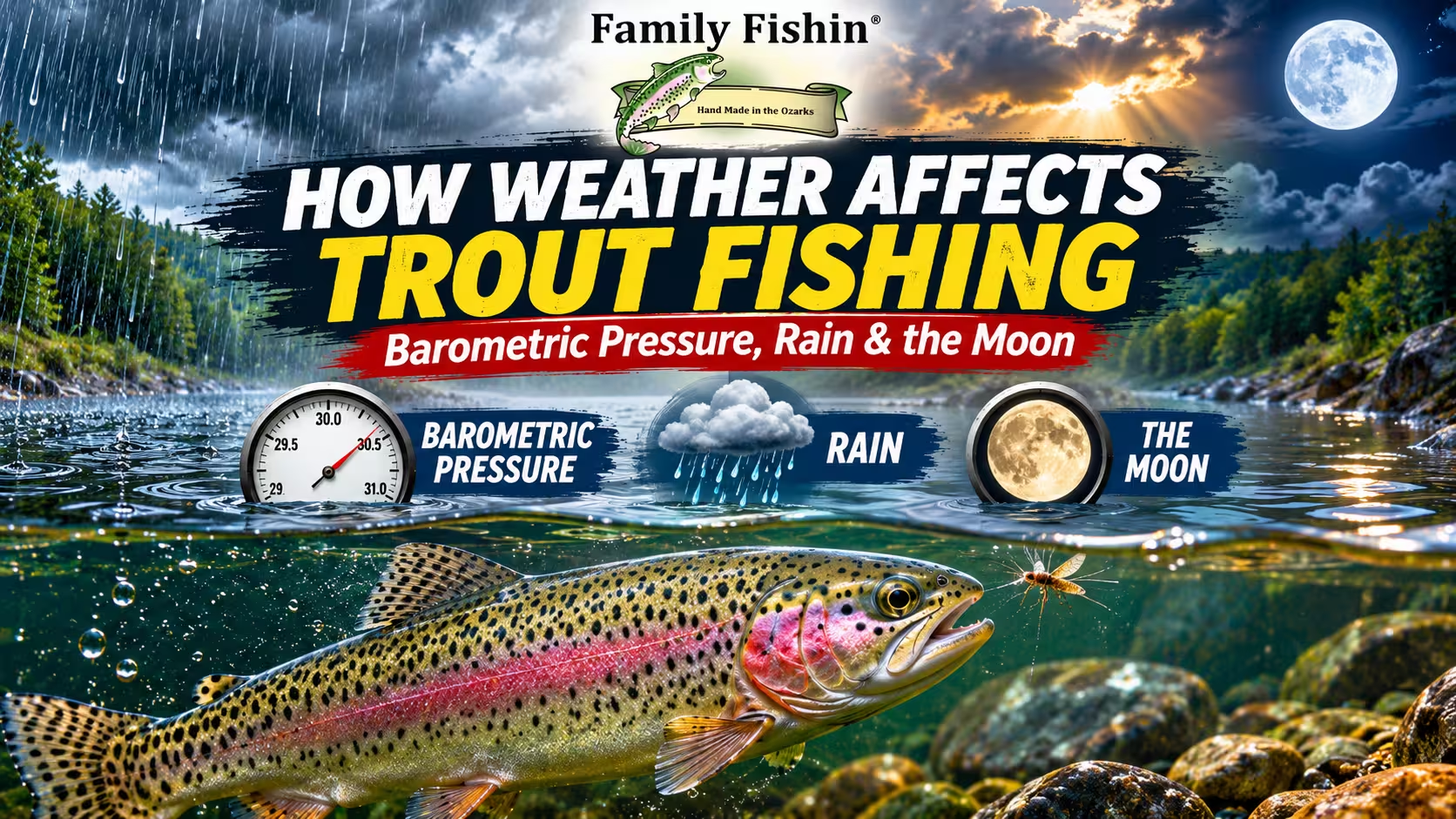
Understanding how weather affects trout fishing requires looking beyond simple predictions about approaching storms or changing barometric pressure. Rainfall, water temperature, streamflow, light conditions, and seasonal patterns can all influence trout behavior, but their effects are not always straightforward.
How Weather Affects Trout Fishing: What Actually Matters
Every trout angler has a weather story. The morning the barometer dropped like a stone and the fish went wild. The bluebird afternoon after a cold front when you could not buy a bite with a handful of twenties. The full-moon night a buddy swore the browns were feeding “like clockwork,” and the next full moon when they were not. Fishing gives us just enough pattern to believe in rules and just enough exceptions to doubt them, and few subjects carry more confident advice and less honest explanation than weather. Whether barometric pressure, rain, or the moon affects trout bites is a question with a real answer, but it is not the answer you will find on most fishing forecast apps, and it is not “it’s all a myth” either.
Here is the short version, and then we will earn it. Barometric pressure, by itself, is a weak and mostly indirect influence on trout feeding. Rain is a strong influence, but through specific, measurable changes in light, temperature, oxygen, flow, clarity, and food delivery rather than through the rain itself. The moon is almost entirely irrelevant as a gravitational or “solunar” force, but moonlight at night does change how some trout feed. In every case the useful question is not “what does the forecast say?” but “what is this weather actually doing to the water my trout are sitting in?” Once you can answer that, weather stops being a coin flip and becomes one of the more predictable parts of trout fishing.
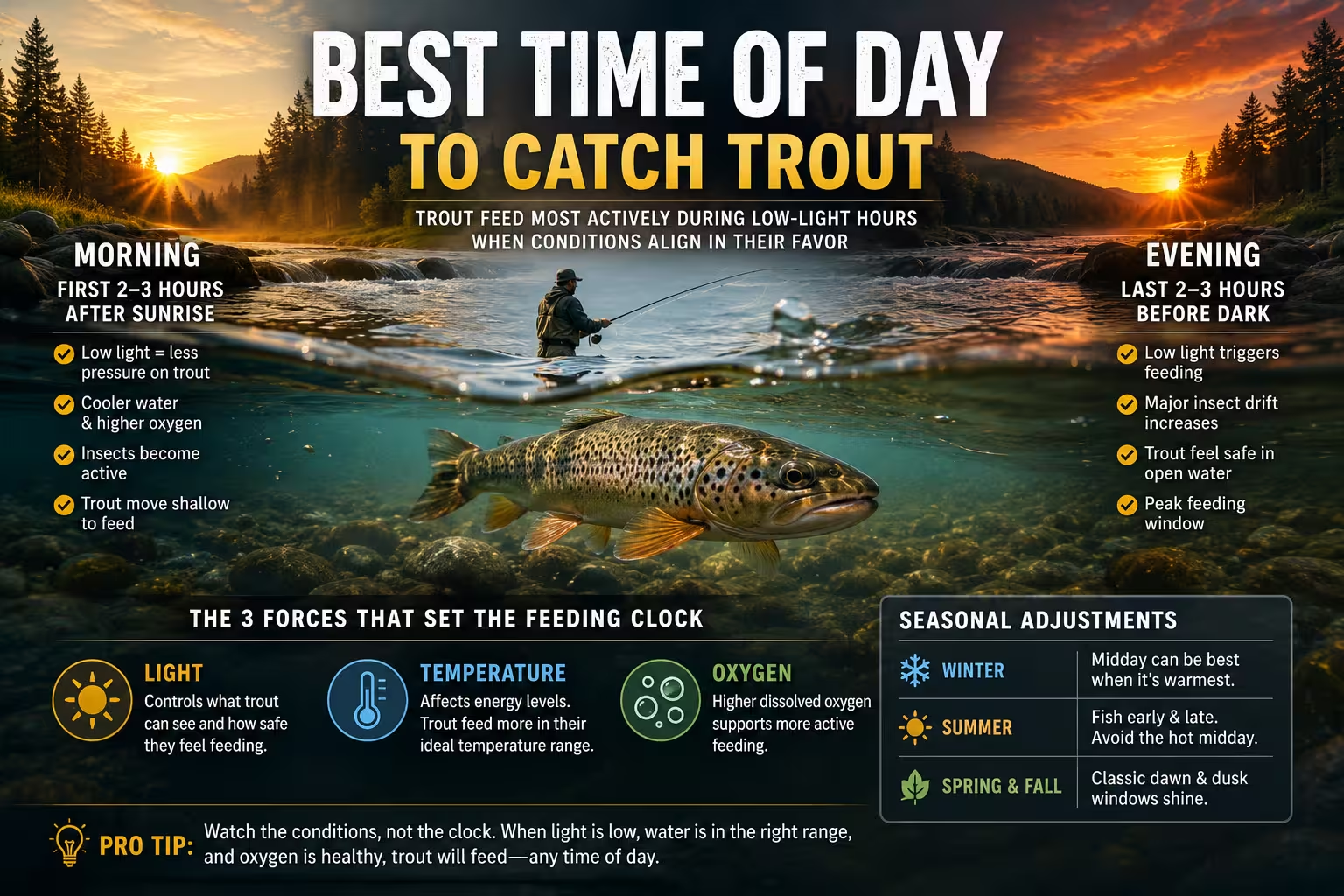
This post is a companion to several earlier pieces in our trout science series, and it leans on them heavily. Our guide to the best water temperature for trout explains why temperature governs metabolism. Our piece on how dissolved oxygen affects trout explains the second half of that equation. Our post on how water clarity affects trout fishing covers how trout see and judge a lure. And our guides to the best time of day to catch trout and why big trout feed at different times cover the daily clock. Weather is the layer that sits on top of all of those. It does not replace them. It changes them, sometimes within an hour.
The Short Answer, Before the Long One
If you only have a minute, here is what the evidence and the biology support.
Barometric pressure: the number on the barometer is not what trout respond to. The weather that travels with pressure changes, meaning cloud cover, wind, temperature swings, and runoff, is what moves the bite. A falling barometer often precedes good fishing because it usually means overcast, wind, and warming ahead of a front, not because the fish feel the pressure drop and get hungry.
Rain: the effect depends on the kind of rain and the stage of the water. A gentle drizzle on an overcast day is among the best conditions a trout stream ever offers. A steady rain that raises and stains the water can produce excellent fishing on the way back down. A violent downpour that blows a river out shuts most fishing down until it recovers.
The moon: moon phase has no credible mechanism for affecting a trout stream, a pond, or a reservoir. Moonlight, however, is real light, and at night it changes insect behavior and the feeding confidence of big, wary trout, particularly brown trout. That is a lighting effect, not a lunar one.
Everything else in this article is the reasoning behind those three paragraphs and how to use it.
What the Barometer Actually Measures, and What a Trout Could Feel
Barometric pressure is the weight of the column of air above you, measured in inches of mercury or hectopascals. At sea level it averages about 29.92 inches of mercury. A strong high-pressure system might push that to 30.40 or more. A deep low-pressure system or storm might drag it below 29.50. The swings that anglers talk about, “the barometer dropped half an inch overnight,” are real, but they are small numbers.
Here is the number that rarely makes it into fishing articles: water pressure. Every foot of water above a fish adds roughly 0.88 inches of mercury of pressure on top of whatever the atmosphere is doing. A trout holding in four feet of water is living under about 3.5 inches of mercury more pressure than a trout at the surface. A trout that rises two feet to sip a fly experiences a pressure change of about 1.8 inches of mercury in a second or two, which is several times larger than the entire swing of a typical cold front, and it does so without any apparent trouble.
That is the first problem with the idea that a barometer drop of a third of an inch over twelve hours should switch trout on or off. Trout and other fish routinely move through pressure changes many times larger than anything the weather delivers, and they do it voluntarily, in seconds, every time they change depth to feed, shelter, or escape a predator. Weather-driven pressure changes are slow and shallow by comparison.
It is important to be careful here. Fish can detect pressure changes. They have sensory systems tied to the swim bladder, the inner ear, and the lateral line that respond to pressure and vibration, and laboratory work on several species has shown that fish respond to changing pressure, most often by adjusting their depth. Detecting a change is not the same as being driven to feed or fast by it. The leap from “a fish can sense pressure” to “a falling barometer triggers a feeding frenzy” is one that the evidence does not clearly support, and studies that have tried to link barometric pressure to catch rates in sport fisheries have tended to find weak, inconsistent, and species-specific relationships rather than a clean rule.
The Swim Bladder Argument: Why Trout Are Not Pressure Gauges
The most common biological explanation for pressure effects is the swim bladder, the gas-filled organ that gives many fish neutral buoyancy. The argument goes that a falling barometer lets the bladder expand, making the fish uncomfortable or buoyant, which triggers behavior changes. It sounds plausible, and for some fish it contains a grain of truth. For trout, it runs into a structural problem.
Trout, like other salmonids, are physostomes, which means the swim bladder remains connected to the gut by an open duct called the pneumatic duct. A physostome can gulp air at the surface to add gas and can burp gas out through the duct to release it. Fish with a sealed swim bladder, called physoclists, have to move gas in and out through the bloodstream, a slow process that makes rapid depth changes and pressure swings harder to manage. A trout can adjust its buoyancy quickly and directly. That makes trout among the least likely fish to be pushed around by the slow pressure changes of a weather front, and it is one more reason the “barometer controls the bite” explanation is shakier for trout than it might be for, say, a deepwater species.
Add the fact that most trout we fish for live in shallow, flowing, well-oxygenated water, in streams a few feet deep and lakes where they hold in the upper layers, and the case for a direct pressure effect gets thinner still. Stocked trout in a small pond are not rolling around with a swollen swim bladder because a front is coming. They are hungry, or they are not, for other reasons.
Why the Barometer Still Seems to Predict the Bite
If pressure itself is a weak lever, why do so many experienced anglers swear by it? Because the barometer is a very good proxy for weather, and weather is a very good lever.
Barometric pressure does not travel alone. A falling barometer typically means a low-pressure system or a front is approaching. That usually brings rising cloud cover, increasing wind, warmer air ahead of the front, and a chance of rain. A rising barometer after a front passes usually means clearing skies, cold dry air, bright sun, and light winds. A high, stable barometer means settled, often clear and bright weather. So the barometer correlates with four things that clearly do matter to trout: light, temperature, wind, and moisture.
This is why the folk wisdom works often enough to survive. The classic “fish bite before a front” observation is really “fish bite under overcast, breezy, warming skies with a bit of moisture in the air.” The classic “fish shut down after a front” is really “fish shut down under cold, bright, windless skies with cooling water and no cloud cover.” The barometer is a reasonable shorthand for those conditions. It is just not the cause, and treating it as the cause leads to bad decisions when the shorthand breaks down. A high-pressure day that is overcast and mild can fish well. A falling-pressure day that is bright and cold can fish poorly. If you only read the barometer you will miss both.
Weather Fronts, Stage by Stage
Because fronts bundle so many variables together, it helps to walk through what a typical front does to a trout stream or pond, stage by stage, and why each stage tends to fish the way it does. Treat these as tendencies, not guarantees. Water type, season, and species change the details.
Stage one: the approach. Ahead of a front, air usually warms, clouds build, and wind picks up. For trout, falling light levels mean more security and more willingness to roam. Wind ruffles the surface, which hides the angler and breaks up the visual field. Warming air can nudge water temperature up a degree or two, particularly in cold seasons. Insect activity often increases, and terrestrial insects get blown into the water on windy banks. This stage frequently produces the best fishing of the cycle, and it is the stage the “falling barometer” saying is really describing.
Stage two: the passage. When the front itself arrives, conditions can swing quickly. There may be rain, a sudden wind shift, and a sharp temperature drop. Fishing in this window is variable. Many anglers report a brief, intense feeding burst right as the front moves through, often tied to the combination of low light, rain, and moving water. It can also shut off abruptly if temperature plunges quickly or runoff muddies the water. If you can fish it safely and the water stays fishable, it is a window worth taking.
Stage three: the bluebird day. In the day or two after a cold front passes, you often get clear, cold, bright, calm conditions under high pressure. Light is intense, water may be a few degrees cooler than before, and aquatic insect activity can be subdued. Trout have the least cover and the most visibility in this stage, so they are spookier and more selective. This is the stage that gets blamed on high pressure. It is really blamed on light and temperature.
Stage four: stabilization. After two or three days of settled weather, trout adjust to the new temperature and light regime and feeding often normalizes. A stable pattern, even a cold or hot one, is generally more predictable than a rapidly changing one. This is why experienced anglers often rank “day three after a front” ahead of “day one.”
The big takeaway from walking through the stages is that the trout were never responding to the number on the barometer. They were responding to a sequence of changes in light, temperature, wind, and water, each of which our earlier posts cover in detail. If you manage those variables with your presentation, the barometer becomes a footnote.
The Water Temperature Trend Matters More Than the Pressure Trend
If you want one number to track instead of barometric pressure, track the direction of water temperature. A trout’s metabolism and willingness to feed are controlled by temperature far more than by any weather variable that travels with a front, as our best water temperature post explains in detail.
A front can push water temperature either way, depending on the season. In winter and early spring, the cold snap behind a front can drop water temperature a few degrees and slow the bite, while a warm, cloudy stretch ahead of one can raise it and turn fish on. In midsummer, the reverse can be true: a front that cools the air and brings rain can drop water temperature out of the stress range and trigger the best fishing of the week, while a stagnant, hot high-pressure dome can push marginal water over the edge. A trout that is thermally comfortable and rising in temperature feeds. A trout that is chilled or heat-stressed does not, whatever the barometer says.
This is also why the same weather pattern can produce opposite results in different seasons, a source of enormous confusion in fishing folklore. “Cold fronts shut the bite down” is mostly a spring and fall observation, when water is already near the lower end of the feeding range. In a hot August on a marginal trout stream, a cold front can be the best thing that happens to the fish all month.
Rain: What Actually Changes in the Water
Rain is where weather becomes unmistakably relevant to trout, because rain changes the water itself. A raindrop hitting the surface does very little to a trout. But what rain triggers upstream, on the banks, and in the watershed changes the environment in at least six distinct ways.
Light. Rain almost always arrives with thick cloud cover, and cloud cover dramatically lowers the light reaching the stream. Trout, which are visual predators with eyes adapted for hunting in low light and which depend on overhead cover to feel safe from birds, herons, and otters, move and feed more confidently under low light. We covered this in detail in our time-of-day posts. A dark, rainy afternoon can fish like a prolonged dawn.
Temperature. Rain is usually cooler than the water it falls on in summer and often warmer than the near-freezing water of winter and early spring. A summer rain that lowers a stream’s temperature a few degrees can pull trout out of thermal stress and back into feeding mode. Snowmelt rain in early spring does the opposite by chilling the water, which is why spring runoff can be a double-edged sword.
Oxygen. Rain can improve oxygen indirectly. Cooler water holds more dissolved oxygen, and increased flow and turbulence mix more air into the water. In a warm, low, sluggish stream, a rise in flow can meaningfully improve oxygen conditions, as discussed in our dissolved oxygen post. In a cold, high-oxygen stream, the effect is minor.
Flow. Rain raises flow, and flow changes where trout hold. As current speed increases in the main channel, trout move toward the margins, behind boulders, into slack pockets, and along banks where they can hold in softer water. The fishable water shifts from the middle of the stream to its edges. The same stretch of river can have its fish in completely different places at normal flow and at elevated flow.
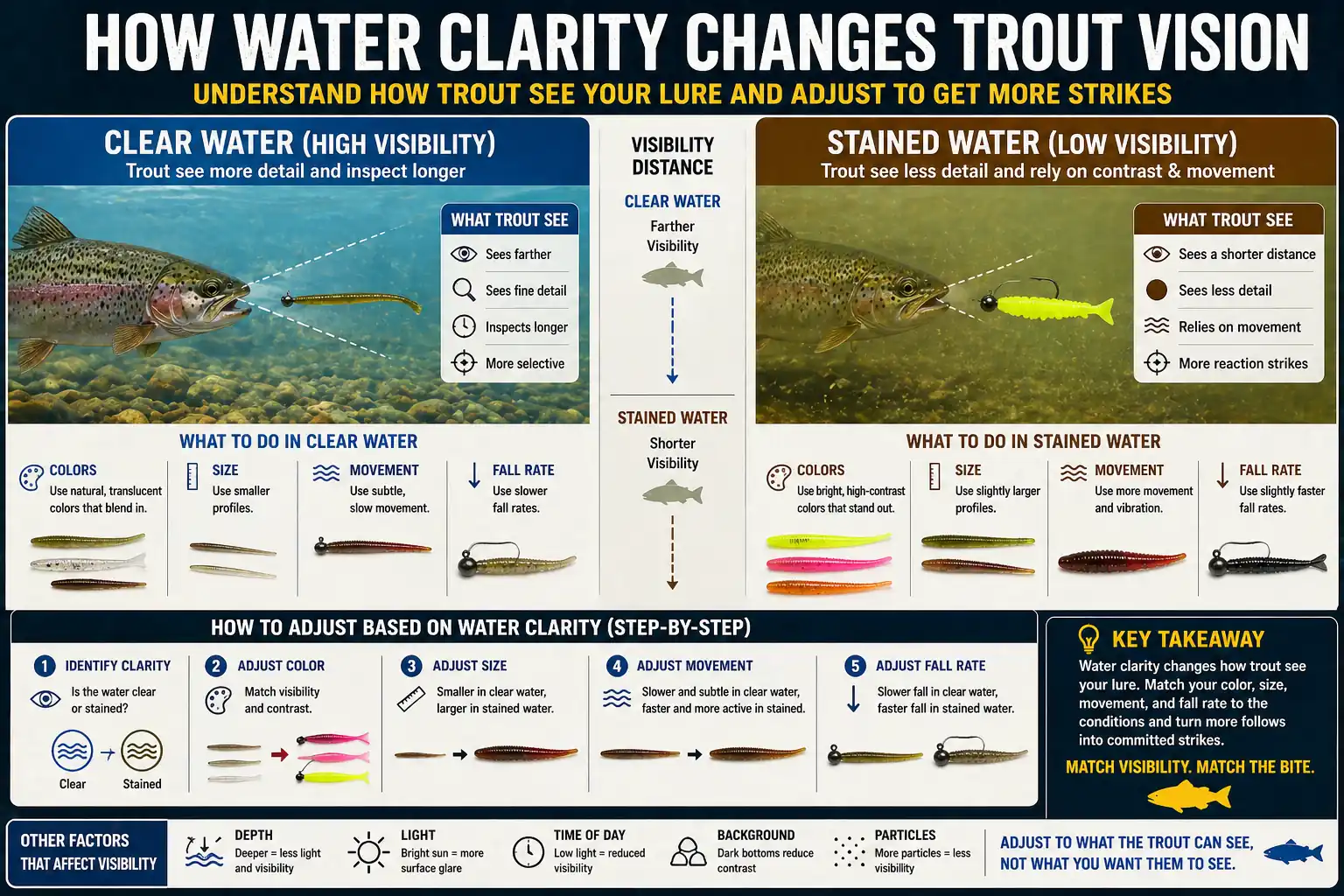
Clarity. Runoff carries sediment, and sediment reduces visibility. This is a double effect. Trout see less, so they rely more on scent, vibration, and the lateral line, and they also feel more secure because predators see them less well. We covered how clarity affects a trout’s inspection of a lure in the water clarity post. Moderately stained water often produces confident, aggressive strikes. Heavy, chocolate-milk mud usually shuts feeding down because even trout cannot locate food in it.
Food delivery. This is the biggest lever of all. Rising water dislodges aquatic invertebrates from the stream bottom and sends them drifting, a process stream ecologists call catastrophic drift. Runoff washes terrestrial insects, worms, grubs, and crawfish off the banks and into the water. Heavy rain on a farm field or a forested hillside is, from a trout’s point of view, a conveyor belt of food arriving all at once. Our post on why trout eat worms covers one of the clearest examples: the “worm bite” is not a mystery, it is the arrival of earthworms flushed from saturated banks into a stained, rising stream.
Put those six together and rain is not one condition. It is a bundle of changes whose net effect depends on the timing and the magnitude of each. That is why the answer to “is rain good for trout fishing?” is “it depends on what kind of rain and where in the cycle you are.”
The Four Stages of a Rain Event
The most useful way to think about rain is as a sequence. Trout and food respond differently at each stage, and the same storm can go from poor to excellent to poor again in a few days.
Drizzle and light rain. A soft, steady drizzle without much runoff is some of the best weather in trout fishing. Light is low, water temperature is stable or slightly cooler, the surface is textured by falling drops, and there is little change in clarity or flow. Many aquatic insects, particularly mayflies like blue-winged olives, famously favor overcast, drizzly conditions for emerging. Trout feed with confidence and on a wide variety of foods. This is the condition to prioritize if you have a choice.
Rising water. When rain is heavy enough to raise and color the stream, fishing becomes more difficult and more specialized. Fast, rising water is usually the hardest stage of a storm. Trout are being pushed out of their normal lies, the water is changing minute by minute, and food is being delivered everywhere at once, which can actually make a single lure harder to stand out. Safety also becomes a real concern, since a rising stream can trap an angler on the wrong bank. If you fish rising water, fish the soft edges, eddies, and inside seams, and be conservative about wading.
Peak and blown-out water. At peak flow, with brown, debris-laden water running bank to bank, most trout fishing is poor and often dangerous. Fish are hunkered down in refuges away from the full force of the current. This is a good time to stay off the water. The exceptions are small streams that run clearer than large rivers, or tailwaters where releases rather than rain control the flow.
Falling and clearing water. This is the stage many experienced anglers wait for. As the water drops and the color changes from chocolate toward something like coffee with cream, trout are returning to their usual positions, they are still being fed by the leftover flush of worms, insects, crawfish, and baitfish, and the visibility is low enough that they feel secure and are not picky. Strikes tend to be confident and committed. If you can only choose one stage of a storm to fish, falling and clearing water is usually it. A good visual rule: when you can see your lure for a foot or two under the surface, trout can see it too, and you are probably in the productive zone.
Matching Your Presentation to Rainy and Stained Conditions
Weather matters most when it changes what you do. Here is how the rain science translates into presentation choices.
In stained or rising water, use a larger profile, more vibration, and more scent. Trout locating food by lateral line and smell respond to bulk and movement. A bait or lure that gives off a clear vibration signature, a slightly larger silhouette, and a color that contrasts with the stained water, such as bright chartreuse, white, black, or fire orange, tends to be found more reliably than a tiny natural pattern. Our work on lure color contrast and fluorescent colors goes deeper on that choice.
In falling and clearing water, drift natural worm and baitfish profiles along the edges and seams. Red and pink worm tones, as covered in our worm post, match the color a real worm shows when it is injured. A slim, supple soft plastic like our 2.95″ Round Trout Worm flutters naturally on a dead drift and suits this condition well.
In drizzle and overcast, trout will often take small insect imitations, small spinners, and natural-colored jigs. Because they feel secure and the light is low, you can often use lighter line and more natural presentations without sacrificing bites.
In rising or very fast water, add weight to get the bait down into the slower water near the bottom and along the banks, and fish the margins rather than the center. Keep the presentation compact and controlled. Speed and complexity work against you in fast water.
In all stained conditions, slow down and let the bait sit in the strike zone longer. Trout locating food by scent and vibration need time to track it. This is where the patient techniques in our dead-sticking guide shine.
Wind, Clouds, and Snow: The Overlooked Weather Variables
Pressure and rain get the attention, but three other weather variables often explain more of the day-to-day variation in a trout bite.
Cloud cover. Light is the single most consistent weather lever on trout behavior. Overcast skies extend the effective feeding window through the middle of the day, reduce the spookiness of fish in clear water, and often trigger insect emergence. A fully overcast day behaves a bit like a long dawn and dusk. A cloudless, high-sun day compresses the best fishing into the first and last hours of daylight and sends trout toward cover and depth. If you only check one thing on a forecast, check the cloud cover forecast.
Wind. Wind is underrated. A moderate breeze ruffles the surface, which breaks up the trout’s view of the angler and the line, reducing spookiness in clear, shallow water. It also blows terrestrial insects such as grasshoppers, ants, and beetles into the water along windward banks, and trout position themselves to intercept them, as covered in our grasshopper post. On stillwater, wind pushes surface food and plankton toward one shore, and trout follow. Strong, gusty wind that makes casting miserable is another matter, but a steady breeze is usually an ally.
Snow and cold rain. Snow itself is less important than the temperature and flow changes it implies. Falling snow in cold weather often brings overcast, low light, and a modest warming relative to the clear, frigid nights that precede it, and midday bites can be decent. Snowmelt, on the other hand, floods streams with very cold water that can slow trout metabolism sharply. Winter weather is a conversation about temperature first and everything else second.
The Moon: What Solunar Theory Claims, and What It Gets Right
Now to the moon. Solunar theory was popularized in the 1920s and 1930s by a fisherman and writer named John Alden Knight, who proposed that fish and game feed more actively during predictable “major” and “minor” periods tied to the moon’s position overhead and underfoot, with extra strength around new and full moons. Solunar tables have been a fixture of fishing guides and apps ever since, and they remain popular. The idea has an intuitive appeal: the moon moves oceans, so why not fish?
The problem is the physics. The moon’s gravitational pull creates ocean tides because oceans are vast bodies of water. A lake or river is too small for a measurable tidal effect. Even the largest freshwater lake in the world shows a lunar tide of only an inch or two. A trout stream, a farm pond, or a mountain reservoir has no meaningful lunar tide at all. There is no known mechanism by which the moon’s gravitational pull alters the feeding behavior of a trout in a creek.
The empirical support is also thin. Controlled studies tying solunar periods or moon phase to trout catch rates are scarce, and the broader literature on moon phase and freshwater fishing success is mixed and inconclusive. Anglers can easily find data to support their own pattern because fishing success varies for dozens of other reasons, and humans are very good at noticing the hits and forgetting the misses. This is not a claim that solunar fishing never produces a good day, since the moon is up every day and fish are caught every day. It is a claim that there is no reliable evidence of a moon-phase signal strong enough to plan a trip around, particularly for trout.
There is one honest partial exception that is worth taking seriously. Solunar “major” periods often overlap with sunrise and sunset, which are already the best feeding windows for trout for reasons that have nothing to do with the moon. When a solunar table says the best time to fish is dawn or dusk, it is right, but you did not need the moon to tell you that. The table gets credit for a result that the sun already delivers.
What Moonlight Really Changes: Night Drift and Big Brown Trout
Moon phase is a poor lever. Moonlight is a real one, because light is the thing trout and their prey respond to, and a bright full moon is a meaningful change in the light environment at night.
Stream ecologists have documented for decades that the drift of aquatic invertebrates, the nightly release of insect larvae and nymphs into the current, follows light levels. Drift rises sharply after dark, which is part of why trout feed so heavily at dusk and into the night, and it is often reduced on bright, moonlit nights compared with very dark ones. The mechanism is simple: invertebrates that are vulnerable to visual predators hold back from the current when there is enough light to be seen. Fewer insects in the water means fewer easy meals for the trout hunting them.
For night-feeding trout, particularly large brown trout, which are well known for shifting toward nocturnal feeding as they grow, as our post on why big trout feed at different times describes, a very bright night may also change how confident they feel moving into the open to hunt. Many night anglers report that the dark of the moon, or heavily clouded nights, often produce more reliable feeding than a bright, clear full-moon night. Others report the opposite. Both can be true, since cloud cover can turn a full moon into a dark night and a clear new moon can still show a river full of starlight. The actionable variable is not the moon phase. It is how much light actually reaches the water.
If you fish at night for big trout, check the cloud cover forecast and the moonrise and moonset times together. A full moon high in a cloudless sky is a bright night. A full moon behind a thick overcast is a dark one. And a waning moon that does not rise until after midnight gives you a dark first half of the night regardless of its phase. For daytime fishing, the moon is effectively noise.
A Season-by-Season Weather Cheat Sheet
Because weather effects flip with the season, it helps to put the science into a simple seasonal frame. These are tendencies, not laws.
Winter. Warm, cloudy, and stable is the combination to hunt for. A mild day with overcast skies and a modest warming trend can turn on midge and nymph feeding, and the best window is usually early afternoon after the water has had time to warm slightly. Falling air temperature, hard freezes, and fresh snowmelt are the conditions to avoid or fish very slowly. Pressure is a minor factor next to the temperature trend.
Spring. This is the most weather-sensitive season, because water is near the threshold where small temperature changes change metabolism, and runoff, rain, and hatches are all active. Warm, overcast, drizzly days produce the best insect activity and the most confident feeding. Cold snaps after a warm spell can shut things down for a day or two. Falling and clearing water after a spring storm is a prime window for worm and baitfish presentations.
Summer. Heat stress is the controlling variable. Cool fronts, rain, and cloud cover can be a gift, dropping water temperature and extending the feeding window. Hot, still, bright, high-pressure weather pushes trout toward the early morning and late evening and onto the coolest, best-oxygenated water, a theme we covered in the temperature and dissolved oxygen posts. Afternoon thunderstorms can deliver a short, productive window of worm, terrestrial, and crawfish feeding right after the rain, with the usual caution about lightning and flash floods.
Fall. Trout are in a pre-winter feeding push, and the weather effect is often to amplify it. Overcast, cool, breezy fall days can produce some of the most aggressive feeding of the year, especially with streamers and baitfish patterns. A stable run of crisp, clear fall days compresses the best fishing back toward the low-light edges of the day. Spawning activity adds its own layer, as described in our posts on eggs and redds.
Stocked Trout and Weather
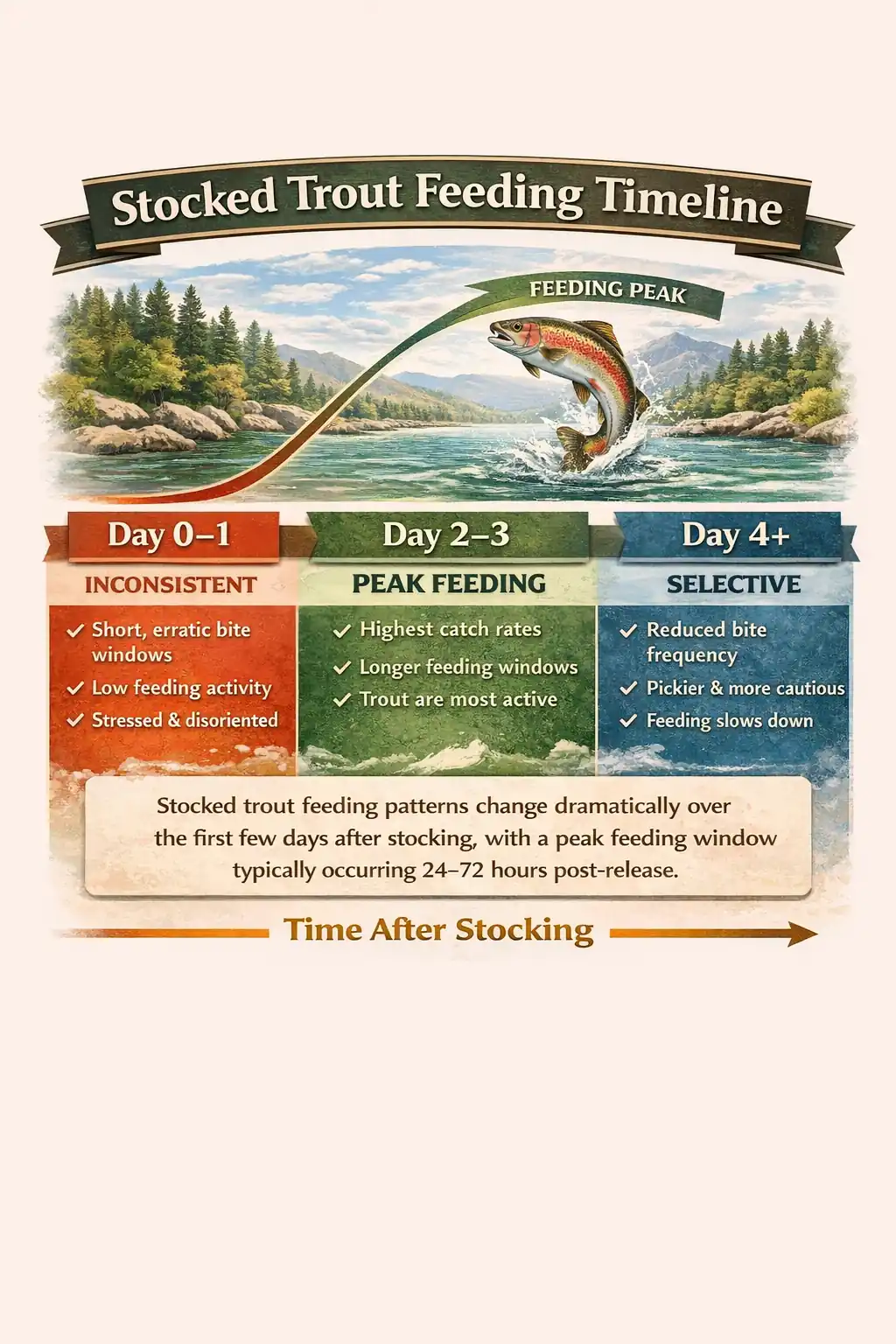
Stocked trout deserve their own note, because hatchery fish respond to weather a little differently. Their feeding is driven in part by their recent history: how recently they were stocked, how much pressure the water has received, and how they are adapting to natural food. Weather matters, but it often interacts with those factors. In the first days after stocking, as discussed in our stocked trout posts, fish are often more willing to feed regardless of the weather, and recently stocked fish are generally less selective than wild trout in the same water. As they settle in and become conditioned to the new environment, they begin to respond to weather and light the way wild fish do. Overcast and rainy days often reduce the wariness of stocked trout that have seen heavy angling pressure, while bright, calm, high-pressure days make them noticeably more cautious. If you are targeting a pressured put-and-take pond, a cloudy, breezy day is a big advantage. Our guide to when stocked trout actually eat goes deeper on the timing windows.
A Practical Weather Checklist for Trout
The weather does not need to be complicated. Before a trip, run through these questions in order. They are ranked by how much each one usually matters.
First, what is the cloud cover? Overcast extends the bite, bright sun compresses it. If you can choose between a cloudy day and a sunny day, choose the cloudy day.
Second, which way is the water temperature trending? A warming trend in cold water, or a cooling trend in hot water, is a green light. A chilling trend in cold water, or a heating trend in hot water, is a yellow or red light.
Third, what is the water doing? Look at the gauge, the color, and the trend. Falling and clearing water is the prime window. Rising water is difficult, peak water is usually not worth fishing, and stable, clear water calls for a more careful presentation.
Fourth, is there wind? A steady breeze is generally good. A calm, bright, clear day calls for stealth and finesse.
Fifth, where are you in the front cycle? Ahead of a front is often productive. The day immediately after is often slow. Day three often normalizes. Treat the barometer as a clue to which stage you are in rather than as a verdict.
Sixth, if you fish at night, how bright will it actually be? Check cloud cover and moonrise together, not the moon phase alone.
And last, always put safety ahead of fishing. Rising water, lightning, and cold-weather wading all carry real risk, and no bite is worth a bad outcome.
Common Weather Myths, Corrected
A few ideas show up so often that it is worth addressing them directly.
“Fish stop biting when the barometer is high.” Fish bite under high pressure all the time. What changes is often the light and temperature that accompany it, which you can adapt to with a more careful presentation.
“Fish go crazy right before a storm.” They often do feed well ahead of a front, but because of overcast skies, wind, and warming, not because of a switch flipped by the barometer. If the sky is clear and cold before a storm, the effect often does not appear.
“Rain ruins fishing.” Light rain and falling, clearing water after rain can be among the best fishing of the year. Heavy runoff and blown-out water are the real problems.
“The full moon is the best time to fish.” There is no reliable evidence for a moon-phase effect on trout. At night, bright moonlight can matter, in either direction, by changing how much light reaches the water.
“The solunar table is basically a fishing forecast.” It can be a reminder to fish at dawn and dusk. It is not a replacement for reading the water, the temperature, and the sky.
Frequently Asked Questions
Does barometric pressure really affect trout fishing?
Barometric pressure has a weak, indirect effect on trout. Trout can detect pressure changes, but the swings produced by weather are small compared with the pressure changes trout experience every time they change depth, and trout have an open connection between the swim bladder and the gut that lets them adjust buoyancy quickly. The reason the barometer seems to predict fishing is that it travels with cloud cover, wind, temperature changes, and rain, which do strongly influence feeding.
Is a falling barometer good for trout fishing?
Often, but for indirect reasons. A falling barometer usually signals an approaching front, which brings cloud cover, wind, and often warming air, all of which tend to improve trout feeding. If a falling barometer comes with clear, cold, calm weather, the effect is less reliable. Read the sky and the water temperature, not just the number.
Is it good to fish trout in the rain?
It can be excellent. Light rain and overcast skies lower the light, calm trout’s caution, and often trigger insect emergence. Rain that raises and stains the water can produce strong fishing as it falls and clears, because runoff delivers worms, insects, and crawfish. Very heavy rain that blows the river out is the exception, and fishing in rising water can be dangerous.
What is the best stage of a rain event to fish for trout?
For most waters, falling and clearing water is the best stage. Trout have returned to their usual positions, the leftover flush of food is still available, and the color of the water, often like coffee with cream, helps them feel secure. When you can see your lure for a foot or two beneath the surface, you are probably in a productive condition.
Do trout bite better after a cold front?
Usually not on the first day. The day after a cold front is often bright, cold, and calm, which makes trout more cautious, and falling water temperature can slow their metabolism. Fishing typically improves by the second or third day as conditions stabilize. In midsummer, a cold front can actually help by cooling overheated water.
Does the moon phase affect trout feeding?
There is no solid evidence that moon phase affects trout feeding, and no plausible gravitational mechanism in streams, ponds, or lakes. Moonlight can matter at night, because it changes insect drift and the feeding confidence of wary, nocturnal trout such as large brown trout. That is a lighting effect, and it depends on cloud cover and moonrise as much as on the phase.
Are solunar tables worth using for trout?
They are not reliable on their own. Solunar periods often overlap with dawn and dusk, which are already prime trout feeding windows, so a table can appear to work simply because it points toward low-light hours. Use it as a gentle reminder to fish early and late, not as a forecast.
What weather is best for trout fishing?
Overcast, mild, slightly breezy conditions with stable or rising water temperature in cool seasons, or cooling water in summer, are the combination most anglers do best in. Light drizzle, falling and clearing water after rain, and the hours ahead of a front are particularly productive. Bright, cold, windless days after a front are usually the toughest.
Should I change my lure when the weather changes?
Yes. In stained or rising water, use larger profiles, more vibration, brighter contrast colors, and slower presentations that give trout time to find the bait by scent and lateral line. In clear, bright conditions, downsize, use natural colors, and be stealthy. In drizzle and overcast, trout feed confidently and will take a wide range of natural presentations.
Does weather affect stocked trout differently than wild trout?
Stocked trout respond to the same light, temperature, and flow cues, but their behavior is also shaped by how recently they were stocked and how much pressure they have seen. Freshly stocked fish tend to feed readily regardless of weather, while pressured stocked fish are noticeably more cautious on bright, calm days and more willing on cloudy, breezy, or rainy ones.
Closing Thought
Trout do not check the barometer, the moon calendar, or the radar. They respond to light, temperature, oxygen, current, clarity, and the food that all of those deliver, and weather is simply the most dramatic way those conditions change. When someone tells you the bite is off because the pressure is high, or on because the moon is full, they are usually describing something real in the wrong words. Learn to translate. Ask what the sky is doing to the light, what the air is doing to the water temperature, and what the rain is doing to the flow, the clarity, and the food, and you will be able to read tomorrow’s weather as clearly as you read a riffle. That skill will do more for your catch rate than any gadget on your phone, and it works the same whether the barometer is rising, falling, or sitting perfectly still.
About Family Fishin
Family Fishin is a family-owned fishing tackle company dedicated to designing, testing, and producing high-quality fishing lures — inspired by generations of fishing tradition and driven by a passion for innovation. Every product is developed with one goal in mind: helping anglers spend more time doing what they love, catching fish and creating memories on the water.