Why Trout Eat Caddisflies
Lift a few rocks from the bottom of almost any healthy trout stream and you will find them: small, stubby tubes of sand and gravel stuck to the stone, tiny bright-green worm-like creatures wriggling in the current, or silk-spun webs strung between pebbles like miniature fishing nets. Most people walk right past them. Trout do not. Understanding why trout eat caddisflies begins beneath these rocks, where some of the most important food sources in a trout stream spend much of their lives. Caddisflies are among the most consistently available foods in cold-water streams, and trout eat them in every stage of their lives: as larvae crawling over the bottom, as pupae swimming to the surface, and as adults skittering across it.
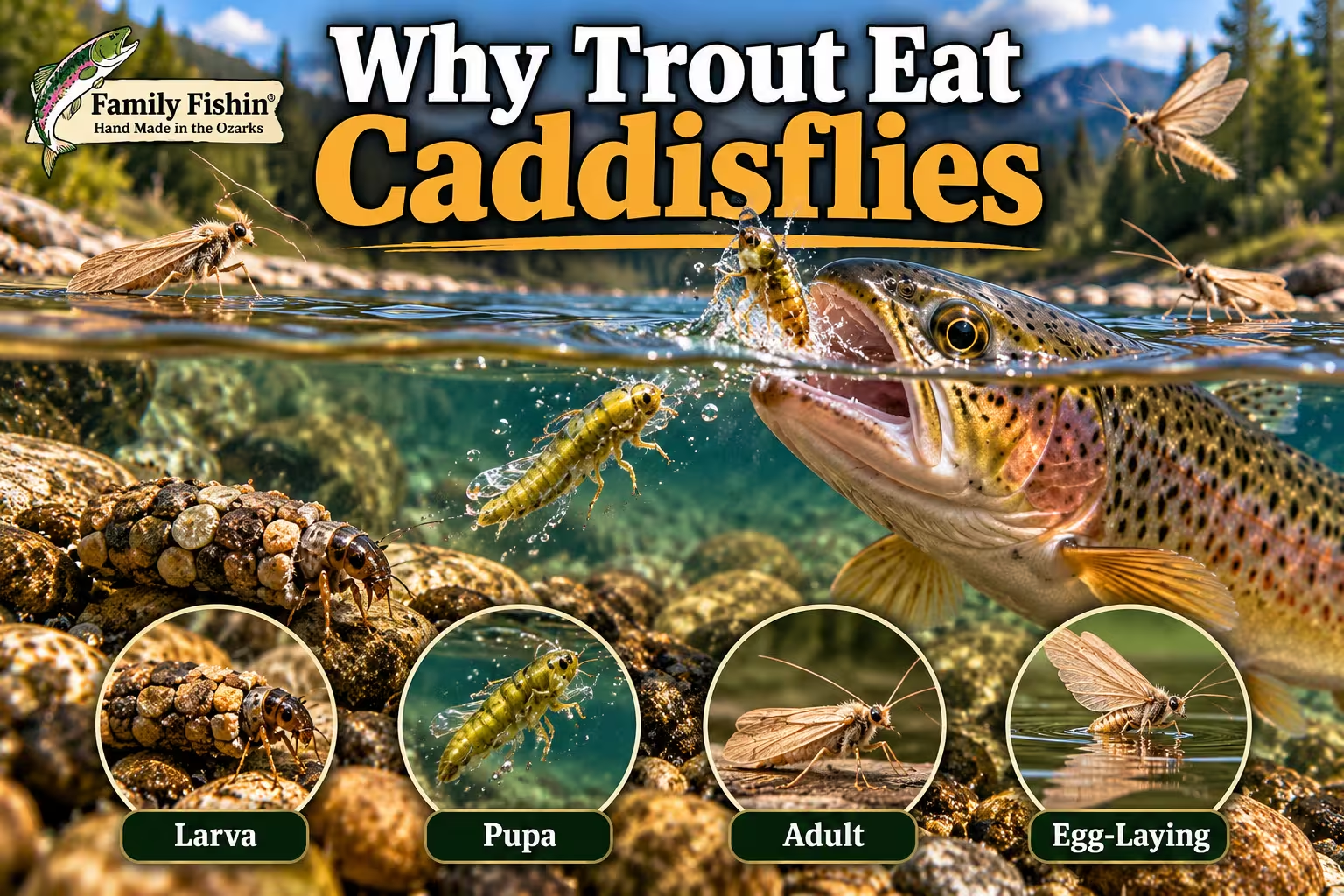
What makes the caddisfly unusual among trout foods is how many different ways a trout can encounter it. A mayfly is eaten mostly as a nymph and then as a floating adult. A stonefly spends most of its life crawling on the bottom. A midge is a tiny, abundant package in a very specific stage. A caddisfly, by contrast, offers a trout a full menu: an armored larva, a vulnerable swimming pupa, an energetic adult, and a diving, egg-laying female, each with a different behavior and a different reason it ends up in a trout’s mouth. Understanding why trout eat caddisflies means understanding all four, and it explains why a trout’s rise to a caddis can look so different from its rise to a mayfly.
This post is part of our Trout Food Sources series, and it fills one of the largest gaps in our insect coverage. We have already written about mayflies, stoneflies, midges, scuds, and hellgrammites, and our overview of aquatic insects for trout places all of them in context. Caddisflies are the missing piece, and for many anglers they are the most important insect in the stream, even if they rarely get the attention that a mayfly hatch does.
What a Caddisfly Actually Is
Caddisflies belong to the insect order Trichoptera, a name that comes from Greek words meaning “hairy wings,” because the adults’ wings are covered in fine hairs rather than the scales of a moth. The resemblance to moths is not an accident. Caddisflies are fairly close relatives of moths and butterflies, and an adult caddis, with its tent-shaped wings folded over its back and long, trailing antennae, looks a lot like a small, drab moth. Worldwide there are well over ten thousand described species, and North America alone has well over a thousand, which is a big part of why caddisfly hatches vary so much from one stream to the next.
The most important thing to know about a caddisfly is that it goes through complete metamorphosis. Where a mayfly or stonefly nymph gradually grows into an adult, a caddisfly passes through four distinct stages: egg, larva, pupa, and adult. The larva looks nothing like the adult, and there is a resting pupal stage in between, much as a caterpillar becomes a chrysalis and then a butterfly. This single fact explains much of why caddisflies are such a rich food source. Each stage lives in a different place, behaves in a different way, and is exposed to trout at a different time.
Caddisflies also have a close relationship with silk. Larvae produce silk from modified salivary glands, and they use it for everything: building cases, spinning nets, anchoring themselves to rocks, and constructing the shelter in which they pupate. The silk is the key to understanding the larval stage, because the way a larva uses it determines where it lives, how it feeds, and how vulnerable it is to trout.
The Larva: Three Lifestyles, One Food Source
Caddis larvae are the stage trout encounter most often, because the larval stage lasts the longest, often most of a year, and because larvae are present in the stream every month. They are soft-bodied, segmented, roughly worm-shaped insects with a hard head and six short legs near the front of the body. Beyond that general plan, larvae fall into several distinct groups, each with its own habits.
Case-makers
The most familiar caddis larvae are the case-makers, which construct a protective tube around the soft rear of their bodies and carry it with them as they move. The materials depend on the species. Some use tiny grains of sand, some use small pebbles, some use bits of leaf or bark, and some use short pieces of twig or plant stem placed lengthwise or crosswise. Certain species build neat, four-sided “log cabin” cases from tiny sticks. Others build a case shaped like a turtle shell or a saddle that sits flat on a stone. Tiny species called microcaddis build small purse-shaped cases that are only a few millimeters long.
The case is a defense, but it is not a perfect one. A cased larva is a soft, protein-rich meal wrapped in a package that a trout can swallow whole. Trout regularly eat cased caddis, and the cases are sometimes found intact in the stomach contents of fish that have been feeding on them, a detail that surprises anglers who assume a trout would reject the gritty tube. The case does reduce the caloric value of the mouthful, since part of what the trout swallows is sand and plant fragments, but the sheer abundance of cased larvae in many streams makes up for it. A trout that sits near a rocky riffle full of cased caddis can feed steadily without chasing anything.
Case-makers are also vulnerable in predictable ways. Cases get dislodged by high water. Larvae leave their cases and are swept downstream in the drift. They travel across open bottom while grazing, and they move at night and low light in many streams, when trout are feeding in shallows. The result is a steady, low-level supply of cased larvae in the drift, with spikes after floods.
Net-spinners
A second group, the net-spinning caddis, builds silk nets between stones to filter food from the current. The larvae sit in a retreat at the edge of the net and wait for drifting algae, detritus, and small invertebrates to be caught. These larvae are most common in riffles and fast runs, where the current is strong enough to bring a constant supply of food, and where oxygen levels are high. That connection to fast, well-oxygenated water echoes what we describe in our guide on how dissolved oxygen affects trout: the same riffles that net-spinners favor are the ones trout use for feeding lies.
Net-spinning larvae do not carry cases and are more exposed than case-makers, but they live in places that are hard for trout to get at: tucked into crevices between rocks, under cobbles, and in the churning water of riffles. They enter the drift when disturbed by high water, by other animals, or by their own movement, and they can be present in large numbers in productive streams.
Free-living larvae
The third group lives without a case or a net. Free-living larvae, such as the green rockworms that are bright green and roughly worm-like, crawl openly over the stream bottom, hunting small prey and moving between rocks. They still use silk, spinning a thin anchor line as they go so that if they are swept away, they can sometimes pull themselves back. Without the protection of a case, they are far more exposed, and trout eat them whenever they lose their grip and tumble into the drift.
Free-living caddis larvae are of particular interest to anglers who fish soft plastics, because they look quite a bit like a small, slim, segmented worm, often in shades of green, olive, or cream. A small soft plastic in a similar color and profile, fished on a dead drift, can sit in the same category of food as these larvae, even if the angler had a worm in mind. That is our own reading of the overlap rather than a documented fact, but it is a reasonable one.
Why Larvae Are Such a Dependable Food
Trout eat caddis larvae because they are present nearly everywhere, nearly all the time. A few characteristics explain why larvae are such dependable prey.
They are abundant. In a productive stream, caddis larvae can make up a large fraction of the insect life on the bottom. Mayflies and stoneflies may be more famous, but a rock turned over in a healthy riffle will often hold more caddis than anything else.
They are available year-round. Many caddis larvae are in the stream throughout the colder months, growing slowly, while the adults of other insects are long gone. This makes larvae a core part of the winter diet, a pattern that fits what we describe in our overview of trout diet by season.
They enter the drift regularly. Aquatic insects are constantly dislodged and carried downstream. This “drift” is a major source of food for trout, which hold in positions where the current brings food to them. Drift tends to increase at dawn, dusk, and at night, and during high-water events, and caddis larvae contribute to that flow at all times.
They require little energy to catch. A larva in the drift is a slow-moving, nearly defenseless meal. This is the same economic principle we describe in our post on trout energy conservation: a trout will pick the food that gives the best calories for the least effort, and a drifting larva fits perfectly.
They are nutritious. Insect larvae are rich in protein and, depending on the species, fat. They are not the calorie bomb that a baitfish or an egg can be, but they are a solid, reliable food that fish can take in volume.
The Pupa: The Most Vulnerable Moment in a Caddisfly’s Life
If the larva is a caddisfly’s long, quiet period, the pupal stage is where it becomes spectacularly vulnerable, and it is the stage that fly anglers pay the most attention to.
When a larva is fully grown, it seals itself inside its case, or builds a new shelter and anchors it to the underside of a rock, and transforms into a pupa. Inside this shelter the larva’s body reorganizes into an adult. This resting phase can last weeks, and the pupa is protected by the case or cocoon during that time. But when the transformation is complete, the pupa must get out and reach the surface or the shore to emerge as an adult. That trip is the dangerous part.
Many species cut their way out of the shelter and swim or drift up toward the surface, using the long, paddle-like legs the pupa has developed for swimming. They are strong swimmers compared to most aquatic insects, and the rise from the bottom to the surface can be quick, but they are exposed throughout the journey. For a trout, a caddis pupa is a perfect target: a large, soft, plump insect moving through open water, rising toward the surface in a pulse that is easy to predict.
Some species behave differently. Certain caddis pupae crawl along the bottom to the stream margin and emerge on the shore, and others complete emergence at the surface in seconds, hardly pausing at all. But for the many species that swim up through the water column, the pupa is the stage trout key on most heavily. Anglers and researchers who have sampled the stomach contents of feeding fish during caddis hatches often find that pupae outnumber adults, even when trout appear to be rising to adults on the surface.
The splashy rise
This is why a trout feeding on caddis pupae can look so different from a trout sipping a mayfly spinner. A mayfly dun floats passively, and a trout tips up and takes it in a quiet, deliberate rise. A caddis pupa is moving, and it is moving fast. A trout chasing it will often slash, boil, or leap, sometimes breaking the surface entirely in pursuit of a pupa near the top. Those aggressive, splashy rises are often a sign that fish are taking pupae or adults that are skittering across the surface, rather than quietly taking duns.
That behavior points to an important truth: trout feeding during a caddis hatch are often not eating what you can see. The adults on the surface may be only part of the story, and the fish may be taking pupae a few inches below. This is why anglers who fish a caddis hatch with only a dry fly sometimes struggle, and why a pupa or emerger pattern fished in or just under the surface film can outperform it.
The Adult: A Moth-Like Insect That Doesn’t Float Quietly
Once a pupa reaches the surface or the shore, the adult emerges quickly. In many species, the transformation from pupa to flying adult takes only seconds, and the adult can take off almost immediately. This speed is another contrast with mayflies, which often sit on the surface for a longer period while drying their wings. A caddis spends less time stationary and more time moving.
Adult caddis behave very differently from adult mayflies. They are active, strong flyers, and when they are on the water they often run, skitter, and flutter across the surface, which attracts fish. A trout may take a skittering adult with a hard, committed strike. Adults are covered in fine hairs, which helps them stay on top of the film, and their tent-shaped wings give them a recognizable silhouette. Colors vary widely by species, from tan, gray, and brown to olive, black, and the bright orange of the large October caddis in western rivers.
Adults live for a relatively short time, often days to a few weeks depending on the species, during which they mate and lay eggs. Their lives are usually centered on the stream corridor, where they rest in streamside vegetation during the day and fly in clouds during the evening. Because adults often emerge and return in big numbers, an evening caddis flight can produce some of the best dry-fly fishing of the summer.
The egg-laying female
The female’s egg-laying behavior is another reason caddis are so available to trout. Species differ in how they do it. Some females skitter across the surface, dipping their abdomens to release eggs. Some drop eggs from the air. And some swim or crawl underwater to lay eggs on stones, riding down with a bubble of air that gives their bodies a silvery sheen. These diving females are in open water, moving through the strike zone and often taking up a lot of attention from trout. Fish feeding on diving egg-layers often take them well below the surface, which is why a wet fly or soft hackle can be effective during an evening caddis flight.
The combination of these behaviors makes the adult stage a sustained, rather than momentary, feeding opportunity. A trout can feed on caddis adults and egg-layers for hours during a good evening, and it can feel the difference between a quiet rise and an aggressive one.
When Caddisflies Are Available: The Seasonal Picture
Because caddisflies include so many species, their emergence is spread across much of the year rather than concentrated in one brief window. That is a major advantage for trout and for anglers.
Early spring. In many streams, some of the first significant insect hatches of the year are caddis. In parts of the country, the heavy spring emergence of certain species, popularly known as the Mother’s Day caddis because it often falls near early May, is one of the best-known events of the trout calendar. Specific dates vary widely with latitude, elevation, and weather, so local knowledge matters.
Late spring and summer. This is the heart of the caddis season for much of the country. Multiple species emerge across the warm months, and evenings often bring heavy flights of adults and egg-layers. The evening timing ties into what we describe in our guide to the best time of day to catch trout, where low light and cooling water often bring fish up to feed.
Fall. In some regions, large caddis emerge in the autumn. The October caddis of the western United States is a famous example, a big, orange-bodied insect that gives trout a substantial meal when many other hatches have faded.
Winter. Larvae continue to be a food source, and in mild spells, a few small caddis may emerge, but adult activity is limited. Fishing larva patterns near the bottom can be productive in cold months, especially when trout are conserving energy and holding in slower water.
Temperature plays a role in all of this. Caddis emergence responds to water temperature and day length, and warming trends can trigger hatches. Our guide to the best water temperature for trout covers how temperature shapes insect activity and trout feeding more broadly.
Why Trout Eat Caddisflies More Often Than Anglers Realize
It is easy to overlook caddisflies because they do not have the visual drama of a big mayfly hatch. A heavy mayfly emergence is easy to see: duns float in plain view, and the rises are obvious. Caddis activity is subtler and often happens at the bottom of the stream, at night, or in the fading light of evening. But from a trout’s point of view, caddisflies are a core part of the diet for several reasons.
First, they are present in a wide range of habitats. Caddis are found in fast riffles, slow pools, spring creeks, tailwaters, freestone streams, and even lakes. This broad distribution means that trout in many different environments have access to them.
Second, their stages overlap. Because caddis species emerge at different times, a stream may have some stage of caddis available on almost any day of the year. Larvae are always present, and pupae and adults come and go through the seasons. This steady supply makes caddis a reliable background food.
Third, they are good indicators of a healthy stream. Caddisflies, mayflies, and stoneflies make up the group of insects that biologists often use to gauge water quality. Many caddis species are sensitive to pollution and low oxygen, so a healthy, diverse caddis population usually signals a healthy stream, and a healthy stream usually grows more and bigger trout. Some species, especially certain net-spinners, tolerate more disturbance, which is part of why caddis can persist in streams where other insects have declined.
Fourth, they provide food at every level of a trout’s life. Small trout eat small caddis larvae and microcaddis. Larger trout eat bigger larvae, pupae, and adults. And because caddis are so widespread, they feed fish across an entire size range.
How Trout Choose Among the Stages
If caddis are available in four forms, how does a trout decide which to eat? The answer is that trout are opportunists that respond to what is most abundant, most accessible, and cheapest to catch at that moment.
During the day, when no hatch is happening, trout are most likely to be feeding on larvae in the drift near the bottom. This is the time when a nymph-style caddis imitation fished near the stream bed is most effective. When pupae begin to rise, the feeding focus shifts: trout move higher in the water column and begin taking pupae in mid-water or just under the surface. During the peak of the hatch, adults on the surface become important, but the fish may still be taking a lot of pupae below. After dark or in the evening, egg-laying females and returning adults take over.
This is why reading the water matters. If you see splashy rises with few insects on the surface, fish may be chasing pupae. If you see adults fluttering across the water and fish taking them in loud, aggressive rises, a skated or twitched dry fly may be the best choice. If there are no rises at all but the bottom is rocky and the water is cold, a larva pattern drifted deep is a good bet.
Selectivity is real, too. During a heavy hatch, trout can become locked onto one stage and ignore everything else, and the fish that are feeding on pupae may refuse an adult pattern completely. A simple way to test this is to try a different stage if the one you are fishing is not producing, and to pay attention to where the fish are rising and what the rises look like.
Matching the Caddis: What to Look For
You do not have to be an entomologist to fish a caddis hatch well, but a few observations help.
Size. Caddis range from tiny microcaddis a few millimeters long to large species over an inch. Most adults that trout feed on fall in the range of roughly a quarter-inch to three-quarters of an inch. Matching size is usually more important than matching exact color.
Color. Larvae are commonly green, olive, cream, tan, or brown, with a dark head. Pupae are often similar to the larvae but with a more developed shape and sometimes a hint of the adult’s color showing through. Adults are most often tan, gray, brown, olive, or black, with some species orange or yellow. Check the bodies of insects near the water, on streamside vegetation, or caught in spider webs, which often reveal what is hatching.
Behavior. Watch how the adults act on the water. Are they drifting, skating, or fluttering? Are trout rising quietly or slashing at the surface? Behavior tells you what the fish are doing and how your fly should move.
Location. Turn over a few rocks in the riffle and see what is stuck to them. A handful of cased larvae or a net-spinning retreat tells you immediately that caddis are present, and the case material gives you a good hint for color and size.
Fly and Lure Patterns for Each Stage
Larva patterns
Larva imitations are fished near the bottom and are used all year. Simple patterns work: a slim, segmented body in green, olive, cream, or tan, sometimes with a dark head or a bead for weight. Patterns that imitate cased caddis often include a rough, buggy body in mottled brown or olive. Fish them on a dead drift at the level of the stream bed, since larvae in the drift tumble near the bottom.
For spin anglers, a very small jig in olive, tan, or chartreuse, fished slowly along the bottom, covers the same ground. Our soft plastics aren’t designed as caddis imitations, but a slim, supple worm profile in green or olive, such as our 2.95″ Round Trout Worm, overlaps with the free-living larva silhouette when drifted naturally on a light jig head. Use the lightest line you can manage so the bait falls and drifts freely, as we describe in our guide to choosing the best fishing line for trout.
Pupa and emerger patterns
Pupa patterns are among the most effective caddis flies, and they are fished in the water column and just under the surface. A classic example is a sparkle-style pupa, built with a bubble-like layer of translucent material around the body to suggest the gas bubble that some emerging caddis carry. That approach was developed and popularized by the angler and author Gary LaFontaine, whose book on caddisflies remains a standard reference. Soft-hackle patterns, which have a body and a sparse collar of soft feather fibers that pulse in the current, are also traditional and effective for both pupae and egg-laying females.
Pupa patterns can be fished on a dead drift, then allowed to swing across the current and rise at the end of the drift. That rising motion at the end of the swing imitates a pupa swimming to the surface, and many strikes come as the fly lifts. This technique is often called a lift or a swing, and it works because it copies the pupa’s most vulnerable behavior.
Adult patterns
Adult patterns float on the surface and imitate the tent-winged silhouette of the insect. A hair-wing dry fly with a body in the right color and a collar of hackle to keep it afloat is the standard design, and one such pattern has been a staple for decades. Because caddis skitter, adult patterns do not always need a perfect drag-free drift. A fly that is twitched, skated, or allowed to drag slightly can draw hard strikes. This is one of the biggest practical differences between fishing caddis and fishing mayflies, where a drag-free float is usually essential.
Egg-layer patterns
For diving egg-layers, wet flies and soft hackles that sink below the surface can imitate the female swimming down with her air bubble. These are usually fished on a short swing near the end of the evening flight.
Rigging multiple stages
Because trout may be feeding on several stages at once, a common strategy is to fish two flies, such as a dry adult with a pupa or emerger on a short dropper beneath it. This covers the surface and the subsurface at the same time, and the dry fly doubles as a strike indicator. Another option is a nymph rig with a larva pattern near the bottom and a pupa above it.
Techniques for Fishing Caddis
Fish the larva near the bottom. Dead-drift a larva pattern deep, tick the stones lightly, and adjust weight until you are getting near the bottom without constantly hanging up. This works at any time of year and is especially useful in winter and in the hours before a hatch.
Fish the pupa with a lift. Cast across and slightly upstream, let the fly drift down and deep, then allow it to swing on a tight line at the end. The upward arc imitates the pupa’s rise. Watch for a tug or a pause as the fly rises.
Fish the adult actively. Cast a dry caddis, let it drift briefly, then try small twitches or a slight drag to create a V-wake or skitter. Strikes on a skated caddis can be explosive.
Fish the evening. The last hour or two of light often produces the heaviest caddis activity. Be patient, stay low, and be ready to switch stages as the fish change what they are eating.
Use a light touch. Strikes on pupae can be subtle underwater, and strikes on skated adults can be violent. Be ready for both.
Match the water. Fast riffles and pocket water favor larva and net-spinner imitations. Tailouts and glides favor pupae and adults. Pools just below riffles are good places to find fish picking off drifting pupae and emergers.
For anglers using a bobber, a small caddis nymph suspended at the right depth under a float is an effective way to cover a riffle or run, and our guide to setting a bobber’s depth for trout explains how to find that depth. For slow, still fishing near the bottom, our piece on dead sticking covers presentations for fish that are not chasing.
Caddis Versus Other Insects: Where They Fit in the Trout Diet
Caddis do not exist in isolation. A trout’s diet is a mix, and the relative importance of each food changes by stream, season, and day.
Compared with mayflies, caddis are less predictable in their emergence timing and more varied in behavior, but they are available across a wider part of the year in many streams. Mayfly hatches are often more concentrated and visible, while caddis hatches are often more subtle and spread out.
Compared with stoneflies, caddis larvae are smaller and more numerous, while stoneflies are larger and more concentrated in specific habitats and seasons.
Compared with midges, caddis are larger and less constantly abundant, but they provide a more substantial meal per insect, and the pupal rise is a spectacular feeding event.
Compared with scuds and crustaceans, caddis offer a more seasonal and stage-dependent supply, whereas scuds are present all year in the right habitat.
Compared with eggs, which we cover in why trout eat eggs, caddis are a more constant background food, whereas eggs are a short, intense seasonal pulse.
Compared with worms, which we describe in why trout eat worms, caddis are true residents of the stream, whereas worms are terrestrial arrivals, usually after rain. The overlap is that both are soft, drifting, low-effort meals.
The point is not that one food is better than another. It is that a trout’s decision at any moment depends on what is plentiful and easy, and caddis are plentiful and easy more often than most anglers realize.
Common Mistakes When Fishing Caddis
Fishing only the adult. Many anglers see caddis on the water and tie on a dry fly, only to find that fish are ignoring it. Often the fish are feeding on pupae or emergers just below. Try a pupa pattern or a dropper.
Dead-drifting everything. Mayfly instincts say to avoid drag, but caddis often respond to movement. If a dead-drift adult is not working, add a twitch or a skate.
Fishing too high for larvae. Larva patterns belong near the bottom. If your fly is drifting in mid-water, you may be missing the zone where larvae tumble.
Ignoring the evening. Many caddis hatches peak late. Anglers who leave at dusk often miss the best of it.
Over-sizing the fly. Many caddis are small. If the fish are refusing your fly, try going down a size.
Neglecting the lift. The upward movement at the end of a swing is the trigger for many pupal strikes. Do not rush to recast before the fly has finished its rise.
Stirring up the water. Wading heavily in a riffle can dislodge larvae and put down fish. Approach carefully, particularly in clear, low water.
Forgetting to look. A few minutes spent turning over rocks, watching the air, and checking streamside vegetation is often worth more than an hour of guessing.
Practical Tips for Beginners
If you are new to fishing caddis and want a simple starting point, here are a few ideas.
Start with a larva. If you are unsure what is hatching, fish a small olive, green, or tan larva pattern near the bottom. It is the stage trout encounter most consistently.
Add a pupa in the afternoon and evening. As the day winds down, switch to or add a pupa pattern fished in the film or on a swing.
Carry an adult in the right color. A tan or olive hair-wing dry fly in a couple of sizes covers most situations.
Be ready for different rises. Learn to read the difference between a quiet sipping rise and a splashy, aggressive one. The second is more likely to be a caddis.
Keep the gear light. Fine line, small hooks, and a natural presentation help throughout. If you are fishing with spinning gear, a small jig on 3- to 4-pound line works in most conditions.
Release carefully. Fish feeding hard on a hatch are often active and strong, and gentle handling keeps them healthy, as we discuss in our guide to trout catch-and-release.
Closing Thought
Caddisflies are a quiet cornerstone of the trout diet. They build their homes from the stream itself, spend most of their lives on the bottom, and then, for a brief, vulnerable moment, rise through the water column and skitter across the surface in front of hungry fish. Trout eat them because they are abundant, nutritious, available in one form or another nearly all year, and easy to catch at every stage. For an angler, that means a caddis is rarely a bad thing to imitate, but it also means the details matter: which stage, which depth, and which kind of movement. Pay attention to what is on the rocks, in the air, and on the water, match the stage the fish are actually using, and you will find that the humble caddis explains a lot of the fishing that otherwise seems mysterious.
Frequently Asked Questions
Do trout really eat caddisflies?
Yes. Caddisflies are one of the most important insect foods for trout. Trout eat caddis larvae from the stream bottom, pupae as they swim to the surface, adults on the water, and egg-laying females. Because caddis are common and available in some stage for much of the year, they are a core part of many trout diets.
What stage of the caddisfly do trout eat most?
It depends on the time and conditions. Larvae are eaten year-round, especially in the drift. During a hatch, trout often focus heavily on pupae as they rise toward the surface, even when adults are visible on top. In the evening, adults and egg-laying females become important.
What does a caddis larva look like?
A caddis larva is a soft-bodied, segmented, worm-like insect with a hard head and six small legs near the front. Many species live inside a case made of sand, pebbles, or plant material. Others spin silk nets or live free on the stream bottom, and free-living larvae are often bright green.
Why do trout eat cased caddis?
Cased caddis are abundant and slow-moving, and they enter the drift regularly, especially after high water. A trout can swallow the larva and its case whole. The case adds less nutrition than a bare insect, but the volume of larvae available makes them a worthwhile food.
Why do trout splash when feeding on caddis?
Caddis pupae swim quickly toward the surface, and adults skitter across it. Trout chasing these moving targets often slash, boil, or leap, producing splashy rises. A quiet rise is more typical of trout feeding on drifting mayflies or midges.
When do caddisflies hatch?
Caddis hatch across much of the year, depending on species and location. Many streams see early spring hatches, and late spring and summer are often the peak. Evening is a common time for flights of adults and egg-laying females. Some regions also have large fall hatches. Local conditions vary, so check with nearby anglers or shops.
What is the best caddis fly pattern?
There is no single best pattern, because it depends on the stage. Larva patterns work near the bottom all year. Pupa and emerger patterns work during hatches. Hair-wing dry flies work for adults. Soft-hackle patterns are useful for pupae and egg-laying females. Match the stage the fish are using.
Should I dead-drift or twitch a caddis fly?
It depends on the stage. Larvae and drifting pupae call for a dead drift. Pupae near the end of a swing benefit from a rising lift. Adult caddis often respond to twitching or skating, since real adults skitter across the surface. If one approach is not working, try the other.
What colors should I use for caddis imitations?
Larvae and pupae are commonly green, olive, cream, tan, or brown. Adults are often tan, gray, brown, olive, or black, and some species are orange. Check rocks, streamside vegetation, and insects on the water to see what is present, and match both size and color as closely as you can.
Can I use spinning gear to imitate caddis?
Yes. A small jig in olive, green, tan, or cream, fished slowly near the bottom on light line, covers the larval stage. A small jig or nymph under a bobber can also imitate larvae and pupae. Use fine line and a natural, dead-drift presentation.
Are caddisflies a sign of a healthy stream?
Often, yes. Many caddis species are sensitive to pollution and low oxygen, and biologists often use caddisflies along with mayflies and stoneflies as indicators of water quality. A diverse caddis population usually suggests clean, well-oxygenated water, although some species tolerate more disturbance.
How do I know if trout are feeding on caddis?
Look for splashy or aggressive rises, tent-winged insects skittering on the water, and caddis flying over the stream in the evening. Turn over rocks to look for cases or larvae. Check streamside vegetation for adults. If fish are rising but ignoring your dry fly, try a pupa or emerger pattern just below the surface.
About Family Fishin
Family Fishin is a family-owned fishing tackle company dedicated to designing, testing, and producing high-quality fishing lures, inspired by generations of fishing tradition and driven by a passion for innovation. Every product is developed with one goal in mind: helping anglers spend more time doing what they love, catching fish and creating memories on the water.
Post Tags: #trout food sources #caddisflies #aquatic insects #caddis larvae #caddis pupae #fly fishing #trout behavior #brown trout #rainbow trout #fishing biology