Redd Spawning Gravel: How Trout Build Nests, Why Gravel Quality Decides the Fishery, and How to Fish Around Them
Redd spawning gravel is one of the most important habitats in a wild trout stream, yet many anglers walk right across it without realizing what lies beneath their feet. Walk a trout stream in late fall or early spring and you may notice a patch of streambed that looks unusually clean, pale, and loosely packed. The rocks appear freshly washed, with a shallow oval depression at the upstream end and a low mound of gravel just below it. This is a trout redd—a spawning nest where fertilized eggs develop beneath the stones. Understanding how to recognize and protect these nests is essential to maintaining healthy wild trout populations.
Redd spawning gravel is the foundation of every wild trout population. Every wild trout you have ever caught started life as a tiny egg buried in a few inches of clean gravel, and whether that egg lived or died depended on things that most anglers never think about: the size of the stones, the amount of fine sediment packed between them, the speed of the water moving through them, and the oxygen riding in on that water. A stream can have cold temperatures, good insect hatches, and plenty of deep holding water, and still fail to produce wild trout if the gravel is wrong.
This post is a look at redds from two angles at once: the fish biologist’s view of how and why trout build them, and the trout fisherman’s view of what they mean for where fish are, how they behave, and how you can fish responsibly around them. It fits alongside the rest of our trout science series. If you have read our posts on the best water temperature for trout and how dissolved oxygen affects trout, you already have the two physical variables that matter most for a spawning fish and for the eggs it leaves behind. Gravel is the third piece, and it ties the other two together.
What a Redd Actually Is
A redd is a nest excavated in the streambed by a female trout (or salmon, or char) to receive and protect her eggs. The word comes from an old Scots term for “to clear out” or “to put in order,” which is a fair description of what the fish is doing. The female is not simply dropping eggs onto the bottom. She is building a small piece of habitat engineering that will have to keep a few hundred to a few thousand embryos alive for weeks or months, with no parental care after the spawning act is over.
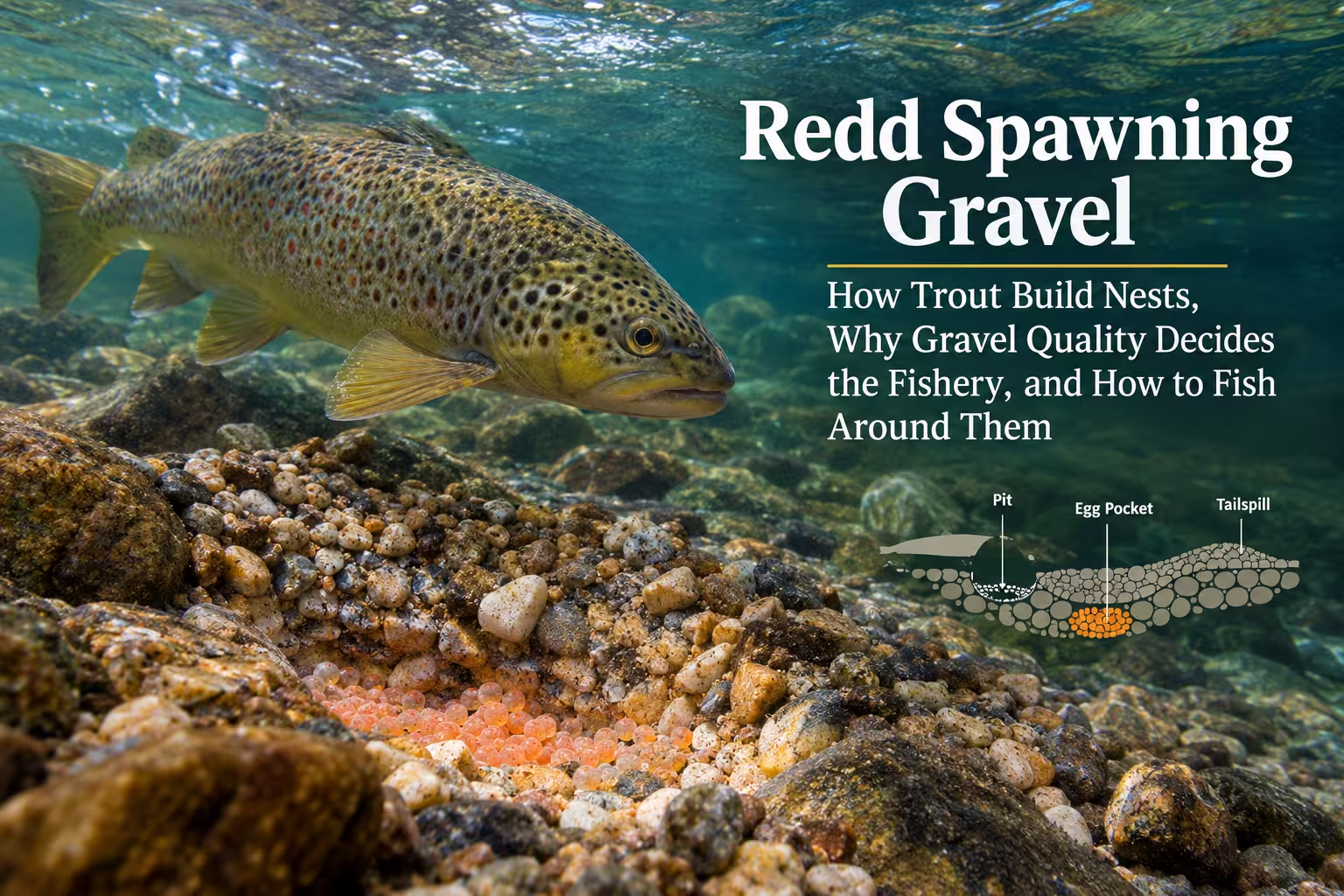
A typical redd has three parts that are easy to recognize once you know what to look for.
The pit (or “pot”). This is the depression the female digs, and it is where the eggs are deposited. She digs it by turning partly onto her side and beating her tail, hard and repeatedly, against the bottom. This tail-beating, which biologists call “cutting,” creates a pressure wave and a strong current that lifts gravel and fine material off the bottom and carries it downstream. The sand, silt, and algae that were sitting on and between the stones get flushed away in the process. That is why a fresh redd looks bright and clean.
The egg pocket. At the bottom of the pit, the eggs settle into the spaces between the stones. A female typically deposits eggs in several pulses, each time with a male alongside her, releasing milt at the same moment. The egg pocket can sit anywhere from a few inches to a foot or more below the surface of the gravel, depending on the fish.
The tailspill. As the female digs, the displaced gravel is carried downstream and settles in a mound just below the pit. After the eggs are fertilized she moves just upstream and digs again, and the gravel she displaces drops back over the egg pocket, burying it. Over a few rounds of this, a single redd can grow into a long, oval-shaped feature with a pit at the head, a raised tailspill at the downstream end, and several egg pockets buried in the mound. A small trout’s redd may be a foot or two across. A large female brown trout or steelhead can build one several feet long.
That final burial step matters more than it sounds. The covering layer of gravel hides the eggs from sight-feeding predators, protects them from being swept downstream in high flows, and sets up a protected microclimate in which water can seep through the stones, bringing in fresh oxygen and carrying away waste.
Why Clean Redd Spawning Gravel Matters for Trout Eggs
It is easy to say trout spawn in gravel. It is more useful to ask why gravel specifically. The reason comes down to a simple fact of fish embryology: an egg buried in a streambed is breathing through its shell, and it cannot move.
A trout embryo is a living, respiring organism. It needs a constant supply of dissolved oxygen delivered to the surface of the egg, and it needs the carbon dioxide and metabolic wastes it produces to be carried away. In open water, that happens easily. In a streambed, it only happens if water can flow through the spaces between the stones. Biologists call this movement of water through the gravel “intragravel flow,” and it is the single most important physical process in a redd.
Gravel works because it is a skeleton of stones with open void spaces between them. Water moves through the voids, delivering oxygen and removing wastes. The larger and cleaner the voids, the better the flow. The more those voids fill with sand, silt, and organic fines, the less water passes through, and the less oxygen reaches the eggs.
This is where gravel quality becomes the deciding factor. Fine sediment is the enemy of every embryo in the stream. If silt and fine sand pack the gaps between stones, the redd becomes a poorly ventilated tomb. Eggs can suffocate even in a stream where the surface water is cold, clear, and rich in oxygen. Research on salmonid streams has repeatedly shown that as the percentage of fine sediment in spawning gravel increases, embryo survival and emergence success fall, often steeply. Even after eggs hatch, the tiny fry (called alevins) still have to wriggle up through the gravel to reach open water. A crust of fine sediment above the egg pocket can trap them, a problem biologists call entombment.
If you want a plain-language way to think about it, imagine a gravel redd as a sponge. A clean sponge passes water easily. A sponge that has been clogged with mud barely passes anything. A trout egg is trying to breathe through that sponge for weeks at a time.
This ties directly into what we covered in our dissolved oxygen post. Oxygen availability is not only about the water you see at the surface. For a developing egg, it is about oxygen in the water inside the gravel, and that number can be much lower than what a meter reading in the open stream suggests.
What Size Gravel Do Trout Choose?
Trout are picky about substrate, and the preference tracks the size of the fish. A female can only move stones she is physically strong enough to move with her tail, so the particle size in a redd scales with body size.
As a general rule, trout spawn in gravel from roughly pea-size up to about the size of a golf ball or a bit larger, with the sweet spot for most small and mid-size trout falling in the range of about half an inch to two inches in diameter. Bigger females, such as a large brown trout or a steelhead, can work gravel and small cobble that would be impossible for a ten-inch brook trout to shift. A common rule of thumb from fisheries research is that a female can move particles up to about ten percent of her body length. A twenty-inch fish can therefore handle stones that a seven-inch fish cannot touch.
Three things have to line up in the substrate:
- The stones must be small enough to move. If the bed is armored with large cobble and boulders, the female cannot dig, and no redd gets built there no matter how perfect the water is.
- The stones must be large enough to leave open spaces. If the bed is mostly sand, the voids are tiny, flow is poor, and eggs suffocate. Sand also tends to shift and collapse into the pit.
- The mix must be mostly clean. Some sand and fine material is natural and unavoidable. A healthy spawning gravel has enough of it to be stable but not so much that it plugs the voids.
This is why good spawning habitat is often patchy even in a fine trout stream. You can walk a quarter mile of boulder-and-bedrock pocket water with no spawning gravel at all, then come to a single gravel bar below a bend that holds a dozen redds in November. Those gravel patches act like nurseries, and the entire population of a long stretch of river may depend on a few of them.
Where in the Stream Trout Build Redds
Trout do not dig redds at random. They select sites that combine the right gravel, the right depth, and the right water movement. The pattern is remarkably consistent from stream to stream, and once you learn it, you can predict where redds will be before you see one.
The tail-out of a pool. The classic redd location is the shallow, gently accelerating water at the downstream end of a pool, where the bed rises toward the riffle that follows. In this zone, surface water is pushed down into the gravel, which creates the downwelling that drives intragravel flow. The velocity is moderate, the depth is usually shallow enough for the female to work comfortably, and the gravel tends to be sorted by the current into just the right size.
The head of a riffle. The upstream edge of a riffle is a close cousin of the tail-out and often serves the same role. Water speeds up as it drops over the transition, and gravel accumulates there.
Gravel bars and the inside of bends. Where currents slow on the inside of a bend, they drop gravel. Bars like this are common redd sites in larger streams and rivers.
Spring seeps and upwelling areas. Brook trout and some other species also use areas where cold groundwater wells up through the bed. Upwelling water is stable in temperature and often rich in oxygen, and it can keep eggs from freezing in winter.
In terms of depth and speed, most trout redds are built in water from roughly six inches to a couple of feet deep, with a steady but not violent current, in the range of around a foot or two per second. These are not exact numbers, and fish adjust to what the stream offers, but the pattern is a reliable guide.
If you have read our piece on how trout use current breaks, notice that spawning fish pay attention to many of the same features, just for a different reason. A feeding trout wants a cushion of slow water next to fast current to save energy. A spawning trout wants a specific combination of moderate current and clean stones to keep eggs ventilated.
The Spawning Calendar: Who Spawns When
Not every trout spawns at the same time of year, and this has a huge effect on how you should fish. The split is simple:
Fall spawners. Brown trout, brook trout, and lake trout (a char) spawn in the fall, generally from about October into December across much of North America, triggered by shortening daylight and falling water temperatures. Their eggs spend the winter in the gravel and hatch in late winter or early spring.
Spring spawners. Rainbow trout and cutthroat trout spawn in the late winter and spring, with timing varying by region and elevation. Rainbows commonly spawn from late winter into spring as water temperatures climb into the 40s Fahrenheit, and cutthroat often spawn later in spring or even early summer in snowmelt-fed streams. Their eggs incubate during the warming months and hatch in a matter of weeks.
The practical meaning is that a stream is never entirely free of redds. In a river with both rainbows and browns, there are active nests for much of the year, and the eggs from one species may still be developing in the gravel while the other is spawning on top. This is also the reason that regulations in many waters include seasonal closures, special rules, or catch-and-release only periods that match the spawning time of the dominant species.
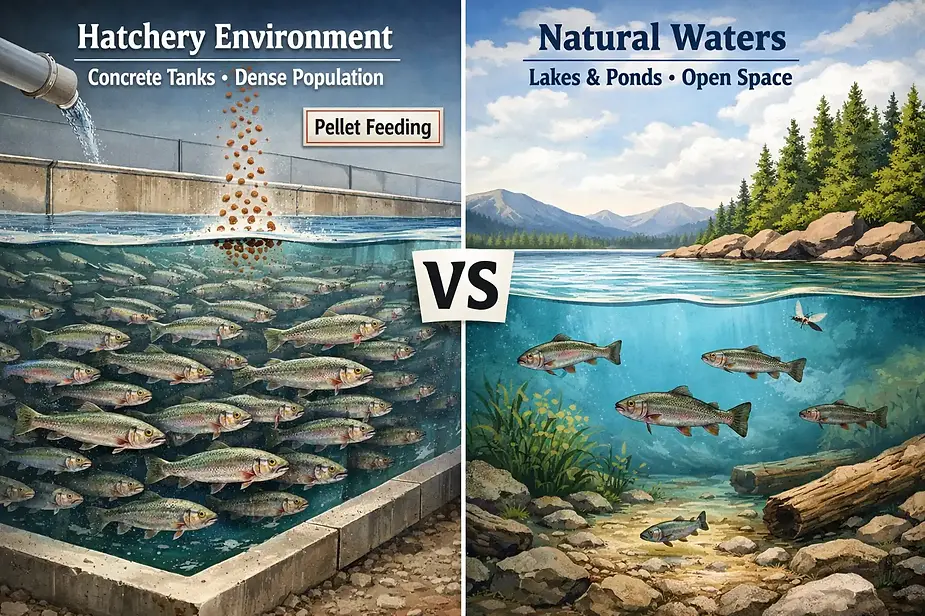
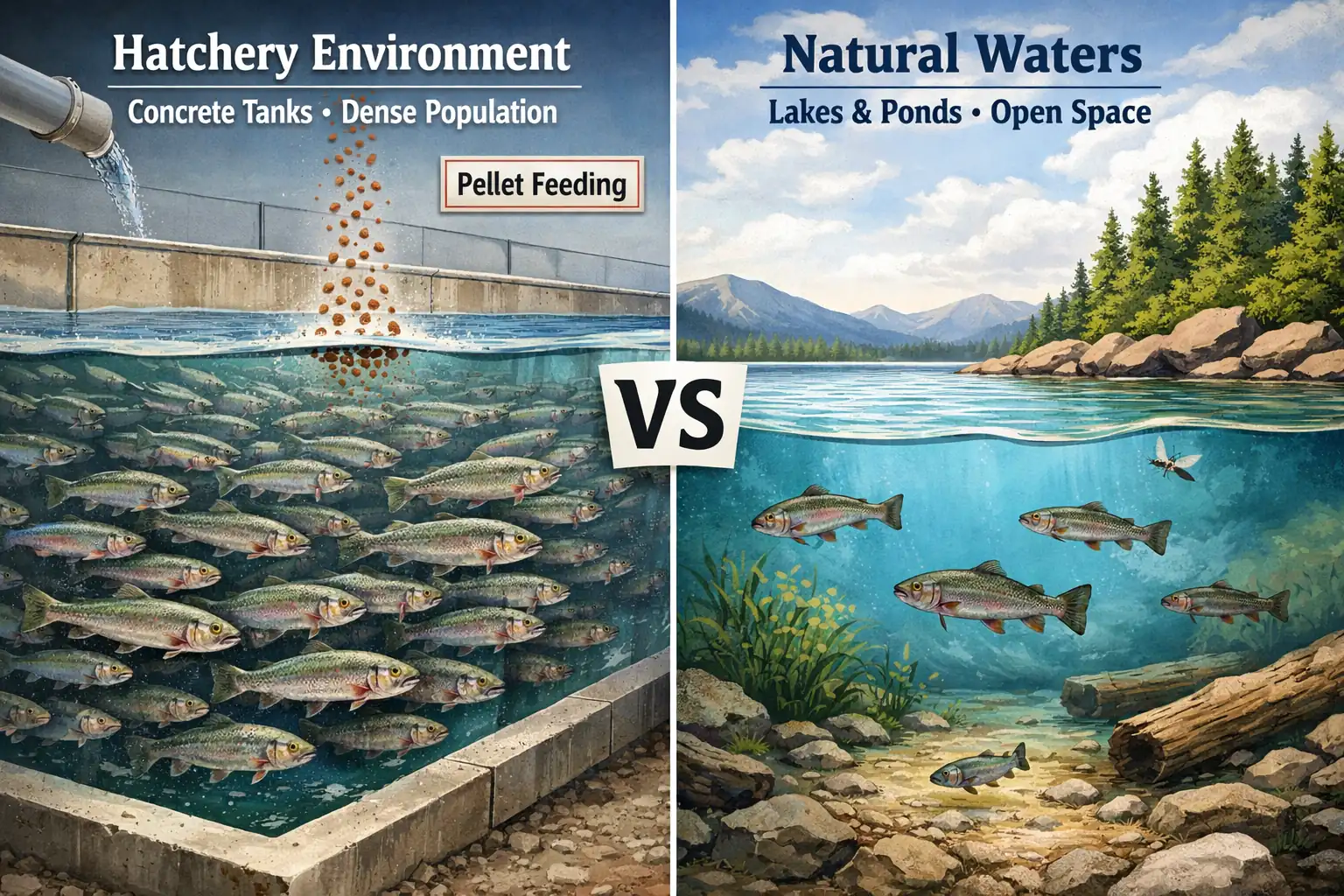
A note on stocked fish. Many fisheries, including a lot of Missouri trout waters and similar put-and-take fisheries elsewhere, are sustained largely by hatchery stocking, not natural reproduction. Hatchery-raised rainbows often try to spawn, and you will sometimes see them cutting redds, but the success rate is generally low in waters that are too warm, too silty, or too stable in flow for eggs to survive. If you fish stocked water, our posts on stocked trout fishing tips for the first 72 hours and stocked trout feeding behavior after hatchery conditioning are better guides to how those fish behave. Redds matter most in wild and naturally reproducing fisheries, but they are worth recognizing anywhere.
The Spawning Act, Step by Step
Watching trout spawn is one of the great experiences of time on the water, and it follows a recognizable script.
First, the female selects a site. She will often hold over a patch of gravel for some time, making trial digs and sometimes abandoning a site that does not feel right. Once she commits, she begins cutting, turning on her side and beating her tail against the gravel. Flashes of her flank, the puff of silt downstream, and the scattering of tiny stones as she works are all easy to spot from the bank.
A dominant male, usually the largest and most colorful, positions himself beside or just downstream of her and defends her against rivals. Smaller “satellite” males often hover around the edges waiting for a chance to sneak in. Males in the fall-spawning species frequently develop dramatic color, especially brown trout and brook trout, and many develop a hooked lower jaw called a kype, which they use in displays and fights over mates.
When the nest is ready, the female settles into the pit with her vent near the stones. The male crowds beside her, and the two fish arch and quiver together. In that moment she releases eggs and he releases milt. The fertilized eggs fall into the spaces between stones. The female then moves just upstream and cuts again, and the gravel she dislodges washes back over the eggs.
This sequence repeats several times over hours or even days until she has deposited most of her eggs. A female trout produces on the order of a thousand or more eggs per pound of body weight, and a large female can lay thousands. She may build more than one redd, and more than one male may fertilize eggs in the same one.
Afterward, the parents leave. The female may guard the area for a short time, but trout provide no real parental care. The eggs are on their own.
The Egg’s Long Wait
Once a redd is covered, the clock starts. How long it takes for the eggs to develop depends mainly on water temperature. Colder water slows development, warmer water speeds it up, and the process is often described in “temperature units” or degree-days, the accumulated temperature across the incubation period. For a rainbow trout, development takes on the order of a month in water in the 50s Fahrenheit and longer in colder water. Brown trout and brook trout, which spawn in the fall into cold water, can take two to three months or more, with the eggs sitting in the gravel through the heart of winter.
During this time, the embryos pass through recognizable stages. The “eyed” stage, when two dark eyespots become visible through the shell, is the point at which the egg is more resistant to handling and physical shock. After hatching, the young fish are called alevins. An alevin looks like a tiny fish dragging a large yolk sac, and it will stay hidden in the gravel while it absorbs that yolk, which can take several more weeks. Only when most of the yolk is gone does the fry swim up out of the gravel, a process called emergence, and begin feeding in the stream.
At every stage of this process, the quality of the gravel matters. The yolk sac stage fish are extremely vulnerable. They cannot yet swim well, and they depend on open channels through the gravel to reach the surface.
What Kills Redds
Understanding what ruins a redd is a good way to understand what keeps a fishery healthy. The major threats are well known to fisheries biologists, and several of them have a direct connection to what anglers see on their home water.
Fine sediment. The leading cause of spawning failure in many streams is excess sand and silt entering from eroding banks, construction sites, logging roads, agriculture, livestock access, and urban runoff. When fine sediment settles into the gravel, it plugs the voids and reduces oxygen delivery. This is a quiet problem. A stream can look fine to a casual observer while the gravel underneath is slowly being smothered.
Floods and bed scour. A large flood during incubation can scour the streambed, ripping out gravel and the eggs inside it. Fall spawners, whose eggs sit through winter and spring runoff, are especially exposed. Spring spawners can be hit by spring floods and snowmelt surges. Natural floods are part of the ecosystem, but when watersheds are altered by development, the floods become flashier and more destructive.
Low flows and dewatering. A redd built at moderate flow can end up high and dry if water levels fall, or can lose the water exchange it needs. Dams that release water in sharply varying amounts, and diversions that pull water from streams, can leave redds exposed.
Temperature. Eggs and alevins have narrow temperature tolerances. Too warm, and development speeds up, oxygen demand rises, and mortality increases. Too cold or freezing, and eggs can be damaged. See our deep dive on water temperature and trout for how this fits into the broader picture.
Superimposition. Later spawners sometimes dig in the same gravel as earlier ones, unearthing and destroying eggs already deposited. This happens naturally when good gravel is scarce, and it becomes more common when habitat is limited or crowded, which is another reason that protecting the few good gravel areas matters.
Predation and egg loss. Eggs that are dislodged and drift downstream become food. Trout, sculpins, suckers, crayfish, and other bottom-dwelling feeders will all eat drifting eggs. This is not a flaw in the system. It is part of the ecosystem and one of the reasons spawning is a feeding event for non-spawning fish.
Wading and trampling. This is the one threat that anglers directly control. A boot or a wading staff crushing a redd can destroy hundreds of developing eggs in a single step, and the damage is invisible because the eggs are buried. Studies of angler wading on redds have documented egg mortality when people walk on them, particularly during sensitive stages of development.
Redds and the Food Web: Why Spawning Changes How Trout Feed
Here is where the biology meets the fishing. Spawning is not a standalone event. It reshapes how trout behave, where they hold, and what they will eat, and it creates feeding opportunities for every fish in the stream.
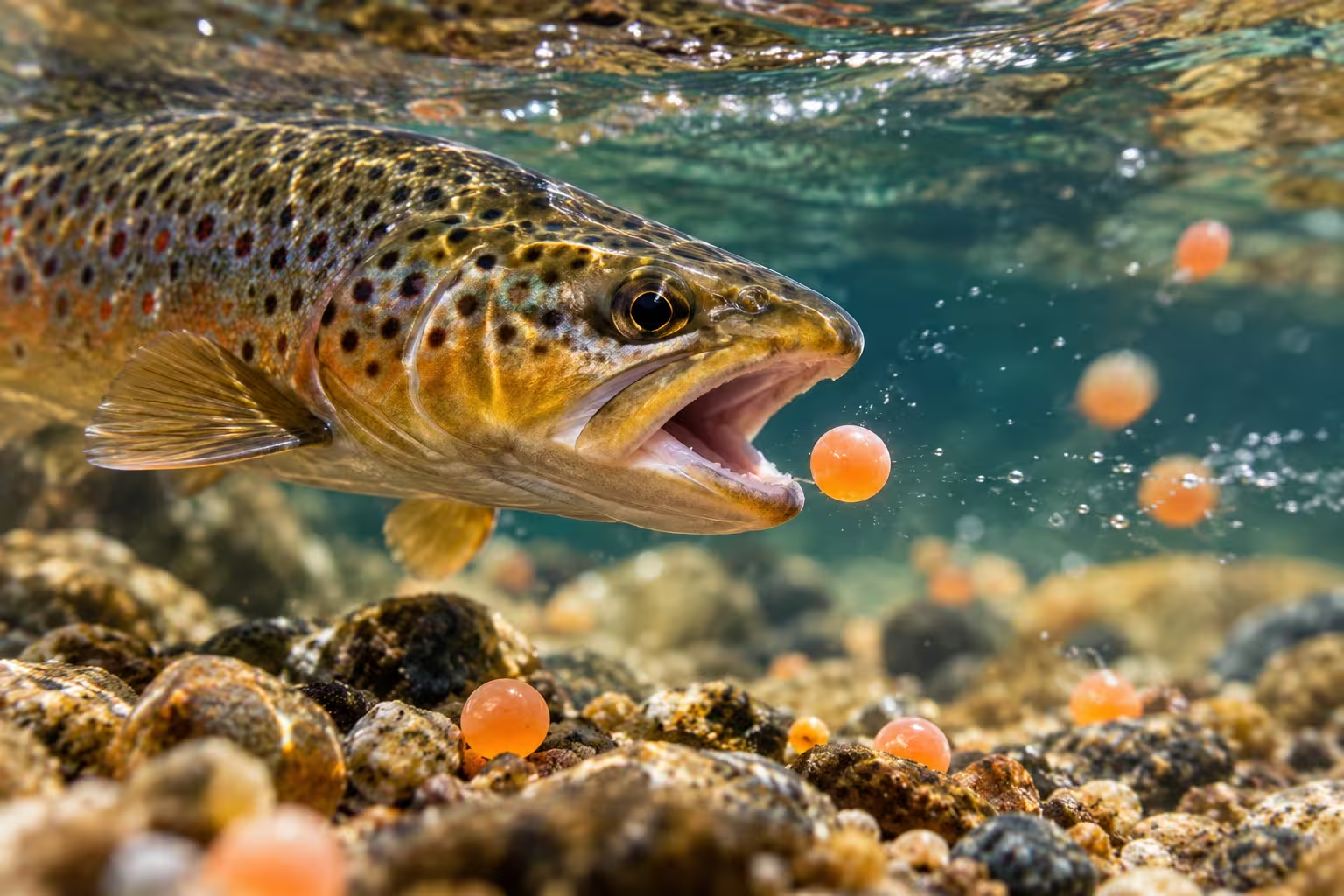
Eggs become a food source. When a female cuts a redd, some eggs always escape the gravel and drift downstream. Trout that are not spawning, including juveniles, males, and fish of other species, position themselves below active redds to intercept those eggs. Biologists have documented this behavior in many streams, and it is why egg patterns and egg imitations are staples in the fall for brown trout and in the spring for rainbows. It is also why our post on synthetic salmon eggs vs real eggs is relevant to this topic: those egg imitations work because they match a real, seasonal, high-protein food that trout learn to expect near spawning gravel.
Digging stirs up the invertebrate community. Gravel is not just a nursery. It is also habitat for a huge amount of insect life. When a female excavates a redd, she dislodges nymphs, larvae, and other invertebrates that lived in the gravel, and the current carries them downstream. Mayflies, stoneflies, caddisflies, midge larvae, and scuds all live in the interstitial spaces of a healthy gravel bed. If you want to understand what is in that gravel, our posts on aquatic insects for trout, stoneflies, midges, and scuds cover the major players. A redd in progress is effectively a conveyor belt of food for any fish sitting below it.
Sculpins and bottom feeders gather. Sculpins in particular love gravel, and they will pick over redd areas for eggs and displaced invertebrates. That in turn draws larger trout that eat sculpins. Read our piece on sculpins as a trout food source for how that relationship works.
Crayfish and hellgrammites use the same gravel and cobble. Both are significant predators in the streambed, and both are on the menu for larger trout. See our posts on hellgrammites and why trout eat crawfish if you want to understand how these bottom-dwellers fit into the same food web.
Spawning is expensive. For the fish that do the spawning, the process is a major energy drain. Fall-spawning browns and brook trout can lose a substantial share of their body condition during the spawning period, because they spend weeks fighting, digging, and defending instead of feeding. That is where our post on trout energy conservation comes in. A trout is always running an energy budget, and spawning is the largest withdrawal it makes. After spawning, fish that survive are often hungry and thin, and they feed hard to rebuild. Anglers call these post-spawn fish “kelts” in the sea-run context, and the same basic idea applies to resident trout: the weeks after spawning can produce aggressive, hungry fish in the pools below spawning areas.
This changes the way you think about trout diet by season. In late fall and early spring, a trout’s menu includes eggs, dislodged insects, and baitfish and sculpins pulled into the area, on top of the usual insect hatches and terrestrial food that dominate summer.
How to Recognize a Redd
You cannot protect what you cannot see, so it is worth learning to spot redds. A few cues help:
- Color contrast. A fresh redd is noticeably lighter and cleaner than the surrounding bed. Over time, it gets covered with algae and silt again and fades, but in the weeks after spawning it often stands out as a pale patch.
- Shape. Look for an oval pit upstream and a rounded mound downstream. The mound is often slightly raised above the surrounding bed.
- Stone size. The gravel in a redd is usually a bit smaller and more uniform than the bed around it, because the female has sorted and cleaned it.
- Fish behavior. If you see a trout holding motionless over a clean patch, or a pair of fish close together over gravel, assume there is a nest there. In the fall, a big male brown trout holding steady in shallow water alongside a female is a strong hint.
- Polarized sunglasses. They cut surface glare and make redd detection far easier, especially in shallow water with good light.
If you are new to spotting them, look in the places discussed earlier: pool tail-outs, riffle heads, and gravel bars. Spend a few minutes looking before you step into the water, and plan your wading path to avoid those clean patches.
Fishing Around Redds: The Ethical Angle
This is the part of the conversation where a biologist and an angler have to sit at the same table. Fishing during the spawn is a debated subject, and thoughtful anglers land in different places. Here is the straightforward version.
Know the regulations first. Many states and managed waters have seasonal closures, catch-and-release-only periods, or special gear rules specifically to protect spawning fish and redds. Follow them without exception. Regulations are written by fisheries biologists with knowledge of the local population, and they are the baseline.
Never wade on redds. This is the single most important thing an angler can do. If you can see a redd, stay out of it. If you cannot be sure whether the water you are about to wade is a redd area, stay off gravel patches in pool tail-outs and riffle heads in spawning season, and cross where the bottom is clearly rough and cobbled instead.
Do not target fish actively on the nest. A trout that is cutting a redd or defending one is not feeding in any normal sense, and it is spending irreplaceable energy. Pulling it off the nest, even briefly, can interrupt spawning, expose eggs to predators, and drain a fish that has little in reserve. Many anglers and guides treat spawning fish as off limits, and you will earn respect on the water for doing the same.
Fish the water below and around, not on, the gravel. The fish that are feeding on drifting eggs and dislodged insects are positioned downstream of the redds, often in deeper, slower water, and they are legitimate targets where fishing is legal. Fishing these fish takes pressure off the nest while still putting you in contact with feeding trout.
Handle every fish carefully. Spawning-season fish are stressed. Cold water helps oxygen levels, but a fish that has been fighting rivals and digging gravel has less reserve than usual. Keep them in the water, use barbless hooks, minimize air exposure, and release them quickly. Our post on trout catch-and-release covers the details of what actually keeps fish alive.
Skip the net lift for big fish. Use a rubberized net, support the fish in the water, and avoid squeezing the belly of a female. Handling gravid females carelessly can damage eggs.
Practical Tactics: Fishing the Egg and Gravel Food Web
When you fish legally and responsibly around spawning areas, the feeding patterns we described translate into some clear tactics.
Match the egg. Egg imitations in the right color and size work best below redds. Natural trout eggs are typically in the range of a pea, sometimes a bit smaller, and the color runs from pale cream and peach to orange depending on species and diet. Rainbow trout eggs tend to be smaller and paler, while brown trout eggs tend to be a deeper orange or peach. Fish egg patterns on a dead drift, close to the bottom, because that is how real eggs travel.
Think nymphs and larvae. A redd stirs up a lot of nymph life, so natural-looking insect patterns that match what lives in your local gravel can be just as productive as eggs. Stonefly nymphs, caddis larvae, and scuds are all reliable.
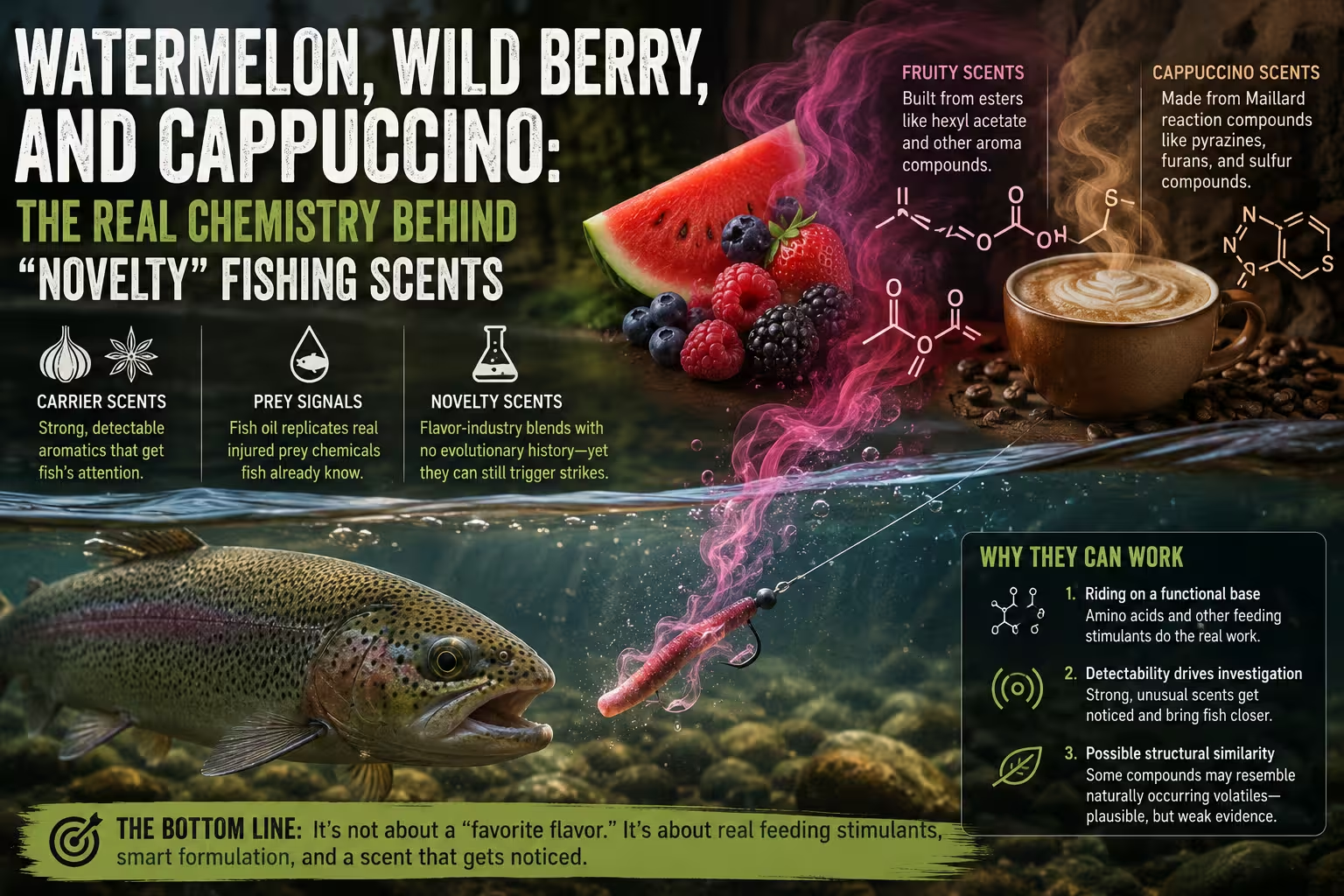
Use worms and worm-style baits. Worm imitations are among the most dependable trout lures year-round, and they imitate food that washes out of banks and gravel after high water and disturbance. Our post on why trout eat worms explains the logic, and our guide to the best trout lures for beginners shows how to build a simple starter lineup.
Watch for the aggression window. Pre-spawn brown trout can be territorial and aggressive, and larger predatory fish may take streamers and baitfish imitations aggressively. Post-spawn fish are hungry. Both can produce excellent fishing, as long as you are catching them away from active nests.
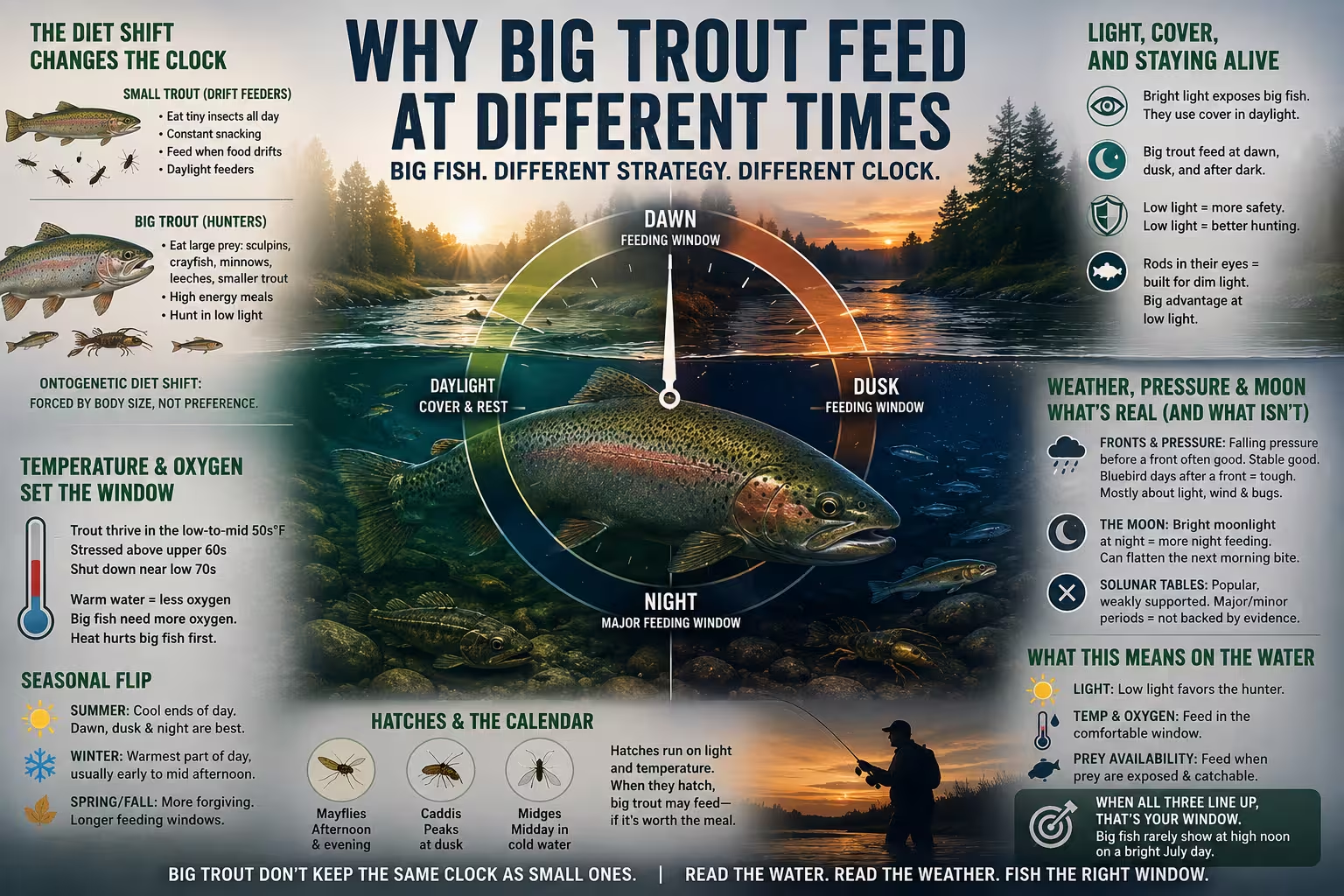
Time your day. Cold weather changes the daily bite window. In late fall and early spring, midday is often the warmest and most active period. For a broader look at timing, see our post on the best time of day to catch trout and why big trout feed at different times.
A Closing Thought
If you take one idea from this post, let it be this: a trout stream is only as good as its worst-limiting habitat, and for a surprising number of streams, that limiting factor is a few patches of clean gravel. The deep pools and undercut banks that anglers love to cast to are where adult trout live. The gravel is where they come from.
Understanding redds changes how you read a stream. A pool tail-out stops being just a place where the water gets shallow before the riffle and becomes a possible nursery. A pale patch of stones stops being a convenient place to stand and becomes a nest. Eggs drifting downstream explain why a certain run holds so many fish in the fall. Insects dislodged from gravel explain why the water below a spawning bar fishes so well. And a thin, hungry post-spawn trout explains why the same pool can go from lifeless to loaded in a matter of weeks.
The best trout anglers are part biologist, whether they know it or not. They read the water, they understand the food, and they protect the habitat that makes the fishing possible. Learn to recognize redd spawning gravel, step around it, and fish the water that surrounds it, and you will see more fish, catch more of them, and leave behind a stream that keeps producing for the next generation.
Frequently Asked Questions
What is a trout redd?
A redd is a nest that a female trout digs in the gravel of a streambed to hold her eggs. It usually consists of a shallow pit at the upstream end and a raised mound of gravel, called the tailspill, just downstream. The eggs are buried beneath the gravel, where flowing water supplies oxygen and carries away wastes.
What does a trout redd look like?
A fresh redd looks like a clean, light-colored oval patch of gravel that stands out against the darker, algae-covered or silty bed around it. You will usually see a slight depression at the head and a rounded mound at the tail. It is typically a foot or two across for small trout and larger for big fish.
What size gravel do trout need to spawn?
Most trout spawn in gravel from about pea-size to golf-ball size, with the ideal range for many streams falling between roughly half an inch and two inches. Larger fish can move larger stones. The gravel must be small enough for the female to move but large enough to leave open spaces for water to flow through.
When do trout spawn?
It depends on the species. Brown trout, brook trout, and lake trout spawn in the fall, generally October through December. Rainbow trout and cutthroat trout spawn in late winter and spring, with timing varying by region, elevation, and water temperature.
Do stocked trout spawn?
Hatchery-raised trout often attempt to spawn, and you may see them digging redds, but successful natural reproduction is uncommon in many stocked waters because the habitat, temperature, or sediment conditions are not suitable for eggs to survive. Fisheries that depend on stocking usually need regular restocking to maintain fish numbers.
How long does it take trout eggs to hatch?
Incubation depends on water temperature. Rainbow trout eggs may hatch in around a month in moderately cool water, while fall-spawned brown and brook trout eggs can take two to three months or more in cold winter water. After hatching, the alevins stay in the gravel for several more weeks before emerging.
Is it bad to step on a redd?
Yes. Walking on a redd can crush eggs and alevins buried in the gravel and can pack down the stones, reducing the flow of oxygenated water. Because the eggs are hidden, the damage is invisible, which is why it is so important to learn to recognize redds and wade around them.
Is it ethical to fish for trout that are spawning?
Most fisheries biologists and many experienced anglers recommend not targeting fish that are actively spawning or guarding a redd. Spawning is energetically demanding and critical for the population. A better approach is to fish the water below and around spawning areas for non-spawning fish that are feeding on drifting eggs and insects, and to follow all local regulations and seasonal closures.
Why do trout eat eggs from other trout’s redds?
Trout are opportunistic feeders, and drifting eggs are a calorie-dense, easy-to-catch food. Eggs that escape from a redd during digging drift downstream, and non-spawning trout, sculpins, suckers, and other fish take advantage of them. This is a normal part of the stream ecosystem and the reason egg patterns work so well near spawning areas.
What damages spawning gravel the most?
The most common problem is excess fine sediment from erosion, runoff, livestock access, and construction, which fills the spaces between stones and cuts off oxygen to the eggs. Floods that scour the bed, falling water levels that expose redds, and temperature extremes are other major threats.
How can I help protect trout spawning habitat?
Stay off redds, follow seasonal regulations, and release fish carefully. Beyond the water’s edge, support streamside vegetation and livestock exclusion fencing, volunteer with local Trout Unlimited chapters or watershed groups, and take part in redd counts and restoration projects when you can.
About Family Fishin
Family Fishin is a family-owned fishing tackle company dedicated to designing, testing, and producing high-quality fishing lures — inspired by generations of fishing tradition and driven by a passion for innovation. Every product is developed with one goal in mind: helping anglers spend more time doing what they love, catching fish and creating memories on the water.
Post Tags: #redd #spawning gravel #trout spawning #trout behavior #wild trout #brown trout #rainbow trout #fishing biology #trout habitat #trout food sources