Brook Trout: How to Identify Them, Where to Find Them, and How to Catch Them.
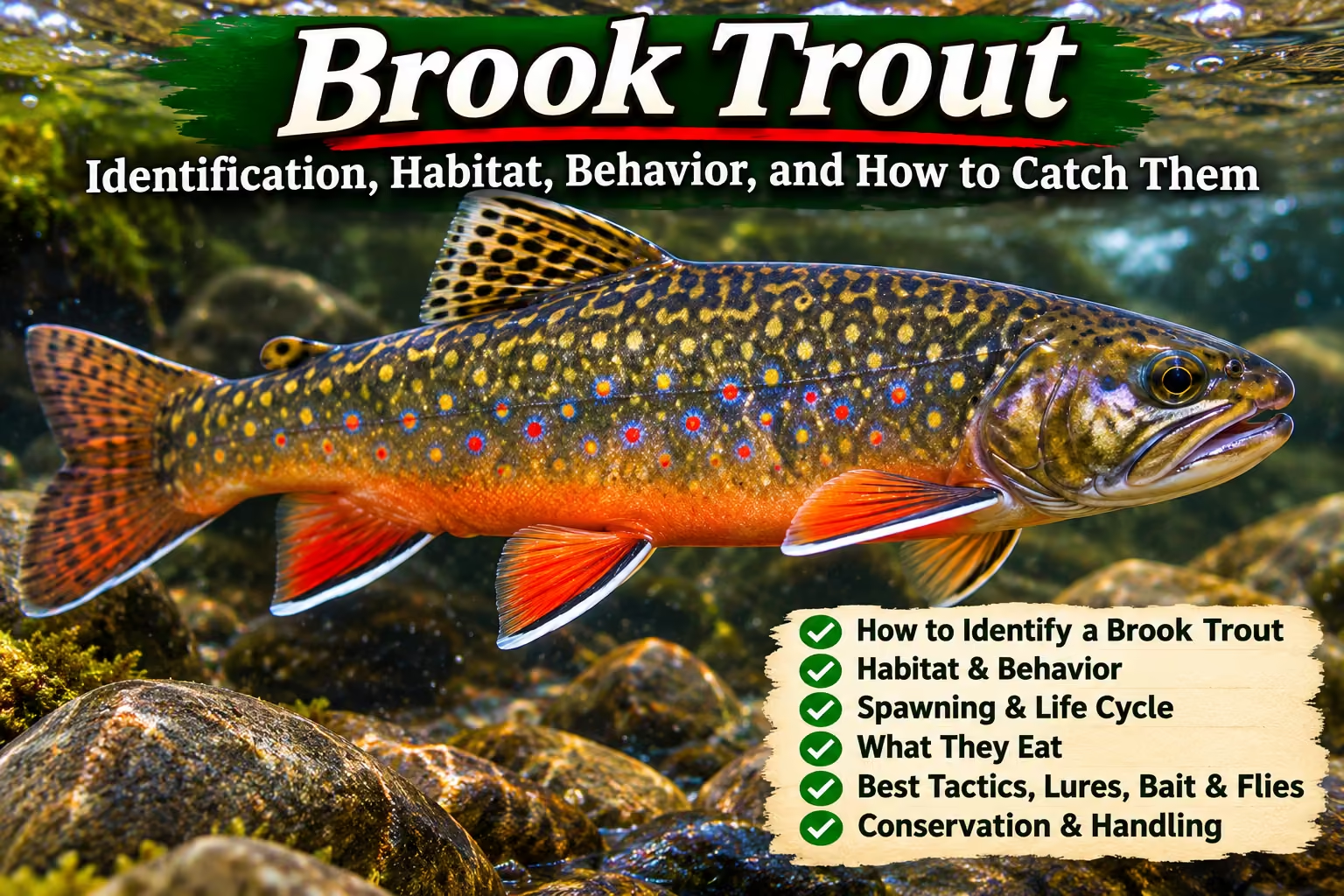
Brook trout (Salvelinus fontinalis) are recognized by their marbled olive-green backs, pale spots on a dark body, red spots ringed in blue, and orange-red lower fins edged in white. Coloration varies by habitat, season, and spawning condition.
There is a moment every angler remembers. You have crept up a small, cold creek, crouched behind a boulder, and flicked a tiny bait into a pocket no bigger than a kitchen table. The line twitches. You lift, and a fish the size of your hand comes up out of the shadows looking like it was painted by someone who had just discovered every color in the box. Dark olive back with pale worm-like markings. Sides scattered with yellow spots and red dots circled in blue. A belly that glows orange. Lower fins edged in a stripe of bright white.
That is a brook trout, and it is one of the most beautiful freshwater fish in North America. It is also one of the most misunderstood. It is not technically a trout. It does not live where most trout live. It is usually easier to catch than a brown or a rainbow, and yet it can vanish from a stream that is only a few degrees too warm. It is a fish of cold springs, shaded headwaters, beaver ponds, and big northern lakes, and it rewards the angler who learns to move quietly, fish small, and think like the water.
This guide covers everything you need to know about brookies. We cover how to identify them (and how to avoid mixing them up with brown trout and tiger trout), where they came from and where they live, how their fall spawn works, what they eat, how temperature controls everything about their behavior, and how to catch them with ultralight spinning gear, soft plastics, bait, and flies. We finish with conservation and handling, a game plan for unfamiliar water, and a detailed FAQ.
This post is part of our trout species and behavior series. It builds on our overview of rainbow, brown, brook, and cutthroat trout and connects to our complete system in How to Catch Trout. If you want to compare brookies with the fish that most often share their water, see our guide to brown trout vs rainbow trout.
Brook Trout Quick Facts
| Feature | Brook Trout |
|---|---|
| Scientific name | Salvelinus fontinalis |
| Group | Char (same genus as lake trout and Arctic char) |
| Native range | Eastern North America, from northern Canada down the Appalachians to Georgia |
| Best ID marks | White-edged lower fins; marbled (vermiculated) back; pale spots on a dark body; red spots with blue halos |
| Spawning season | Fall (roughly September through November) |
| Preferred water temperature | About 45 to 60°F; stress begins around the mid-to-upper 60s |
| Typical habitat | Cold headwater streams, spring-fed creeks, beaver ponds, northern lakes |
| Personality | Bold, opportunistic, but easily spooked by movement and shadows |
| Typical size | 6 to 12 inches in small streams; several pounds in big northern waters |
| Top tactics | Ultralight spinners, small soft plastics, worms, small dry flies and nymphs |
Is a Brook Trout Really a Trout?
Technically, no. Brook trout belong to the genus Salvelinus, which makes them char. Their closest relatives are lake trout, Arctic char, and Dolly Varden, not rainbow or brown trout. Rainbow trout belong to the Pacific trout group, and brown trout belong to the genus Salmo, alongside Atlantic salmon.
Anglers call them trout for good reason. They live in the same kind of cold, clean water, they eat many of the same foods, and they respond to many of the same tactics. But the char heritage explains several things you will notice in the field:
- The reversed spotting pattern. Trout have dark spots on a light body. Char have light spots on a dark body. That pale-on-dark pattern is the first thing that tells you a brookies is not a rainbow or brown.
- The white-edged fins. Char typically show bright leading edges on the lower fins. Trout do not.
- The fall spawn. Like most char, brookies spawn in autumn, usually over gravel where cold groundwater seeps up through the stream bed.
- The love of cold water. Char are cold-water specialists. brookies are the least tolerant of warm water of the common stream species.
How to Identify a Brook Trout
brookies have the most distinctive field marks of any North American stream fish. Once you know them, you will not mistake one for anything else.
White Leading Edges on the Lower Fins
Look at the pectoral, pelvic, and anal fins on the underside of the fish. On a brookies, each has a bold white leading edge, followed by a thin black stripe, followed by orange to red. This is the fastest way to identify a brookie, and it works even on fish that are pale or silvery.
Worm-Like Marbling on the Back
The back and dorsal fin carry wavy, irregular, pale markings called vermiculations. They look like marbling or like worm tracks in dark mud. No rainbow, brown, or cutthroat has this pattern. If you see it, you have a brook trout or a hybrid that has brook trout parentage.
Pale Spots and Blue-Haloed Red Dots
The sides of a brookie carry pale yellow or cream spots on a dark olive background. Scattered among them are small red or orange dots ringed with blue. The pale-on-dark spotting is the reverse of what you see on rainbows and browns.
No True Black Spots
A pure brook trout has no black spots on the body. If you catch a fish with brook trout features plus bold black spots, look more closely. It may be a hybrid, such as a tiger trout.
A Squared or Barely Forked Tail
The tail is usually squared or only slightly forked, and it is mottled rather than spotted.
Spawning Colors
In the fall, male brookies are spectacular. The belly turns deep orange to crimson, the back darkens, the lower fins turn nearly black with brilliant white edges, and the jaw develops a pronounced hook called a kype. Females also color up, though less dramatically. A fish in full spawning dress is easy to identify from across a stream.
Coasters and Salters
Not every brookie lives its whole life in a small creek. Coaster brook trout live in Lake Superior and return to tributary streams to spawn. Salters, found in parts of the Northeast and Atlantic Canada, spend part of their lives in brackish water or the sea. Both forms are more silvery than stream-resident fish but keep the white-edged fins and some of the marbling.
Brook Trout vs Brown Trout vs Tiger Trout
Three fish are commonly confused in water where brookies and brown trout overlap.
| Feature | Brook Trout | Brown Trout | Tiger Trout |
|---|---|---|---|
| Lower fins | Orange-red with bold white leading edge | Plain, sometimes tinged yellow-orange | Often orange with pale edges |
| Back pattern | Marbled, wavy lines | Spotted, no marbling | Bold, worm-like markings across the whole body |
| Body spots | Pale spots; red dots with blue halos | Black spots and red spots with pale halos | Few distinct spots; strong tiger-stripe pattern |
| Spawning | Fall | Fall | Sterile in most cases |
| Where found | Cold headwaters, spring creeks, northern lakes | Larger, slower, warmer water; structure | Stocked lakes and ponds in some states |
A tiger trout is a cross between a brook trout and a brown trout. Tigers are rare in the wild but are produced by hatcheries because they are sterile, and several states stock them in lakes and ponds. They are aggressive and often grow fast. If a fish has brookie marbling spread across its entire body instead of just the back, it is probably a tiger.
For a deeper side-by-side on the species brookies most often share water with, see our guide to brown trout vs rainbow trout.
Where Brook Trout Came From and Where They Live Now
The Native Range
brookies are native to eastern North America. Their original range runs from northern Canada and the Great Lakes region down the Appalachian Mountains into northern Georgia. In the cold streams of the Northeast and the high Appalachians, brookies were the only trout. They are the state fish of several eastern states.
A Fish Under Pressure at Home
In their native range, brook trout have lost a great deal of ground. Logging, development, road crossings, warming streams, and competition from introduced brown and rainbow trout have all reduced wild populations. Many conservation groups, agencies, and local anglers now work to protect and restore wild brookies streams. That context matters for how you fish: a wild brook trout in a tiny eastern headwater may be part of a population that has survived for thousands of years.
A Fish Introduced Elsewhere
brookieshave also been introduced across the western United States and Canada, and to Europe, South America, and elsewhere. In some western headwater lakes and streams they are considered invasive because they can displace native cutthroat trout. In those waters, agencies often encourage harvest. In their native East, wild brook trout waters often have the opposite emphasis: release. This is why checking regulations for each water you fish is not optional.
Stocked brookies
Many states stock hatchery brook trout in ponds and streams, especially in the spring. Stocked brookies are usually easier to catch than wild ones and respond well to many of the same finesse presentations we describe later. Our guide to when stocked trout actually eat explains how catch rates change in the first few days after a stocking, and the same principles apply to brookies
Brook Trout Habitat: Where to Look
brookies do not live just anywhere. They need cold, clean, oxygen-rich water, and they are often found in places other trout cannot tolerate or ignore.
Headwater Streams
Small, steep, shaded streams in forested hills are classic brook trout water. These streams stay cold because of tree cover, groundwater, and elevation. Look for pools, plunge pools below small falls, and the pockets behind boulders. In a very small stream, a single deep pool can hold most of the fish in a long stretch.
Spring Seeps and Spring Creeks
Groundwater is the key. Springs deliver water that stays cold in summer and relatively warm in winter, and brookies concentrate around them. In hot weather, the mouth of a spring seep or a cold tributary can hold fish when the rest of the stream is too warm.
Beaver Ponds
Beaver ponds are brookies factories in many regions. They offer deep water, cover, and abundant food. The edges, the inlet, and the area around the dam are all worth fishing. Be aware that beaver ponds can also warm the water, so the best ponds are the ones fed by cold springs or shaded tributaries.
Lakes and Large Rivers
In northern waters, especially in Canada and parts of the Northeast and Great Lakes region, brook trout live in large lakes and rivers, where they can grow to several pounds. Fish in these waters feed heavily on baitfish, leeches, and mayfly hatches. The all-tackle world record is 14 pounds 8 ounces, caught in the Nipigon River in Ontario in 1916, and Lake Superior coasters are famous for their size.
What They Need
- Cold water. They feed best at roughly 45 to 60°F and are the first trout to suffer as water warms.
- Clean gravel for spawning. Without it, populations fail.
- Cover. Undercut banks, overhanging vegetation, boulders, and woody debris give them a place to hide.
- Oxygen. Cold, moving, shaded water holds more dissolved oxygen than warm, slow water.
- Clean water. brookies tolerate somewhat more acidic water than browns and rainbows, but pollution, sedimentation, and acid deposition have still harmed many streams.
Temperature: The Rule That Controls Everything
If you remember one thing about brookies, remember this: temperature decides where they live, when they feed, and whether they survive a catch.
Brook trout are the least tolerant of warm water among the common stream trout. They feed best between roughly 45 and 60°F. As water climbs through the mid-60s, they become stressed. In the upper 60s and above, they can die, even if they swim away after release. Because many brook trout streams are small and have little room to retreat, a few warm days can concentrate fish in a few cold pockets and make them extremely vulnerable.
Practical rules:
- Carry a stream thermometer. It costs a few dollars and tells you whether you should be fishing at all.
- Fish early on hot days. Water is coldest at dawn.
- Stop when it gets too warm. If the water is in the mid-to-upper 60s, consider ending the day or moving to a colder stretch.
- Look for refuges. Springs, cold tributary mouths, deep pools, and shaded runs.
- Remember that weather matters. Our guide to how weather affects trout fishing explains how rainfall, temperature, and flow change feeding behavior.
The Fall Spawn
The char spawn is one of the great spectacles of the cold-water world. It is also the most important period in their year, and it deserves respect.
How It Works
char spawn in the fall, usually from roughly September through November, depending on latitude and elevation. Females build redds in clean gravel, often near spring seeps where upwelling groundwater keeps the eggs supplied with cold, oxygen-rich water. Males defend territory, display their brilliant colors, and compete for access to females. After spawning, the eggs incubate in the gravel through winter and hatch in late winter to spring.
What It Means for Anglers
- Pre-spawn fish feed hard. In the weeks before spawning, these fish are aggressive and bold, which makes for great fishing.
- Eggs drift. During spawning, loose eggs are in the drift, and other fish feed on them. Our guide to why trout eat eggs explains the biology.
- Redds are fragile. A redd looks like a clean, lighter patch of gravel with a shallow pit upstream and a mound downstream. Do not wade through it. Our article on redd spawning gravel shows you how to recognize a nest.
- Leave spawning fish alone. Fish on redds are doing the most important thing they do all year. Many anglers choose not to target them at all, and some waters are closed during spawning.
What Brook Trout Eat
brookies are opportunists. In small headwater streams, food is limited, so they cannot afford to be picky. They will eat almost anything that looks like food and fits in their mouths.
Aquatic Insects
Mayflies, caddisflies, stoneflies, and midges are staples. In small streams, drifting nymphs are an important food source, and brook trout hold in pockets where the current delivers them. See our guides to caddisflies and midges for the details.
Terrestrial Insects
In summer, ants, beetles, grasshoppers, and caterpillars fall from overhanging vegetation. brookies in shaded streams depend heavily on this food, and a small terrestrial imitation can be one of the best flies in July and August.
Worms
Rain washes earthworms into creeks, and these fish rush to eat them. This is one reason small worm imitations are so effective, especially after rain.
Crustaceans
Scuds, small crayfish, and other crustaceans are important in spring-fed streams. See our guide to scuds for more.
Fish and Other Prey
Larger brookies eat minnows, sculpins, and even small salamanders. In big northern lakes and rivers, baitfish are a major part of the diet. See our guide to sculpins for how bottom-dwelling baitfish fit in.
Eggs
Char will eat drifting eggs during the spawn, whether their own species or others.
Brook Trout Behavior
Bold, but Spooky
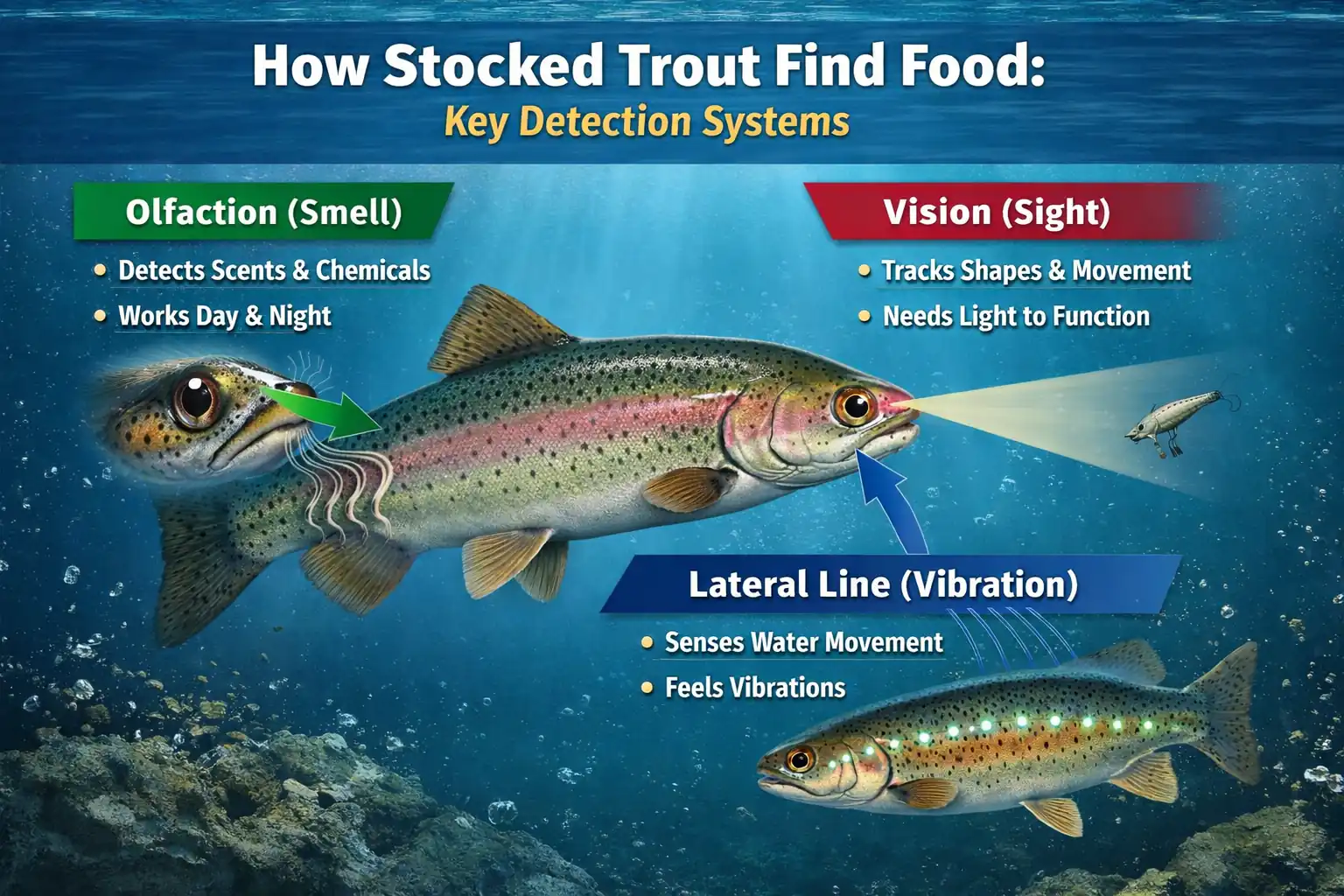
Brook trout have a reputation for being easy, and that reputation is half true. In remote streams with little fishing pressure, they will often attack a bait on the first cast. But they are also extremely sensitive to movement, vibration, and shadow. A brookie that sees you will dart under a bank and refuse to feed for a long time. The easiest char to catch are the ones that never see you.
Territorial Hierarchy
In small pools, the biggest fish take the best positions, usually at the head of the pool where food drifts in. Smaller fish hold on the edges. This means the first fish you catch from a pool is often the dominant one, and once it is gone, the next-largest fish may move up. It can pay to fish a good pool patiently and watch who moves.
Short Lives, Fast Growth Where Food Allows
In small streams, brookies often live only a few years. A 7- or 8-inch fish may be fully mature. In richer water, such as spring creeks and big northern lakes, they grow faster and larger.
Low-Light Feeders in Pressured Water
In clear, pressured water, brookies will feed more in the early morning and evening and during overcast weather. Where pressure is light, they will feed throughout the day. In either case, they feed more actively when water temperatures are in their preferred range.
Do They Learn?
Yes. Even brookies can become cautious in heavily fished water, especially stocked fish that have been caught a few times. We cover this in Do Trout Learn to Avoid Lures?
How to Catch Brook Trout: The Core Approach
Char fishing comes down to four principles: approach quietly, fish small, present naturally, and fish the right water.
Approach Quietly
Walk slowly, stay low, and avoid casting your shadow across the water. Wear drab clothing. In very small streams, approach pools from downstream and keep a boulder or bush between you and the fish. Cast from a crouch or a kneel, and do not stomp on the bank. Vibrations travel through the ground and into the water.
Fish Small
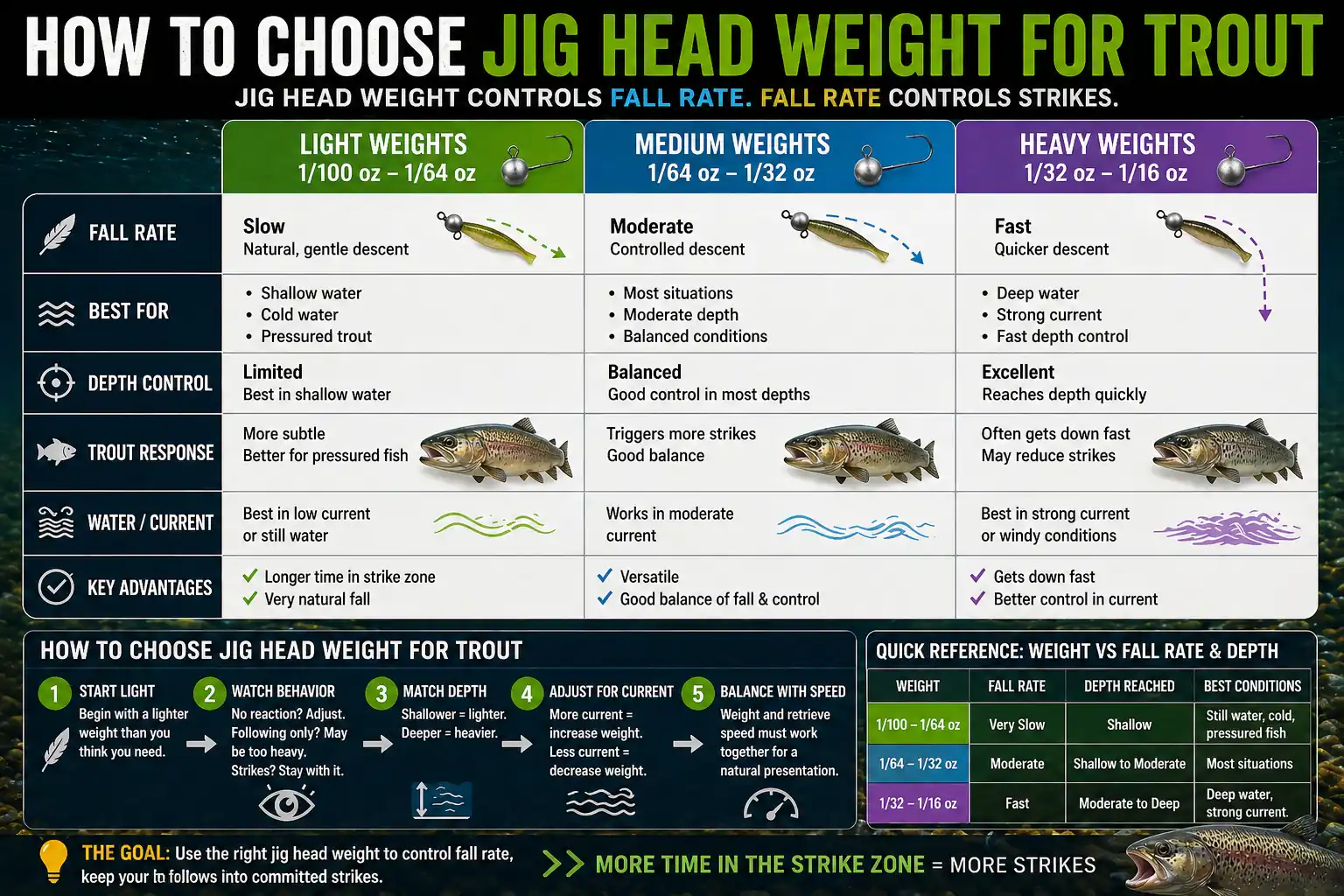
Small streams call for small baits and light line. Tiny hooks, light jig heads, and 2 to 4 pound line let you present baits naturally and feel every bite. Brook trout have small mouths, and an oversized bait often results in short strikes and missed fish. Our guide to small baits and finesse fishing goes deeper on why smaller profiles produce more bites.
Present Naturally
Let the bait drift with the current and look like food that fell in the water. Avoid dragging the bait across the current or reeling it in a way that looks unnatural. In pockets, a dead drift with a gentle lift is often best.
Fish Upstream
Trout face into the current and are less likely to see you if you approach from behind. Cast upstream or up and across, and let the bait drift back toward you, keeping just enough line tension to feel the bite.
Ultralight Spinning Gear for Brookies
The Setup
- Rod: A 5½ to 6½ foot ultralight rod. Short rods are easier to cast in tight, brushy streams.
- Reel: A 1000-size spinning reel.
- Line: 2 to 4 pound monofilament or fluorocarbon. In clear water, fluorocarbon or a fluorocarbon leader helps. Our guide to the best fishing line for trout explains how to choose.
- Terminal tackle: Small hooks, light split shot, and 1/80 to 1/32 ounce jig heads.
Inline Spinners and Spoons
Size 0 and size 1 inline spinners are classic brookie lures. Cast upstream or across and retrieve with the current, just fast enough to keep the blade turning. Small spoons and tiny crankbaits in the 1.5-inch range also work, especially in beaver ponds and lakes. Many brook trout waters allow only artificial lures, and spinners are legal nearly everywhere, but check your regulations.
Jigs and Soft Plastics
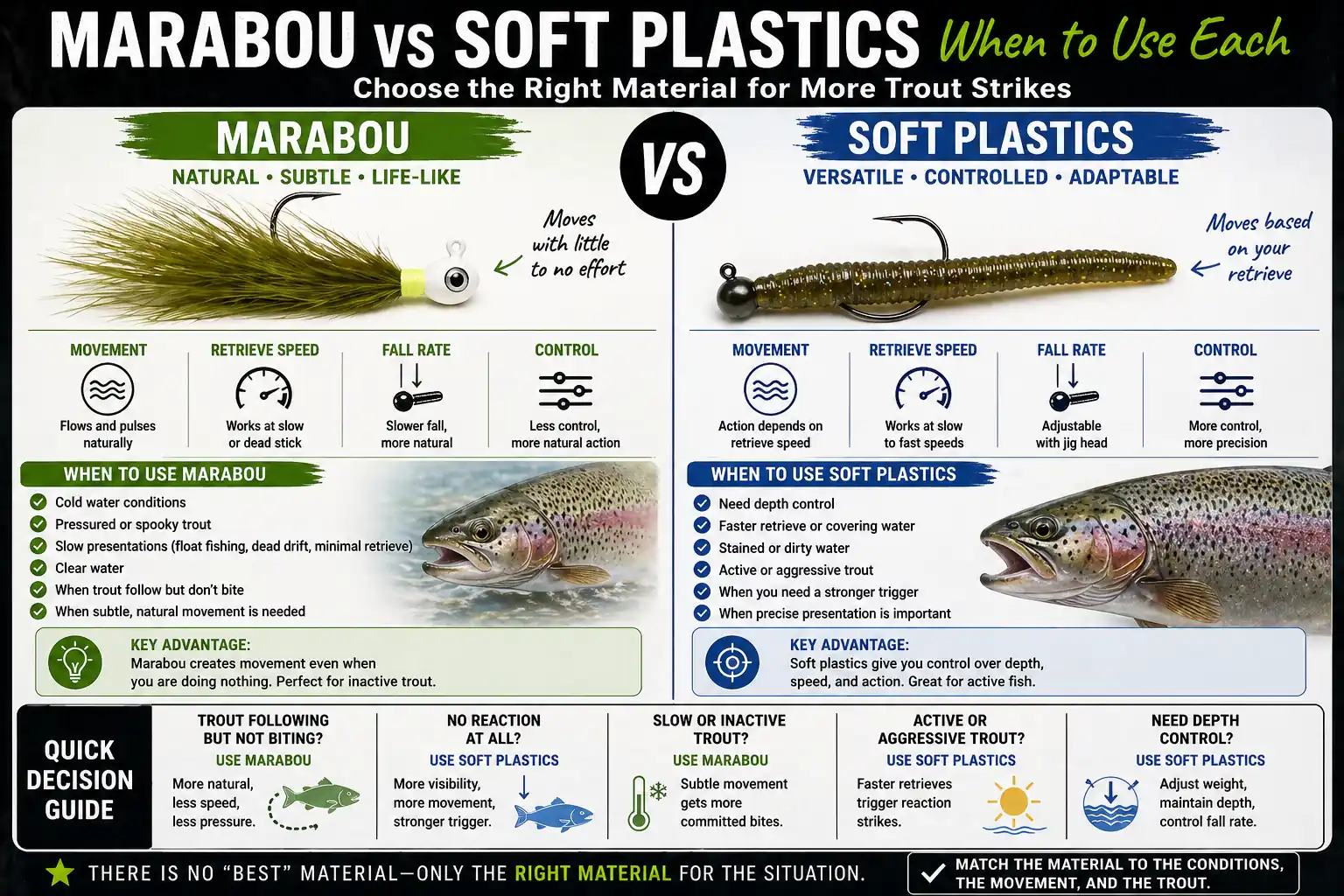
A small jig with a soft plastic body is one of the most versatile char presentations. It lets you control depth, drift naturally through pockets, and cover everything from fast runs to deep plunge pools. See our guide to the best soft plastics for trout for the full system.
Soft Plastics for Brook Trout
Soft plastics shine in brookie water for several reasons. They imitate the foods brookies already eat, they fall naturally, and they can be fished slowly in tiny pockets. They are also legal where bait is not, which matters on many brook trout streams.
Worm Imitations
Brook trout feed on worms washed into streams, particularly after rain. A small worm on a light jig head, drifted through pockets and plunge pools, can be deadly. Our Ribbed Trout Worm was designed for finesse fishing for stocked and pressured trout, with a ribbed body that creates subtle micro-vibration and a controlled fall rate, plus garlic scent that keeps working through cold water and slow bites. The thicker 2.95″ Round Trout Worm can be fished full length in stained water or trimmed down for clear creeks and ponds.
Wax Worm Imitations Under a Float
In beaver ponds, stocked ponds, and slow pools, a small bait suspended under a float is a simple, effective rig. The Wax Worm Soft Plastic is a compact bait for pressured trout and cold water that works under floats, on micro jigs, and with slow retrieves. Set the depth so the bait hangs just above the cover or bottom where the fish are holding, and let the float drift.
Insect Imitations
When char are feeding on drifting nymphs, an insect imitation fished with a natural drift can outfish almost everything else. Our 1″ Mayfly Soft Plastic is built for clear water and pressured trout and rigs on a 1/80 or 1/64 ounce jig head for precise depth control through seams, riffles, and pools. The Soft Plastic Stonefly 1″ offers a natural, no-flash stonefly nymph presentation for trout keyed on subsurface insects.
Crustacean Imitations
In spring-fed water and rocky creeks, small crayfish are a natural food. The 1″ Soft Plastic Crawfish is a realistic juvenile craw imitation designed for ultralight fishing in creeks, rivers, ponds, and small lakes, and it works on a micro jig head or a drop-shot rig.
A Simple Starting Kit
If you want a matched setup without guessing, the Pressured Trout Starter Kit pairs baits, jig heads, and rigging guidance for finesse fishing in stocked ponds and pressured water.
How to Fish a Soft Plastic in a Small Stream
- Pick the pocket. Look for a spot where current slows behind a rock or drops into a pool.
- Cast upstream of the pocket. Let the bait sink and drift into the target zone.
- Keep a tight but gentle line. You want to feel the bait tick the bottom without dragging it unnaturally.
- Watch for subtle takes. Brook trout often take with a light tap or a pause in the drift. Lift and set the hook with a short, easy wrist flick.
- Limit your casts. If a pocket has not produced in two or three drifts, move on.
- Change one thing at a time. Color, size, or weight. Not all three.
Bait Fishing for Brook Trout
Where bait is legal, small worms are the traditional favorite. Thread a piece of worm onto a tiny hook, add little or no weight, and let it drift naturally through pools and along undercut banks. In beaver ponds and lakes, a small piece of worm under a float can be very effective.
Be aware that deeply hooked fish suffer when bait is used, so set the hook early and use a hook size that matches the fish. In streams where you plan to release fish, lures and flies are kinder. Many brookie streams, especially native fisheries, are restricted to artificial lures or flies only, so check the rules before you tie anything on.
Fly Fishing for Brook Trout
Small-stream char fishing is one of the most enjoyable forms of fly fishing, and it does not require expensive gear.
The Setup
- Rod: A 7 to 8 foot, 2- to 4-weight rod. Short and light is ideal for tight quarters.
- Line: A weight-forward floating line.
- Leader: A 7½ foot leader, 5X to 7X tippet in clear water.
Dry Flies
Char rise eagerly to visible, buoyant dries, especially in summer. Reliable choices include Royal Wulffs, Stimulators, Elk Hair Caddis, and Parachute Adams in sizes 12 to 16. In summer, small terrestrial patterns like ants, beetles, and foam hoppers are often even more productive than mayfly imitations.
Nymphs
When fish are not looking up, small bead-head nymphs fished near the bottom produce steadily. A dry-dropper rig, with a buoyant dry fly and a nymph hanging below it, is a productive searching rig in pocket water. Fish it the same way you fish the soft plastic mayfly: slow, natural, and close to the bottom.
Streamers
In larger water and big lakes, small streamers in olive, brown, and white imitate minnows and sculpins and take bigger brook trout. Fish them with short strips and pauses.
Technique
Approach from downstream, stay low, and make short, accurate casts. In very small streams, a 15-foot cast is a long cast. Fish each pocket and pool with a few drifts, then move on. A brookie will often hit the first good drift.
Fishing Brook Trout Through the Seasons
Spring
As snowmelt recedes and water warms into the 40s and low 50s, brookies become active. Fish pools and deeper runs where fish recover after winter. Higher, stained water favors worm imitations and spinners. As flows drop and clear, switch to natural drifts and smaller baits. Spring is also when many states stock brook trout, so check your state wildlife agency for stocking schedules.
Summer
Summer is the critical season. brookies concentrate in cold pockets, near spring seeps, and in headwater sections. Fish early in the morning and stay out of the water when it climbs beyond the mid-60s. Terrestrials and small dries are productive. If your thermometer reads too high, consider not fishing at all.
Fall
Fall is peak season for beauty and aggression. Pre-spawn brook trout feed hard and show their brightest colors. Spinners, streamers, and soft plastics all produce. Stay away from redds, fish below them rather than on them, and leave spawning fish alone.
Winter
In some regions, brookies streams remain open for year-round fishing. Fish are slow and prefer deep, slow pools. Go small and slow in the warmest part of the afternoon. In lakes and ponds, char are a popular ice-fishing target, using small jigs, minnows, or spoons. Small soft plastics tipped onto micro jigs and fished with gentle lifts work well, and our small baits and finesse fishing guide covers cold-water presentations in more detail.
Fishing Brook Trout in Ponds and Lakes
Stocked brook trout ponds and natural lakes call for a different approach than streams.
- Use floats. A small bait suspended under a float lets you fish a precise depth and covers water slowly.
- Fish the edges. Brook trout cruise the shoreline, weed edges, and drop-offs, especially in the morning and evening.
- Look for inlets and springs. Cold water holds fish in summer.
- Go small and slow. Micro jigs, tiny spinners, and small soft plastics retrieved slowly are best.
- Watch for rises. In the evening, brook trout often rise to insects, and a small fly or a bait under a float cast to the rise can produce fast action.
Common Mistakes When Fishing for Brook Trout
- Fishing when the water is too warm. The most serious mistake. A fish that swims away after release may still die.
- Standing in plain sight. Walk upstream, stay low, and use cover.
- Using heavy line and big hooks. Small streams call for light line and small hooks.
- Casting too much. Two or three good drifts per pocket are enough. Move on.
- Wading through redds. In the fall, learn to recognize spawning gravel.
- Ignoring regulations. Many brook trout streams have special rules on gear, size, and harvest.
- Squeezing fish. Brook trout are fragile. Handle them gently and quickly.
Handling and Conservation
brookies live in cold, clear, low-productivity water, and they are easily injured. If you plan to release them, how you handle them decides whether they survive.
- Use barbless or pinched-barb hooks. They are easier to remove and cause less injury.
- Wet your hands before touching a fish. Dry hands strip the protective slime layer.
- Keep fish in the water. Net them in the water, unhook them in the water, and keep photos to a few seconds.
- Do not squeeze the belly. Support the fish gently.
- Revive fish before release. Hold it facing upstream until it swims away on its own.
- Do not fish when water is too warm. The mid-to-upper 60s are a warning sign.
- Avoid redds. Walk around spawning gravel.
- Clean, drain, and dry your gear. This prevents spreading invasive species and disease between waters.
- Do not move fish or bait between waters.
- Check regulations. Some waters are catch-and-release, some have special size limits, and some allow generous harvest of invasive brook trout.
If you keep fish for the table, choose waters where harvest is allowed and sustainable. Stocked brookies in put-and-take ponds and introduced brook trout in western headwater lakes are often good choices. Wild native brook trout in eastern streams generally deserve release.
Gear Checklist for a Day on a Brook Trout Stream
- Ultralight spinning rod and 1000-size reel, or a 2- to 4-weight fly rod.
- 2 to 4 pound line, or a 5X to 6X leader and tippet.
- A small box of soft plastics (worms, mayflies, stoneflies, crawfish) and light jig heads.
- A few size 0 and 1 inline spinners.
- Small split shot and a few extra hooks.
- A stream thermometer.
- Polarized sunglasses to see fish and structure.
- Forceps, nippers, and a small rubber net.
- Drab clothing, wading boots with good traction, and a rain layer.
- Your license, regulations, and a map or GPS.
A Simple Game Plan for Unfamiliar Brook Trout Water
- Check the water temperature. If it is too warm, go somewhere colder or come back another day.
- Approach quietly. Stay low and use cover.
- Start at the bottom of the stretch. Fish upstream, so you are always approaching from behind the fish.
- Read the water. Plunge pools, pockets behind boulders, undercut banks, and the heads of pools hold the best fish.
- Start with a versatile bait. A small worm or insect soft plastic on a light jig head, or a size 0 or 1 inline spinner.
- Make two or three good drifts per pocket. Then move on.
- Adjust. If you are getting follows, downsize. If you are getting nothing, slow down and switch colors.
- Handle every fish carefully. Wet hands, brief photos, and a gentle release.
- Take notes. Record temperature, flow, and what worked.
Final Thoughts: Small Fish, Big Rewards
Brook trout are not the biggest fish in the stream. They are not the hardest fighters or the wariest. But they may be the most beautiful, and they live in the kind of places that make fishing feel like a reward in itself: cold, shaded, clear, and quiet. They ask for a soft approach, a small bait, and respect for the water they live in.
Learn the field marks, and you will know a brookie from a brown or a tiger in an instant. Learn the temperature rules, and you will know when to fish and when to leave them alone. Learn the finesse tactics, from ultralight spinners to soft plastic worms and mayflies, and you will catch fish in places most anglers walk past.
Bookmark this page, and use our complete guide to how to catch trout to go deeper on location, bait, lures, and presentation. For the baits we build for finesse trout fishing, browse our trout lures.
Tight lines.
Frequently Asked Questions About Brook Trout
What is a brook trout?
A brook trout (Salvelinus fontinalis) is a freshwater fish native to eastern North America. Despite the name, it is technically a char rather than a true trout. It is known for its marbled back, pale spots, red dots with blue halos, and orange-red lower fins edged in white.
Is a brook trout really a trout?
Not technically. Brook trout are char, in the genus Salvelinus, and are more closely related to lake trout and Arctic char than to rainbow or brown trout. Anglers call them trout because they live in similar water and respond to similar tactics.
How can I tell a brookie from a brown trout?
Look at the fins and the back. Brook trout have bold white edges on the lower fins and a marbled, wavy pattern on the back. Brown trout have no marbling and typically carry black spots plus red spots with pale halos. Both can have red spots, but only brook trout have the white-edged fins.
What is a tiger trout?
A tiger trout is a cross between a brook trout and a brown trout. It has bold, worm-like markings across the entire body. Tiger trout are rare in the wild, but several states stock them in lakes and ponds because they are sterile.
What is the best bait for brookies?
Small worms are the traditional favorite where bait is legal. Among artificials, small soft plastic worms, insect imitations on light jig heads, and size 0 or 1 inline spinners are reliable. Always check local regulations, since many brook trout streams are artificial-only.
What is the best lure for brookies?
Small inline spinners and soft plastics on light jig heads are the most dependable. A worm-style or insect-style soft plastic drifted through pockets and plunge pools covers most situations. Tiny spoons and 1.5-inch crankbaits also work, especially in ponds and lakes.
What size line should I use for brook trout?
2 to 4 pound line is ideal for most small streams. In clear water, fluorocarbon or a fluorocarbon leader helps. Heavier line can spook fish and affect the natural drift of a small bait.
What water temperature do brook trout prefer?
They feed best at roughly 45 to 60°F. Stress begins around the mid-60s, and in the upper 60s and above, fish can die even after release. Carry a thermometer, and if the water is too warm, fish early or stop for the day.
When do brook trout spawn?
brookies spawn in the fall, usually from about September through November depending on latitude and elevation. They often spawn near spring seeps where groundwater keeps the eggs cold and oxygenated. Avoid wading through redds and leave spawning fish alone.
Where do brookies live?
They are native to eastern North America, from northern Canada down the Appalachians to Georgia. They live in cold headwater streams, spring creeks, beaver ponds, and northern lakes and rivers. They have also been introduced in the western United States, Canada, and other parts of the world.
Are brook trout hard to catch?
In remote streams with little fishing pressure, brook trout are often among the easiest trout to catch. They are bold and opportunistic. The challenge is approaching without being seen, since they are very sensitive to movement and shadow. In heavily fished or stocked waters, they can become much more cautious.
What time of day is best for brook trout fishing?
Early morning and evening are usually best, especially in summer, when water is coolest. In spring and fall, midday can be productive. Overcast days can produce fish all day.
How big do brook trout get?
In small streams, adults are often 6 to 12 inches. In richer water and large northern lakes and rivers, they can reach several pounds. The all-tackle world record is 14 pounds 8 ounces, caught in the Nipigon River in Ontario in 1916.
What is a coaster brook trout?
A coaster is a large, lake-run brook trout that lives in Lake Superior and returns to tributary streams to spawn. Coasters are famous for their size and are the focus of conservation and restoration efforts in the Great Lakes region.
What is a salter brook trout?
A salter is a sea-run brook trout that spends part of its life in brackish water or the sea, found in parts of the Northeast and Atlantic Canada. Salters are more silvery than stream fish but keep the white-edged fins.
Do brook trout eat other fish?
Yes. Larger brook trout eat minnows, sculpins, and small fish. In small streams, they eat mostly insects, worms, and crustaceans. In big lakes and rivers, baitfish become a major part of the diet.
Can I use soft plastics for brook trout?
Yes. Soft plastics are one of the most effective ways to catch brook trout, especially small worm, insect, and crayfish imitations on light jig heads. They are also legal on many waters where natural bait is not. Check local regulations for your water.
Do I need a special license for brook trout?
Almost always, you need a fishing license, and many states also require a trout stamp or permit. Check your state wildlife agency for license requirements, limits, gear restrictions, seasonal closures, and stocking schedules before you fish.
Is it legal to keep brook trout?
It depends on the state and the water. Many wild brook trout streams are catch-and-release or have strict limits, while stocked ponds and introduced populations often allow harvest. Regulations can change from year to year, so read the current rules for the specific water you are fishing.
How do I release a brook trout safely?
Use barbless hooks, wet your hands, keep the fish in the water, avoid squeezing the belly, and revive it facing upstream until it swims away on its own. Do not fish for brook trout when the water is in the mid-to-upper 60s, since survival after release drops sharply.
Do brook trout have teeth?
Yes. Like other trout and char, brook trout have small teeth on the jaws and roof of the mouth. They are not dangerous, but they help the fish hold slippery prey.
Why are wild brook trout declining?
Habitat loss, warming water, logging, development, sedimentation, pollution, and competition with non-native brown and rainbow trout have all contributed to declines across their native range. Conservation groups and agencies work to protect and restore cold, clean streams.
About Family Fishin
Family Fishin is a family-owned fishing tackle company dedicated to designing, testing, and producing high-quality fishing lures, inspired by generations of fishing tradition and driven by a passion for innovation. Every product is developed with one goal in mind: helping anglers spend more time doing what they love, catching fish and creating memories on the water.
#brook trout #brook trout fishing #brook trout identification #ultralight trout #creek fishing #trout species #trout behavior #how to catch trout #stocked trout