Best fishing line for Trout
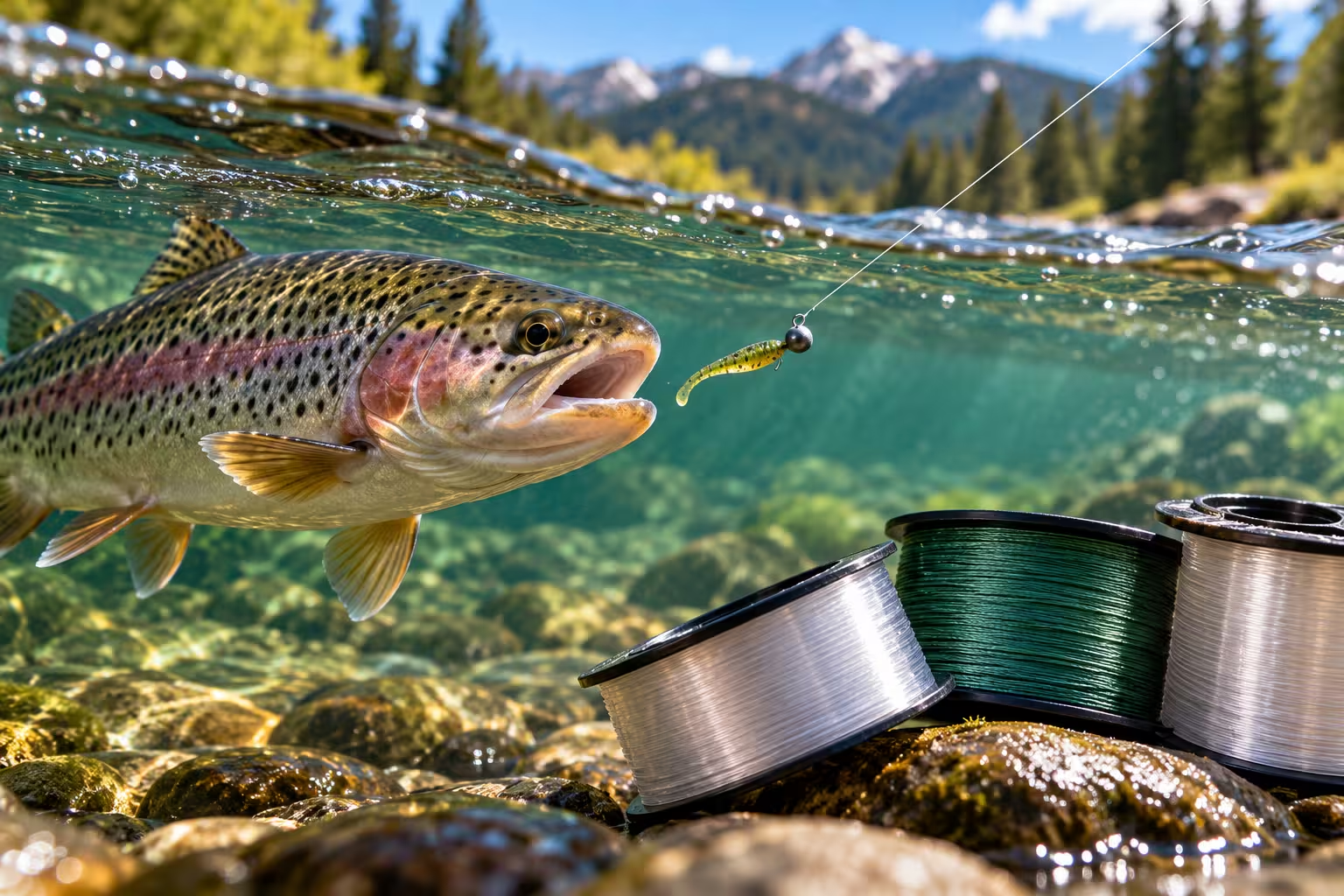
Choosing the best fishing line for trout is just as important as selecting the right jig head, hook size, or bait scent. Yet most trout anglers will spend twenty minutes agonizing over those details and then spool their reel with whatever was on sale. It’s an understandable habit, because line is the least exciting part of the setup. It doesn’t have a color theory, a hatch chart, or a flashy action. But line is the only part of your rig that is physically connected to everything else: it sets how your jig falls, how a soft plastic swims, how much of a subtle bite you actually feel, how much of a hard run your hook can survive, and, depending on the water, how much a wary trout notices before it ever looks at your bait. A perfect lure on the wrong line is a compromised lure.
The question “what is the best fishing line for trout” doesn’t have a single answer, and anyone who gives you one without asking about the water is guessing. What it has instead is a set of tradeoffs that are genuinely predictable once you understand what each material does: how much it stretches, how fast it sinks, how thick it is for a given strength, how stiff it gets in the cold, and how visible it is under different light and water conditions. This post walks through all of it. It also builds on the rest of our trout series, since line is the final piece of a system that starts with how to choose jig head weight, hook size, and how water clarity changes what trout see. The short version, for anglers who want it up front: for most trout fishing, 4-pound monofilament or a 4-pound fluorocarbon line is the right answer, 2- to 3-pound line is the right answer in clear, low, pressured water, and braid earns its place only as a main line with a fluorocarbon or monofilament leader. The rest of this post explains why, so you can make the call yourself instead of memorizing a rule.
Why Line Matters More for Trout Than for Most Fish
Trout fishing is unusual because the gear is light and the fish are cautious. A largemouth bass will eat a lure on 15-pound line without a second thought. A trout in a clear, slow pool is a different animal: it has excellent eyesight, it spends most of its life evaluating small drifting objects for signs that they’re real food, and in heavily fished water it has had a lot of practice at ignoring things that look wrong. That combination makes line unusually important in three separate ways.
The first is visibility. The finer and less conspicuous the line near your lure, the less there is for a wary fish to notice. We’ll spend a good section on this below, because the popular claims about visibility are a mix of real physics and marketing, and sorting out which is which changes how you buy line.
The second is presentation. Trout lures are light. A 1/64-ounce or 1/32-ounce jig head, a small soft plastic worm, a tiny inline spinner: these are all light enough that the line’s weight, diameter, and stiffness visibly change how they behave. Thick, stiff line holds a light jig up, adds drag in current, and pulls a small bait out of its natural drift. Thin, supple line gets out of the way. When we say a jig “wobbles on the fall” or a worm “flutters on a dead drift,” that behavior depends on the line not interfering with it.
The third is sensitivity and hook-setting. A trout often mouths a bait and ejects it quickly, which is a large part of why trout spit the hook before you feel it. How quickly you detect a bite, and how well your hookset transmits down the line to a very small hook, depends heavily on how much the line stretches. Too much stretch and a bite gets muted and a hookset gets absorbed. Too little and a hard-hooked trout on light gear can tear the hook out or break off at the first lunge.
Because of those three effects, the right line for trout is almost never the strongest line. It’s the finest line that your water, your fish size, and your conditions will allow.
The Four Properties That Actually Matter
Before comparing materials, it helps to understand the handful of properties that separate one line from another. Every claim on a spool label ultimately comes down to these.
Diameter. Line strength is labeled in pounds, but for trout, diameter is often the more important number. Two lines can both be rated at 4 pounds and differ noticeably in thickness depending on the material and how it’s made. Thinner line is less visible, casts farther on light gear, creates less drag in current, and lets a light lure sink and move more naturally. As rough reference points, 2-pound monofilament is on the order of 0.005 to 0.006 inches thick, 4-pound is around 0.007 to 0.008 inches, and 6-pound is around 0.009 to 0.010 inches. Those figures vary by brand and model, and the actual diameter is printed on most spool labels, so check it rather than trusting a pound-test rating alone. Braid is dramatically thinner than either mono or fluorocarbon at the same strength, which is the reason it exists, though as we’ll see, that advantage comes with a catch for trout.
Stretch. Every line stretches under load, but they stretch by very different amounts. Monofilament is the stretchiest of the common options, stretching roughly a fifth or more of its length before breaking in many models. Fluorocarbon stretches somewhat less. Braid barely stretches at all, typically only a few percent. Stretch is a double-edged property: it cushions a sudden surge from a hot trout and protects small hooks and light knots, but it also dampens bite feel and softens a hookset, especially at a distance.
Density, which controls sink rate. Nylon monofilament is only slightly denser than water, so it sinks slowly and often hangs in the surface film for a moment. Fluorocarbon is considerably denser, around one and three-quarters times the density of water, so it sinks faster and holds a lure deeper. Braided line made from ultra-high-molecular-weight polyethylene is actually less dense than water, which is why most braid floats unless it’s treated. For a trout angler this matters both for getting a jig down and for how much line sags between the rod tip and the lure.
Stiffness and memory. Memory is a line’s tendency to hold the coiled shape it had on the spool. Stiffer, larger-diameter lines have more of it, and cold temperatures make it worse. Memory shows up as loops and coils in your cast, line that won’t lie flat in the water, and a decrease in the amount of contact you have with your bait. It’s an especially real problem for trout anglers, who often fish in cold water on small spinning reels with narrow spools, which exaggerate coiling.
With those four properties in mind, the three materials make a lot more sense.
Monofilament: The Default for Good Reasons
Monofilament, usually made of nylon, is the line most trout anglers should reach for first, and the reasons are practical rather than nostalgic.
Its stretch is a real advantage on light trout gear. When you’re fishing 1/64- to 1/16-ounce jigs on small hooks with a 4-pound line, a trout’s first lunge or head shake can transmit a lot of force to a very small hook point. Mono’s give acts like a shock absorber, which helps keep that hook pinned and keeps the knot from being shocked loose. This is especially valuable with stocked trout, which tend to be aggressive and make hard first runs, and it’s part of why simple 4-pound mono is the most common choice on stocked public water. If you’re fishing close to your target, the muted bite feel from stretch is rarely a real problem, because the line is short and the movement between a bite and your hand is small.
Mono is also forgiving to handle. It’s easy to tie, it holds common knots reliably, and it tolerates small mistakes. It’s inexpensive enough that you can replace it often, which is worth doing, because mono degrades with sunlight exposure and use and develops memory over time. Many anglers fish the same spool for several seasons and then wonder why their casts have gotten sloppy and their breakoffs more frequent. Replacing trout mono every season, or at least stripping off the first fifty feet when it starts to coil, is cheap insurance.
Mono also floats or sinks slowly, which is an advantage in some situations. For bobber fishing, a floating or slow-sinking main line lets you mend and control the float, and keeps the line from pulling the indicator under. For drifting a worm or small soft plastic under a float, it behaves predictably.
The downsides are real, and they’re the reason other materials exist. Mono is more visible than a comparable fluorocarbon line in many conditions, partly because of its higher refractive index and partly because it’s often available only in tinted colors. It also absorbs a small amount of water, which can lower its strength slightly when wet and increases its stretch. It has more memory in cold water than some premium lines, and it degrades with UV exposure. Many modern monofilaments are specifically engineered to be limp and low-memory, and for trout, those premium versions are worth the extra few dollars.
Best uses for mono: stocked trout, general-purpose spinning gear, bobber rigs, inline spinners and spoons, beginners, and any situation where you want a forgiving, inexpensive, shock-absorbing line.
Fluorocarbon: Sinks Faster, Stretches Less, Costs More
Fluorocarbon is made from a polymer, typically polyvinylidene fluoride, that has a different density and different optical properties than nylon. The two things anglers talk about most are its invisibility and its sink rate, and only one of those claims is cleanly supported.
The sink rate is straightforward physics. Because fluorocarbon is much denser than water, it sinks faster than mono and holds a lure at depth more reliably. For jig fishing in a deeper pool, a fluorocarbon line gets the jig down and keeps it there, with less bow between the rod tip and the bait. For a jig that you want to fall on a controlled, near-vertical path, this matters, and it’s related to why jig head weight affects the way a bait falls. A fluorocarbon line’s higher density means less sag, and less sag means a more direct connection to the jig.
Fluorocarbon also has lower stretch than mono, which improves bite sensitivity and gives a slightly more direct hookset. It’s also more resistant to abrasion, which matters when you’re fishing near rocks, logs, and shell-lined bottoms, and it doesn’t absorb water the way nylon does, so its strength and stretch stay more consistent after a long day. It also holds up well against sunlight, which is why many anglers keep fluorocarbon leader material on a spool for years.
The visibility claim is where honesty matters. Fluorocarbon has a refractive index closer to that of water than nylon does, and the manufacturers’ argument is that this makes it less visible underwater because it bends less light. That is a real optical property, and it’s reasonable to expect it to help. But the practical size of the effect is debated, and no line is truly invisible to a trout. Visibility depends on light angle, water clarity, line diameter, color, the background behind the line, and how long the fish gets to look at it. In murky or stained water, the difference between mono and fluorocarbon is probably irrelevant. In very clear, bright, low water with pressured fish, it might help, but diameter almost certainly matters at least as much. A thin mono can be less conspicuous than a thick fluorocarbon. If you’re choosing between a thick, stiff fluorocarbon and a fine, supple mono, the finer line usually wins on visibility and presentation both.
The downsides: fluorocarbon is stiffer than mono at the same diameter, which means more memory and more coiling on small spinning reels, especially in cold weather. It’s more expensive. It can be harder to knot, because the material is slippery and can be damaged by friction when a knot is cinched dry, so you should always wet the knot before tightening. And its lower stretch is a mixed blessing: it improves feel, but it gives up some of mono’s shock absorption, which matters when a trout makes a hard run on a small hook.
Best uses for fluorocarbon: as a leader (more on this below), for jig fishing where sink rate and sensitivity matter, in clear water with pressured fish, and around abrasive structure.
Braid: Thin, Sensitive, and Not Always the Right Tool
Braided line is woven from multiple strands of ultra-high-molecular-weight polyethylene fibers. It’s extraordinarily strong for its diameter and nearly stretchless, and it has been taking over from mono in many kinds of fishing. For trout, though, it needs a more careful look.
The advantages are significant. For a given strength, braid is much thinner than mono or fluorocarbon, so a 6-pound braid can be around the same diameter as 1- or 2-pound mono. That means less wind drag, longer casts with light lures, and better line control in current. Its near-zero stretch gives exceptional bite sensitivity and a direct hookset, and it can detect very faint taps from a subtle, finicky trout. It also has no practical memory and does not degrade much from UV exposure, so one spool can last several seasons.
The disadvantages for trout fishing are equally real. Braid is highly visible in clear water, because of its weave and its opaque, solid color, and because it has no refractive-index advantage at all. Used alone in clear, low water, it will put down wary fish. Braid also has no stretch at all, which on a light-wire trout hook and a 4-pound-class rod means a hard hookset or a surging fish can pull hooks, straighten small hooks, or cause knot failures. It floats, so it can drag a light jig up and bow in the wind. It’s more expensive and harder to tie knots in, since it’s slippery and can slip in standard knots, which requires specific knots like the Palomar or a double uni, and often a few extra wraps. And it can slip on a spool arbor, so the first layer should be a few wraps of tape or a bit of mono backing to keep it from spinning around the spool.
Braid is also a poor match for the light, soft-action rods most anglers use on trout. Ultralight rods are designed to absorb shock using the rod’s own flex plus the stretch of mono. Remove the line’s stretch, and all the shock goes to the hook, the knot, and the fish’s mouth.
That doesn’t mean braid has no place. It makes real sense in specific situations: fishing from a distance on large lakes or reservoirs, fishing deep with a heavier jig where sensitivity matters, fishing in current with a lot of line out where mono’s stretch would dull the hookset, or fishing around heavy cover for larger trout where you need a lot of strength. In nearly every case where braid makes sense for trout, it should be paired with a fluorocarbon or monofilament leader, which restores both the stretch and the low visibility right where it matters, at the lure.
Best uses for braid: reservoir or lake trout fishing, deep jigging, long casts with light lures, and any situation where you pair it with a 3- to 6-foot fluorocarbon leader.
What Trout Can Actually See
Because visibility drives so much of the marketing in this category, it’s worth a direct, honest look at what’s known.
Trout are visually oriented predators with excellent eyesight, and they can see color across a good part of the spectrum. How much of your line they notice depends mostly on a few variables. Diameter is the single biggest one: a thicker line subtends a larger angle in the fish’s field of view and is simply easier to detect. Water clarity is the second. In stained or turbid water, a trout’s visual range shrinks to a few feet, and any reasonable line is effectively invisible beyond that. This is the same reasoning we covered in our look at how water clarity affects trout fishing: the clearer the water, the more every detail matters. Light is the third: bright, direct overhead sun and calm water make a line stand out; overcast skies, wind chop, and low light make it blend in. And background matters: a line seen against a bright sky looks different than a line seen against a dark bottom.
Color matters too, but less than many anglers think. Water absorbs different wavelengths at different rates, with red light disappearing within the first several feet, so a red or orange line becomes a dark, neutral tone at depth. Clear and low-visibility green lines tend to blend with stream backgrounds. High-visibility yellow or chartreuse line is easy for the *angler* to see on the water, which is a real advantage for detecting a bite when you’re watching the line for a subtle twitch, and it’s a reasonable choice for the portion of line above a leader, where trout are unlikely to pay attention to it. The practical approach is to use a low-visibility line near the lure and let visibility be a convenience for you rather than the fish.
Here’s the honest summary of the visibility debate: no line is invisible, fluorocarbon’s optical advantage is real but modest, and the most reliable way to reduce line visibility is to use a thinner line and a longer, lighter leader. If you’re fishing clear, pressured water, drop to 2- or 3-pound line before you spend extra on a premium material. If you’re fishing stained water, stocked fish, or a put-and-take pond, line visibility is a minor concern and you should prioritize durability, simplicity, and shock absorption.
This also connects to a bigger pattern. In our post on whether trout learn to avoid lures, the point is that pressured fish become more selective over time. A trout that has seen hundreds of anglers is more likely to notice the thick line, the large knot, or the heavy snap swivel. Finer line is one of the least expensive ways to get back some of that lost ground.
Choosing Pound Test: The Lightest Line That Fits the Job
A useful rule is to choose the lightest line that can handle the fish you’re likely to hook and the structure you’re fishing around. For trout, that generally means one of the following ranges.
2-pound test is a clear-water, small-stream, pressured-trout line. It lets light jigs and small soft plastics fall and drift with very little interference, and it’s nearly invisible compared to heavier options. It requires a light drag, a smooth hookset, and careful handling, and it’s not the right choice around snags, in heavy current, or for fish over several pounds. It also makes knot quality more important, because every knot weakens the line.
3-pound test is a good middle ground for clear water with some current or slightly larger fish. It keeps most of the advantages of 2-pound while giving a little more margin for error.
4-pound test is the all-around standard for trout. It handles stocked rainbows, most wild trout, and the occasional larger fish, it’s strong enough to withstand moderate snags, and it’s thick enough to be easy to tie and handle. If you only own one spool, this is the one. It’s what we’d recommend for anyone starting out or fishing stocked public water.
6-pound test is for larger trout, heavier cover, bigger lures, and situations where you expect to fight a fish through structure, such as lakes with bigger rainbows or browns, or brushy stream banks. It’s also reasonable as a mono leader on a braided main line. The tradeoff is more visibility and more drag on small lures.
8-pound and heavier is rarely appropriate for trout unless you’re targeting large lake trout, fishing large streamers, or dealing with significant structure. It’s generally too visible and too heavy for the small baits that make up most trout fishing.
One more thing about pound test: the number on the spool is not the strength of your rig. Every knot reduces a line’s effective strength, often by ten to thirty percent depending on the knot and how well it’s tied. Many lines also test somewhat above or below their labeled strength. The best practice is to tie knots carefully, wet them before cinching, trim tag ends cleanly, and retie after any nick, abrasion, or hard fight. A well-tied 4-pound line can outperform a poorly tied 6-pound line every time.
Your drag should be set lighter than you think. For small trout gear, a drag set so that a firm pull on the line makes the spool give slowly, well below the line’s breaking strength, lets the reel absorb the surge of a running fish and protects the knot. Many anglers set a trout drag too tight, and then lose fish at the net or at the first run.
Leaders: When They Help and When They Don’t
A leader is a separate section of line, usually fluorocarbon or monofilament, tied between your main line and your lure. It serves three purposes: reducing visibility near the lure, adding abrasion resistance to the part of the line that touches rocks and teeth, and, with braid, restoring stretch and shock absorption.
For trout, a leader is most valuable when you’re using braid as the main line (always), when fishing very clear, pressured water, when fishing around abrasive structure, and when you want a lighter, less visible section of line near the lure without refilling the whole spool. It is less necessary with a full spool of light mono or fluorocarbon fished on stocked trout, small streams with little pressure, or stained water.
A typical trout leader is two to four feet of line. Longer leaders put more distance between the main line and the lure but make casting awkward and can create a visible knot-to-lure span that tangles in wind. Shorter leaders are easier to cast but keep the knot close to the bait. For fly anglers, the same idea shows up as tippet sizing: the common tippet system says to subtract the X number from 11 to get the diameter in thousandths of an inch, so 5X tippet is about 0.006 inches, which is close to the diameter of 3-pound mono. That’s why spin anglers can use the same logic when deciding how fine to go.
Leader strength should usually be the same as or slightly lighter than the main line, so if something snags and breaks, it breaks at the leader and you lose only a few feet rather than a long run of main line. Never use a leader stronger than your main line unless you have a specific reason.
Connecting the leader is where many anglers run into trouble. The most reliable knots are a double uni knot, a surgeon’s knot (for lines of similar diameter), or a blood knot (if you’re comfortable tying it). For connecting braid to a leader, the double uni is the standard, wetted before tightening and tightened slowly. If you tie a leader to a swivel, a barrel swivel adds visibility and weight, so it’s best used only when a lure spins and twists the line, as inline spinners and some spoons do. For jigs, soft plastics, and bobber rigs, a swivel is usually unnecessary and sometimes harmful, since it adds weight and a visible hard point to a light presentation.
Matching Line to Technique
Different trout techniques stress line differently. Here’s how the principles above apply to the situations you’re most likely to fish.
Jigging soft plastics. Jig fishing with soft plastic worms and tails is where line choice shows up most in the feel and action of the bait. For a light jig, you want a thin, supple line that doesn’t hold the jig up, and a low-stretch line helps you feel the subtle tick of a trout taking a bait on the fall. Fluorocarbon in 3- or 4-pound test is an excellent choice because it sinks, stretches little, and is low in visibility. If the line is too stiff or too thick, a light jig head may hang in the water instead of falling naturally. Our post on why jig heads wobble on the fall covers how line interacts with the jig’s falling action, and it’s the main reason thin line matters here. A soft plastic like our 2.95″ Round Trout Worm fished on a light jig head performs best when line drag is kept to a minimum.
Dead-drifting worms and small baits. A natural drift is the goal here, and anything that interferes with it hurts. Use the lightest line you can, preferably 2- to 4-pound mono or a fluorocarbon leader, with minimal weight. Because mono sinks slowly and doesn’t bow as aggressively as stiffer lines, it can actually be a better drifting line than fluorocarbon in slow water, while fluorocarbon wins when you need to get the bait down quickly in faster current.
Bobber and float rigs. For fishing under a float, mono is typically the best main line, because its slow sink rate and low density let it ride gently at the surface instead of dragging the float under. Fluorocarbon works well as a leader below the float, where its sink rate holds the bait down. See our guide to setting bobber depth for trout for how to pair this with depth.
Inline spinners and spoons. These lures twist the line as they spin, and thin line with a lot of memory will quickly coil and tangle. Use a high-quality, limp mono in 4-pound test, or add a small ball-bearing swivel a foot or two above the lure to take out the twist. Avoid very stiff fluorocarbon for spinners unless you’re using it as a short leader.
Dead sticking and still-fishing. When you’re fishing a bait on the bottom and waiting, as in our guide on dead sticking for trout, bite detection matters more than casting performance. A line with low stretch helps you feel a subtle pickup, but you also want a bit of slack-and-give so a fish can take a bait without feeling resistance. A moderate-stretch line like mono, or braid with a leader and a very light touch, can work. A highly visible line above the water, such as hi-vis yellow, can help you watch for a twitch.
Fishing for stocked trout. Stocked trout are usually less selective than wild or pressured fish, so line visibility is a smaller concern and durability and simplicity matter more. 4-pound mono is nearly always the right call. Our post on how stocked and wild trout differ in presentation goes further into when to refine your approach.
Fishing for wild, pressured, or large trout. Drop to 2- or 3-pound fluorocarbon or a fine mono, lengthen the leader, use smaller knots, remove unnecessary hardware, and lighten your drag. Everything about the setup should be quieter and finer than it is for stocked fish.
Cold Water, Memory, and Seasonal Line Choices
Because trout are a cold-water species, many anglers fish in conditions that expose line weaknesses that don’t show up in warm-weather fishing. As water temperature drops, trout metabolism slows, and, as we cover in our guide to the best water temperature for trout, bites become softer and more tentative. At the same time, line gets stiffer. Mono and especially fluorocarbon develop more memory in cold conditions, which creates coils, reduces casting distance, and weakens the connection between you and your bait.
A few practical steps help. Choose a limp, low-memory line in the lightest size you can manage. Keep spools out of hot cars or direct sun in storage, since heat sets memory in the line. Before fishing in cold weather, pull off some line and stretch it gently or let the bait pull it straight in the water. Lighten your weights in very cold water, since heavy lures yank cold, stiff line into awkward curves. And keep your line fresh: a spool that’s been through two cold seasons will almost always coil worse than a new one.
Seasonal patterns also change how you think about line visibility. In spring, runoff often brings stained, higher water and shorter visibility, so line concerns drop. In summer low-flow conditions, water is clear, trout are often concentrated in deeper holes and seams, and fine line matters most. In fall, clear water and lower light often make visibility a concern again. In winter, clear, cold, low water with sluggish fish rewards the lightest line you can fish effectively, along with patience.
Knots That Hold on Light Line
A line is only as strong as its weakest knot, and light trout line makes knot craft more important, not less. A few reliable choices cover almost everything.
The improved clinch knot is the traditional choice for tying mono to a hook or jig head. Make five to seven wraps for light line, pass the tag through the loop near the eye and then through the big loop, wet it, and cinch down slowly. It’s reliable with mono but can slip with fluorocarbon and braid unless you add extra wraps.
The Palomar knot is one of the strongest and simplest knots for light line and works with mono, fluorocarbon, and braid. Double the line, pass it through the eye, tie an overhand knot, pass the loop over the lure, and cinch. It’s an excellent default for jig heads, since it keeps the line centered and holds near its full strength.
The uni knot is versatile, easy to adjust, and good for both tying to lures and joining lines. A double uni knot is the standard way to join braid to a leader.
The non-slip loop knot leaves a small open loop at the lure, which lets a jig or soft plastic swing and move more naturally. For light jigs where freedom of motion matters, a loop knot can noticeably improve how a bait falls and swims.
Whatever you choose, always wet the knot before tightening, because dry friction heats and weakens line. Pull the knot snug slowly and steadily, and test it with a firm tug before casting. Trim the tag end close but not so close that it nicks the knot. And retie often: after every fish, every snag, and any time you feel a rough spot or kink on the first few feet of line.
Common Line Mistakes Trout Anglers Make
A handful of mistakes account for most of the line problems trout anglers run into.
Using line that’s too heavy. This is the most common issue. Thick line looks safe, but it kills the action of light baits, adds visibility, and makes casting small lures harder. Unless you’re fishing heavy cover or large fish, step down a size.
Using braid with no leader in clear water. The thin diameter is tempting, but a bare braid line is easy for trout to see and gives no shock absorption. Add a fluorocarbon leader.
Overfilling or underfilling the spool. A spinning reel should be filled to within about an eighth of an inch of the lip. Underfilled spools cause line to scrape the edge and lose casting distance; overfilled spools produce tangles and loops.
Keeping old line. Old line has memory, UV damage, and small nicks. If your line coils, feels rough, or is faded, replace it.
Setting the drag too tight. Small trout hooks, light line, and soft rods all depend on the drag giving up line during a run. A locked-down drag turns a good fish into a broken line.
Ignoring the first few feet of line. The section of line closest to the lure takes the most abuse. Run your fingers along it regularly and cut off any part that feels rough, flat, or kinked.
Not matching line to the rod. An ultralight rod with a limp 4-pound mono is a balanced system. Stiff 10-pound line on that same rod is not. The rod, reel, line, and lure should work as a single, matched unit.
Putting It Together: A Simple Line System
If you want a clear starting point, here’s a straightforward setup that covers most trout fishing.
For general stocked trout fishing, spool a small spinning reel with 4-pound limp monofilament. Tie directly to your jig head, hook, or lure with a Palomar or improved clinch knot. Replace the line each season.
For clear, pressured, or wild trout, spool 3- or 4-pound mono and add a 3-foot leader of 2- to 3-pound fluorocarbon, joined with a double uni or surgeon’s knot. Or, if you prefer a single line, use 2- to 3-pound fluorocarbon or a very fine mono.
For lakes, reservoirs, and long casts, spool 6-pound braid with a 4- to 6-foot leader of 4-pound fluorocarbon, and keep your drag light.
For bobber fishing, use 4-pound mono as the main line and a fluorocarbon or mono leader below the float.
In every case, match the pound test to the water clarity and fish size, tie your knots carefully, keep your line fresh, and set your drag lighter than you think you need. Line is rarely the reason a trout bites, but it’s often the reason one doesn’t, and it’s one of the few places where a small, inexpensive upgrade can improve nearly every presentation you make.
Closing Thought
Line is the quiet part of trout fishing. It doesn’t have the appeal of a new lure color or the satisfaction of a perfectly matched hatch, so it tends to be an afterthought. But every trout you hook is connected to you by a few feet of very thin plastic, and the choices you make about that plastic, its material, its diameter, its freshness, and how you tie it on, shape what the fish sees, how your bait moves, how much you feel, and how many fish stay hooked. Choose the finest line that fits your water and your fish, give your lures the freedom to move, and keep everything fresh and well-tied. You’ll feel more bites, hook more of them, and lose fewer of the fish that matter.
Frequently Asked Questions
What is the best fishing line for trout overall?
For most trout fishing, 4-pound monofilament is the best all-around choice. It’s inexpensive, easy to tie, forgiving on small hooks because of its stretch, and strong enough for stocked rainbows and most wild trout. Step down to 2- or 3-pound line, or add a fluorocarbon leader, in clear, low, pressured water.
Is fluorocarbon better than mono for trout?
Not automatically. Fluorocarbon sinks faster, stretches less, resists abrasion, and may be slightly less visible, which makes it excellent for jig fishing, clear water, and leaders. Mono is cheaper, easier to handle, has more shock-absorbing stretch, and is often the better choice for stocked trout, bobber rigs, and general use.
Can I use braid for trout fishing?
Yes, but usually not on its own. Braid is thin, strong, and sensitive, which helps on lakes, reservoirs, and long casts, but it is visible in clear water and has almost no stretch, which can pull small hooks. Pair it with a 3- to 6-foot fluorocarbon or monofilament leader.
What pound test line should I use for trout?
Use 4-pound test as a default. Go down to 2- or 3-pound in clear water, small streams, or with pressured fish, and up to 6-pound for larger trout, heavier cover, or lake fishing. Choose the lightest line that can handle the fish and the structure you expect.
Do trout see fishing line?
Yes, trout can see fishing line under many conditions, especially in clear, bright, low water. The visibility depends mostly on line diameter, water clarity, light, and background, with material and color mattering less. No line is invisible, so the best way to reduce visibility is to use a thinner line and a longer, lighter leader.
Does line color matter for trout?
Slightly. Low-visibility or green lines tend to blend into stream environments, and clear lines are common for leaders. Hi-vis yellow or chartreuse is easy for you to see on the water and is reasonable for the section of line above a leader. Diameter matters more to the fish than color does.
Do I need a leader for trout fishing?
Not always. A leader is essential with braid and helpful in very clear, pressured water or around abrasive structure. On stocked trout or in stained water, a full spool of light mono is usually enough. A typical trout leader is two to four feet long and the same strength as, or lighter than, the main line.
How often should I change my trout fishing line?
Monofilament and fluorocarbon should generally be replaced at least once a season, or sooner if the line coils, feels rough, or has faded. Braid lasts much longer, but its leader should be checked and replaced often. Fresh line casts farther, ties stronger knots, and breaks less.
What is the best line for ultralight trout spinning gear?
A limp, low-memory 2- to 4-pound monofilament is the best match for most ultralight setups, since its stretch complements the rod’s flex. Fluorocarbon in the same sizes works well for jigging. Avoid heavy or stiff line, which hurts casting and bait action.
What line works best for fishing soft plastic worms for trout?
Thin, supple line in 3- to 4-pound test, either fluorocarbon or low-memory mono, works best. It lets light jig heads fall naturally and keeps the worm’s action intact. Heavier or stiffer line can hold a soft plastic up, add drag in the current, and reduce bite sensitivity.
Why does my line keep coiling and tangling?
Coiling is caused by line memory, which is worse with stiffer line, cold temperatures, old line, and heat-exposed spools. Switch to a limper line, replace old line, avoid overfilling the spool, and don’t leave spools in hot cars. A small swivel can help with spinner twist.
How should I set my drag for trout?
Set it light. The drag should release line smoothly under a firm pull, well below the line’s breaking strength, so a running trout can pull line without snapping off or tearing out the hook. Test it by pulling line by hand before you fish and adjust as needed.
About Family Fishin
Family Fishin is a family-owned fishing tackle company dedicated to designing, testing, and producing high-quality fishing lures, inspired by generations of fishing tradition and driven by a passion for innovation. Every product is developed with one goal in mind: helping anglers spend more time doing what they love, catching fish and creating memories on the water.
Post Tags: #trout fishing line #fluorocarbon #monofilament #braid #trout leader #line visibility #ultralight #fishing line for trout #trout gear