The Chemistry Behind Fish Oil Scent: Why Trimethylamine Is the Real “Dead or Dying Fish” Signal
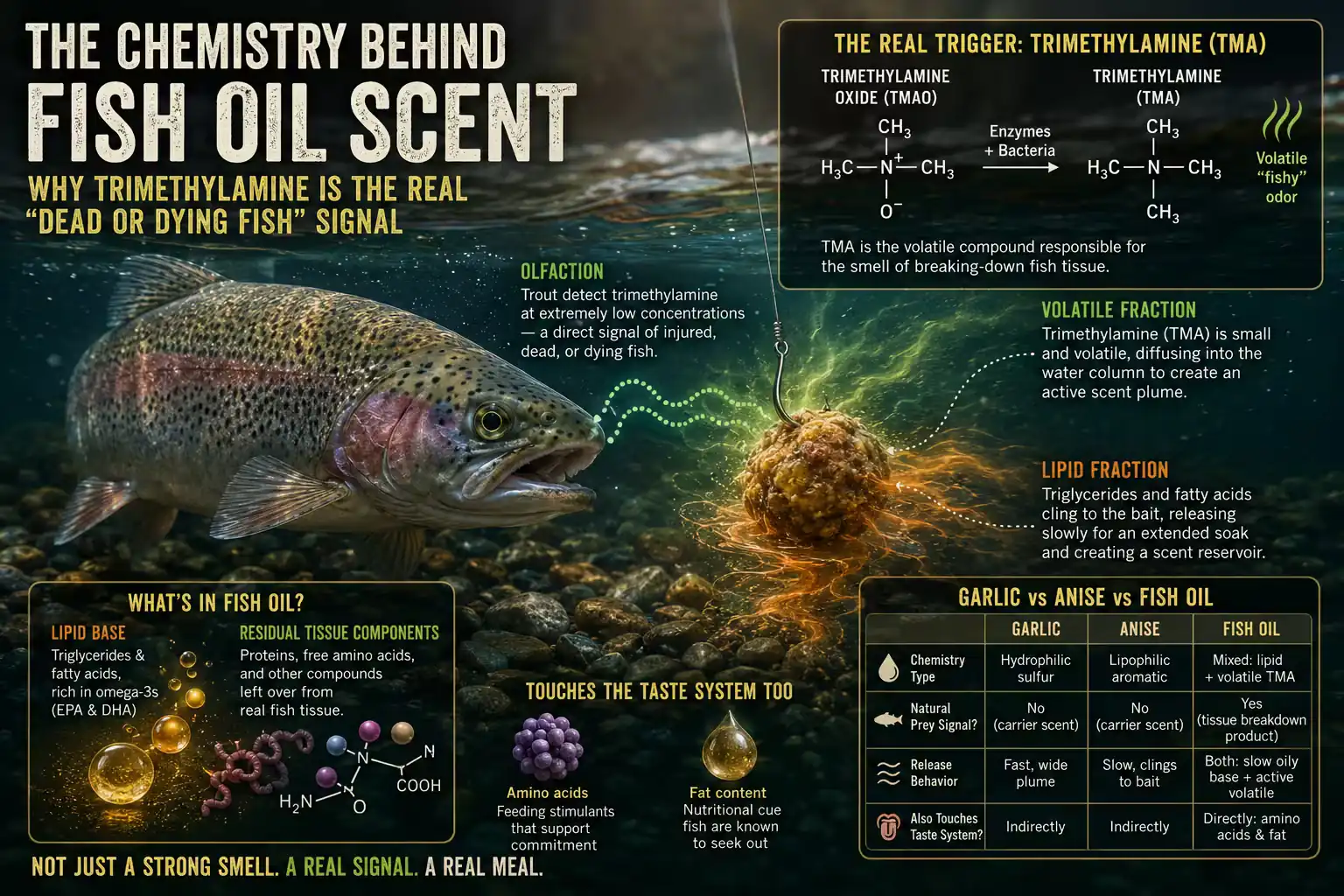
The fish oil scent for trout works differently than garlic or anise. As fish tissue breaks down, trimethylamine (TMA) is released, creating a natural chemical signal that trout recognize as injured or dying prey.
1.Why the Fish Oil Scent for Trout Works Differently
As covered in the garlic and anise chemistry breakdowns, both of those scents work as carrier compounds — strong, low-odor-threshold aromatics that get a trout’s attention without actually being part of its natural diet. Fish oil breaks that pattern. It’s rendered directly from fish tissue, which means the compounds it releases into the water aren’t a generic “loud smell” — they’re the same breakdown products released by an actual injured or dying fish. A trout’s olfactory system isn’t just noticing fish oil. It’s recognizing it.
2.What’s Actually in Fish Oil
Fish oil is mostly lipid: triglycerides and free fatty acids, dominated by long-chain omega-3 polyunsaturated fatty acids — primarily EPA (eicosapentaenoic acid) and DHA (docosahexaenoic acid), the same fatty acids fish tissue is naturally rich in. Depending on how it’s processed, it also carries residual proteins and free amino acids left over from the source tissue.
None of that alone explains the strong “fishy” smell, though. Triglycerides are large, heavy molecules that don’t evaporate or diffuse well — on their own they’d barely register to a trout’s nose. The actual scent signal comes from a much smaller, much more specific molecule.
3.Trimethylamine: The Real Trigger
Fish tissue naturally contains a compound called trimethylamine oxide (TMAO), which fish use to help manage cellular water balance. When fish tissue starts to break down — after death, or during processing — enzymes and bacteria convert TMAO into trimethylamine (TMA), a small, volatile, distinctly “fishy”-smelling molecule. TMA is the actual chemical signature of decomposing fish tissue, and it’s the molecule most responsible for fish oil’s scent.
This matters biologically in a way garlic and anise can’t match: TMA is a direct, unambiguous chemical signal that fish tissue nearby is injured, dead, or dying — precisely the scavenging and predation opportunity a trout’s olfactory system evolved to detect and act on. It’s not a strong smell borrowed from an unrelated plant. It’s the real thing.
The plain-language version: garlic and anise are loud smells a trout notices because they’re hard to miss. Trimethylamine is a smell a trout is specifically built to recognize as “food nearby” — because across its whole evolutionary history, it always has meant exactly that.
4.How Fish Oil Behaves in Water — A Hybrid of the Other Two
Fish oil doesn’t fit neatly into the “water-loving vs. oil-loving” split covered in the garlic and anise posts. It does both at once:
- The lipid fraction (triglycerides, fatty acids) is oil-based and behaves like anethole in the anise post — it clings to the bait surface, resists dissolving directly into water, and releases slowly over an extended soak.
- Trimethylamine itself is small and volatile enough to diffuse into the surrounding water fairly readily, behaving more like garlic’s sulfur compounds — building an active plume rather than staying locked to the bait’s surface.
That combination is what makes the fish oil scent for trout so versatile compared to a single-mechanism scent like garlic or anise.
5.Where It Also Touches the Taste System
The garlic post drew a hard line between olfaction (smell, pulling a trout in) and gustation (taste, deciding whether to hold on), with free amino acids identified as the strongest documented feeding-stimulant molecules on the taste side. Fish oil is the one scent in this series that plausibly works on both sides of that line at once — its residual amino acid and fatty acid content, left over from real fish tissue, overlaps directly with the same feeding-stimulant compounds covered in that post. Fat content itself is also a meaningful nutritional cue fish are known to key on when selecting food, separate from the amino acid feeding-stimulant response.
Tactical adjustment: this is why fish oil tends to perform especially well when trout are actively keyed on baitfish rather than insects — the scent profile lines up with what a trout is already primed to associate with a fish-based meal, on both the “come check this out” and the “yes, hold on” side of the decision.
Common mistake: treating all three scents as interchangeable “stronger vs. weaker” options. Garlic and anise are carrier scents built for detectability; fish oil is a genuine prey-derived signal. Choosing between them should be based on what trout are actually feeding on and the presentation style, not which one smells strongest at the tackle box.
6.Garlic vs. Anise vs. Fish Oil, Side by Side
| Scent chemistry compared | |||
| Property | Garlic | Anise | Fish oil |
| Chemistry type | Hydrophilic sulfur compounds | Lipophilic aromatic (anethole) | Mixed — lipid fraction + volatile TMA |
| Natural prey signal? | No — carrier scent | No — carrier scent | Yes — genuine tissue breakdown product |
| Release behavior | Fast, wide plume | Slow, clings to bait | Both — slow oily base + active volatile |
| Best suited to | Fast detection, moderate current | Long soak, fast current, still water | Baitfish-focused feeding, mixed conditions |
| Also touches taste system? | Indirectly, via shape/texture | Indirectly, via shape/texture | Directly — residual amino acids and fat |
7.Common Mistakes
- Assuming fish oil is just “another strong scent” like garlic or anise, rather than a genuine prey-derived signal with a different mechanism
- Ignoring that fish oil’s dual chemistry (oily base plus volatile TMA) means it behaves differently in water than either single-mechanism scent
- Using fish oil in situations keyed on insect activity rather than baitfish, where an insect-matched scent or shape is the better match
- Overlooking that fish oil’s amino acid and fat content can support the taste-confirmation step, not just the initial detection
Key Takeaways
- Fish oil is chemically different from garlic and anise in kind, not degree — it’s a genuine natural prey signal, not a borrowed strong-smelling carrier
- The actual trigger compound is trimethylamine (TMA), produced when fish tissue breaks down — a direct, evolutionarily meaningful “injured or dead fish” signal
- Fish oil’s chemistry is a hybrid: an oily, slow-release lipid base plus an actively diffusing volatile, combining behaviors seen separately in garlic and anise
- Residual amino acids and fat content mean fish oil can support both the olfaction (detection) and gustation (commitment) steps of a strike, not just one
- Best matched to conditions where trout are feeding on baitfish rather than insects
Frequently Asked Questions
Does fish oil actually attract trout?
Yes — the fish oil scent for trout works through a different mechanism than garlic or anise. Fish oil releases trimethylamine, the compound responsible for the characteristic smell of breaking-down fish tissue — a direct chemical signal of injured or dying prey that a trout’s olfactory system is specifically tuned to detect, rather than a generically strong smell.
What makes fish oil smell “fishy”?
Fish tissue naturally contains trimethylamine oxide (TMAO). As tissue breaks down, that compound converts into trimethylamine (TMA) — a small, volatile molecule that is the actual chemical signature most people identify as a “fishy” smell.
Is fish oil scent better than garlic or anise for trout?
Not universally better — they work through different mechanisms. Garlic and anise are carrier scents chosen for how detectable and long-lasting they are. Fish oil is a genuine prey-derived signal, generally strongest when trout are actively feeding on baitfish rather than insects.
Does fish oil affect taste as well as smell?
It can. Unlike a pure carrier scent, fish oil retains residual amino acids and fat content from real fish tissue — both of which are relevant to a trout’s taste-confirmation step, not just its initial detection of the bait.