The Chemistry Behind Anise Scent: How Anethole’s Oil Chemistry Changes the Scent Trail
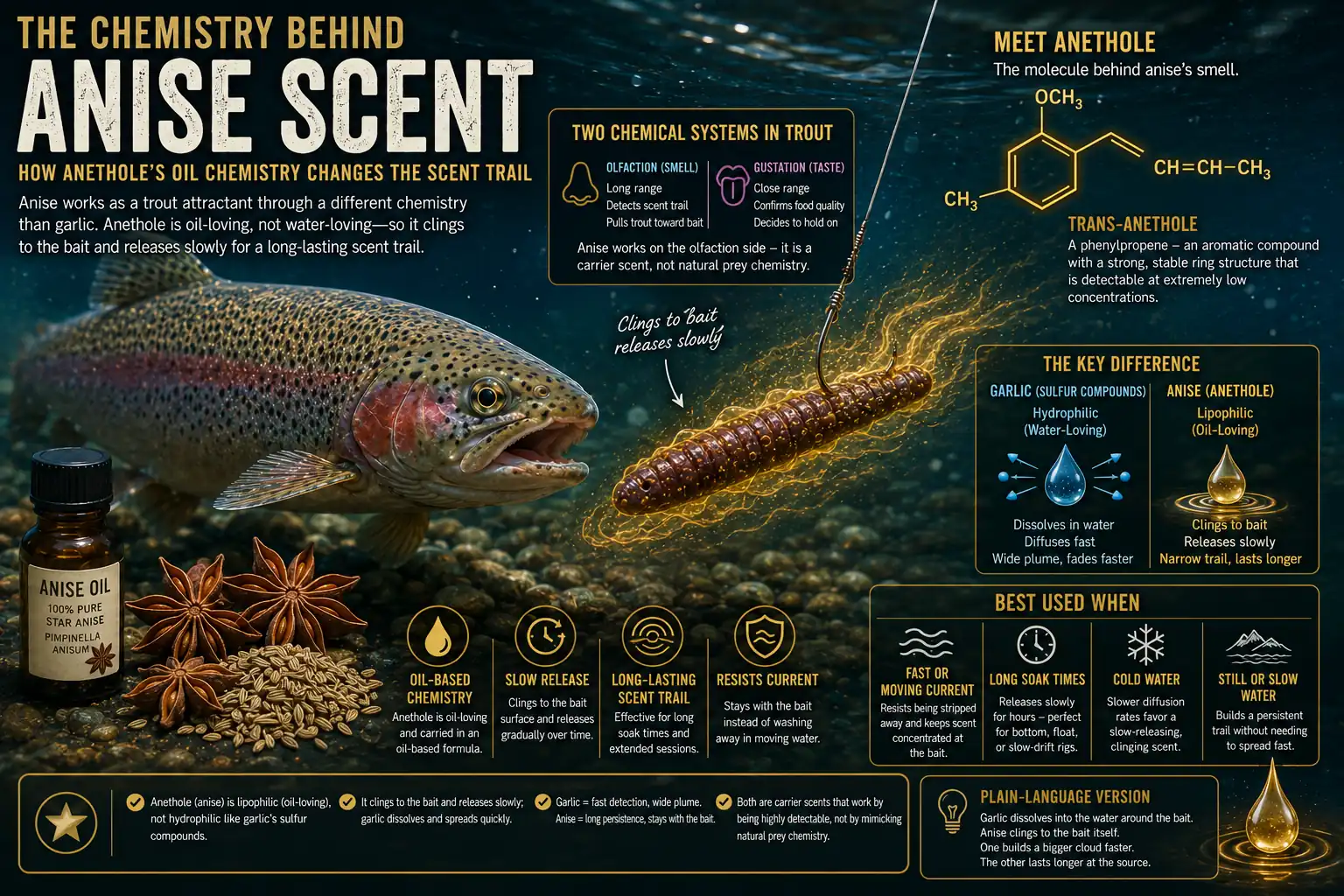
Anise scent for trout works differently than garlic because its active compound, anethole, is oil-loving instead of water-loving. That unique chemistry allows anise scent to cling to the bait and create a slow, long-lasting scent trail that performs especially well during extended presentations.
1.Same Two Systems, Different Molecule
As covered in our garlic scent chemistry breakdown, a trout runs two separate chemical systems: olfaction (smell, long range, pulls a trout toward the bait) and gustation (taste, close range, decides whether it holds on). Garlic and anise both operate on the olfaction side — they’re carrier scents that build a detectable trail, not natural trout-prey chemistry themselves. What’s different is the specific molecule doing the work, and that molecule’s physical properties change everything about how the scent behaves once it hits water.
2.Meet Anethole: The Molecule Behind Anise’s Smell
The compound responsible for anise’s distinct sweet, licorice-like smell is anethole (specifically trans-anethole) — the same aromatic compound found in star anise and fennel, which is why all three share a similar smell despite being unrelated plants. Chemically, anethole belongs to a class called phenylpropenes: an aromatic ring with a short carbon chain attached, a structural family built around strong, stable aromatic rings rather than the reactive sulfur chemistry behind garlic.
That aromatic ring structure is part of why anethole is detectable at extremely low concentrations across a wide range of animal species — it’s a molecule built to be noticed.
3.The Key Difference: Oil-Loving vs. Water-Loving Chemistry
This is the part that actually matters for how you fish it.
Garlic’s active compounds (allicin and related sulfur molecules) are hydrophilic — water-loving. They dissolve readily into water and diffuse outward fast, which is exactly why a garlic-scented bait builds a wide plume quickly.
Anethole is the opposite: lipophilic — oil-loving, and relatively poor at dissolving directly into water. Think of it like a drop of cooking oil dropped into a glass of water: it doesn’t dissolve and disperse the way food coloring would. It clings together, clings to fat and oil, and resists mixing into the surrounding water.
That’s exactly why anise-based fishing scents are almost always carried in an oil-based formulation rather than a water-based one, and why anethole released from a bait behaves less like an expanding cloud and more like a thin, persistent film that clings to the bait’s surface and releases slowly over time.
The plain-language version: garlic dissolves into the water around the bait; anise clings to the bait itself. One builds a bigger cloud faster. The other lasts longer at the source.
4.What That Means Underwater: Release Rate and Plume Shape
| Garlic vs. anise scent behavior | ||
| Property | Garlic (sulfur compounds) | Anise (anethole) |
| Chemistry class | Hydrophilic (water-loving) sulfur compounds | Lipophilic (oil-loving) aromatic compound |
| How it spreads | Dissolves and diffuses fast — wide plume, quickly | Clings to bait surface — narrow, persistent film |
| Plume duration | Strong initially, fades faster in moving water | Slower to build, lasts longer per application |
| Best suited to | Fast detection, moderate to slow current | Long soak times, still or slow water, extended sessions |
Neither is “better” in an absolute sense — they solve different problems. A fast-spreading, water-soluble scent gets noticed quickly but also washes away or gets swept downstream quickly in current. A slow-releasing, oil-based scent takes longer to build a noticeable trail but keeps working long after a water-soluble scent would have washed off.
5.When Anise Scent for Trout Outperforms Garlic
Fast or moving current: water-soluble scent gets carried away almost as fast as it’s released, shortening its effective range. An oil-based anise scent clinging to the bait itself resists being stripped away by current, keeping scent concentrated at the bait rather than smeared downstream before a trout ever crosses it.
Long-soak, stationary presentations: if you’re fishing a bait still for extended periods — bottom presentations, suspended under a float, or slow-drift technique — anise’s slow release means the bait is still actively scenting the water an hour in, well past the point a fast-dissolving scent has depleted.
Cold water: slower water movement and reduced diffusion rates in cold water already favor a scent that doesn’t need to move fast to work. Anise’s cling-and-release behavior pairs naturally with the patient, motionless presentations cold water already calls for.
Common mistake: using a water-soluble, fast-dispersing scent on a long-soak or bottom presentation and reapplying constantly to compensate. A slower-releasing, oil-based scent solves the actual problem — duration — instead of fighting it with more frequent reapplication.
6.A Note on Anise’s History as an Attractant
Anise and anethole have a long track record as an attractant well outside of trout fishing specifically — used historically in catfish and carp baits, and even in some trapping and hunting lures, across a wide range of target species. That cross-species effectiveness lines up with the underlying chemistry: a strong, stable, low-odor-threshold aromatic compound doesn’t need to mimic one specific prey item’s chemistry to be detected — it just needs to be a molecule the receiving animal’s olfactory system is sensitive to. That’s the same mechanism explored in the garlic post: the scent’s job is to get noticed and followed, not to chemically impersonate natural trout food.
7.Common Mistakes
- Assuming anise and garlic are interchangeable — their release behavior in water is fundamentally different, not just their smell
- Using a fast-dispersing scent for a long-soak presentation, or a slow-release scent when you need a quick, wide plume in fast water
- Over-applying oil-based scent expecting it to spread like a water-soluble one — it won’t, and it doesn’t need to
- Ignoring current speed when choosing between the two — it’s the single biggest factor in which one actually performs
Key Takeaways
- Anise’s active compound, anethole, is chemically opposite to garlic’s sulfur compounds: lipophilic (oil-loving) rather than hydrophilic (water-loving)
- That difference means anise clings to the bait and releases slowly, while garlic dissolves and spreads into the water quickly
- Garlic favors situations needing fast, wide detection; anise favors long-soak, stationary, or fast-current situations where persistence at the bait matters more than initial spread
- Both are carrier scents that work by being highly detectable, not by mimicking a trout’s natural prey chemistry
- Choosing between them is really a question about current speed and soak time, not which “smells stronger”
Frequently Asked Questions
Does anise scent actually work for trout fishing?
Yes — anise’s active compound, anethole, is a strong, low-odor-threshold aromatic that’s been used as a fish and game attractant across many species. It works by being highly detectable, similar in principle to garlic, but with different release behavior in water because of its oil-based chemistry.
What is anethole?
Anethole is the aromatic compound responsible for the smell of anise, star anise, and fennel. It’s a phenylpropene, a class of aromatic compounds that are lipophilic (oil-loving) rather than water-soluble, which is why anise-based scents are typically carried in oil rather than water.
Is anise or garlic scent better for trout?
Neither is universally better — they behave differently underwater. Garlic’s sulfur compounds are water-soluble and build a fast, wide-spreading plume, best for quick detection in moderate current. Anise’s anethole is oil-based and releases slowly, best for long-soak presentations or fast current where a water-soluble scent would wash away too quickly.
How long does fishing scent actually last in water?
It depends on the chemistry. Water-soluble scents like garlic’s sulfur compounds diffuse and deplete relatively fast, especially in moving water. Oil-based scents like anise’s anethole cling to the bait surface and release more gradually, generally lasting longer per application — particularly in still or slow water.