Hellgrammites Explained: Why These Giant Aquatic Insects Are an Important Trout Food Source
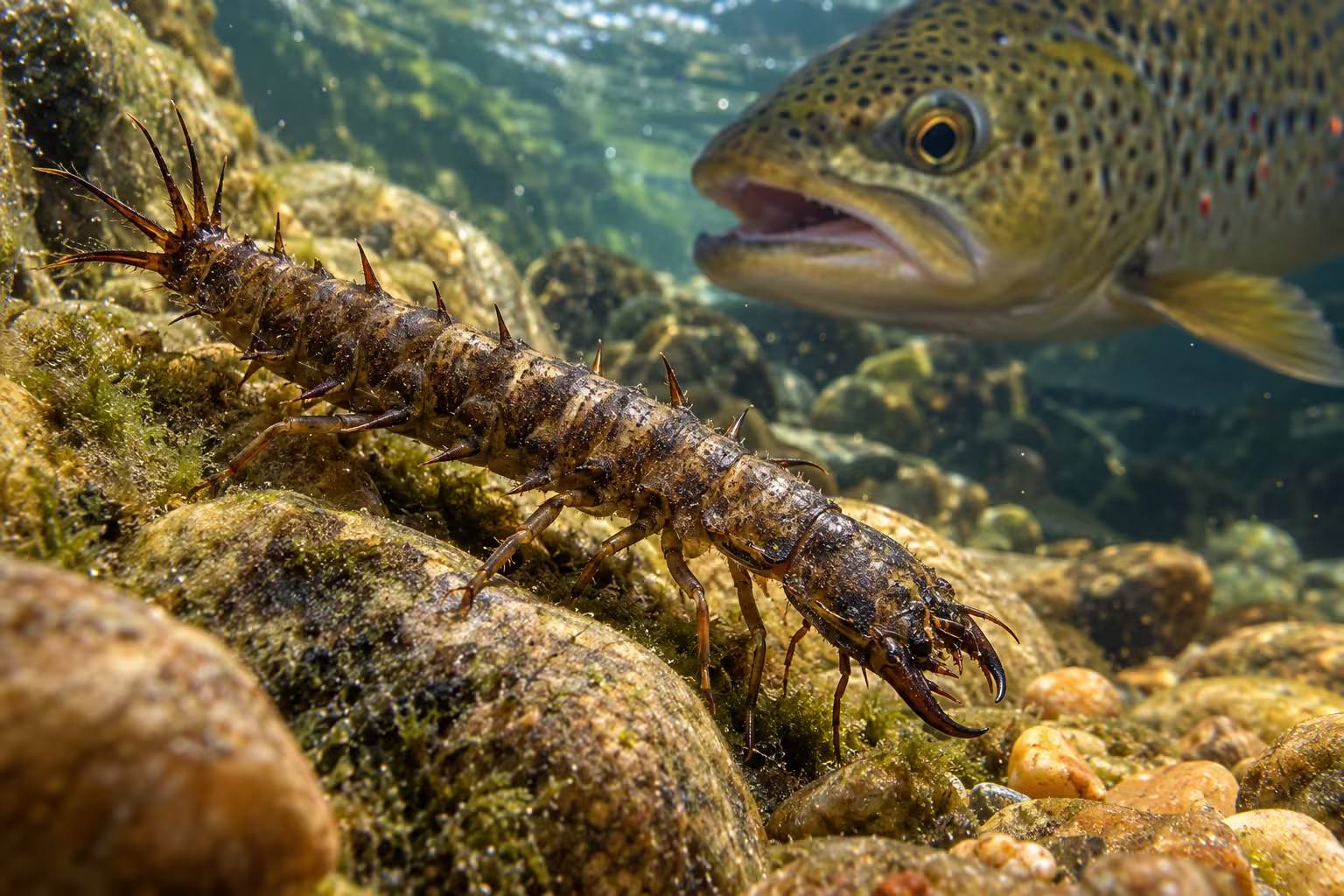
Turn over the right rock in a clean, fast-moving stream and you may find something that looks more suited to a science-fiction movie than a trout stream. Understanding hellgrammites for trout starts with knowing where these large aquatic insects live and how they become available as food.
A hellgrammite has a long, flattened body, powerful jaws, six true legs near the front of its body, and pairs of fleshy filaments running down its abdomen. Large specimens can be several inches long. They look intimidating, and their jaws are capable of delivering a painful pinch.
To a trout, however, a hellgrammite represents something much simpler:
A large, protein-rich meal living exactly where trout already spend much of their time feeding.
Hellgrammites are the aquatic larval stage of dobsonflies. Unlike mayflies and some other aquatic insects anglers associate with short seasonal hatches, hellgrammites spend a long portion of their lives underwater. In the eastern dobsonfly (Corydalus cornutus), for example, the larval period can last two to three years. During that time, the larvae live primarily around rocks, cobble, gravel, woody debris, and other structure in flowing water.
They are predators themselves, feeding on other aquatic organisms. But despite being formidable hunters, hellgrammites are also prey.
Fish eat them.
That combination—large size, long aquatic residence, bottom-oriented behavior, and association with moving water—makes hellgrammites an important food source to understand if you fish streams and rivers where they occur.
More importantly, understanding how a hellgrammite actually lives tells us much more about how to imitate one than simply knowing what color lure to buy.
The better we understand the food, the better we understand the fish.
What Is a Hellgrammite?
A hellgrammite is the aquatic larval stage of a dobsonfly, an insect belonging to the order Megaloptera and family Corydalidae.
The term is most properly associated with dobsonfly larvae rather than every large, similar-looking aquatic insect.
One of the best-known North American species is the eastern dobsonfly, Corydalus cornutus. Its larvae inhabit flowing streams and rivers across much of eastern North America. Other dobsonfly species occur elsewhere, so anglers should not assume every hellgrammite they encounter belongs to the same species.
The basic body plan, however, is unmistakable.
Hellgrammites typically have:
- A long, somewhat flattened body
- A heavily hardened head
- Large, powerful mandibles
- Three pairs of jointed legs
- Paired lateral filaments along the abdomen
- Abdominal gill structures
- Two strong terminal prolegs equipped with hooks
EPA identification material describes dobsonfly larvae as large aquatic macroinvertebrates with conspicuous jaws, lateral filaments and bush-like gills along the underside of the abdomen.
That appearance is not accidental.
A hellgrammite is built for life in current.
Its flattened profile helps it occupy spaces around and beneath rocks. Its legs and terminal hooks help it maintain contact with the substrate. Its large jaws allow it to capture other aquatic organisms.
In other words, this is not a helpless insect larva waiting to become an adult.
It is an aquatic predator.
And it may remain an aquatic predator for years.
Hellgrammites Are Dobsonfly Larvae
Understanding the dobsonfly life cycle is important because anglers primarily care about one particular stage: the larva.
Dobsonflies undergo complete metamorphosis:
Egg → Larva → Pupa → Adult
The aquatic larva is the hellgrammite.
For the eastern dobsonfly, egg masses may contain hundreds of eggs and are deposited on rocks, vegetation, or other surfaces above the water. After hatching, the young larvae enter the water and begin their aquatic existence.
The remarkable part is how long that aquatic stage can last.
Eastern dobsonfly larvae may develop for approximately two to three years before leaving the water to pupate. Mature larvae eventually crawl onto land and form protected pupal chambers beneath rocks, logs, soil, or similar cover.
That means trout living in a hellgrammite-producing stream potentially encounter these larvae during a large portion of the year rather than during one brief emergence.
That is a major difference between hellgrammites and many of the aquatic insects anglers normally discuss.
A mayfly hatch may create an intense feeding event.
A hellgrammite population creates a persistent benthic food resource.
For a broader look at the other aquatic organisms trout encounter, see Best Aquatic Insects for Trout).
Where Do Hellgrammites Live?
If you want to understand why trout eat hellgrammites, start with habitat.
Hellgrammites are strongly associated with flowing water.
Penn State Extension notes that hellgrammites can occur in higher-quality freestone streams and occupy some of the fastest-moving sections. Macroinvertebrate abundance in these systems is often concentrated in riffles, where moving water provides favorable habitat and oxygen conditions.
Typical hellgrammite habitat includes:
- Riffles
- Runs
- Rocky stream bottoms
- Cobble
- Gravel
- Spaces beneath larger rocks
- Boulder fields
- Woody debris
- Current seams adjacent to rocky structure
This immediately creates an overlap with trout habitat.
Trout frequently position themselves near moving water because current continuously transports potential food. But trout normally avoid wasting energy by fighting the strongest current unnecessarily.
Instead, they often use rocks, depressions, logs, banks, seams, and other structures to reduce the amount of energy required to hold position.
Trout Energy Conservation Explained becomes especially important here.
A trout can hold in relatively manageable water while watching faster water deliver food.
That creates an important relationship:
Hellgrammites often live in the substrate of current-producing habitat, while trout frequently feed immediately downstream or adjacent to that habitat.
That is exactly the kind of predator-prey overlap anglers should look for.
Hellgrammites Are Bottom-Dwelling Predators
Hellgrammites are not passive grazers.
They are predators.
Penn State describes them as predators of macroinvertebrates and other small aquatic organisms.
Their jaws tell part of the story.
A hellgrammite spends much of its time around the stream bottom searching for or ambushing prey among rocks and crevices.
That makes its normal ecological position very different from an insect drifting helplessly through the middle of the water column.
Most of the time, the correct mental picture is:
rock → crevice → bottom → current
rather than:
open water → surface
That distinction becomes extremely important when fishing an imitation.
An anatomically perfect hellgrammite imitation suspended several feet above the bottom may be less convincing than a less-perfect imitation moving naturally through the correct zone.
Before worrying about whether your imitation should be dark brown, black, olive, or amber, get it into the part of the stream where a trout would reasonably expect to encounter one.
Why Hellgrammites for Trout Are Such a Valuable Food Source
A trout constantly faces an energy problem.
Food provides energy.
Capturing food costs energy.
The fish therefore benefits when the energy obtained from prey exceeds the energy required to capture it.
This doesn’t mean trout consciously perform a mathematical calculation before attacking something. Natural selection has simply favored feeding behaviors that generally produce useful energetic returns.
A hellgrammite offers several advantages as prey.
1. Hellgrammites Can Be Large
Compared with midges and many other aquatic invertebrates, a mature hellgrammite can represent a substantial mouthful.
Eastern dobsonfly larvae, for example, can reach roughly 70 millimeters according to identification references.
A trout may need to capture many tiny insects to obtain the biomass represented by one large prey item.
That does not mean trout will always choose the largest possible food.
Availability, vulnerability, current speed, trout size, competition, feeding pressure, and previous experience all matter.
But a large aquatic invertebrate can offer a substantial energetic reward.
USGS research on trout feeding has demonstrated an important general principle: trout can select disproportionately for larger invertebrate prey rather than simply consuming organisms according to their numerical abundance. In one spring-fed stream study, brown and rainbow trout selected larger prey, with consumed invertebrates commonly larger than the average organisms simply available in the drift.
Hellgrammites fit the large-prey side of that feeding equation particularly well.
Hellgrammites Are Usually Protected Until Something Goes Wrong
Here is one of the most important concepts in this entire article:
Abundance is not the same thing as availability.
There could be hundreds of hellgrammites living within a stream reach without hundreds of hellgrammites being available to trout at any particular moment.
Why?
Because many are protected by the stream bottom.
A hellgrammite underneath a large rock is difficult for a trout to capture.
A hellgrammite swept from underneath that rock and tumbling downstream is a completely different situation.
Suddenly the prey is exposed.
That distinction helps explain why changes in flow can create feeding opportunities.
Anything that disturbs bottom habitat can potentially increase the number of aquatic organisms entering the drift.
That includes:
- Rising water
- High flows
- Storm runoff
- Rocks being disturbed
- Changing current velocities
- Natural movement of substrate
- Hellgrammites relocating
- Mature larvae moving toward shore before pupation
The important fishing question therefore isn’t only:
Are hellgrammites present?
It is:
What would make one vulnerable to a trout right now?
That is a much more useful question.
Current Turns a Bottom-Dweller Into Drifting Food
Current is the delivery system connecting a hellgrammite to a trout.
Imagine a hellgrammite living beneath a cobble in a riffle.
As long as it remains protected beneath the rock, a trout may never see it.
Now imagine that the insect loses its grip or becomes dislodged.
Immediately, the situation changes.
The current begins carrying the insect downstream.
It may:
- tumble,
- roll,
- crawl,
- momentarily catch against another rock,
- become dislodged again,
- or wash into slower water.
That movement creates exactly the kind of opportunity trout exploit.
A trout doesn’t necessarily need to chase the prey very far. It can hold behind a rock or along a current seam and allow the stream to deliver the meal.
This is why How Trout Use Current Breaks is directly connected to understanding hellgrammites.
Look downstream from productive rocky habitat.
Look behind boulders.
Look where fast water borders slower water.
Look at the downstream edge of riffles.
Look where a shallow riffle transitions into a deeper run or pool.
These are locations where a displaced hellgrammite can leave protected substrate and enter a trout’s feeding lane.
The Riffle-to-Run Transition Can Be Especially Important
One of the most useful places to apply this biology is where a riffle begins transitioning into deeper water.
Upstream, you may have:
- rocks,
- cobble,
- oxygenated water,
- abundant aquatic insects,
- and significant current.
Immediately downstream, you may have:
- greater depth,
- reduced velocity,
- current seams,
- pockets,
- and trout holding positions.
That is a natural food-delivery system.
Aquatic organisms dislodged upstream are transported directly toward fish positioned downstream.
This doesn’t guarantee trout are feeding on hellgrammites.
But if hellgrammites are present in the stream, this is exactly the type of habitat relationship an angler should recognize.
Instead of randomly casting throughout the pool, you can ask:
Where is food entering this pool?
That question is useful far beyond hellgrammites.
Hellgrammites and Dissolved Oxygen
Hellgrammites can also tell us something about the stream itself.
EPA materials have historically placed hellgrammites among macroinvertebrates relatively sensitive to environmental degradation, and Penn State associates them with higher-quality freestone streams.
Fast-moving rocky water also tends to promote aeration.
Turbulence increases exchange between air and water, which can increase dissolved oxygen. EPA notes that turbulence enhances oxygen absorption into water.
This creates another ecological overlap.
Trout also require well-oxygenated water.
That does not mean finding one hellgrammite proves a stream is pristine, nor does it mean every oxygen-rich trout stream must contain hellgrammites.
Aquatic ecosystems are much more complicated than that.
But their presence can be part of a broader biological picture suggesting suitable flowing-water habitat.
For more about how oxygen affects trout behavior, see How Dissolved Oxygen Affects Trout: The Science Behind the Bite Window.
Water Temperature Still Matters
Hellgrammites do not override the basic physiology of trout.
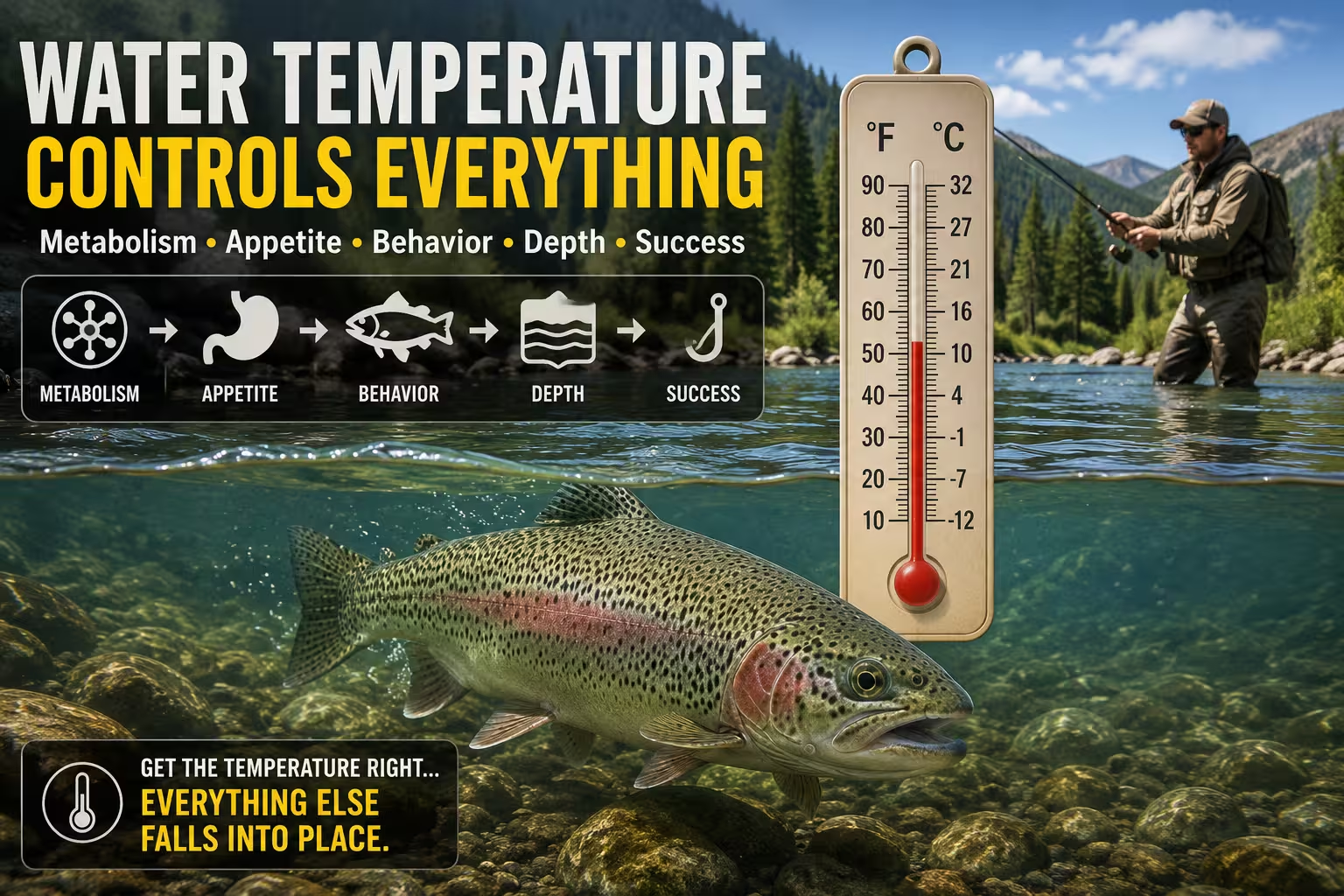
Even when an excellent food source is available, water temperature influences trout metabolism, oxygen demand, activity, and feeding behavior.
Cold water can reduce metabolic demand.
Warmer water generally increases metabolism until temperatures approach stressful levels, while warmer water simultaneously holds less dissolved oxygen.
That relationship is covered in detail in Best Water Temperature for Trout: The Science Behind Why Temperature Controls Everything.
For hellgrammite fishing, the practical lesson is simple:
Do not evaluate the food source independently from the fish.
A perfect hellgrammite presentation placed in front of a thermally stressed trout may still receive little response.
Food availability is only one variable in the feeding equation.
Do Trout Specifically Recognize Hellgrammites?
Trout do not need a human-style taxonomic understanding of a hellgrammite.
They do not need to think:
“That is a dobsonfly larva.”
They need sensory information that fits something worth investigating or eating.
That can include:
- Size
- Shape
- Silhouette
- Movement
- Contrast
- Location
- Speed
- Scent or chemical information
- Previous feeding experience
A trout living in a stream with a strong hellgrammite population has opportunities to encounter them repeatedly.
Those encounters can reinforce the relationship between a particular prey profile and food.
This is especially relevant to wild trout that have spent their lives interacting with the natural prey community of the stream.
Stocked trout create a somewhat different behavioral situation because hatchery conditioning influences their initial feeding experience.
As stocked trout remain in natural water and begin exploiting naturally occurring foods, their behavior can increasingly reflect the opportunities available in that environment.
Hellgrammite vs. Stonefly Nymph
Hellgrammites are sometimes confused with stonefly nymphs because both can be relatively large, dark aquatic insects associated with rocky flowing water.
They are not the same insect.
Stoneflies belong to the order Plecoptera.
Dobsonflies belong to Megaloptera.
A hellgrammite generally has numerous paired lateral filaments running along its abdomen and powerful jaws. Stonefly nymphs have a different body structure and typically have two prominent tails, or cerci, extending from the end of the abdomen.
EPA identification materials specifically distinguish dobsonfly larvae by their lateral abdominal filaments.
Both can occupy trout streams.
Both can be eaten by trout.
Both can make large subsurface prey.
But their biology and life cycles are different.
For a closer look at stoneflies, see Stoneflies for Trout: Lifecycle, Behavior & Fishing Strategy and Stonefly Nymph: How to Rig and Fish It for Trout.
Hellgrammites vs. Mayfly Nymphs
Mayflies represent another important aquatic trout food, but again the feeding ecology differs.
Many mayfly nymphs are considerably smaller than mature hellgrammites.
Their behavior, body shape, habitat preferences, swimming ability, emergence patterns, and vulnerability to trout vary tremendously among species.
Hellgrammites are generally better thought of as large benthic prey rather than as a conventional hatch-matching insect.
That difference matters.
When trout are keyed into an emerging mayfly event, matching the insects moving through the water column can be extremely important.
When imitating a hellgrammite, the more important problem may simply be presenting a large aquatic-insect profile naturally near rocky bottom structure.
For more on mayfly behavior, see Mayflies for Trout: Subsurface Behavior & Presentation Strategy).
When Are Hellgrammites Most Available to Trout?
Because hellgrammites spend such a long period underwater, there isn’t one universal “hellgrammite season” comparable to the way anglers discuss some insect hatches.
Instead, think in terms of availability events.
The insect may exist in the stream year-round while its vulnerability changes.
Several conditions can increase that vulnerability.
Rising Water
Increasing flow can disturb bottom habitat and change hydraulic forces around rocks.
Aquatic organisms that normally remain protected may become exposed or displaced.
This can make bottom-oriented prey more available.
After a Flow Increase
As flows change, trout may reposition.
Instead of simply fishing the same location you used under normal flow, identify:
- New current seams
- Flooded margins
- Softer pockets
- Behind-boulder refuges
- Downstream edges of riffles
- Protected banks
Food may be moving, but trout still need positions where the energetic cost of feeding makes sense.
Natural Movement
Hellgrammites are not permanently attached to one rock.
They crawl and relocate while hunting and seeking shelter.
Movement creates vulnerability.
Pre-Pupal Migration
When mature larvae complete aquatic development, they eventually leave the water to pupate on land.
That movement toward shore creates another period when large larvae may become unusually exposed.
The important concept is that the best hellgrammite fishing conditions may occur when something increases exposure, not simply when the insects exist.
Where Should You Fish a Hellgrammite Imitation?
Start with habitat rather than lure color.
1. Rocky Riffles
These are potential hellgrammite-producing areas.
Fishing directly through extremely fast shallow riffles can be difficult, so also examine what lies immediately downstream.
2. Riffle Tails
As fast shallow water transitions toward deeper water, dislodged prey can be delivered into trout holding positions.
3. Boulder Pockets
A large rock creates multiple hydraulic zones.
Water accelerates around the sides while slower water forms behind it.
A trout can use that protected area while watching food move past.
4. Current Seams
The boundary between faster and slower water is one of the most important feeding structures in moving water.
A drifting hellgrammite carried along the faster side may become available to trout holding near the slower side.
5. Deep Runs Below Rocky Water
These provide depth, security, and access to food coming from upstream.
6. Undercut Banks Near Current
Especially during elevated flow, large aquatic prey can be carried toward protected bank water.
The recurring pattern is:
Find the habitat producing food, then identify the nearest efficient trout holding position.
That is much more reliable than casting randomly.
How to Imitate a Hellgrammite
You do not necessarily need a perfect anatomical reproduction containing every filament and body segment.
The important characteristics are more fundamental:
- Elongated body
- Relatively large profile
- Dark natural coloration
- Segmentation or texture
- Appendage movement
- Bottom-oriented presentation
Common natural colors include:
- Dark brown
- Brown
- Black
- Olive-brown
- Dark amber
Water clarity can change how much contrast you want from an artificial presentation.
Fly-Fishing a Hellgrammite Pattern
A hellgrammite fly should generally be treated as a subsurface pattern.
The primary objective is getting it into the feeding zone.
That may require:
- Weighted flies
- Split shot where legal
- A sinking leader or appropriate line system
- Indicator nymphing
- Tight-line techniques
- High-stick presentations
The exact system is less important than achieving the correct depth and drift.
If the fly races unnaturally above the bottom while natural hellgrammites are associated with rocks underneath it, the presentation is missing an important biological cue.
Allow the fly to travel naturally with the current while maintaining enough control to detect a strike.
A little irregular movement can be useful because a displaced hellgrammite isn’t necessarily a perfectly motionless object.
But avoid turning it into a rapidly swimming minnow.
It is still an aquatic insect.
Fishing a Soft-Plastic Hellgrammite
A soft-plastic hellgrammite can reproduce several important features of the natural insect particularly well:
- Flexible body
- Moving appendages
- Segmented profile
- Bottom contact
- Slow crawling movement
Rigging options can include a small jig head, bottom rig, float-controlled presentation, or other light tackle appropriate for the water being fished.
The critical variable is weight.
Too little weight and the imitation may never reach the feeding zone.
Too much weight and it may constantly wedge between rocks or move unnaturally.
How to Choose Jig Head Weight for Trout explain this relationship in more detail.
Ideally, use enough weight to maintain contact with or proximity to the bottom without making the lure behave like an anchor.
That balance changes with:
- Depth
- Current speed
- Line diameter
- Casting angle
- Lure size
- Jig-head shape
There is no single correct hellgrammite jig weight for every stream.
Natural Hellgrammites as Bait
Where legal, natural hellgrammites have a long history as fishing bait.
Their effectiveness should not be surprising.
They already possess:
- The correct size
- The correct shape
- Natural texture
- Natural movement
- Natural chemical cues
However, anglers should check local regulations before collecting or using aquatic organisms as bait.
Collection regulations, bait restrictions, transport rules, protected waters, and restrictions designed to prevent movement of invasive species can vary considerably.
Also remember that hellgrammites have strong jaws.
Handle them carefully.
Presentation Under Low Fishing Pressure
When trout have experienced little fishing pressure, presentation errors may be relatively forgiving.
You can often begin with:
- A larger profile
- Natural dark coloration
- Moderate movement
- Bottom-oriented drift
- Slightly more aggressive coverage of water
The objective is to determine whether trout are willing to respond to a substantial prey item.
Start by targeting obvious feeding structures rather than reducing everything immediately.
Presentation Under Moderate Fishing Pressure
As pressure increases, trout may become less tolerant of unnatural presentations.
This is where details begin becoming more important.
Try:
- Slightly smaller profiles
- Natural coloration
- Lighter line where appropriate
- Longer casts
- More natural drift
- Less unnecessary lure movement
- Better control of depth
Instead of assuming the fish “aren’t hungry,” consider whether they are rejecting something about the presentation.
Presentation Under Heavy Fishing Pressure
Heavily pressured trout may still eat.
The challenge is getting them to accept your offering.
This is where subtlety can become extremely important.
Try:
- Smaller hellgrammite profiles
- Minimal added action
- Precise bottom positioning
- Natural current speed
- Reduced terminal tackle visibility
- Casting beyond the fish rather than directly at them
- Allowing the current to deliver the imitation
A nearly motionless presentation can sometimes be particularly effective when trout refuse moving lures.
Dead sticking is a way of fishing that can exploit this behavior, especially when fish are unwilling to chase.
The principle is not that dead sticking is always superior.
It is that reducing movement can reduce the amount of unnatural information a pressured trout receives.
Don’t Overwork the Lure
One of the easiest mistakes when fishing any artificial lure is assuming more action automatically produces more strikes.
With a hellgrammite, excessive action can destroy the biological illusion.
Remember what the natural organism does.
It crawls.
It grips.
It becomes displaced.
It tumbles.
It catches itself.
It crawls again.
It does not normally shoot several feet through the water every second.
So rather than constantly snapping the rod tip, experiment with:
drift → touch bottom → pause → crawl → drift
The stream itself can provide much of the action.
This is particularly important in moving water.
Why Bottom Contact Matters—but Constant Snagging Doesn’t
Because hellgrammites are benthic organisms, anglers often assume the lure must drag continuously across the bottom.
Not necessarily.
The real objective is to remain within the bottom feeding zone.
An imitation passing a few inches above rocks can still look completely believable to a trout.
In fact, that can be more efficient than allowing the lure to wedge underneath every rock.
Your tackle should tell you approximately where the lure is.
Occasional bottom contact confirms depth.
Constant snagging usually indicates excessive weight, an inefficient casting angle, or poor line control.
The goal is not:
Stay attached to the bottom.
The goal is:
Stay close enough to the bottom to look like natural food.
Hellgrammites, Trout Size, and Meal Size
A large hellgrammite is a substantial prey item.
That makes hellgrammite imitations particularly interesting when targeting larger trout.
Larger trout often have the physical capacity to consume larger prey and can sometimes improve energetic efficiency by capturing fewer, larger food items.
This is one reason large trout diets can differ from those of smaller trout. However, don’t make the mistake of assuming:
big lure = big trout only.
Smaller trout can attack surprisingly large prey, while large trout sometimes feed heavily on very small organisms.
Food selection depends on what is available, vulnerable, profitable, and abundant at that particular time.
Hellgrammites Are Part of a Larger Food Web
One of the most useful things about studying individual trout foods is discovering how interconnected the stream really is.
Hellgrammites eat other aquatic organisms.
Trout eat hellgrammites.
Trout also eat:
- Mayflies
- Stoneflies
- Caddisflies
- Scuds
- Crawfish
- Leeches
- Worms
- Minnows
- Sculpins
- Terrestrial insects
- Other available prey
USGS research has documented how trout diets can shift when aquatic insect availability changes, demonstrating that feeding behavior reflects the prey community available to the fish.
That is why there is no universal “best trout bait.”
The better question is:
What food is available to these trout, in this water, under these conditions, right now?
Hellgrammites simply represent one particularly interesting part of that food web.
What Hellgrammites Can Tell You About a Trout Stream
Even if you never fish a hellgrammite imitation, finding them can teach you something.
Turn over a few rocks in a riffle—carefully replacing them afterward—and examine what lives underneath.
You may find:
- Mayfly nymphs
- Stonefly nymphs
- Caddisfly larvae
- Scuds
- Hellgrammites
- Aquatic beetles
- Other macroinvertebrates
Suddenly, lure selection becomes less theoretical.
You have sampled the stream’s pantry.
A stream containing numerous large hellgrammites is giving you information about potential prey size, habitat, and feeding opportunities.
This is one of the simplest lessons in fishing:
Look at what actually lives in the water.
The trout already know.
The Bigger Fishing Lesson: Think Like an Ecologist
Hellgrammites demonstrate why successful fishing is about much more than lure selection.
The chain looks something like this:
Habitat → prey → current → vulnerability → trout position → presentation
Hellgrammites live around rocky substrate.
Current flows across that substrate.
Some hellgrammites become exposed or dislodged.
Current transports them.
Trout use efficient holding positions to intercept vulnerable prey.
The angler’s job is to place an imitation into that same system.
Once you begin looking at streams this way, individual fishing techniques start making more sense.
You stop asking only:
What lure should I throw?
And begin asking:
Where is the food produced?
What makes that food vulnerable?
Where will the current carry it?
Where can a trout intercept it without wasting energy?
How do I make my lure travel through that same path?
Those questions are the foundation of consistent trout fishing.
Frequently Asked Questions About Hellgrammites and Trout
What is a hellgrammite?
A hellgrammite is the aquatic larval stage of a dobsonfly. Dobsonflies belong to the insect order Megaloptera. Hellgrammites are large predatory aquatic larvae commonly associated with rocky, flowing streams and rivers.
Do trout eat hellgrammites?
Yes. Hellgrammites are eaten by fish and can represent a substantial aquatic food item. Their large size makes them a potentially valuable meal when they become exposed or dislodged from bottom habitat. Penn State specifically notes that hellgrammites are eaten by fish.
Are hellgrammites the same as stonefly nymphs?
No. Hellgrammites are dobsonfly larvae belonging to the order Megaloptera. Stoneflies belong to Plecoptera. Both can live in rocky flowing water, but they have different anatomy and life cycles.
How big do hellgrammites get?
Size varies by species and life stage. Eastern dobsonfly larvae can reach roughly 70 mm, or around 2.75 inches, and individual observations of similarly large larvae are common.
Where do hellgrammites live?
They are strongly associated with streams and rivers, particularly rocky flowing habitat. Look around cobble, gravel, boulders, riffles, runs, and other bottom structure.
Are hellgrammites a sign of clean water?
Their presence can be associated with relatively good stream conditions, and hellgrammites have been used among relatively pollution-sensitive macroinvertebrate groups in biological water-quality assessment. However, finding one hellgrammite by itself does not prove that a stream is pristine. Water quality should be evaluated using multiple biological, physical, and chemical indicators.
Are hellgrammites dangerous?
They are not dangerous in the way a venomous animal would be, but large hellgrammites have strong mandibles and can pinch or bite when handled. EPA identification guidance specifically warns about their powerful jaws.
What color are hellgrammites?
Natural coloration varies, but dark brown, brown, blackish, olive-brown, and amber tones can all provide reasonable starting points for artificial imitations.
What is the best hellgrammite color for trout?
There is no universally best color. Begin with colors resembling the local insects and then consider water clarity, light, depth, and background contrast. Natural dark brown or olive-brown patterns are logical starting points in clear water.
What is the best way to fish a hellgrammite for trout?
Keep the presentation close to rocky bottom habitat and allow the current to create much of the movement. Riffle tails, current seams, boulder pockets, and runs immediately below rocky water are logical places to start.
Should a hellgrammite imitation drag on the bottom?
It can touch or crawl along the bottom, but continuous bottom contact isn’t necessary. The more important objective is keeping the imitation within the bottom-oriented feeding zone while maintaining a natural presentation.
Can you fish hellgrammites under a bobber?
Yes. A float can be used to control the depth of a hellgrammite imitation or natural bait where regulations allow. Set the rig deep enough for the offering to travel close to the bottom without becoming constantly snagged.
Can you use a hellgrammite on a jig head?
Yes. Soft-plastic hellgrammite imitations can be effective on jig heads. Choose the lightest practical weight that allows the lure to reach the feeding zone and maintain control in the current.
When is the best time to fish a hellgrammite?
There isn’t one universal hellgrammite season because the aquatic larval stage can persist for years. Instead, pay attention to conditions that increase prey vulnerability, including changing flow, rising water, substrate disturbance, and natural movement of mature larvae.
Are hellgrammites active in cold water?
Hellgrammites remain aquatic for an extended portion of their life cycle, but activity and availability can change with temperature and season. More importantly for anglers, trout metabolism and feeding behavior also change with water temperature.
Do stocked trout eat hellgrammites?
They can. Newly stocked trout may initially behave differently because of hatchery conditioning, but trout are capable of exploiting naturally available aquatic prey as they acclimate to stream conditions.
Do brown trout eat hellgrammites?
Yes. Brown trout consume aquatic invertebrates extensively, and a hellgrammite can fall within the size and prey type available to stream-dwelling brown trout.
Do rainbow trout eat hellgrammites?
Yes. Rainbow trout are opportunistic predators that consume aquatic invertebrates, and hellgrammites can be part of the available prey community in streams where both occur.
Do brook trout eat hellgrammites?
Brook trout consume a wide variety of aquatic invertebrates. Where hellgrammites overlap with brook trout habitat and become vulnerable, they can represent potential prey.
Are hellgrammites better than worms for trout?
Neither is universally better. They represent different natural food sources and behave differently in the water. The better choice depends on what prey exists locally, trout behavior, water conditions, fishing pressure, and how the bait or imitation is presented.
Why would a trout eat such an aggressive insect?
Because being dangerous to smaller aquatic organisms doesn’t make a hellgrammite immune from predation. A trout large enough to capture one gains access to a substantial food item. Predators routinely become prey when they encounter something larger.
Why are hellgrammites especially interesting to trout anglers?
Because they connect several major pieces of trout behavior at once.
They live in rocky current.
They are relatively large.
They spend a long time underwater.
They can become vulnerable when displaced.
And the same current that dislodges them can deliver them directly to trout using energy-efficient feeding positions.
That makes the hellgrammite more than an unusual-looking insect.
It is a perfect example of how stream biology, current, trout behavior, and lure presentation all connect.
Final Takeaway
Hellgrammites look complicated.
The fishing lesson behind them isn’t.
They are large aquatic predators that spend much of their lives around the bottom of flowing streams and rivers. Their rocky habitat often overlaps with the same riffles, runs, boulders, seams, and current transitions that create productive trout water.
Most of the time, their bottom-oriented behavior provides protection.
But once a hellgrammite becomes exposed or dislodged, current can transform it from a hidden bottom-dweller into a large drifting meal.
That is the opportunity a trout exploits.
And it is the opportunity an angler can imitate.
Don’t start by asking which hellgrammite lure has the perfect color.
Start with the biology.
Find the rocks.
Find the current.
Find where that current delivers food.
Find the place a trout can hold without wasting energy.
Then put the imitation there.
Because whether the food source is a hellgrammite, scud, stonefly, crawfish, sculpin, minnow, leech, or worm, the fundamental principle remains the same:
Understanding what trout eat is useful. Understanding how that food reaches the trout is what turns biology into a fishing strategy.