Why Lure Colors Change Underwater: How Depth and Light Affect Soft Plastics
Lure colors underwater don’t behave the same way they do above the surface. Some colors fade to nothing within the first few feet of a dive. Others carry their full visible strength fifty, seventy, even a hundred feet down. This means a bait that looks bright and vivid sitting in your hand on the bank can look completely different — sometimes unrecognizably different — by the time it reaches a fish’s eye at depth.
Most anglers understand this at a surface level: “reds go dark,” “blues stay visible,” that kind of thing. But understanding why it happens — the actual physics of light passing through water — changes how you think about color selection entirely. It moves color choice from a guessing game based on what looked good in the store, to a calculated decision based on depth, water clarity, and what a fish can physically detect at the moment your bait is in the strike zone.
This part of the series breaks down exactly what happens to light as it enters water, why the order of color loss is so predictable, and how to translate that physics into real decisions on the water.
Light Is Not One Thing — It’s a Range of Wavelengths
To understand why water treats colors differently, you have to start with what color actually is. Visible light is a narrow slice of the electromagnetic spectrum, made up of different wavelengths that our eyes interpret as different colors. Red light has the longest wavelength and the lowest energy per photon. As you move through orange, yellow, green, blue, and violet, wavelength shortens and energy per photon increases.
Water absorbs light — but it doesn’t absorb every wavelength at the same rate. Longer wavelengths (red, orange) are absorbed quickly. Shorter wavelengths (blue, green, violet) penetrate much further before they’re absorbed. This isn’t a marketing claim or an angling myth — it’s basic physics that applies to any body of water on Earth, freshwater or salt, lake or river, and it’s the same reason the ocean looks blue from an airplane: blue is the wavelength that survives being reflected back up after traveling the furthest into the water column.
Every photon of light that enters water is either absorbed by water molecules (turned into heat), scattered by particles suspended in the water, or reflected back toward the surface. The deeper light travels, the more of it gets absorbed. Wavelength determines how fast that absorption happens.
How Lure Colors Underwater Change With Depth
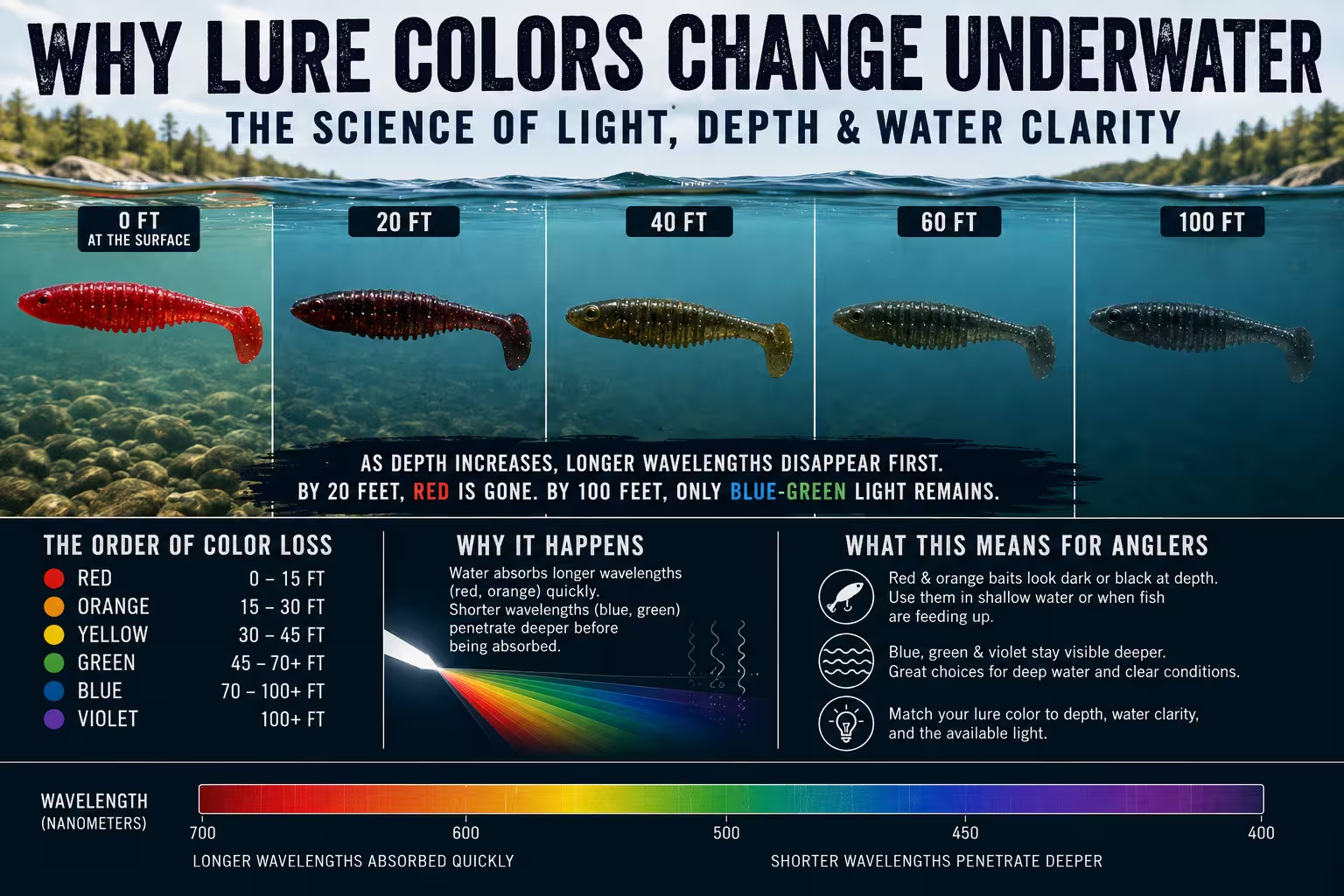
As depth increases, color disappears in a consistent, well-documented order:
- Red disappears first — typically within the first 15–20 feet in clear water, sometimes sooner in stained water.
- Orange goes next, generally fading out somewhere in the 25–30 foot range.
- Yellow follows, often losing most of its visible punch by 35–45 feet.
- Green survives considerably longer, often still detectable well past 70 feet in clear conditions.
- Blue and violet penetrate the deepest of all visible wavelengths, sometimes remaining detectable past 100 feet in very clear water.
These aren’t hard cutoffs — they’re gradual fades, and the exact depth at which a color effectively disappears depends heavily on water clarity, which we’ll get into below. But the order never changes. Red always goes first. Blue and violet always last the longest. That order is a direct consequence of wavelength and is true in every body of water on the planet.
What “Disappears” Actually Means
It’s important to understand what’s actually happening when a color “disappears.” The bait isn’t becoming invisible — it’s losing the specific wavelength of light needed to reflect that color back to an eye. A red soft plastic doesn’t stop reflecting light at depth; it simply has no red light left in the water column to reflect. What’s left is whatever ambient light remains, which at that depth is dominated by blue-green wavelengths.
The result: a red bait at 20 feet doesn’t look “less red.” It looks dark, almost black. The pigment hasn’t changed — the light available to bounce off it has. This is the single most important, and most commonly misunderstood, concept in underwater color theory.
The Physics Behind the Fade: A Closer Look at Absorption
It helps to understand not just that water absorbs light unevenly, but how that absorption actually works, because it explains why the fade is gradual rather than a hard cutoff.
As light travels through water, a certain percentage of each wavelength’s remaining energy is absorbed for every additional unit of depth it travels. This is an exponential process, not a linear one — meaning the loss isn’t “10% absorbed in the first foot, 10% in the second foot, 10% in the third,” but rather a compounding reduction where each additional foot removes a percentage of what’s left, not a fixed percentage of the original amount. This is the same mathematical relationship that governs how sound fades, how radioactive decay works, and how many other natural absorption processes behave — a rate of loss that compounds rather than staying constant.
The practical result is that color loss looks dramatic near the surface and then levels off the deeper you go — because most of the “loseable” light for that wavelength has already been absorbed in the first several feet. This is part of why the depth ranges given earlier are described as fades rather than hard lines: a red bait doesn’t have a light switch that flips off at exactly 18 feet. It’s noticeably duller at 8 feet, significantly darker by 15, and essentially black by 20-25, with the steepest part of that curve happening earliest.
Different wavelengths have different absorption rates within this exponential process — that’s the entire reason red, orange, yellow, green, and blue all fade at different speeds. Red has the highest absorption rate per foot of any visible wavelength, meaning it loses the largest percentage of its remaining energy for every foot of depth. Blue and violet have the lowest absorption rates of the visible spectrum, which is why they’re still detectable at depths where red disappeared many feet earlier.
Why a Red Bait Behaves Like a Black Bait at Depth
This is where the practical payoff of the physics starts to show up. Because red loses its wavelength so quickly, a red soft plastic at any meaningful depth is functionally a black or dark-silhouette bait, not a “red” bait in any way a fish would perceive.
This matters for two reasons.
First, it means red baits at depth aren’t triggering a fish based on color — they’re triggering it (or failing to) based on silhouette and contrast against the background light. If you’re choosing red because you think it’s the most visible or triggering color, and you’re fishing it below 15-20 feet, you’re not getting the effect you think you’re getting. You’re fishing a dark silhouette bait and getting dark-silhouette results, whether you intended to or not.
Second — and this is genuinely useful once you internalize it — it means red can be a deliberate silhouette choice at depth, not just an accidental one. A sharp, dark outline against ambient light can be an extremely effective trigger, especially in low-light or overcast conditions where fish are relying more on shape and movement than fine color discrimination. Some of the most effective “black” presentations anglers fish at depth are, technically, red baits that have simply lost their red.
Colors That Hold Up vs. Colors That Fade Fast
Grouping colors by how they behave underwater gives you a much more useful mental model than thinking about them individually.
Colors that retain visibility at depth: blue, purple, green, and — critically — chartreuse and other fluorescent/UV-reactive pigments (more on why below). These are the colors that still look like themselves, not just dark shapes, once you get past the shallow zone.
Colors that lose visibility quickly: red, orange, and bright pink. These are colors that look spectacular in your tackle box and on the boat deck, and then convert almost immediately into a dark silhouette once they’re a rod-length or two below the surface.
This doesn’t mean red, orange, and pink are bad colors — they’re excellent shallow-water colors, and as discussed above, they can be intentional dark-silhouette choices at depth. It means the reason you’re choosing them needs to match the depth you’re fishing. A color chosen for its vivid true-color visibility only works as intended in the shallow zone where that wavelength still exists.
Why Fluorescent and UV-Reactive Colors Are the Exception
Here’s a detail that most color guides skip entirely, and it’s one of the more useful pieces of underwater color science for lure selection: fluorescent pigments don’t play by the same rules as ordinary reflective pigments, because they don’t just reflect light — they convert it.
A fluorescent pigment absorbs higher-energy wavelengths (often in the blue and ultraviolet range, which — as covered above — are exactly the wavelengths that survive deepest into the water column) and re-emits that energy as visible light at a different, usually longer, wavelength. Practically, this means a fluorescent chartreuse or orange bait isn’t relying on ambient orange or yellow light being present to look orange or yellow. It’s pulling in blue and UV light — which is abundant at nearly every depth you’ll fish — and converting it into visible color on the spot.
This is why fluorescent baits often remain genuinely, vividly colored at depths where an identically-colored non-fluorescent bait has already gone flat and dark. It’s not hype. It’s a different physical mechanism for producing color, and it’s the reason fluorescent and UV-reactive soft plastics have earned a reputation as reliable deep-water and stained-water performers.
Water Clarity Changes Everything
Depth alone doesn’t tell the full story — water clarity determines how fast the entire process happens.
In clear water, light travels further before being absorbed or scattered, so the depth ranges above (red fading around 15-20 ft, blue surviving past 100 ft) hold reasonably true. Clear lakes, clear rivers, and clear tailwaters give color the most room to work as intended.
In stained or murky water, everything changes — and not just because visibility is generally worse. Suspended particles (silt, algae, organic matter, tannins) don’t just block light; they scatter it in every direction. This scattering has two effects. First, it accelerates the loss of every wavelength, not just red — even blue and green, which survive deep in clear water, get absorbed and scattered much faster in turbid conditions. Second, it degrades the eye’s ability to resolve fine color differences at all, because scattered light reduces contrast between the bait and its surroundings.
This is why, in low-visibility water, contrast and silhouette matter more than exact color. A fish in stained water isn’t picking your bait out by comparing subtle shades of green versus chartreuse — it’s picking it out (or not) by whether the bait creates enough of a visual break against the murky background to be noticed at all. This is also why solid dark colors (black, junebug, dark purple) are consistently strong performers in stained water: they create maximum contrast against ambient light regardless of what that ambient light’s exact color composition is.
For a deeper breakdown of how contrast functions independently of color, see: Fishing Lure Color Contrast Explained
Other Factors That Shift the Picture
Depth and clarity are the two biggest variables, but they’re not the only ones. A handful of secondary factors shift exactly where these fade points occur on any given day:
- Overhead light conditions. A bright, high sun sends more total light into the water column at every wavelength, pushing all the fade points slightly deeper. Overcast skies or early/late light reduce total light penetration and pull every fade point shallower — colors that “hold up” to 10 feet on a sunny afternoon might fade out by 5-6 feet under heavy cloud cover.
- Water color type. Tannic water (dark, tea-stained, common in swamps and some rivers) absorbs light differently than algae-bloom green water or clay-stained runoff water. Tannic water tends to hammer red and orange even faster than clear water does, while still allowing some blue-green penetration. Algae-heavy green water does the opposite — it filters out blue more aggressively while allowing more green/yellow light through, which is part of why chartreuse and green pumpkin are such consistently strong producers in algae-stained lakes specifically.
- Time of day and sun angle. Light entering water at a low angle (early morning, late evening) reflects off the surface more and penetrates less efficiently than light entering at a steep midday angle. This compounds with the overhead light effect above.
- Depth of the fish, not just depth of the bait. A fish suspended at 25 feet looking up at a bait silhouetted against brighter surface light sees a very different picture than a fish at the same depth looking across or down at a bait against a darker background. Silhouette and contrast, again, become the dominant factor in these looking-up scenarios regardless of the bait’s actual pigment.
How to Apply This on the Water
All of this physics translates into a genuinely practical depth-based selection framework. Here’s how to put it to use.
Shallow Water (0–4 feet)
At this depth, in reasonably clear water, essentially every color in your box is still working close to full strength. Red, orange, and bright pink haven’t lost meaningful wavelength yet, and they remain excellent true-color triggers here — this is their strongest zone. This is the water column where fine color distinctions genuinely matter most to a fish, because it’s the one place where all of them are still visually available. Natural, translucent, and baitfish-imitating colors also perform well here since fish get a clean, undistorted look at the bait.
Mid-Depth (4–10 feet)
This is the transition zone, and it’s where color selection starts to require more intention. Red and orange are beginning their fade — they’re not gone, but they’re losing saturation and starting to trend darker. This is the range where it makes sense to start shifting toward blue, purple, green, or a deliberately high-contrast dark color, especially as you approach the deeper end of this range or if water clarity is anything less than gin-clear. Chartreuse and other fluorescent colors are excellent choices through this entire zone, since they’re not depending on fading wavelengths to stay visible.
Deep Water (10+ feet)
Past 10 feet, true reflective red and orange have essentially converted to dark silhouettes regardless of what the package says the color is. This is the zone where dark, high-contrast presentations (black, dark purple, junebug) dominate — not because they’re inherently “better” colors, but because they’re working with the physics instead of against it, delivering a clean silhouette regardless of what ambient light remains. Fluorescent chartreuse, orange, and pink remain genuinely useful here too, since their glow mechanism isn’t dependent on ambient light of that specific wavelength being present. Natural flash and reflective elements (glitter, holographic flake) can still catch and redirect whatever ambient blue-green light is present, creating attraction even when base color has gone flat.
A Quick Reference
| Depth Zone | What’s Happening to Color | Strongest Approach |
|---|---|---|
| 0–4 ft | All colors near full strength | True color selection matters most; red/orange/pink shine |
| 4–10 ft | Red/orange fading, blue/green holding | Begin shifting toward blue, purple, green, or fluorescent |
| 10+ ft | Red/orange effectively black | Dark silhouettes, fluorescent glow colors, flash/reflection |
A Note on Fish Vision
It’s worth briefly addressing a question that comes up here: does it matter that different fish species have different color vision than humans? To a degree, yes — species vary in which wavelengths their eyes are most sensitive to. But the underlying physics discussed in this article applies regardless of species-specific vision, for a simple reason: if a wavelength has already been absorbed by the water before it reaches the fish, no eye — human or fish, however sensitive — can detect a color that isn’t there. Water strips wavelengths out of the light before it ever reaches an eye. Species-specific color sensitivity affects how vividly a fish perceives the wavelengths that do reach it, but it can’t recover a wavelength the water has already removed. That’s why the depth-based framework above holds up as a practical guide regardless of what species you’re targeting.
How Manufacturers Actually Formulate Around This
Understanding this physics also explains some choices in how soft plastics are colored and marketed that otherwise seem arbitrary. Many “deep water” or “night” color lines lean heavily on fluorescent and UV-reactive pigment bases rather than standard reflective pigment, precisely because of the conversion mechanism described above — a manufacturer targeting a bait for structure fishing at 15-25 feet has every reason to build the color around a pigment that generates its own visible light from ambient blue/UV, rather than one that depends on a wavelength that’s already mostly gone at that depth.
It’s also why so many proven “confidence colors” across the industry cluster around a small handful of combinations: black/blue, junebug (a blend of blue and purple), green pumpkin, and watermelon with some form of chartreuse or red flake accent. These aren’t arbitrary tackle-industry trends — they’re combinations that happen to hold up across the widest range of depth and clarity conditions. Black/blue gives a strong dark silhouette with a blue undertone that still reads as “blue” even fairly deep. Green pumpkin sits in the wavelength range that survives moderate depth in almost any water color. A small amount of red or chartreuse flake in an otherwise dark bait gives a flash accent that catches light without requiring the whole bait to depend on a fast-fading wavelength.
A Simple Way to Test This Yourself
You don’t need a light meter or any special equipment to see this effect for yourself, and doing so is worth the ten minutes it takes. On a clear, sunny day, take a handful of soft plastics in different colors — a bright red, an orange, a chartreuse, and a dark purple or black — and simply lower each one on a rod tip or a length of line next to the boat or dock in progressively deeper water, watching how each one looks at 3 feet, then 8 feet, then 15 feet if the water allows it.
The red will visibly shift toward brown and then black faster than you’d expect, often within the first 10-12 feet even in fairly clear water. The chartreuse, if it’s a fluorescent formulation, will often still look genuinely bright and colored well past where the red has gone dark. This kind of direct observation does more to internalize the underwater color effect than any chart or explanation, because you’re seeing your own actual tackle behave exactly as the physics predicts — and it will change which baits you reach for once you’ve watched it happen with your own eyes.
Species Considerations Worth Noting
While the water-column physics apply identically regardless of what you’re targeting, it’s worth touching on how this interacts with a few common species, since the practical fishing situations differ.
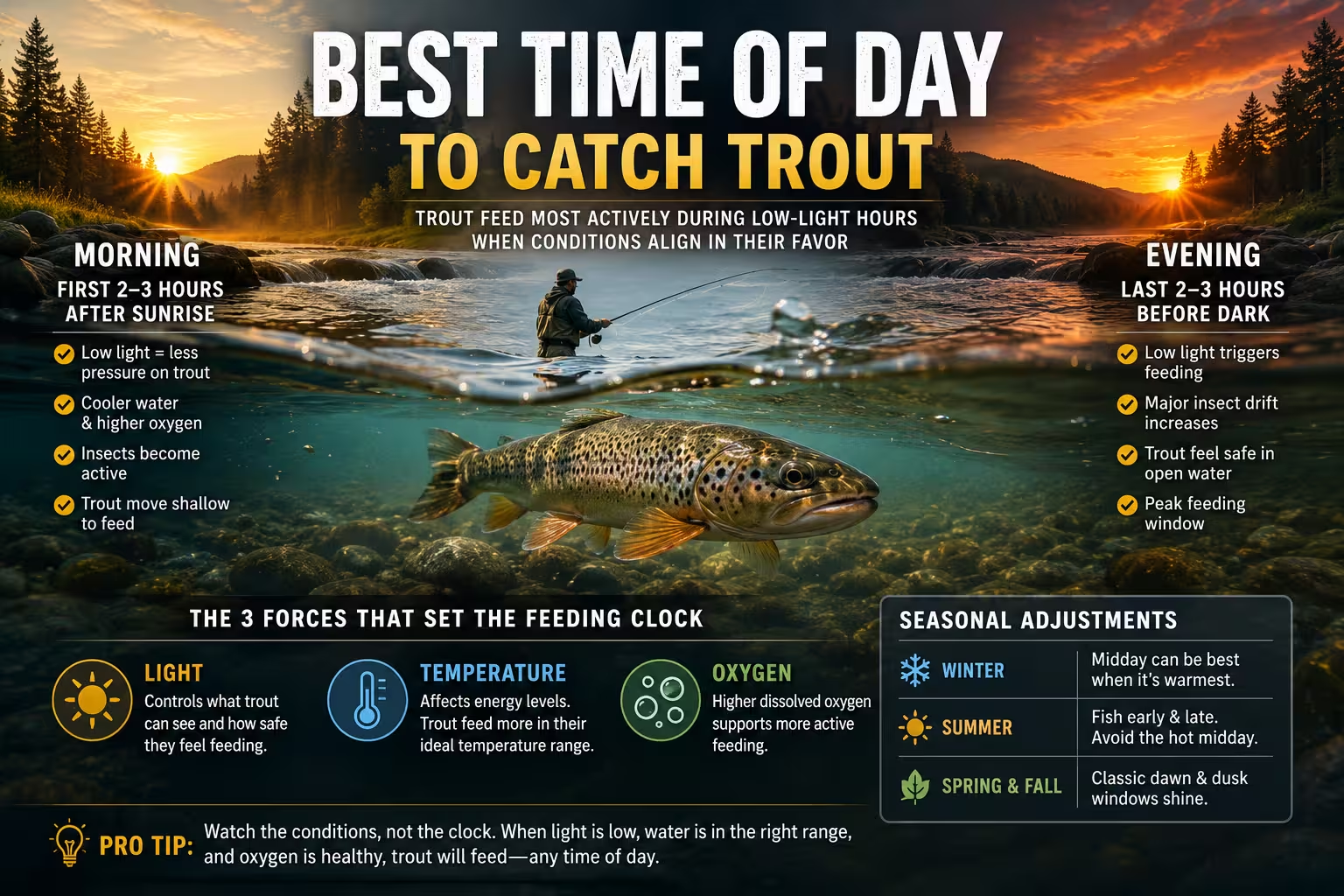
Trout, especially in clear mountain streams and tailwaters, are frequently encountered in the shallow zone (0-6 feet) where full color range is still available — which is part of why natural, translucent, and true-to-baitfish colors perform so well for trout relative to bass fishing, where deeper structure fishing is far more common. When trout are holding deeper in a lake or reservoir environment, the same depth-based shift toward dark silhouettes and flash applies.
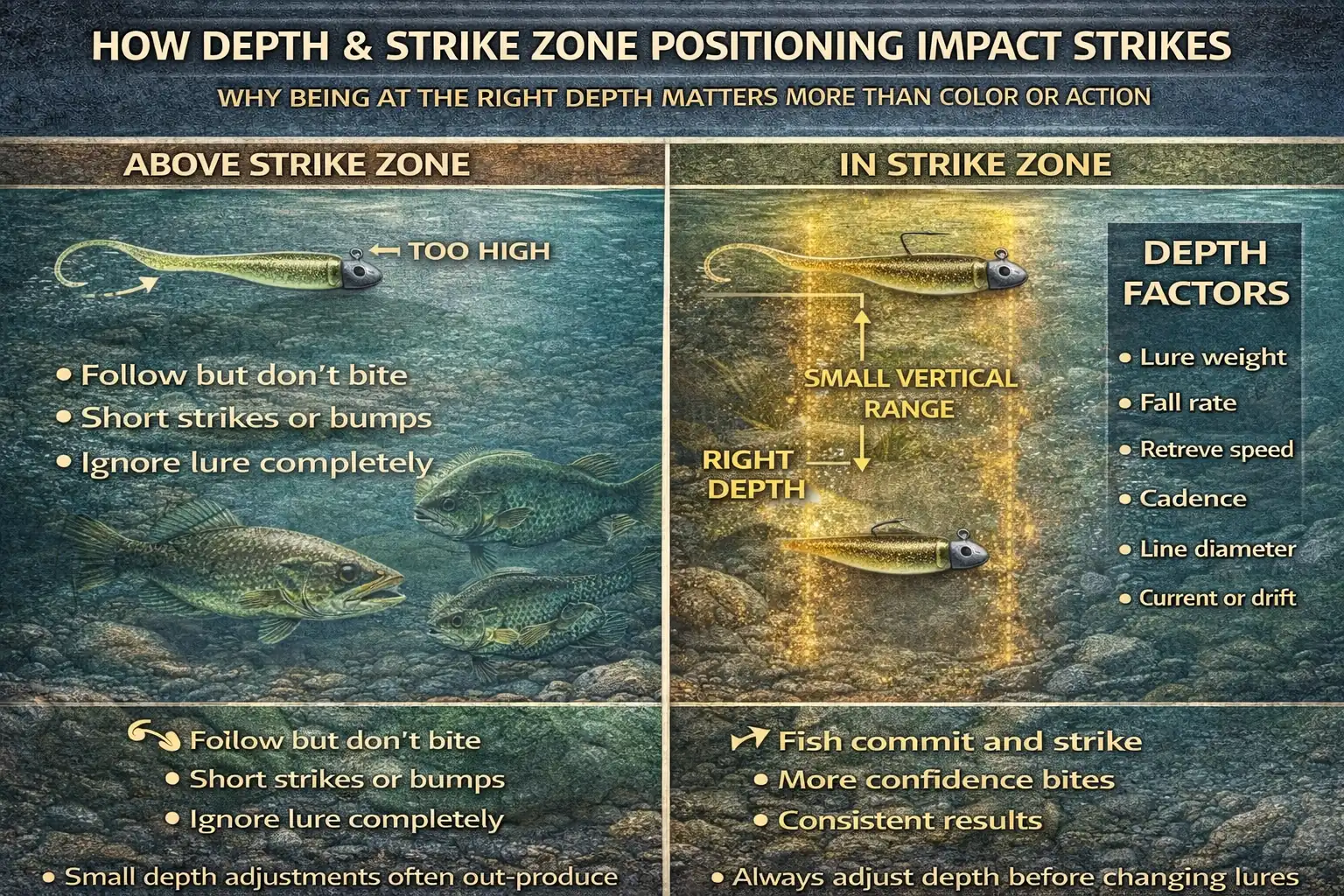
Bass, particularly when fished on deep structure, drop-offs, or in reservoirs with significant depth, are the scenario where this entire framework earns its keep most directly — deep-structure bass fishing regularly puts baits well into the 10+ foot zone where silhouette and fluorescent glow genuinely outperform true-color selection.
Panfish and other shallow-water species are most often encountered in the 0-6 foot range where the full color spectrum remains intact, which is why bright, true-color panfish presentations (fluorescent orange, bright pink, chartreuse) tend to succeed as much for their true-color visibility as for any glow effect — at that shallow depth, both mechanisms are working simultaneously.
Bringing It Together
The core idea running through all of this is simple, even if the physics behind it is detailed: color is not a fixed property of a bait once it’s underwater — it’s a moving target that depends on depth, clarity, and light conditions at the moment a fish sees it. A bait’s color in your hand tells you almost nothing about what a fish sees at 15 feet in stained water on an overcast afternoon.
Once you build depth and clarity into your color selection process — not just “what color looks good” but “what wavelength will actually still be present when this bait reaches the strike zone” — color choice stops being guesswork and becomes a genuinely calculated part of your presentation, right alongside bait profile, fall rate, and action.
The next part of this series goes even deeper into the wavelength science itself — the specific physics of why certain wavelengths survive longer than others, and what that means for how manufacturers formulate colors in the first place.
Frequently Asked Questions
Why does red fade first underwater?
Red has the longest wavelength and lowest energy per photon of any visible color. Water absorbs longer wavelengths faster than shorter ones, so red loses its color within the first 15–20 feet in clear water, sometimes sooner in stained water.
What color lasts longest underwater?
Blue and violet penetrate the deepest of any visible wavelength, remaining detectable past 100 feet in very clear water. Green also holds up well, often staying visible past 70 feet.
Does a red lure actually turn black underwater?
Functionally, yes. The pigment doesn’t change, but once the red wavelength is gone from the water column, there’s no red light left to reflect. The bait appears dark, essentially behaving like a black silhouette bait rather than a color-based one.
Why do fluorescent and UV colors stay bright at depth when other colors don’t?
Fluorescent pigments don’t just reflect light — they absorb higher-energy wavelengths like blue and UV (which are abundant at nearly every depth) and re-emit that energy as visible color. This means they aren’t dependent on their own wavelength surviving the trip down, which is why they often stay visibly colored well past where a same-colored non-fluorescent bait has already gone dark.
Does murky or stained water change these depth ranges?
Yes, significantly. Suspended particles scatter and absorb light faster than clear water, so every wavelength — not just red — fades sooner. In low-visibility water, contrast and silhouette matter more than exact color, because scattered light makes fine color differences hard for a fish to resolve anyway.
What color should I use in deep water?
Past roughly 10 feet, dark, high-contrast colors (black, dark purple, junebug) work with the physics rather than against it, since red and orange have already faded to near-black at that depth regardless of what color they started as. Fluorescent chartreuse, orange, and pink are also strong choices here because of their glow mechanism.
Does fish vision change any of this?
Species do vary in which wavelengths their eyes are most sensitive to, but that can’t bring back a wavelength the water has already absorbed. If the light isn’t there, no eye — human or fish — can detect that color, regardless of how sensitive it is.
At what depth should I start changing colors?
Roughly 4 feet is where red and orange begin visibly fading in clear water. By 10 feet, that fade is essentially complete. Between those two points is the transition zone worth adjusting for — shifting toward blue, purple, green, or fluorescent options as you fish deeper.
Previous: Part 2 — Fishing Lure Color Contrast
Next: Part 4 — Color Wavelengths Explained