Fishing Lure Color Wavelengths Explained: Why Some Colors Stay Visible Deeper Than Others
Part 5 of the Soft Plastic Lure Color Guide
Every lure color underwater is shaped by the wavelengths of visible light that survive their trip through the water column. As light travels down through the water column, water absorbs some wavelengths far faster than others — and the pattern is consistent enough to predict: longer wavelengths disappear first, shorter wavelengths travel farther. Part 4 of this series covered how a trout’s eye processes whatever light survives that trip. This part covers the trip itself — why the physics works the way it does, how far each color actually carries before it’s gone, and why “gone” doesn’t mean the same thing in every kind of water.
Why Wavelength Determines Depth
The common explanation for this — that red carries less energy and blue carries more, so blue “pushes through” farther — is the version that gets repeated most often, and it isn’t the actual mechanism. Photon energy runs the opposite direction: shorter wavelengths (blue) carry more energy per photon than longer wavelengths (red), not less. The real explanation is about water itself, not the light.
Water is a simple three-atom molecule, and its O-H bonds vibrate at specific frequencies. Those vibrations, and their harmonics, happen to fall in a range that overlaps the red and near-infrared part of the visible spectrum — which means water molecules absorb red light directly, converting it to molecular vibration (heat) far more efficiently than they absorb blue or green light. Measured absorption data on pure water shows the effect clearly: water’s absorption coefficient is lowest in the blue range, with a minimum around 420 nanometers, and climbs sharply toward the red end of the spectrum — roughly a hundredfold increase in absorption strength between the blue minimum and the red end of the visible range. That minimum is also the reason large volumes of pure water — a swimming pool, a clear lake, the open ocean — read as blue to the eye even with no algae, sediment, or dissolved color involved: it’s an intrinsic property of the water molecule, not a reflection of what’s suspended in it.
This matters for lure color because it means the fade pattern isn’t a rule of thumb invented by anglers — it’s a direct, measurable consequence of what water is made of. It holds in a farm pond, an Ozark stream, and the open ocean alike. What changes between those bodies of water is how fast the pattern plays out, which is covered further down — but the order in which colors disappear doesn’t change.
It’s also worth being clear about what “absorbed” means physically, because the word gets used loosely in fishing content. Absorption isn’t the light bouncing away or scattering somewhere else — it’s the water molecule converting that light’s energy into molecular vibration, which shows up macroscopically as heat. The light doesn’t go missing; it’s converted into a different form of energy and is genuinely gone as usable illumination. That’s different from scattering, which is what suspended particles do — bouncing light in new directions rather than absorbing it outright, which is a separate process covered in the stained-water section further down and one of the reasons murky water behaves differently from merely deep clear water.
Fishing Lure Color Wavelength Reference
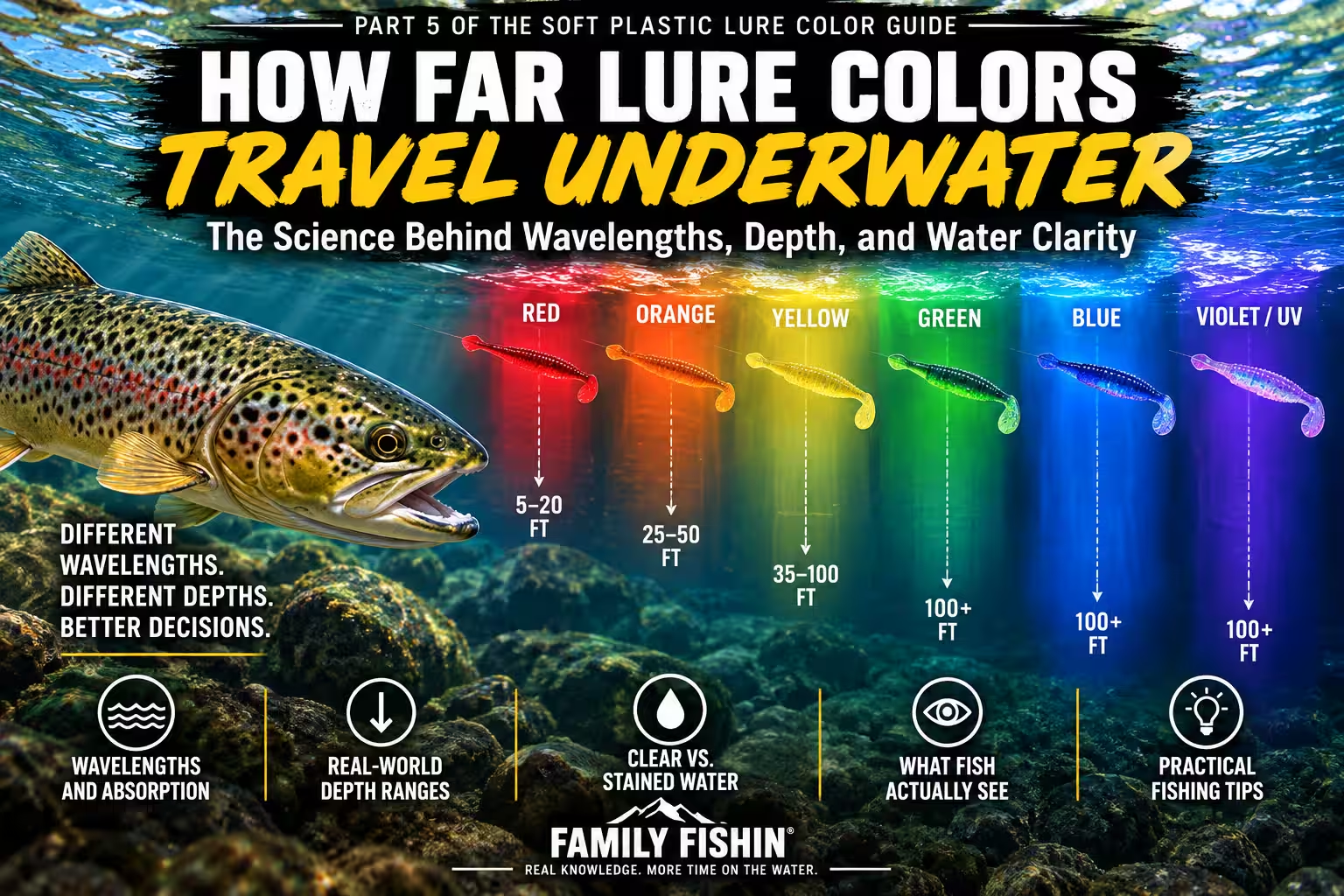
The table below sets out where each color sits on the visible spectrum and roughly how far it carries in reasonably clear freshwater before it’s no longer functioning as a distinct color to a fish. These are the same clear-water benchmarks used in Part 4 of this series, so the two hold together rather than contradicting each other — a common failure point in lure color content, where “how deep does red go” gets answered differently every time it’s covered.
| Color | Wavelength (nm) | Approximate Range in Clear Water | What Happens Beyond That Range |
|---|---|---|---|
| Red | 620–750 | Fading noticeably by 5–10 ft; essentially gone by 15–20 ft | Reads as a dark, low-contrast silhouette rather than as “red” |
| Orange | 590–620 | Holding color to roughly 25–35 ft, fading through 50 ft | Shifts toward brown, then gray-black |
| Yellow | 570–590 | Usable out to roughly 35–60 ft, fading further through 100 ft in very clear water | Loses saturation, shifts toward green-gray |
| Green | 495–570 | Good visibility well past 100 ft in clear water | Remains one of the last true colors visible at depth |
| Blue | 450–495 | Deepest-penetrating visible color; visible past the ranges above | Persists longest of any hue-bearing wavelength |
| Violet / UV | ~380–450 (violet); below 380 (true UV) | Variable, and dependent on how much UV is in the ambient light to begin with | UV-reactive materials can extend detectable range beyond what standard pigment offers |
A few things in this table are worth flagging directly, because they’re easy to get wrong. These are clear-water figures, not universal constants — stained water compresses every one of these ranges, sometimes drastically, and that’s covered in its own section below. They also describe visible-light depth, meaning how far a wavelength survives as usable light in the water — not the separate question of how well a given fish’s eye can resolve it once it arrives, which depends on the receptor biology covered in Part 4. And violet and true UV are lumped into one row here because they sit next to each other on the spectrum, but they are not the same thing: violet is the shortest wavelength humans can see, while UV lies below 380 nanometers, entirely outside human vision, and requires UV-reactive material — not just a “purple” or “violet” pigment — to exploit the UV-sensitive cone documented in trout.
It’s also worth noting these figures describe absorption in vertical, downward-traveling sunlight — a straightforward, well-studied geometry. A lure worked at an angle, viewed by a fish holding off to the side rather than directly below, or fished under low sun angle near dawn or dusk is passing through more total water for the same nominal depth, because the light and the sightline are both traveling a longer slant path rather than straight down. The numbers in the table are a reasonable planning baseline, not a precise measurement for every possible geometry a lure might actually be fished in.
Why Red Becomes Black at Depth
Red sits at the long-wavelength end of the visible spectrum, and it’s the first color absorbed as light travels through water — a direct result of the O-H vibrational absorption described above. In practice, this means a red lure that looks bright and saturated in your hand can look dark brown or effectively black to a fish once it’s fished at depth, because the wavelength that produces “red” has already been absorbed out of the available light before it ever reaches the lure to be reflected.
It’s worth being precise about what “becomes black” actually means here, because it’s a physical statement, not a claim about the fish’s eye. The lure isn’t dyed a different color at depth, and the fish’s visual system hasn’t changed either — there is simply no red wavelength left in the water for the lure’s red pigment to reflect. A red-dyed bait can only return the wavelength of light it’s designed to reflect; if that wavelength isn’t present in the surrounding water, the bait reflects whatever else reaches it, which at typical depths is very little, and reads as a dark, low-contrast shape.
There’s a common claim in angling content that this dark, silhouette-like appearance is actually advantageous — that a red bait “loses its artificial brightness” at depth and becomes a subtler, less suspicious presentation than it would be up close. That’s a plausible-sounding explanation, but it’s an angling theory, not something the vision research in this series can confirm or rule out. What the science does support is narrower and more useful on its own: at depth, red functions as a dark silhouette color, full stop — how a fish responds to that silhouette compared to other dark colors is a separate question this series isn’t going to overstate an answer to.
Orange: A Short Step Behind Red
Orange sits immediately next to red on the spectrum and follows the same pattern on a short delay — absorbed quickly, though it holds usable color a bit farther than red does before fading toward brown and then gray-black. In practice this makes orange a reasonable shallow-to-moderate-depth color, particularly in stained water where its warmth and contrast against green or brown backgrounds can still register even after true red has already gone flat. Past that window, orange is functioning the same way red does — as brightness and silhouette rather than as a distinct hue.
Yellow: The Midpoint
Yellow occupies a middle position on the spectrum and correspondingly holds its color through a middle range of depths — well past where red and orange have faded, but nowhere near as far as green or blue carry. In clear water, yellow can remain a genuinely distinct color out to a moderate range before it starts shifting toward a duller, greener cast. This makes it a useful transition color for mid-depth presentations, and it’s part of why chartreuse — a yellow-green blend — shows up so often as a “confidence color” across a wide range of conditions: it sits close enough to both the yellow and green wavelength ranges to hold up reasonably well across a broader depth window than a pure yellow or pure green would individually.
One cross-species note worth flagging from Part 4: chartreuse’s effectiveness is not a universal, species-independent fact. It reads as a genuinely distinct hue to a trout’s four-cone system, but largemouth bass research found chartreuse yellow nearly indistinguishable from white to a bass’s two-cone system, because it stimulates both bass cone types almost equally. A color’s wavelength behavior in water is the same regardless of which fish is looking at it — what differs is whether a given species’ eye can actually tell that color apart from its neighbors once it arrives.
Yellow’s midpoint position also makes it a useful diagnostic color for reading conditions on the water. Because it fades gradually rather than dropping out sharply the way red does, a yellow or chartreuse presentation that’s starting to look washed-out and pale at a given depth is a reasonably good visual cue that you’re approaching the edge of where warm tones are still functioning as color at all — worth noticing before switching to a cooler palette rather than after several unproductive presentations.
Green: Where Visibility Starts Getting Serious
Green marks the point on the spectrum where wavelengths start carrying meaningfully farther than the warm end of the palette. Green light penetrates water well past the depths where red, orange, and yellow have already faded to gray, which is also why underwater scenes — lakes, rivers, deep pools — so often take on a green cast even without visible algae: green is simply one of the last true colors still present in quantity. Green also has a practical camouflage dimension worth naming directly: because it blends closely with algae, aquatic vegetation, and the general greenish cast of the water itself at moderate depth, a green lure doesn’t always stand out by contrast the way a lure in a less common wavelength might — useful for a natural, forage-matching presentation, and a real trade-off if the goal is maximum visibility rather than natural blending. That trade-off is worth deciding on purpose rather than by default: a natural green pattern fished to imitate forage is doing exactly what it’s supposed to when it blends in, while a green pattern chosen simply because “green goes deep” without accounting for how well it also blends with the background may be less visible to a fish than a less naturally colored option at the same depth.
Blue: The Deepest-Penetrating Color
Blue sits at the far short-wavelength end of the visible spectrum and is the last true color remaining as depth increases, consistent with water’s absorption minimum sitting in the blue range. This is the same reason open, clear water looks blue from a distance — blue is what’s left after everything else has been absorbed out. For deep presentations in clear water, blue and blue-based color combinations carry a real, physics-backed advantage over warm tones: they’re not fighting the water’s own absorption spectrum the way red, orange, and yellow are.
Blue also interacts differently with a soft plastic’s overall color scheme than the warm end of the spectrum does, which matters for how these lures are actually built rather than just how they’re chosen. A two-tone or accent-color soft plastic that pairs a blue or blue-green base with a small amount of warm accent color is, in effect, hedging across the depth range — the blue base keeps working as true color well past the point where a solid orange or red bait would have already faded to silhouette, while the accent color still does its job in the shallower window where warm tones remain functional. This is part of the underlying logic behind color combinations that read as more than just aesthetic choices once the wavelength behavior is accounted for.
Violet and UV: Not the Same Signal
Violet and ultraviolet sit next to each other on the spectrum but are functionally different signals, and lure marketing often blurs the two together in a way that’s worth untangling. Violet (roughly 380–450 nanometers) is still within the range of human vision, just barely — it’s the shortest wavelength most people can perceive as a color. True UV lies below that, outside the range human eyes register at all. A “purple” or “violet” pigment reflects violet light and is visible to a human exactly the way any other pigment color is. A UV-reactive finish is built to interact with ultraviolet light specifically — light a human eye can’t see in the first place — which means its effect can’t be evaluated by eye in the way every other color on this list can.
Part 4 covered the biology this connects to: rainbow trout carry a UV-sensitive cone, with peak sensitivity measured near 378 nanometers, that has no equivalent in human vision at all. That gives UV-reactive material a genuine sensory channel to work with — but two conditions limit how much that channel actually matters on a given day. First, there has to be UV light present in the water to begin with, which generally means shallower depths and clearer water, since UV is a shorter wavelength but still an atmospheric and near-surface phenomenon rather than something that persists at real depth the way blue does. Second, UV sensitivity in trout is strongest early in life and fades with maturity, with older fish retaining only a fraction of that sensitivity through a secondary mechanism. UV-reactive lures are a legitimate, biology-backed tool — not a universal upgrade that outperforms standard colors in every condition regardless of water clarity, depth, or the age structure of the fish in front of you.
Depth Ranges Assume Clear Water — Stained Water Changes Everything
Every depth figure in the table above describes reasonably clear water. Stained or turbid water — the kind common after rain in Ozark streams, or in any system carrying suspended sediment or dissolved tannins — compresses all of those ranges, sometimes dramatically, through two separate mechanisms working together. Suspended particles scatter light and reduce overall penetration depth across every wavelength at once, the same way fog reduces visibility in air regardless of what color the object is. Dissolved organic material, tannins in particular, does something more specific: it selectively absorbs the shorter, blue end of the spectrum, which shifts the remaining light toward yellow-green and further shortens the range at which blue-based colors hold any advantage at all.
The practical result is that “red is gone by 15–20 feet” is a clear-water statement, and in stained water that range can shrink to a few feet or less. It also means the blue-and-green-favor-depth logic from the sections above doesn’t carry over unchanged into stained water, because tannins are actively working against blue penetration in a way clear water isn’t. This is consistent with what’s covered in Part 4: fish populations living permanently in tannin-stained water have been documented with visual systems shifted toward that altered light environment, which is a strong signal that the light environment itself, not just the fish looking at it, is fundamentally different between clear and stained systems — not just a dimmer version of the same thing.
Reduced clarity has a second, separate effect worth naming alongside the wavelength shift: it shrinks the overall distance at which a predatory fish detects anything at all, in any color. Research on foraging behavior in turbid water has found reduced reaction distance in predatory fish — the range at which a predator visually notices and responds to potential prey — which lowers encounter rate independent of what color that prey or lure happens to be. That’s a useful distinction to keep separate from the color-fade discussion above: stained water isn’t just re-shuffling which colors work best, it’s also compressing the window in which any color gets noticed in the first place, which is part of why retrieve speed and presentation size often matter more on off-color days than the specific hue tied on.
Choosing Lure Color Underwater Using Wavelength and Depth
The reference table above is a starting point, not a fixed rule to apply the same way in every situation — depth, water clarity, and light intensity all interact with it. A practical way to apply it:
- Shallow water, roughly 5 feet or less, in reasonably clear conditions: All colors on the spectrum are still functioning as distinct colors here, including red, orange, and yellow. This is the one depth range where “pick a color you have confidence in” is a genuinely defensible strategy, because the water isn’t yet editing the choice for you.
- Mid-depth, roughly 5–15 feet: Red and orange are fading out of true color and starting to read as dark silhouette. Green, chartreuse, white, and darker profile colors hold their function better through this range.
- Deeper water, 15 feet and beyond in clear conditions: Blue, purple, and UV-enhanced colors are working with wavelengths that are still genuinely present, while warm tones have already shifted to silhouette-only. This is the range where the physics most clearly favors cool tones over warm ones.
- Stained water, at any depth: Treat the ranges above as compressed, not eliminated — the order colors fade in doesn’t change, but the distances shrink. Contrast against the water color and lure silhouette start mattering more than exact hue faster than they would in clear water, and by the depths and clarity levels covered in Part 4 where rod vision takes over entirely, color identity has stopped being the deciding factor regardless of which color was chosen.
A Common Mistake Worth Naming
The wavelength chart above is genuinely useful, but it’s also easy to misuse by treating it as a fixed lookup table rather than a description of a moving target. Water clarity, sun angle, cloud cover, and even the amount of suspended sediment stirred up by recent rain all shift exactly where these fade points land on a given day — the order colors disappear in is reliable, but the exact depth at which each one fades is not a constant you can memorize once and stop thinking about. The more durable habit is reading the water in front of you — clarity, depth, light — and reasoning from the principle, rather than treating “blue works past 15 feet” as a rule that applies identically on a bluebird afternoon and a post-rain, off-color morning on the same stretch of water.
Part 6 of this series moves from wavelength behavior into UV-reactive lures specifically — what “UV-enhanced” actually means in a soft plastic, how it differs from a lure that simply looks purple or blue-white under normal light, and where it earns a place in the rotation based on everything covered here and in Part 4.
Frequently Asked Questions
Why does red disappear before blue underwater?
It comes down to water’s own molecular structure, not the energy carried by each wavelength. Water’s O-H bonds absorb light strongly in the red part of the spectrum through vibrational resonance, while absorbing far less in the blue range — measured data puts water’s absorption roughly a hundred times stronger at red wavelengths than at its blue absorption minimum near 420 nanometers. Blue isn’t “pushing through” more efficiently — water simply isn’t very good at absorbing it in the first place.
At what depth does a red lure stop looking red?
In reasonably clear water, red starts fading noticeably by 5–10 feet and is essentially gone by 15–20 feet, at which point it reads as a dark, low-contrast silhouette rather than as a color. In stained or turbid water, that range compresses significantly and can shrink to just a few feet.
Does becoming a “black silhouette” make red lures better at depth?
That’s a common claim in angling circles, but it’s an angling theory, not something the underlying vision science directly confirms. What’s established is narrower: red functions as a dark silhouette color at depth because there’s no red wavelength left for it to reflect. Whether that specific silhouette outperforms other dark colors is a separate question this series isn’t going to overstate an answer to.
Are violet and UV the same thing?
No. Violet (roughly 380–450 nm) is the shortest wavelength within human vision — a violet pigment looks purple to a person the same way any other pigment color does. True UV lies below 380 nm, outside human visual range entirely, and requires a UV-reactive finish, not just a purple dye, to interact with the UV-sensitive cone documented in trout.
Does UV-enhanced always outfish standard colors?
No. UV only matters where there’s UV light actually present to react with — generally shallower, clearer water — and trout’s UV sensitivity is strongest when young and fades with maturity, so its value varies with both conditions and the fish’s age. It’s a real, biology-backed edge in the right circumstances, not a universal upgrade.
Why does chartreuse work in so many different conditions?
Chartreuse sits at the boundary between yellow and green wavelengths, which gives it a wider effective depth window than a pure yellow or pure green individually. Worth noting from Part 4: that advantage is trout-specific reasoning. Largemouth bass research found chartreuse nearly indistinguishable from white to a bass’s two-cone visual system — the wavelength physics is the same for every species, but which colors read as distinct depends on the fish’s own eye.
Do these depth ranges apply the same way in every lake or stream?
No — they describe reasonably clear water specifically. Stained or turbid water compresses every range in the table, through suspended particles scattering light broadly and dissolved tannins selectively cutting the blue end of the spectrum. The order colors fade in stays consistent; the distances at which that happens do not.
Is color the most important factor at every depth?
No. Past the point where a given depth and water clarity push a fish’s vision into rod-dominated mode — covered in Part 4 — color identity stops being something the fish’s visual system can even process, and silhouette, contrast, and movement take over as the deciding factors regardless of which color was on the lure.
Previous: Part 4 — How Fish See Color
Next: Part 6 — UV Fishing Lures Explained