How Fish See Color: What Lure Colors Fish Can Actually Detect
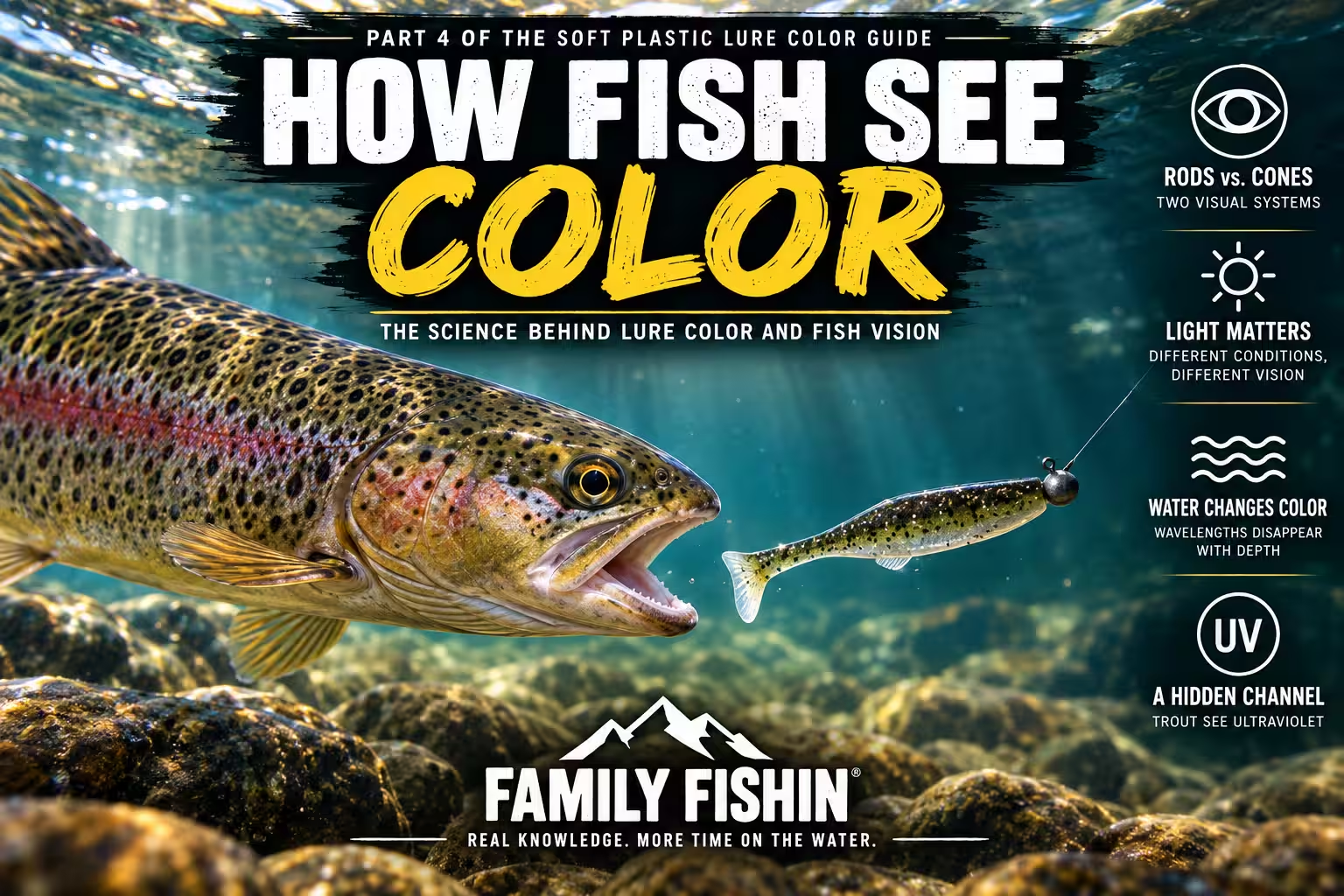
Part 4 of the Soft Plastic Lure Color Guide
Understanding how fish see color starts with one important fact: fish don’t see color the way humans do. Anglers pick lure colors standing in daylight, turning a bait over in their hand, judging it against the same visual system they use to read a stop sign or match paint chips. A fish never sees the lure that way. It sees whatever wavelengths survive the trip through water, filtered through an eye that is built on entirely different hardware than ours — different numbers of receptor types, different sensitivities, and a switch between two separate visual systems depending on how much light is available.
Understanding how a fish’s eye actually works explains why a color that looks “obviously right” on the workbench can be invisible in the water, and why a color that looks drab in your hand can be the most visible thing in the strike zone. This part of the series breaks down the biology — rods, cones, and the specific wavelengths trout and other freshwater predators can and cannot detect — before Part 5 covers how those wavelengths behave as they travel through water.
Two Separate Visual Systems, Not One
Human eyes and fish eyes are both built around the same two receptor types — rods and cones — but the balance between them, and how they’re used, is different. In a fish retina, rods and cones aren’t just present together; they function as two largely separate systems that take turns doing the work depending on light levels. Rods handle vision when light is scarce. Cones take over when light is abundant. A fish moving from a sunlit flat into a shadowed log jam, or from midday into last light, is shifting which system is doing most of the work — sometimes within seconds.
This matters for lure selection because color and contrast are not interchangeable. A lure can be highly visible without being identifiable by color, and it can be theoretically “the right color” while being functionally invisible because there isn’t enough light reaching the cones to resolve it. Knowing which system is active in a given set of conditions is the difference between picking a color and picking a bait that actually gets seen.
Rod Cells: Built for Motion, Contrast, and Low Light
Rod cells are extremely sensitive to light but carry no color information at all — a rod-dominated view of the world is a world of brightness, shape, and movement, not hue. Rods contain a single light-sensitive pigment, which is what makes them so efficient in dim conditions: they don’t have to divide their sensitivity across multiple wavelength ranges the way cones do, so they can respond to far fewer photons.
Rods are the dominant receptor whenever light is limited, which in practice covers more fishing time than most anglers assume:
- Low light — dawn, dusk, overcast days, and full night
- Stained or muddy water — even at midday, turbidity and suspended sediment cut light penetration the same way darkness does
- Depth — as light attenuates with distance traveled through water, cone-driven color vision fades out and rod-driven vision takes over, regardless of the surface conditions
- Deep shade — under docks, log jams, undercut banks, and dense weed cover
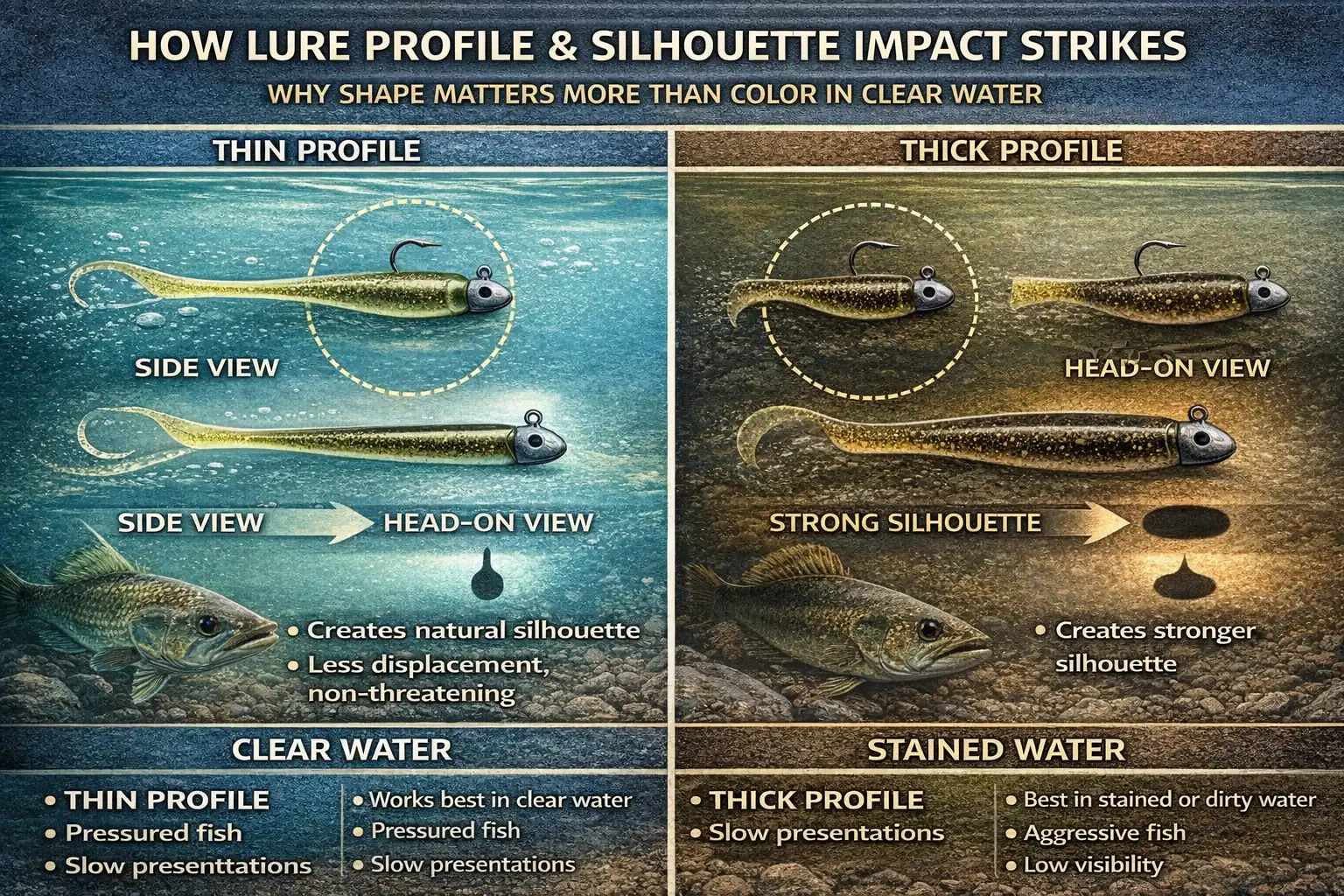
When rods are doing the work, a fish is not evaluating hue. It’s detecting silhouette against the available light, contrast against the surrounding water color, flash, and — critically for soft plastics — motion transmitted through the water via the lateral line and picked up visually as displacement. This is why a lure’s profile, action, and contrast against background often outperform any specific color choice in stained water or low light: the fish’s visual system literally cannot use color information to make the decision.
Cone Cells: Where Color Vision Actually Happens
Cone cells are the receptors that generate color vision, but they need considerably more light to function than rods do, which is why they’re most effective in bright, clear, shallow water during daylight hours. Each cone type contains a different opsin — a light-sensitive protein tuned to respond most strongly to a specific wavelength range — and the brain compares the relative output of the different cone types to construct a sense of hue.
Humans are trichromatic: three cone types (commonly described as red, green, and blue-sensitive) generate the color spectrum we perceive. Freshwater game fish are frequently more equipped than we are, not less. Rainbow trout, for example, are tetrachromatic — they carry four distinct cone types rather than three. Direct electrophysiological measurements of rainbow trout cone photoreceptors have found peak sensitivities near 378 nanometers (ultraviolet), 429 nanometers (blue), 516 nanometers (green), and 565 nanometers (a longer wavelength in the yellow-to-red range). That fourth channel — ultraviolet — is not present in the human eye at all, which means trout have access to visual information that never registers for the angler standing above the water.
This has a direct, practical consequence: a trout is not working with a smaller color palette than a human. In good light, it may be working with a larger one, including a UV channel humans have no direct reference point for. That doesn’t mean every color decision should chase UV enhancement — it means the “fish just see washed-out versions of what we see” assumption anglers sometimes fall back on isn’t accurate for every species, and definitely isn’t accurate for trout.
How the Brain Turns Cone Signals Into Color
A single cone cell, on its own, can’t tell the brain what color it’s looking at — it can only report how strongly it was stimulated. Color perception comes from the brain comparing the relative output of different cone types against each other. This is why the number and spacing of cone types matters so much: a trout comparing four channels (UV, blue, green, and yellow-red) has more points of comparison available than a bass comparing two (green and red), and more comparison points generally means finer color discrimination, at least across the wavelength ranges those cone types actually cover.
It also explains a counterintuitive finding from the bass research above: two colors can look completely different to a human and still be functionally identical to a fish, simply because they stimulate that fish’s available cone types in the same ratio. Chartreuse yellow reading as indistinguishable from white to a bass isn’t a matter of the bass having “worse” vision — it’s a direct, predictable consequence of having only two cone channels to compare instead of three or four. The same logic applies in reverse: two lure colors that look similar to an angler’s eye can stimulate a trout’s four cone types in very different ratios and read as clearly distinct colors in the water. Judging “how different two lure colors are” by eye is judging it with the wrong visual system entirely.
Not All Fish See the Same Way
One of the most important — and most commonly overlooked — facts in this whole discussion is that fish vision is not one universal system. Different species have evolved different numbers and types of cone cells depending on the visual environment they live in, and lure color advice that treats “fish” as a single category is working from bad biology.
Trout, as covered above, are tetrachromatic with strong sensitivity spanning UV through the yellow-red range. Largemouth bass are a useful contrast case, and one of the better-studied examples in freshwater gamefish vision. Detailed research combining photoreceptor measurement, visual modeling, and behavioral testing found that largemouth bass are dichromatic — they have only two cone types, a green-sensitive single cone (peak sensitivity around 535 nanometers) and a red-sensitive twin cone (peak sensitivity around 614 nanometers), alongside a rod cell peaking near 528 nanometers. The behavioral consequences of that two-cone system are specific and counterintuitive: bass models and behavioral trials both indicated that chartreuse yellow is very difficult for a bass to distinguish from white, because chartreuse stimulates the green and red cones at nearly equal levels — and separately, that blue and black are difficult for a bass to tell apart, while red and green remain easy for a bass to identify and separate from gray-scale stimuli.
The point isn’t to turn this trout-focused series into a bass biology lesson — it’s to make clear that vision is species-specific hardware, not a shared human-adjacent baseline that scales up or down. Advice built around one species’ visual system doesn’t automatically transfer to another, and generic “how fish see color” content that doesn’t specify the species is skipping the part that actually determines the answer.
Older behavioral work on bass color response, going back to research from the 1930s and revisited with modern color-selection tools in the 1980s, found bass could behaviorally discriminate a wide range of colors and showed a consistent preference toward fluorescent blue, green, chartreuse, and orange under varied light and clarity conditions — findings that sit somewhat in tension with the two-cone dichromatic model, and a useful reminder that a photoreceptor count explains what wavelength information is available, not everything about how a fish behaviorally responds to it. Anatomy sets the ceiling on what’s detectable; it doesn’t fully predict preference on its own.
What Water Does to Light Before a Fish Ever Sees It
None of the cone or rod biology above matters in isolation — it matters in combination with what water does to sunlight before it reaches the fish’s eye. Water absorbs different wavelengths of visible light at different rates, and the pattern is consistent: longer wavelengths (red, orange) are absorbed fastest and disappear first with depth; shorter wavelengths (blue, and to a lesser extent green) penetrate significantly farther.
In clear water, the commonly cited depth ranges at which colors become effectively unavailable are roughly:
- Red — gone by about 15–20 feet
- Orange — gone by about 25–50 feet
- Yellow — gone by roughly 35–100 feet, depending on clarity
- Green and blue — persist far deeper, with blue penetrating the farthest of any visible wavelength
The mechanism is straightforward physics: longer wavelengths carry less energy and are absorbed by water molecules more readily, while shorter wavelengths scatter and penetrate farther. This is also why open water takes on an increasingly blue cast with depth — blue is simply the last wavelength still present in meaningful quantity.
The practical implication for lure color is that a lure’s color is not fixed once it leaves the package — it is being actively edited by the water column in real time, and that editing is a function of depth (and, as covered next, water clarity) rather than anything about the lure itself. A red lure at two feet in clear water reflects red light normally. The same red lure at fifteen feet is reflecting almost nothing, because there’s no red light left to reflect — it will read to the fish as a dark, low-contrast silhouette rather than as “red” in any meaningful sense. This is covered in more depth, including the practical implications for lure selection at specific depths, in Part 3 of this series.
Depth Isn’t the Only Distance That Matters
Most discussions of light attenuation focus on depth — how far down a lure is fished — because it’s the easiest variable to visualize. But the physics driving that attenuation is about distance the light travels through water, not depth specifically. The same absorption pattern that strips red out of a lure fifteen feet down also strips red out of a lure sitting two feet down but viewed from fifteen feet away horizontally. A fish holding in a deep pool looking across a flat, or sitting in a shaded run looking at a lure worked along a sunlit bank thirty feet off, is dealing with cumulative light loss across that horizontal distance in addition to whatever depth is involved.
This matters for how anglers reason about visibility. “Fishing shallow” is often treated as functionally equivalent to “fishing where color still works,” and depth alone doesn’t guarantee that — a long cast, low light angle, or a fish holding well off the presentation can put just as much water between the lure and the fish’s eye as a few extra feet of depth would. Total distance through the water column, not depth in isolation, is the number that actually determines which wavelengths are still present when the light reaches the fish.
Reflected Color vs. Flash: Two Different Signals
One more distinction worth separating out, because it gets collapsed into “color” more often than it should: a lure’s visible color and a lure’s flash are not the same signal, and they don’t behave the same way underwater. Pigment-based color — dye or paint reflecting a specific wavelength band — is entirely dependent on that wavelength being present in the ambient light to begin with. Strip the red out of the water at depth, and a red-pigmented bait has nothing left to reflect, regardless of how saturated that red looked in the package.
Metallic, reflective, and flash-based finishes work differently. Rather than absorbing all wavelengths except one and reflecting that one band, a reflective surface bounces back whatever ambient light is actually present — meaning a flash finish can still produce a bright, detectable signal even at depths or in water clarity where a pigment-based color of the same nominal hue has already gone flat and gray. This is part of why flash and reflective components remain effective in conditions where color-matching theory would predict a color should be losing its impact — the flash isn’t relying on a specific wavelength surviving the trip through the water, it’s relying on whatever light is left, in whatever band that light happens to be in. Under rod-dominated conditions in particular, where color identity has already stopped mattering to the fish’s visual system, flash and reflected brightness are doing real work that a flat pigment color cannot replicate.
Stained Water Rewrites the Rules Further
Depth isn’t the only variable editing color before it reaches the fish. Water clarity does the same thing horizontally that depth does vertically, and it does it faster. Clear water and stained or tannin-colored water — the kind common in Ozark streams and many freshwater systems — don’t just reduce overall light; they change which wavelengths dominate what’s left. Suspended sediment scatters light and reduces penetration depth across the board, while dissolved organic material (tannins, in particular) selectively absorbs the shorter, blue end of the spectrum, shifting the remaining light toward yellow-green and reducing overall visual range further still.
This isn’t a minor footnote — it’s significant enough that some fish populations have evolved to it. Research on populations living in tannin-stained, “blackwater” habitats with a strongly red-shifted light spectrum has documented visual systems adapted toward that shifted light environment, distinct from populations of the same species in clear water. Separately, research tracking fish communities across a large gradient of water color found that species with larger eyes were consistently more common in darker-water lakes — a straightforward adaptation to a visual environment where every advantage in light-gathering matters.
There’s a foraging cost to this shift, not just a sensory one. Studies of predatory fish in turbid and stained water have found reduced reaction distance — the range at which a predator visually detects and responds to prey — which lowers encounter rate and forces changes in foraging behavior to compensate. Reduced water clarity doesn’t just change which colors read best; it measurably shrinks the window in which any lure, in any color, gets noticed at all. That’s a separate variable from color choice, but it’s one worth factoring in on stained-water days: a slower retrieve or a longer pause can matter as much as which bait is tied on, simply because the fish’s effective detection range has already been cut down by the water itself before color ever enters the decision.
For an Ozark angler, the working takeaway is that “clear water” and “stained water” aren’t just different difficulty levels of the same visual task — they’re closer to different visual environments, with different wavelengths dominant and different visual ranges available. A color strategy built for a gin-clear spring-fed stretch doesn’t necessarily transfer to a stretch running off-color after rain, and it isn’t just about “going darker” or “going brighter” — it’s about which wavelengths are actually still present to reflect.
Ultraviolet Vision: A Channel Humans Don’t Have
The ultraviolet-sensitive cone in trout deserves its own explanation, because it’s easy to misunderstand and easy to oversell. UV light is present in daylight and penetrates water reasonably well in the upper portion of the water column, particularly in clearer water — meaning a UV-sensitive cone genuinely has usable signal to work with in a lot of real fishing conditions, not just as a theoretical curiosity.
There’s also a documented developmental wrinkle worth knowing: UV cone sensitivity in trout is strongest early in life and diminishes with maturity. In older fish, a secondary sensitivity mechanism partially fills the gap left by fading UV cones, but research indicates it recovers only a fraction — roughly a quarter to a third — of the sensitivity present when the UV cones were fully functional. In practical terms, this means UV sensitivity is real and biologically documented in trout, but it is not necessarily uniform across every trout in the system — a stocked fingerling and a mature holdover trout are not working with identical visual equipment on the UV channel, even though both are still tetrachromatic.
This is a case where the honest answer is more useful than the marketing answer: UV-reactive materials aren’t a universal magic trigger, but they aren’t hype either — they’re exploiting a genuine, measured sensory channel that human vision simply doesn’t have access to, with sensitivity that varies by fish age and by how much UV light the water conditions are actually transmitting.
How Fish See Color: Putting the Biology to Work
None of this is useful as trivia — it’s useful because it changes how you evaluate a color before you tie it on. The visual system doing the work at any given moment depends on light level, and the wavelengths available to that system depend on depth and water clarity. Put together, three broad conditions cover most situations on the water:
Low light, stained water, or depth — rods dominate. Color identity stops being the deciding factor because the visual system active in these conditions doesn’t process color at all. Silhouette, contrast against the background water color, profile, and movement carry the decision. A lure that reads as a strong, moving shape against the available light will outperform a lure chosen purely because its color looked good in the package, because “its color” may not be information the fish’s rods can even use.
Bright light, clear water, shallow depth — cones are active, and color accuracy starts to matter. This is the condition where the specific wavelength a lure reflects, and how closely that wavelength matches what a trout’s four cone types are tuned to detect, becomes a real variable rather than a background one. Natural tones that match available forage, and colors that maintain good contrast against the substrate and water color, are worth the extra attention here in a way they simply aren’t once light drops or water colors up.
UV-enhanced materials — a genuine but conditional edge. UV can add visibility beyond what’s available through the standard visible-light channels, and the effect is most relevant in the upper water column where UV light still penetrates, and in stained or low-light conditions where standard color contrast is already compromised and any additional detectable signal has outsized value. It is not a universal upgrade for every presentation in every condition, and its effectiveness is tied to how much fish age and water clarity are limiting the fish’s UV channel in the first place.
The Mistake Worth Avoiding
The single most common error in lure color selection is evaluating the lure the way a human sees it and assuming that evaluation transfers. It doesn’t, for two independent reasons that compound each other: the water itself is actively filtering out wavelengths before the fish ever sees the lure, and the fish’s own eye is processing what’s left through a completely different receptor system than the one you used to pick the color off the shelf. A color chosen by eye, in hand, under tackle-shop lighting, is being judged by a visual system, light source, and viewing distance that have nothing in common with the conditions the lure will actually be fished in.
The more reliable approach is to work backward from conditions rather than forward from preference: identify whether rods or cones are going to be doing the work at the depth and clarity you’re fishing, and then choose silhouette-and-contrast or wavelength-accuracy accordingly. Matching the presentation to the visual system that’s actually active in front of the fish will improve results more consistently than chasing a specific color because it produced fish somewhere else, under conditions that may not have been the same at all.
Part 5 of this series builds directly on this: a closer look at how specific wavelengths behave as they travel through water — how far each color realistically carries, how that interacts with the depths and clarity conditions covered here, and what that means for choosing colors by the water you’re actually fishing rather than by habit.
→ See: How Water Clarity Affects Trout Fishing
Frequently Asked Questions
Do trout see color the same way humans do?
No. Trout are tetrachromatic, with four cone types peaking near 378nm (UV), 429nm (blue), 516nm (green), and 565nm (yellow-red). Humans are trichromatic with no UV channel. Trout aren’t seeing a duller version of human color vision — in good light, they’re working with an extra channel humans don’t have at all.
Can trout see ultraviolet light?
Yes, measured directly in rainbow trout cone photoreceptors. UV sensitivity is strongest in young trout and declines with maturity; older fish retain only about a quarter to a third of that sensitivity through a secondary mechanism. UV light also has to actually be present and penetrating the water for this to matter — it’s strongest in the upper water column in clearer water.
Do all fish species see color the same way?
No. Vision is species-specific. Trout are tetrachromatic. Largemouth bass are dichromatic — two cone types (green- and red-sensitive) instead of four — and research shows bass can’t reliably distinguish chartreuse from white, or blue from black, because those color pairs stimulate their two cone types almost identically. Advice about “what fish see” only holds for the species it was studied in.
Why does lure color seem to disappear at depth?
Water absorbs longer wavelengths first. Red is essentially gone by 15–20 feet in clear water, orange by 25–50 feet, yellow by roughly 35–100 feet. Green and blue penetrate far deeper. A red lure at depth isn’t reflecting red back to the fish — there’s no red light left for it to reflect, so it reads as a dark silhouette instead.
Does this attenuation only apply to depth?
No — it’s driven by total distance the light travels through water, not depth alone. A lure fished shallow but viewed from far off horizontally, or in low light, loses the same wavelengths a lure loses at greater depth. Casting distance and light angle matter alongside depth.
Does color matter in stained or muddy water?
Less than silhouette, contrast, and movement do. Low light and turbidity push a fish’s vision into rod-dominated mode, and rods don’t process color at all — only brightness, shape, and motion. Stained water also reduces overall detection range, so retrieve speed and presentation size can matter more than color choice on off-color days.
Is flash the same thing as color?
No. Pigment-based color only works if the matching wavelength is present in the ambient light to reflect. A reflective or metallic finish bounces back whatever light is available, regardless of band, which is why flash can still read clearly at depths or clarity levels where a same-hue pigment color has already gone flat.
Should I always use UV-enhanced lures?
Not automatically. UV is a real, measured sensory channel in trout, not marketing hype, but its value depends on UV light actually being present (shallower, clearer water) and on the fish’s age, since UV sensitivity fades with maturity. It’s a conditional edge, not a universal upgrade.
Previous: Part 3 — Why Lure Colors Change Underwater
Next: Part 5 — Color Wavelengths Explained