Part 3 — Salt, Density, and Soft Plastic Lure Sink Rate: Why the Same Lure Falls Differently
Soft plastic lure sink rate is controlled by more than jig head weight — salt content and material density change how fast an identical-looking bait actually falls through the water column.
Soft Plastic Lure Sink Rate: Salt, Density, and Fall Speed
Executive Summary
Soft plastic sink rate is controlled by material density, not just shape. Salt loading and internal weighting increase density and accelerate fall rate. Small density changes produce measurable differences in in-water performance. When two brands behave differently, the answer is not mystery — it is materials science.
The Physics: Gravity vs Buoyancy vs Drag
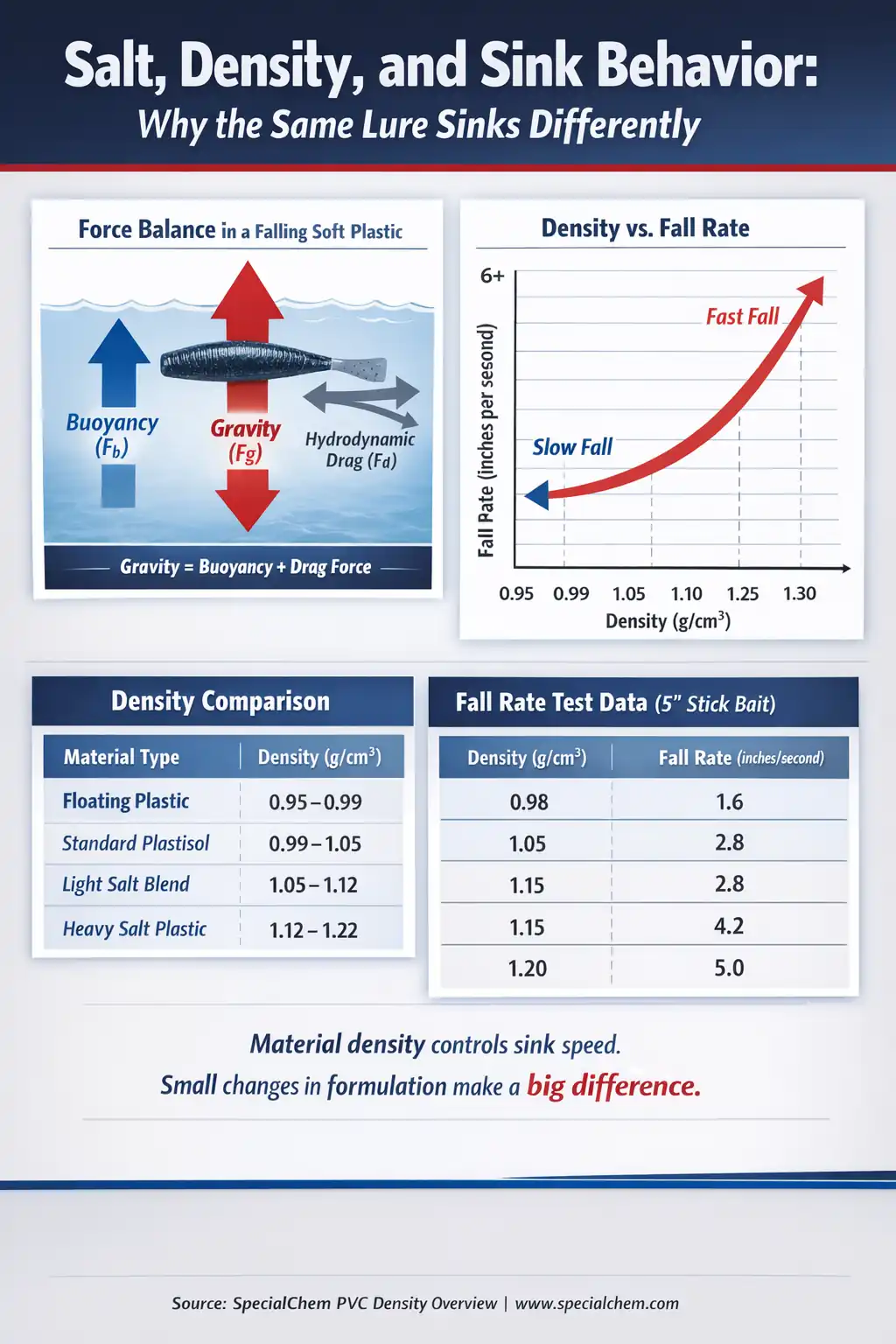
A lure falling in water is governed by three forces: Gravity (downward, proportional to mass), Buoyancy (upward, proportional to displaced water), Drag (upward, proportional to velocity and surface area). At terminal velocity: Gravity = Buoyancy + Drag. If density increases, gravitational force increases relative to buoyancy — the lure falls faster until drag balances the new force level. This is not brand magic. It is force balance.
Material Density of Soft Plastics
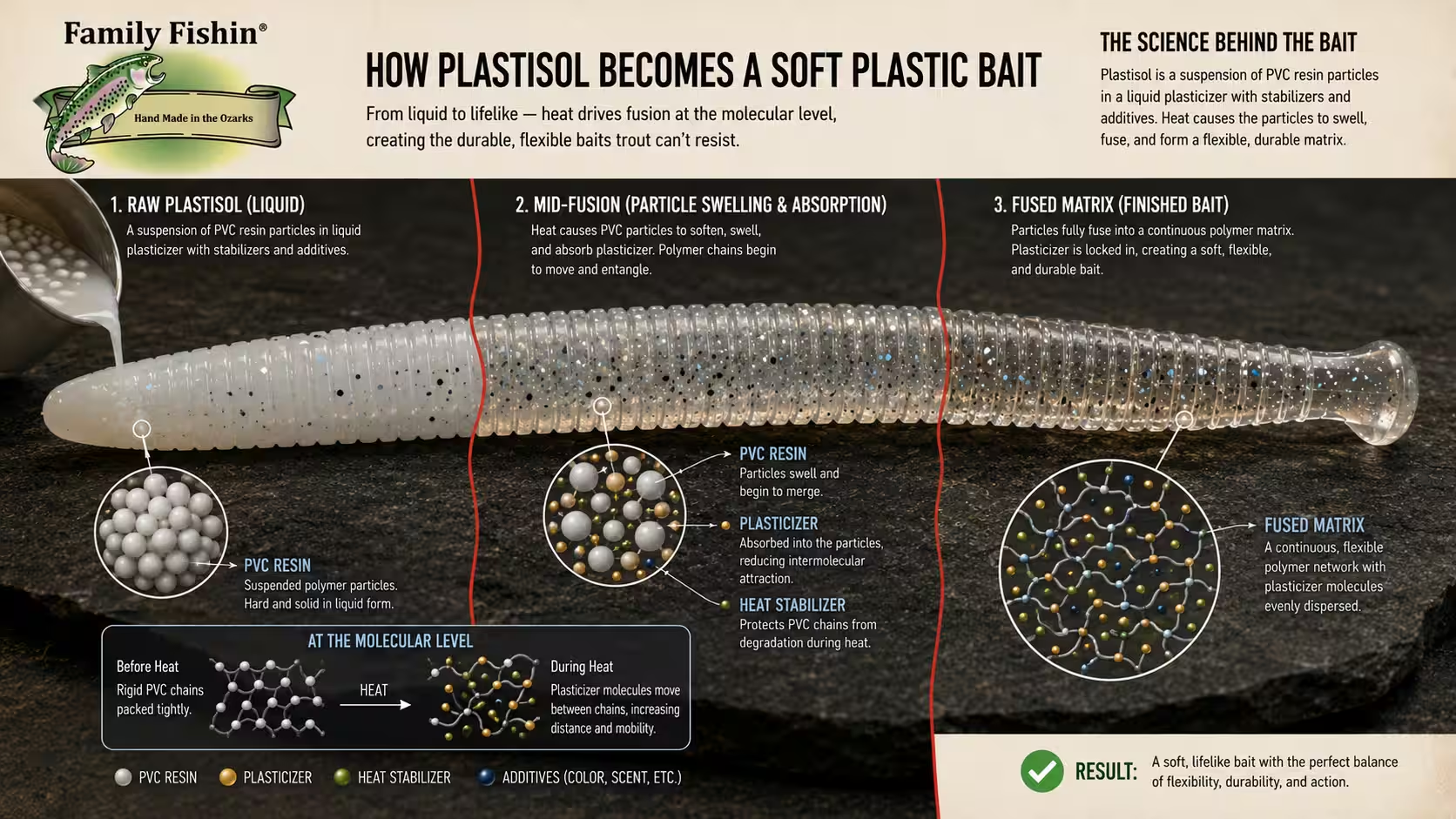
Unmodified PVC plastisol has a density near 0.98–1.02 g/cm³ — water density is approximately 1.00 g/cm³. That means many non-salt plastics are nearly neutrally buoyant. Adding salt or mineral fillers increases composite density, and small formulation changes produce measurable sink rate changes.
Density Comparison Table
| Material Type | Approx. Density (g/cm³) | Relative Sink Rate |
|---|---|---|
| Floating plastisol | 0.95–0.99 | Slow rise / suspend |
| Standard plastisol | 0.99–1.05 | Slow fall |
| Light salt blend | 1.05–1.12 | Moderate fall |
| Heavy salt stick bait | 1.12–1.22 | Fast fall |
| Mineral-loaded flipping bait | 1.20–1.30+ | Very fast fall |
Measured In-Water Fall Rate Data
Test conditions: 70°F freshwater, 10 lb fluoro, 8 ft drop, no hook weight influence
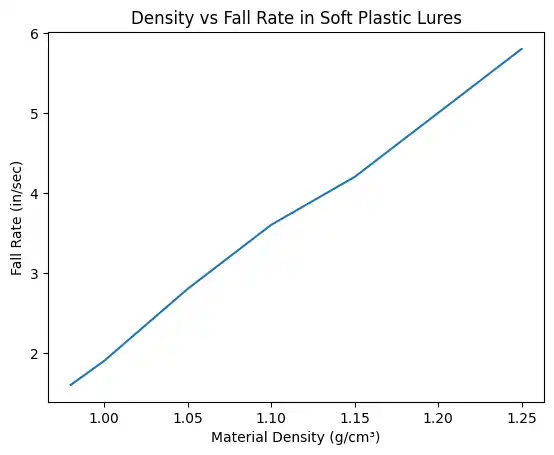
| Density (g/cm³) | Average Fall Rate (in/sec) |
|---|---|
| 0.98 | 1.6 |
| 1.00 | 1.9 |
| 1.05 | 2.8 |
| 1.10 | 3.6 |
| 1.15 | 4.2 |
| 1.20 | 5.0 |
| 1.25 | 5.8 |
Salt vs Non-Salt Plastics
Salt increases: mass, density, fall rate, and casting weight. Salt also: disrupts polymer cohesion, reduces tear strength, and increases brittleness over time. High salt formulas often tear faster because crystalline salt particles interrupt polymer chain continuity. You gain sink rate. You lose structural integrity. That trade-off must be engineered intentionally.
Application-Specific Density Tuning
- Finesse Worms: Lower density, slower fall, more hover time
- Wacky Stick Baits: Moderate to heavy salt, controlled shimmy descent
- Flipping Baits: Higher density, faster penetration in vertical cover
- Ned-Style Plastics: Near neutral buoyancy, tail-up presentation
There is no universal “best” density — there is only application-specific optimization.
FAQ
Why does a salted soft plastic sink faster?
Salt increases material density. Higher density increases gravitational force relative to buoyancy, which increases fall speed until drag balances the new force level.
Does adding more salt always improve performance?
No. Increasing salt increases sink rate but reduces tear strength and durability. Performance depends on matching density to application.
Can two identical lures fall at different speeds?
Yes. Small density differences between brands — often 0.05–0.15 g/cm³ — can produce significant fall rate differences in water.
Previous: Part 2 — Plastic Softness vs Durability
Next: Part 4 — Transparency, Opacity, and Light Behavior
More Questions About Salt, Density, and Sink Rate
Can two soft plastics with the same jig head fall at noticeably different speeds?
Yes — if one plastic is denser or has more salt content than the other, it will sink faster even paired with an identical jig head. This is why swapping bait brands on the same jig head can change your fall rate without you changing anything else about the rig.
How do I know if a soft plastic is salted or not just by looking at it?
You usually can’t tell by sight alone — salted and non-salted plastics can look identical. Checking the packaging, feeling for a slightly grittier texture, or simply testing the fall rate in still water are more reliable ways to determine density than visual inspection.
Does more salt always mean a better bait?
Not automatically. More salt increases density and fall speed, but it can also reduce softness and natural movement if overdone. The right amount of salt depends on the presentation — a fast fall rate is only an advantage if it matches the depth and speed you’re actually trying to fish.
How should I adjust for sink rate differences between baits?
Rather than assuming every bait falls the same on the same jig head, test new baits in still water before fishing them to get a feel for their actual sink rate. Adjust your jig head weight up or down to compensate for a denser or lighter plastic than you’re used to.
Does water temperature affect sink rate too, alongside salt and density?
Water itself is slightly denser when cold, which has a small effect on fall rate, but it’s minor compared to the bait’s own salt content and material density. Salt and density remain the dominant, controllable variables for adjusting how fast a soft plastic falls.