Part 2 — Plastic Softness vs Durability: The Trade-Off Nobody Explains
Plastic softness vs durability is a real trade-off, not a marketing myth — softer plastics that catch more fish also tear faster, and no formulation fully escapes that relationship.
Plastic Softness vs Durability: The Real Trade-Off
Soft plastic fishing lures are always a compromise between flexibility and structural integrity. Increasing softness improves movement, collapse rate, and hook penetration. However, as flexibility increases, tensile strength and tear resistance decrease. This is not marketing language — it is polymer physics.
The question is not “soft or durable?” The real question is: Where is the optimal balance for the intended application?
1. What Defines Soft vs Firm Plastisol?
Softness is measurable. In practical terms, most soft plastic fishing baits fall within a Shore A hardness range of approximately 5A–35A. Even small shifts within that window can significantly change tear strength and movement. In plastisol, softness is primarily controlled by: plasticizer ratio, plasticizer type, additive loading (salt, fillers), and fusion quality.
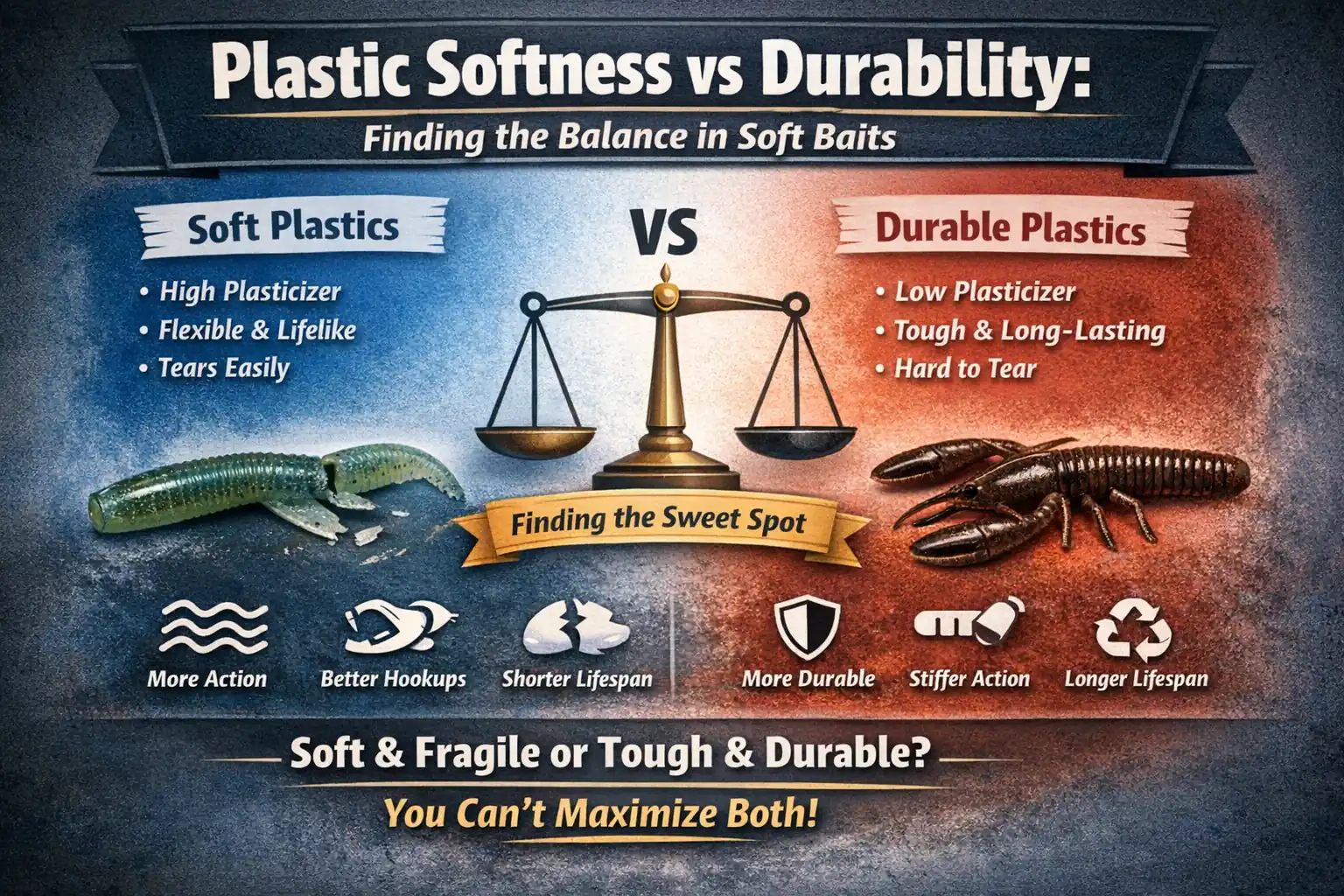
- Soft Compounds: Higher plasticizer content, greater elongation under stress, lower tear strength. Collapse easily on a bite, respond to subtle rod movement, tear more easily at hook penetration points. Applications: finesse worms, drop shot plastics, Ned-style baits.
- Firm Compounds: Lower plasticizer ratio, higher stiffness, greater tear resistance. Hold geometry under load, survive multiple fish, maintain structure in heavy cover. Applications: flipping baits, heavy-cover worms, salt-loaded stick baits.
Softness vs Durability Trade-Off
| Design Variable | Increases Softness | Increases Durability |
|---|---|---|
| Plasticizer Ratio | Higher ratio | Lower ratio |
| Salt Loading | Softer feel | Weakens tensile strength |
| Fusion Control | Proper fusion improves both | Under-fusion reduces both |
2. Why Softer Plastics Tear More Easily
In PVC plastisol systems, flexibility comes from separating polymer chains with plasticizer molecules. As plasticizer content increases, intermolecular forces between PVC chains decrease — improving mobility and stretch. However, reduced chain interaction also lowers resistance to crack propagation. When a hook penetrates or a fish bites down, stress concentrates at thin sections. In highly plasticized systems, the material stretches but does not redistribute stress efficiently, leading to tearing.
3. Why “Too Soft” Becomes a Problem
- Structural Instability: Excess plasticizer can cause appendages to stick together, tails to lose defined action, and the bait to deform during storage
- Tear Failure Under Load: During a hookset, stress concentrates at the hook entry point — higher softness lowers tear strength
- Shelf Life: High plasticizer ratios can increase surface oil migration and long-term deformation in packaging
4. Why Increased Durability Reduces Performance
To increase durability, manufacturers reduce plasticizer and tighten polymer structure. That directly reduces action. Firm plastics resist subtle rod input, require more force to activate, and show limited movement in cold water. A firm compound also resists compression when a fish bites — delaying hook exposure and potentially allowing fish to eject the bait. Durability improves lifespan — but may reduce bite conversion.
5. Why Fragile Baits Often Catch More Fish
Many high-performing baits tear easily. Soft compounds provide: natural movement activated by water pressure alone, realistic compression in the fish’s mouth, and faster hook exposure during the hookset. The same increase in plasticizer that improves flexibility also reduces tear strength — the performance gain and durability loss come from the same adjustment.
6. Application-Specific Optimization
- Finesse trout and panfish baits: Higher plasticizer ratio, lower tear resistance acceptable
- Bass worms: Moderate flexibility with improved tensile strength
- Heavy-cover flipping baits: Lower plasticizer, higher durability focus
- Salt-loaded stick baits: Plasticizer levels adjusted to maintain flexibility while offsetting salt stiffening
There is no universal “best” softness — there is only application-specific optimization.
FAQ
Does a softer fishing lure always catch more fish?
Not necessarily. Softer lures often produce more natural movement and collapse easier on hooksets. However, they tear more easily. The best choice depends on fishing pressure, species, and presentation style.
Why do durable soft plastics feel stiffer?
Durable plastics typically contain lower plasticizer ratios or formulations that increase intermolecular cohesion. This strengthens the polymer network and improves tear resistance — the trade-off is reduced flexibility.
What makes a soft plastic bait tear around the hook?
Tearing usually occurs where stress concentrates — typically at the hook bend. Higher softness increases chain mobility but reduces cohesive strength, leading to localized tearing under load.
Previous: Part 1 — What Are Soft Plastic Fishing Lures Made Of?
Next: Part 3 — Salt, Density, and Soft Plastic Lure Sink Rate
More Questions About Softness vs Durability
Is it worth buying a more durable bait even if it catches fewer fish?
It depends on the situation. For toothy fish or heavy cover where baits get destroyed fast, some added durability can be worth the trade-off in movement. For finesse presentations to selective trout, prioritizing softness and hookup ratio over bait lifespan is usually the better call.
Can I make a durable bait perform more like a soft one?
Not really, beyond minor adjustments — durability and softness are baked into the plastisol formulation itself. Trimming a firmer bait down in size can help it move a bit more naturally, but it won’t replicate the collapse and hook exposure of a genuinely softer plastic.