Part 1 — What Are Soft Plastic Fishing Lures Made Of? (PVC, Plastisol & Plasticizers Explained)
Soft plastic fishing lures are made of PVC and plasticizers, not rubber — understanding that basic chemistry explains why some baits feel alive in your hand while others feel stiff and lifeless.
What Soft Plastic Fishing Lures Are Made Of: PVC and Plasticizers
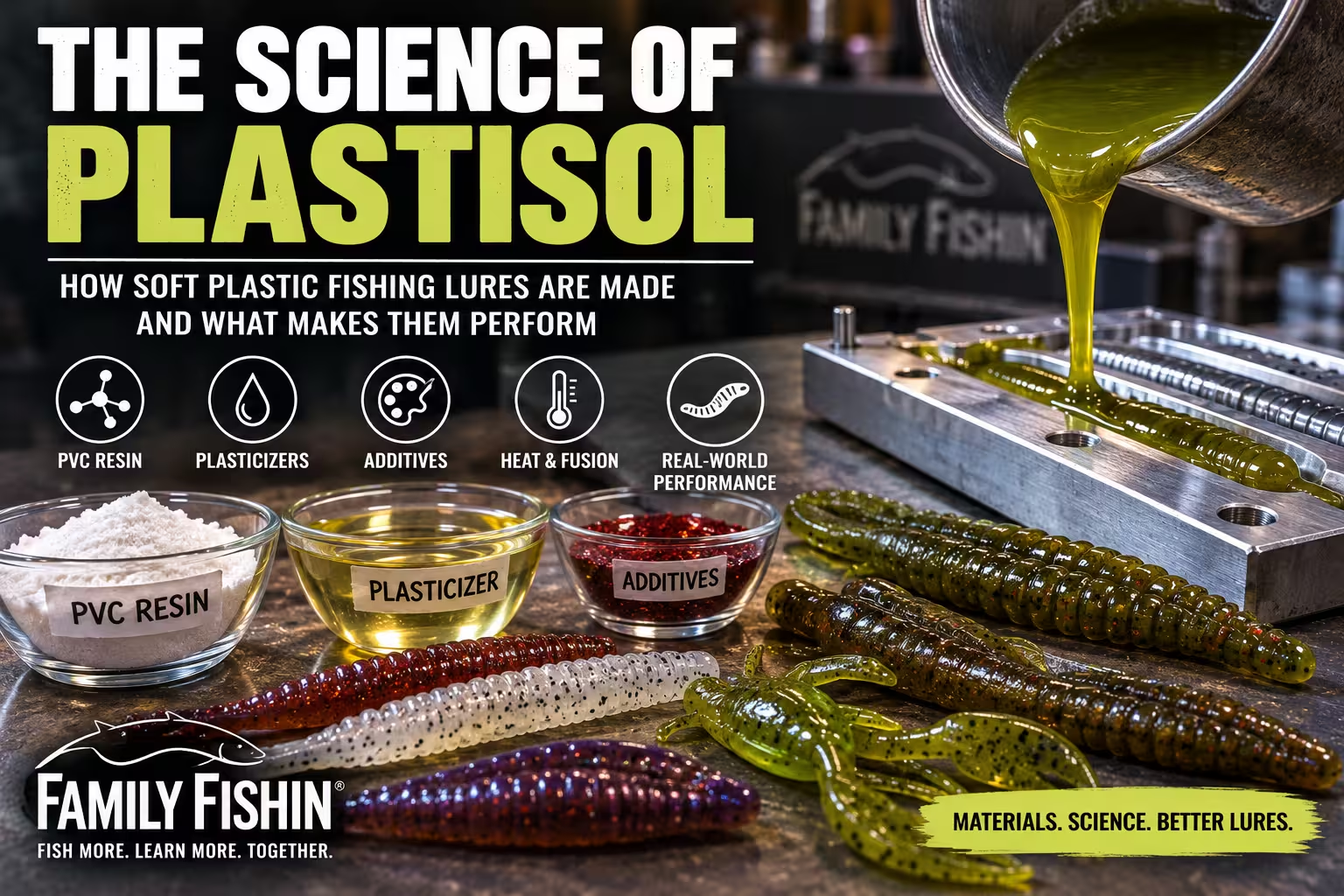
Soft plastic fishing lures are made from PVC (polyvinyl chloride) resin suspended in liquid plasticizer — a material system known as plastisol. When heated to approximately 320–350°F, the PVC resin particles absorb plasticizer, fuse into a homogeneous melt, and solidify into a flexible finished lure after cooling. Most anglers assume soft plastic fishing lures are simply “rubber,” but that assumption ignores the engineered material system behind them.
Soft Plastic Lure Materials Comparison
| Property | PVC Plastisol (Soft Lures) | Rubber | Silicone |
|---|---|---|---|
| Base Material | PVC resin + liquid plasticizer | Natural or synthetic rubber | Silicone elastomer |
| Processing | Heated to ~320–350°F to fuse | Vulcanized (chemical crosslinking) | Cured via heat or catalyst |
| Density Control | Easily adjusted with salt or additives | Limited control | Limited control |
| Re-meltable | Yes (thermoplastic) | No (thermoset) | No (thermoset) |
1. PVC: The Backbone of Soft Plastics
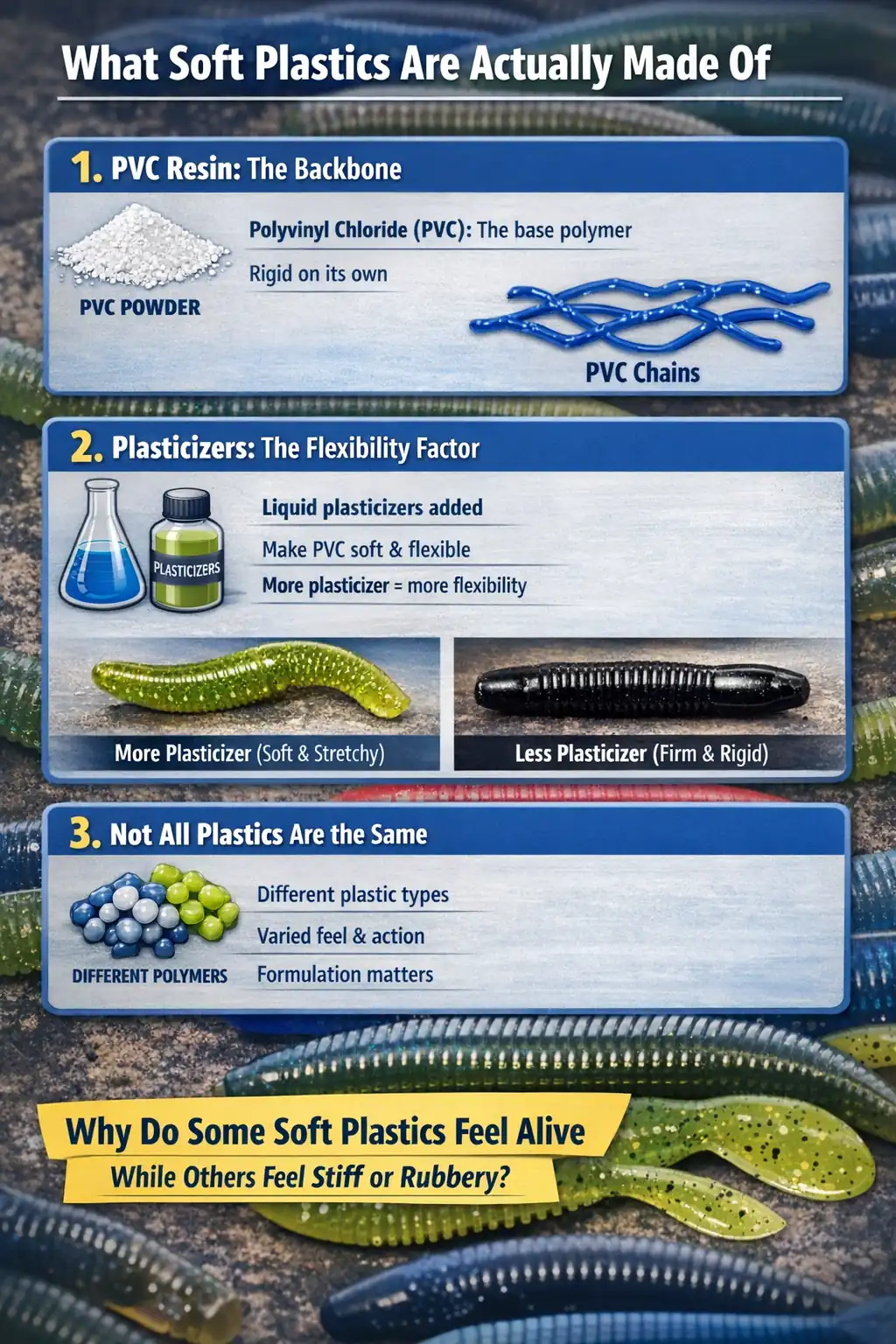
At the core of nearly every traditional soft plastic lure is PVC — Polyvinyl Chloride. PVC starts as a fine white powder. In this form, it is rigid and brittle. At the molecular level, PVC consists of long-chain polymers that naturally pack tightly together. When heated alone and allowed to cool, PVC forms a hard, inflexible solid. Only when plasticizer molecules are blended into the system do those chains gain mobility.
2. Plasticizers: The Flexibility Engine
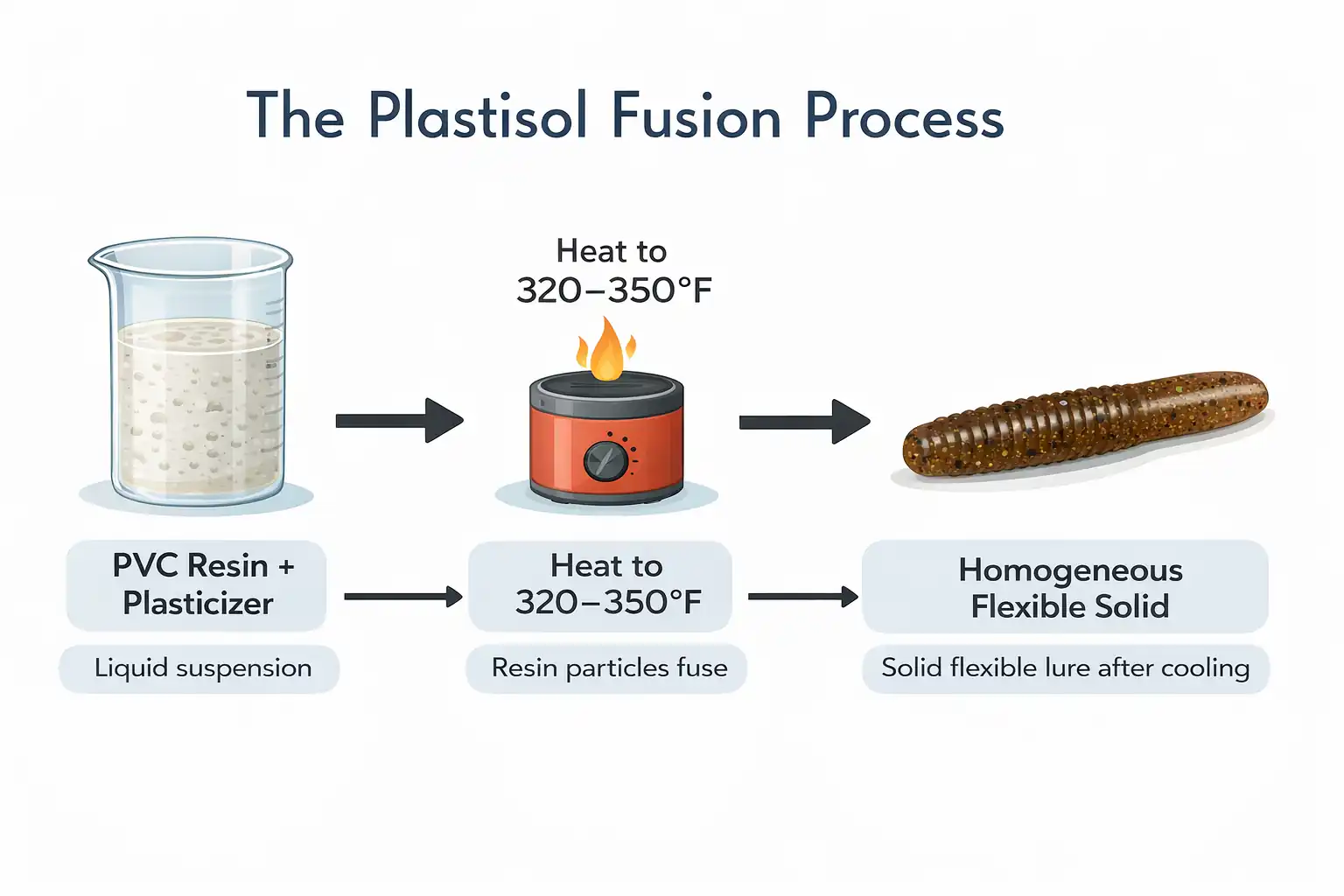
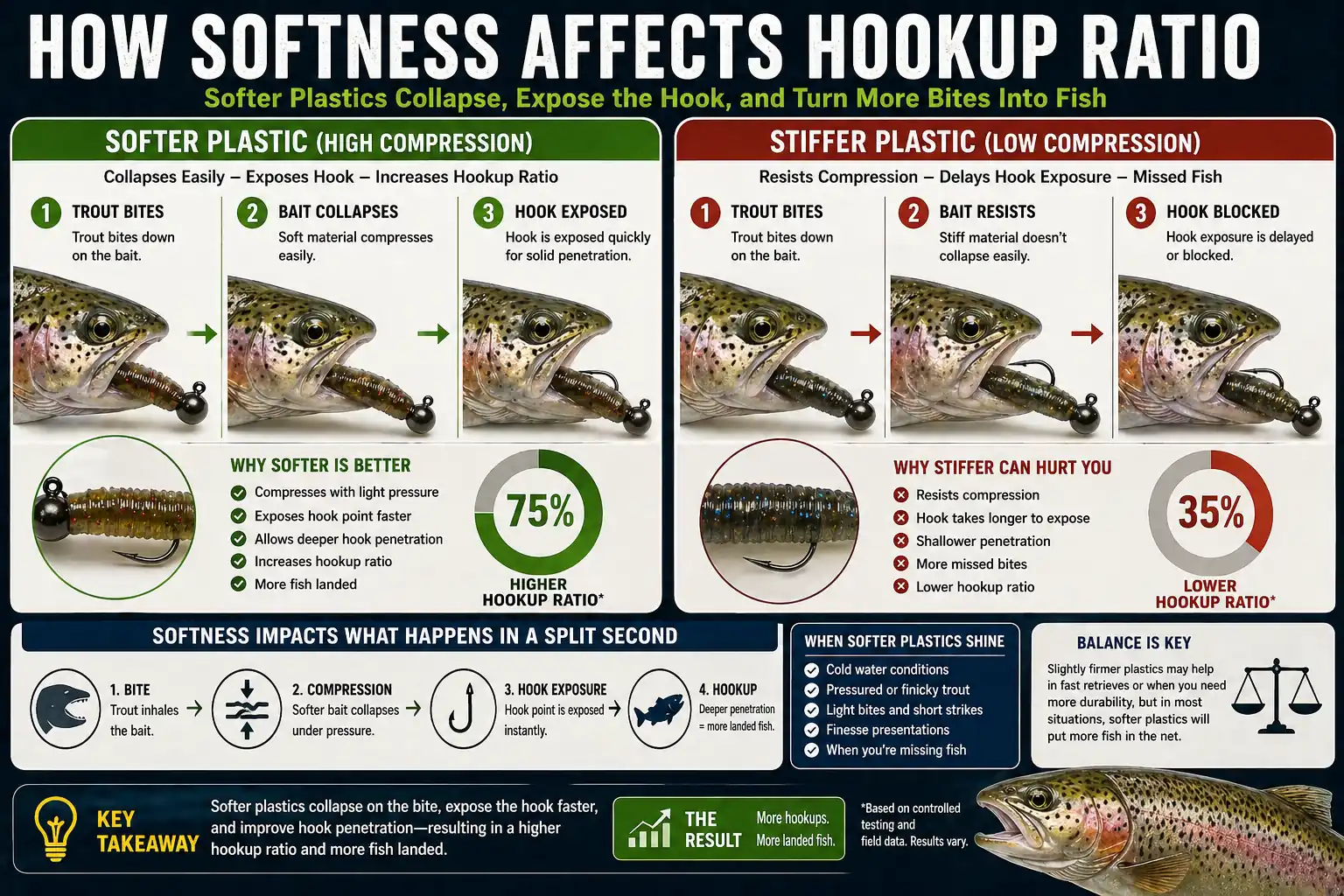
Plasticizers are liquid additives blended into PVC before heating. They wedge between PVC molecular chains, reduce internal friction, and allow the chains to slide past each other. The more plasticizer added, the more flexible the finished material becomes — this is the single biggest reason some soft plastics feel supple while others feel stiff.
| Property | High Plasticizer (Soft) | Low Plasticizer (Firm) |
|---|---|---|
| Shore A Hardness | 5A–15A | 20A–35A |
| Flexibility | Very high | Moderate |
| Tear Resistance | Lower | Higher |
| Action in Water | Subtle / “alive” | Tighter / controlled |
| Best Use | Finesse, trout, panfish | Flipping, heavy cover |
3. Why Not All Soft Plastics Feel the Same
This is exactly why we built our Ribbed Trout Worm around a high-plasticizer, soft formula: it fits squarely in the finesse/trout category above, with the subtle “alive” action that firmer plastics can’t match.
Two baits can look identical but feel completely different. That difference comes down to: plasticizer ratio, resin particle size (finer resins fuse smoother and create more uniform texture), and additive loading.
| Additive | Effect on Density | Effect on Action | Effect on Feel |
|---|---|---|---|
| Salt | Increases | Dampens | Firmer |
| Floating Agents | Decreases | Increases lift | Softer perceived |
| Elastomers | Neutral | Smoother | Rubber-like |
| Stabilizers | Neutral | None | Heat stability |
Why Some Baits Feel “Alive”
The “alive” feeling comes from proper plasticizer balance, controlled fusion during heating, correct additive loading, and clean resin dispersion. If the formula is off, the bait may feel rubbery, snap back too slowly, resist subtle rod input, or appear stiff in cold water. The “alive” feeling is not accidental — it is the result of precise chemical balance.
FAQ
Are soft plastic fishing lures made of rubber?
No. Most soft plastic fishing lures are made from PVC-based plastisol systems. Softness comes from plasticizers blended into PVC resin — not natural rubber compounds.
What is plastisol in fishing lures?
Plastisol is a liquid suspension of PVC resin particles in plasticizer. When heated to approximately 320–350°F, the PVC particles fuse into a homogeneous, flexible solid that solidifies into the finished lure after cooling.
What is plastisol made of?
Plastisol is made of PVC (polyvinyl chloride) resin suspended in liquid plasticizer, plus small amounts of stabilizers, pigments, and other additives depending on the formula. It stays liquid at room temperature and only becomes a solid, flexible bait once heated.
What makes one soft plastic bait softer than another?
Softness depends on plasticizer ratio, PVC resin characteristics, additive loading, and processing quality. Higher plasticizer levels reduce stiffness — small formulation differences change flexibility, density, and action.
Next: Part 2 — Plastic Softness vs Durability: The Trade-Off Nobody Explains
More Questions About Soft Plastic Lure Materials
Why do soft plastics smell the way they do?
The distinct smell comes from the plasticizers and manufacturing process used to make plastisol, before any scent additives are mixed in. Many manufacturers add fish-attracting scents on top of this base material specifically because the raw PVC and plasticizer blend has little natural appeal on its own.
Are all plastisol soft plastics recyclable or biodegradable?
Standard plastisol soft plastics are neither readily recyclable nor biodegradable under normal conditions, since PVC is a durable synthetic polymer. This is part of why interest in biodegradable alternatives has grown, though those materials typically involve different trade-offs in softness and durability.