Glow-in-the-Dark Fishing Lures: How Glow Pigments Actually Work (and How to Use Them)
Glow-in-the-dark fishing lures are deadly in deep water, night fishing, murky water, and the first gray light of dawn. But anyone who has used them knows the frustration: some glow baits blaze for hours, while others fade within minutes. The difference comes down to the glow pigment itself and how the lure is charged and used.
Why Glow-in-the-Dark Fishing Lures Work
Unlike standard lure colors that depend on available light to remain visible, glow-in-the-dark fishing lures create their own visibility by storing light energy and releasing it slowly over time. This allows fish to see them in conditions where normal colors fade away, including deep water, night fishing, and heavily stained water. Understanding the science behind that glow helps anglers choose better lures, charge them properly, and fish them more effectively.
First: Glow Is Not the Same as “UV” or Fluorescent
There’s a lot of confusion here, so let’s nail it down before anything else, because it changes everything about how you use the bait.
- Glow (phosphorescent) pigments store light energy and then release it slowly, so the bait keeps glowing in the dark after the light source is gone — for minutes or hours. This is what people mean by “glow in the dark,” and it’s the subject of this article.
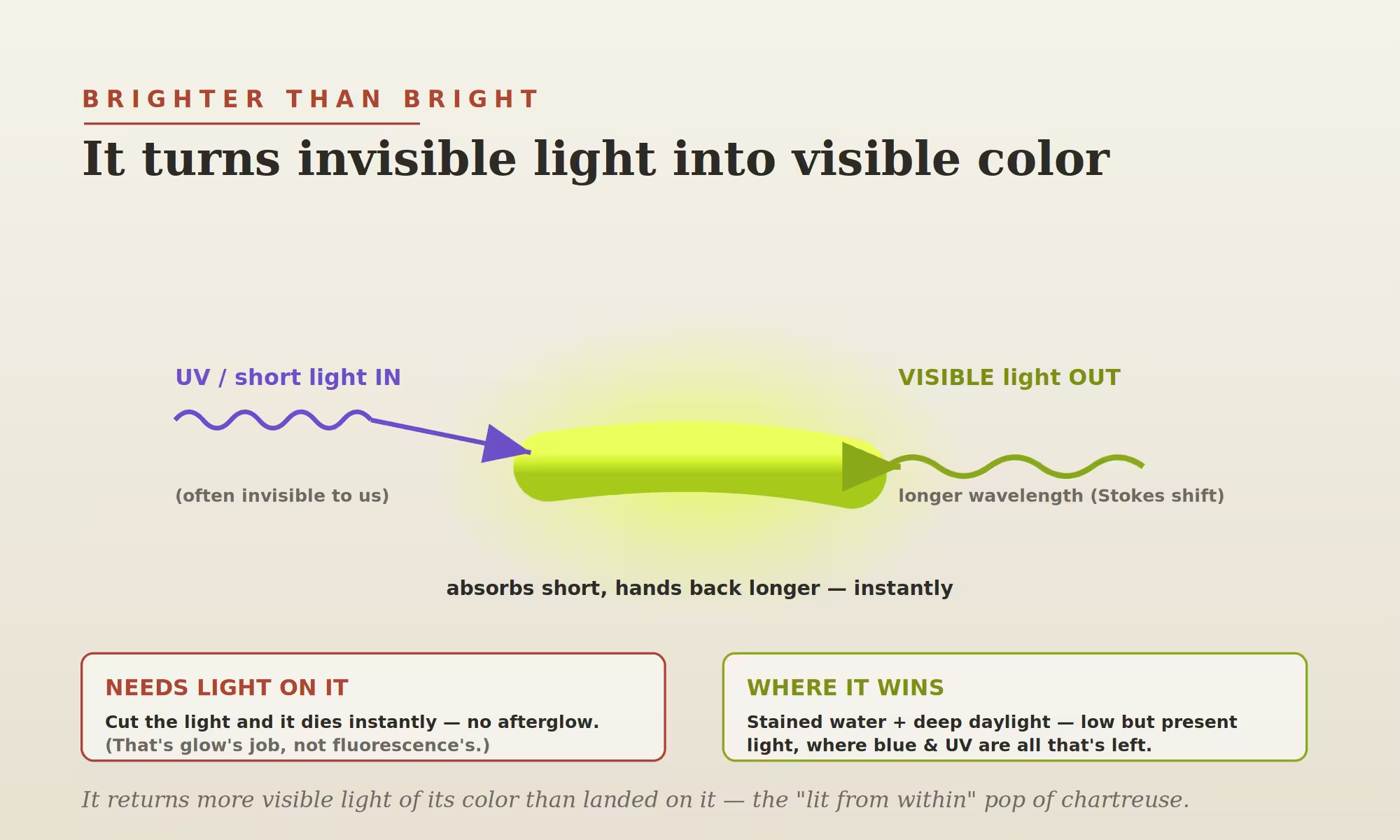
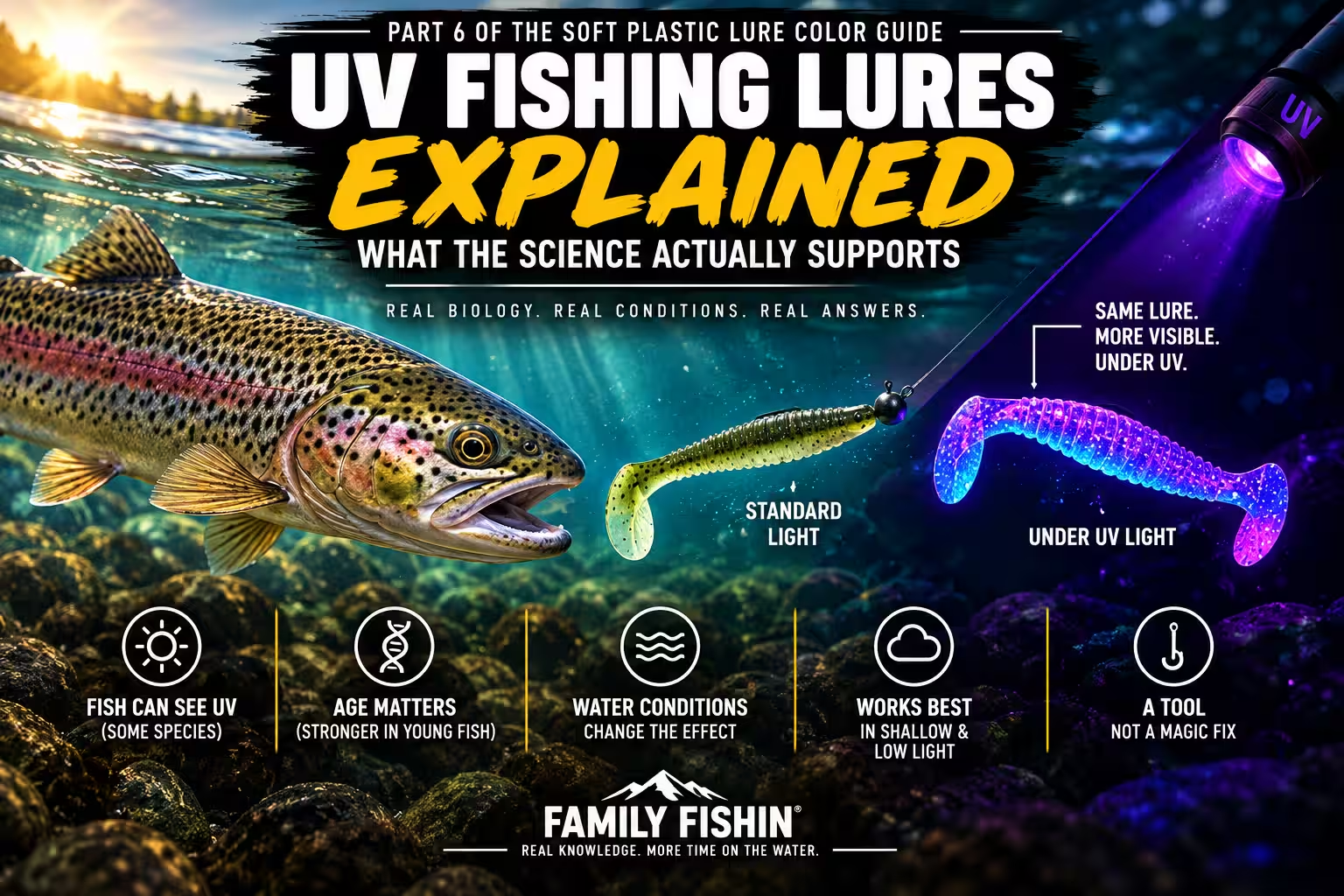
- Fluorescent / UV-reactive pigments only emit light while they’re being hit by UV or short-wavelength light. The instant that light stops, they stop. They don’t store anything — there’s no afterglow. (That’s a different pigment and a different tactic, covered in fluorescent pigments.)
The simple test: if it glows under a black light but goes dark the moment you switch the black light off, it’s fluorescent. If it keeps glowing after you turn the lights off, it’s phosphorescent — true glow-in-the-dark. This article is about the second kind: the bait that carries its own light into the dark.
Two Glow Chemistries — and Why Some Baits Die in Minutes
Nearly every disappointing glow bait comes down to which pigment it’s made with. There are two, and they’re night and day.
Zinc sulfide (the old stuff). The original glow pigment is copper-doped zinc sulfide (ZnS). It works, but it’s comparatively dim, glows only that classic greenish-yellow, and — the killer — it fades fast. Zinc sulfide can actually be a touch brighter in the very first minute, but it decays rapidly and is essentially gone to the naked eye within about ten minutes. If you’ve got glow baits that look great when you pull them out of the box and dead by the time they sink, you’ve got zinc sulfide.
Strontium aluminate (the modern stuff). The current standard is strontium aluminate doped with two rare-earth elements, europium and dysprosium (written SrAl₂O₄:Eu,Dy). It’s a different league: roughly ten times brighter than zinc sulfide and, more importantly, it holds a visible afterglow for 8 to 12 hours after a full charge instead of ten minutes. It comes in green (the brightest and longest), blue-green, and sky-blue, and it’s completely non-toxic and non-radioactive (unlike the radium-based luminous paints of a century ago). If you want a glow bait that’s still working at the bottom of a long drop or deep into a night session, this is the pigment.
The practical takeaway: when you buy or pour glow baits, the question isn’t “does it glow” — it’s “what’s it made of.” Strontium aluminate is worth seeking out (or pouring with); zinc sulfide is a short-lived novelty by comparison.
A Quick History (and Why Glow Is Safe Now)
Worth knowing where this comes from, because the early version was genuinely nasty. A century ago, “luminous” paint glowed because it contained radium — actually radioactive, and responsible for real tragedies among the workers who painted watch dials with it. That gave way to copper-doped zinc sulfide, which is safe and non-radioactive but dim and short-lived. The big leap came in the 1990s with strontium aluminate, which delivered an order-of-magnitude more brightness and hours of afterglow with no toxicity and no radioactivity at all. So modern glow baits are completely safe to handle and fish — the glow comes from light energy stored and released, not from anything radioactive. The pigment in your tackle box is the third generation of a long-improving technology.
How Glow Actually Works: Charge, Trap, Release
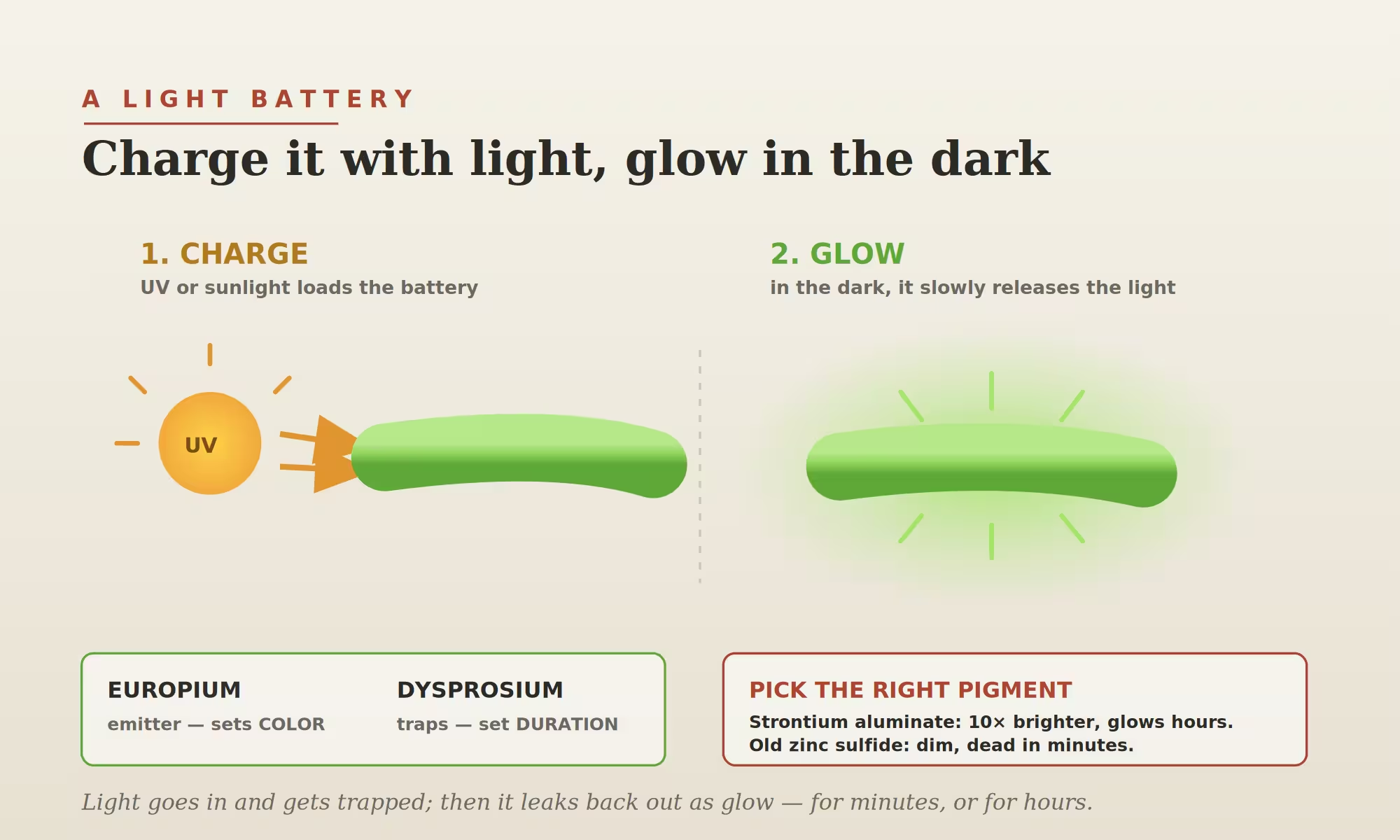
Think of a glow bait as a tiny light battery. You charge it with light, it stores that energy, and then it spends the energy slowly as visible glow. Here’s what’s happening inside, in plain terms first.
When light hits the pigment, the energy knocks electrons in the crystal up to a higher, “excited” energy level. In a plain material those electrons would immediately fall back and release that energy as a quick flash (that’s basically what fluorescence is). But strontium aluminate has a trick: its crystal is studded with tiny traps that catch those excited electrons and hold them, instead of letting them fall right back. Then, at ordinary temperatures, the warmth of the world slowly springs those electrons loose from the traps one at a time — and each one that falls back releases its stored energy as a particle of visible light. That slow, steady leak of trapped energy is the afterglow. The bait isn’t making light from nothing; it’s releasing light it banked earlier.
The two rare-earth dopants split the work, and this is the elegant part:
- Europium is the emitter — it’s the ion that actually gives off the light, and it sets the color of the glow (green, blue-green, etc.).
- Dysprosium builds the traps — it creates the catch-and-hold sites that store the electrons, and it’s what stretches the afterglow from a quick flash into hours.
So in one sentence: europium decides what color it glows, dysprosium decides how long. Zinc sulfide’s traps are shallow by comparison, which is exactly why its glow leaks out and dies in minutes while strontium aluminate’s deep traps dole the light out for hours.
Charging It Right (This Is Where People Go Wrong)
A glow bait is only as good as its last charge, and not all light charges it equally. The key fact: UV light charges it fastest and most fully. Ultraviolet photons carry more energy than visible light, so they reach the deep traps and pack them full. Practically:
- Sunlight charges it well — 10 to 30 minutes of daylight gives a strong charge (sunlight is rich in UV).
- A UV flashlight or “blacklight” is the fastest charge of all and the pro move — a few seconds of UV right before you drop the bait tops it off completely. Many night and deep-water anglers carry a small UV light specifically for this.
- A camera flash gives a quick punch of charge in a pinch.
- Ordinary indoor light charges it slowly and weakly — a bait that’s been sitting in a dim tackle box is barely charged.
And you can recharge it endlessly — quality strontium aluminate keeps performing after thousands of charge cycles. The habit to build: charge the bait right before it goes where the light won’t reach. A blast of UV at the boat, then drop it down to the deep, dark fish, and it carries a full battery the whole way.
The Glow Fades on a Curve — So Charge Fresh
A charged bait isn’t equally bright the whole time. Glow is brightest in the first minutes right after charging and then decays steadily — the brightness has a “half-life” on the order of hours, dropping quickly at first and then trailing off. The good news is that a full charge of strontium aluminate easily outlasts a long stretch of fishing — you are not recharging every cast. But because it’s brightest early, the smart move is to top it off right before the moment that matters most: re-zap it with a UV light just before you drop into the prime deep hole or the night bite, so it’s at peak brightness when the fish are most likely to see it.
Does It Charge Underwater? Mostly No
Here’s a reality that trips people up: once the bait is down deep in the dark, it’s only discharging — there’s little or no light down there to recharge it. In shallow, clear, sunlit water it stays partly topped up from the daylight reaching it, but in deep or stained water, the bait is spending its stored battery from the moment it sinks, with nothing refilling it. That’s why surface charging matters so much, and why anglers fishing long deep or night sessions will periodically reel up and re-hit the bait with a UV light to recharge before sending it back down. Think of the charge as fuel you load at the surface, not something the water keeps refilling.
Color and Duration Are Built In
One thing you can’t change by charging: the glow color. That’s set by the pigment (the europium), not by how you charge it. Green is the brightest and longest-lasting and the default choice for most fishing; blue and aqua versions exist and look great in clear water but glow dimmer and shorter. So pick the pigment color for the look you want, and know that green will always give you the most visible, longest glow for the same charge.
Why green specifically? Two reasons stack up. First, strontium aluminate’s green emission (around 520 nanometers) is simply its strongest, longest-lasting output — it’s where the pigment is most efficient. Second, that green-yellow band happens to be where eyes are most sensitive in low light, so it reads as even brighter than the raw output suggests. Blue glow can actually be the better visibility pick in deep or stained water where blue penetrates and lingers — but you’re trading away some raw brightness and duration to get it. For most situations, green is the workhorse; reach for blue or aqua when clarity and depth specifically favor it.
How to Tell What You’re Buying
If you buy glow baits rather than pour them, you can usually figure out the chemistry before you waste a trip on dim baits:
- Read the afterglow claim. Strontium aluminate products tend to advertise long afterglow — “glows for hours,” “super glow,” “long-lasting,” and sometimes “strontium” outright. If the packaging only says “glow” with no duration boast, or markets it as cheap novelty glow, suspect zinc sulfide.
- Price is a tell. Strontium aluminate costs more than zinc sulfide, so bargain-bin glow baits are more likely the short-lived kind.
- Run the home test. Charge the bait with a phone flashlight or, better, a UV light for 30 seconds, then take it into a dark closet. Check it again at 30 minutes. Zinc sulfide will be essentially dead; strontium aluminate will still be clearly glowing. Do this once with a known-good bait so you know what “good” looks like.
The same test works on baits already in your box — sort the long-glowers from the duds before your next night trip instead of finding out on the water.
For the Pourer: Working Glow Pigment Into Your Baits
If you pour your own, glow pigment behaves differently than regular colorant, and a few things matter:
- It survives the heat. Glow pigment is an inorganic crystal (a fired ceramic, basically), so it shrugs off normal plastisol pouring temperatures without breaking down — no special handling on that front. (Just don’t scorch your plastic for other reasons — see Why Plastisol Yellows and Scorches.)
- Use a translucent or clear base. Glow works by emitting light out through the plastic, so an opaque, heavily-pigmented bait smothers it. The brightest glow baits are built on a clear or lightly-tinted base so the light can escape. If you mix glow into a dark opaque color, you’ll choke most of the glow.
- Load it heavier than you’d think. Glow pigment usually needs a higher loading than regular colorant to glow strongly — brightness scales with how much pigment is in there. But there’s a trade-off (next point).
- Mind the grit and the settling. Glow powder is gritty and mildly abrasive, and heavy loading can make the plastic harder to pour cleanly and can wear on your equipment over time. Finer powder pours smoother but can glow a little less per grain; coarser glows brighter but feels grittier. The particles are also denser than the plastic, so in the liquid plastisol they tend to settle toward the bottom of the cup between pours — give it a stir right before each pour or your first baits will be glow-heavy and your last ones glow-starved. Mix it in thoroughly and evenly — clumps make bright spots and dim spots (the same dispersion problem any pigment has).
- Glow goes great as a belly, dot, or layer. A lot of effective glow baits aren’t glow all over — they’re a natural color with a glow belly, glow dot, or glow core. That puts the light where it triggers a strike without making the whole bait an unnatural blob of green.
Glow Doesn’t Have to Be All-or-Nothing
One of the biggest mistakes is treating glow as a yes/no switch — a bait is either fully glow or it isn’t. In practice, how much and where you put the glow is a real tactic, and matching it to the water beats blasting maximum glow every time.
- Full glow (the whole bait) is for the darkest situations — deep night, heavy stain, no moon. When there’s truly no light, you want maximum visibility.
- Glow accents — a glow belly, a glow tail, a glow dot or stripe on an otherwise natural bait — give a fish a target and a flicker of visibility without turning the whole lure into an unnatural green blob. In moderate low light (dusk, overcast, lightly stained water), an accent often outproduces a full-glow bait that looks fake.
- Subtle glow — a light glow loading mixed into a natural translucent color — gives a faint inner light that reads as “alive” rather than “lit up.” Good for clearer water and pressured fish that a bright glow would spook.
The principle mirrors the rest of color selection: the dirtier and darker the water, the more glow you want; the clearer and brighter the conditions, the more you dial glow back to an accent or skip it. Glow is a slider, not a switch.
When and Where Glow Actually Helps
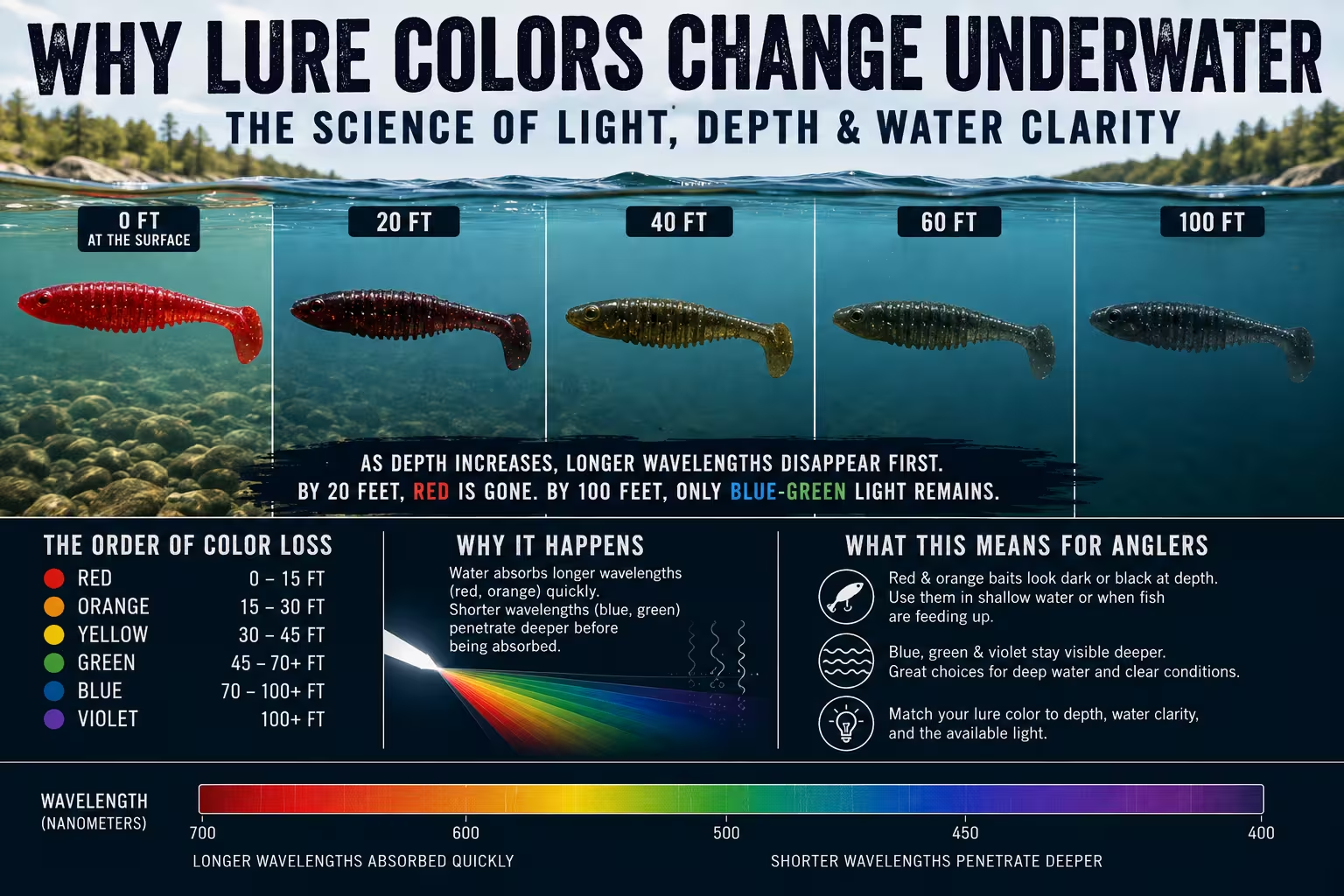
Glow is a tool for one specific condition: not enough ambient light for a normal color to show. A regular pigment works by reflecting the light around it — but in deep, dark, or murky water there’s little light to reflect, and color fades out. A glow bait doesn’t wait for light to reflect; it brings its own. So glow earns its keep in:
- Deep water, where sunlight has largely run out (especially the warm colors, which die first).
- Night fishing, the obvious one.
- Murky, stained, or muddy water, where visibility is low even in daytime.
- Dawn, dusk, and overcast low-light windows.
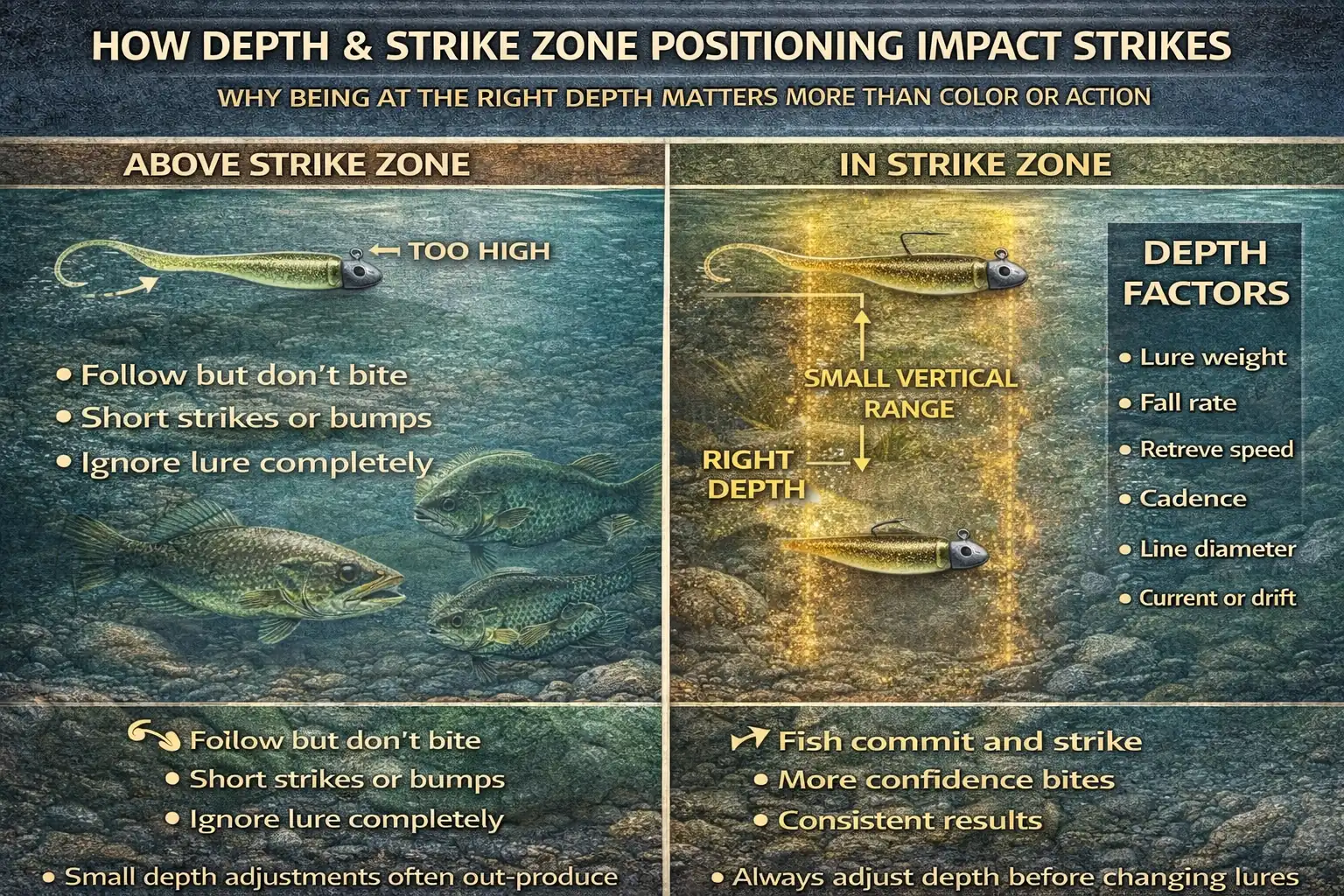
It is not automatically better everywhere — in bright, clear, shallow water, a strong glow can look unnatural and may do more harm than good. The deeper science of how light and depth change what a fish sees (and when glow versus other colors wins) lives in the color series — see lure color and depth guide. The material point for here: glow is the answer when there’s no light to reflect, because it makes its own.
How to Test Your Glow at the Bench
You can compare glow baits or pigment batches easily, and it’s worth doing since brightness and duration vary so much:
- Charge identically, then go dark. Hit two baits with the same light for the same time (a UV flashlight for, say, 30 seconds), then take them into a fully dark closet and compare. Same charge, side by side — the brighter one wins.
- Test the duration, not just the flash. The real question isn’t how bright it is at second one — it’s how bright at 30 minutes and 2 hours. Check them again later in the dark. This is where strontium aluminate crushes zinc sulfide, and where a cheap glow bait exposes itself.
- Test your base. Pour the same glow loading into a clear base and an opaque one and compare — you’ll see for yourself how much an opaque color smothers the glow.
- Change one thing. As always, vary only the pigment, or only the loading, or only the base, and keep a note. “Doubled glow loading in clear base — much brighter, slightly grittier pour” is the kind of result that’s worth more than any spec.
Diagnose Your Glow
- Glows bright then dies in minutes — it’s zinc sulfide, not strontium aluminate. Switch pigments if you want long afterglow.
- Dim even right after charging — too little pigment, an opaque base smothering it, or it wasn’t charged with strong/UV light. More pigment, clearer base, better charge.
- Won’t seem to charge — it’s been getting only weak indoor light. Hit it with sunlight or a UV flashlight.
- Gritty, rough pours — glow loading too high or powder too coarse; ease the loading or use finer powder.
- Bright spots and dead spots — pigment clumped; mix more thoroughly next batch.
Modern glow-in-the-dark fishing lures work because they store light energy and release it slowly over time, making them effective when normal lure colors disappear in darkness or stained water.
Frequently Asked Questions
How long do glow-in-the-dark fishing lures glow?
High-quality glow lures made with strontium aluminate pigments can remain visible for several hours after a full charge, although they are brightest during the first hour.
What is the best way to charge a glow lure?
A UV flashlight provides the fastest and strongest charge. Direct sunlight also works well, while normal indoor lighting produces a weaker charge.
Are glow-in-the-dark fishing lures better than UV lures?
They serve different purposes. Glow lures store light and continue glowing after the light source is removed, while UV-reactive lures only shine when exposed to UV light.
What color glow lure works best?
Green glow is generally the brightest and longest-lasting option. Blue and aqua glows can be effective in clear water but typically fade sooner.
When should I use glow-in-the-dark fishing lures?
They work best for night fishing, deep water, dawn and dusk periods, and stained or muddy water where natural colors become difficult for fish to see.
The Bottom Line
A glow lure is a light battery: it stores light and releases it slowly in the dark. The pigment is everything — modern strontium aluminate (europium for color, dysprosium for the hours-long afterglow) blows away the old zinc sulfide that dies in minutes. Charge it with UV or sunlight right before it goes deep or into the dark, build it on a clear base so the light can escape, and use it where there’s no ambient light to reflect — deep, night, and murky water. Do that and you’ve got a bait that’s still working, and still visible, when everything else has gone dark.
Glow is just one member of the “effect pigment” family. Its instant-only cousin — fluorescent and UV-reactive pigments that light up while lit but don’t store a glow — is covered in fluorescent pigments, and the chemistry of the plastisol you’re loading all this into lives on the the Science of Plastisol hub.
About Family Fishin
Family Fishin is a family-owned fishing tackle company dedicated to designing, testing, and producing high-quality fishing lures — inspired by generations of fishing tradition and driven by a passion for innovation. Every product is developed with one goal in mind: helping anglers spend more time doing what they love, catching fish and creating memories on the water.
Tags: #glow lures #glow in the dark #soft plastics #lure making #phosphorescent #strontium aluminate #night fishing #DIY lures