Why Soft Plastic Baits Melt Together (and How to Store Them So They Don’t)
You open the tackle tray after a few weeks and find a horror scene: two baits fused into one sticky, half-liquid blob, sometimes welded right to the bottom of the box. Proper soft plastic lure storage prevents melting, hardening, plasticizer migration, and other common bait problems that shorten lure life. The natural assumption is heat — they “melted.” But that’s not what happened, and believing it is why people keep ruining baits. The real cause is a slow chemical process called plasticizer migration, it happens at room temperature, and once you understand it, every storage rule that sounds like superstition suddenly makes perfect sense. Here’s exactly what’s going on and how to stop it.
The Root Cause: The Plasticizer Wants to Leave
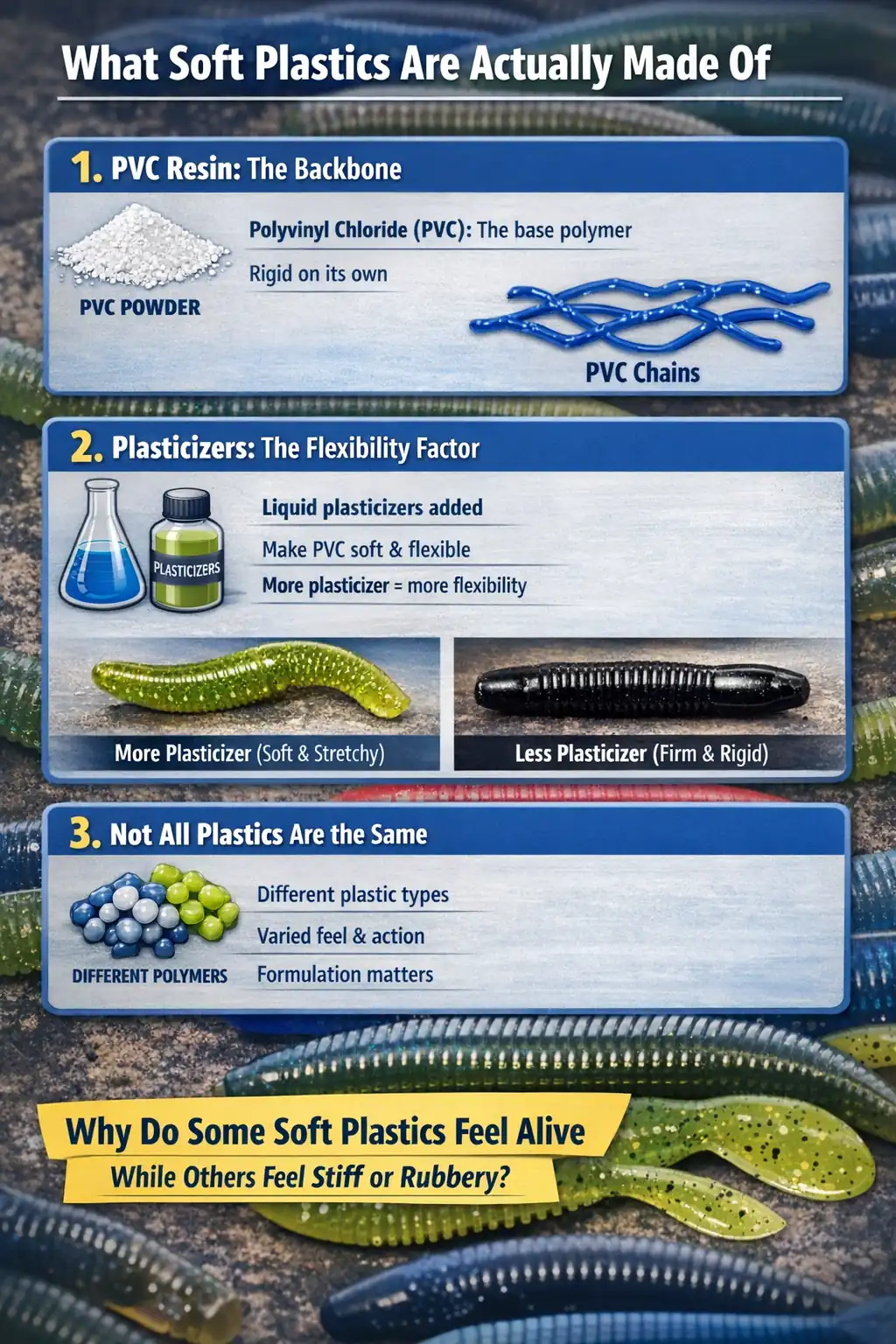
A soft-plastic bait is mostly two things: PVC (the plastic itself) and plasticizer (an oil that makes the hard PVC soft and flexible). The critical fact almost nobody knows is that the plasticizer is not chemically bonded into the plastic. It’s just physically held there, mixed in — and it spends its whole life slowly trying to escape. It creeps to the surface, evaporates into the air, and most destructively, soaks into anything it touches that it can dissolve into.
That single process — plasticizer migration — is the hidden cause behind nearly every way a soft plastic goes bad in storage. The fused blob, the greasy film, the bait that got hard and shrank, the color that bled, even the melted tackle box: they’re not separate problems. They’re one process — plasticizer leaving — wearing different masks. Get that one idea and the rest of this article is just details.
What actually drives it is simple: molecules always move from where they’re crowded to where they’re sparse. Inside the bait, plasticizer is packed in tight; the air or a touching surface has almost none. That difference is the engine — the plasticizer flows “downhill” from full to empty, slowly and relentlessly, the same way a drop of food coloring spreads through still water. You can’t switch the engine off; all of storage is about making that downhill flow as slow as possible.
The “Melt”: When Two Plastics Dissolve Each Other
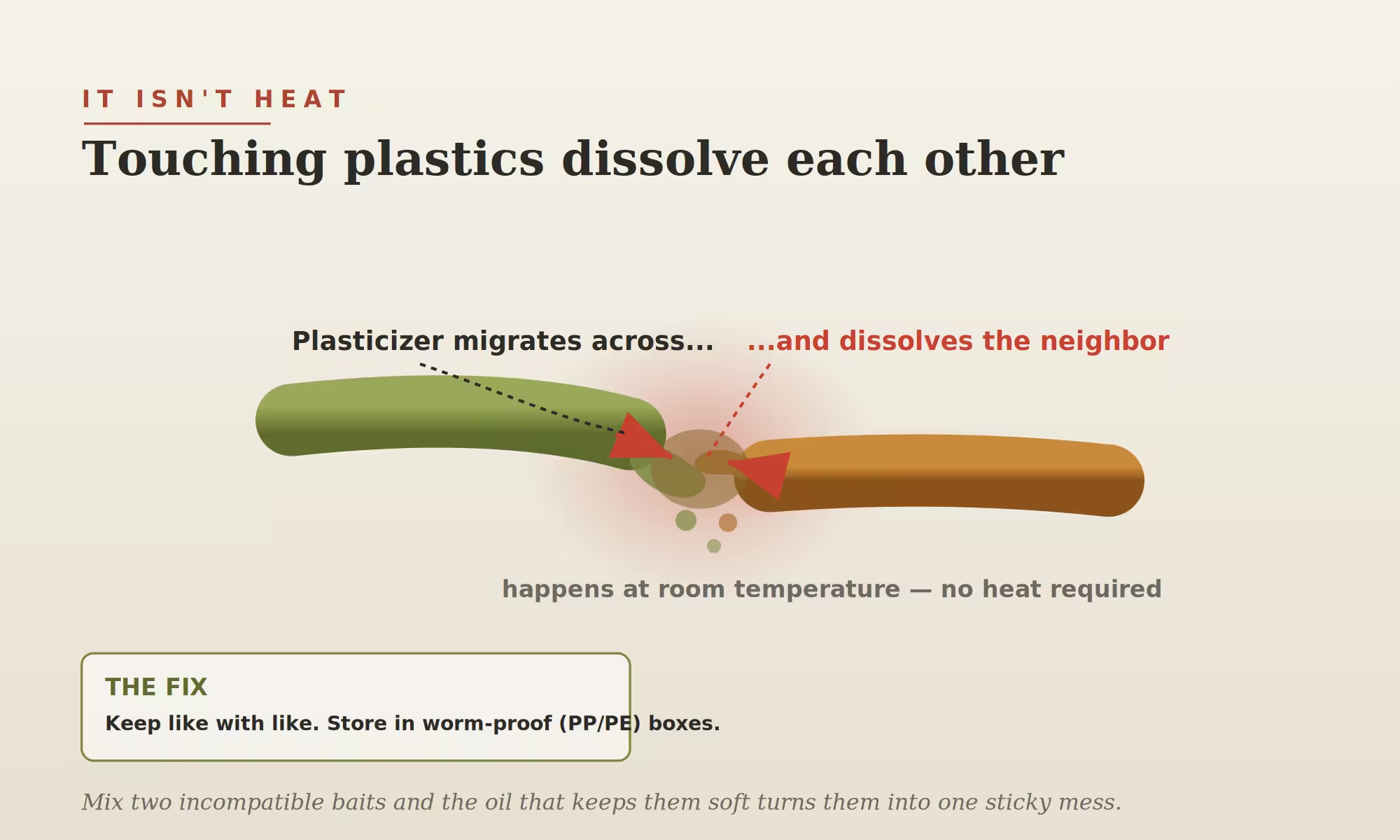
Here’s what actually happens in that fused-blob disaster, and why heat gets the blame unfairly. When two incompatible plastics are pressed together, the plasticizer (and any oils) from one penetrate and dissolve the other. The plasticizer is essentially a solvent — and given enough contact time, it dissolves the matrix of whatever it’s touching until both go to mush. The key word is incompatible: it’s a chemistry mismatch, not a temperature problem. It happens at room temperature, in a cool dark drawer, with no heat at all. Heat and sunlight speed it up, but the cause is two materials that should never have touched.
The single worst offender is mixing different bait materials. The big one is putting standard plastisol (PVC) baits in contact with ElaZtech / TPE-type baits — the Z-Man-style elastomers. That material is a completely different chemistry, very high in oil, and it acts like an aggressive solvent against PVC. Press a Z-Man bait against a plastisol worm and the plastisol will liquefy. They cannot share a compartment, period. The fix is a rule simple enough to never forget: keep like with like. Plastisol with plastisol, ElaZtech with ElaZtech, and neither one touching the other or touching hard-bodied baits.
A couple of special cases worth knowing:
- Z-Man / ElaZtech baits can be stored together with other ElaZtech safely — just never with plastisol or hard baits. (They have their own quirk in the cold, covered below.)
- Berkley Gulp! is its own separate class entirely — it’s a water-based bait, not plastisol at all, so it must stay sealed in its own packaging liquid or it dries out and stiffens. Keep it isolated too.
A Simple Compatibility Guide
You don’t need a brand-by-brand chart — you need to think in material families, because compatibility is about chemistry, not logos. Sort everything you own into four buckets and the rules fall out on their own:
- Plastisol (PVC) soft plastics — the large majority of soft baits: most worms, grubs, craws, swimbaits, tubes. These can safely touch each other (watch only for color bleed). This is the “default” soft plastic.
- TPE / ElaZtech elastomers (Z-Man and similar) — a different chemistry, high in oil. Safe with other ElaZtech/TPE only. Never with plastisol, never with hard baits.
- Water-based baits (Berkley Gulp! and kin) — keep sealed in their own juice, isolated from everything.
- Hard baits (crankbaits, jerkbaits, jig bodies, anything rigid) — keep soft plastics off them entirely; plasticizer attacks many hard-bait plastics and finishes.
The one-line version: anything in a different bucket should never touch. Within a bucket, you’re only managing color bleed. That mental model covers every brand you’ll ever buy without memorizing a single product.
Not Sure What a Loose Bait Is Made Of?
Lost the packaging? You can usually tell plastisol from ElaZtech/TPE by feel. Plastisol tears fairly easily and snaps when you stretch it hard. TPE/ElaZtech stretches dramatically — way past where plastisol would break — and springs back, or feels stiff-but-rubbery without tearing. If a bait stretches like a rubber band and refuses to rip, treat it as TPE and store it away from your plastisol. When the packaging is around, check it — many bags list the material (you’ll see “TPE” or similar). When in doubt, isolate it; assuming a mystery bait is incompatible costs you nothing, while guessing wrong can cost a whole tray.
Why the Box Itself Can Melt — and Which Boxes Don’t
If plasticizer dissolves incompatible plastics, then the tackle box is just another plastic in the equation — and a lot of boxes are made of exactly the kind of plastic the plasticizer attacks. This is the classic “it even melted the box” disaster, and there’s a well-known tell: people report a bait melting in a clear box but being fine in a black one. That’s not random. Cheap clear boxes are often polystyrene, which the plasticizer readily attacks, while quality tackle boxes are molded from polypropylene (PP) or polyethylene (PE) — and the plasticizer simply can’t dissolve into those.
That’s the entire meaning of the term “worm-proof.” It doesn’t mean tough or thick; it means the box is made of a plastic (PP or PE) that resists being dissolved by plasticizer oils. Polypropylene has a slick, “low-energy” surface that the oils won’t bond to, plus a high melting point, so it shrugs off both the chemistry and modest heat. So the rule is: if a box isn’t specifically labeled worm-proof, assume it isn’t, and don’t trust your baits to it for long-term storage. A bargain box that “fit the last little space” is exactly how people lose a whole tray of plastics.
There’s a quick way to check a box you’re unsure about: flip it over and look for the recycling code in the little triangle. #5 (PP, polypropylene) and #2 or #4 (PE, polyethylene) are the safe ones — plasticizer won’t dissolve them. #6 (PS, polystyrene) is the dangerous one and the usual culprit behind a “melted clear box,” since cheap rigid clear boxes are often polystyrene. No code or unsure? Treat it as unsafe for long-term storage and keep the baits bagged inside it instead.
Why Baits Go Hard, Greasy, or Shrink
The fused blob is migration’s dramatic form. The slow, everyday form is the bait that just goes bad sitting alone in a drawer — and it’s the same plasticizer leaving, only into the air and to the surface instead of into a neighbor.
As plasticizer gradually migrates out over months and years, the bait loses the very thing that kept it soft, so it slowly gets harder, stiffer, and a little smaller (it shrinks), eventually turning brittle. That old worm that’s stiff as a twig didn’t “dry out” in the water sense — it lost its plasticizer. And there’s a telltale surface sign: migration often shows up first as an oily, greasy film or a faint white bloom on the bait’s surface. That sheen is literally plasticizer that has reached the surface and is leaving. So a greasy bait isn’t dirty — it’s aging.
Here’s a useful piece of the why, and it’s a real lever for makers: smaller plasticizer molecules migrate much faster than big ones. A light, small-molecule plasticizer can migrate roughly ten times faster than a large, heavy one, slipping out through the plastic and showing surface bloom within weeks to months, while a high-molecular-weight plasticizer stays trapped far longer. That’s the difference between a bait that’s still supple after years and one that’s stiff in a season — and it’s chosen at the formula stage, not in the tackle box.
Color Bleed: When Baits Stain Each Other
Pigments and dyes can travel along with migrating plasticizer, which is why two differently colored baits pressed together can bleed into each other — a white bait left touching a hot-pink worm comes back with a pink stain. It’s cosmetic rather than structural, but it ruins a clean presentation. Same fix as everything else: store baits separated, or leave them in their original packaging where they aren’t in contact. Many anglers simply keep each color in its own bag.
Salt Leaching: The Density Trade-Off Comes Home
If your baits are salted for weight and sink rate, storage adds a failure mode. Salt is water-soluble, so a heavily salted bait that’s stored damp — or fished and tossed back in the box wet — slowly leaches its salt out. As the salt dissolves it leaves tiny voids behind, and the bait turns brittle and crumbly, eventually falling apart. It’s the long-term cost of using salt as a cheap weight: great fall rate, shorter shelf life, and worse if it isn’t kept dry. (How salt sets a bait’s fall and action in the first place is covered in What Makes a Soft Plastic Lure Come Alive.)
Heat, Cold, and Sun: The Accelerators
Migration is always happening, but the environment controls how fast:
- Heat speeds everything up. Diffusion climbs steeply with temperature — as a rule of thumb, the migration rate roughly doubles for every 15–20°F you go up. So a bait that would age slowly in a 70°F closet is aging several times faster in a 110°F truck cab, and many times faster again on a black boat deck in the sun. It isn’t a gentle, linear penalty; it’s a steep one. The widely cited safe window is roughly 50–90°F.
- Sun adds UV damage on top. Sunlight fades pigments and breaks down the plastic itself, and worse, it compounds with migration: UV opens up the plastic’s structure so plasticizer escapes faster, while the escaping plasticizer carries away the protective additives. Sun-baked baits don’t fade gracefully — they go downhill fast.
- Cold has its own trap, mostly for ElaZtech. Standard plastisol mostly just stiffens in cold (and recovers when warm), but ElaZtech/TPE baits left in hard freezes — below about 20°F — can have their oil leach out, causing permanent shrinkage and lost stretch. Z-Man-type baits should come indoors in winter, not live in an unheated garage or truck.
The practical reading: store cool, dark, and dry, and treat a hot vehicle or a sunny window as the enemy on all three fronts.
Don’t Forget the Liquid Plastic Itself
If you pour your own, the raw plastisol in the jug has its own shelf life. Because it’s a suspension — solid PVC particles floating in liquid plasticizer, plus any salt, glitter, and pigment — those solids slowly settle and separate over time, leaving thinner liquid on top and a dense sludge on the bottom. That’s normal and recoverable: it just needs a thorough re-stir back to uniform before you pour, or the batch runs inconsistent. Stored cool, capped, and out of sunlight, quality plastisol keeps a long time; left hot or open, it can skin over, thicken, or discolor before it ever hits the pot.
So How Long Do Soft Plastics Actually Last?
There’s no expiration date stamped on a bag of worms, and “how long do they last?” has the honest answer: entirely depends on how you store them. The same bait can last five years or five weeks.
Stored right — in original packaging, separated by material, cool and dark — quality soft plastics keep their action and softness for years. Plasticizer is still slowly leaving, but so slowly you’ll likely fish them before it matters. Stored wrong — mixed materials in a hot, sunny box — the same baits can be a fused, greasy, or stiff mess in a single season, sometimes in weeks if an incompatible bait is touching them. Salted baits and small-molecule “super soft” baits trend toward the shorter end; firm, high-permanence baits toward the longer. The takeaway isn’t a number — it’s that you control the clock far more than the bait’s age does. Buy in quantities you’ll realistically fish, rotate older stock first, and storage does the rest.
Soft Plastic Lure Storage Best Practices
The best soft plastic lure storage method is to keep baits in their original packaging, separate incompatible materials, use worm-proof tackle boxes, and store everything in a cool, dry location away from direct sunlight.
The Storage Protocol (the Whole Point, in Five Rules)
Every rule below is just a way to slow plasticizer migration and keep light and heat off. Follow these and the fused-blob disaster basically never happens:
- Original packaging is king. It’s the single most effective rule. In the bag, baits aren’t touching anything incompatible, and the bag is made to be compatible with them. When in doubt, leave them where they came.
- Separate by material — never mix. Plastisol with plastisol, ElaZtech with ElaZtech, Gulp! sealed on its own, and none of them touching hard baits. This one rule prevents the catastrophic melt.
- Use only worm-proof (PP/PE) boxes if you’re going to use trays at all. Skip cheap clear/polystyrene boxes for anything but a day’s use.
- Separate by color (or keep colors bagged individually) to stop bleed.
- Store cool, dark, and dry — roughly 50–90°F. No hot trucks, no sunny windows, no damp boxes. And bring ElaZtech indoors in hard cold.
A practical middle ground a lot of anglers use: keep the main stash in original packaging, and only load a small day-tray (worm-proof, separated) with what you’ll actually throw that trip, dumping leftovers back into their bags at the end of the day.
For the Maker: You Set Shelf Life at the Pot
If you pour your own baits, the deepest takeaway is that shelf life is designed in at the formula stage, not managed in the box. The moment you pick a plasticizer, you’ve chosen how fast it will migrate — small, light plasticizers give a softer, livelier bait but bloom and stiffen sooner; large, heavy ones last far longer but cost you some softness and slow your pours. That’s the permanence-versus-performance trade, and there’s no free lunch. If you want baits that hold up for years, lean toward higher-molecular-weight, well-matched plasticizers and accept the trade-offs; if you’re pouring for maximum action and you’ll fish them soon, a livelier small-molecule plasticizer is fine. Either way, good storage only slows a process you already locked in chemically. (The formula side of this — what plastisol is and how plasticizer choice works — lives on the Science of Plastisol hub.)
A quick bench tell: if fresh-poured baits develop an oily surface bloom within weeks, your plasticizer is migrating fast — a sign to move toward a higher-permanence plasticizer if shelf life matters for what you’re making.
You Found a Melted Mess — Now What?
First, the hard truth: a bait that’s genuinely fused or liquefied is gone — there’s no un-dissolving it, and trying to “re-firm” a migrated bait doesn’t restore what’s left. But you can stop the damage from spreading:
- Get the survivors out and separated immediately. A melting bait is actively leaking solvent onto its neighbors; every hour of contact spreads the damage.
- Clean the box thoroughly. The sticky residue left behind is plasticizer-laden and will keep attacking the next baits you put in — and if it’s a non-worm-proof box, retire it; it’s been compromised.
- Re-bag by material and color so you don’t repeat the mix that caused it.
- Catch bloom early. A bait just starting to get an oily sheen isn’t ruined yet — pull it from contact, bag it alone, and store it cool to buy time. (A torn bait is a different fix — see the tear article for mending those.)
The goal after a melt isn’t rescue; it’s containment and not doing it again.
Diagnose the Damage
What you’re looking at, and what caused it:
- Two baits fused into a sticky blob — incompatible materials stored touching (classic plastisol-meets-ElaZtech). Separate by material.
- The tackle box itself is etched or melted — wrong box plastic (polystyrene). Switch to worm-proof PP/PE.
- Oily, greasy film or white bloom on a single bait — normal plasticizer migration, sped up by heat. Store cooler; expect it sooner from small-molecule plastic.
- Bait went hard, stiff, and a bit smaller — long-term plasticizer loss (aging). It’s lost its softness for good.
- One bait stained with another’s color — color bleed from contact. Bag colors separately.
- Salted bait turned crumbly and brittle — salt leached out, leaving voids. Store dry; ease off salt if it’s a recurring problem.
The Bottom Line
Soft plastics don’t “melt” from heat — they undergo plasticizer migration, the slow escape of the oil that keeps them soft. Press the wrong two plastics together and that oil dissolves them into a blob at room temperature; leave a bait alone and the same process makes it greasy, then hard, then brittle; store it hot or sunny and it all happens faster. The defense is almost embarrassingly simple: keep baits in their original bags, never mix materials, use worm-proof boxes, separate colors, and store cool and dry. Do that and a tray of plastics will outlast the season instead of becoming a science experiment.
What we haven’t covered here is the other way soft plastic breaks down — not in storage, but during the heat of being made (why it yellows, smells, and degrades in the pot). That’s a different chemical process, and it gets its own breakdown in Why Plastisol Yellows, Smells, and Scorches.
Frequently Asked Questions About Soft Plastic Lure Storage
Why do soft plastic fishing lures melt together?
Soft plastic lures usually do not melt because of heat alone. Most “melting” occurs when incompatible plastics touch each other and plasticizer migrates from one material into another, causing the baits to soften, dissolve, and fuse together.
Can soft plastic baits melt at room temperature?
Yes. Plasticizer migration happens at room temperature. Heat speeds the process up, but incompatible soft plastics can fuse together even in a cool tackle box or storage drawer.
Can I store Z-Man ElaZtech baits with regular soft plastics?
No. ElaZtech and traditional plastisol baits should never be stored together. The different materials react chemically and can quickly ruin both baits.
What does “worm-proof” tackle box mean?
A worm-proof tackle box is made from plastics such as polypropylene (PP) or polyethylene (PE) that resist damage from plasticizer oils. These materials prevent soft plastics from attacking and melting the tackle box itself.
Why do old soft plastic baits become hard and brittle?
As plasticizer slowly leaves the bait over time, the lure loses flexibility and becomes harder, smaller, and more brittle. This is a normal aging process that can be slowed with proper storage.
Why do soft plastic baits get oily or greasy?
An oily film is often a sign that plasticizer is migrating to the surface of the bait. This is an early indicator of aging and is accelerated by heat and prolonged storage.
How should soft plastic lures be stored?
The best method is to keep baits in their original packaging, separate different material types, avoid mixing colors when possible, use worm-proof tackle boxes, and store everything in a cool, dark, dry location.
How long do soft plastic fishing lures last?
When stored correctly, quality soft plastics can remain usable for many years. Poor storage conditions, excessive heat, sunlight, or mixing incompatible materials can ruin baits in a matter of weeks or months.
Can soft plastic baits damage tackle boxes?
Yes. Plasticizer can attack certain plastics, especially polystyrene. This is why some clear tackle boxes become cloudy, warped, or partially melted after prolonged contact with soft plastics.
What is plasticizer migration?
Plasticizer migration is the slow movement of the oil-like compounds that keep soft plastics flexible. It is the primary cause of bait melting, color bleeding, surface bloom, hardening, shrinkage, and many other long-term storage problems.
What is the best soft plastic lure storage method?
The best soft plastic lure storage method is to keep baits separated by material type, store them in their original bags whenever possible, and use worm-proof tackle boxes made from compatible plastics.
About Family Fishin
Family Fishin is a family-owned fishing tackle company dedicated to designing, testing, and producing high-quality fishing lures — inspired by generations of fishing tradition and driven by a passion for innovation. Every product is developed with one goal in mind: helping anglers spend more time doing what they love, catching fish and creating memories on the water.
Tags: #soft plastics #lure storage #plasticizer migration #bait care #plastisol #DIY lures #tackle storage #ElaZtech