Why Soft Plastic Baits Tear (and How to Make Them Last)
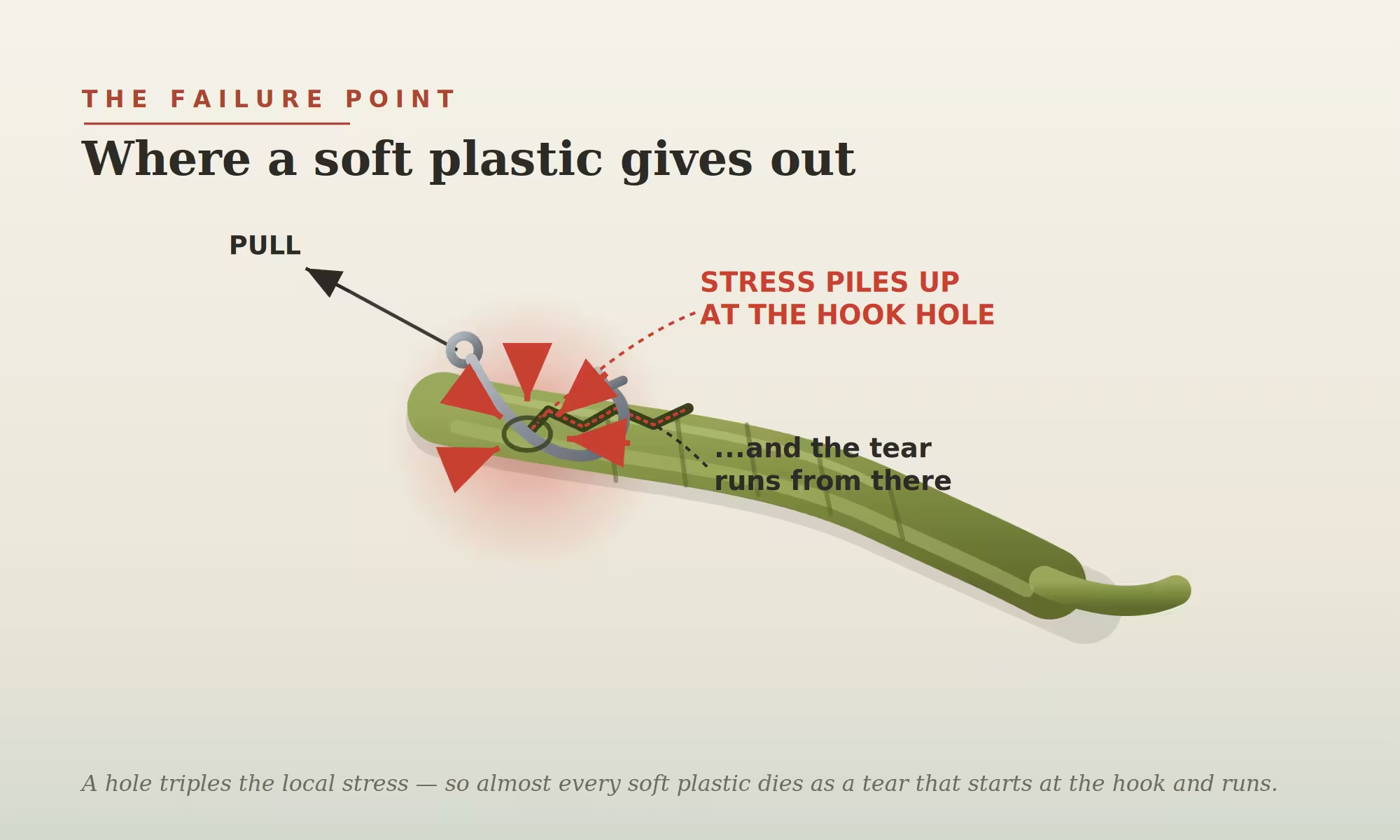
Almost every time soft plastic baits tear, the damage starts at the hook hole and spreads through the body of the lure. You’ve seen it a hundred times. A great-feeling bait catches one fish, maybe two, and then it’s hanging off the hook in shreds. It didn’t wear out evenly. It didn’t dissolve. It tore — and almost always from the same spot. Understanding why is the difference between a bait that’s a one-fish throwaway and one that lands a dozen, To understand why soft plastic baits tear, you have to look at what happens around the hook hole during a cast, hookset, and fight. and it comes down to a single material property most anglers have never heard of tear strength.
This is the property that decides whether your bait survives the hookset and the fight. It is not the same thing as how “strong” the plastic feels and confusing those two is the most common mistake in thinking about bait durability. Below we’ll break down what’s actually happening when a bait rips — in plain terms — then how you can test your own plastic at the bench, and finally exactly what controls it at the pour pot.
Tear Strength Is Not the Same as “Strong”
Three different words get jammed together when people talk about tough plastic: hardness, tensile strength, and tear strength. They’re three different things, and only one of them is what’s failing when your bait rips.
Hardness is how stiff the plastic feels when you press it. Tensile strength is how hard you can pull the whole bait apart end-to-end — stretching it evenly until it snaps. Tear strength is something else entirely: it’s how well the plastic resists a cut or nick spreading. That’s the one that matters, because a bait almost never fails by being stretched evenly apart. It fails because something put a hole in it — a hook — and that hole became the starting line for a rip.
Here’s the part that trips people up: these don’t track together. A bait can feel firm in your hand (decent hardness) and still tear like wet paper. Hardness tells you nothing about tear resistance — they’re unrelated properties. So “this plastic feels tough” is not the same as “this plastic won’t tear,” and a lot of disappointing baits live in exactly that gap.
Why Soft Plastic Baits Tear at the Hook Hole
To see why baits tear where they do, you have to understand one idea from engineering called stress concentration. It sounds technical; it’s actually simple. The reason soft plastic baits tear so predictably is that stress concentration turns a small hook hole into the most heavily loaded part of the lure.
When you pull on a solid, intact piece of plastic, the force spreads out evenly across the whole thing — every part shares the load. But the instant there’s a hole, a nick, or a cut, that even sharing stops. The force can’t pass through the empty hole, so it crowds around the edge of the hole instead — and piles up there. At the rim of a simple round hole, the local stress is roughly three times higher than the force you’re actually applying.
Make that concrete. Say you set the hook and put about two pounds of pull on the line. Spread evenly, two pounds is nothing to the plastic. But it isn’t spread evenly — it’s funneled to the edge of the hook hole, where that roughly-3× multiplier turns it into something like six pounds of concentrated stress at one tiny spot. The rest of the bait feels two; the rim of the hole feels six. That’s why the hole is where it lets go, even though the plastic everywhere else is perfectly sound. The plastic didn’t get weak — the hole put a three-times stress multiplier on one specific point, and that point lost.
And once a tear starts, it gets worse on its own. As the tiny tear opens, the stress re-crowds at the new tip of the tear, which drives it forward, which moves the tip again, which drives it forward again. The bait unzips. In fact, this is how rubbery materials almost always fail — not by pulling apart uniformly, but by a flaw reaching a critical point and a crack ripping across from there. That runaway is why a bait can be totally fine one cast and split the next: the tear didn’t gradually wear in, it reached the hole and then ran.
Two Different Ways a Bait Tears
Here’s a distinction almost nobody makes, and it changes how you fix the problem. There are two completely different tearing failures, and they have different causes.
The one-shot overload tear. A single event — a hard hookset, a big fish, a hard hookset into a rock — puts enough force at the hook hole to rip the bait right then. This is the dramatic one: fish on, fish off, bait destroyed. It’s governed by raw tear strength: did the plastic have enough resistance to survive that one big spike of force.
The fatigue tear. This one is sneakier and far more common than people realize. Many anglers assume soft plastic baits tear from a single fish, when the damage often begins dozens of casts earlier as microscopic cracks slowly grow. The bait isn’t killed by one big force — it’s killed by the same modest force repeated over and over. Every cast, every twitch, every head shake, every fish flexes the plastic a little at the same stressed spot. Each flex is nowhere near enough to tear it on its own, but each one nudges a microscopic crack forward a hair. Cast after cast, fish after fish, that crack grows until one ordinary hookset — no bigger than the hundred before it — is the one it finally lets go on. That’s fatigue: failure by accumulation, not by a single overload.
The useful idea buried in here is that there’s a kind of threshold of effort. Below a certain stress level, those repeated flexes basically don’t grow the crack at all and the bait lasts a very long time. Above it, every single cycle nibbles the crack forward and the bait is on a countdown. Good design and good pouring are about keeping the stress at that hook hole below the threshold where repetition starts eating the bait alive.
One more piece, and it’s a real one: heat makes both kinds of tearing worse. Soft plastic is a rubbery material, and rubbery materials generate a little heat internally every time they flex — and they’re poor at shedding that heat. So a bait worked hard, fast, and repeatedly warms up slightly at its stress points, and a warmer soft plastic tears more easily than a cool one. Stack that with a hot summer day or a bait that’s been baking in a sun-hit tackle tray, and you’ve got plastic that’s primed to tear at forces it would have shrugged off cold. If your baits seem to fall apart faster in July than in March, that’s not your imagination.
How the Pros Measure It (and Why You Don’t Have To)
Worth knowing, because it proves tear is a real, separate, measurable property — not a vague notion of “toughness.” The industry standard for rubbery materials is ASTM D624. A sample is deliberately nicked, then pulled so the tear runs through that nick, and a machine records the force needed to drive the tear through. The result is reported as force per unit thickness, and the common sample shape is “Die C” — which is why a real spec sheet lists something like “tear strength, ASTM D624 Die C.” The point for you: this test is deliberately separate from the tensile-strength test, because the industry knows resisting a tear and resisting a straight pull are two different abilities.
You don’t own that machine. But you can run garage versions that tell you what you actually need to know.
How to Test Tear Strength in Your Garage
You can’t get a number in kN/m at the bench, but you don’t need one. What you need is comparison — is this batch tougher than that batch? Did dropping the salt help? Did a hotter cure help? For that, a controlled home test beats any spec sheet, because it’s testing your plastic, your cure, your mold.
The single rule that makes garage testing actually mean something: change one thing at a time, and keep everything else identical. Same mold, same color, same thickness, same hook, same spot, same day. If you change the salt and the cure time and the resin at once, the test tells you nothing. Change only the salt, test side by side against an otherwise-identical control, and now you’ve learned something real.
Here are three tests, from quickest to most honest:
1. The hook-pull tear test (the core one). Push a hook through the bait at the exact spot it’ll be rigged, then pull the hook straight out through the plastic and watch what happens. A tough plastic resists, stretches, and the hook drags out leaving a small hole; a weak one rips open with almost no resistance. Do it on two baits side by side — your control and your changed batch — using the same hook through the same spot, and you’ll feel and see the difference immediately. This is exactly how the difference between plastics gets judged in the real world, and it directly mimics the failure you care about.
2. The hang-weight test (the repeatable one). This turns “feels tougher” into something closer to a number. Push the hook through the same spot on each bait, hang the bait from the hook (or hang a small container off the bait), and add weight — washers, fishing weights, water poured slowly into the container — until the bait tears through. Whatever weight it took is your score. Same hook, same hole location, same bait thickness every time. Now “Batch A tore at 12 ounces, Batch B with less salt held to 19 ounces” is a real, repeatable result you can write down and trust.
3. The stretch test (quick and dirty). Grab each end and pull until it breaks, noting how far it stretches and how hard it fights. This leans more on tensile than tear, but it’s a fast way to feel gross differences between batches and to spot a badly undercooked pour (which will feel weak and break short). Use it as a screen, then confirm with the hook-pull or hang-weight test.
4. The notch test (mirror the real lab test). Want to test pure tear resistance the way the ASTM machine does? Make a small, identical cut in the edge of each bait with a razor — same depth, same place on every sample — then pull the two sides apart and feel how easily that nick runs. This isolates tear from everything else: you’ve pre-made the flaw, so all you’re measuring is how hard the plastic fights the crack spreading. Tougher plastic makes you work to keep the cut moving; weak plastic zips open from the nick with almost no effort. It’s the closest a garage gets to a real Die-C tear test, and it’s brutal at exposing a batch that feels fine in the hand but has no crack resistance underneath.
5. The only test that fully counts: fish it. Pour a small batch, rig it, and count fish per bait against your usual plastic. Bench tests get you 90% of the way and let you fail cheap; the water settles it. Small batches are the whole game here — test a handful before you pour a hundred.
Keep a cheap notebook. “March 3 — cut salt from 8% to 4%, hang-weight up from 10 oz to 17 oz, action still good.” Three lines like that are worth more than any forum argument, because they’re about your exact setup.
What Actually Controls Tear Strength at the Pour Pot
Now the levers you can pull — and with the mechanism in hand, each one makes sense.
Resin and plastic choice — the biggest lever. Tear resistance lives in the polymer network: the long, tangled molecular chains gripping each other are what a spreading tear has to rip through, and longer, more-entangled chains resist that better. This is why not all “soft” plastics are weak — some soft formulas are built to be genuinely tear-resistant because the resin system, not just the softness, is doing the work. Blending a small amount of a stretchy elastomer into PVC is one well-known way makers boost tear resistance without simply making the bait stiffer.
Fusion — cook it right or it tears. This is the lever garage pourers control most directly and underrate most. If the plastic isn’t fully fused — not heated hot enough or held long enough — the polymer network never fully formed, and an undercooked bait tears far more easily. A bait that rips suspiciously easily is often not a bad formula; it’s an undercooked one. Your stretch test will catch this fast: undercooked plastic feels weak and breaks short. (If you want the full why-behind-the-heat, that’s its own deep topic in the fusion section of the plastisol guide.)
Salt — every grain is a built-in flaw. Salt is how you add weight and sink rate, but it costs you tear strength, and stress concentration explains why. Each salt crystal is a hard little chunk sitting in soft plastic — and just like the hook hole, every hard inclusion is a stress concentrator, a built-in starting point for a tear. Load a bait heavy with salt and you’ve seeded it with thousands of tiny notches. It’ll sink great and tear early. (It gets worse over time, too, as the salt slowly leaches out and leaves voids behind.)
Bubbles, clumps, and contamination — silent tear-starters. Anything that isn’t smooth, fused plastic is a flaw where a tear can begin: trapped air bubbles from pouring too fast or skipping de-gassing, clumps of poorly mixed-in pigment, bits of contamination. A bait can have a flawless formula on paper and still tear early because one trapped bubble gave the crack a place to start. This is why mixing colorant in smoothly and getting the air out aren’t just cosmetic — a streak or a bubble is also a weak point and a tear waiting to happen.
Hooks and Rigging: You Control the Stress Concentrator
Here’s the empowering part: since tearing starts at the hook hole, how you hook the bait changes how soon it tears — and that’s free. Because soft plastic baits tear from a stress concentration point, small rigging changes can dramatically extend lure life.
Hole size matters. A thick-wire hook punches a bigger hole, and a bigger hole is a bigger stress concentrator. A thinner-wire hook of the same strength leaves a smaller wound and tears the bait less. There’s a balance — you still need a strong enough hook for the fish — but going needlessly heavy on wire diameter shortens bait life.
Spread the load. Anything that keeps the pull from landing all on one torn edge helps. Bait keepers, screw-lock hook collars, and keeper barbs spread the force over more plastic instead of concentrating it at a single hole rim. Threading the hook so it exits through a thicker section, rather than a thin edge, puts the stress where there’s more material to resist it.
Mend before it runs. Lure glue — the “mend it” type made for soft plastics — genuinely extends a bait’s life by fusing a starting tear closed before it can propagate. Catch a small tear early, bond it, and you’ve reset the countdown. (Regular super glue works in a pinch but is harsh and sticks to everything; the purpose-made stuff is friendlier.)
Diagnose Your Tear: Where It Ripped Tells You Why
The location and look of a tear is a clue to the cause:
- Clean tear right at the hook hole — normal stress concentration. Expected. Reduce by thinner wire, load-spreading rigging, or a tougher formula.
- Tears everywhere, mushy and weak all over — undercooked (incomplete fusion) or over-salted. Cook hotter/longer, or cut the salt. The stretch test will tell you which.
- Tears along a line or seam, or at a streak — a flaw: trapped air, a contamination line, or poorly dispersed pigment. Fix your pouring and mixing, de-gas.
- Was greasy/stiff first, then tore — an old bait that lost plasticizer over time and got brittle. That’s an aging/storage issue, not a formula one.
- Falls apart faster in summer — heat lowering tear resistance plus heat speeding aging. Store cool and out of the sun.
The Trade-Off You Can’t Escape
Here’s the honest catch. The very things that make a bait soft, lively, and full of action — more plasticizer, less resin, salt for the fall — are often the same things that lower tear strength. The adjustment that adds action subtracts durability. You can’t simply max out both; every bait is a chosen balance, and the right balance depends entirely on the technique. A finesse drop-shot worm is tuned soft and accepts being a few-fish bait; a flipping creature meant to punch cover and take repeated bites is tuned tougher and gives up a little action for it. Which way to lean for which style of fishing is its own subject, and we cover it in depth in Plastic Softness vs Durability: The Trade-Off Nobody Explains.
Making a Bait Tougher Without Killing It
Putting it together, if your baits tear too soon, you’ve got real levers — and most don’t require making the bait stiffer:
- Make sure it’s fully fused. The cheapest fix. Get your heat and time right before blaming the formula, and let the stretch test confirm it.
- Ease off the salt. If you don’t need maximum sink rate, less salt means fewer built-in flaws and a tougher bait. Use only as much as the presentation actually needs.
- Get the air out. De-gas, pour clean, mix pigment smoothly. Fewer internal flaws, fewer tear-starters.
- Consider an elastomer blend or a tougher resin. When a style demands both softness and durability, the answer is usually in the polymer system, not in cranking up stiffness.
- Rig smarter. Thinner-wire hooks, load-spreading keepers, and lure glue all reduce or repair the stress at the hook hole.
- Store cool. Heat lowers tear strength now and ages the plastic for later.
- Test it. Change one thing, run the hang-weight test against a control, write down the result. Let your own bench data decide.
Frequently Asked Questions About Why Soft Plastic Baits Tear
Why do soft plastic baits usually tear at the hook hole?
Most soft plastic baits tear at the hook hole because the hole creates a stress concentration point. During casts, hooksets, and fights, force becomes concentrated around the edge of the hook hole, making it the most likely place for a tear to begin.
What is tear strength in soft plastics?
Tear strength is a material’s ability to resist a cut, nick, or hole from spreading into a larger tear. It is different from hardness and tensile strength. A bait can feel firm and still tear easily if its tear strength is poor.
Does salt make soft plastic baits tear more easily?
Yes. Salt particles act as tiny stress concentrators inside the bait. Higher salt loads can improve sink rate, but they also create more potential starting points for tears, reducing overall durability.
How can I make my soft plastic baits last longer?
Improving fusion during heating, reducing unnecessary salt, eliminating air bubbles, using thinner-wire hooks, adding bait keepers, and repairing small tears with soft-plastic lure glue can all increase bait life and improve tear resistance.
Can I test tear strength at home?
Yes. Simple methods such as hook-pull tests, hang-weight tests, stretch tests, and notch tests can help compare batches and identify changes that improve durability. The key is changing only one variable at a time and testing against a control sample.
Does hot weather affect soft plastic durability?
Yes. Heat lowers tear resistance and accelerates plastic aging. Soft plastic baits often tear more easily during hot summer conditions and when stored in direct sunlight or excessive heat.
The Bottom Line
Tensile strength tells you how hard you can pull a bait before it snaps. Understanding why soft plastic baits tear starts with understanding the difference between tensile strength and tear strength. Tear strength tells you whether it survives a hook and a fish — and for an angler, that’s almost always the number that matters. It fails at the hook hole because a hole roughly triples the local stress, and a tear, once started, runs on its own. It can fail in one big overload or slowly fatigue over many fish, and heat makes both worse. You build tear resistance in with the right resin, a complete cure, restrained salt, and clean pouring — you can test the result on your own bench — and you spend that toughness back, deliberately, every time you choose more action.
The same plastic that tears is also the plastic that bends, kicks, and concentrates all that stress at its thinnest point — the hinge where a tail meets the body. Why a bait bends where it does, and why that hinge is both where the action comes from and where the tearing eventually wins, is the next piece of the story. [Coming next: how bending stress and geometry decide where a bait flexes — and where it finally fails.]
About Family Fishin
Family Fishin is a family-owned fishing tackle company dedicated to designing, testing, and producing high-quality fishing lures — inspired by generations of fishing tradition and driven by a passion for innovation. Every product is developed with one goal in mind: helping anglers spend more time doing what they love, catching fish and creating memories on the water.
Tags: #soft plastics #lure making #tear strength #bait durability #plastisol #DIY lures #pouring baits