Retrieve Speed for Trout Fishing: How It Changes Behavior
Retrieve speed for trout directly controls behavior — too fast or too slow leads to missed strikes, while the correct speed triggers commitment.
(And How to Adjust It for More Strikes)
Retrieve speed is one of the most important — and most misunderstood — variables in trout fishing. Most anglers focus on color, lure type, and location — but ignore the factor that often determines whether a trout commits or refuses: how fast the bait is moving.
Trout respond differently to speed depending on water temperature, pressure, visibility, and feeding behavior. Understanding how retrieve speed changes trout behavior allows you to adjust presentation instead of guessing.
This guide is part of a complete trout fishing system that explains how speed, fall rate, visibility, and material work together. → Start with the complete trout fishing system
Retrieve Speed for Trout Fishing: Why It Matters More Than Most Anglers Think
Trout do not strike randomly. They react based on how a bait moves relative to their energy level, their environment, and their feeding mode. If your retrieve speed is wrong: trout may follow without striking, trout may ignore the bait entirely, or trout may reject it at the last second. This is why speed often matters more than color.
The 3 Types of Trout Responses to Speed
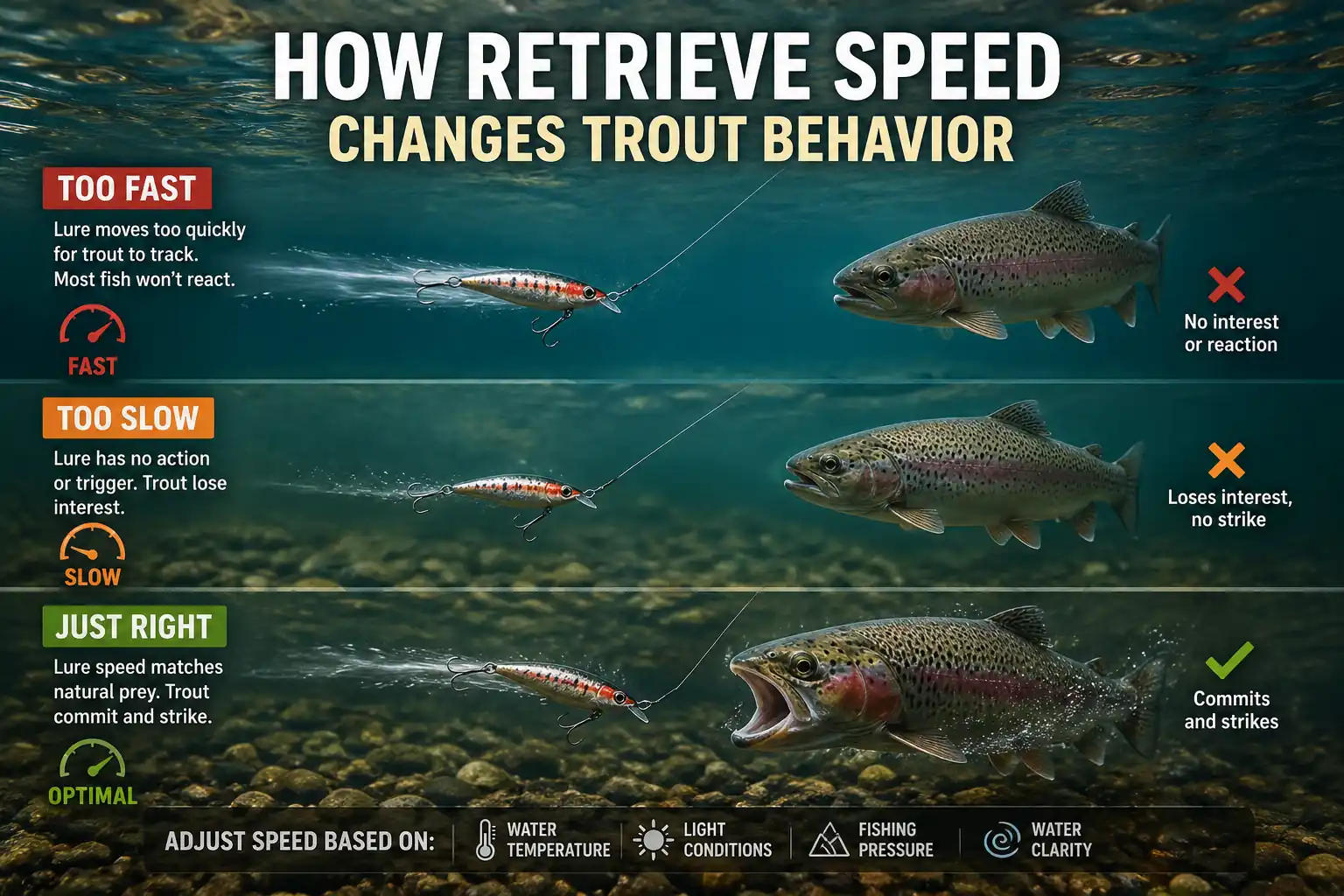
- 1. No Reaction (Too Fast or Too Slow): Too fast → trout cannot track it. Too slow → no trigger response. Common in cold water, pressured fish, or low visibility.
- 2. Follow Without Strike (Most Common Problem): Trout track the bait but do not commit. Speed is close but not correct, or the bait looks unnatural at that speed. This is the most important signal. → See: Why Trout Follow But Don’t Bite
- 3. Immediate Strike (Correct Speed): When speed matches conditions, trout react quickly with minimal hesitation and higher hookup rate.
How Water Temperature Changes Retrieve Speed
- Cold Water (Slow Speed Required): Trout conserve energy and movement is limited — aggressive retrieves fail. Best approach: slow retrieves, subtle movement, longer pauses. Marabou and soft plastics excel here because they move without speed.
- Moderate Temperature (Balanced Speed): Trout feed more consistently. Best approach: controlled steady movement with occasional speed changes.
- Warm Water (Faster Speed Can Work): Trout may react more aggressively. Best approach: slightly faster retrieve — but avoid erratic or unnatural motion.
How Fishing Pressure Changes Speed Preference
- High Pressure: Trout become cautious, inspect longer, reject unnatural movement. Best approach: slower retrieves, minimal action, natural drift where possible.
- Low Pressure: Trout are more aggressive and commit more easily. Best approach: slightly faster retrieve with more defined movement.
How Retrieve Speed Affects Strike Conversion
- Too Fast: Trout chase but don’t strike, bait exits strike zone too quickly.
- Too Slow: Trout lose interest, no reaction trigger.
- Correct Speed: Bait stays in strike window, movement appears natural, trout commit instead of following.
How to Find the Right Retrieve Speed
- Step 1 — Start Slower Than You Think: Most anglers fish too fast. Start slow and increase speed gradually.
- Step 2 — Watch Trout Behavior: No reaction → adjust speed. Follows → refine speed. Strikes → maintain.
- Step 3 — Adjust in Small Increments: Do not make large changes. Small adjustments produce better results.
- Step 4 — Match Speed to Conditions: Adjust based on temperature, water clarity, and fishing pressure.
Retrieve Speed vs Fall Rate (Important Relationship)
Speed and fall rate work together. Fast retrieve + fast fall = unnatural. Slow retrieve + controlled fall = natural. If your speed is correct but trout still won’t strike, the fall rate is likely wrong. → See: How to Choose Jig Head Weight for Trout
Why Soft Plastics and Marabou Respond Differently
- Soft Plastics: Require controlled speed to maintain action. Too fast = unnatural. Too slow = no movement.
- Marabou: Moves naturally with minimal input. Effective at slower speeds. Excels in cold or pressured conditions.
Common Mistakes with Retrieve Speed
- Retrieving too fast in cold water
- Never adjusting speed during a session
- Using the same speed in all conditions
- Overworking the bait
Frequently Asked Questions About Retrieve Speed for Trout
What’s the biggest mistake anglers make with retrieve speed?
Fishing too fast. Most anglers default to a pace that looks fine to them but is too fast for trout to track, especially in cold water or under fishing pressure. Start slower than feels natural, then speed up gradually until you get reaction.
How do I know if my retrieve is too fast or too slow?
Watch how trout respond. No reaction at all usually means your speed is wrong in either direction. Trout following without striking means you’re close — refine the speed in small increments rather than switching to a different lure.
Does water temperature really change the right retrieve speed?
Yes, significantly. In cold water, trout conserve energy and can’t chase an aggressive retrieve — slow, subtle movement with longer pauses works best. In warm water, trout can react more aggressively, so a slightly faster retrieve can work without looking unnatural.
How does fishing pressure affect retrieve speed?
Pressured trout get cautious and inspect bait longer before committing, so slower retrieves with minimal action and natural drift produce more strikes. In low-pressure water, trout commit more easily and a slightly faster, more defined retrieve often works better.
Is retrieve speed more important than fall rate?
They work together, not separately. A fast retrieve paired with a fast fall looks unnatural even if the speed alone seems right. If your retrieve speed is correct but trout still won’t strike, fall rate is the next thing to check.
Do marabou and soft plastics need different retrieve speeds?
Yes. Marabou moves naturally with very little input, so it stays effective at slower speeds — especially in cold or pressured conditions. Soft plastics need a controlled speed to maintain their action; too slow and they stop moving altogether, too fast and the action looks forced.
Summary
Retrieve speed controls how trout perceive your bait. Too fast: unnatural, low conversion. Too slow: no trigger. Correct speed: natural movement, higher strike rate. When you match speed to conditions, trout respond with confidence instead of hesitation.
To understand how retrieve speed fits into the full system, see the → complete trout fishing guide
Recommended Next Reads
- Why Trout Follow But Don’t Bite
- How to Choose Jig Head Weight for Trout
- How Water Clarity Changes Trout Vision
- When to Use Marabou vs Soft Plastics