Part 5 — Soft Plastic Scent Retention: Why Some Plastics Hold Scent Longer Than Others
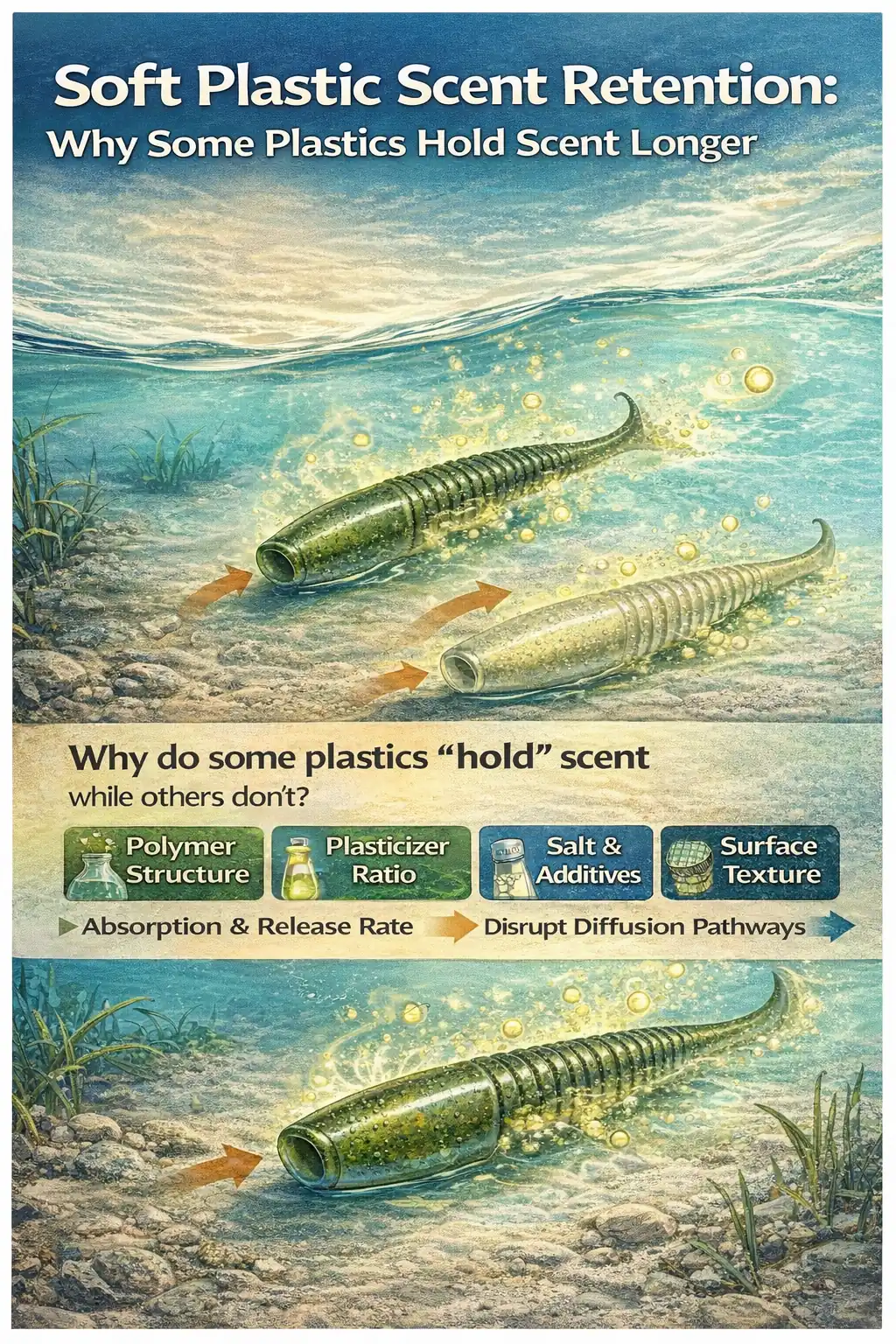
Soft plastic scent retention is controlled by material chemistry, not marketing — how a plastic absorbs and holds scent determines whether that scent trail lasts one cast or an entire session.
Soft Plastic Scent Retention: What Actually Holds Scent Longer
Executive Summary
Soft plastic scent retention depends on polymer structure, plasticizer content, and additive compatibility. Some compounds absorb and slowly release scent molecules. Others allow rapid surface evaporation. Scent effectiveness is controlled by material chemistry — not just how much scent is added.
How Soft Plastic Scent Retention Is Controlled by Material Chemistry
Soft plastic scent retention varies because different plastisol compounds interact with scent molecules differently. Polymer polarity, plasticizer ratio, additive loading, surface area, and salt content all affect how scent is absorbed and how quickly it diffuses back out. Two identical-looking baits can release scent at completely different rates. The difference is material absorption and diffusion.
How Soft Plastics Absorb Scent
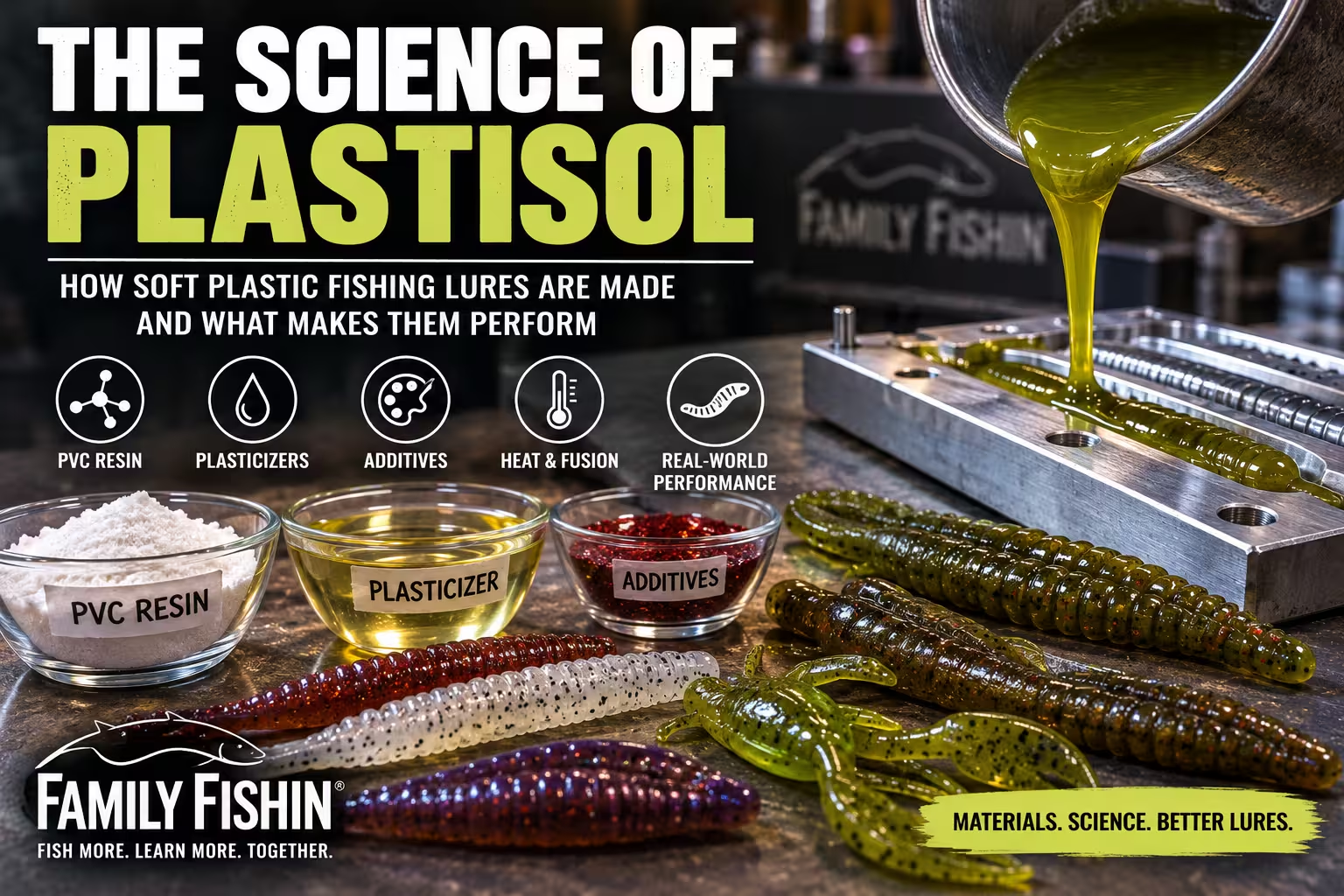
Most fishing scents are oil-based or solvent-based compounds. When applied to a soft plastic lure, scent can sit on the surface, diffuse slightly into the plasticizer phase, or penetrate deeper into the polymer network. Plasticized PVC contains mobile plasticizer molecules that create microscopic free volume within the material — allowing certain scent molecules to migrate inward. Higher plasticizer content often increases scent absorption capacity, but can also increase release speed.
Absorption vs Retention
Absorption = how much scent enters the material. Retention = how long it remains before evaporating or diffusing back out. A very soft compound may absorb more scent initially but release it faster due to higher molecular mobility. A firmer compound may absorb less but release it more slowly. Soft plastic scent retention is a diffusion balance problem.
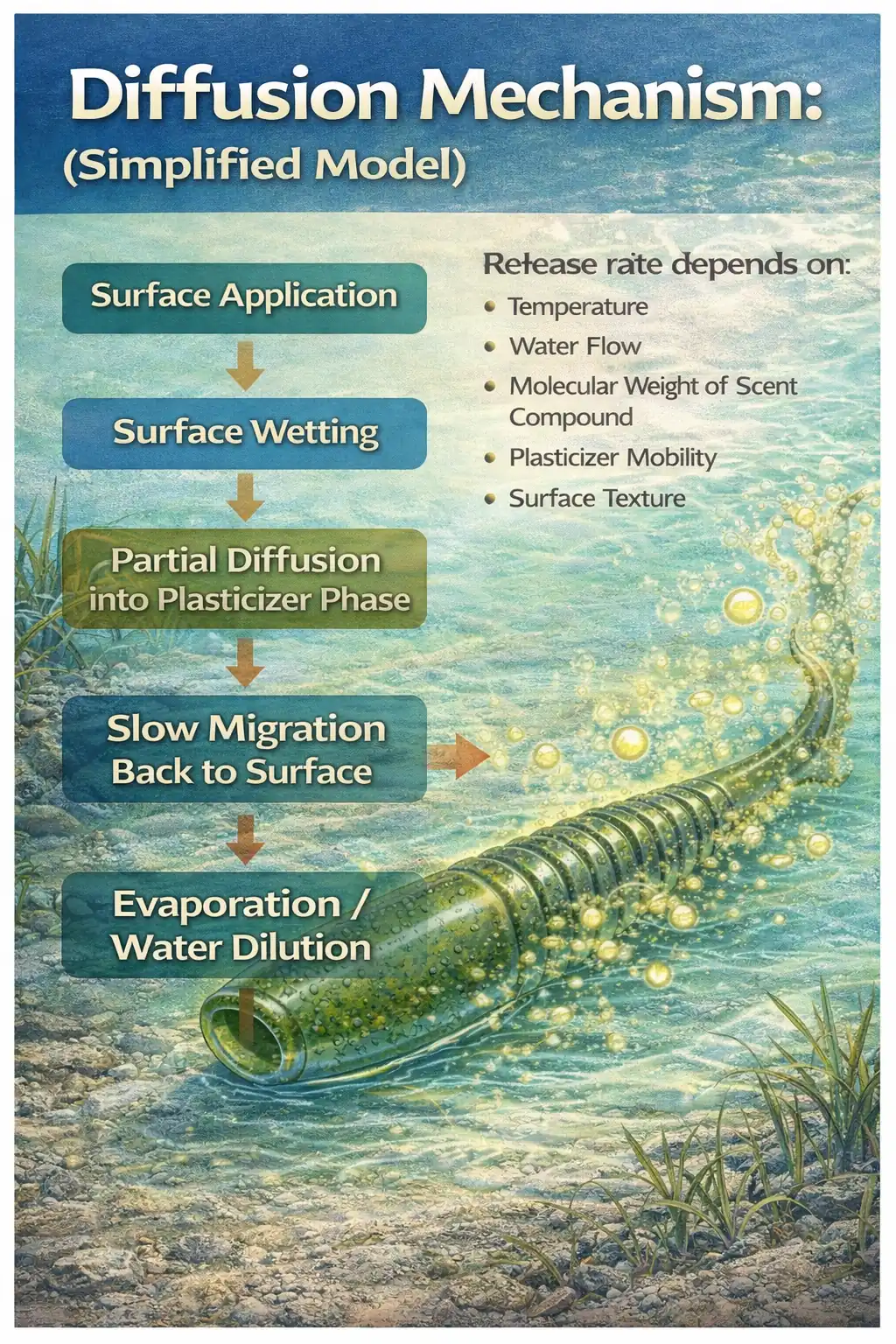
Release rate depends on: temperature, water flow, molecular weight of the scent compound, plasticizer mobility, and surface texture. Warmer water increases diffusion speed.
How Salt Affects Scent Retention
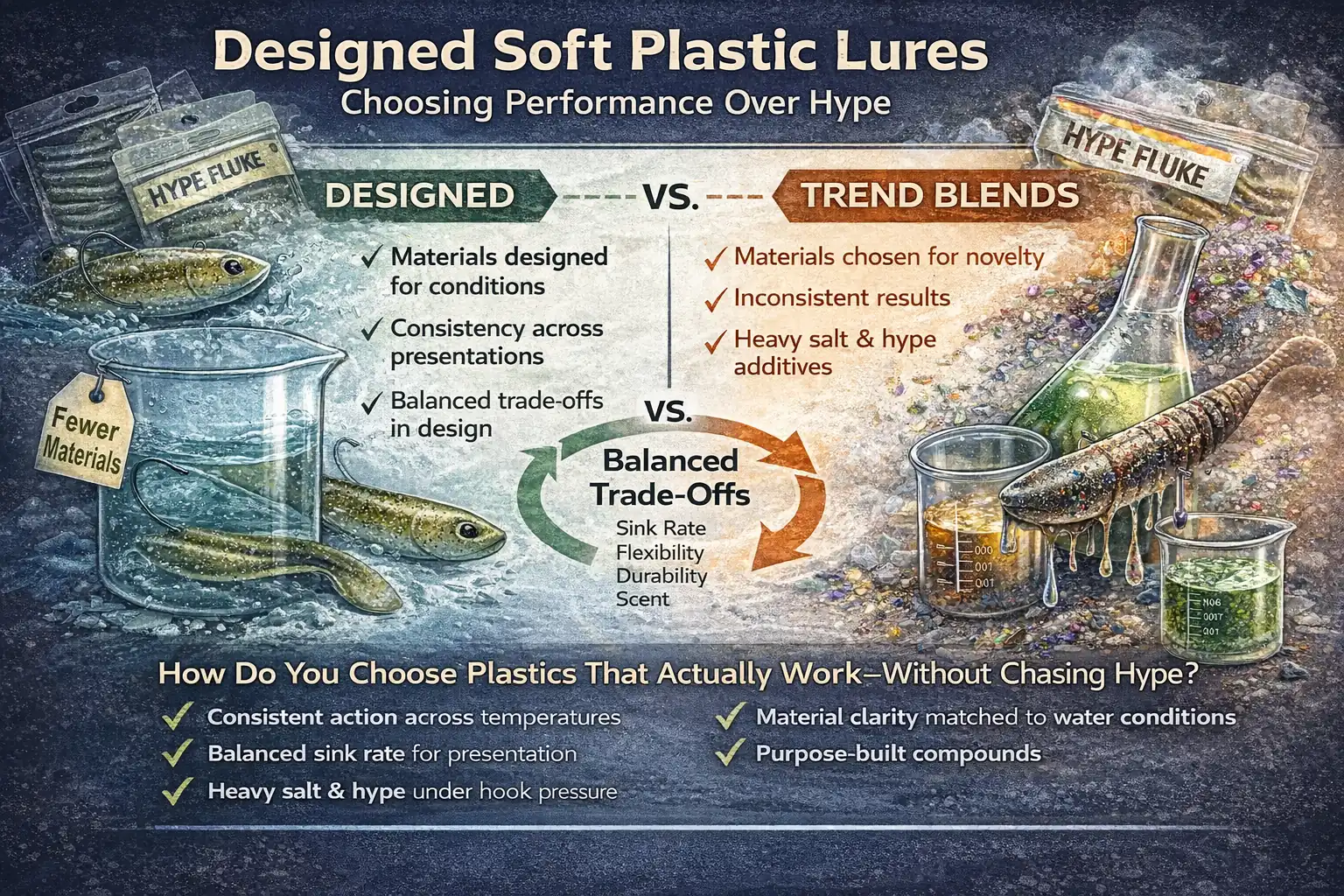
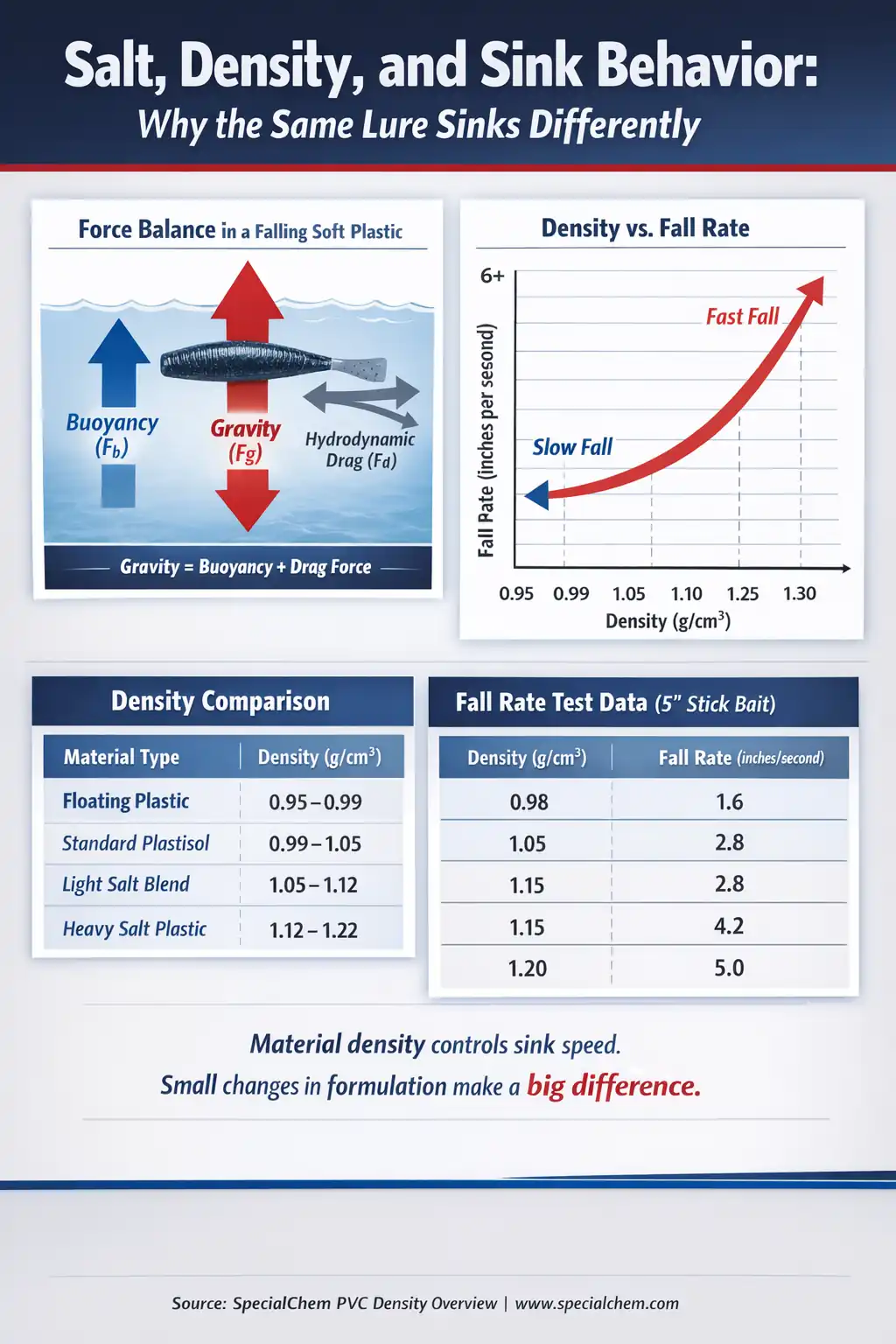
Salt changes two things: increases internal scattering and disrupts polymer continuity. Heavy salt loading can reduce uniform diffusion pathways, increase micro-voids, and accelerate scent release. High-salt stick baits often smell strong at first but lose intensity faster. Again, density and scent behavior are linked.
Measured Scent Retention Comparison
| Compound Type | Initial Absorption | 4-Hour Retention | 12-Hour Retention |
|---|---|---|---|
| High-plasticizer finesse blend | High | Moderate | Low |
| Balanced compound | Moderate | Moderate | Moderate |
| High-salt stick bait | Moderate | Low | Very Low |
| Firmer flipping blend | Low | Moderate | Moderate |
The strongest smell at hour zero does not always last the longest.
When Scent Actually Matters
- Clear Water / Finesse: Scent can increase hold time, reduce rejection, and matter during slow presentations
- Reaction Fishing: Scent is largely irrelevant — strike occurs before chemical detection
- Cold Water: Scent diffusion slows, retention time increases
- Heavy Current: Surface scent washes off quickly — material retention matters more
Scent is situational — not universal.
Surface Texture and Scent Holding
- Ribbed / high-surface-area baits: Trap scent externally, increase surface contact, release scent faster
- Smooth bodies: Absorb internally, release more gradually
External retention and internal retention behave differently.
Engineering Implications
Soft plastic scent retention is influenced at formulation stage by: plasticizer type, plasticizer percentage, salt loading, filler compatibility, and fusion quality. Over-fused plastisol reduces free volume. Under-fused plastisol may leak plasticizer and scent faster. Compound balance determines whether scent is briefly strong or sustainably present.
Frequently Asked Questions
Why do some soft plastics hold scent longer?
Because scent retention depends on polymer structure and plasticizer content. Some compounds allow deeper scent diffusion and slower release, while others lose scent quickly due to faster molecular mobility.
Does adding more scent improve performance?
Not necessarily. More surface scent may smell stronger initially but can evaporate or wash off quickly. Material absorption controls long-term retention.
Does salt reduce scent retention?
Heavy salt loading can disrupt polymer continuity and accelerate scent release, reducing long-term retention compared to balanced compounds.
When does scent matter most?
Scent is most influential in slow, finesse presentations where fish inspect and hold a bait longer.
The Engineering Conclusion
Soft plastic scent retention is not about how much scent is added. It is about how the compound interacts with that scent at the molecular level. Absorption, diffusion, and release rate determine whether a lure smells strong for minutes or hours. Scent performance is a materials decision.
Next: Part 6 — Soft Plastic Cold Water Performance: Why Baits Go Dead in Cold Water
More Questions About Soft Plastic Scent Retention
Can I add scent to any soft plastic and expect it to last?
Not equally well. A plastic’s material chemistry determines how much scent it can absorb and hold, so applying scent to a bait with poor retention properties means reapplying constantly. Choosing a plastic engineered for scent retention matters more than how much scent you apply at once.
Does scent retention matter in every fishing situation?
It matters most in the first 24 to 36 hours after stocking, when trout are feeding primarily by smell, and in murky water where visibility is limited. In clear water with established, visually-feeding fish, scent retention becomes less critical than presentation and profile.