Part 4 — How to Dye Marabou Feathers: Color Formulation & Custom Recipes
Dye marabou feathers color formulation is engineering, not guesswork — precise blends, forage-matched colors, and repeatable recipes instead of eyeballing dye weights.
Dye Marabou Feathers Color Formulation: Building Repeatable Recipes
Color is not random. It is engineered.
When learning how to dye marabou feathers at a professional level, color formulation must be controlled with the same precision as pH and temperature. This section moves beyond “red,” “chartreuse,” or “olive” and into measurable blending, repeatable recipes, and forage-based design. This is where chemistry becomes visual strategy.
1. How to Build a Color Formula When Learning How to Dye Marabou Feathers
Professional color building follows three rules: measure every pigment by weight, maintain fixed water volume, adjust saturation by grams — not by time.
Primary Blending Method
Most marabou color systems are built from three base families: yellow base, red base, blue base. By combining these in measured ratios, nearly any forage tone can be produced.
Example Base Blend (Neutral Olive Foundation)
- 1-gallon distilled water
- 3g yellow acid dye + 1g blue acid dye + 0.2g black acid dye
- Target: pH 4.3 | 175°F | 30 minutes
- Produces natural olive base suitable for perch or juvenile baitfish tones
Saturation Adjustments
Never increase dwell time to deepen color. Instead: increase total dye grams by 10–20% for deeper tone, reduce by 10–20% for lighter tone. Example: if medium olive = 4g total dye → deep olive = 4.8g total dye. Time remains constant. This preserves softness.
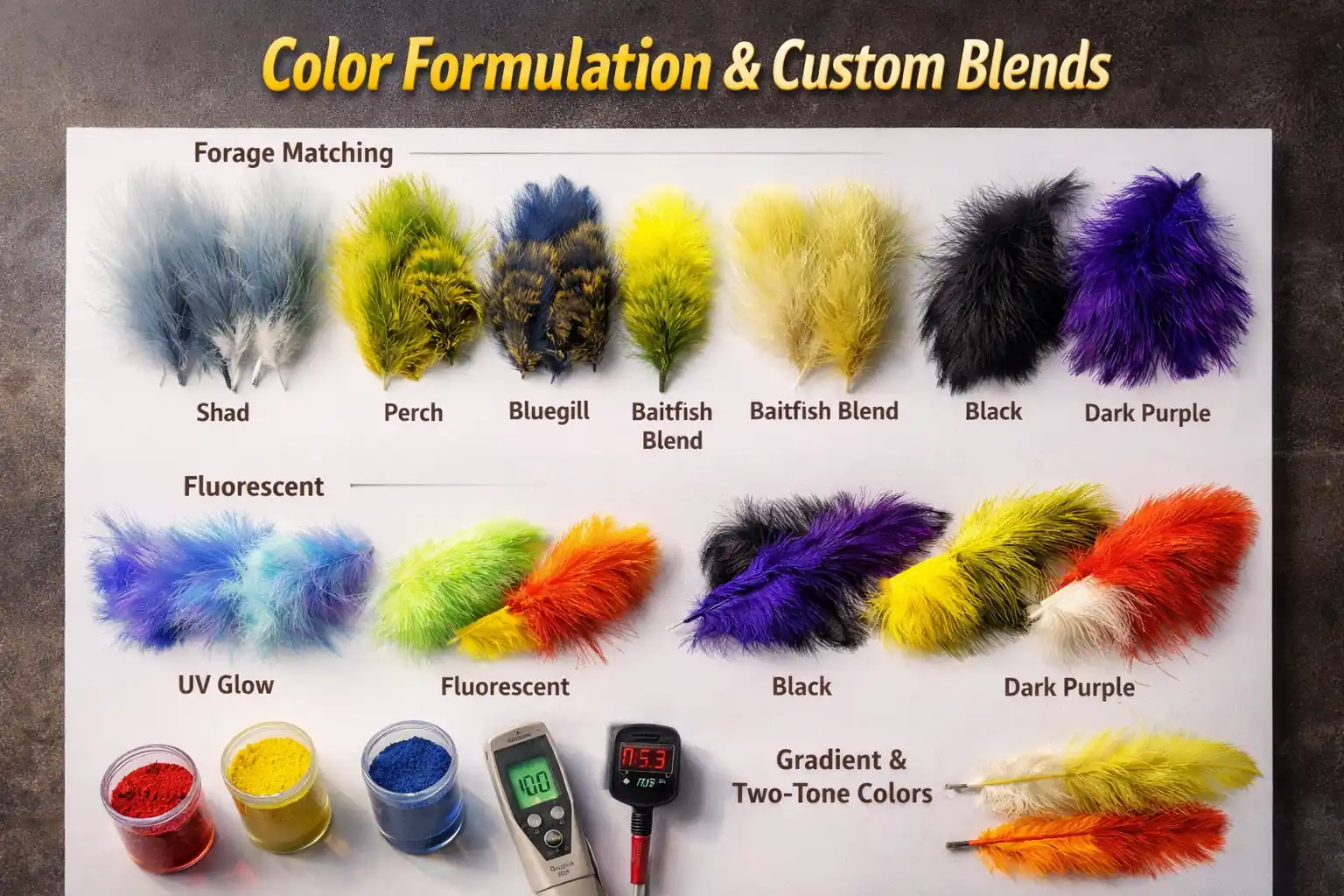
2. Matching Forage Species
Shad Blend (Silver-Gray Tone)
- 2g black + 1g blue + 0.5g pearl gray + 0.2g yellow
- Produces cool silver-gray base for threadfin or gizzard shad
Perch Blend (Yellow-Green Body)
- 4g yellow + 0.8g blue + 0.3g black
- Optional: light overdye with 0.2g chartreuse for brightness
- Produces warm perch tone without neon artificial look
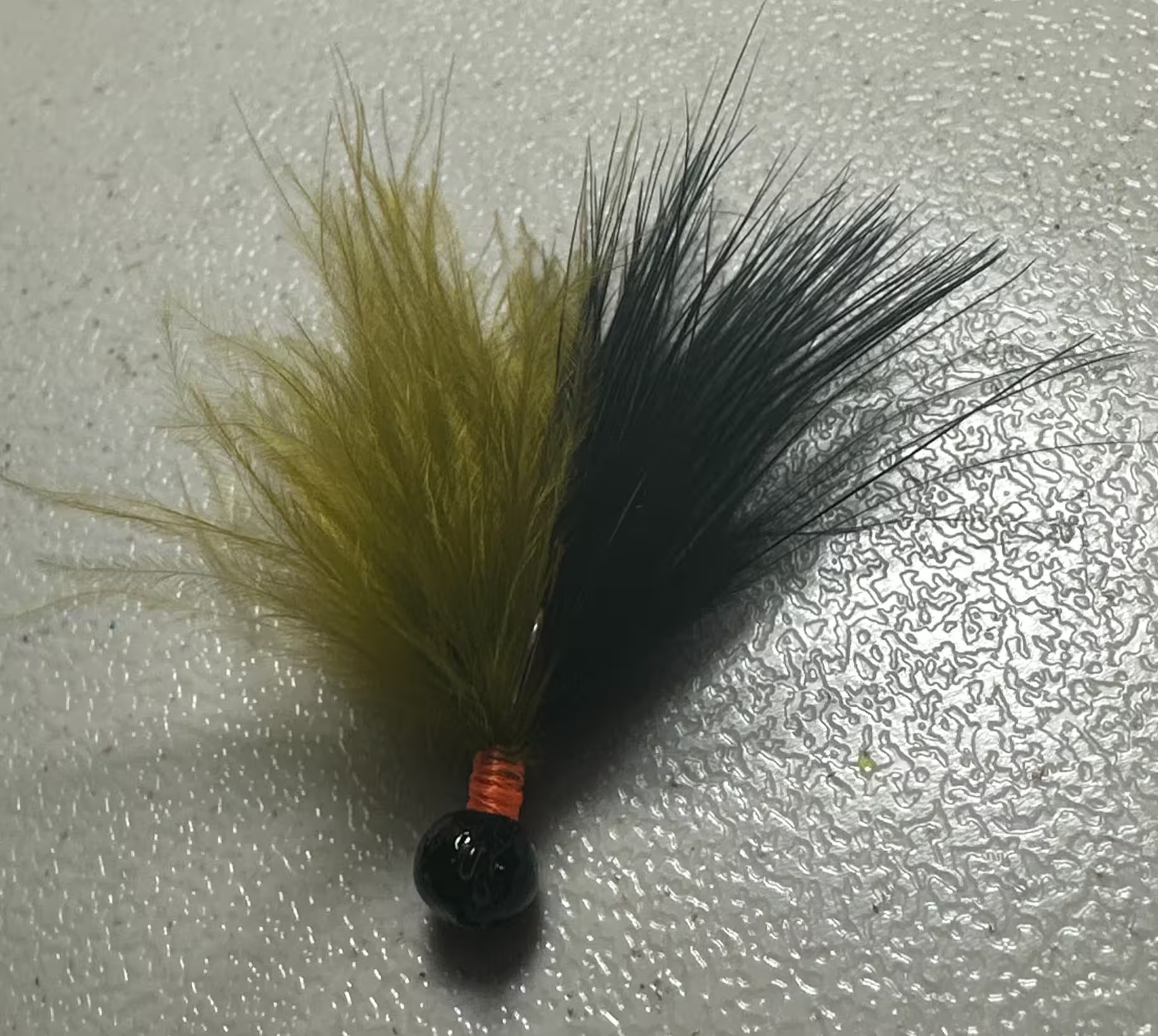
Bluegill Blend (Muted Olive-Brown)
- 3g yellow + 1g blue + 0.5g red + 0.3g black
- Red warms the olive to a bluegill bronze tone
Neutral Baitfish Blend
- 2g yellow + 0.8g blue + 0.4g red + 0.3g black
- Balanced mix for mixed forage environments
3. UV Enhancement Techniques
- Additive Method: Add 0.2–0.5g UV-reactive powder per gallon to existing formula. Do not exceed 10% of total pigment weight — excess UV reduces natural tone.
- Top-Dip Method: After full fixation, prepare dilute UV solution (1g per gallon), dip tips only for 60–90 seconds, rinse lightly. Creates subtle UV highlight without oversaturation.
4. Fluorescent vs Standard Pigments
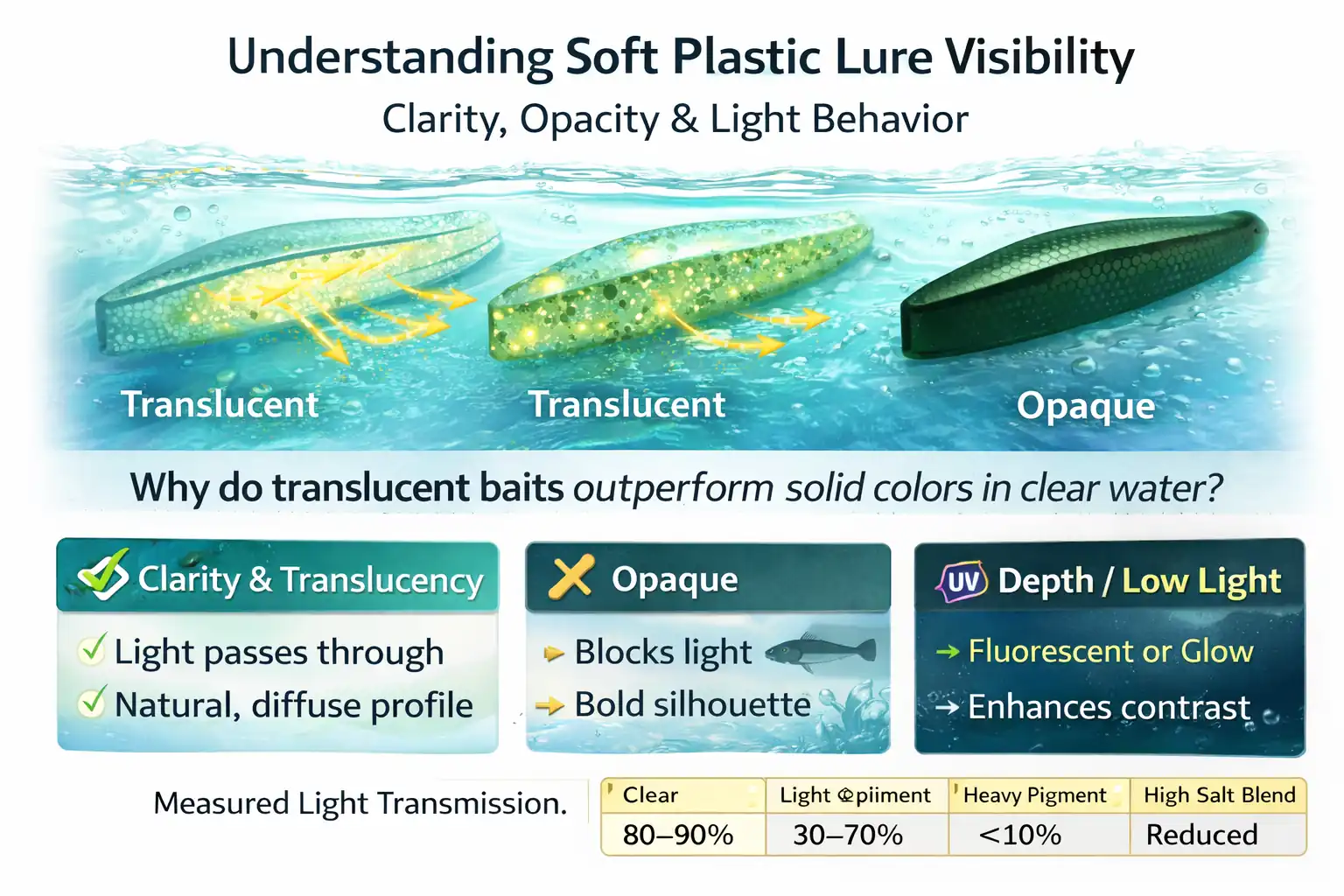
- Fluorescent: Higher light intensity, brighter in stained water, fades faster under UV. Use for visibility.
- Standard: More natural appearance, greater durability, better in clear water. Use for realism.
5. Achieving Deep Blacks & Dark Purples
- Deep Black: 5–7g black per gallon, slight acid increase (maintain pH 4.2), stable 175°F for full 30 minutes
- Dark Purple: 4g red + 1g blue + 0.5g black. Too much blue shifts toward indigo. Deep tones require precise agitation to prevent surface darkening.
6. Two-Tone & Overdye Techniques
- Tip-Dip: Dye base fully, rinse and partially dry, dip tips 1–2 inches into secondary bath, bond 5–10 minutes only.
- Full Overdye: Dye light base first, apply darker overlay at 50% concentration. Example: base 3g yellow → overlay 1g olive blend. Creates depth without heaviness.
7. Gradient Marabou Method
- Submerge feather fully for 10 minutes
- Raise feather gradually over next 10 minutes, keeping lower half submerged
- Fix for total 30 minutes
- Result: deep base tone fading toward natural tip
- Agitation must remain gentle to prevent hard lines
Measured Color Recipe Reference Table
All recipes per 1 gallon distilled water | pH 4.2–4.5 | 170–180°F | 30-minute bonding time
| Color Profile | Yellow | Red | Blue | Black | Total Grams |
|---|---|---|---|---|---|
| Olive | 3g | — | 1g | 0.2g | 4.2g |
| Perch | 4g | — | 0.8g | 0.3g | 5.1g |
| Bluegill | 3g | 0.5g | 1g | 0.3g | 4.8g |
| Shad | — | — | 1g | 2g | 3g |
| Deep Black | — | — | — | 6g | 6g |
| Dark Purple | — | 4g | 1g | 0.5g | 5.5g |
Why Color Formulation Matters When Learning How to Dye Marabou Feathers
Color depth, tone balance, and pigment control directly affect visibility, realism, water penetration, and fish response. Random mixing produces unpredictable results. Measured formulation produces repeatable performance.
If you have not reviewed the execution system behind these formulas, refer back to Part 3 — How to Dye Marabou Feathers: Step-By-Step Professional Dyeing Process. Understanding process control ensures color recipes remain consistent batch after batch.
Next — Part 5: Advanced Techniques. In Part 5, we move beyond standard formulation and into advanced control methods used to refine performance and realism, including layered overdyes, controlled bleaching, and specialty effects. Advanced dyeing is not about adding more pigment — it is about controlling how and where color bonds within the fiber.
Frequently Asked Questions About Marabou Color Formulation
Why use a measured color formula instead of eyeballing dye amounts?
A measured formula is what makes a color reproducible batch after batch. Eyeballing dye weights might get close once, but without exact ratios logged, you can’t reliably recreate that same shade the next time you dye a batch.
How do I match a dye blend to a specific forage species?
Start from a known base blend — shad, perch, bluegill, or a neutral baitfish tone — and adjust saturation from there rather than building a new formula from scratch. Matching real forage coloring, not just picking an appealing color, is what makes the imitation convincing.
What’s the difference between fluorescent and standard pigments?
Fluorescent pigments convert UV light into visible light, making them appear brighter than standard pigments even in identical lighting conditions. Standard pigments only reflect the light that hits them, so they read as more natural and less attention-grabbing in clear water.
How do I achieve deep blacks or dark purples on marabou?
Deep, dark tones generally need higher dye concentration and longer bond time than lighter colors, since the fiber has to absorb significantly more pigment to reach full saturation. Rushing the process on dark colors is one of the most common causes of a muddy, uneven result instead of a true deep tone.