Part 1 — How to Dye Marabou Feathers: Material Control and Performance Preservation
Dye marabou feathers material control is where consistent results actually start — grading, stem thickness, and pre-dye preparation decide whether your color and movement turn out right before you ever mix a dye bath.
Dye Marabou Feathers Material Control: Why It Comes First
How to Dye Marabou Feathers Without Losing Natural Movement
If you want consistent color and preserved movement, learning how to dye marabou feathers correctly is essential. Proper grading, temperature control, pH balance, and saturation management determine whether a feather retains its natural pulsing action or becomes stiff and lifeless.
Scope
This guide defines the grading, preparation, temperature, pH, and saturation controls required to properly dye marabou feathers without sacrificing natural movement. Applies to: fly tying, hair jigs, inline spinners, and feather-based lure production. This is written for both serious builders and serious fishermen.
1. Why Material Control Matters When Learning How to Dye Marabou Feathers
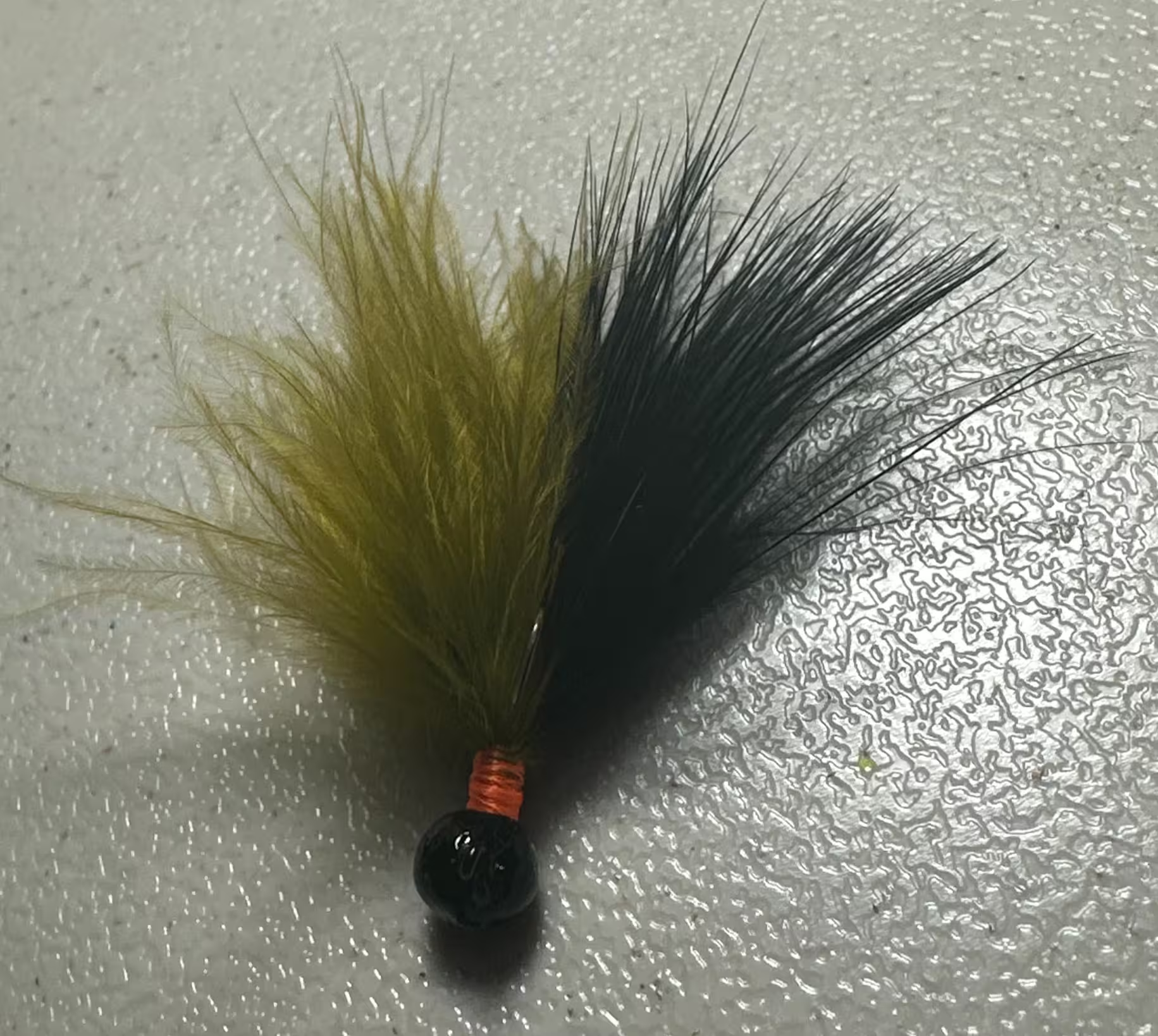
Learning how to dye marabou feathers correctly is not about making color brighter. It is about controlling a natural protein fiber so softness, separation, and movement are preserved. Marabou is a keratin-based protein fiber that absorbs dye internally rather than on the surface. Because of that structure, it reacts quickly to heat, pH shifts, and saturation levels. When control is lost, fibers stiffen, clump, and lose the subtle breathing action that makes marabou jigs and flies effective — especially in cold water, clear water, current, and slow presentations.
2. Understanding Fiber Behavior
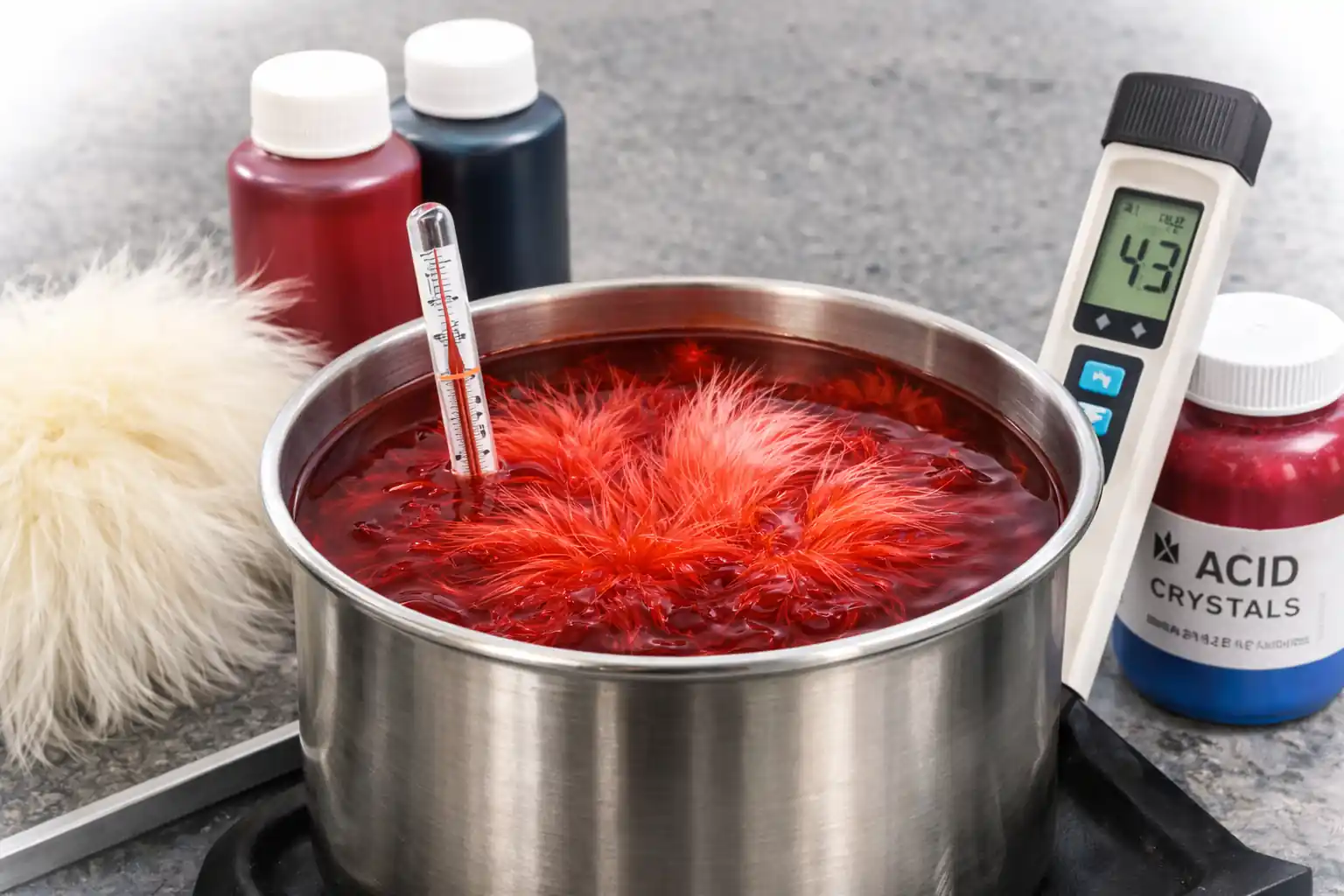
Acid dyes bond to marabou through ionic bonding under controlled heat and acidity. Three variables control that bond: temperature, pH, and exposure time. If heat exceeds safe limits (above approximately 185°F / 85°C), keratin begins to denature. On the water, that shows up as stiff fibers, reduced breathing action, less natural collapse on pause, and flatter presentation in current. Boiling marabou sacrifices movement for brightness. That tradeoff is not worth it.
3. Marabou Grading Standard
Not all marabou behaves the same in a dye bath — or in the water. Feathers should be graded before dyeing. Do not mix structural grades in the same batch.
Grade A — Blood Quill (High Movement)
- Long fibers (typically 3–5 inches), thin flexible stem, maximum breathing action
- Rapid dye strike, easy to oversaturate, sensitive to temperature spikes
- On the water: Best for finesse jigs, cold water, pressured fish, maximum pulsing on slow retrieve
Grade B — Woolly Bugger (Medium Density)
- Medium fiber length (2–4 inches), moderate stem thickness, holds fuller profile
- Slower absorption, more tolerant of controlled heat
- On the water: Better for bass jigs, maintains silhouette in stained water, holds shape during faster retrieves
Grade C — Mixed / Strung
Mixed stem thickness, mixed density, irregular taper. Sort by stem thickness before dyeing. If thin and thick stems are dyed together: thin stems oversaturate, thick stems under-develop — inconsistency shows up immediately on the water.
4. Stem Thickness and Dye Migration
Dye travels along the stem through capillary action. Stem diameter controls speed of internal saturation.
- S1 (Thin, <1.0mm): Very flexible, fast dye migration, higher oversaturation risk
- S2 (Medium, 1.0–1.5mm): Balanced migration, most stable production class
- S3 (Thick, >1.5mm): Slower dye migration, requires steady heat for full penetration
Batch feathers with similar stem thickness only. On the water, mixing stem classes can cause uneven fall rates and inconsistent breathing.
5. Pre-Dye Preparation for Properly Dyeing Marabou Feathers
5.1 Degreasing
- Water temperature: 100–110°F (±3°F) | Duration: 5–10 minutes | Mild, low-residue detergent
- Below 95°F: Oils remain, dye penetration uneven, increased blotching
- Above 115°F: Premature softening of protein fibers, reduced structural integrity, slight loss of future movement. Damage at this stage cannot be corrected later.
5.2 Rinsing
Rinse until water runs clear, no visible bubbles remain, and feather surface no longer feels slick. If soap is not fully removed: ionic dye bonding is reduced, patchy strike occurs, color durability decreases.
5.3 Wet Transfer
Feathers must enter the dye bath wet. Allowing them to dry first can cause uneven first-contact strike, spotting, and irregular internal saturation. Wet transfer promotes uniform bonding.
6. Dye Chemistry Control
- Temperature: 170–180°F | Tolerance once stabilized: ±2°F | Maximum swing: 4°F
- pH: Target 4.2–4.5 | Acceptable drift: ±0.3
- Dwell time: 20–40 minutes | Allowable variance: ±5 minutes
7. Dye Strike and Exhaustion
- Correct strike rate: Gradual color development, even penetration from stem to tip, dye bath clears progressively
- Too fast: Outer barbs darken first, interior pale, tips may stiffen
- Too slow: Weak color, incomplete bonding
Dye exhaustion: bath becomes visibly lighter, minimal free dye remains, feather shows uniform tone.
8. Saturation Benchmarks
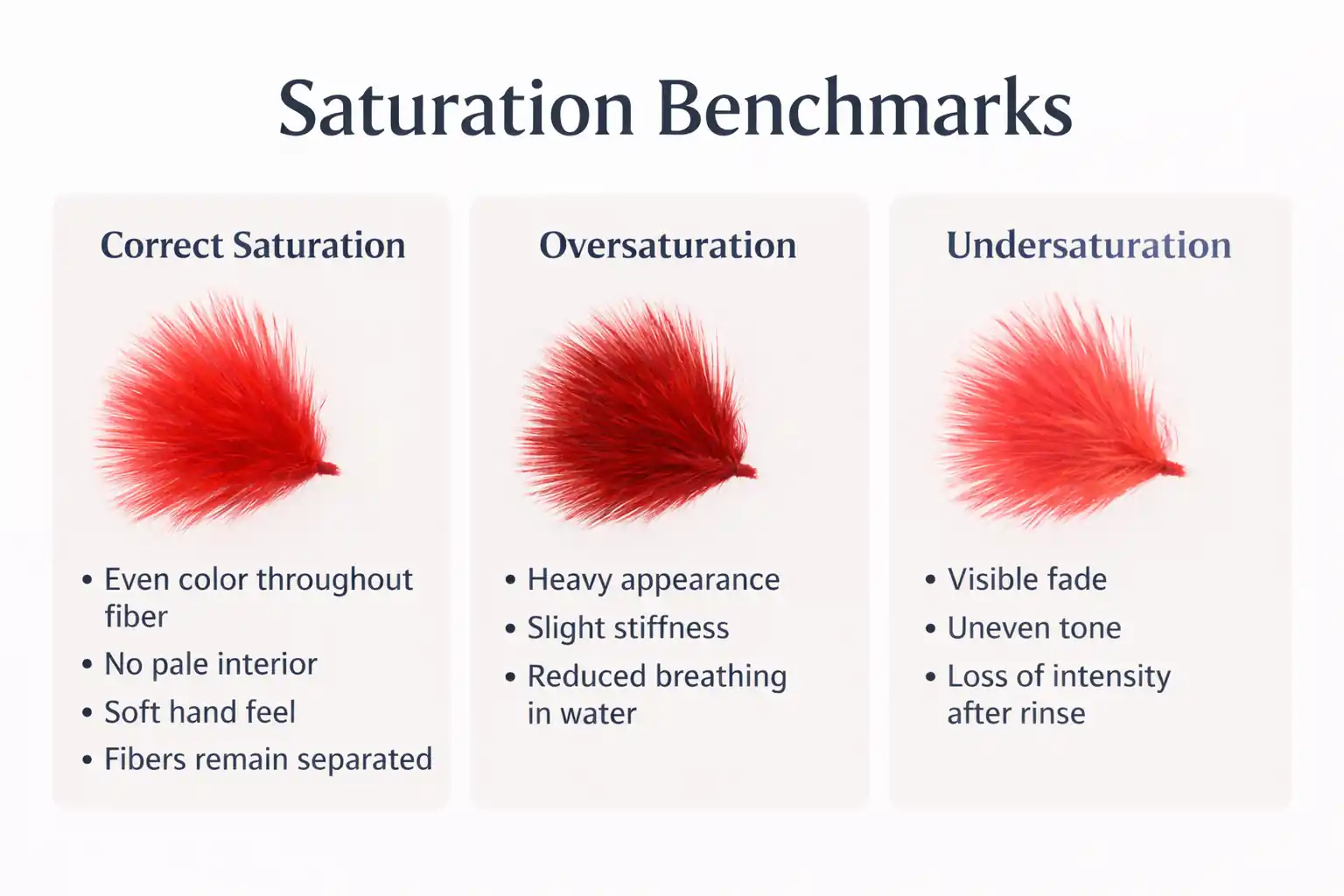
- Correct: Even color throughout, no pale interior, soft hand feel, fibers remain separated
- Oversaturation: Heavy appearance, slight stiffness, reduced breathing in water
- Undersaturation: Visible fade, uneven tone, loss of intensity after rinse
9. Post-Dye Inspection
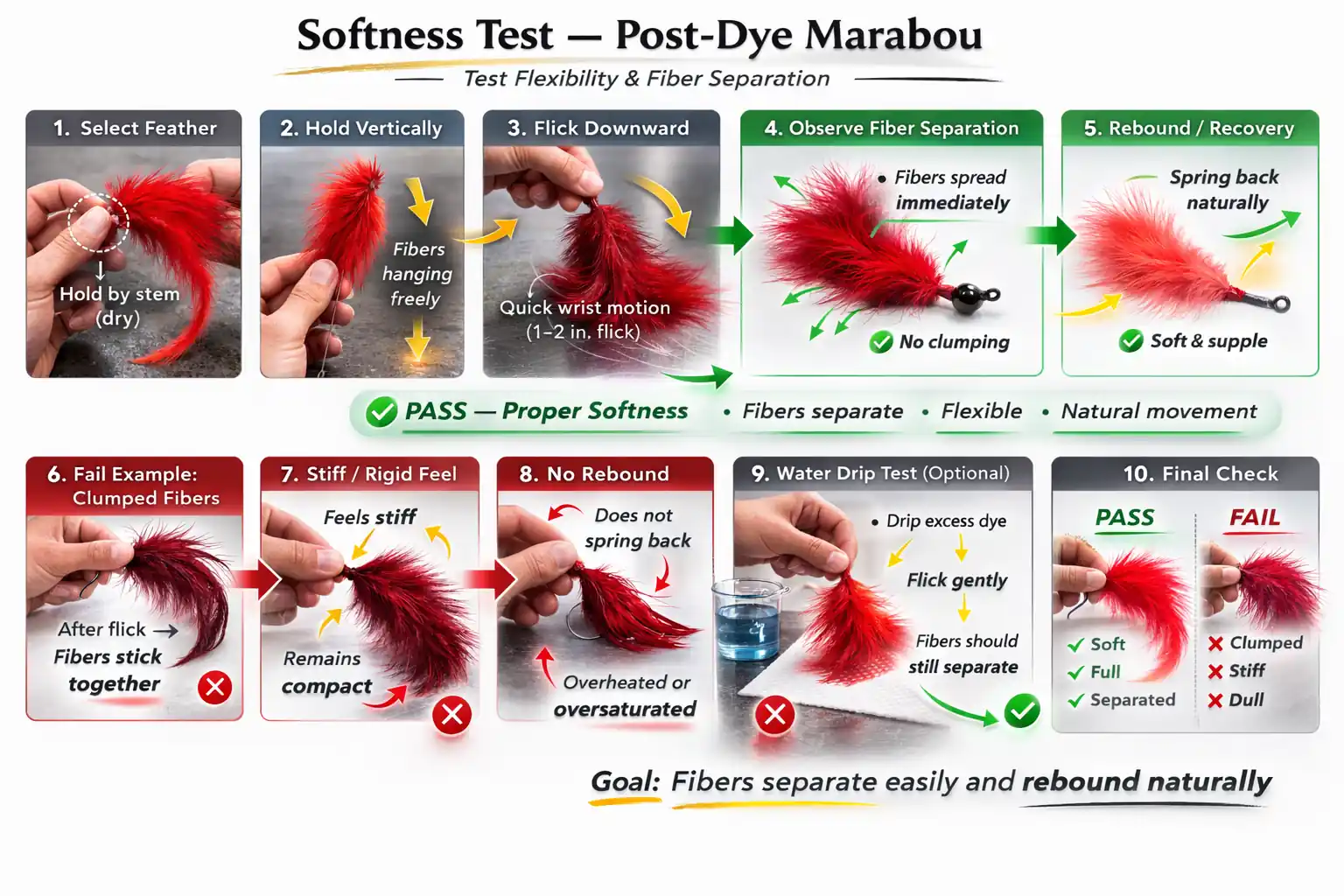
Softness Test
Flick feather downward. Pass: fibers separate immediately, no stiffness, no cracking sound.
Separation Test
Light finger comb and single shake. Pass: fibers re-separate naturally, no clumping.
Rinse Durability Test
Rinse sample feather for 30 seconds in warm water. Pass: no visible dye bleed, no noticeable fade. If multiple feathers show stiffness or bleed, review temperature and pH logs before continuing production.
10. Performance Connection
- Properly dyed: Pulses under minimal rod movement, collapses and expands naturally, consistent tone jig to jig, predictable fall rate
- Improperly dyed: Moves stiffly, appears flat in cold water, uneven coloration, inconsistent performance
Frequently Asked Questions About How to Dye Marabou Feathers
What is the best temperature for how to dye marabou feathers correctly?
The recommended dye bath temperature is 170–180°F (77–82°C). Below 160°F results in weak bonding and pale color. Above 185°F risks protein denaturation, stiffness, and reduced movement. Controlled heat preserves both color depth and natural breathing action.
What pH is required to properly dye marabou feathers?
Target pH range: 4.0–5.0, optimal bonding window: 4.2–4.5. Below 3.5: dye strikes too fast, interior penetration uneven. Above 5.5: bonding weakens, color depth decreases, durability suffers. Correct pH ensures deep bonding without damaging fiber structure.
Why does marabou get stiff after dyeing?
Marabou becomes stiff when: dye bath temperature exceeds 185°F, dwell time is excessive, fibers are oversaturated, degreasing water was too hot, or pH was outside acceptable range. Once structural damage occurs, softness cannot be restored.
Should marabou be dry before going into the dye bath?
No. Feathers must enter the dye bath wet immediately after rinsing. Allowing feathers to dry causes uneven first-contact absorption, spotting, and irregular internal saturation. Wet transfer promotes uniform dye migration and balanced bonding.
How do you know if marabou is properly saturated?
Properly dyed marabou shows even color from stem to tip, no pale interior fibers, soft hand feel, and natural fiber separation. Oversaturated marabou appears heavy and slightly stiff. Undersaturated marabou fades after rinsing and shows uneven tone.
Coming next — Part 2: Dye Chemistry Made Simple (But Accurate). In Part 2, we move into the chemistry that determines how acid dyes bond to keratin, how to control strike rate, how to build deep even color without oversaturating fibers, and real-world troubleshooting so color depth and softness remain balanced.