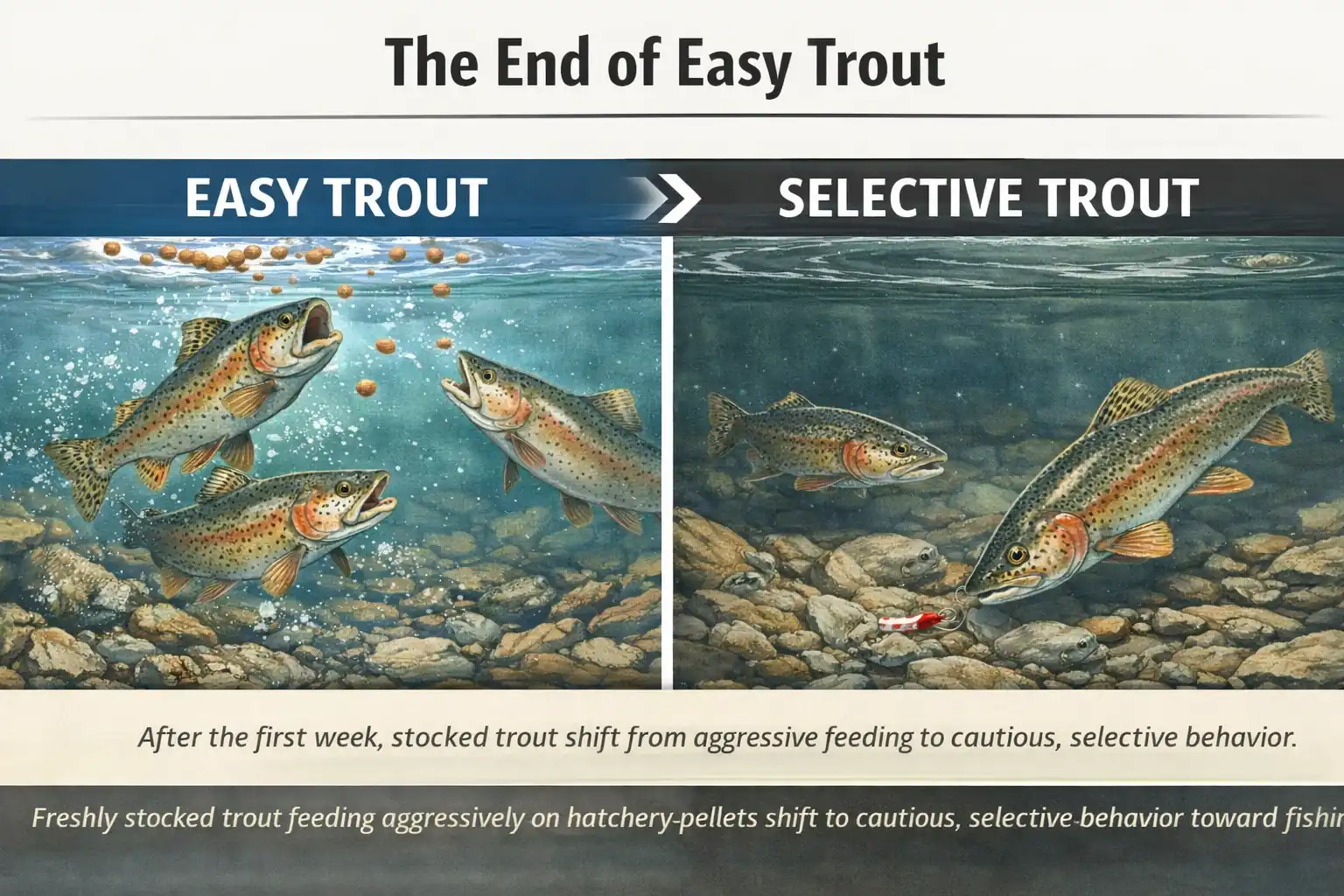
How Stocked Trout Behavior Changes After the First Week (And How to Adjust)
Stocked trout behavior changes after first week in the water — the shift from hatchery conditioning to wary, learned avoidance is the single biggest reason bites slow down after the initial rush.
How Stocked Trout Behavior Changes After First Week
Part 6 — Learning, Adaptation, and the Shift From Conditioning to Instinct
This article is part of a complete trout fishing system. For bait selection, rigging, and performance, see Best Soft Plastics for Trout: Complete Guide to Color, Rigging & Performance.
1. The Core Shift After the First Week
After the first several days, stocked trout are no longer operating purely on hatchery conditioning. Trout transition from recognition-based feeding to experience-based decision making.
- Feeding becomes selective
- Fish become cautious, reaction time slows, strike commitment decreases
- Static bait becomes less effective
- Strong scent alone is no longer sufficient
- Trout begin rejecting unnatural presentations
2. Learning Through Negative Reinforcement
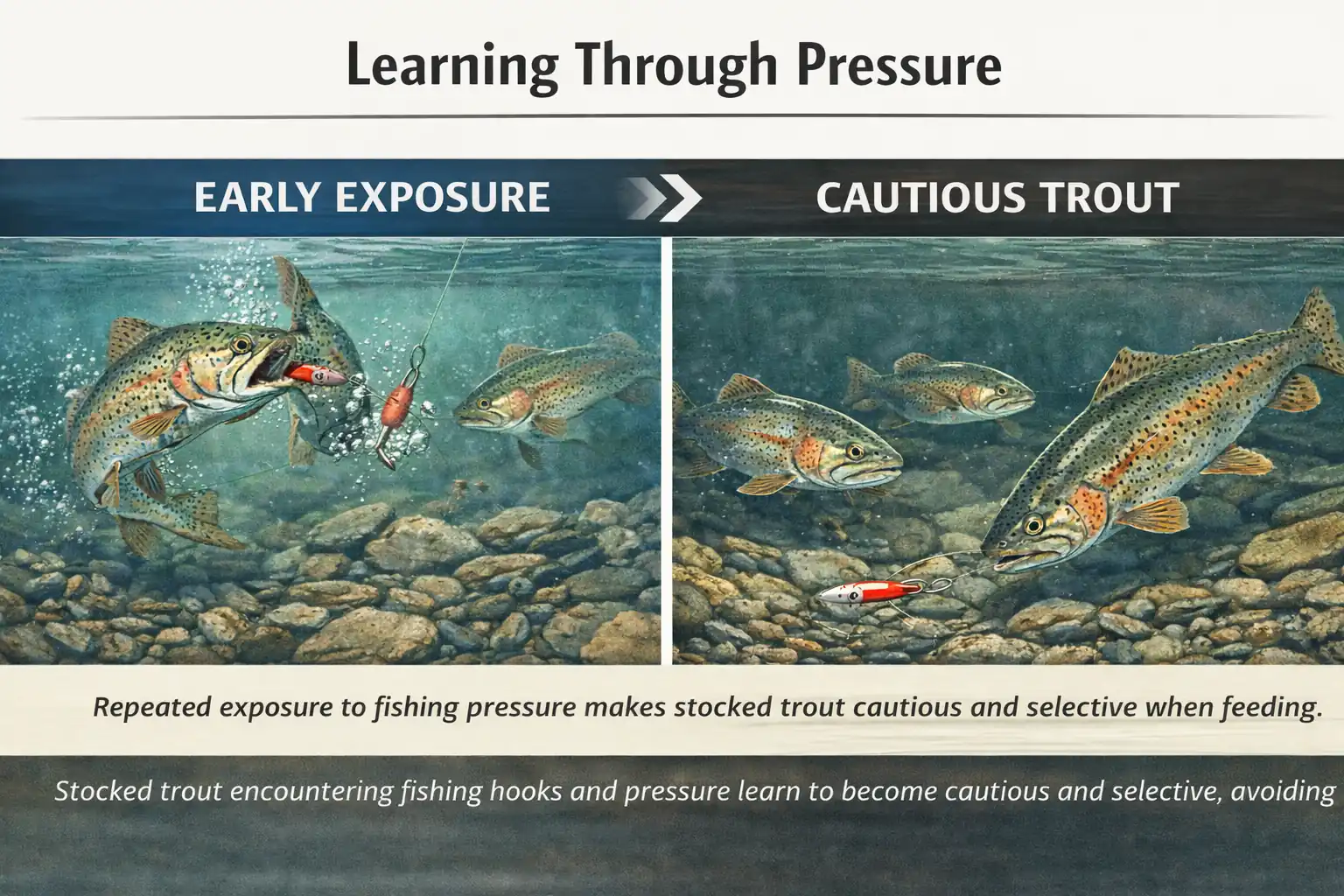
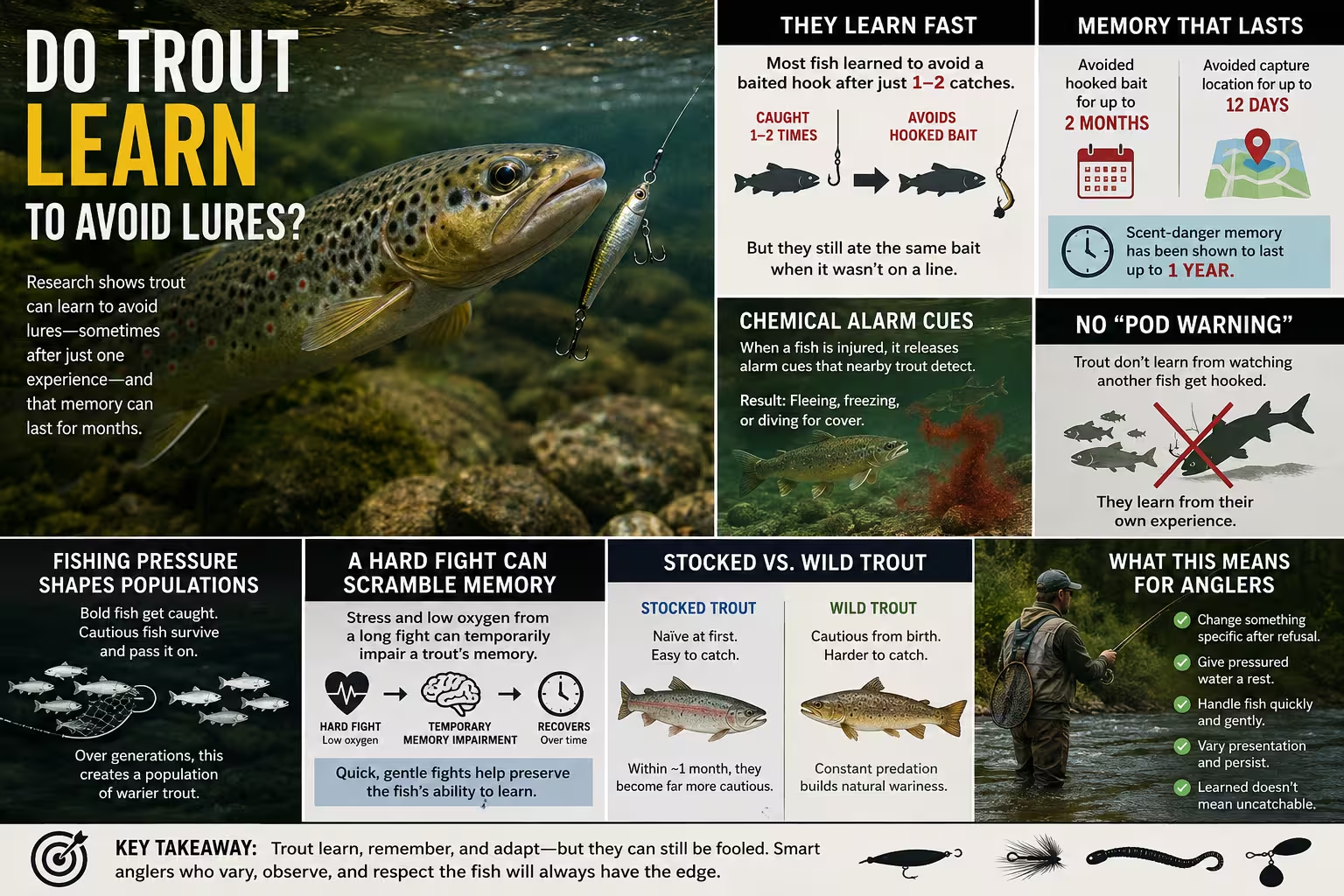
Within days of stocking, trout are exposed to hooks, fishing pressure, and repeated artificial presentations. They begin associating certain shapes with danger, repeated scents with unnatural conditions, and high-activity zones with risk. Result: reduced aggression, increased hesitation, more inspection before striking.
Common Mistake: Continuing early-stage tactics when trout have adapted. Transition techniques as fish evolve.
3. Feeding Becomes Conditional
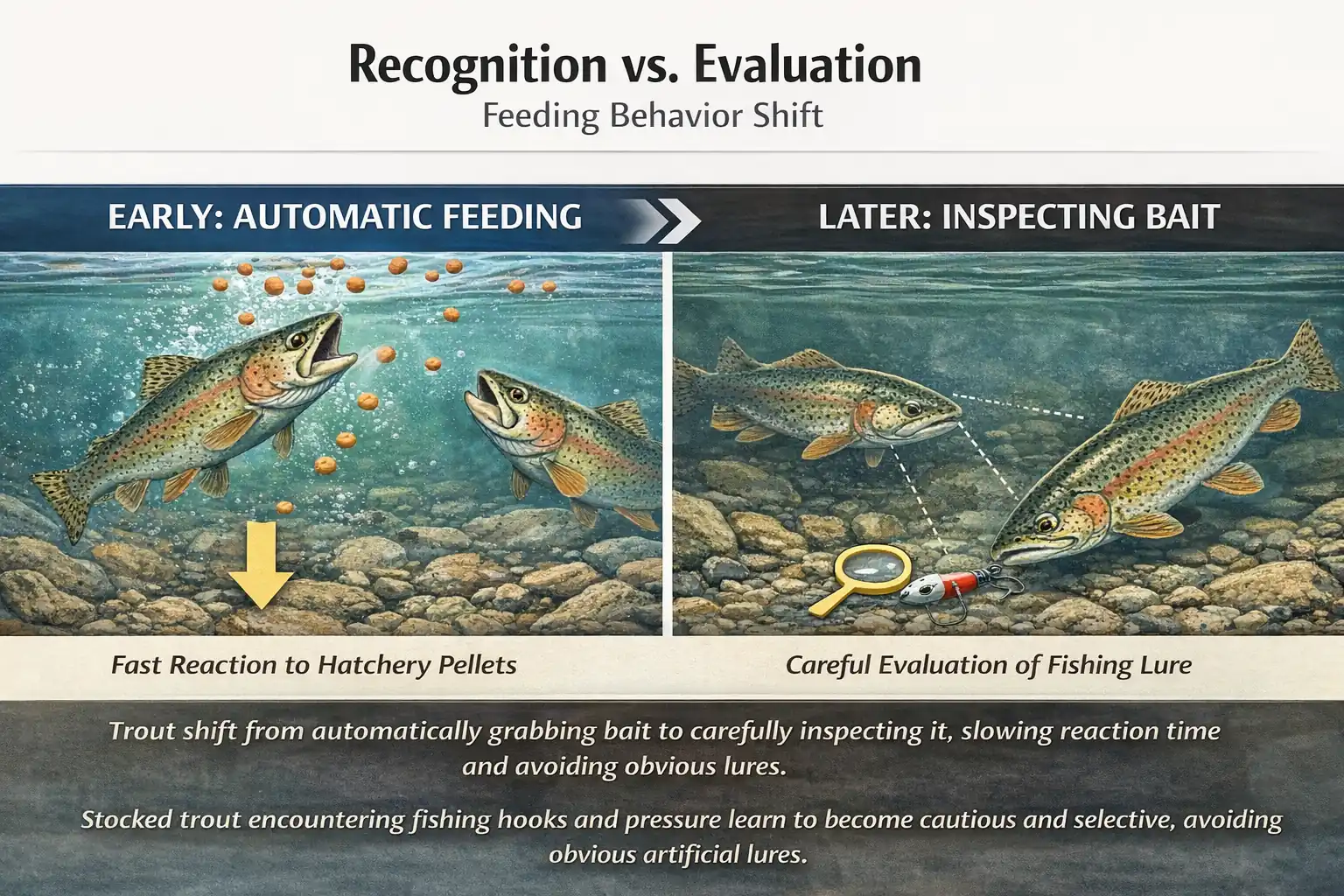
Early stage: feed based on recognition. Later stage: feed based on conditions and opportunity. Trout now evaluate: energy required to eat, safety of the situation, and natural appearance of bait.
4. Transition to Natural Forage
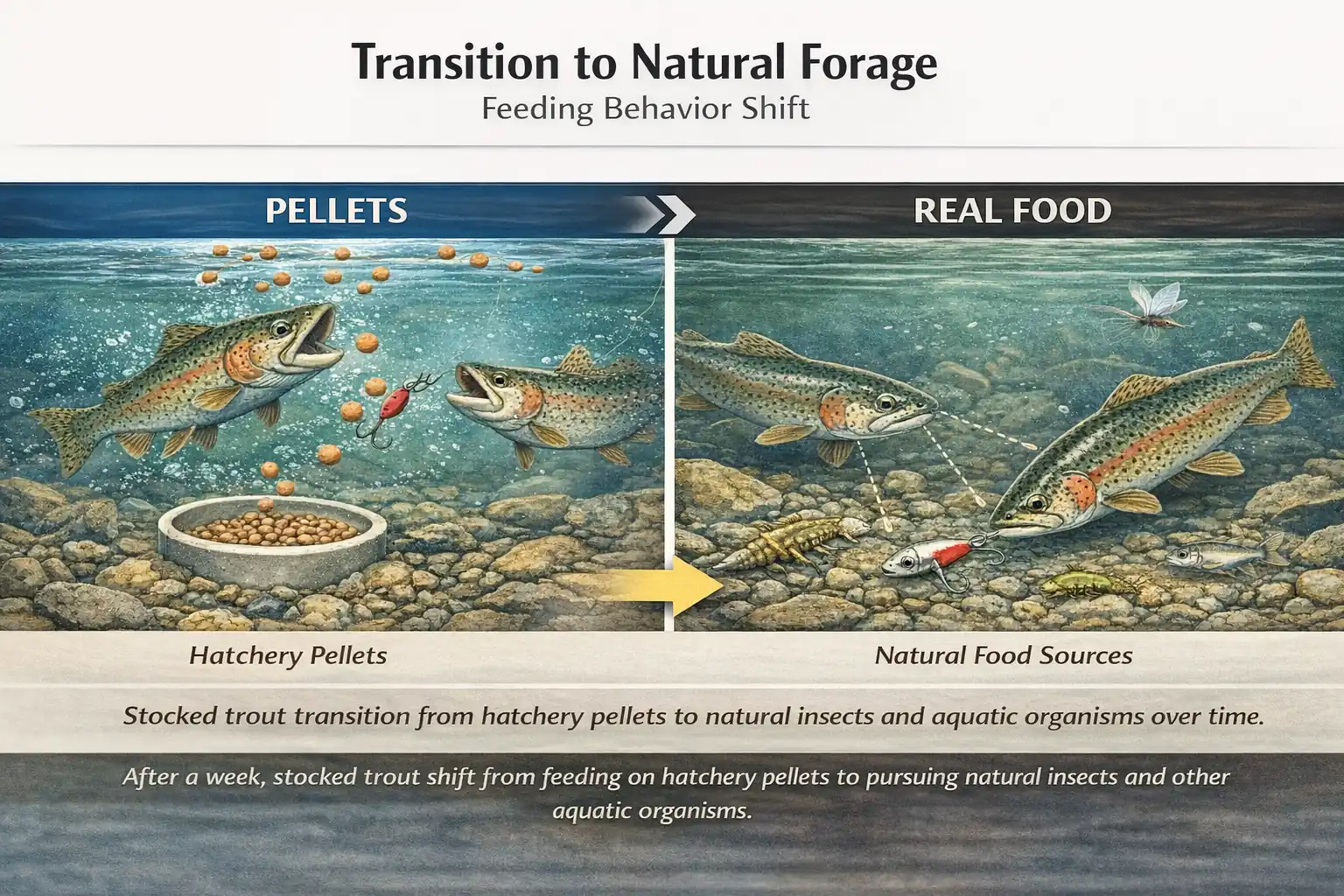
Trout begin identifying insects, small aquatic organisms, and natural drift patterns. Artificial bait must now compete with real food sources.
- Bait adjustments: Smaller profiles, more natural colors, less scent saturation
- Lure adjustments: Subtle action, slower retrieves, natural presentation
5. Increased Role of Vision
Vision becomes more dominant than scent. Trout inspect bait visually before committing, shape accuracy becomes critical, and movement must appear natural.
- In Clear Water: Downsize bait, use natural colors, reduce terminal tackle visibility
- Common Mistake: Oversized or bright bait triggers suspicion rather than strikes
6. Movement Becomes a Trigger
Trout begin responding to motion, vibration, and directional movement. Fish are no longer relying solely on scent — predatory instincts begin to develop.
- Effective movement: Slow consistent retrieves, subtle action, occasional pauses
- Ineffective: Fast erratic retrieval, excessive vibration
- Lure categories that improve: small spinners, micro spoons, lightweight soft plastics
7. Hook Avoidance Behavior
Trout begin to short strike, nudge bait without committing, and reject bait after contact. Caused by previous hook exposure and learned association with unnatural resistance.
- Improve hookup rate: Downsize hooks, use softer bait, delay hook set slightly
- Allow trout more time to commit before setting the hook
8. Pressure Creates Micro-Locations
Early stage: fish spread broadly. Later stage: fish concentrate in low-pressure areas — less accessible banks, deeper zones, areas with cover, edges of fishing pressure.
- Relocation strategy: Move away from main access points, fish overlooked areas, target transition zones
- Common mistake: Fishing obvious locations repeatedly — fish have relocated away from pressure
9. Feeding Windows Narrow
Feeding becomes less frequent and windows become shorter. Timing becomes more critical. Focus on low-light periods, be prepared before the window opens, maintain consistent presentation.
10. Bait vs Lure Shift
Early stage: bait dominates. Later stage: lures become equally or more effective as trout begin chasing moving targets and curiosity increases.
- When to switch: After bite slows on bait, when fish are visibly moving, after several days post-stocking
- Hybrid approach: Use scent-enhanced lures that combine movement with scent
11. Adaptation System
- Step 1 — Identify Stage: Freshly stocked = simple bait. Adjusted fish = refined presentation.
- Step 2 — Adjust Profile: Smaller, more natural
- Step 3 — Adjust Movement: Introduce slow motion, avoid aggressive retrieves
- Step 4 — Adjust Location: Move away from pressure, target less obvious areas
- Step 5 — Adjust Timing: Focus on short feeding windows
12. Common Failure Points
- Not adapting — using the same method too long
- Overusing scent, which reduces effectiveness over time
- Ignoring pressure effects, fishing crowded areas
- Fishing too aggressively and spooking cautious fish
Key Takeaways
- Trout quickly learn and adapt after stocking
- Feeding shifts from recognition to evaluation
- Natural presentation becomes critical
- Movement becomes an effective trigger
- Pressure and experience reduce strike rates
For the complete trout system, including bait selection and presentation, visit: Best Soft Plastics for Trout: Complete Guide to Color, Rigging & Performance
Next Article: Part 7 — A Complete System for Consistently Catching Stocked Trout
Frequently Asked Questions About Stocked Trout Behavior Over Time
Why do stocked trout get harder to catch after the first few days?
They learn through negative reinforcement — every missed strike, close call, or hook they escape teaches them to be more cautious. Feeding also becomes conditional rather than automatic, so a presentation that worked on day one can stop working entirely by day five or six.
When do stocked trout switch from pellets to natural forage?
This transition happens gradually over roughly the first week, as hatchery-conditioned trout begin recognizing and pursuing natural food sources in the stream or lake. Baits that imitate real forage become more effective as this shift progresses, while pellet-imitating baits lose their edge.
Does vision become more important as trout adjust to the wild?
Yes. Freshly stocked trout rely heavily on scent, but as they settle in, vision plays a larger role in both finding food and avoiding danger — including recognizing unnatural movement or an angler’s presence. This is part of why presentation quality matters more as the week goes on.
How should I adjust my approach for trout that have been stocked a week or more?
Expect narrower feeding windows, more selective behavior, and fish that have moved into micro-locations created by fishing pressure — tighter cover, deeper pockets, or less-pressured stretches of water. Slower, more natural presentations generally outperform the faster, simpler approaches that work on freshly stocked fish.