Why Trout Eat Worms
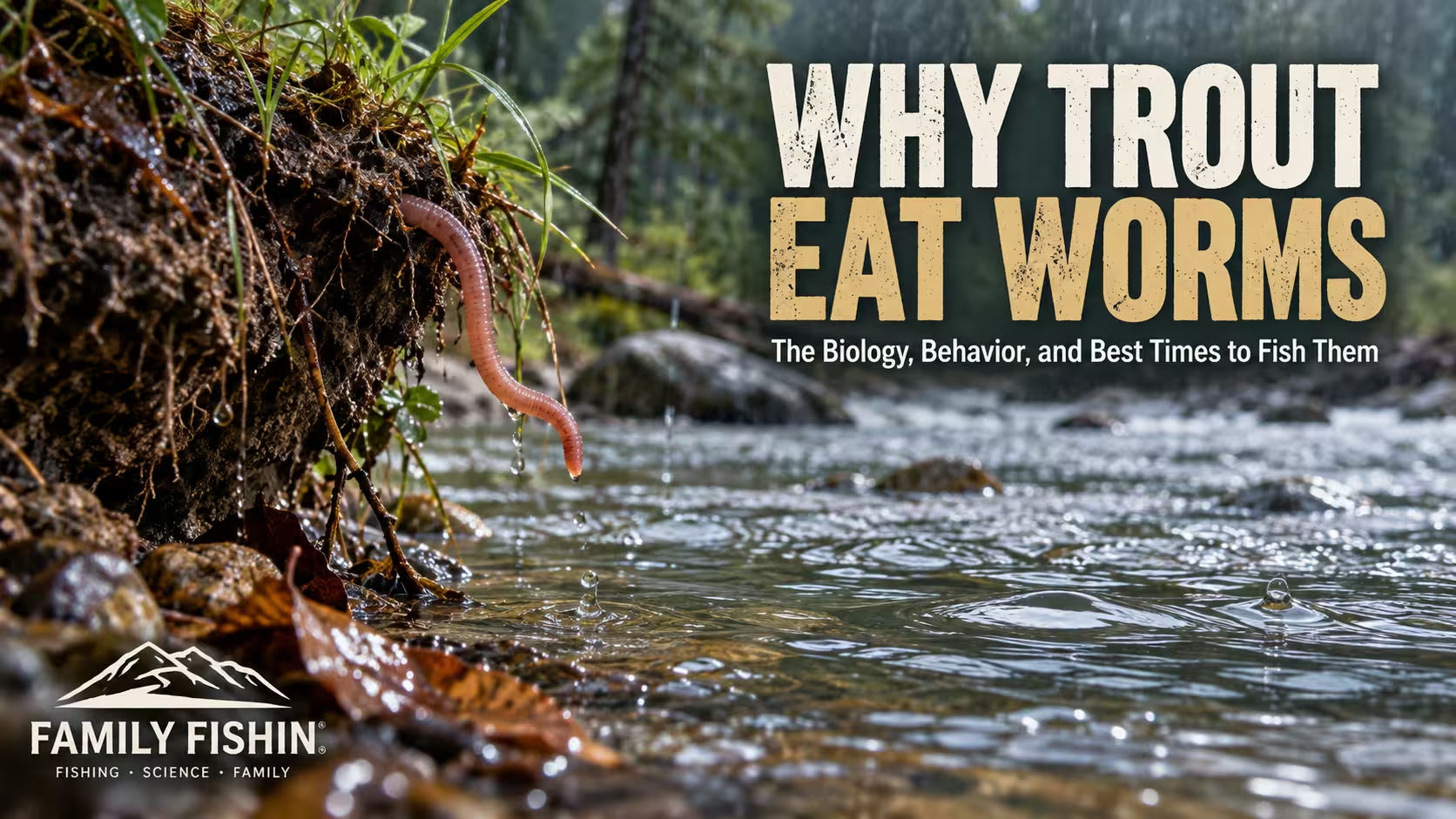
Ask a hundred anglers to name the first bait they ever used for trout, and a solid majority will say a worm — usually threaded onto a bare hook by a parent or grandparent and dropped into a hole below a riffle. It’s such a universal starting point that a lot of anglers never stop to ask why it works so well, or why it seems to work best on exactly the days when nothing else does — the days after a hard rain, when the water’s up and stained the color of coffee with cream. Understanding why trout eat worms explains a genuinely counterintuitive fact: the bait responsible for more first trout than any other isn’t actually a resident of the water it’s fished in. A worm doesn’t live in a trout stream. It falls in, washes in, or gets flooded out of the bank — and the mechanics of that arrival are the real key to fishing worms well, live or artificial.
This is the fifth post in our Trout Food Sources series, and the earlier posts are worth reading if you haven’t, since the ideas build on one another. Our overview on how trout diet shifts by season lays out why feeding priorities track water temperature and metabolism. Our piece on why trout eat minnows covers the shift toward fast, high-calorie baitfish predation as trout grow. Our piece on why trout eat crawfish covers a food source tied to a molt calendar rather than a metabolic one. Our piece on why trout eat leeches covers a stillwater food source available almost year-round. Worms don’t fit cleanly into any of those patterns. They’re not aquatic residents like a minnow, a crawfish, or a leech — they’re terrestrial animals that end up in the water by accident, and that single fact changes almost everything about when, where, and how trout key in on them.
What a Worm Actually Is
Before getting into the biology of why trout eat them, it’s worth being precise about what “worm” means here, since anglers use the word loosely to cover several different animals. The worms relevant to trout fishing are almost all earthworms — segmented worms in the class Oligochaeta, the same broad group that includes garden worms, nightcrawlers, red wigglers, and dew worms. Despite superficial resemblance, earthworms are not closely related to leeches beyond both belonging to the wider phylum Annelida; a leech is built for swimming and predation in water, while an earthworm is built for burrowing through soil and has no meaningful aquatic adaptations. That distinction matters enormously for how each behaves once it’s in a trout’s world.
Different worm species show up in an angler’s bait container under different names, and the differences aren’t just marketing. Nightcrawlers (Lumbricus terrestris) are large, robust worms, often four to ten inches long, that live in deep permanent burrows and surface at night to feed and mate — hence the name. Red wigglers (Eisenia fetida) are smaller, more active worms adapted to shallow, nutrient-rich environments like compost piles and leaf litter rather than deep soil, and they’re considerably more energetic once hooked. Garden worms and dew worms cover a range of smaller, common species found in ordinary topsoil and lawns across most of North America. All of them share the same basic body plan: a soft, segmented, tubular body with no shell, no legs, no eyes, and no real defense beyond retreating into soil or, once exposed, thrashing in an attempt to work back underground. Nightcrawlers deliver the biggest single meal and hold up best to casting; red wigglers move more energetically once hooked but rarely wash into streams in large numbers, since they favor compost and leaf litter over deep streamside soil; garden worms and dew worms, being the most common worm type in ordinary topsoil, are the ones most likely to actually end up in a stream after a rain event.
Structurally, a worm’s body is built from repeating segments, with a thin, mucus-covered skin it uses to both move and breathe — earthworms have no lungs or gills and instead absorb oxygen directly through moist skin, a detail that matters a great deal once a worm ends up in water, as covered below. Locomotion comes from alternating waves of muscle contraction gripped against the surrounding soil by tiny bristles called setae, producing the familiar inching crawl. In water, with nothing to grip, that same muscular effort produces a helpless, twisting, corkscrewing motion that has no equivalent in the worm’s normal life — and is one of the most reliable strike triggers in all of trout fishing.
Why Trout Eat Worms: A Familiar Meal With No Defenses
The same rule that’s governed every food source in this series applies here too: a meal has to deliver more energy than it costs to catch, and worms clear that bar as easily as any prey item a trout will ever encounter.
On the calorie side, a worm is soft, protein-rich tissue from end to end, with no shell, no scales, no claws, and no bones to work around — closer to a leech in this respect than to a crawfish or a baitfish. It isn’t quite as calorie-dense as an oily minnow, but it offers essentially total digestibility. A worm of any real size — a nightcrawler in particular — represents a meaningfully large single meal relative to a trout’s normal prey, especially for a smaller stream trout used to subsisting on aquatic insects a fraction of the size.
On the cost side, a worm in water is close to defenseless in a way that goes beyond even a leech, which at least is built to swim and attempt an undulating retreat. A worm that’s ended up in the water has no swimming ability whatsoever — it can thrash and twist, but it cannot outmaneuver, outrun, or evade a trout in open water. There’s no armor, no pinch, no bite, nothing resembling a deterrent. Intercepting a drifting worm is about as close to a guaranteed, effortless calorie transaction as exists in a trout’s environment — which is precisely why worm-based bait has produced more trout, across more waters and more generations of anglers, than almost any other single presentation.
Not a Local: Why Worms Aren’t Actually Living in the Stream
This is the detail that separates worms from every other food source covered so far in this series, and it’s worth dwelling on, because it changes the entire logic of when and where worm fishing pays off.
Minnows live in the water. Crawfish live in the water. Leeches live in the water. A trout sharing habitat with any of those three encounters them as a matter of course, simply by being a fish in that piece of water. A worm does not live in the water at all. Earthworms are terrestrial animals, adapted to moist soil, and they end up in a trout’s world only by accident — washed out of a streamside bank during high water, flooded out of saturated ground after heavy rain, or dislodged by bank erosion. There is no resident stream-worm population the way there’s a resident crawfish or leech population; a worm’s presence in the water is always the result of some disruptive event on land.
This has a direct biological consequence most anglers sense but rarely articulate: a worm’s window of appeal in the water is short. Earthworms breathe through moist skin rather than gills, so they can survive brief submersion, but prolonged submersion drowns them — a dead worm sinks, goes limp, and stops producing the twisting motion that makes a live one so appealing. A worm just washed into the current, still thrashing as it tumbles along, is an entirely different proposition to a cruising trout than one that’s been submerged for hours and gone inert — the worm equivalent of the molt-window vulnerability that drives crawfish predation, a narrow period of maximum appeal bookended by much lower value on either side.
Which Waters — and Which Trout — Actually Key on Worms
Because worms arrive by accident rather than residing permanently, the water types that produce strong worm bites look different from the water types that hold good crawfish or leech populations, and the determining factor has more to do with the banks than the bottom.
Streams and rivers with soft, dirt-based, vegetated, or actively eroding banks are far more productive worm water than streams running through solid rock or gravel with little topsoil nearby. A meandering lowland stream cutting through farmland, pasture, or forested bottomland, with earthy banks packed with worm burrows, delivers a steady supply of worms every time the banks get saturated or undercut. A high mountain freestone stream running through thin, rocky soil simply doesn’t have the same reservoir of terrestrial worms waiting to wash in.
Both rainbow and brown trout eat worms readily, and unlike crawfish predation, which skews hard toward larger, more experienced browns, worm predation doesn’t require much size or sophistication — a worm’s total lack of defenses means even small trout eat them confidently. This is a big part of why a garden worm on a bare hook remains the classic first-fish bait: it produces across essentially the entire size range of trout present, in a way few other presentations manage. Brook trout and cutthroat eat worms just as opportunistically, and stocked trout — raised in a hatchery environment where anything soft and wriggling reliably means food — often show a particularly unhesitant response to a drifting worm, especially soon after a stocking release.
The Rain Is the Trigger: How Worms Actually Enter the Water
If leech predation is triggered by a swim and crawfish predation is triggered by a molt, worm predation is triggered by weather — specifically, by rain and the runoff it produces — and this is the single most useful piece of biology in this entire post for deciding when to fish a worm.
Heavy or sustained rain saturates streamside soil, and saturated soil does two things that matter to a worm population. First, it floods the burrows worms normally live in, forcing them to the surface to avoid drowning underground — the same reason worms surface en masse on saturated lawns and trails during heavy rain. Second, rising water erodes and undercuts banks that were previously dry, washing worm-rich soil, and the worms living in it, directly into the stream. Both processes deliver a sudden pulse of worms into the water at exactly the moment flow and turbidity are elevated — a pulse trout learn to anticipate and exploit, rain event after rain event.
This is the real mechanism behind what anglers have long called “the worm bite,” or in some regions “the June rise” — a period of intensified worm availability tied to spring rains and snowmelt rather than to any change in the trout’s own metabolism. It also explains the folk wisdom that worm fishing is at its best in high, rising, slightly stained water rather than the low, clear conditions that favor careful presentations. High water isn’t just tolerable for worm fishing — it’s the exact condition under which real worms are most abundant in the stream in the first place.
Turbidity does additional work here, too. Stained water reduces a trout’s reliance on sight and increases its reliance on scent, vibration, and the lateral line — senses a drifting worm engages particularly well, as covered below. The combination of elevated worm availability and reduced visual acuity is exactly why high, dirty water after a rain event consistently produces some of the best worm fishing of the season, even though it’s some of the least productive water for almost every other presentation in this series.
When Worm Predation Peaks
Because worm availability is tied to weather rather than to a fixed seasonal calendar, worm predation doesn’t follow quite the same clean annual pattern that baitfish chasing or crawfish molting does, but a few reliable windows still stand out.
Spring is the strongest overall window for worm fishing across most of trout range, driven by snowmelt runoff, seasonally heavier rainfall, and saturated ground left over from winter. Spring runoff regularly washes large numbers of worms into streams already running high and off-color, and trout coming off a long winter are eager for an easy, high-value meal — much the way early-season leech predation works in stillwater, but concentrated in moving water instead.
Any sustained rain event, in any season, reliably produces a worm-fishing window in the hours during and immediately following it, as saturated banks flush worms into the current. This makes worm fishing one of the more genuinely weather-driven presentations in trout angling — checking the forecast for recent rain tells you more about whether to fish a worm today than checking a calendar does.
Summer worm fishing concentrates around afternoon thunderstorms and their aftermath, with the same rain-triggers-availability logic applying on a shorter, more localized timescale. Outside of rain events, summer worm fishing is considerably less productive, since dry ground simply isn’t delivering worms into the water.
Fall sees a return of the pattern as seasonal rains pick back up in a lot of regions, though it competes with the baitfish-driven feeding surge described in our minnows post. Winter is the weakest worm-fishing season almost everywhere, both because rain is less frequent in cold climates and because a trout’s reduced winter metabolism, covered in our seasonal diet post, lowers its willingness to intercept any moving food source. Where winter rain does occur in milder climates, the same rain-triggers-availability logic still applies, just at reduced intensity.
How Trout Actually Hunt Drifting Worms
The mechanics of a trout eating a worm differ from every other food source in this series, because a worm doesn’t hold to structure like a crawfish, cruise open water like a leech, or swim in a school like a baitfish. A worm in the water is, functionally, drifting debris with a pulse — carried by current, tumbling along or near the bottom, with no ability to choose its own path.
Trout keying on worms respond to this by positioning the way they would for any other drifting food source: holding in a current seam, behind a current break, or at the tail of a pool where drifting material concentrates, and intercepting worms as the current delivers them rather than actively hunting the way a trout working a rocky bank for crawfish does. This is closer to the classic dead-drift feeding lane behavior trout show toward drifting insects than to the structure-probing behavior described in our crawfish post, even though the caloric value of a worm meal is in a different league from a single aquatic insect.
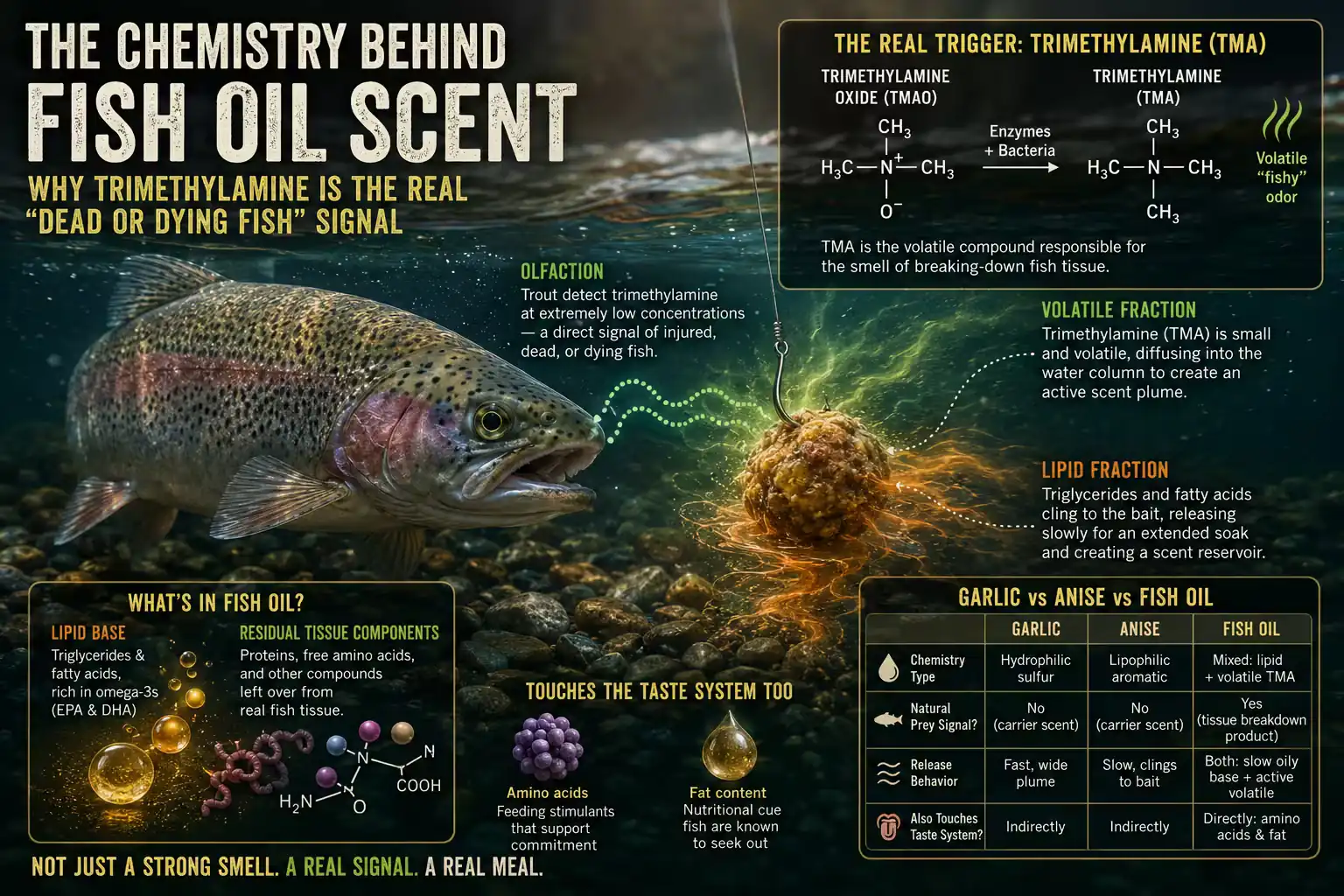
Scent plays a far larger role in worm predation than with any other food source in this series. Trout have a well-developed olfactory system, and a worm — especially one injured, cut, or actively dying in the water — releases coelomic fluid and mucus that create a genuine scent trail a trout can track well beyond visual range. This matters most in the high, stained water where worm predation peaks, where visual detection is compromised but scent detection isn’t — which is a large part of why a worm threaded onto a hook and simply left to sit in a likely holding lie can produce strikes with no active drift at all.
Because a drifting worm offers no resistance and no threat, the strike itself tends to be committed and unhurried, similar in character to a trout taking a leech, though it can also come as a sharp, decisive take in faster current. Detecting the take matters more with worm fishing than with almost any other presentation, since trout frequently mouth a worm briefly and can eject it just as quickly if anything feels wrong — the reason experienced worm anglers favor a light touch and a quick hookset on subtle, unusual line movement rather than waiting for an obvious pull.
Scent, Color, and What Actually Triggers the Strike
Color plays a smaller role in worm-pattern effectiveness than it does for crawfish, and a much smaller role than most anglers assume, because scent, movement, and silhouette dominate the decision far more than fine color detail does.
Real earthworms run in a fairly narrow natural range — pinkish-tan, reddish-brown, and dull gray-brown are the dominant colors, with the reddish tint coming from hemoglobin in the worm’s coelomic fluid, the same pigment family responsible for blood color in vertebrates. This explains why red and pink consistently rank among the most productive colors for soft plastic worm imitations — not an arbitrary “hot color” choice, but a reasonably direct match to the color a stressed or injured worm shows where its skin has broken and coelomic fluid is leaking out, often the most scent-active part of the animal.
Movement is, as with every food source in this series, an enormous trigger — but the movement that matters here is different from the swim of a leech or the tail-flip of a crawfish. A worm in current shows a passive, helpless tumble punctuated by occasional muscular twisting, not a directed swim, which is precisely why a dead-drift presentation so consistently outperforms a worked or twitched one. Soft plastic worm imitations built with a soft, supple material that flutters passively in current, rather than a stiff body holding an unnatural shape, sell this illusion far better.
Size matters more directly here than with most other food sources, since the size range of worms a trout might encounter is genuinely wide — from a small red wiggler a couple of inches long to a nightcrawler pushing eight or ten inches. Smaller trout generally respond better to a smaller profile, while larger trout in bigger water can handle, and often prefer, a larger one that delivers more calories per strike.
Fishing Worms — Live and Artificial — for Trout Effectively
Putting the biology to work, a handful of practical principles consistently separate a productive worm presentation from an unproductive one.
Fish it after rain, in rising or recently risen water, rather than waiting for conditions to clear. This runs against a lot of anglers’ instinct to wait out high, stained water, but it’s exactly backward from the worm’s perspective — off-color water right after rain is when real worms are most available, and when a trout’s reliance on scent over sight plays directly into a worm presentation’s biggest strength.
Let it drift naturally rather than working it like a lure. A worm can’t swim, and any unnatural, directed motion — twitching, jigging, a fast retrieve — works against the illusion. A dead-drift through a current seam, tail-out, or pocket water, with just enough weight to get the bait down without dragging bottom, remains the gold standard.
Use a light touch and minimal hardware. Trout frequently mouth and test a worm before committing, and excessive weight, a stiff leader, or a large hook all increase the odds a trout feels something wrong and ejects the bait. A small, sharp hook and the lightest split shot that still reaches the right depth consistently outproduces a heavier rig.
Favor natural reddish-brown and pink tones for artificial imitations, particularly in stained water where they match the coelomic fluid coloration real injured worms display. For anglers fishing soft plastics, a slim, supple profile like our 2.95″ Round Trout Worm flutters naturally on a dead drift and can be rigged on a light jig head, drop-shot, or plain hook-and-split-shot rig.
Target current seams, tail-outs, and pocket water where drifting food concentrates, rather than fishing a worm through open water the way you’d swim a baitfish imitation. The same current-break locations that produce on a dry fly or nymph rig will generally produce on a drifted worm too.
Don’t discount a worm as a year-round searching bait outside peak rain-driven windows. Because its appeal comes as much from scent and helplessness as from any narrow trigger, a well-presented worm can still draw strikes on a clear, low-water day — just at somewhat lower odds than during an active rain event.
A Note on Regulations and Stocked vs. Wild Trout
Many wild trout fisheries and catch-and-release sections restrict or prohibit live bait, since a worm’s scent and the way trout take it deeply increases the odds of gut-hooking a fish anglers intend to release. Always check local regulations, and where live bait is legal, set the hook promptly on any unusual line movement rather than letting a trout run with it. Soft plastic worm imitations sidestep the issue entirely, since they carry no scent trail encouraging a deep swallow — part of why they’ve become popular even where live bait is legal, and the only option where it isn’t. Stocked trout also tend to hit worms with less hesitation than wild trout in the same water, which is part of why a simple worm presentation remains such a reliable choice on stocked public water.
Frequently Asked Questions
Do trout actually eat worms in the wild, or is that just a beginner’s bait?
Trout genuinely eat worms in the wild, and it isn’t just a beginner’s presentation — worms wash into trout streams regularly, especially after rain, and trout of all sizes eat them opportunistically. The bait’s reputation as a beginner’s choice comes from how easy and forgiving it is to fish, not from any lack of real effectiveness.
Why do worms show up in trout streams if they don’t live in the water?
Earthworms are terrestrial animals that end up in streams by accident — washed out of saturated streamside banks during and after rain, flooded out of their burrows by rising groundwater, or dislodged by bank erosion. There’s no resident worm population living permanently in the water the way there is for minnows, crawfish, or leeches.
When is the best time to fish worms for trout?
During and immediately after rain, particularly in spring when snowmelt runoff and seasonal rain combine to wash large numbers of worms into streams already running high and off-color. Any significant rain event, in any season, tends to trigger a short window of improved worm fishing as saturated banks flush worms into the current.
Why do trout hit worms so well in muddy or high water?
High, stained water is exactly when real worms are most available, since it’s the runoff and bank erosion from rain that delivers them into the stream in the first place. Stained water also shifts trout toward relying on scent and vibration over sight, which plays directly to a worm’s biggest advantage — a strong scent trail that’s detectable even when visibility is poor.
Should I use a nightcrawler or a smaller worm for trout?
It depends on the water and the trout. Nightcrawlers deliver more calories per bite and work well in bigger water and for larger trout, while a smaller garden worm or red wiggler often produces better in smaller streams or for smaller trout that struggle to comfortably eat a full-sized nightcrawler in one take.
What color soft plastic worm works best for trout?
Reddish-brown and pink tones tend to perform best, particularly in stained water, since they closely match the coloration real earthworms show when injured — a byproduct of hemoglobin in the worm’s coelomic fluid. These aren’t arbitrary “hot” colors; they track a genuine biological cue trout have learned to recognize. For a closer look at color selection, including how stocked trout respond differently than wild fish, see our guide to the best trout worm colors for stocked trout.
Is live bait fishing for trout legal everywhere?
No. Many wild trout fisheries and catch-and-release sections restrict or ban live bait, largely due to the increased risk of a trout swallowing the hook deeply, which raises mortality risk on fish anglers intend to release. Always check local regulations before fishing live bait, and consider a soft plastic worm imitation where live bait isn’t allowed.
Why does a dead-drift presentation work better than retrieving a worm like a lure?
A real worm can’t swim — in water, it can only tumble passively in the current or twist helplessly in place. A dead-drift presentation matches that natural, undirected motion, while an actively retrieved or twitched presentation creates a directed swimming motion no real worm can produce, which trout can recognize as unnatural.
Closing Thought
A worm never belonged in the water in the first place, and that’s exactly why it works — no evasive skill built up over generations of aquatic predator pressure, no armor, nothing to do but drift and twist helplessly until a trout finds it by sight or scent. Fish it after rain, fish it on a natural drift, keep your touch light, and pay attention to your banks and your forecast the way you’d pay attention to a hatch chart, and a well-presented worm will keep producing the same easy, confident strikes that have made it the first bait in tackle boxes for as long as people have fished for trout.
About Family Fishin
Family Fishin is a family-owned fishing tackle company dedicated to designing, testing, and producing high-quality fishing lures — inspired by generations of fishing tradition and driven by a passion for innovation. Every product is developed with one goal in mind: helping anglers spend more time doing what they love, catching fish and creating memories on the water.