Part 6 — Soft Plastic Cold Water Performance: Why Baits Go Dead in Cold Water
Executive Summary
Soft plastic cold water performance is controlled by temperature-driven changes in flexibility and internal polymer mobility. As water cools, plastisol stiffens, action slows, and some baits lose vibration entirely. Cold-water design requires softer base compounds, adjusted plasticizer balance, and controlled filler loading to maintain movement at lower temperatures.
When a bait “stops working” in cold water, it is not the fish. It is the material.
Soft Plastic Cold Water Performance Explained
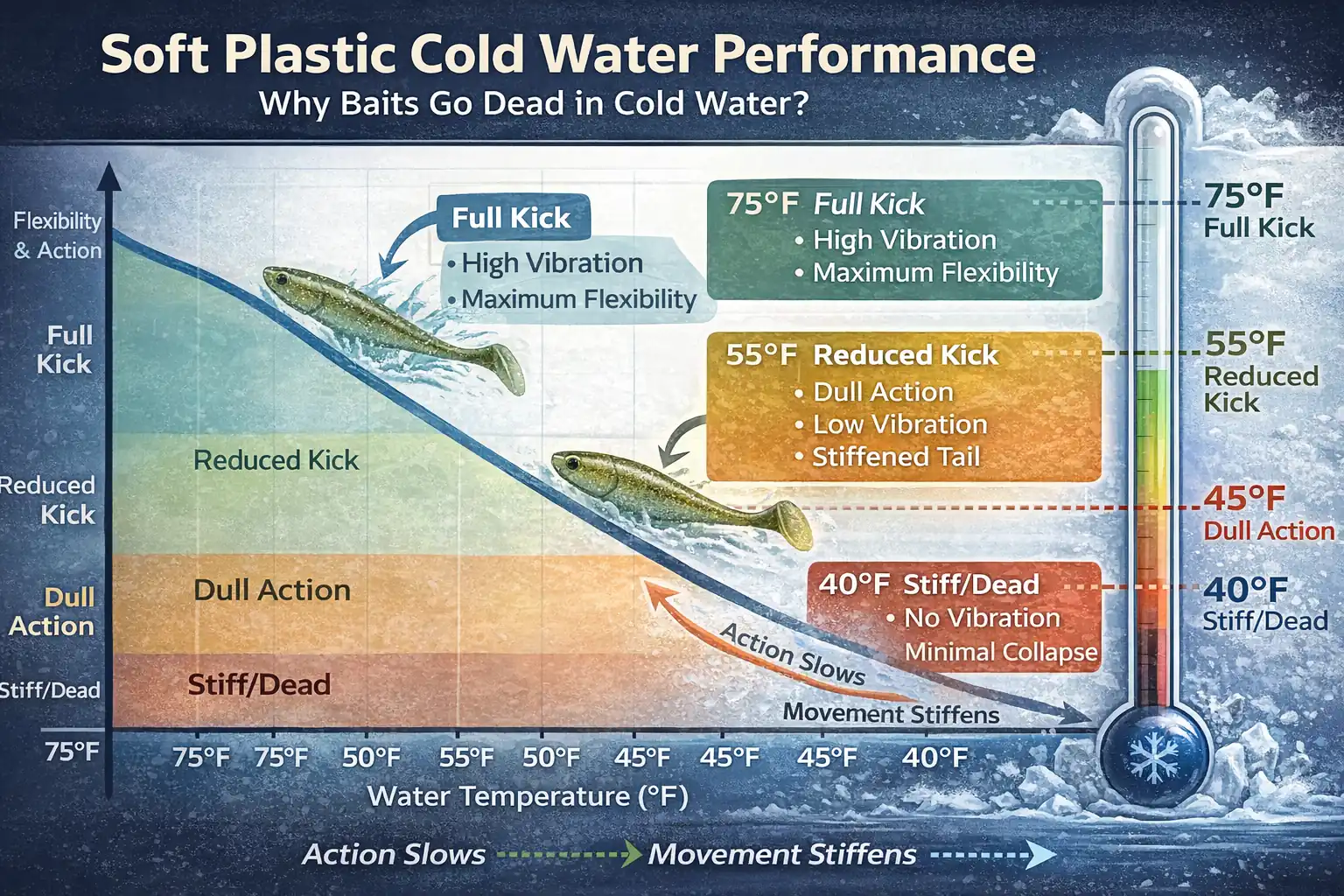
Soft plastic cold water performance depends on how temperature affects molecular movement inside the plastic. As temperature drops: polymer chains move less, the material becomes stiffer, flexibility decreases, action slows or stops. This is not marketing — it is basic material behavior. A lure that swims freely at 75°F can feel rigid at 45°F. The design either accounts for that shift — or it does not.
Why Does a Bait Stop Working When the Water Cools?
Because flexibility changes with temperature. Soft plastics rely on controlled elasticity to kick tails, pulse appendages, create subtle vibration, and collapse naturally on the hookset. When water cools: plasticizer mobility decreases, the compound stiffens, tail amplitude drops, vibration frequency slows, and action becomes muted or disappears. If the compound was engineered for warm-water flexibility only, it will underperform in cold conditions.
The Physics Behind Temperature and Flexibility
Plastisol is a plasticized PVC system. Its softness depends on: plasticizer ratio, resin structure, additive compatibility, and filler loading. As temperature decreases, the material approaches a stiffer state. While fishing plastics do not reach true glass transition temperatures, the reduction in molecular mobility is enough to noticeably reduce movement.
Measured Flexibility Shift (Relative Bend Test Example)
| Water Temp (°F) | Relative Flexibility | Tail Movement |
|---|---|---|
| 75°F | 100% baseline | Full kick |
| 60°F | ~85% | Slightly reduced |
| 50°F | ~70% | Noticeable loss |
| 45°F | ~60% | Minimal kick |
| 40°F | ~50% | Nearly rigid |
Small formulation differences dramatically affect these percentages.
Cold-Water Performance Design
Cold-water optimization typically includes: higher plasticizer balance, lower filler content, controlled salt loading, flexible base resin selection, and reduced heavy pigment loading. The goal is to preserve movement at lower temperatures without sacrificing durability. Designing for cold water is not about making a bait “softer” — it is about maintaining controlled elasticity across a temperature range.
Warm Water vs Cold Water Compounds
- Warm-Water Focus: Slightly firmer feel, higher durability, faster snap-back, strong structure under heavy cover
- Cold-Water Focus: Greater elasticity, lower stiffness at 40–55°F, maintained tail activation at slow retrieve speeds, natural collapse on light bites
There is no universal best compound. There is only condition-specific engineering.
When Temperature Matters Most
Temperature effects become critical when fishing below 55°F, working slow bottom presentations, targeting pressured fish, using finesse plastics, or relying on subtle tail vibration. In high-speed summer retrieves, stiffness changes are less noticeable. In cold water, subtle movement determines strike triggers.
Frequently Asked Questions
Do soft plastics get harder in cold water?
Yes. Lower temperatures reduce polymer mobility, increasing stiffness and reducing movement.
Can scent or salt affect cold water flexibility?
Yes. High salt and heavy filler loading increase stiffness and can worsen cold-water performance.
Are ultra-soft baits always better in winter?
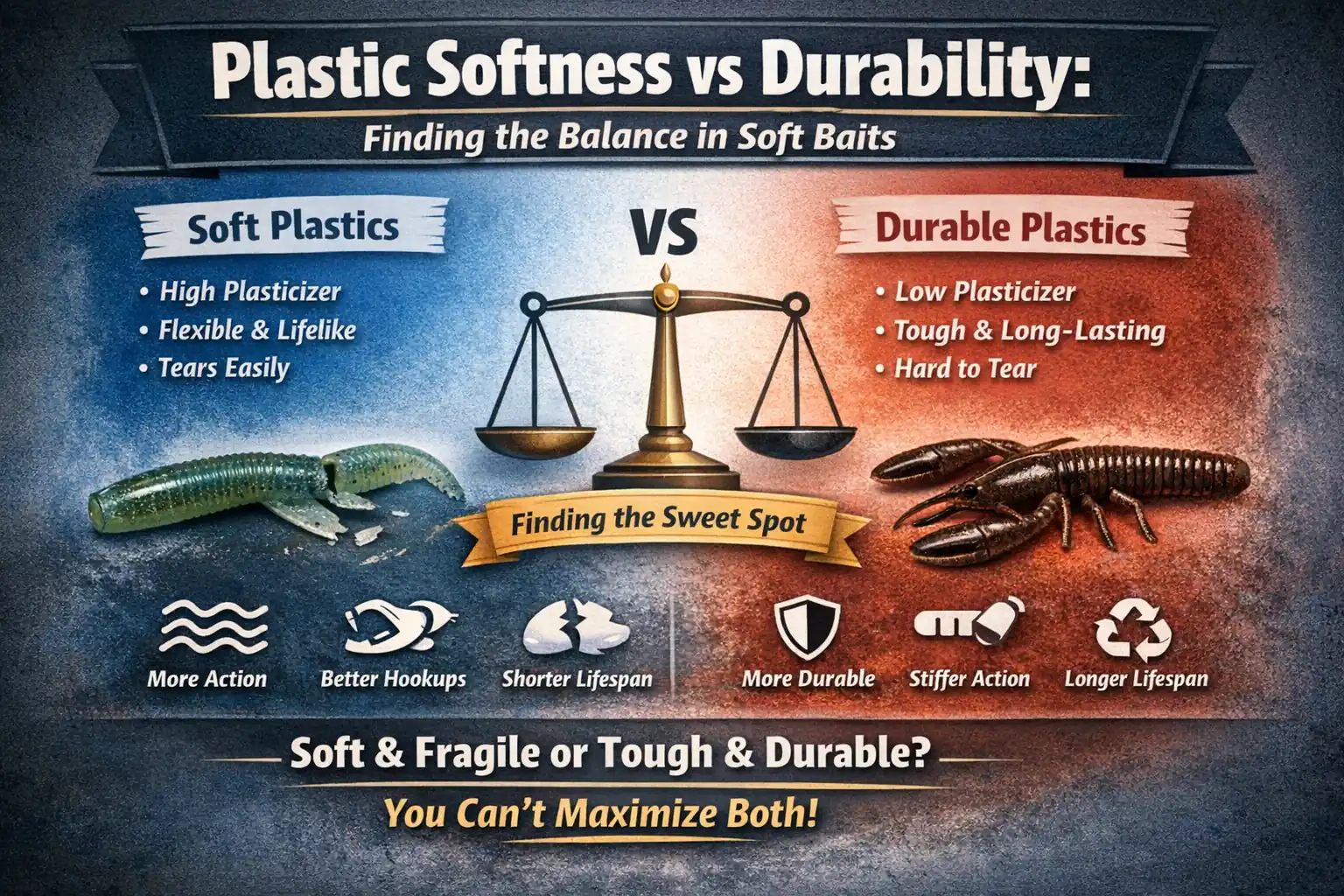
Not always. Too soft can reduce durability and structural response. Balance is required.
The Engineering Conclusion
Soft plastic cold water performance is controlled at the formulation stage. Temperature changes flexibility. Flexibility changes action. Action changes results. When a bait stops working in cold water, the material was not engineered for that temperature range.
If you haven’t read Part 5 — Soft Plastic Scent Retention, review it next. Scent absorption and release are controlled by the same material variables that influence flexibility and cold-water performance — polymer structure, plasticizer balance, and additive loading.
Next: Part 7 — Designed Soft Plastic Lures: Choosing Performance Over Hype