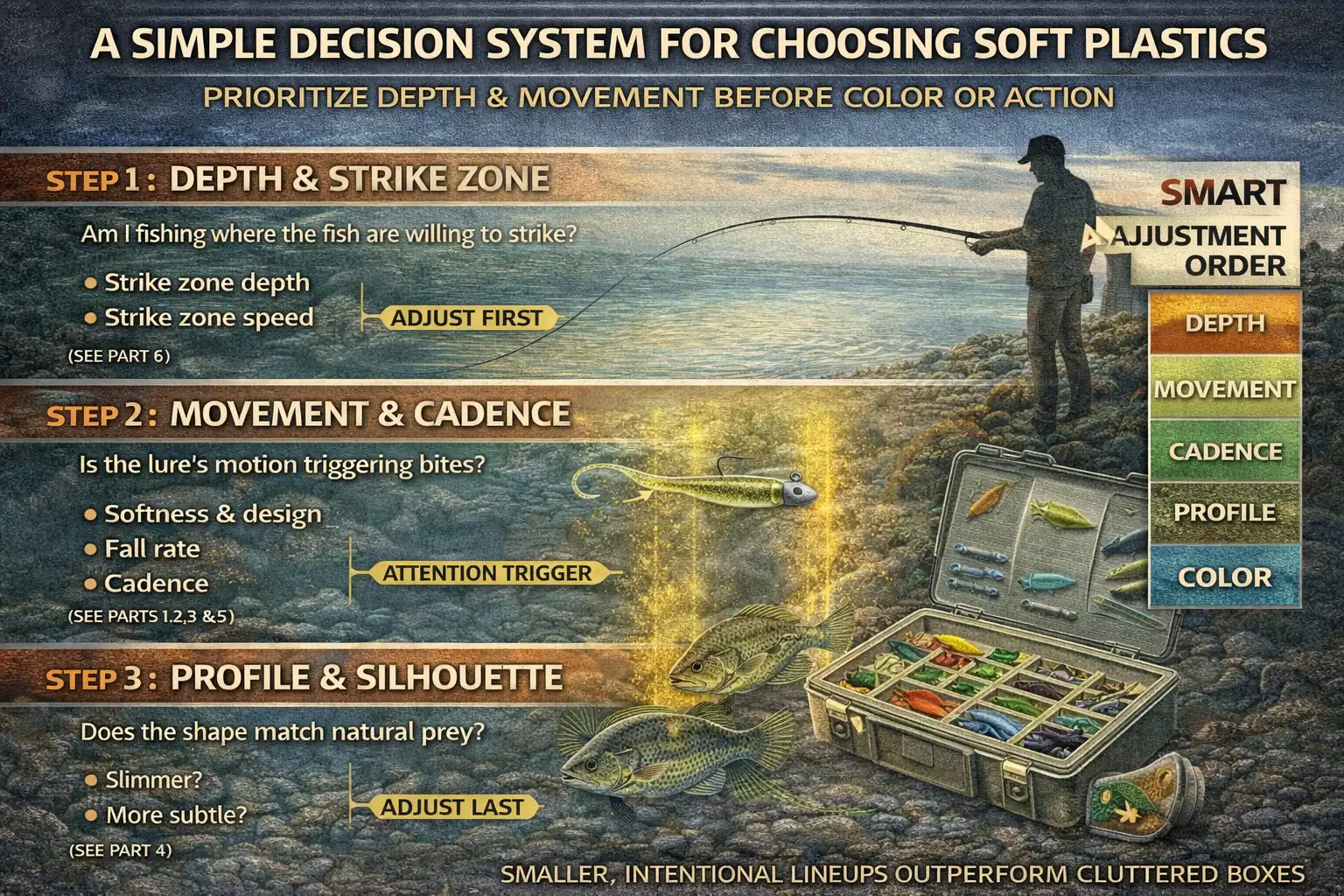
What Actually Makes a Soft Plastic Lure “Come Alive” (The Science of Action)
Soft plastic lure action is what makes a bait look alive in the water. You can nail the color. You can match the shape to the forage perfectly. And a fish will still swim up, look at your bait, and turn away — while the same fish crushes a plainer-looking bait two casts later. The difference, almost always, is action — how the bait moves. Action is the thing that separates a lure that looks like food from one that behaves like food, and it’s the least understood property in all of soft plastics. The Why Soft Plastic Lures Bend covered the shape side of movement — where a bait bends. This one covers the deeper question: once it’s bending, why does a good soft plastic move like something alive, while a stiff one just hangs there like a piece of rubber? The answer is one strange, beautiful property of the material itself.
The Big Idea: Soft Plastic Is Part Spring, Part Fluid
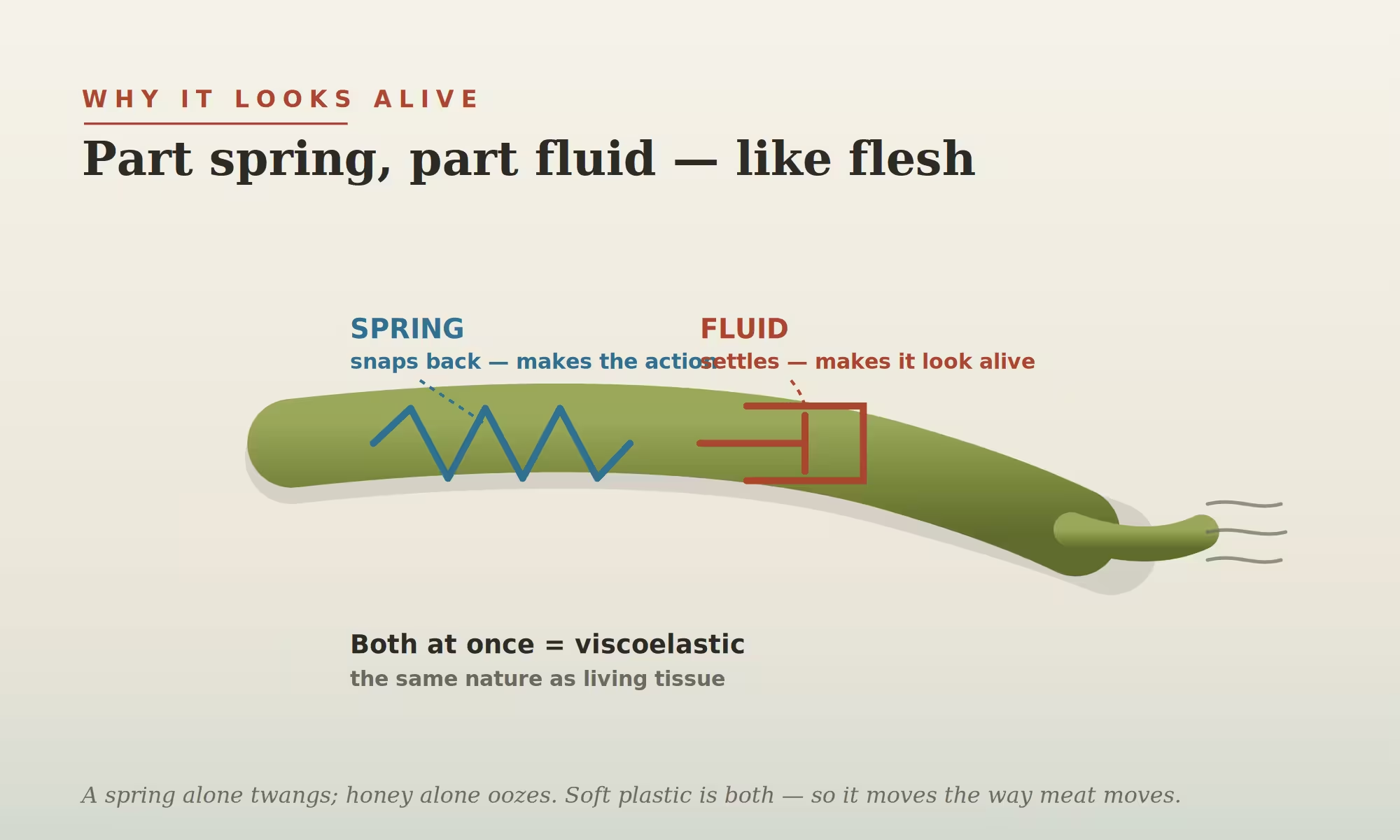
Most materials are one or the other. A steel spring is elastic — push it and it snaps right back, instantly and completely, storing and returning energy. Honey is viscous — push it and it slowly flows, resisting, never snapping back, just oozing into a new shape. Soft plastic is the rare thing that’s both at once. Engineers call it viscoelastic: it has a spring inside it and a fluid inside it, working together every time it moves.
That combination is the entire secret of action, so it’s worth feeling it in your hands. Pinch a good soft-plastic worm and let go. It springs back toward its shape — that’s the elastic, spring half. But it doesn’t snap back like a rubber band and twang; it eases back and settles, with a little resistance, a little slowness — that’s the viscous, fluid half dragging on the spring. Snap-back plus settle, at the same time. A rubber band is almost pure spring (it twangs). Wet clay is almost pure fluid (it just stays bent). Soft plastic lives in between, and that in-between is where lifelike movement comes from.
Why It Moves Like It’s Alive (the Real Reason Fish Buy It)
Here’s the part that should give you chills a little. Living tissue is also viscoelastic. A minnow’s body, a worm, the meat of a crawfish — real prey is made of flesh, and flesh is part spring, part fluid, exactly like your soft plastic. It springs and it settles. It doesn’t twang like a hard object and it doesn’t flop like a dead rag — it moves with that specific blend of rebound and damping that says alive to a predator’s eye.
Now compare a hard bait. A hard crankbait or a jig body is nearly pure spring — strike it and it vibrates, it rings, it rattles. That’s useful for a reaction strike, but it doesn’t read as living flesh. A soft plastic, being viscoelastic like real tissue, moves the way meat moves. So when we say a soft plastic “looks alive,” what’s really happening is deeper than looks: it’s mechanically behaving like living material. You’re not just matching the shape and color of prey — you’re matching its physical character. That’s the deepest reason soft plastics fool fish that refuse hard lures, and it’s a property no amount of paint can give a hard bait.
The Two Halves, and What Each One Does for You
Break the viscoelastic behavior into its two parts and each one earns its keep on the water.
The spring half (elastic) gives you rebound and recovery. Every time you twitch the rod, the bait flexes and then springs back toward shape — and that snap-back is the action. A tail kicks because it springs back after the water pushes it aside; an appendage flutters because it keeps springing back between pushes. Without the spring half, a bait would bend once and just stay bent. The spring is what makes the motion repeat.
The fluid half (viscous) gives you the lifelike settle — and kills the dead “ring.” This is the half people never think about, and it’s what separates a natural-looking bait from a cheap one. When a material flexes, the viscous half dissipates a little energy — it bleeds off as a tiny bit of heat — instead of bouncing it all back. That energy loss is why a soft plastic damps: it moves, then settles smoothly, instead of vibrating and ringing like a hard object. A pure spring would twang and quiver mechanically; the fluid half soaks that twang up and turns it into a soft, organic glide-and-settle. That damping is the difference between a tail that wags like a swimming fish and one that buzzes like a tuning fork. It’s literally why soft plastic looks soft when it moves.
So: the spring makes the action happen, and the fluid makes the action look alive instead of mechanical. You need both, and the balance between them is a real design lever — more on that below.
It Takes Two: the Bait and the Water
One thing worth saying plainly, because it reframes everything else: a soft plastic has no action sitting in your hand. Wave it in the air and it just flops. Action only exists when the material meets moving water — it’s a conversation between the two. The plastic brings the spring and the fluid character (how readily it bends, how it rebounds, how it settles); the water brings the force that pushes the bait around and the resistance that pushes back. Action is what happens in the handshake between them.
That’s why the same bait can look dead in one situation and alive in another with no change to the bait at all — slack current versus a feeding rip, a dead pool versus moving water past a drop. It’s also why every test that matters ultimately happens in water, not dry on the bench: the bench tells you what the material brings to the conversation, but the water is the other half of it. Keep that in mind through the rest of this — we’re always really talking about how the material answers the water.
Movement Without Speed: Why Dead-Sticking Works
Here’s a payoff that confuses a lot of anglers: a great soft plastic catches fish when it’s barely moving at all. Drop-shotting, dead-sticking, a slow finesse hang in the strike zone — the bait is nearly still, and fish eat it anyway. Viscoelasticity explains why.
Because a soft, low-stiffness bait responds to the faintest force, the tiny currents and micro-eddies in any water are enough to make thin tails and appendages quiver and “breathe” on their own — no rod input needed. And there’s a second, subtler thing happening. When you hold a viscoelastic material in a bent or stretched position, it doesn’t sit rigidly — over a few seconds the internal stress quietly relaxes and the bait eases into a natural, settled pose (engineers call this stress relaxation). So even a motionless bait is subtly, continuously settling and shifting, the way a real creature at rest still breathes and adjusts. To a watching fish, a dead-stuck soft plastic isn’t dead — it’s a living thing holding still. That’s movement without speed, and it’s something a rigid bait simply cannot do.
Other Materials, Other Kinds of Action
It helps to see where plastisol sits among the materials a lure can be made from, because “action” is really a material choice before it’s a shape choice. Line them up by how much spring versus fluid each one has:
- Hard plastic and wood (crankbaits, jerkbaits) are nearly pure spring. They don’t deform and settle — they vibrate, rattle, and wobble on a tight, mechanical rhythm. Great for triggering reaction strikes, useless for looking like soft flesh.
- Plastisol (PVC soft plastic) is the balanced viscoelastic middle — enough spring to generate repeating action, enough fluid to look like living tissue. That all-around balance is exactly why it became the dominant bait material.
- TPE and ElaZtech-type elastomers lean further toward the springy, elastic side and are dramatically more durable and stretchy — they rebound livelier and survive far more fish, but they feel and move differently than plastisol, and they famously can’t be stored touching it
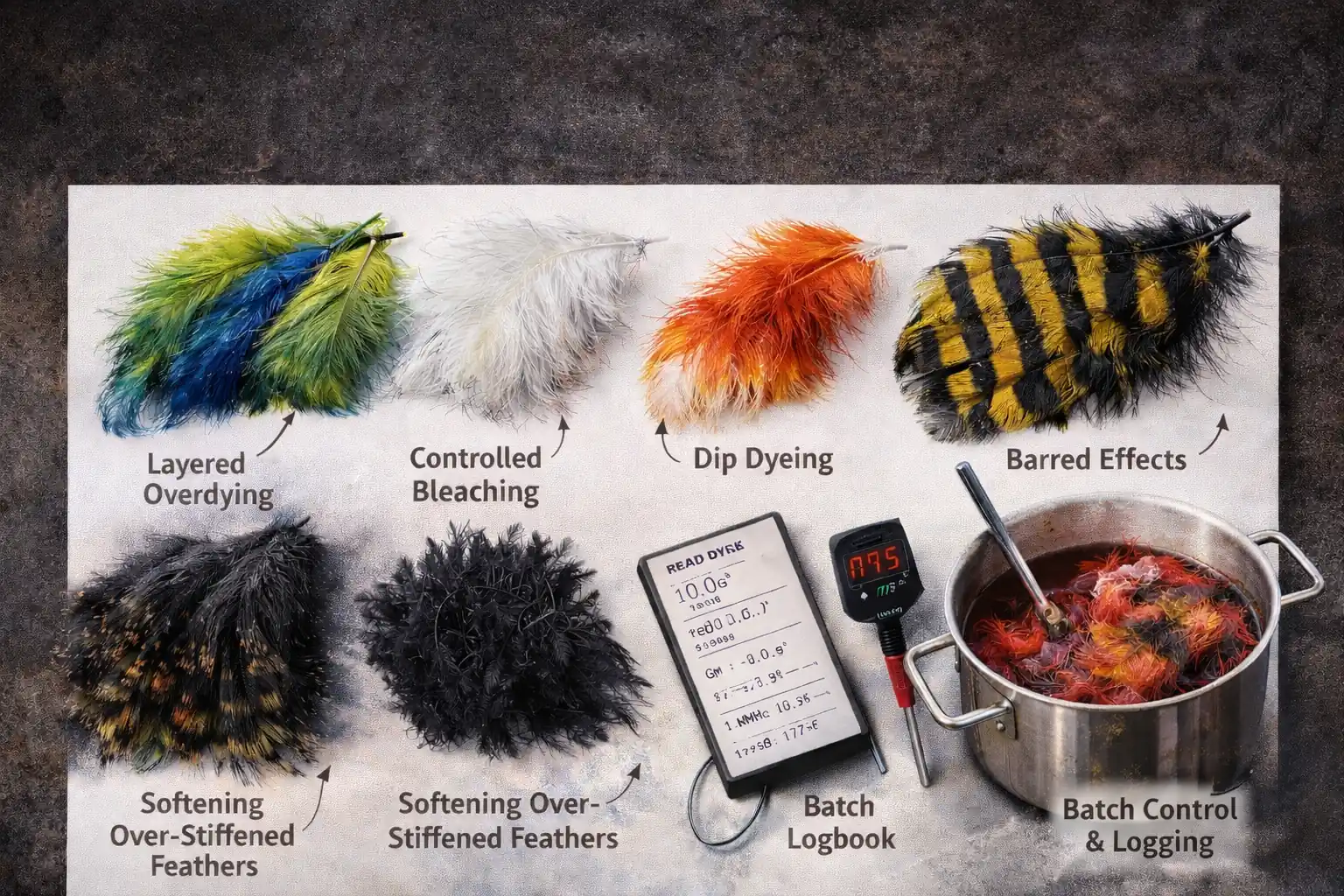
- Feathers, marabou, and soft fibers are almost pure fluid flutter. They have barely any spring to hold a shape, so they breathe, pulse, and undulate from the faintest current — the ultimate “movement without speed.” That’s why a marabou jig comes alive on a dead-slow crawl in cold water when a stiff bait does nothing, as we cover in Marabou Jigs for Trout.
The lesson: each material has a native kind of action, set by its own spring-versus-fluid balance. Choosing a material is choosing a baseline motion and then shape and formula fine-tune it from there.
The Fall Is Half the Action
A huge share of strikes come while the bait is falling, not while you’re working it — and the fall is pure action, controlled by how the bait’s weight plays against the water. A bait’s density (set mostly by how much salt is in it) decides whether it plummets, glides, or hangs:
- A light or neutral bait falls slowly, gliding and fluttering, with long hang time in the strike zone — deadly for inactive or inspecting fish.
- A dense, salted bait drops fast with a tighter, faster wobble — good for getting down to deep fish or triggering a reaction.
- And buoyancy decides orientation: a bait with a floating tail stands its tail up off the bottom where fish can see it, while a uniformly dense bait lies flat.
Same body, same color — change the density and you’ve changed where in the water column the action happens and how the bait behaves getting there. The chemistry of how salt and material set that density lives on the the Science of Plastisol hub. The practical point for action: the fall isn’t dead time between twitches. It’s often the most important move the bait makes, and it’s tunable.
Collapse on the Strike: Action That Hooks Fish
Softness does one more job that has nothing to do with looking alive and everything to do with landing the fish. When a fish inhales a soft bait, the plastic collapses — it compresses and folds in the fish’s mouth instead of resisting. That matters for two reasons. First, a fish feels less unnatural resistance, so it holds on a fraction longer instead of spitting it. Second, and bigger: when you set the hook, a soft bait compresses out of the way and lets the hook point drive through cleanly, while a hard or overly stiff bait can block the point and cost you the fish — the hook has to shove the bait aside before it ever reaches the jaw.
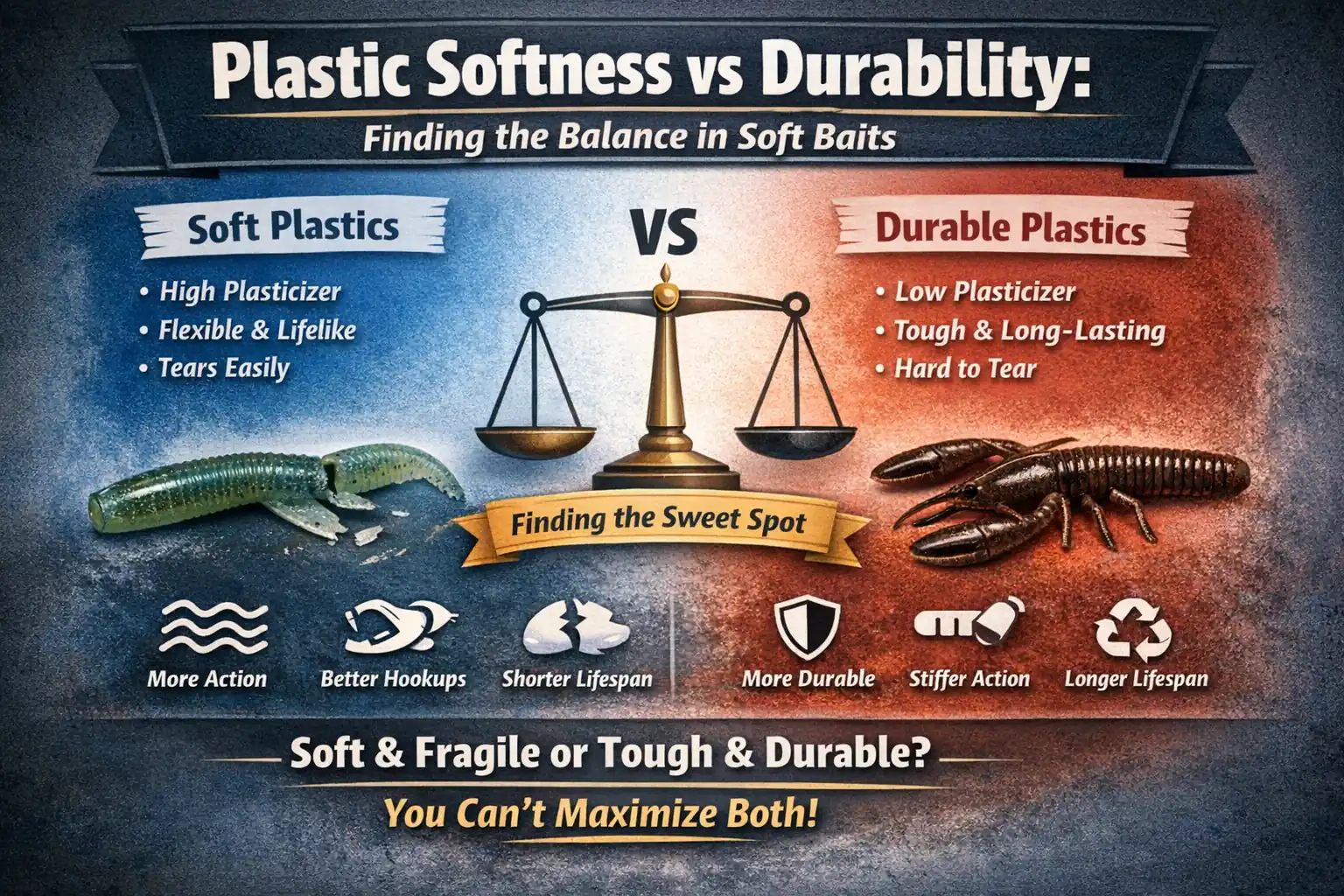
This is why finesse and soft-plastic anglers get good hookups on light wire and subtle bites: the bait gets out of the hook’s way. It’s also a real trade-off lever — the softer the bait collapses, the better it hooks, but the easier it tears Why Soft Plastic Baits Tear. Action and hookups and durability all pull on the same softness dial.
Why the Same Bait Swims Differently Fast vs. Slow
Ever notice a bait that looks perfect at a slow crawl turns into a stiff, lifeless dart when you speed up — or a bait that’s dead slow but comes alive fast? That’s not in your head, and it’s not only about water force. Viscoelastic materials have a weird, important trait: the faster you flex them, the stiffer they act. Flex one slowly and it’s soft and yielding; flex it fast and that same material resists more, behaving stiffer than it “really” is.
So when you speed up your retrieve, two things happen at once: the water pushes harder (more force), and the faster flexing makes the plastic itself act stiffer. Both change the action. A bait tuned soft and lively at a slow crawl can go rigid and narrow-actioned when you burn it; a beefier bait that’s dead slow can need that speed to wake up. The practical takeaway: every bait has a speed window where its action is best, and finding that window is part of fishing it well. When a bait “isn’t working,” the fix is often retrieve speed, not a new bait — you’re hunting for the speed where its viscoelastic character and the water force line up.
Your Twitch Cadence Has a Speed Limit
There’s a flip side to the spring-and-fluid behavior that governs how fast you should work a bait. After you twitch the rod and the bait flexes, it needs a moment to spring back to shape before it can perform the next move — and because of the fluid half, that recovery isn’t instant. It takes a beat to settle.
That recovery time sets a hidden speed limit on your cadence. Twitch again before the bait has sprung back, and the second move starts from a half-collapsed bait — the actions blur together into a shapeless mush, and the bait stops looking like anything. Give it that beat to recover, and every twitch reads as a clean, distinct dart or kick. This is why a snappy, springy bait can be worked with a fast, aggressive cadence and still look crisp, while a soft, heavily damped bait wants a slower, more deliberate rhythm — work the lazy bait too fast and you’re just stirring it. Matching your cadence to the bait’s recovery speed is one of the quiet skills that separates anglers who make a bait “talk” from those who just drag it. When a soft bait looks frantic and unconvincing, slow your hands down and let it finish each move.
The Quality of the Motion Is Tunable, Too
Two baits can be equally soft and still move completely differently — one with a crisp, snappy kick, another with a lazy roll, another a dead mush. That’s because the damping (how much the fluid half soaks up) can be tuned somewhat independently of the raw softness. In plastisol, the type of softener used — not just how much — shifts how much energy the material dissipates per flex, which changes the character of the motion: snappy and lively, or smooth and slow, or sluggish. So “soft” isn’t a single thing. There’s soft-and-snappy and soft-and-lazy, and a maker chasing a specific action is really tuning the damping, not just the softness. (
How to Feel and Test Action at Your Bench
You can read a bait’s viscoelastic character with your hands and a tabletop, before it ever touches water.
The squeeze-and-release test. Pinch the bait and let go, and watch how it returns. A lively, well-balanced bait springs back with a little life and settles smoothly — that’s a good spring/fluid balance. If it snaps back hard and almost quivers, it’s leaning too elastic (it’ll feel “rubbery” and ring rather than swim). If it just slowly oozes back or stays dented, it’s too far toward dead/mushy and won’t generate repeating action. You’re feeling the two halves fight, and you want them balanced.
The drop-and-settle test. Hold the bait by one end, give it a little shake, and stop. Watch how it settles. Lifelike plastic quivers briefly and eases to rest — a natural decay. Too-stiff plastic buzzes or holds rigid; too-dead plastic flops once and quits. This is the damping you’re seeing, and it directly predicts how “alive” the bait looks moving through water.
The fall test (in a clear jug or tank). Drop the bait in water and watch it fall. Note the speed, the glide, whether the tail flutters on the drop, how it orients at rest. This is the fall action you can’t feel dry, and it’s a huge part of how the bait fishes.
The speed-window test (on the water). Same bait, same spot, vary only the retrieve speed from a crawl to a burn, and watch where the action looks best. Write down the window. You’re mapping where its viscoelastic stiffness and the water force line up.
As always: change one thing at a time, compare against a control, and keep a notebook. “Softer batch — snappier kick but washes out above medium speed” is worth more than any spec.
Diagnose the Feel
What the bait’s motion is telling you:
- Hangs dead, no life even when worked. Too stiff (too little plasticizer) or too cold — the spring can’t respond to the water. Soften it, or fish it where it’s warmer.
- Rubbery, buzzy, rings instead of swimming. Leaning too elastic with too little damping — the motion is mechanical, not organic. A damping/softener adjustment smooths it toward “alive.”
- Mushy, no rebound, one flop and done. Too far toward the fluid side — not enough spring to make the action repeat. Firm it up slightly.
- Great slow, dies fast (or vice versa). Normal viscoelastic speed-stiffening. Not a flaw — find the bait’s speed window instead of fighting it.
- Lost its life after a season in the box. The plastic aged and stiffened as it lost plasticizer over time — an older bait genuinely has less action than a fresh one.
The Bottom Line
A soft plastic comes alive because it’s viscoelastic — part spring, part fluid — the same mechanical nature as living flesh, which is why it moves like prey instead of like a painted object. The spring half makes the action happen; the fluid half makes it look alive instead of mechanical; the fall adds action you’re not even working for; the softness lets it collapse and hook fish; and because the material stiffens with speed, every bait has a speed window where it shines. The Why Soft Plastic Lures Bend told you where a bait bends; this is how that bend becomes lifelike movement. Put shape, material, and how you fish it together, and you stop hoping a bait has action — you understand exactly where it comes from.
The deeper layer under all of this — what plastisol actually is, and how the formula sets the softness, damping, and density that drive everything here — lives on the the Science of Plastisol hub.
Frequently Asked Questions About Soft Plastic Lure Action
What gives a soft plastic lure its action?
Soft plastic lure action comes from the interaction between the lure’s material, shape, thickness, length, and the forces acting on it in the water. A lure moves not because it is simply soft, but because water pressure bends flexible parts of the bait and creates motion.
Why do soft plastic lures look alive underwater?
Soft plastic lures look alive because they deform and recover in a way that resembles living tissue. Unlike hard baits, soft plastics can flex, pulse, undulate, and compress as they move through the water, creating more natural movement.
What is viscoelasticity in a soft plastic lure?
Viscoelasticity is the ability of a material to behave partly like a spring and partly like a fluid. The spring component helps a lure snap back toward its original shape, while the fluid component creates smooth, flowing movement. Together, these properties give soft plastics their lifelike action.
Does softer plastic always create better action?
No. Shape usually has a greater effect on lure action than softness alone. A well-designed bait made from moderately soft plastisol often produces more action than a poorly designed bait made from extremely soft plastic.
Why do some soft plastic lures move more than others?
Lures move differently because of variations in shape, thickness, length, tail design, body profile, and material properties. Thin sections bend more easily, while thicker sections resist movement and create a different action profile.
What role does water resistance play in lure action?
Water resistance is the force that causes a lure to bend and move. The more water a tail, appendage, or body section pushes against, the more force is available to create action. Without water resistance, there would be little or no lure movement.
Is plastisol the best material for soft plastic lure action?
Plastisol offers a balance of flexibility, durability, and lifelike movement that has made it the most widely used soft bait material. Other materials such as TPE and ElaZtech-style elastomers can produce excellent action as well, but they often move differently because of their unique material properties.
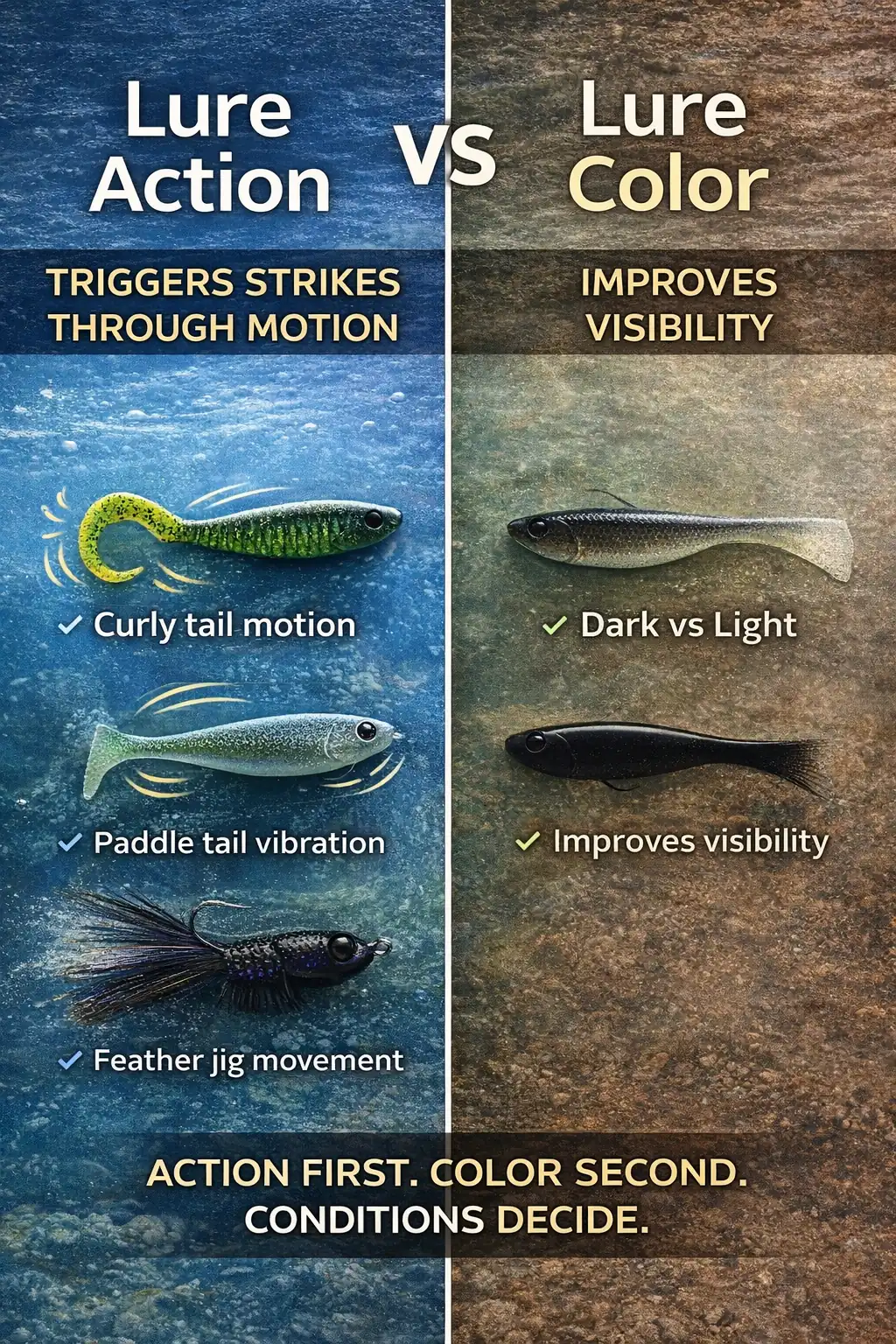
Does lure action matter more than color?
In many situations, yes. Fish often detect movement before they distinguish color. While color can influence strike decisions, natural and convincing action is frequently what first attracts a fish’s attention.
Can lure shape change action more than lure material?
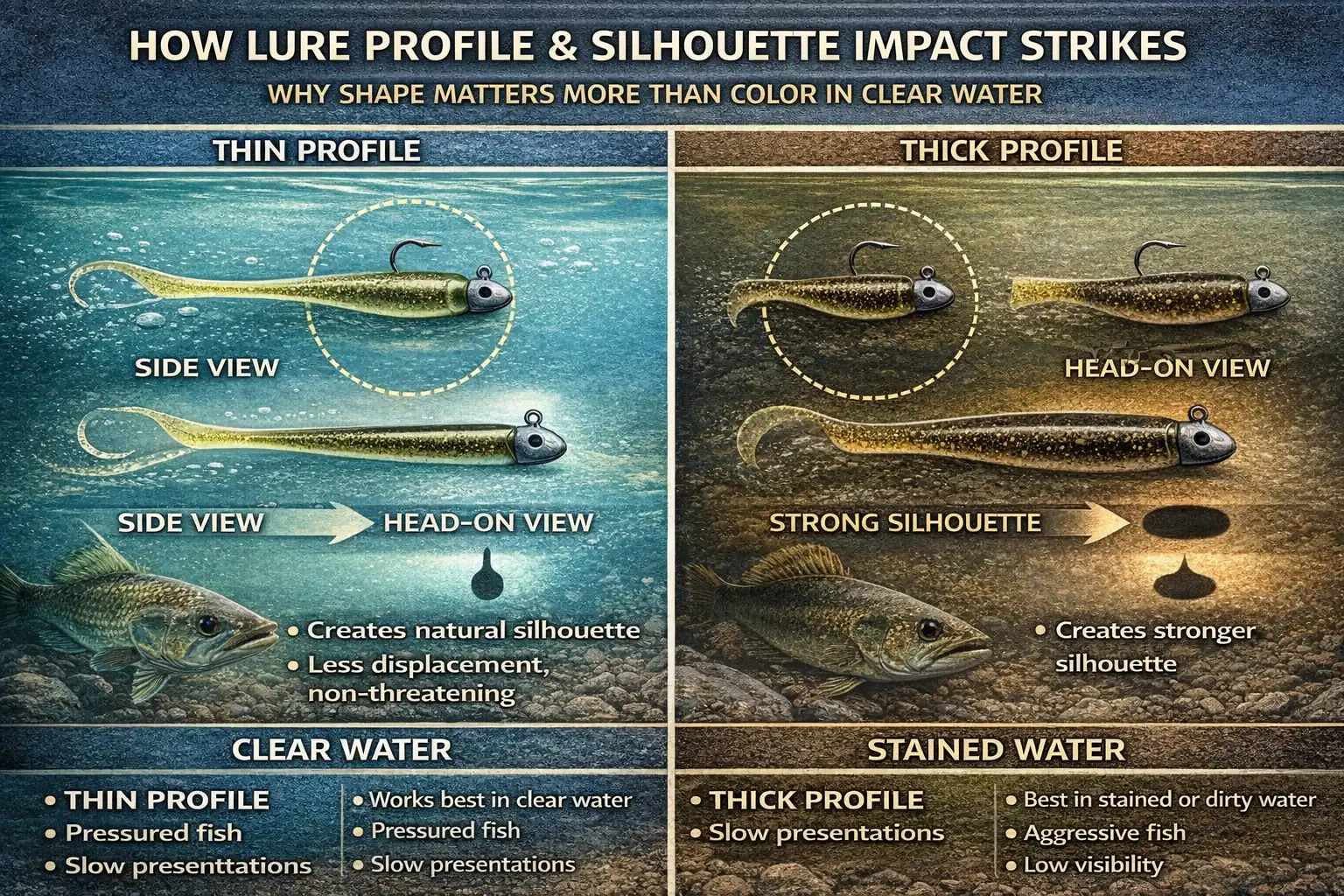
Yes. Small changes in thickness, tail design, body profile, or length can dramatically change how a lure behaves in the water. In many cases, shape has a greater influence on action than the specific material used to make the bait.
Why do different soft plastic lures have different types of action?
Every lure is designed to achieve a specific balance between stability, vibration, tail movement, body roll, and water displacement. Different shapes and materials create different action signatures, allowing anglers to match various fishing conditions and forage types.
About Family Fishin
Family Fishin is a family-owned fishing tackle company dedicated to designing, testing, and producing high-quality fishing lures — inspired by generations of fishing tradition and driven by a passion for innovation. Every product is developed with one goal in mind: helping anglers spend more time doing what they love, catching fish and creating memories on the water.
Tags: #soft plastics #lure action #lure making #bait design #plastisol #DIY lures #finesse fishing #viscoelastic