Why D3 Jig Heads Wobble on the Fall
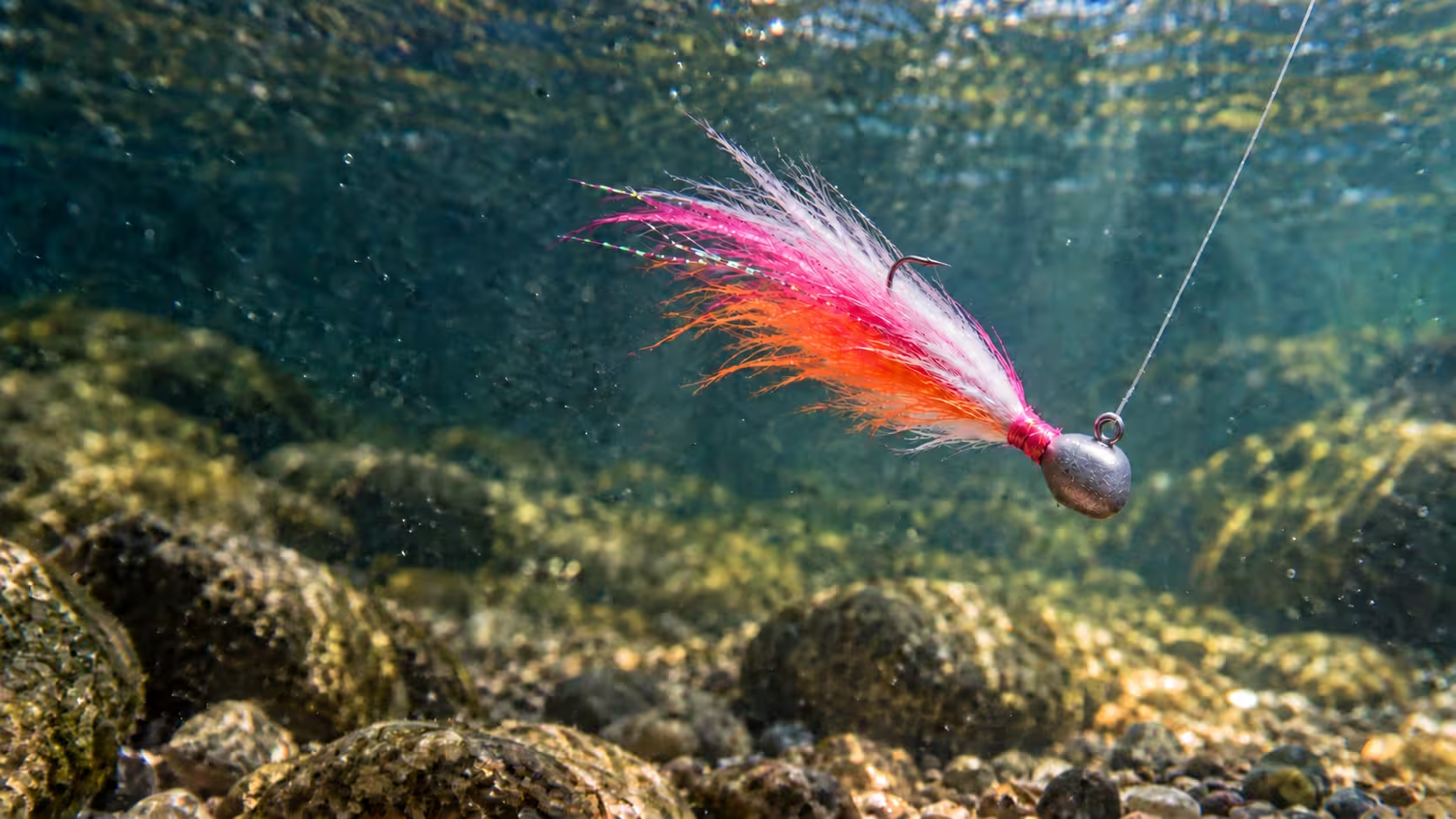
The D3 jig head wobble begins with a simple design choice: one side of the head is lighter than the other. As the jig falls, its uneven balance and the changing push of the water can make the head lean, roll, curve, or slowly circle instead of dropping in a perfectly straight line.
The D3 is made lighter on one side on purpose. As it falls, its uneven weight and the push of the water make it difficult for the head to stay straight. It may lean, roll, wobble, curve, or slowly circle as it sinks.
The D3 is especially suited to tied jigs made with marabou, feathers, hair, flash, thread, or similar materials. Those flexible materials do more than add color. They bend, open, close, trail behind the head, and continue moving after the head changes direction. Knowing why that happens helps you tie and fish the jig correctly. It also explains why a tight line can reduce the wobble and why fish often bite during the fall.
This guide explains what creates the wobble, how tying materials change it, how to fish the D3, and what to check when its action does not look right.
What Is a D3 Jig Head?
The Family Fishin D3 is an uneven, or asymmetrical, jig head. “Asymmetrical” simply means the two sides are not the same. One side contains less material, so it is lighter. That changes the balance of the whole head.
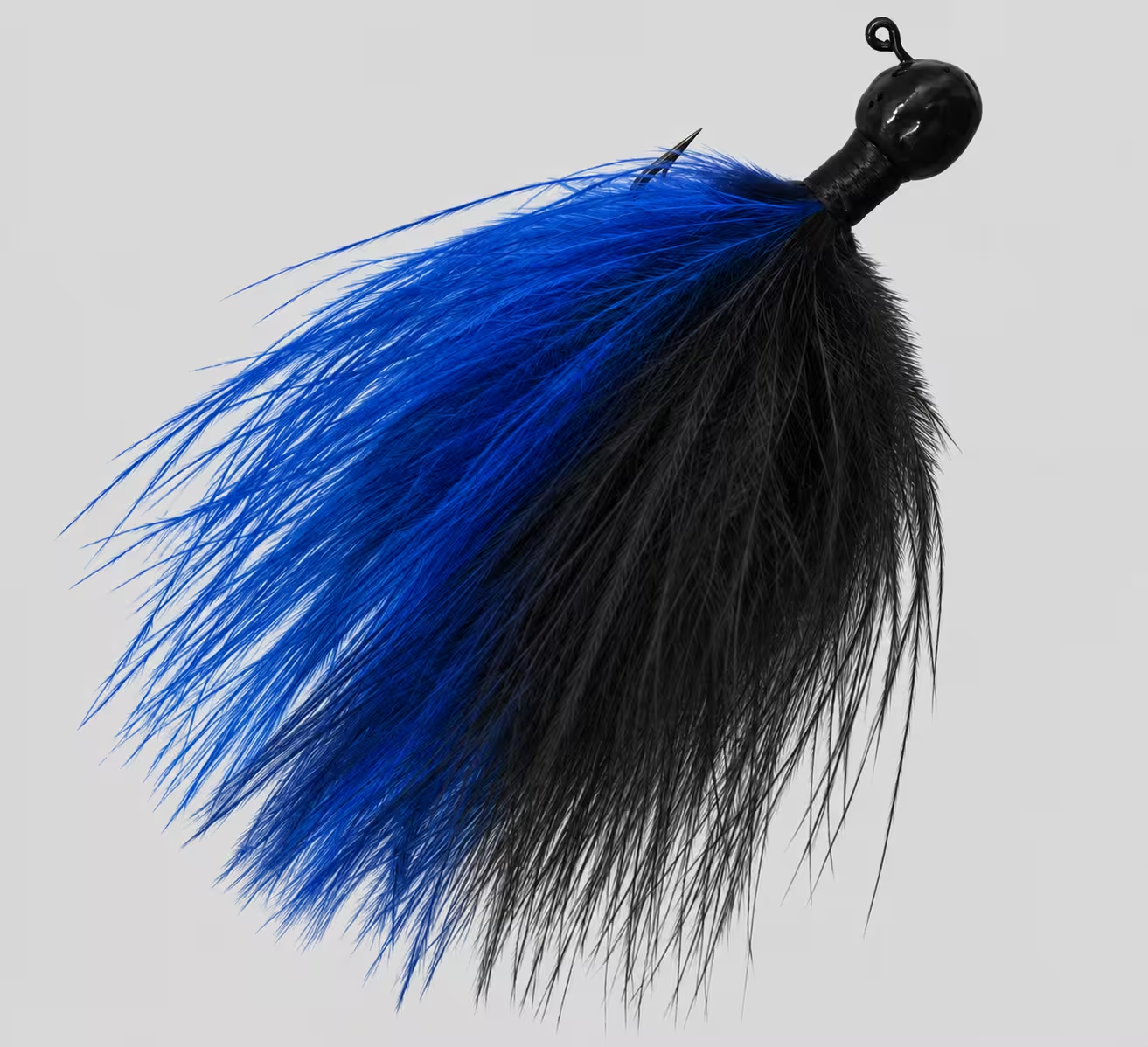
An ordinary round head has about the same amount of material on both sides. The hook, tied body, line, or current can still make it turn, but the head itself does not strongly cause an uneven fall.
The D3’s unequal sides react differently as gravity pulls down and water pushes back.
That uneven balance is there on purpose. It is meant to make the jig move while it falls.
The jig will not follow the same path on every cast. Its movement changes with the tied material, water, and pull from the line.
The Science Behind the D3 Wobble
The science may sound complicated, but the main idea is simple: the D3 is uneven, gravity pulls it down, and water pushes against it as it falls.
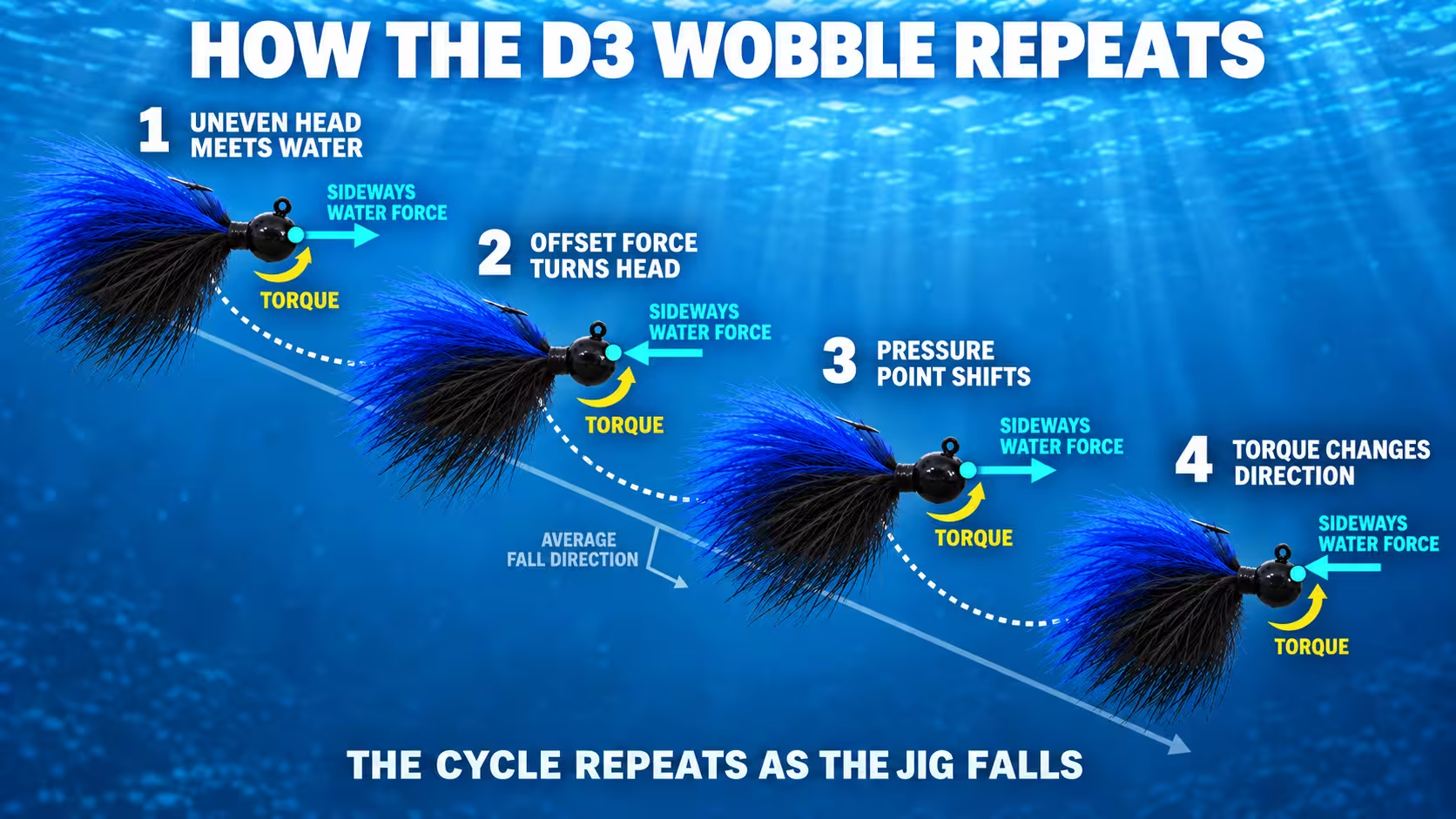
The uneven head starts to turn. As it turns, a different part of the head faces the water. The push of the water changes, slowing the first turn and sometimes starting a turn in the other direction. When that happens again and again, we see a wobble.
The Jig Is Moving Through Water, but Water Is Also Moving Around the Jig
A jig does not have to be in a flowing stream to feel moving water. When a D3 sinks through still water, the jig moves down and the water must move around it. From the jig’s point of view, water is flowing upward past the head.
This is called relative motion. It simply means that movement depends on what you are comparing. A person sitting in a moving boat feels air coming toward them even on a calm day. In the same way, a falling jig meets water even when the lake itself appears still.
In a river or creek, both kinds of movement happen at once. The jig falls while the current also carries it sideways. That makes the water meet the head at a different angle and can change the wobble.
Four Things Push or Pull on the Jig
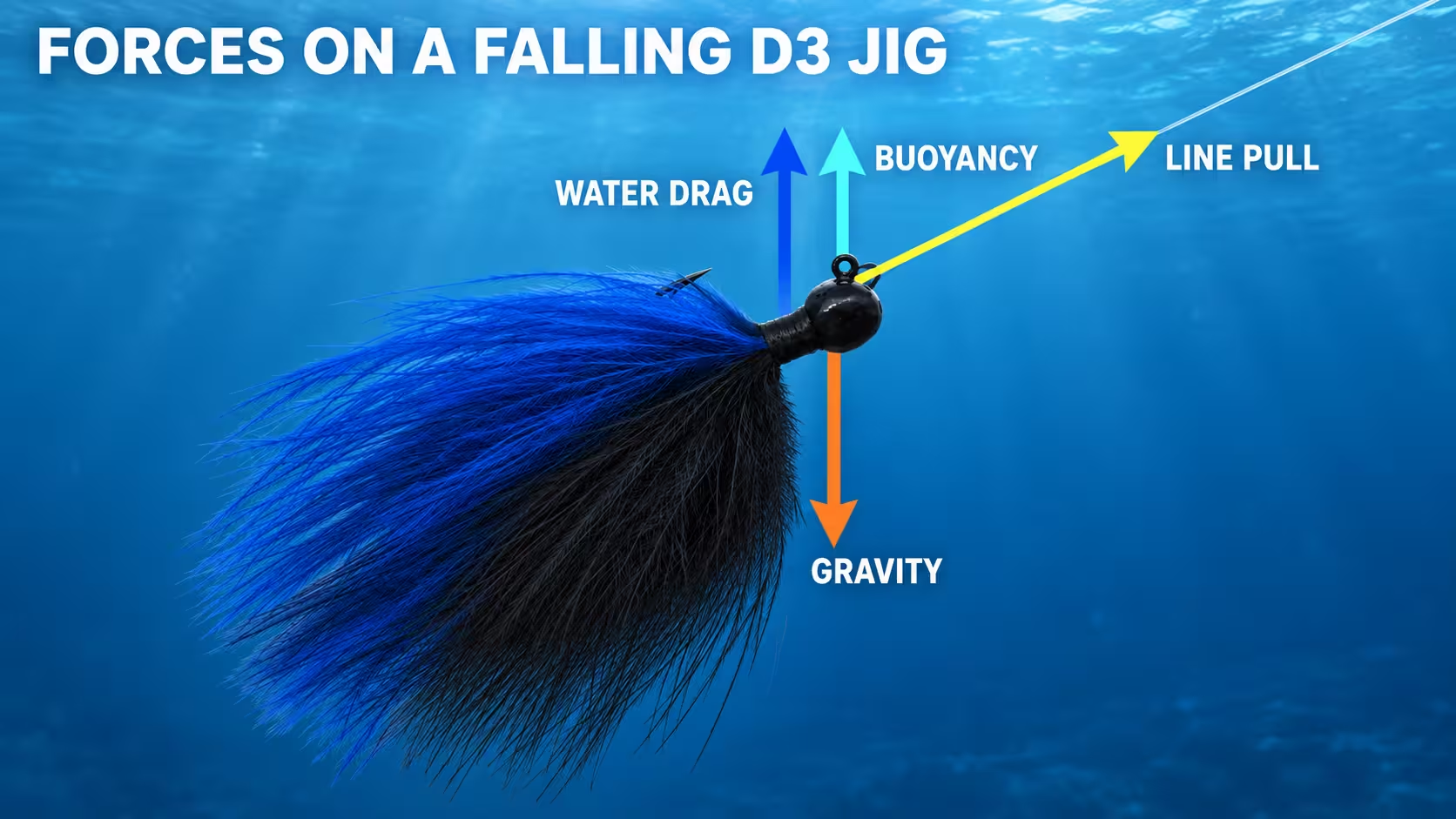
Four main things affect a falling D3:
- Gravity pulls the jig down.
- Water pushes against the head, hook, and tied material.
- The fishing line pulls from the line eye.
- The hook and tied material change the balance and slow the fall.
Think about dropping a spoon into water. It may lean, flutter, turn, or slide because its shape is not equal in every direction. The D3 follows the same basic rule: its uneven shape gives the water an uneven surface to push against.
Formula 1: The Pull of Gravity
The first formula is the easiest:
Weight force = mass × gravity
Fg = m × g
Here is what the letters mean:
Fgis the downward force caused by gravity.mis the mass of the complete tied jig.gis the pull of gravity.
Mass means how much matter is in the jig. In everyday fishing language, a jig with more mass is a heavier jig. Gravity pulls every part downward: the head, hook, thread, and wet tying material.
The pull of gravity is nearly constant during a cast. If the complete jig has twice the mass, gravity pulls down with about twice the force. That is why a heavier jig generally sinks faster than a lighter jig when their shapes are similar.
This formula explains the downward pull, but it does not explain the entire fall. Water also pushes upward and against the moving jig.
Formula 2: The Upward Push of Water
Water gives every submerged object an upward push called buoyancy. The formula is:
Buoyant force = water density × displaced water volume × gravity
Fb = ρ × V × g
The unfamiliar-looking letter ρ, pronounced “rho,” simply means density. Density tells us how much matter is packed into a certain amount of water.
Fbis the upward buoyant force.ρis the density of the water.Vis the volume of water pushed aside by the jig.gis gravity.
The main lesson is simple: the more water an object pushes aside, the stronger the upward push. A metal jig is much denser than water, so buoyancy does not make it float. It does slightly reduce the downward force that remains available to make the jig sink.
Fresh water and salt water do not have exactly the same density. Salt water is denser, so it provides a little more upward push. For most small freshwater jigs, tied-material drag has a more noticeable effect than this small difference, but buoyancy is still part of the complete science.
The Two Balance Points Do Not Match
Two imaginary points help explain what happens next.
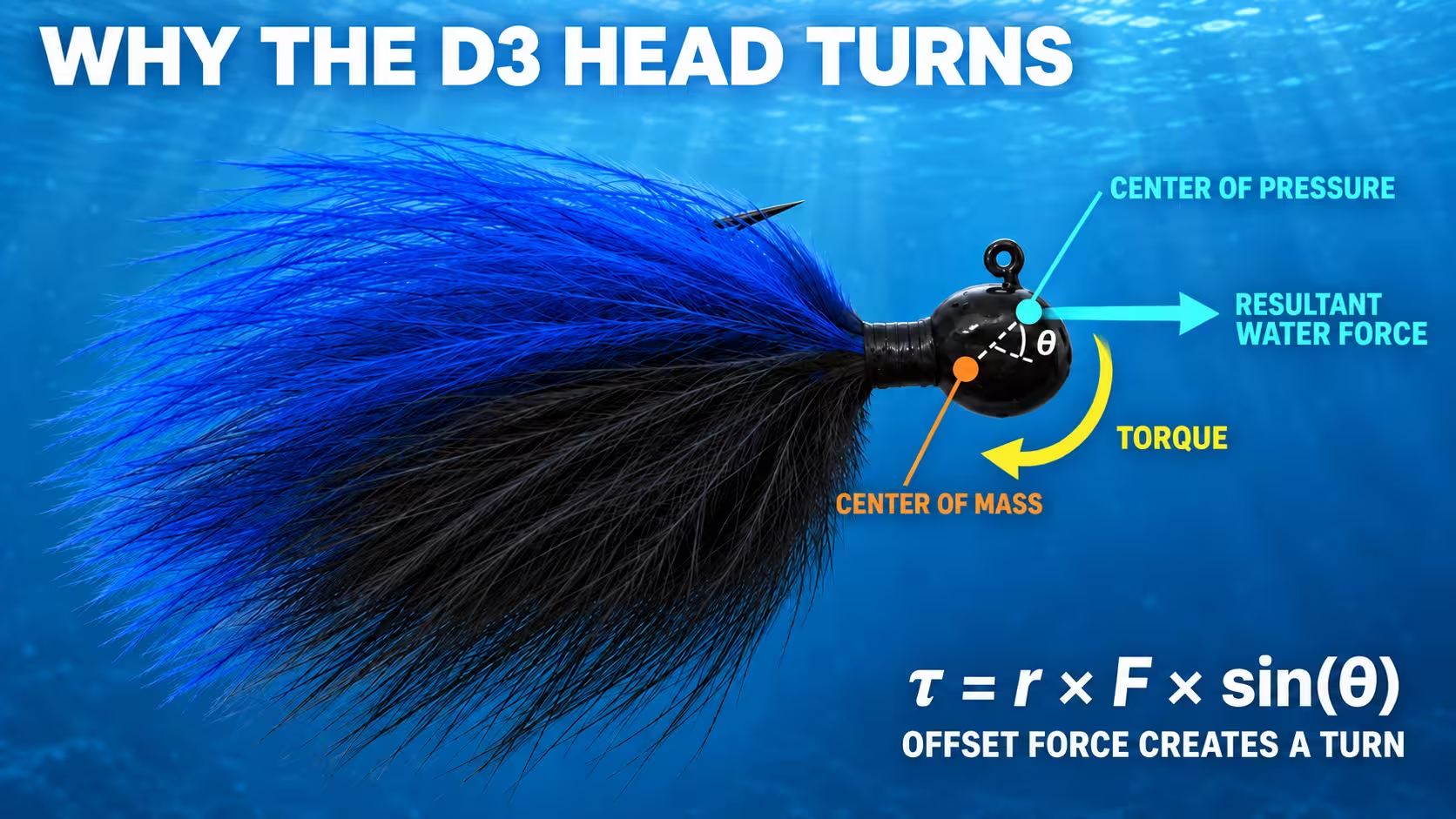
The first is the center of mass, which simply means the balance point of the jig’s weight. Because one side of the D3 has less material, this point sits closer to the heavier side.
The second is the center of pressure. This means the average spot where the water’s total push acts on the head. That spot can move as the head changes angle.
The two points do not always line up. Imagine pushing a door near its hinges and then near its handle. The same push turns the door more easily at the handle because the push is farther from the hinge.
Water can turn the D3 in a similar way. When the water pushes away from the jig’s balance point, it creates a twist. Scientists call that twisting force torque. Torque is what starts the head leaning, rolling, or turning.
Formula 3: The Turning Force
The basic torque formula is:
Turning force = water force × distance from the balance point × angle effect
τ = r × F × sin(θ)
The symbols look harder than the idea:
τ, pronounced “tau,” means torque, or turning force.ris the distance between the jig’s balance point and the place where the water’s push is centered.Fis the amount of force from the water.θ, pronounced “theta,” is the angle between the direction of the push and the line back to the balance point.sin(θ)is simply the part of the push that actually creates a turn.
Think about the door again. A push near the hinge gives us a small r, so it creates little turning force. A push near the handle gives us a larger r, so it turns the door more easily.
The angle matters too. Pushing directly toward the hinge does not swing the door very well. Pushing sideways does. In the same way, not all water pressure turns the D3. Only the part of the push acting in a useful direction and away from the balance point creates the strongest turn.
The lighter side of the D3 changes where the head balances. As the jig changes angle, the center of water pressure also moves. That keeps changing r, F, and the angle in the torque formula. The turning force can grow, become smaller, disappear for a moment, and then act in the opposite direction. That changing torque is at the heart of the wobble.
How Quickly the Jig Begins to Turn
A second short formula connects torque to turning motion:
Turning acceleration = torque ÷ resistance to turning
α = τ ÷ I
α, pronounced “alpha,” means how quickly the turning speed changes.τis the turning force we just explained.Iis the object’s resistance to being rotated. Scientists call it the moment of inertia.
Moment of inertia is not just weight. It also depends on where the weight is located. Weight spread farther from the turning center makes an object harder to start or stop rotating. A figure skater shows this clearly: spinning slows when the arms move outward and speeds up when the arms pull inward.
On a tied D3, the head, hook, thread, wet fibers, and any added flash all contribute. Long or water-heavy material can make the whole jig more resistant to quick changes in rotation. That can turn a sharp wobble into a slower, smoother one.
This is the basic turning formula. In water, drag and the water being moved around the jig add even more resistance to rotation. The formula shows why more torque encourages a quicker turn while more resistance produces a slower turn.
Wobble, Roll, and Swing Are Not Exactly the Same
A jig can turn in three basic ways. Picture three invisible lines passing through the jig from front to back, side to side, and top to bottom.
Roll is the head tipping from side to side, much like a boat rocking on waves.
Pitch is the nose or hook tipping up and down, much like a seesaw.
Yaw is the jig turning left or right, much like changing the direction of a car.
The movement we casually call a wobble may contain all three. The D3 may roll first, turn slightly to one side, and then tip as the line or tied material pulls on it. That is why one fall may look like a gentle wobble while another looks like a curve, flutter, or slow spiral.
These movements also affect one another. A small roll changes the surface facing the water. That can produce a turn. The turn changes how the tied material trails behind the head, and that new pull can change the roll again.
Why the Head Turns Back the Other Way
As soon as the D3 changes position, a different surface meets the water. A side that was partly protected may now face the flow. The water then pushes from a new direction. That new push can slow the turn and begin moving the head back the other way.
The jig may pass the middle before it settles, so water pushes it back again. It is similar to a playground swing passing through the middle before changing direction. The jig also keeps moving briefly before the water stops and reverses it. That tendency to keep moving is called momentum.
Researchers have observed the same broad kind of behavior in many uneven objects moving through a fluid. Depending on shape, balance, speed, and starting position, an object may settle into a repeated flutter, tumble continuously, or follow a less regular path. A D3 is not a flat test plate, so those studies do not give us an exact D3 wobble. They do support the basic science: shape, balance, rotation, and changing water forces can create repeated side-to-side motion.
Why Speed Changes the Wobble
Water pushes harder against an object as the object moves faster. Move your open hand slowly through water and then quickly. The faster movement takes much more effort.
Scientists call this push drag.
Formula 4: Water Drag
The common drag formula is:
Drag = one-half × water density × drag coefficient × front-facing area × speed squared
Fd = ½ × ρ × Cd × A × v²
Here is what each part means:
Fdis the force of water drag pushing against the motion.ρis the density of the water.Cdis the drag coefficient, a number that describes how easily water moves around the shape.Ais the area facing the moving water.v²means speed multiplied by itself.
The most important part for an angler is v². If speed doubles while everything else remains similar, drag becomes about four times stronger. If speed triples, drag can become about nine times stronger. A small increase in speed can therefore create a much larger push from the water.
The area A also helps explain tied-jig action. When marabou opens, more material faces the water, so the effective area becomes larger. When the fibers fold backward, the effective area becomes smaller. Because the material keeps changing shape, the drag also keeps changing.
The drag coefficient Cd tells us that shape matters in addition to size. A broad, blunt shape catches water differently from a narrow, smooth shape with the same area. A full marabou body, a sparse hair tie, and a few strands of flash can therefore behave differently even if they have similar lengths.
At the beginning of a fall, the D3 is moving slowly. As it speeds up, the water pushes harder. Soon, the upward push of the water and the downward pull of gravity come closer to balancing. The jig then settles toward a more even falling speed. This is why a jig does not continue speeding up all the way to the bottom.
For a jig falling with very little pull from the line, we can place the three main up-and-down forces into one plain formula:
Net downward force = gravity − buoyancy − drag
Fnet = Fg − Fb − Fd
“Net” means what remains after the forces working in opposite directions are combined.
- At the start of the fall, speed is low, so drag is low. Gravity wins and the jig speeds up.
- As the jig moves faster, drag grows quickly because speed is squared.
- Eventually, buoyancy and drag nearly equal gravity. The net force approaches zero, so the jig falls at a more even speed.
This more even speed is often called terminal speed. It does not mean the jig has stopped. It means the jig is no longer speeding up very much.
The jig may still wobble at terminal speed because the forces on its two sides keep changing. The total downward forces may be close to balanced while the turning forces are still shifting from side to side.
A tight line, sideways current, or rod movement adds more forces than this simple up-and-down formula shows. Those extra pulls help explain why the same tied jig can fall differently from one cast to the next.
A lighter tied jig normally falls more slowly than a heavier one. A full marabou body also slows the fall because it gives the water more to push against. A slower fall can make the wobble softer and give the fibers more time to open. A faster fall may make the head’s changes in direction sharper. Neither is always better; they are different presentations for different fish and conditions.
The Water Must Be Moved Out of the Way
When the D3 starts moving or suddenly turns, it must also start moving some of the water around it. Scientists sometimes describe this as added mass. The jig does not actually become heavier, and no water is permanently attached to it. The phrase means that the head must spend some of its energy pushing nearby water into motion.
This helps explain why motion underwater looks smoother and slower than the same motion in air. Water is much denser than air. When the head changes direction, the surrounding water resists that change. That resistance can soften a sharp movement and help turn it into a rounded wobble.
The tied fibers must also move nearby water. A bundle of marabou does not snap open and closed without resistance. Each fiber pushes a small amount of water, and all those tiny pushes add up.
The Small Swirls Behind the Head
Watch water flow around a rock in a stream. The flow separates around the rock and forms a disturbed area behind it. This is called a wake.
A jig head also leaves a wake. Because the D3 is uneven and keeps changing angle, that wake can shift from one side to the other. Small spinning areas of water, called vortices, may form and move away from the head. A vortex is simply water turning in a small circle, like a tiny whirlpool.
When a swirl leaves one side of an object, the pressure around that side changes. A later swirl may leave from the other side. These changing pressure differences can add to a repeated rocking or turning motion. Research on fluttering and turning objects shows that rotation and wake movement can be closely connected.
The formulas do not tell us that a certain number of swirls must form during each wobble. They do tell us that an uneven, turning head changes the flow and pressure around itself. That disturbed water can then push back on the head.
Why Tied Material Changes the Movement
A D3 is normally fished as a tied jig, so the head is only the beginning of the moving system. Marabou, feathers, hair, flash, chenille, thread, and the hook all affect what happens.
Flexible material bends with the water instead of remaining stiff. Scientists call this reconfiguration, but the idea is easy to understand. Hold a stiff board in a current and the whole broad surface catches the water. Hold a bundle of soft grass in the same current and the strands bend backward, becoming narrower. Tied fibers do something similar.
At the beginning of a fall, the material may open and catch more water. As the jig gains speed, the fibers bend backward and become more streamlined. “Streamlined” simply means the water can pass around the shape more easily. When the head slows, turns, or pauses, the fibers can open again.
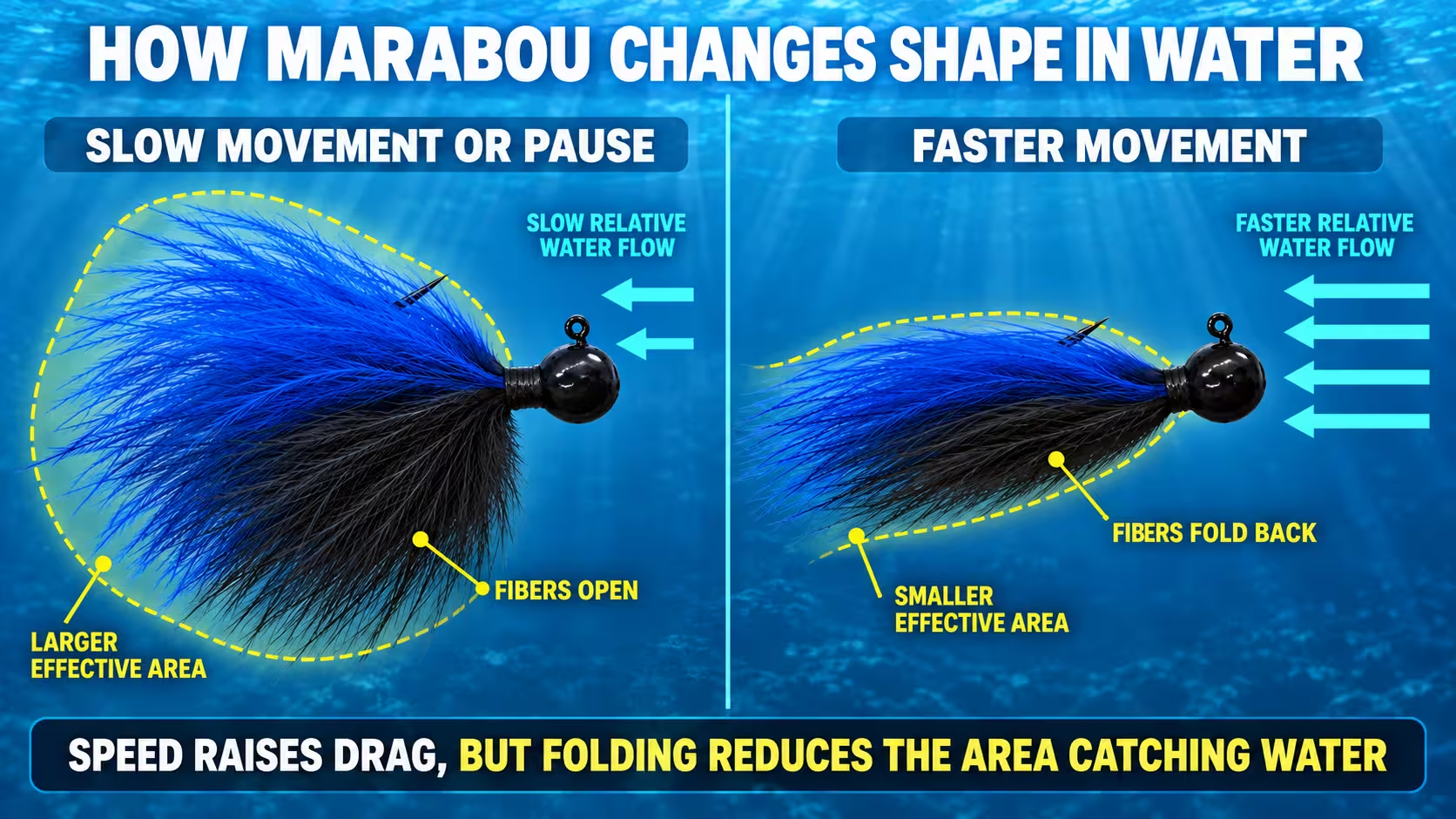
This creates a living-looking change in size. The tied body may appear fuller during one part of the fall and thinner during another. The material does not need a motor or moving joint. Water pressure and the flexibility of the fibers create the motion.
The Fibers Move a Moment After the Head
Tied material does not always change direction at the exact instant the head does. The head may turn first while the soft fibers continue traveling in their old direction for a moment. Then the fibers bend and follow.
That short delay is called lag. You can see the same idea when someone quickly moves the handle of a soft paintbrush. The handle changes direction first, while the bristles bend and catch up afterward.
This lag can make a tied D3 look alive. The head moves, the material follows, and then the fibers may continue closing or opening after the head has already slowed. A fish may therefore see more than one movement from a single lift or fall.
The amount of lag depends on the material. Soft marabou moves easily and responds to small changes. Stiffer hair usually holds its shape more strongly. Flash material may bend differently and reflect light as its angle changes. A fuller tie catches more water, while a sparse tie lets the head control more of the action.
The Tie Can Stabilize or Increase the Wobble
Tied material does not always increase wobble. Sometimes it acts like the feathers on an arrow and helps the jig point in one steady direction. This is more likely when the material is long, stiff, heavy when wet, or unevenly tied.
At other times, a soft and balanced tie slows the fall without completely stopping the head from changing direction. The head wobbles, the fibers lag behind, and both parts add motion.
An off-center tie can pull harder on one side. That may create a steady curve or continuous spin instead of a side-to-side wobble. The shape of the D3 starts the movement, but the tied body decides how much of that movement remains visible.
Why the Line Matters
The fishing line is another part of the system. A tight line acts like a leash. It pulls from the line eye, points the head toward the angler, and limits how freely the jig can turn. A little controlled slack gives the D3 room to move.
The line itself is also pushed by water and wind. Thick line has more surface for the water to push against. A long cast puts more line in the water than a short cast. Either can pull on a light tied jig and change its fall.
This is why the D3 cannot have one guaranteed wobble on every drop. The head, tied material, hook, line, current, and angler all affect the result.
Fish Can Feel Some of the Water Movement
Fish do not depend only on eyesight. Along the sides of many fish is a sensing system called the lateral line. It contains small sensors that respond to nearby water movement and pressure changes.
Laboratory research has shown that fish can detect flowing water and repeating vortex patterns with this system. That does not prove that a fish can identify a D3 by its exact wake. It does mean that the water movement produced by a moving jig can be part of what a fish notices, especially in dim, stained, or moving water.
The visible movement and the water movement work together. The head changes direction, the tied fibers open and close, flash changes angle, and the entire jig leaves disturbed water behind it.
What the Formulas Tell Us
The formulas explain the cause-and-effect relationships behind the D3’s movement.
- More mass creates more downward force.
- More displaced water creates more buoyancy.
- More speed, area, or resistance to flow creates more drag.
- Water pushing farther from the balance point creates more turning force.
- Weight spread farther from the turning center makes quick rotation harder.
- A tight line adds another pull that can guide or steady the head.
- Flexible tied fibers keep changing the area and shape presented to the water.
The formulas also explain why there is no single fixed answer for every D3. Values such as front-facing area, drag coefficient, water force, and angle change throughout the fall. Marabou opens and closes. The head turns. The line becomes tighter or looser. Current changes the direction of the water meeting the jig.
For that reason, the equations are best used to understand what happens when one part changes. More material usually increases drag. A fuller wet tie usually slows the fall. Greater line tension usually reduces freedom. An off-center tie can add one-sided torque. These relationships are more useful to an angler than pretending the D3 follows one exact numerical path on every cast.
A Worked Math Example for Jig-Head Designers
The following example shows how someone can use the formulas while designing or comparing jig heads. These are sample numbers for a made-up jig, not measurements of a Family Fishin D3. The purpose is to teach the method.
Jig weights are given in ounces first, with grams in parentheses. The formulas briefly convert that weight to kilograms because kilograms, meters, and newtons work together without extra conversion factors. Final speeds are converted back into inches per second.
Why the Formulas Change to Metric Units
American anglers normally describe jig weight in ounces and size in inches. That is how the design should be introduced and how the final result should be reported.
Physics formulas are easier to use in the metric system because the units are built to work together. When mass is entered in kilograms, distance in meters, and time in seconds, the force answer comes out in newtons. No hidden conversion number is needed inside the formula.
This does not mean a jig designer must think in metric measurements all day. It means the familiar measurements are converted before they enter the formula and converted back afterward.
The process is:
- Measure or describe the jig in ounces and inches.
- Convert those measurements to the metric units required by the formula.
- Complete the calculation.
- Convert the answer back to ounces, inches, or inches per second when that makes the result easier to understand.
The Basic Conversion Numbers
These are the main conversion numbers used in jig-head calculations:
1 ounce = 28.3495 grams1 ounce = 0.0283495 kilogram1 gram = 0.001 kilogram1 inch = 25.4 millimeters1 inch = 0.0254 meter1 square inch = 645.16 square millimeters1 square inch = 0.00064516 square meter1 cubic inch = 16.3871 cubic centimeters1 cubic inch = 0.0000163871 cubic meter1 pound per cubic foot = 16.0185 kilograms per cubic meter1 foot = 0.3048 meter1 meter per second = 39.3701 inches per second1 inch per second = 0.0254 meter per second1 ounce-force = 0.278014 newton1 ounce-inch of torque = 0.00706155 newton-meter
The words square and cubic are important. Area is measured in square units, while volume is measured in cubic units. Converting one inch to meters is not the same as converting one square inch to square meters.
Converting Jig Weight From Ounces to Kilograms
Jig weight may be listed as 1/64 ounce, 1/32 ounce, 1/16 ounce, or another familiar fraction. The gravity formula needs mass in kilograms.
Use:
Kilograms = ounces × 0.0283495
For a 1/32-ounce jig:
1 ÷ 32 = 0.03125 ounce
0.03125 × 0.0283495 = 0.0008859 kilogram
Rounded for the example:
1/32 ounce (0.89 gram) ≈ 0.000886 kilogram
The gram value is included in parentheses because many small-jig scales display grams. The kilogram value is used only because the force formula requires it.
Mass Ounces and Ounce-Force Are Different
An ounce printed on a jig package describes mass in everyday fishing use. A force formula needs either kilograms of mass or a true force unit.
An ounce-force is the amount of force gravity applies to one ounce of mass near Earth’s surface. One ounce-force equals about 0.278014 newton.
Keeping those meanings separate prevents a common mistake. Do not place a jig’s ounce number directly into a formula that expects kilograms or newtons.
Converting Length From Inches to Meters
Torque calculations use the distance between the balance point and the center of water pressure. A designer may measure that distance in inches, but the torque formula uses meters.
Use:
Meters = inches × 0.0254
For example, 0.059 inch is about 1.5 millimeters:
0.059 × 0.0254 ≈ 0.0015 meter
A distance of 0.020 inch is about 0.5 millimeter:
0.020 × 0.0254 ≈ 0.0005 meter
These numbers are small because a jig head is small. The zeros do not make the distance unimportant. As the torque example later shows, changing the distance from about 0.020 inch to about 0.059 inch can triple the turning force when everything else remains the same.
Converting Area From Square Inches to Square Meters
The drag formula uses the area facing the moving water. If area is measured in square inches, use:
Square meters = square inches × 0.00064516
The sample sparse tie has an estimated effective area of 0.124 square inch:
0.124 × 0.00064516 ≈ 0.000080 square meter
That is also about 80 square millimeters.
The sample fuller tie has an estimated effective area of 0.310 square inch:
0.310 × 0.00064516 ≈ 0.000200 square meter
That is also about 200 square millimeters.
Do not convert area by multiplying by 0.0254 only once. An area has two dimensions, length and width. That is why one square inch equals 0.0254 × 0.0254, or 0.00064516 square meter.
Converting Volume From Cubic Inches to Cubic Meters
The buoyancy formula uses the volume of water displaced by the jig. If volume is estimated in cubic inches, use:
Cubic meters = cubic inches × 0.0000163871
The sample solid volume is 0.0055 cubic inch:
0.0055 × 0.0000163871 ≈ 0.00000009 cubic meter
That is about 0.09 cubic centimeter.
Volume has three dimensions, so the conversion contains more zeros than a length or area conversion. Writing the leading zero and keeping the unit beside the number helps prevent mistakes.
Converting Water Density and Gravity
Fresh water near ordinary fishing temperatures is often described as weighing about 62.4 pounds per cubic foot. The buoyancy and drag formulas use mass density in kilograms per cubic meter.
Use:
Kilograms per cubic meter = pounds per cubic foot × 16.0185
For fresh water:
62.4 × 16.0185 ≈ 999.6 kilograms per cubic meter
That is normally rounded to:
Water density ≈ 1,000 kilograms per cubic meter
Gravity is commonly stated as 32.2 feet per second squared in American units. Convert feet to meters:
32.2 × 0.3048 ≈ 9.81 meters per second squared
That is why the metric gravity formulas use g = 9.81 meters per second squared.
Converting Speed Back to Inches Per Second
The drag calculation produces speed in meters per second. Most anglers will understand the fall more easily in inches per second.
Use:
Inches per second = meters per second × 39.3701
For example:
0.44 meter per second × 39.3701 ≈ 17.3 inches per second
The worked calculation below uses a more exact unrounded value and reports about 17.4 inches per second.
Converting Torque Back to Ounce-Inches
The torque formula produces newton-meters. A jig designer may find ounce-inches easier to picture.
Use:
Ounce-inches = newton-meters ÷ 0.00706155
For example, the sample torque calculated later is 0.000003 newton-meter:
0.000003 ÷ 0.00706155 ≈ 0.000425 ounce-inch
The number is very small because the jig and the distances across its head are very small. What matters most is comparing one design with another. If a shape change triples the torque in newton-meters, it also triples the torque in ounce-inches.
The Sample Jig
Imagine a complete tied jig with these estimated values:
- Total mass:
1/32 ounce (0.89 gram) - Solid volume pushing water aside:
0.0055 cubic inch (0.09 cubic centimeter) - Water density:
62.4 pounds of mass per cubic foot (1,000 kilograms per cubic meter) - Gravity:
32.2 feet per second squared (9.81 meters per second squared) - Effective area facing the water with a sparse tie:
0.124 square inch (80 square millimeters) - Estimated drag coefficient with the sparse tie:
1.0
An effective area is not necessarily the area seen in a photograph. It is the working area that catches the flow. Flexible and porous fibers allow some water to pass between them, so their effective area is smaller than a solid sheet with the same outside size.
A drag coefficient is a shape number. A lower number means water passes around the shape more easily. A higher number means the shape catches more water. The exact number changes with shape, angle, speed, and the movement of the tied fibers. For early design work, it is an estimate used to compare ideas.
First Convert the Units
The force formulas require meters and kilograms, so the familiar fishing measurements are converted only for the calculation:
1/32 ounce (0.89 gram) = 0.000886 kilogram0.0055 cubic inch (0.09 cubic centimeter) = 0.00000009 cubic meter0.124 square inch (80 square millimeters) = 0.000080 square meter
The zeros can look unfriendly. That is why writing the units beside every number matters. A calculator can handle the zeros, but only the designer can make sure the correct units were entered.
Step 1: Calculate the Downward Pull of Gravity
Use:
Fg = m × g
Enter the sample values:
Fg = 0.000886 × 9.81
Fg ≈ 0.00869 newton
A newton is a unit of force. To convert newtons to ounce-force, divide by 0.278014:
0.00869 ÷ 0.278014 ≈ 0.0313 ounce-force
This means gravity pulls the sample jig downward with about 0.0313 ounce-force (0.00869 newton), which is what we would expect for a 1/32-ounce (0.89-gram) jig after rounding.
Step 2: Calculate the Upward Buoyant Force
Use:
Fb = ρ × V × g
Enter the sample values:
Fb = 1,000 × 0.00000009 × 9.81
Fb = 0.000883 newton
Convert that answer to ounce-force:
0.000883 ÷ 0.278014 ≈ 0.00318 ounce-force
The buoyant force is much smaller than the jig’s weight force, so the jig sinks.
Before the jig has built up much speed, the downward force left after buoyancy is:
Fg − Fb = 0.00869 − 0.000883
Fg − Fb ≈ 0.00781 newton downward
That equals about 0.0281 ounce-force:
0.00781 ÷ 0.278014 ≈ 0.0281 ounce-force
Drag will grow as the jig speeds up and reduce that remaining downward force.
Step 3: Estimate the More Even Falling Speed
When the jig reaches a fairly even falling speed, drag is approximately equal to the downward force remaining after buoyancy:
Fd = Fg − Fb
The drag formula is:
Fd = ½ × ρ × Cd × A × v²
We can rearrange that formula to solve for falling speed:
v = √[2 × (Fg − Fb) ÷ (ρ × Cd × A)]
The square-root symbol means we want the number that, when multiplied by itself, produces the value inside the brackets.
Now enter the sparse-tie values:
v = √[2 × 0.00781 ÷ (1,000 × 1.0 × 0.000080)]
Work through the top and bottom:
v = √[0.01562 ÷ 0.080]
v = √0.19525
v ≈ 0.44 meter per second
That is about 17.4 inches per second.
This is only a starting estimate. The real tied jig keeps changing angle and shape, so its area and drag coefficient do not remain fixed. The value is most useful for comparison with another design calculated in the same way.
Step 4: Compare a Fuller Tie
Now imagine that more marabou is added. The complete jig still has nearly the same mass, but the wet fibers present more area and a less streamlined shape to the water.
For the comparison, estimate:
- Effective area:
0.310 square inch (200 square millimeters), or0.000200 square meterfor the formula - Drag coefficient:
1.2
Use the same falling-speed formula:
v = √[2 × 0.00781 ÷ (1,000 × 1.2 × 0.000200)]
v = √[0.01562 ÷ 0.240]
v = √0.06508
v ≈ 0.26 meter per second
That is about 10.0 inches per second.
In this sample comparison, the fuller tie falls much more slowly than the sparse tie: about 10.0 inches per second instead of 17.4 inches per second.
The important design lesson is not that every full tie will fall at exactly 10.0 inches per second. The lesson is that increasing both effective area and drag coefficient can greatly slow the fall even when jig weight changes very little.
Step 5: Compare Different Head Shapes
Suppose two heads have the same mass and the same front-facing area, but one lets water pass around it more easily.
- Shape A has an estimated drag coefficient of
0.6. - Shape B has an estimated drag coefficient of
1.0.
Because falling speed changes with the square root of the drag-coefficient ratio, the comparison can be written as:
Speed of B ÷ speed of A = √(Cd of A ÷ Cd of B)
Enter the sample values:
Speed of B ÷ speed of A = √(0.6 ÷ 1.0)
Speed of B ÷ speed of A ≈ 0.775
Shape B would be estimated to fall at about 77.5 percent of Shape A’s speed. In other words, the higher-drag shape would be about 22.5 percent slower when the other values remain the same.
This example helps explain why two jig heads of the same weight can fall differently. Weight is only one part of the design. Shape and the direction the head faces also change drag.
Step 6: Calculate a Sample Turning Force
Now consider wobble. Imagine the water produces a sideways force of 0.0072 ounce-force (0.002 newton), and the center of that push is 0.059 inch (1.5 millimeters) away from the jig’s balance point. Assume the push acts at a 90-degree angle, which gives the full turning effect.
The force must be in newtons and the distance must be in meters before they enter the metric torque formula.
Convert the force:
0.0072 ounce-force × 0.278014 ≈ 0.002 newton
Convert the distance:
0.059 inch × 0.0254 ≈ 0.0015 meter
That is the same as 1.5 millimeters.
Use the torque formula:
τ = r × F × sin(θ)
At 90 degrees, sin(90°) = 1, so:
τ = 0.0015 × 0.002 × 1
τ = 0.000003 newton-meter
That can also be written as:
τ = 3 × 10⁻⁶ newton-meter
The second form is called scientific notation. It is simply a shorter way to write a very small number.
Convert the answer to ounce-inches:
0.000003 ÷ 0.00706155 ≈ 0.000425 ounce-inch
The sample turning force is about 0.000425 ounce-inch (0.000003 newton-meter).
Now imagine another head where the same water force acts only 0.020 inch (0.5 millimeter) from the balance point. Convert that distance for the formula:
0.020 inch × 0.0254 ≈ 0.0005 meter
τ = 0.0005 × 0.002 × 1
τ = 0.000001 newton-meter
That is about 0.000142 ounce-inch:
0.000001 ÷ 0.00706155 ≈ 0.000142 ounce-inch
Moving the center of pressure from 0.020 inch (0.5 millimeter) to 0.059 inch (1.5 millimeters) produced three times as much torque from the same water force. This is why a small change in balance or shape can make a noticeable difference in how easily a jig begins to roll.
Step 7: See Why the Angle Matters
Keep the 0.059-inch (1.5-millimeter) distance and 0.0072-ounce-force (0.002-newton) water force, but change the angle from 90 degrees to 30 degrees.
sin(30°) = 0.5
τ = 0.0015 × 0.002 × 0.5
τ = 0.0000015 newton-meter
Convert the result:
0.0000015 ÷ 0.00706155 ≈ 0.000212 ounce-inch
The turning force at 30 degrees is about 0.000212 ounce-inch (0.0000015 newton-meter).
The same force at 30 degrees creates only half as much turning force as it does at 90 degrees. A jig head therefore may wobble strongly at one angle and weakly at another. As it rolls, the angle keeps changing, so the torque also keeps changing. That is one reason the head can turn back instead of continuing forever in the same direction.
What a Designer Can Change
The equations show several design controls:
Mass: More mass increases the downward force and usually increases fall speed.
Volume: More displaced water increases buoyancy, although dense metal jig heads still sink.
Front-facing area: More area increases drag and usually slows the fall.
Shape: A blunt or cupped shape often catches more water than a smooth shape, changing both drag and pressure location.
Balance-point location: Removing or adding material shifts the center of mass.
Pressure-point location: Changing curves, flats, edges, or cups changes where water pressure acts as the head turns.
Distance between the two points: A larger distance can create more torque from the same water force.
Tied material: Length, fullness, stiffness, and symmetry change area, drag, balance, and resistance to rotation.
Line-eye position: Moving the line eye changes where line tension pulls and can make the jig more or less stable.
These controls interact. Increasing area may slow the fall but also move the center of pressure. Removing material from one side may shift the balance point and change the exposed surface at the same time. Good jig design is therefore a process of changing one feature, predicting its effect with the formulas, and comparing the result with the previous design.
A Simple Design Worksheet
Someone comparing jig-head shapes can record the following for each design:
- Complete wet weight in ounces (grams)
- Estimated displaced volume
- Estimated area facing the water from several angles
- Estimated drag coefficient used for comparison
- Estimated center of mass
- Estimated center of water pressure at several angles
- Distance between those two points
- Amount and direction of calculated torque
- Tying material, length, and fullness
- Line-eye position
The numbers do not have to be perfect to be useful. When the same assumptions and units are used for every design, the calculations help explain why one version should fall faster, turn more easily, or resist rotation more strongly than another.
Why the Fall Matters to Fish
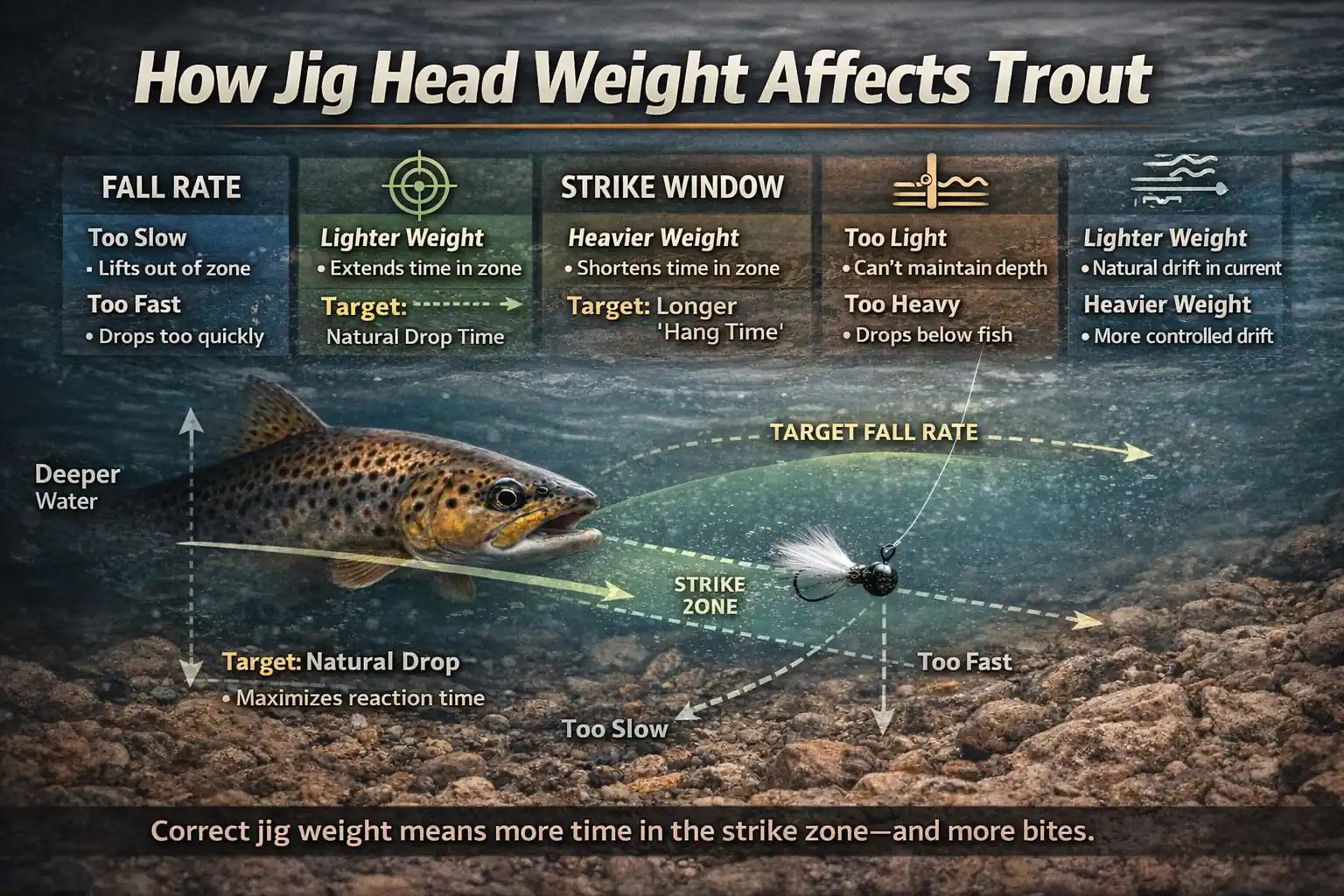
Anglers often focus on what a lure does while they reel it in. That is only part of the story. Many fish see and bite a lure while it is sinking.
Natural food does not always travel in a straight line. Water insects get knocked loose and tumble. Young insects and other tiny creatures sink or drift. Injured baitfish lose their balance. Small crayfish move unevenly near the bottom. Worms and land insects fall into the water and sink without being able to swim in a straight line.
The D3 cannot perfectly copy every kind of food a fish eats. No single jig can. Its value comes from an uneven fall that can look like a small creature that is drifting, injured, confused, or unable to swim steadily.
Movement during the fall helps a small lure get noticed without quickly pulling it past the fish. It stays near the fish longer.
That is especially useful when fish do not want to chase. The D3 can move as it sinks within a small area instead of being pulled away from the fish.
How Tied Materials Affect the Wobble
The D3 is designed mainly for tied jigs, and the materials used in the tie become part of the action. Changing those materials can change the fall almost as much as changing the weight of the head.
A short, sparse tie leaves much of the movement under the head’s control. “Sparse” means the jig uses a smaller amount of material. Water can pass around it more easily, so the head may fall faster and show a clearer wobble.
A long or full tie catches more water. It usually slows the fall and may make the side-to-side movement wider and softer. If the material becomes too full, stiff, or long for the head, it may steady the jig and reduce the wobble. It can also make the jig glide or pull toward one side.
The goal is not always to create the largest possible wobble. A very small movement can be better in clear water or around fish that have seen many lures. A slower, fuller fall may be better when fish are inactive and need more time to bite.
The best tie depends on the water, depth, current, fish, and desired fall speed. Testing different amounts of material in clear water is more useful than assuming one tie will work the same everywhere.
Marabou, Hair, Feathers, and Flash
Each tying material changes the D3 in a different way.
Marabou is soft and moves with very little water pressure. Its fibers open when the jig slows and fold back when it moves faster. This creates a breathing appearance. Marabou can continue moving when the head pauses, which makes it especially useful on a wobbling jig.
Natural or synthetic hair is often stiffer than marabou. It tends to hold a more constant shape and can help create a clear outline in the water. A small amount may let the head wobble freely, while a large or long bundle may steady the fall.
Feather fibers can be soft or stiff depending on the feather and the part used. Some move freely like marabou. Others act more like a small fin and can guide the jig in one direction.
Flash material reflects light as it bends and changes angle. The D3’s roll can make the flash appear and disappear instead of shining steadily. A small amount can add light without greatly changing the fall. Too much can add stiffness or create another uneven pull.
Chenille and thread bodies add shape close to the hook. Because they do not trail as far behind the head, they usually have less effect than a long tail. They still add weight, thickness, and surface for the water to push against.
These materials can be mixed. The important question is not only how the jig looks in your hand. Watch what the complete tied jig does in water.
A Straight, Balanced Tie Still Matters
The D3 head is uneven by design, but the tied body should still be centered unless a one-sided pull is being created on purpose.
Material that is much longer or fuller on one side can act like the steering part on the back of a boat. It may force the jig to curve continuously, spin, or twist the fishing line. That extra pull can cover up the back-and-forth wobble created by the head.
Look at the jig from above, below, and directly behind the hook. The tail should generally follow the center of the hook. The material should not be crowded heavily onto one side. Thread wraps and the finished knot should hold everything firmly so the tie does not shift after several casts or fish.
Then wet the jig. Dry marabou may look perfectly even but change shape when soaked. Gently pull the wet fibers backward as the water would. If one side forms a larger bundle, trim or retie it before blaming the head.
Hand-tied jigs naturally have small differences, and that is not a defect. The purpose is not factory-perfect sameness. The purpose is to prevent a large accidental imbalance from overpowering the D3’s intended movement.
The tied D3 should be treated as a complete lure. Adding a soft plastic to a hook that is already dressed with marabou, hair, or feathers is difficult and usually works against the design. The plastic can crowd or crush the tied material, make the hook harder to use, and overpower the movement of the fibers. The D3’s action should be judged and fished as a properly tied jig.
How Line Tension Controls the D3
The pull of the fishing line is one of the most important and misunderstood parts of fishing a D3.
On a tight line, the jig is pulled from the small loop where the line is tied. That pull points the jig in one direction and gives the head less freedom to move. The D3 may still lean or swing, but the angler’s line now controls more of the fall than the shape of the head does.
On a completely loose line, the head has freedom, but bites are harder to notice. Wind can blow loops into the line, and the jig may reach bottom without you knowing.
The useful middle ground is a line with a little looseness but not a large amount. Anglers often call this a controlled slack line or semi-slack line.
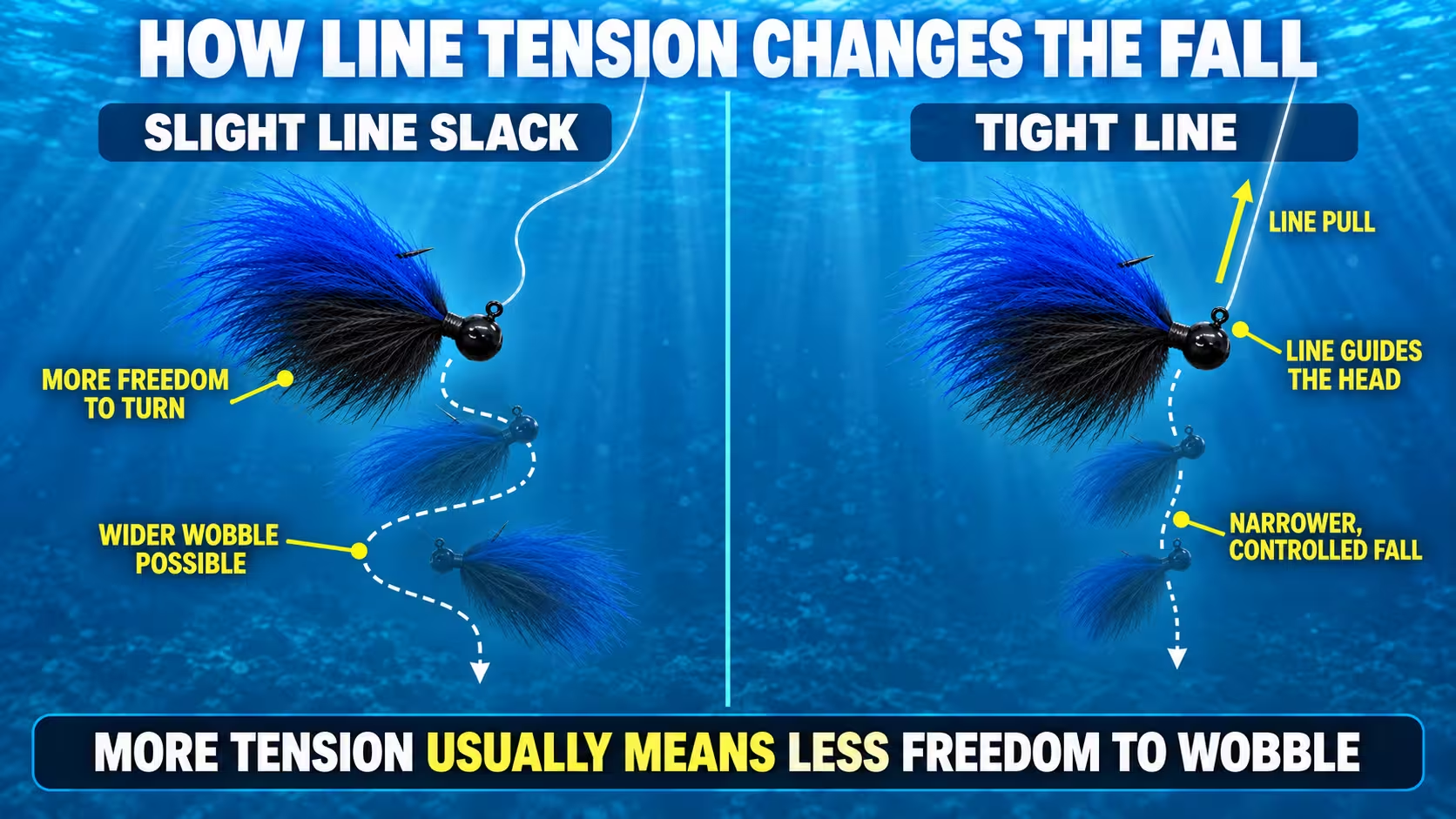
Let the jig fall without pulling it toward you, but keep enough contact to watch the line. A twitch, sideways jump, sudden tightening, or early stop can mean a bite.
The goal is not simply to make the line loose. The goal is to stop pulling hard enough for the head to move while keeping enough contact to see or feel what happens.
How Current Changes the Wobble
A current is water moving in one direction. It pushes the D3 from the side. The jig is no longer affected only by gravity pulling down and the water pushing up. The current also pushes across the head, hook, tied body, and line.
That push can strengthen or weaken the wobble, or sweep the lure in a wide curve. A cast into the current acts differently from one across it. A tight line below you may hold the jig in place but reduce its free fall.
A current seam is the meeting place between faster water and slower water. When the D3 crosses this line, the push against the head changes. The jig may wobble harder, change direction, or suddenly drop when it enters the slower water.
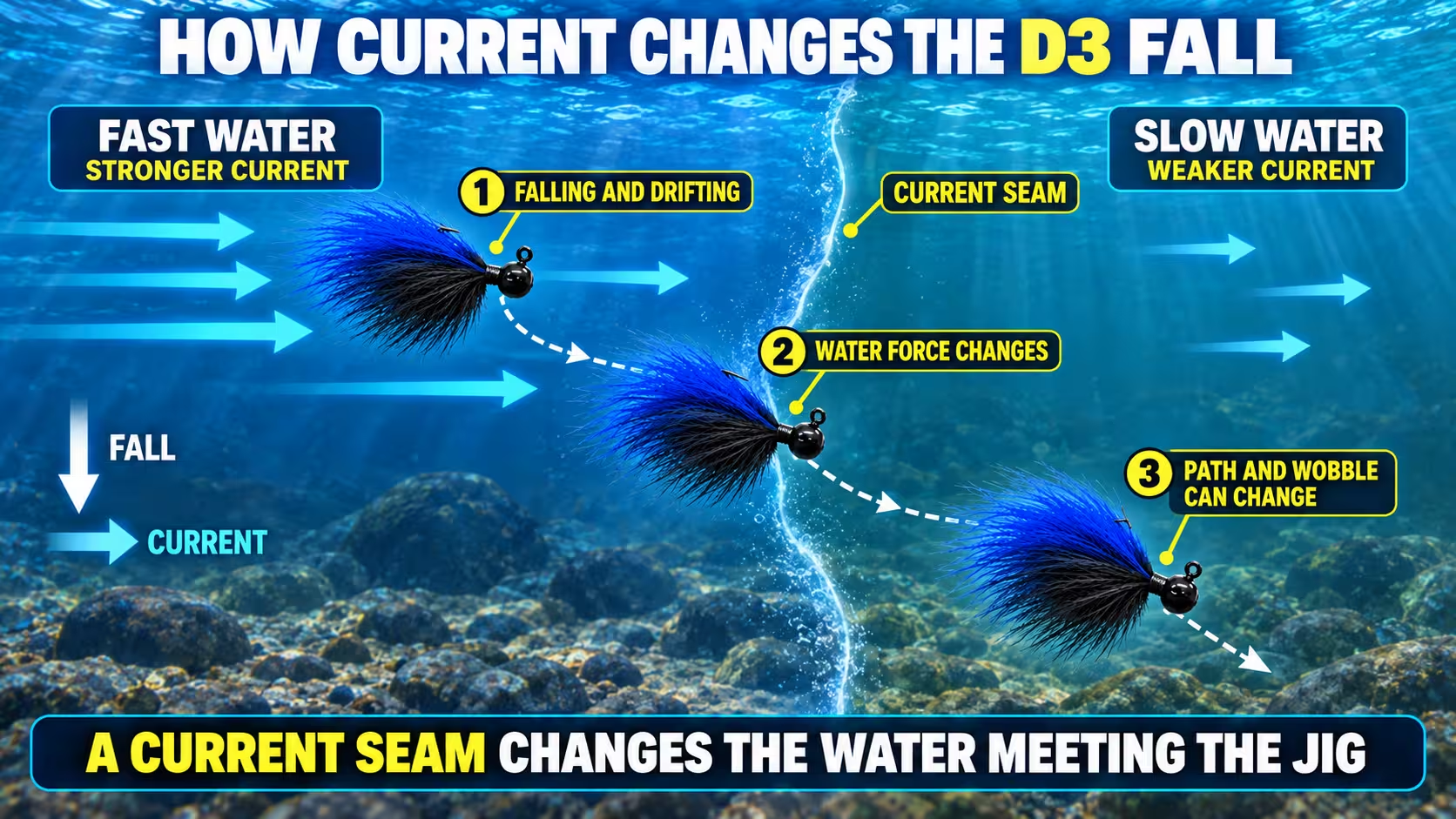
Do not assume that a stationary rod tip means the jig is stationary. Current may be moving the lure while the angler adds no deliberate action.
Casting into or slightly across the current can give the jig time to sink freely. Letting it travel below you creates more line pull and a controlled swing. Both can catch fish.
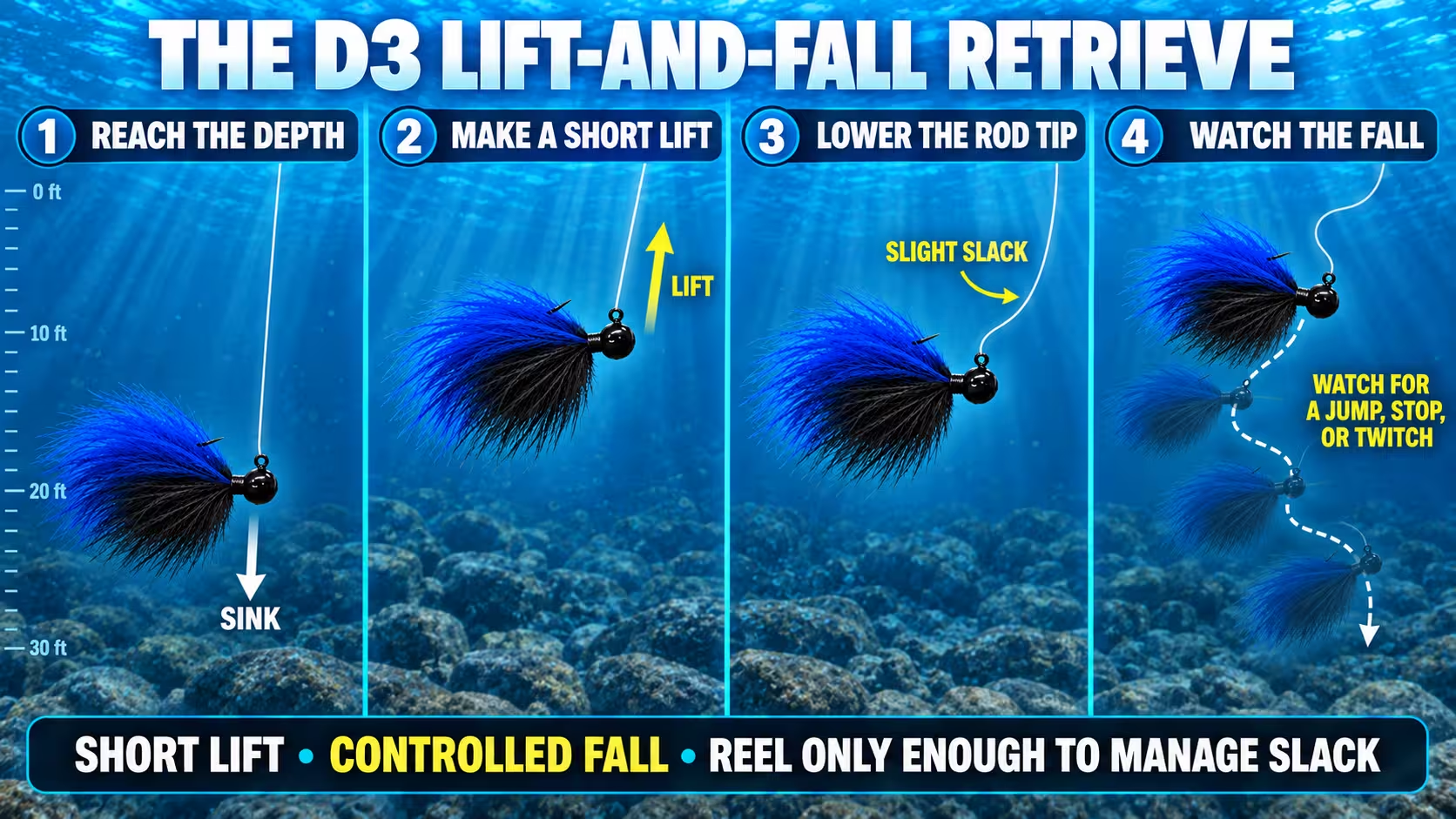
A Basic Lift-and-Fall Retrieve
A retrieve is simply the way you bring a lure back after a cast. The easiest D3 retrieve is called lift-and-fall.
Cast past the place where you believe fish are waiting. Let the jig reach the depth you want. Raise the rod tip enough to lift the jig without jerking it far away from the fish. Then lower the rod tip and let the jig fall while keeping just a little looseness in the line.
The lift helps a fish notice the lure and moves it into position for another fall. The fall is when the uneven head has the best chance to wobble and change direction.
Do not immediately reel while the jig is falling. Reel in only enough loose line to stay in control. If you reel the whole time, the lure begins swimming forward and the line starts guiding the head.
The lift does not need to be large. A short lift may work better when fish are close to the bottom or do not want to chase. A larger lift creates a longer fall, but it also moves the lure farther away from the place where a fish may be waiting.
The Swim-and-Pause Retrieve
The D3 can also be pulled forward through the water instead of mainly being worked up and down.
Reel slowly enough to keep the lure at the depth you want. When it reaches a place where a fish may be waiting, stop reeling and let it fall. A fish sees the lure change from a steady swim to an uneven fall.
This works in open water, along underwater plants, or when fish follow a lure but wait for it to stop before biting.
The sequence is simple:
swim, pause, fall, watch, then swim again.
The pause must last long enough for the head to start falling. A very short pause may slow the lure without giving the D3 enough time to wobble.
Vertical Jigging With the D3
Vertical jigging means working the lure mostly up and down beneath you. This can be done from a boat, dock, bridge, or ice hole. It makes the jig easier to feel, but it is also easy to keep the line too tight.
Lift the D3, and then lower the rod tip a little faster than the jig falls. This puts a small amount of looseness in the line. Watch the line and feel for anything that interrupts the fall before lifting again.
If you lower the rod at exactly the same speed as the jig, the line may remain tight enough to guide the fall. If you drop the rod too quickly, you may create more slack than you can manage.
Short lifts are often enough. Make the jig fall repeatedly through the depth where the fish are; it need not move several feet each time.
Detecting Strikes During the Fall
A fish that bites the D3 while it is falling may not pull hard.
The fish may suck in the lure and stay in one place. It may swim toward you and make the line looser. It may swim sideways or stop the jig before it reaches the depth you expected.
Watch for changes that do not match the normal fall:
- The line jumps or twitches
- Slack disappears unexpectedly
- The line moves sideways
- The jig stops sinking too soon
- The line begins moving against the current
- The jig feels heavier when the next lift begins
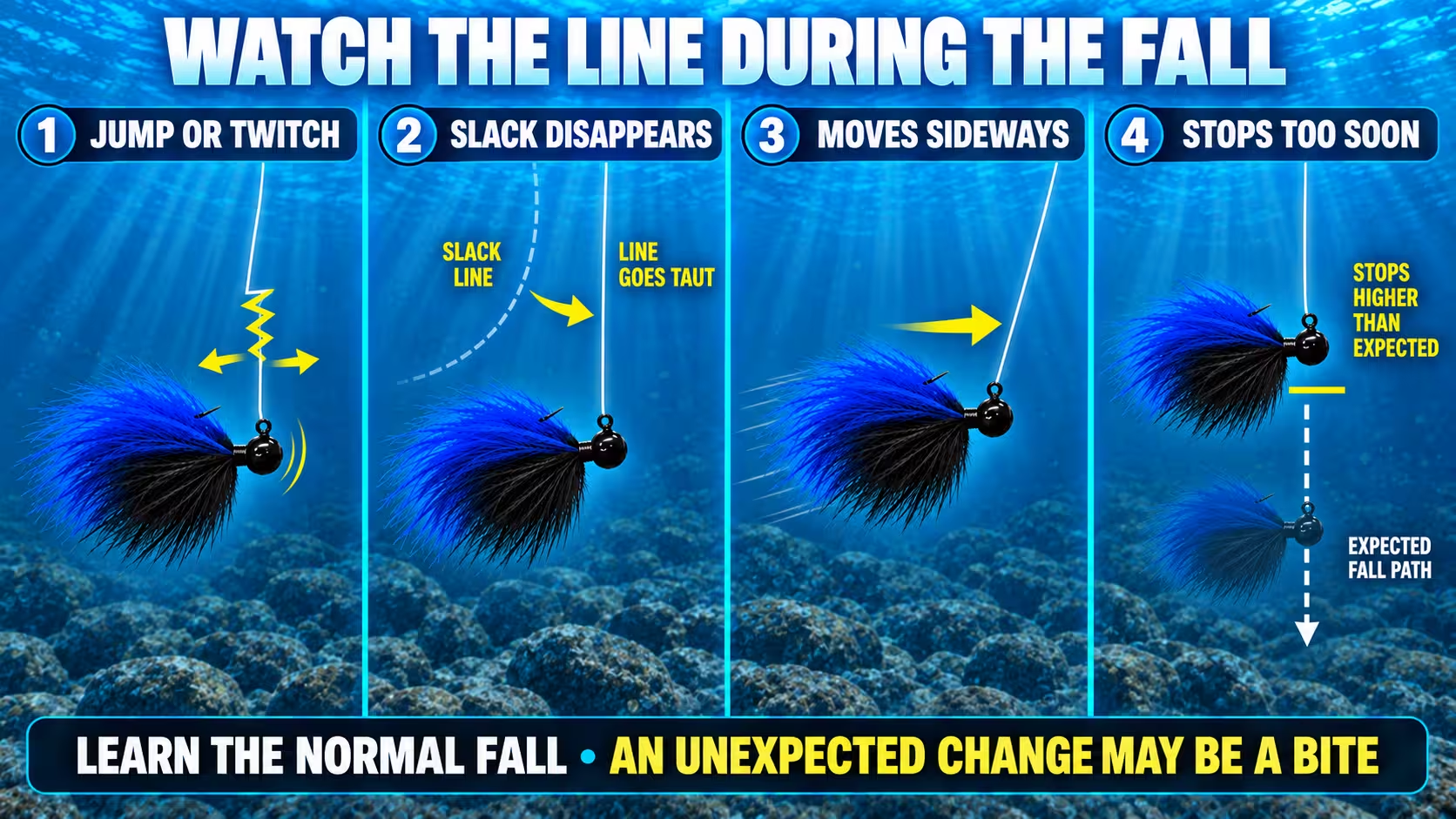
First watch the jig fall in clear, shallow water. Knowing its normal fall helps you recognize a bite later by watching the line or feeling the rod.
Common Reasons a D3 Does Not Wobble as Expected
When the D3 does not wobble as expected, the jig head may not be the problem. Check the tied body, line, and water conditions.
The line is too tight
A constantly tight line pulls the jig along one path. Lower the rod tip during the fall and stop reeling long enough for the head to move freely.
The tie is heavier on one side
Material tied off-center can steer the jig continuously toward one side. Wet the jig and inspect it from several directions. Trim or retie material that forms a much larger bundle on one side.
The tied body is too large, long, or stiff
A large or stiff tied body may guide the jig more strongly than the head does. Try a sparser tie, shorter tail, or softer material.
The current is overpowering the fall
Fast-moving water can sweep the whole setup sideways. Cast in a different direction, move to a different spot, or use a different jig weight to regain control.
The line is being pushed too much
Thick line, a long cast, wind, and moving water at the surface can all pull on a light jig. Make a shorter cast or try thinner fishing line that is still strong enough for the fish and fishing area.
The jig is not being allowed to fall
Steady reeling keeps the head moving forward. Stop reeling long enough for the jig to fall, or use the lift-and-fall method explained above.
Debris is attached to the head or hook
Weeds, algae, and small pieces of vegetation can dramatically change the balance of a compact jig. Inspect the tied jig frequently.
When the D3 Is Most Useful
The D3 is useful when you want a tied jig to create action as it sinks.
It can help when fish are below the jig, when they follow without biting, or when they do not want to chase something fast. Fish that have seen many lures are often called pressured fish. The D3 gives them a tied jig that can breathe, wobble, and fall differently from a jig swimming in a straight path.
The head can be tied with marabou, hair, feather fibers, flash, or a mixture of materials. Trout, crappie, and panfish anglers can work it straight below them or hang it beneath a float. It can also be lifted and dropped around docks, along underwater plants, in open water, or behind objects that slow the current.
The D3 is not limited to one kind of fish. Its uneven fall can resemble many small creatures that are easy for a fish to catch.
Final Thoughts on the D3 Wobble
The Family Fishin D3 jig head wobbles because one side is lighter than the other. That uneven shape moves the head’s balance point and changes how the water pushes against it.
As the jig falls, the heavy side and light side react differently. The head starts to turn, the water begins pushing from a new angle, and the jig turns back or continues to roll. Depending on the tied material, line, and water, you may see a side-to-side wobble, a roll, a curve, a flutter, or a slow circle.
The best way to use that design is to give the head room to move. Keep the tie centered and use an amount of material that does not overpower the head. Do not keep the line tighter than necessary. Let the jig fall and watch the line closely for a bite.
The uneven D3 head starts the wobble, but the angler controls where the jig falls and how much freedom it has to move.
The Research Behind This Explanation
The formulas and explanations in this article come from established studies of falling objects, flexible fibers, and the way fish sense moving water. The research was not conducted on a D3 jig, so it should not be presented as a direct product test. It provides the scientific foundation for understanding the forces involved.
Andersen, Pesavento, and Wang: Why Falling Objects Flutter or Tumble
In 2005, Anette Andersen, Umberto Pesavento, and Z. Jane Wang published “Unsteady Aerodynamics of Fluttering and Tumbling Plates” in the Journal of Fluid Mechanics.
The researchers recorded freely falling plates with high-speed video. This allowed them to measure the plates’ changing position, speed, and acceleration. They also compared the observations with computer solutions of the equations that describe fluid motion.
Their work separated the fluid forces into parts connected with acceleration, straight-line movement, and rotation. One important finding was that fluid circulation around fluttering and tumbling plates was strongly connected to the plate’s rotational speed. In plain English, the object’s turning motion helped change the moving fluid around it, and that changing fluid then affected the object’s motion.
The researchers observed several kinds of descent, including repeated fluttering, full tumbling, and less regular motion. Which pattern appeared depended on factors such as the object’s dimensions, resistance to rotation, fluid conditions, and starting position.
A jig head is not a flat plate, and water is not air. The exact paths and numbers from that study cannot simply be assigned to the D3. The useful connection is the demonstrated principle: an uneven or poorly stabilized object can enter a repeated falling motion because translation, rotation, and changing fluid forces affect one another.
Hu and Wang: Shape and Resistance to Rotation Change the Falling Style
Ruifeng Hu and Lifeng Wang expanded the study of falling shapes in a 2014 Physical Review E paper titled “Motion Transitions of Falling Plates via Quasisteady Aerodynamics.”
They used mathematical models to examine transitions between fluttering, tumbling, irregular motion, and straighter tumbling paths. Their results showed that falling style changes with factors that include moment of inertia, fluid-force coefficients, and aspect ratio.
Moment of inertia describes how strongly an object’s mass resists a change in rotation. Aspect ratio compares one main dimension of a shape with another, such as length compared with width. Fluid-force coefficients are numbers used to describe how shape affects forces such as lift and drag.
For a jig designer, the lesson is that weight alone does not decide the fall. Two heads with equal weight can move differently because their mass is placed differently, their shapes meet the water differently, and they resist rotation differently.
Yang, Liu, and Peng: Flexible Fibers Change Shape in Moving Fluid
Xiufeng Yang, Moubin Liu, and Shiliu Peng published “Smoothed Particle Hydrodynamics and Element Bending Group Modeling of Flexible Fibers Interacting with Viscous Fluids” in Physical Review E in 2014.
Their work modeled flexible fibers of different lengths in a moving, thick fluid. The calculated drag agreed with experimental observations used for comparison. The researchers identified three general fiber shapes or motions: a U-shaped mode, a flapping mode, and a closed mode.
They also found that flexible fibers could reduce drag by bending and changing their shape. This is called reconfiguration. Instead of continuing to face the flow like a stiff flat surface, a fiber can bend backward and offer the fluid a narrower shape. Their results also showed that vortex shedding played an important role when the fibers changed from one bending mode to another.
Marabou or hair tied to a jig is not identical to the single fibers in their model. A tied jig contains many fibers that may touch, separate, trap water, and move in different directions. Even so, the study supports two important ideas used in this article: flexible fibers change shape when fluid pushes on them, and that shape change alters drag.
This helps explain why a tied D3 does not have one permanent area or drag coefficient. The material can open when the jig slows, fold backward when speed increases, and flap as water movement changes.
Chagnaud, Bleckmann, and Hofmann: Fish Can Read Repeating Water Movement
Boris Chagnaud, Horst Bleckmann, and Michael Hofmann published “Kármán Vortex Street Detection by the Lateral Line” in the Journal of Comparative Physiology A in 2007.
The researchers studied nerve responses from the front portion of the lateral-line system in goldfish. The fish were exposed to steady water flow and to water containing a repeating row of vortices. This repeating pattern is sometimes called a vortex street.
Both steady flow and the vortex pattern increased activity in the lateral-line nerve fibers compared with still water. More importantly, the nerve responses contained information matching the frequency at which vortices were being released. The response was especially strong when the fish met the edge of the vortex pattern.
The study showed that a fish’s lateral line can carry information about repeating water movement. It did not test a D3 and does not prove that a fish identifies one particular jig by its wake. It supports the more careful statement that the moving water produced by a wobbling head and flexible fibers can be part of what a nearby fish senses.
What These Studies Add to the D3 Explanation
Together, the studies support four parts of the explanation:
- A falling object’s shape, balance, and resistance to rotation can change whether it falls steadily, flutters, or tumbles.
- Rotation changes the surrounding fluid forces, and those changing forces can feed back into the motion.
- Flexible fibers bend and re-form in moving fluid, changing drag and sometimes entering a flapping motion.
- Fish can detect information carried by moving water and repeating vortex patterns through the lateral line.
None of the researchers claimed to be studying the D3. Credit belongs to them for discovering and explaining the broader physical and biological principles. Applying those principles to a tied D3 helps us explain why its uneven head, flexible materials, fishing line, and surrounding water must be treated as one moving system.
Frequently Asked Questions About D3 Jig Heads
Why does a D3 jig head wobble?
The D3 is lighter on one side, so its weight and shape are uneven. Gravity pulls it down while the water pushes back. Because the two sides react differently, the head begins to turn. That can make it lean, roll, wobble, or follow a curved path.
Is the D3 wobble built into the head?
Yes. The uneven balance is built into the jig head. It does not need a blade, hinge, or other moving part. However, the tied material, line, moving water, balance of the tie, and amount of looseness in the line all change how much wobble you can see.
Is the D3 mainly intended for tied jigs?
Yes. The D3 is intended to become a complete tied jig. Marabou, feathers, hair, flash, thread, and similar materials work with the uneven head to create a slow fall, changing shape, and continued movement after the head turns. It is not meant to be a tied jig with a soft plastic added over the dressing.
What tying material works best on a D3?
There is no single best material for every situation. Marabou responds to very small water movements and creates a soft breathing action. Hair holds a clearer shape. Feather fibers may move freely or guide the jig, depending on their stiffness. Flash reflects light as the head rolls. The best choice depends on the fall speed and action you want.
How much material should be tied on the D3?
Begin with a sparse or medium tie that is centered around the hook. This lets you see how the head moves without a large bundle controlling the fall. Add more material when you want a slower fall or fuller shape. If the jig begins gliding in only one direction or loses most of its wobble, the tie may be too full, long, stiff, or uneven.
Will every D3 fall in exactly the same pattern?
No. The direction the head faces when it begins to fall, the pull of the line, the balance of the tied body, and the moving water all affect the result. The head is designed to create an uneven fall, not to follow the exact same path every time.
Is wobbling the same as spiraling?
No. A wobble is a side-to-side rocking motion. A spiral happens when the whole jig follows a circling path as it sinks. A D3 may wobble, roll, curve, spiral, or combine several of those movements during one fall.
Does the D3 work better on tight or slack line?
The head normally moves more freely when the line has a little looseness. A tight line pulls the head in one direction and can straighten its path. Too much loose line makes bites hard to notice. The goal is to give the jig room to move while keeping enough contact to watch or feel what happens.
Why is my D3 spinning instead of wobbling?
An off-center tie, too much material, a stiff tail, or weeds can make the jig spin continuously. Wet the tied jig and check that the fibers are reasonably centered around the hook. Try a sparser or softer tie to learn whether the material is overpowering the head.
What retrieve works best with a D3 jig head?
Lift-and-fall is a good place to start. Lift the jig a short distance, lower the rod, and let it fall with a little looseness in the line. You can also reel it slowly, stop, and let it drop. The pause changes the jig from a forward swim to an uneven fall.
Do fish usually bite a D3 during the fall?
Many bites happen during the fall because that is when the head shows its strongest wobbling action. A fish may also bite while the tied jig rises, swims, pauses, or hangs in the water. Watch the line closely whenever you stop pulling on it.
Is a D3 always better than a balanced jig head?
No. Different jig-head shapes do different jobs. The D3 is made to create an uneven fall. A balanced head may be better when you want a tied jig to swim straight, move straight up and down, or rest steadily on the bottom.
What should I change first if the D3 has very little action?
First, stop pulling the line so tightly and make sure the jig is truly falling. Next, check for weeds and make sure the wet tying material is centered. If the action is still weak, try a sparser or softer tie and make a shorter cast so less line is being pulled by the water or wind.