Best Soft Plastic Lure Colors: How to Apply Color Theory for Consistent Results
Part 7, The Final Part of the Soft Plastic Lure Color Guide
The best soft plastic lure colors aren’t determined by one universal color chart — they depend on water clarity, light, depth, available forage, and how fish actually see the lure. It’s the result of three things this series has covered in detail: how a fish’s eye actually processes light, how water changes that light before it ever reaches the fish, and how contrast and visibility shift as conditions change. Parts 4 through 6 covered the biology and physics piece by piece — rods and cones, wavelength behavior at depth, and what UV enhancement actually does and doesn’t do. This final part brings all of it together into a single, repeatable system for picking colors, rather than leaving each principle scattered across separate articles.
Why “Pick a Favorite Color” Doesn’t Hold Up
The instinct to develop a go-to color and lean on it across every condition is understandable — confidence matters in fishing, and a color that’s produced fish before is hard to abandon. But everything covered earlier in this series points to the same conclusion: a color’s effectiveness isn’t a fixed property of the color itself. It’s the outcome of an interaction between the wavelength that color reflects, what’s left of that wavelength once light has traveled through a given depth and clarity of water, and what a given fish species’ eye can actually resolve once it arrives. Change any one of those three variables — go deeper, fish stained water instead of clear, target a different species — and the same color can perform completely differently without the lure changing at all.
This is why “best color” questions rarely have a single stable answer, and why anglers who insist they do are usually generalizing from a narrow set of conditions they happen to fish most often. The more durable approach, and the one this series has built toward, is to stop asking “what color works” and start asking three narrower questions that actually determine the answer.
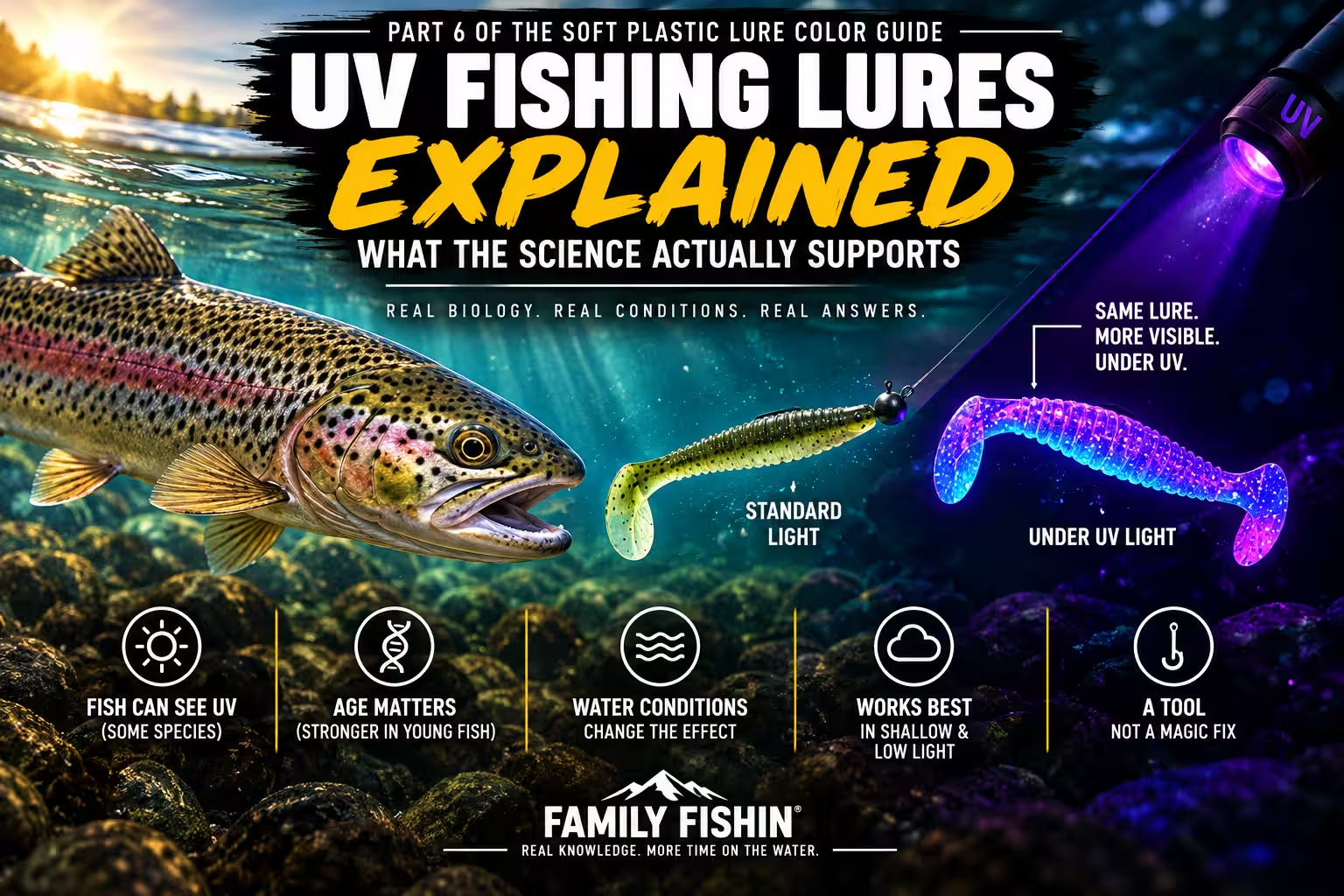
It’s also worth naming directly what this series has and hasn’t tried to establish along the way, since a synthesis article is a natural place for that kind of overclaiming to creep in. The visual biology in Part 4 — rod and cone function, trout’s four-cone system, species differences documented in bass — is measured research. The wavelength behavior in Part 5 — which colors fade first, and roughly where — is physics that’s been directly tested and measured in water itself. The UV material in Part 6 split cleanly into two categories: genuine species-specific UV detection, which is measured, and fluorescence-based brightness, which is a separate, also well-understood mechanism, but neither one licenses the broader marketing claim that any given “UV lure” automatically outperforms a standard one. This final part is doing something slightly different from the three before it: it’s not introducing new measured research so much as organizing what’s already been established into a decision framework, plus a smaller amount of practical angling judgment about how to weight those factors against each other in the moment. Keeping that distinction visible is part of what separates this system from a color chart that simply asserts confident answers without showing the reasoning underneath them.
The Three Foundations of Effective Soft Plastic Colors
1. Visibility: Can the Fish Detect the Lure at All?
Visibility is the foundation everything else depends on, because a color that isn’t detectable in the first place makes the other two questions irrelevant. Part 4 covered the underlying mechanism: a fish’s visual system switches between two functionally separate modes depending on light availability. In low light, stained water, or at depth, rod cells dominate — and rods carry no color information at all, only brightness, contrast, and motion. In bright, clear, shallow conditions, cone cells take over, and that’s the only regime where color identity itself is genuinely part of what the fish is evaluating.
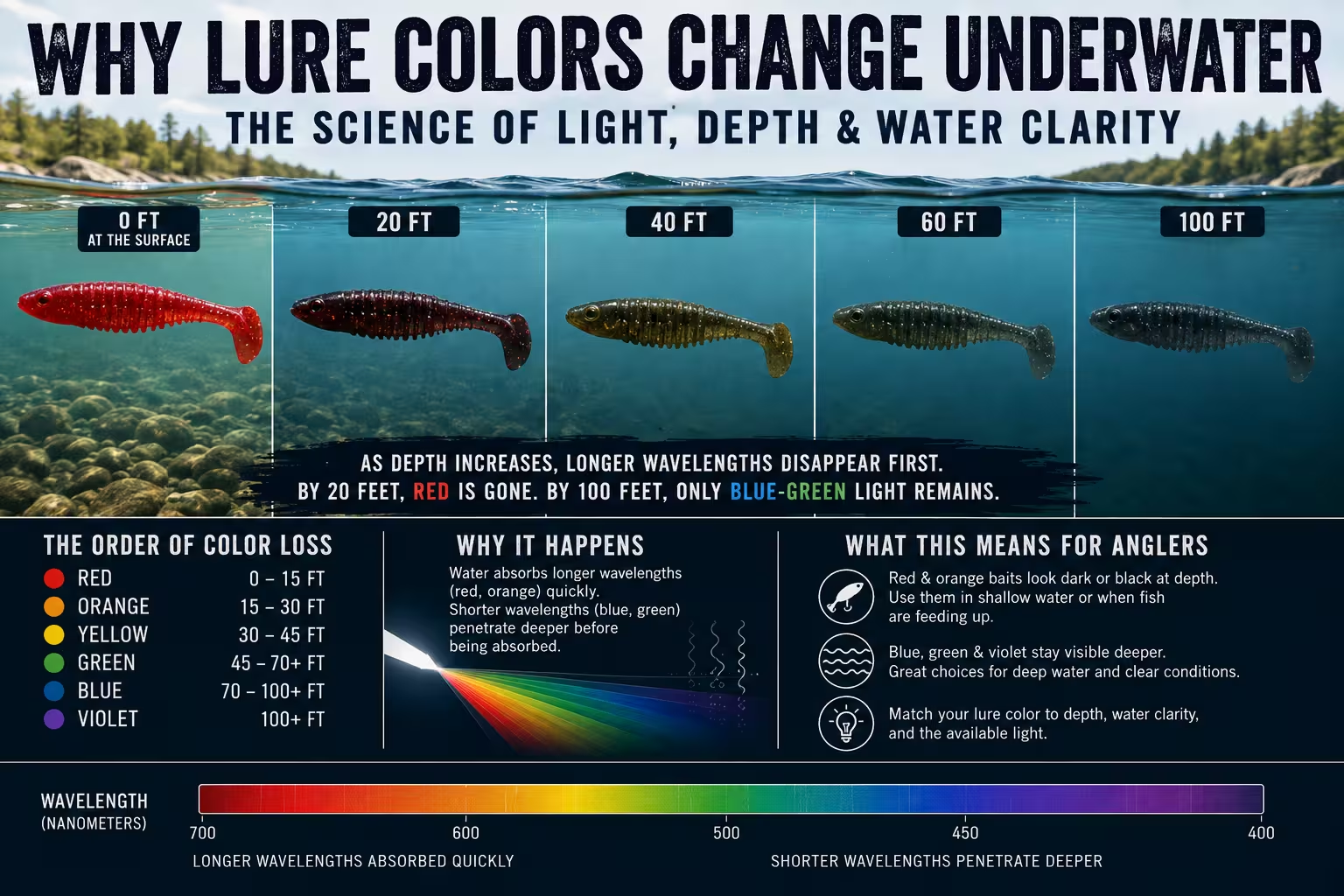
Part 5 added the second half of the visibility picture: even when cones are active and theoretically able to process color, water itself is actively editing which wavelengths are available to see. Red fades to a dark silhouette by roughly 15–20 feet in clear water, orange and yellow hold on somewhat longer, and green and blue persist the farthest. Stained water compresses every one of those ranges further. Visibility, in other words, isn’t one question — it’s the combined answer to “is the fish’s visual system even processing color right now” and “has the water already stripped this particular wavelength out before it got here.” A color can fail on either front independently, and it’s worth diagnosing which one is actually happening rather than assuming the color itself was simply “wrong.”
2. Contrast: Can the Fish Separate the Lure From Its Background?
Contrast is a separate question from visibility, and conflating the two is a common mistake. A lure can be technically visible — enough light is reaching it, enough wavelength survives the depth — and still fail to register as distinct from its surroundings if it blends too closely with the background water color, substrate, or vegetation. High contrast makes a lure easier to pick out against its surroundings; low contrast makes it read as a more natural part of the environment. Neither is universally correct — which one serves the moment depends on whether the goal is maximum detectability or maximum realism, and that itself depends on the visibility conditions covered above.
This connects directly to the rod-versus-cone distinction from Part 4. When rods are doing the work — low light, depth, stained water — contrast against the background is one of the only pieces of information the fish’s visual system has left to work with, since hue identification isn’t available to a rod-dominated eye at all. In that regime, a high-contrast presentation isn’t just a stylistic choice, it’s playing to the only channel the fish can actually use. When cones are active in bright, clear, shallow conditions, a fish has the visual resolution to evaluate a presentation more closely, and low-contrast, naturally blending colors can work with the fish’s full color-processing capability rather than relying on shape and brightness alone. → See: Fishing Lure Color Contrast
3. Imitation: Does the Color Suggest Something the Fish Wants to Eat?
Imitation is where color starts doing more than just getting noticed — it’s the question of whether what gets noticed reads as food. This foundation splits into two practical strategies depending on how the fish are behaving. When fish are actively inspecting a presentation rather than reacting instinctively — heavily pressured water, gin-clear conditions, fish that have seen a lot of lures — matching local forage as closely as possible tends to hold up better than something that stands out as artificial. When fish are aggressive, feeding opportunistically, or working in conditions where visibility is already limited, a reaction-triggering color — something brighter, higher-contrast, or UV-enhanced — can draw a strike based on triggering an instinctive response rather than a considered one.
It’s worth being precise about which parts of this are established biology and which parts are practical angling judgment, because the series has tried to keep that distinction clear throughout. Species-specific color vision — the fact that a trout is working with a four-cone system while a largemouth bass works with two, covered in Part 4 — is directly measured research, and it means “matching forage” is not a species-neutral exercise: the same baitfish pattern can register as a close color match to one species and a much cruder approximation to another, purely based on what that species’ eye can resolve. The “reaction trigger” half of this framework, by contrast, is a working theory grounded in the biology of bright colors and UV enhancement being genuinely more detectable in the conditions described — but the specific claim that this detectability translates into more aggressive, reflexive strikes rather than simply more strikes overall is angling experience layered on top of the vision science, not something this series’ underlying research directly measured. Both halves are worth using — they’re just different kinds of evidence, and it’s worth knowing which is which.
A Fourth Variable: Translucency, Not Just Hue
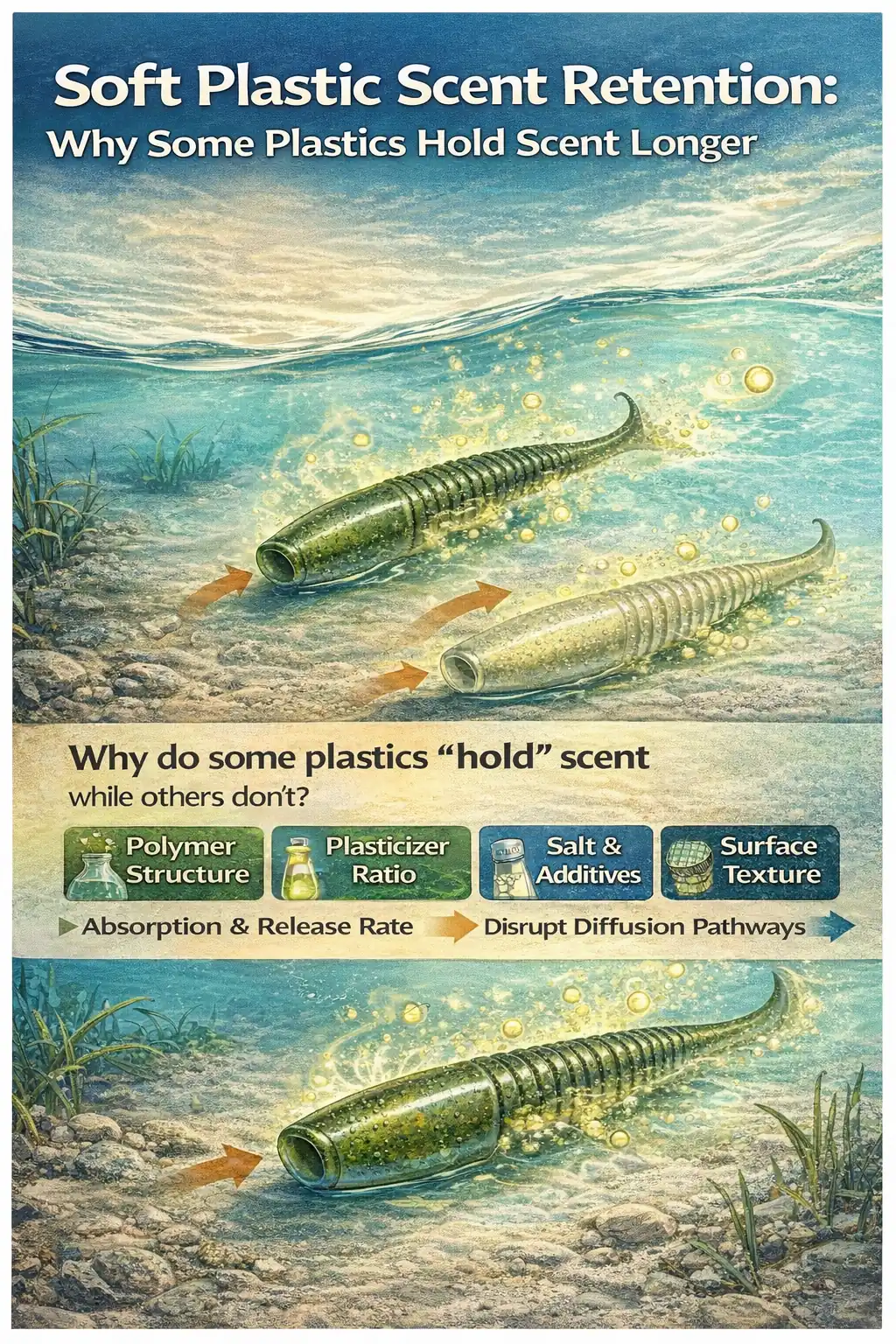
There’s a property of soft plastic bodies specifically — as opposed to painted hard baits — that the three foundations above don’t fully capture on their own: how much light passes through the bait versus reflects off its surface. A translucent soft plastic body behaves differently underwater than an opaque one of the identical pigment, because a translucent body is letting ambient light travel through the material itself rather than bouncing entirely off the surface, which changes how the bait’s color reads depending on how much ambient light is actually available. In bright, clear conditions with plenty of light to transmit, translucent bodies — watermelon, clear, natural flake patterns — can blend naturally into the water column in a way an opaque bait of a similar base color can’t, because the translucent body is genuinely letting light pass rather than presenting a flat, fully reflective surface. In low light or stained water, that same translucency works against the bait: with little ambient light available to transmit in the first place, a translucent body loses definition and can appear duller than an opaque bait of the same nominal color, since an opaque, fully reflective surface isn’t depending on light passing through it to register.
This is a manufacturing and material property sitting alongside pigment choice, not a substitute for the three foundations above — it’s a fourth lever that interacts with the visibility foundation specifically. A practical rule that follows directly from it: lean toward translucent, lightly pigmented bodies in bright, clear, shallow conditions where light transmission is working in the bait’s favor, and lean toward opaque, more heavily pigmented bodies as light drops or water stains up, where relying on transmitted light stops being a reliable strategy and reflected contrast takes over as the more dependable signal.
The Best Soft Plastic Lure Colors Selection System
Put together, the three foundations above turn into a repeatable four-step process rather than a color chosen by habit or hope.
Step 1 — Assess visibility conditions. Before touching a tackle box, read water clarity, light level, and the depth being fished. Clear water combined with bright light means cones are active and true color identity is on the table as a meaningful variable. Stained water, low light, or real depth means rods are doing most of the work, and color identity is taking a back seat to silhouette and brightness regardless of which color gets tied on.
Step 2 — Choose a contrast level. In a rod-dominated situation, lean toward higher contrast — a presentation that stands out clearly against the background water color and light level, since that’s the primary channel still available to the fish. In a cone-dominated situation, contrast becomes a judgment call between detectability and realism rather than a near-necessity, and low-contrast, naturally blending colors become a legitimate option rather than a liability.
Step 3 — Match forage or lean on a reaction trigger. When fish are inspecting carefully — clear water, pressured fish, selective feeding — bias toward colors that closely match the actual forage present, accounting for how the target species’ own vision resolves that color rather than how it looks to the angler’s eye. When fish are aggressive or visibility is already working against a subtle presentation, a bright, high-contrast, or UV-enhanced color is more likely to draw a reflexive response — understanding, per the note above, that this is angling judgment built on top of the detectability research rather than a directly measured behavioral finding.
Step 4 — Start simple and build from results. A working rotation doesn’t need to be large to be effective. Three to five versatile colors, each chosen to answer a different combination of the three foundations, will cover the large majority of conditions an angler actually encounters:
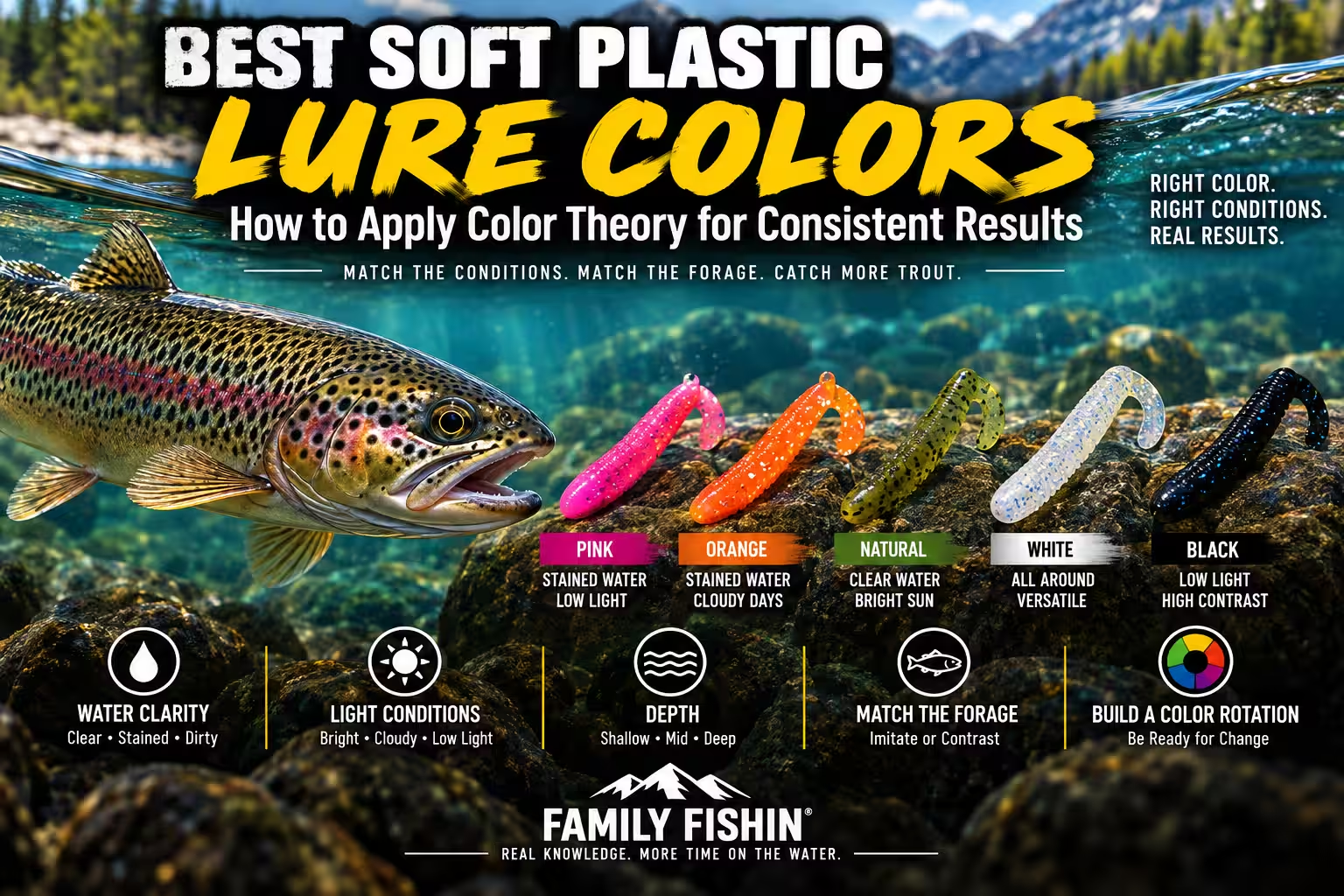
- White/pearl — high visibility and high contrast against most backgrounds, functioning well as both a natural baitfish imitation and a straightforward reaction color in a wide range of light conditions.
- Chartreuse — sitting at the yellow-green boundary on the spectrum discussed in Part 5, chartreuse holds usable color through a wider depth window than a pure yellow or pure green individually, and functions as a strong reaction-trigger color in stained or low-light water where rod-dominated vision favors bright, high-contrast presentations.
- Watermelon/green pumpkin — a natural, forage-matching option for clear, bright conditions where cone vision is active and fish are likely inspecting the presentation closely, offering a low-contrast, realistic profile rather than a standout one.
- Black — the most reliable pure-silhouette color, effective specifically because it doesn’t depend on any particular wavelength surviving the trip through the water; a black profile reads as a strong, consistent shape against light from above regardless of depth or clarity, which is exactly the information a rod-dominated visual system is built to use.
- Brown/olive — a second natural tone rounding out the rotation, useful where local forage runs duller or more olive-toned than a bright green pumpkin pattern would suggest, and a lower-contrast option for clear water where blending in outperforms standing out.
Walking Through the System on the Water
The framework holds together better with a concrete example than as an abstract checklist. Picture an early-morning trip on an Ozark stream: overcast sky, moderate stain from overnight rain, fishing a soft plastic through a run roughly six to eight feet deep. Running through the four steps: visibility conditions are already tilted toward rod-dominated vision — overcast light, stained water, and a depth that’s compressing wavelength availability even further, per Part 5’s stained-water discussion. That points toward a high-contrast choice for Step 2, and toward black or chartreuse depending on how aggressive the fish are behaving — chartreuse if there’s still enough light getting through the stain to register color at all, black if the water’s dark enough that silhouette is doing essentially all the work.
Contrast that with a bright, clear afternoon on a spring-fed section, working the same soft plastic in two to three feet of gin-clear water over a light gravel bottom. Here, cones are fully active, true color identity is in play, and the water hasn’t yet stripped out any part of the visible spectrum at that shallow a depth. That shifts the system toward Step 3’s forage-matching logic — watermelon or a natural olive tone that closely resembles the actual invertebrate and baitfish forage in that stretch, fished with an eye toward blending in rather than standing out, since the fish in that kind of water have the visual resolution and the light to inspect a presentation closely before committing.
Neither scenario has a “right” color independent of the conditions — the same soft plastic body in two different color choices is the correct call in each case, and the system above is what determines which is which rather than leaving it to preference or memory of what worked once before.
A third scenario helps illustrate the translucency variable specifically: fishing that same run at midday, several hours after the morning stain has partially cleared but before it’s fully settled — a common transitional condition on Ozark streams after rain. Visibility conditions here sit between the two extremes above, and it’s a case where the four-step system doesn’t hand back a single obvious answer, which is itself useful information. A moderately translucent, moderately bright pattern — chartreuse with some natural mottling, for instance — can straddle the gap better than committing fully to either the pure-silhouette approach of the low-light scenario or the fully translucent, natural approach of the clear-water scenario. Transitional conditions are where the system earns its keep the most, precisely because there isn’t an obvious default color to fall back on without reasoning through the four steps directly.
Common Mistakes This System Corrects
A few habits are worth naming directly, because they’re the ones the three-foundation framework is specifically built to correct. The first is treating a confidence color as a universal one — carrying the same go-to pattern across every depth and clarity condition regardless of what the water is actually doing to that wavelength, which Part 5 covered in detail as a wavelength-behavior problem, not a fish-preference problem. The second is judging a lure’s likely underwater performance by how it looks in hand under tackle-shop lighting, rather than reasoning through what depth, clarity, and species vision will actually do to that color once it’s fished — a mistake Part 4 covered directly as evaluating a lure with the wrong visual system entirely. The third is treating every “UV” or bright-color claim as automatically justified biology rather than checking, as Part 6 laid out, whether the specific mechanism at play is genuine species-specific UV detection or simple added visible-light brightness through fluorescence — both legitimate, but not the same claim, and not equally relevant to every species and condition. The fourth is reaching for a translucent, natural-looking bait out of habit in conditions where there isn’t enough ambient light left for that translucency to actually do anything — a lightly pigmented, see-through pattern fished at real depth or in stained water isn’t reading as subtle and natural to the fish, it’s often just reading as dim and hard to detect, because the light transmission that pattern depends on isn’t available in the first place.
The Takeaway
Color selection becomes predictable once the goal shifts from chasing specific hues to reasoning through visibility, contrast, and imitation relative to the conditions actually in front of you. None of the three foundations work in isolation — a highly visible color that doesn’t contrast with its background is only doing half its job, and a perfect forage match that the fish’s visual system can’t resolve at the depth being fished isn’t doing much of anything. Anglers who consistently work through these three variables, rather than cycling through colors by hope or habit, are working with a system grounded in how fish actually see rather than how the lure looks in a tackle box under fluorescent lighting.
That’s the core idea this entire series has built toward across six earlier parts: color isn’t a fixed property of a lure, and it was never going to be solved by finding the one right hue. It’s solved by understanding the fish’s eye, the water in between, and the conditions on a given day — and adjusting accordingly. → Complete Trout Fishing System
Frequently Asked Questions
Is there really one “best” soft plastic color?
No — and the series this article closes out is built around explaining why not. A color’s effectiveness depends on light level, water clarity, depth, and which species is looking at it, all of which shift what a fish can actually detect and resolve. The same color can perform very differently in two different conditions without the lure itself changing at all.
What’s the difference between visibility and contrast?
Visibility is whether enough light and the relevant wavelength are reaching the lure at all — a function of depth, clarity, and light level. Contrast is whether the lure, once visible, stands out from its background. A lure can be technically visible and still blend in too closely to register as distinct, which is why the two are separate questions rather than one.
When should I use a natural color versus a bright or UV color?
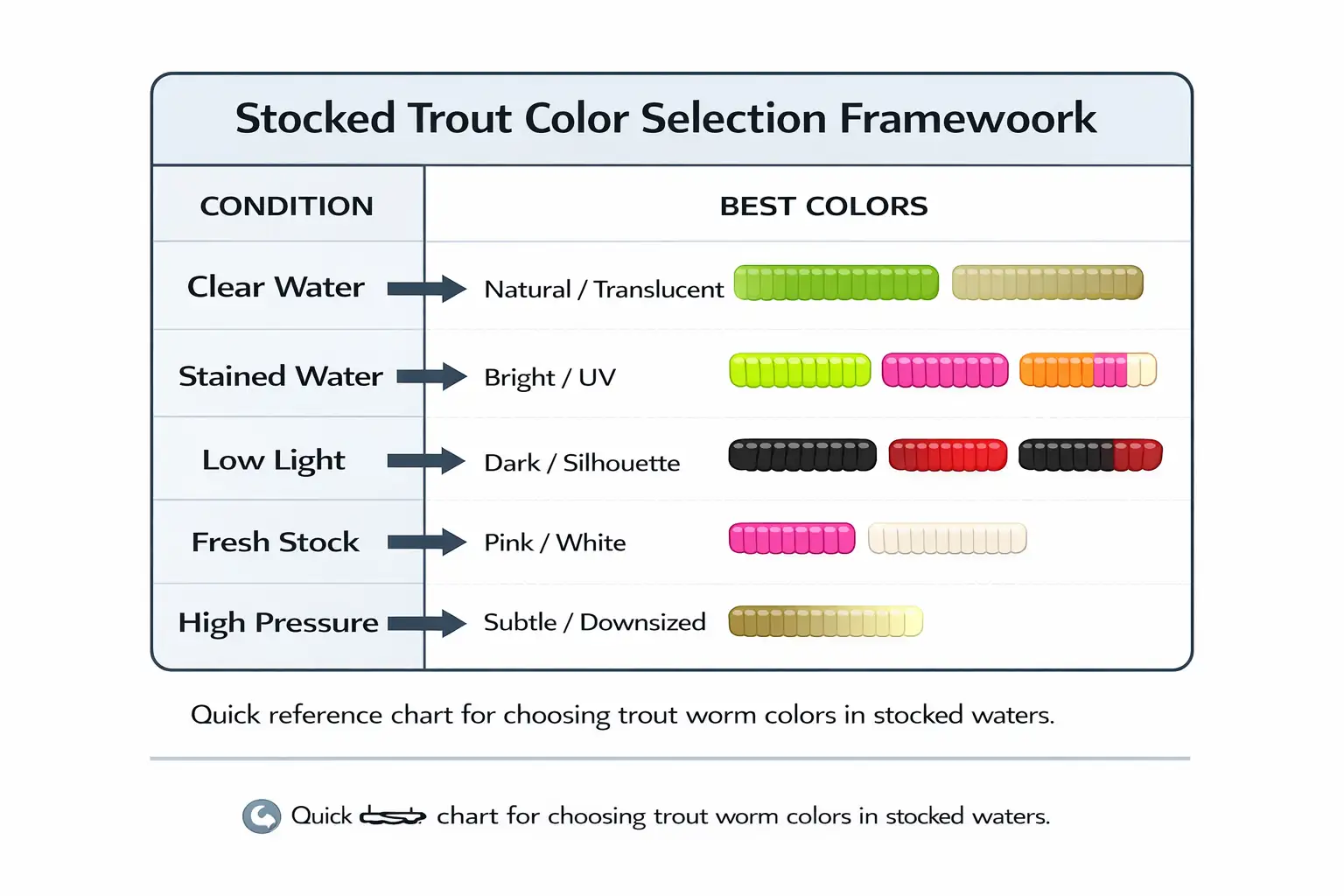
Natural, forage-matching colors tend to work best when fish are inspecting a presentation closely — clear water, pressured fish, selective feeding — because the fish has the light and visual resolution to evaluate the lure in detail. Bright, high-contrast, or UV-enhanced colors tend to work better when visibility is already limited or fish are feeding aggressively, since detectability matters more than close realism in those conditions.
Is the “reaction trigger” idea proven science?
Partly. That bright, high-contrast, and UV-enhanced colors are more detectable in low-visibility conditions is grounded in the vision research covered earlier in this series. That this added detectability specifically produces more reflexive, aggressive strikes — rather than simply more strikes generally — is angling experience built on top of that research, not something this series’ underlying sources directly measured. Both are useful to know, but they’re not the same category of evidence.
Why do these five starter colors work across most conditions?
Each one answers a different combination of the three foundations: white/pearl and chartreuse lean toward high visibility and contrast for detection-driven situations, watermelon/green pumpkin and brown/olive lean toward natural, low-contrast imitation for clear-water conditions, and black provides a pure silhouette that doesn’t depend on any particular wavelength surviving the trip through the water at all.
Does this system work the same way for every fish species?
The physics of visibility and wavelength behavior in water is the same regardless of species. What changes is the imitation piece — a trout’s four-cone visual system and a largemouth bass’s two-cone system don’t resolve the same color the same way, so a forage-matching choice built around one species’ vision doesn’t automatically transfer to another. The framework holds; the specific color decisions inside it are species-dependent.
Do I need a huge color selection to fish effectively?
No. Three to five versatile colors, each chosen to answer a different combination of visibility, contrast, and imitation, cover the large majority of conditions most anglers actually encounter. A large, unfocused color collection is less useful than a small rotation applied with an understanding of why each color is there.
Does translucent versus opaque matter separately from the color itself?
Yes. A translucent soft plastic body lets ambient light pass through the material, which lets it blend naturally in bright, clear conditions where there’s plenty of light to transmit. In low light or stained water, that same translucency works against the bait, since there isn’t enough ambient light available to transmit and the color reads as dull rather than subtle. Opaque, more heavily pigmented bodies rely on reflected contrast instead, which holds up better as light drops.
Previous: Part 6 — UV Fishing Lures Explained