Why Fluorescent Lures Pop So Hard (Fluorescent vs UV vs Glow, Sorted Out)
Fluorescent fishing lures can look almost lit from within. Hold a chartreuse worm or fire-tiger bait in sunlight and it appears brighter than a color has any business being. That effect isn’t glow-in-the-dark paint—it’s fluorescence, a genuine optical phenomenon that helps fluorescent fishing lures stand out in stained water, deep daylight, and other low-light conditions. — brighter than a color has any business being, like it’s glowing from inside. That’s not your eyes and it’s not just “a really bright paint.” It’s fluorescence, a genuine optical trick, and it’s a different thing from both glow-in-the-dark and “UV” lures — two terms it constantly gets confused with. Sort out what fluorescence actually is and you’ll know exactly when a fluorescent color is the right call (deep and dirty water) and when it’s the wrong one (pitch dark). Here’s the whole picture.
First, Untangle the Three “UVs”
Tackle marketing throws “UV” around until it’s meaningless, and it’s hiding three completely different things. Straightening this out is half the battle:
- UV stabilizers are protective. They absorb UV to keep the plastic from breaking down in sunlight, and have nothing to do with color or visibility. (That’s a degradation topic, covered with the rest of plastic breakdown.)
- UV-reflective finishes bounce ultraviolet light back. Fish that see into the UV range can then detect that reflected UV. This is its own real tactic, and it’s covered in the color series — see UV Lures Explained.
- UV-fluorescent pigments convert light — they absorb UV (and other short wavelengths) and hand it back as visible light. This is what makes chartreuse “pop,” and it’s what this article is about.
Same two letters, three unrelated jobs: protect, reflect, convert. This post is only about the third — fluorescence, the converters.
Fluorescent Is Not Glow (and the One-Second Test)
The other constant mix-up is fluorescent versus glow-in-the-dark, and the difference is the whole ballgame:
- A glow (phosphorescent) bait stores light and keeps glowing in total darkness for minutes or hours after the light’s gone (covered in the glow-in-the-dark lures post).
- A fluorescent bait stores nothing. It only emits while light is actively hitting it, and it stops the instant that light is removed. No afterglow, none.
The one-second test settles it every time: shine a black light on the bait, then switch the black light off. If it keeps glowing in the dark, it’s phosphorescent (glow). If it goes dark the instant the light’s off, it’s fluorescent. That single difference — “needs light on it right now” versus “carries its own light into the dark” — decides which one you want, and we’ll come back to it.
How Fluorescent Fishing Lures Actually Work
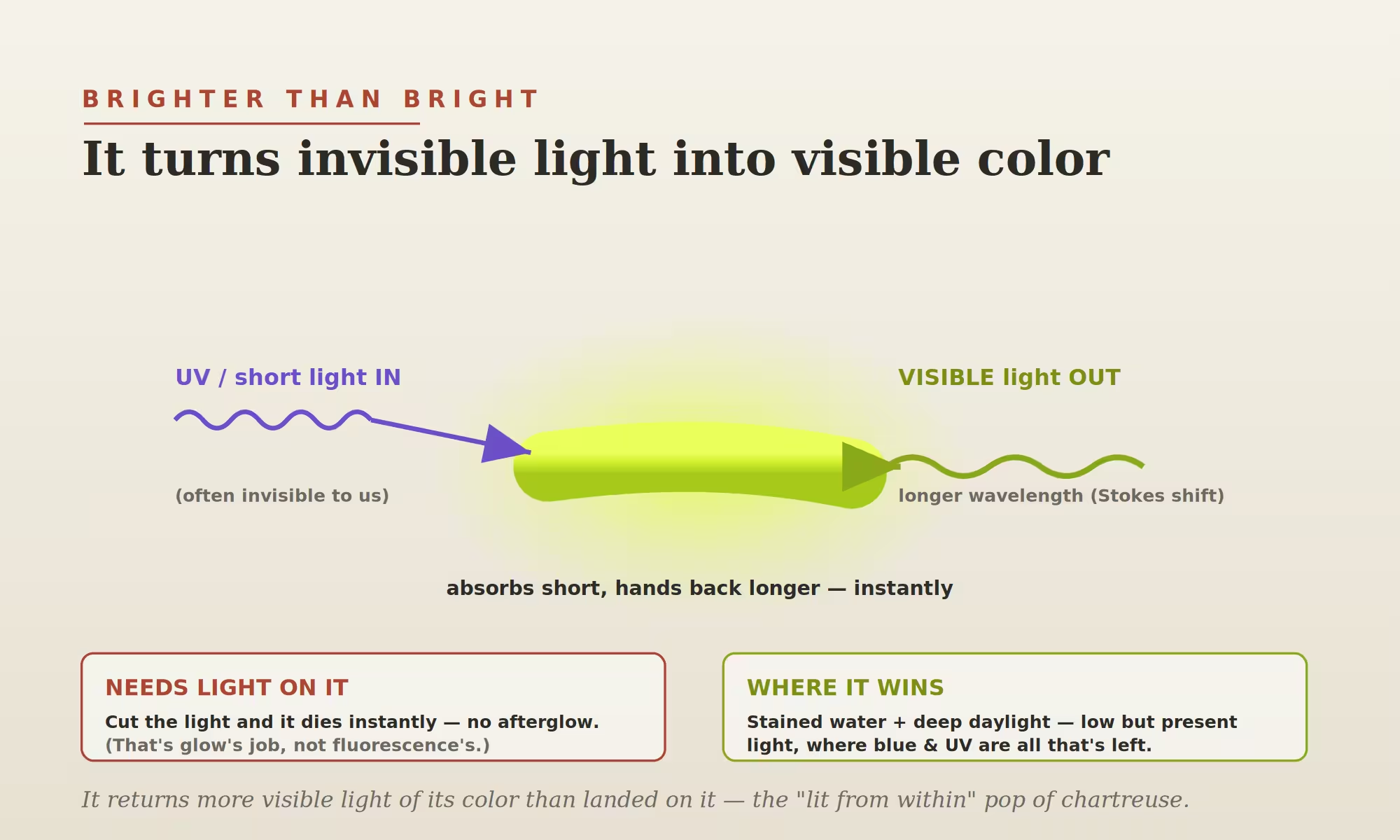
The mechanism is quick and elegant. When a high-energy, short-wavelength photon — ultraviolet, or the blue/violet end of visible light — strikes a fluorescent molecule, the molecule absorbs that energy and one of its electrons jumps up to a higher energy level. That excited state is unstable, so almost instantly (we’re talking billionths of a second) the electron falls back down and the molecule spits the energy back out as a new photon of light.
Here’s the key: the photon that comes out has less energy than the one that went in, because a little energy was lost as heat on the way. And lower energy means a longer wavelength. So short-wavelength light goes in (often invisible UV), and longer-wavelength light comes out — shifted toward the visible colors we can see. That shift toward longer wavelengths has a name, the Stokes shift, and it’s the heart of the whole effect: fluorescence takes light at one wavelength and re-emits it at a longer one. Take in invisible UV, hand back visible green. The color that comes out is set by the molecule itself, and stays the same regardless of exactly what short wavelength charged it.
Why It Looks “Brighter Than Bright”
This is the part that makes fluorescent colors look impossible, and it’s worth understanding because it’s exactly why they work. A normal pigment can only ever reflect part of the light that hits it — it absorbs some wavelengths and bounces back the rest, and the bounced-back portion is always less than what landed. A normal pigment can’t return more light than it received; that’s physically off the table.
A fluorescent pigment breaks that ceiling. It bounces back its color like any pigment and, on top of that, it converts invisible UV and short-wavelength light — energy your eye couldn’t see at all — into extra visible light of that same color. So in its color band, it hands back more visible light than appeared to fall on it. The result is a color that looks lit from within, more saturated and intense than any ordinary pigment can manage. “Daylight fluorescent” pigments (the chartreuse, hot orange, and hot pink of fire-tiger and similar patterns) are specifically built to do this using the UV that’s present in ordinary daylight — so they pop in normal sun, no black light required. That impossible, eye-grabbing intensity is the entire point: fluorescent colors are louder than loud. This is one reason fluorescent fishing lures remain popular for attracting attention in low-visibility conditions.
You’ve actually seen this exact trick at work in your laundry. The “whiter than white” brightness of a fresh white shirt comes from optical brighteners in detergent — fluorescent compounds that absorb invisible UV and re-emit it as blue-white light, making the fabric return more visible light than it received. A fluorescent lure is doing the same thing for its color that your detergent does for your whites: cheating the brightness ceiling by converting invisible light into visible.
A Quick History: the Day-Glo Era
Fluorescent color the way we know it is surprisingly recent. While fluorescent minerals had been observed under UV since the 1800s (which is when the Stokes shift was first described), it wasn’t until the mid-20th century that chemists created stable “daylight fluorescent” pigments — colors engineered to look impossibly bright in ordinary daylight rather than only under a black light. Those became the Day-Glo era of safety vests, hunting blaze orange, highlighters, and eventually fishing lures. So when you tie on a screaming chartreuse worm, you’re using a genuinely 20th-century material trick — one built specifically to be the loudest possible color in normal light.
Why Fluorescent Fishing Lures Excel in Deep and Dirty Water
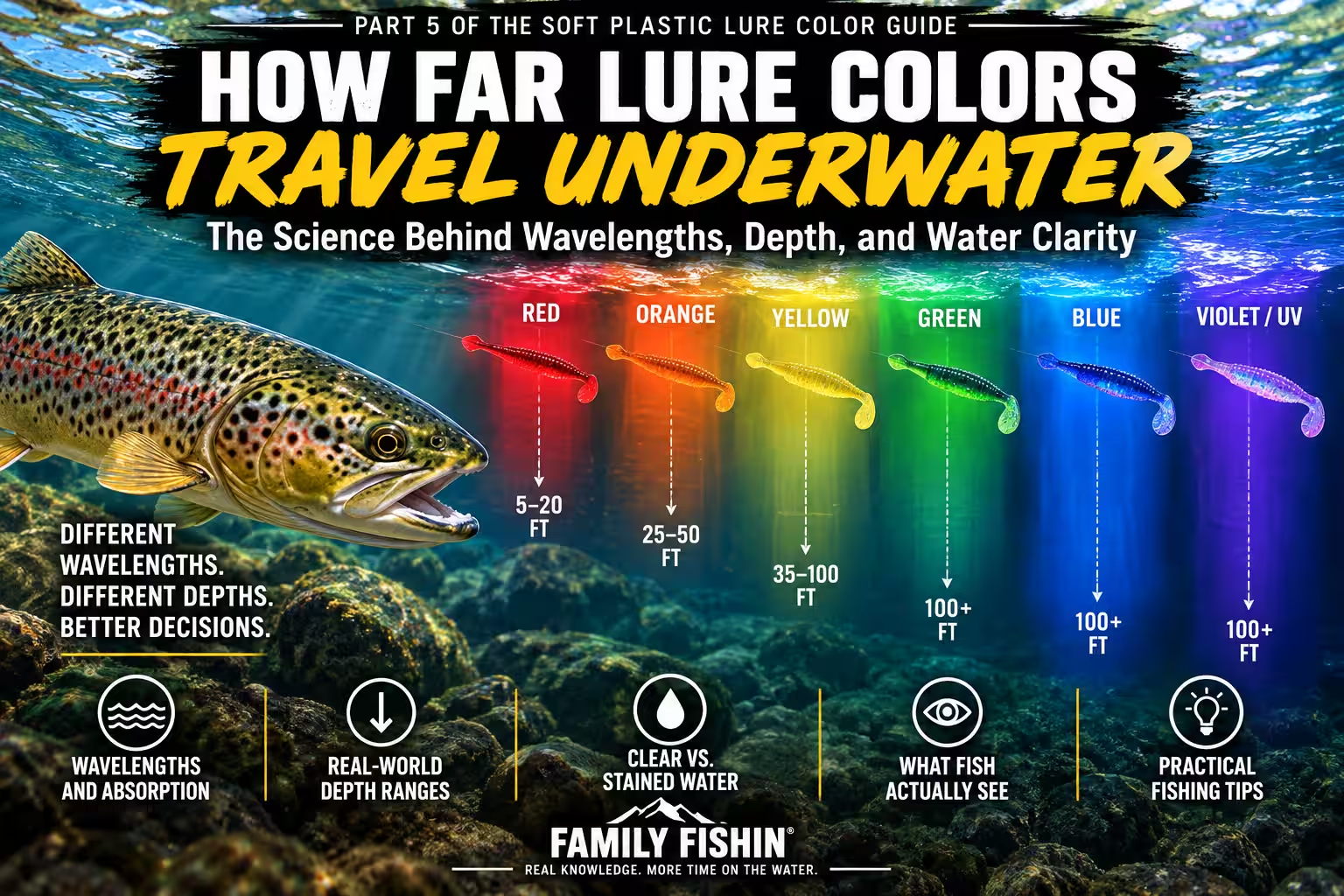
Brightness for its own sake isn’t the reason to reach for fluorescent — where it stays bright is. And to see why, you need one fact from how water filters light: water absorbs the long wavelengths first. Red disappears in the first several feet, then orange, then yellow, while blue, violet, and ultraviolet penetrate the deepest. (The full breakdown of that is in the color series.)
Now connect the two. Down deep, or in stained water, the warm colors are gone — a normal red bait has almost no red light left to reflect, so it just goes dark and muddy. But the light that does survive down there is exactly the short-wavelength blue and UV that fluorescent pigments feed on. So a fluorescent color takes that surviving blue/UV light and converts it into visible glow, staying lit and vivid in the very conditions where ordinary colors die. This is exactly where fluorescent fishing lures gain their reputation for visibility There’s even direct evidence of this in nature: studies of reef fish found their red fluorescence gets brighter with depth — because deeper down there’s more of the blue light, and less competing background light, for the fluorescence to work against. That is the real, physical reason fluorescent chartreuse and fire-tiger are go-to colors in deep water, stained water, and low light: not because they’re “bright,” but because they make their own visible light from the only light left down there.
The Catch: Fluorescent Needs Light Present
Here’s where the fluorescent-versus-glow distinction comes home, and where people get burned. Fluorescence has no afterglow Anglers sometimes expect fluorescent fishing lures to behave like glow lures, but the two work very differently.— kill the light entirely and a fluorescent bait goes completely dark, instantly. So in truly dark water — a moonless night, the bottom of a deep dark hole with no light penetrating — a fluorescent lure does very little, because there’s no light coming in for it to convert. As one early lure patent put it bluntly, in darkened water a fluorescent lure just reflects what little light is around, which is almost nothing.
So the two effects cover different conditions, and that’s how to think about them:
- Fluorescent wins in low but present light — deep daylight, stained or muddy water in the daytime, overcast, dawn and dusk. There’s some light (especially blue/UV) for it to convert, and fluorescence amplifies it.
- Glow (phosphorescent) wins in no light — true night, the lightless deep — because it brought its own stored light and doesn’t need any coming in.
Smart anglers carry both and match to the light, and some baits even combine the two: a fluorescent color for the daylight-and-stained conditions plus a glow element for when it’s truly dark.
The Other Catch: Fluorescent Colors Fade
There’s a real trade-off in the material, and it matters for both buying and pouring: fluorescent pigments are generally less lightfast than ordinary pigments — they fade faster in sunlight. The same energetic UV that makes them glow also slowly breaks down the fluorescent molecules over time, so a fluorescent bait left baking in the sun loses its pop, going from electric chartreuse to a tired pale yellow. It’s the price of the effect. The practical upshot: store fluorescent baits out of direct sun (the same cool, dark storage that’s good for soft plastics generally), and don’t be surprised when an old, sun-exposed fluorescent bait isn’t as loud as a fresh one.
Why Chartreuse Specifically Is the Confidence Color
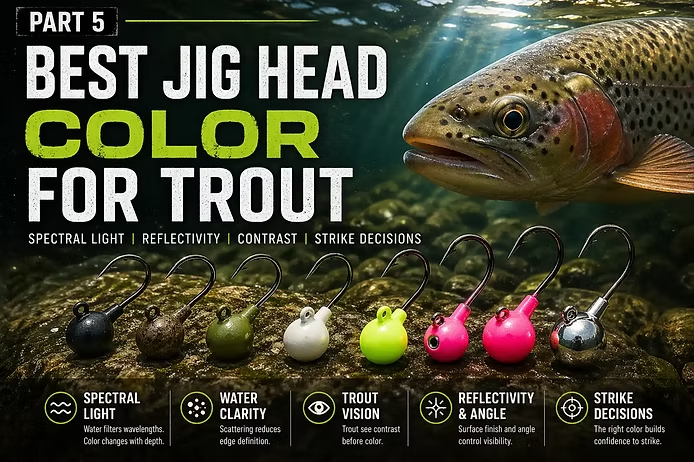
There’s a reason “chartreuse” is half the soft-plastic aisle and the color anglers reach for when nothing’s working. It’s not just that it’s a strong fluorescent — it’s where it sits. Chartreuse is a yellow-green, and that puts it in a sweet spot on two counts. First, it’s one of the most efficient fluorescent colors, so it pops hard. Second, yellow-green sits in a band that still carries reasonably deep into water (it outlasts red and orange as you go down) and contrasts well against the blue-green background of most water. Stack a powerful fluorescent effect on top of a wavelength that both penetrates decently and stands out, and you get a color that’s visible across a huge range of depths and water colors. That combination — not magic — is why chartreuse earns the “tie it on when in doubt” reputation, especially in stained or deep water.
Fluorescent Colors Bleed More — a Storage Heads-Up
One material quirk worth knowing: in soft plastics, fluorescent colorants are often dyes (dissolved into the plastic) rather than solid pigment particles, and dyes are notorious travelers. They migrate more readily than regular pigments, which means fluorescent baits are among the worst offenders for color bleed — a hot-chartreuse worm left touching a white bait will stain it far faster than a normal color would. So fluorescent baits especially want to be stored separated or in their own bags, not jumbled against lighter colors. (This is the same migration story behind baits going bad in storage — see Why Soft Plastic Baits Melt.) For pourers, it also means a little fluorescent dye can creep into the next color you pour if you don’t clean up between batches.
Pairing Glow and Fluorescent in One Bait
Because the two cover opposite light conditions, combining them in a single bait is a genuinely smart move. A fluorescent body handles the stained-water and deep-daylight conditions where there’s still some light to convert, while a glow element (a glow belly, core, or dot) takes over when the light runs out entirely — dusk turning to dark, or sinking past where any light reaches. One bait, charged with a UV light before the drop, then covers the whole light range: fluorescent pop on the way down, glow when it gets truly dark. Many of the best low-light baits are exactly this hybrid, even if the packaging just calls it “UV glow.”
For the Pourer: Using Fluorescent Colorants
Most fluorescent fishing lures rely on specialized colorants that convert short-wavelength light into visible color. If you pour your own, a few things make fluorescent colors behave:
- Build on a translucent or clear base. Like glow, the effect depends on light getting into the pigment and back out, so burying fluorescent colorant in a dense opaque base muffles it. Translucent bases let it light up.
- A little goes a long way. Fluorescent colorants are intense; you usually need less than you’d expect to get a loud color, and overloading can actually dull the effect and waste pigment.
- Combine, don’t necessarily flood. Some of the deadliest patterns are mostly natural with a fluorescent accent — a chartreuse tail, a fire-tiger belly, hot-orange dots. That gives you the attract-and-contrast pop without an entirely unnatural bait.
- Expect the fade. Because fluorescent colorants fade in sun, store your fluorescent pours in the dark, and know that long-term shelf life of the color is shorter than a regular pigment’s.
- Don’t confuse your colorants. Fluorescent colorant (pops under UV, no afterglow), glow pigment (afterglow in the dark), and UV-reflective additive (bounces UV) are three different products that do three different jobs — know which you’re adding and why.
A Word on What the Fish Actually Sees
It’s worth being honest here: everything above is about the physics of the pigment — what light goes in and comes out. Whether a given fish finds that more attractive is a separate question about fish vision, and it’s genuinely more complicated. Fish see color differently than we do, their sensitivity shifts with species and depth, and some species can see into the UV while others can’t. What we can say with confidence is the part this article covers: a fluorescent color puts out a stronger, more visible signal in low-but-present light than an ordinary color does — it’s objectively easier to see in stained and deep daylight conditions. Whether that visibility helps or hurts on a given day depends on the fish, the pressure, and the water, which is the domain of the color and fish-vision series — see How Fish See Color. Treat fluorescence as a visibility tool you’re choosing to dial up or down, not a guaranteed fish-magnet.
When to Use Fluorescent Fishing Lures
Pulling it together, fluorescent is the right tool when:
- The water is stained, muddy, or off-color in the daytime — fluorescence cuts through by amplifying the available light.
- You’re fishing deep in daylight, where warm colors have died but blue/UV still reaches.
- It’s overcast, or dawn/dusk — low but real light that fluorescence makes the most of.
- You want maximum contrast or an attractor — a fluorescent accent draws the eye and triggers reaction strikes.
And it’s the wrong tool in truly dark water (that’s glow’s job), and often too much in bright, clear, shallow, low-pressure water, where a loud fluorescent color can look unnatural and spook wary fish. As with glow, think of it as a dial matched to conditions, not an always-on upgrade.
How to Test It at the Bench
- The black-light check. Shine a UV/black light on the bait. A fluorescent color will blaze; switch the light off and it dies instantly (confirming it’s fluorescent, not glow). This also tells you which of your baits are truly fluorescent versus just bright-colored.
- The daylight pop test. Compare a fluorescent color against a regular pigment of the “same” color in daylight, side by side — the fluorescent one will look noticeably more intense, almost lit. That’s the daylight-fluorescent effect you’re paying for.
- The fade test. Leave a fluorescent bait in a sunny window for a few weeks next to one kept in the dark, then compare. You’ll see the lightfastness trade-off firsthand — useful for deciding how much to trust fluorescent colors for long-stored baits.
Diagnose It
- Blazes under a black light, dark when it’s off — that’s fluorescent working exactly as designed. For dark-water performance you’d want glow instead.
- Looked electric when new, now pale and tired — sun-faded. Fluorescent colors lose lightfastness; store them dark.
- Looks dull and muddy deep or in stained water — if it’s a regular (non-fluorescent) color, that’s expected as warm light is filtered out; a fluorescent color is the fix for those conditions.
- Pops in daylight with no UV light needed — that’s a daylight-fluorescent pigment doing its job off the UV already in sunlight.
Quick Reference: Glow vs Fluorescent vs UV-Reflective
Since these three get jumbled constantly, here’s the whole family at a glance:
- Glow (phosphorescent): stores light, then emits it in total darkness for minutes to hours. Needs charging (UV/sun); works with no ambient light. Best for true dark — night, lightless deep.
- Fluorescent: converts short/UV light to visible light, instantly, only while light is hitting it — no afterglow. Best for low-but-present light — stained water, deep daylight, overcast. Fades in sun.
- UV-reflective: bounces UV back without converting it, so UV-sensitive fish can detect it. A separate tactic about UV contrast, covered in the color guide’s UV post.
One sentence each: glow brings its own light, fluorescent amplifies the light that’s there, UV-reflective bounces invisible light for fish that can see it. Different jobs, different conditions — and the reason “UV” on a package tells you almost nothing until you know which one it means.
Frequently Asked Questions About Photochromic Fishing Lures
What are photochromic fishing lures?
Photochromic fishing lures contain special pigments that change color when exposed to ultraviolet (UV) light. In sunlight they become more colorful, and in shade or low UV conditions they gradually return to their original color.
How do photochromic fishing lures work?
Photochromic pigments contain molecules that physically change shape when struck by UV light. The UV-triggered shape absorbs visible light differently, causing the lure to change color. When UV exposure decreases, the molecule returns to its original shape and the color fades.
Are photochromic fishing lures the same as glow-in-the-dark lures?
No. Glow-in-the-dark lures store light and continue glowing after the light source is removed. Photochromic fishing lures do not store light. They only change color while UV light is present and begin fading as soon as UV exposure decreases.
Are photochromic fishing lures the same as fluorescent fishing lures?
No. Fluorescent fishing lures convert UV light into visible light, making them appear brighter. Photochromic fishing lures change from one color state to another when exposed to UV light. Fluorescence increases brightness, while photochromism changes color.
Do photochromic fishing lures work underwater?
Yes, but the effect depends on how much UV light reaches the lure. In clear water, UV can penetrate relatively deep and keep the lure colored. In stained or muddy water, UV is filtered out more quickly, causing the lure to fade toward its shade-state color at shallower depths.
Can you activate a photochromic fishing lure with a UV flashlight?
Yes. A UV flashlight can trigger the color change just like sunlight. However, unlike a glow lure, the color is not stored. Once the UV source is removed, the lure gradually returns to its original state.
Do photochromic fishing lures change color instantly?
Most photochromic lures begin changing within seconds of UV exposure. Full color development may take several seconds to half a minute depending on the pigment, UV intensity, temperature, and the lure’s construction.
Do photochromic fishing lures wear out?
Yes. Photochromic pigments gradually degrade from repeated UV exposure, a process known as photofatigue. Over time the color change becomes weaker until the effect eventually disappears.
Are photochromic fishing lures difficult to make?
They can be. Photochromic pigments are more heat-sensitive than most lure colorants and can be damaged during the plastisol pouring process. Many formulations use microencapsulated pigments to help protect the color-changing molecules.
When are photochromic fishing lures most useful?
Photochromic fishing lures are most useful when light conditions change frequently, such as moving between sunny and shaded areas, fishing varying depths, or dealing with changing cloud cover. Their ability to automatically adjust their appearance makes them a unique specialty tool rather than an everyday replacement for standard lure colors.
Do fish actually respond to photochromic fishing lures?
The color-changing effect is real and scientifically proven. Whether fish respond positively depends on species, water clarity, light conditions, fishing pressure, and many other factors. Photochromic lures should be viewed as a visibility and presentation tool rather than a guaranteed fish-catching advantage.
The Bottom Line
Fluorescent fishing lures are not simply brighter colors—they are materials engineered to convert invisible light into visible color. Fluorescent colors aren’t just bright — they convert invisible UV and short-wavelength light into extra visible light, handing back more of their color than fell on them and looking lit from within. That makes them the right call exactly where ordinary colors fail: deep daylight, stained water, and low light, where the blue and UV they feed on are the only light left. But they store nothing, so they go dark the instant the light does — true darkness is glow’s job, not fluorescence’s — and they fade faster in the sun, so store them dark. Match fluorescent to low-but-present light and you’ve got a color that punches through conditions that flatten everything else.
Fluorescent and glow are two of the “effect pigments.” Glow — the one that carries its own light into total darkness — is covered in the glow-in-the-dark lures post; the UV reflectance tactic is in UV Lures Explained; and the plastisol you load all of these into is on the the Science of Plastisol hub.
About Family Fishin
Family Fishin is a family-owned fishing tackle company dedicated to designing, testing, and producing high-quality fishing lures — inspired by generations of fishing tradition and driven by a passion for innovation. Every product is developed with one goal in mind: helping anglers spend more time doing what they love, catching fish and creating memories on the water.
Tags: #fluorescent lures #soft plastics #lure colors #chartreuse #lure making #UV fishing #DIY lures #stained water