What Trout Actually Hear (And Why It Should Change How You Fish)
Every trout angler has heard the same advice: walk softly, don’t slam the boat hatch, keep your voice down. It gets passed down like folklore — something a guide says without explaining why. But there’s real science behind trout hearing, and once you understand how a trout actually hears, the advice gets a lot more specific and a lot more useful than simply “be quiet.”
Trout don’t hear the way you do. They don’t have ears you can see, they can’t hear most of what you can hear, and they pick up on things — close, low, physical things — that would never register on a human. Understanding that difference tells you which noises actually matter on the water and which ones don’t, and it explains a few things guides have always sworn by without quite being able to say why.
Water isn’t quiet air
Sound is just a disturbance moving through a medium — a wave of squeeze-and-release traveling outward from whatever made it. A dropped rod, a rock tumbling in a riffle, a rattle inside a lure: all of them push on the surrounding water the same basic way a guitar string pushes on air.
But water is not air, and two differences matter a lot here.
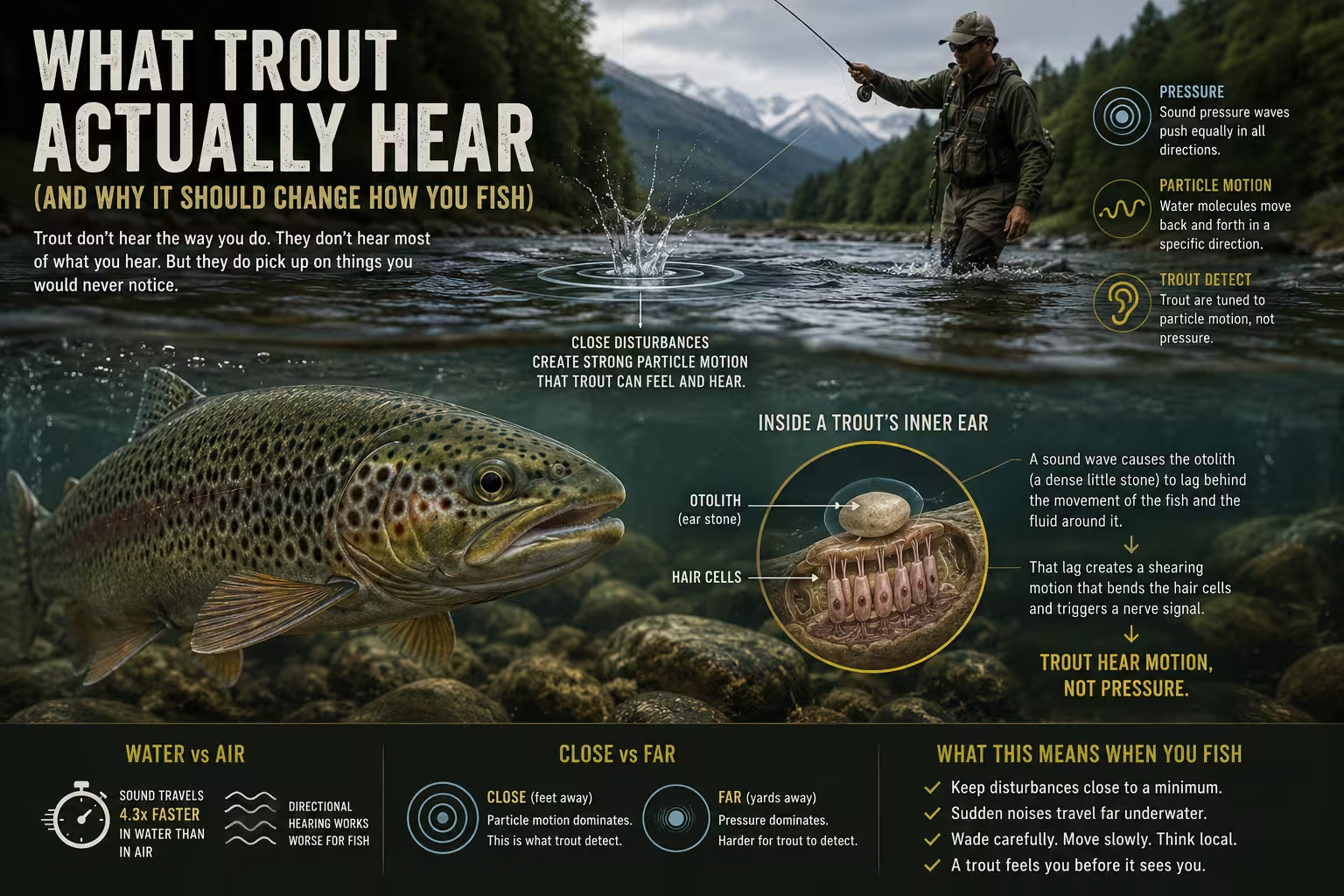
First, sound travels about 4.3 times faster in water than in air — roughly 4,900 feet per second versus 1,125. That’s a big deal for how a fish can (or can’t) tell what direction a sound came from. Humans locate sound partly by the tiny time-lag between it hitting our left ear and our right ear. Underwater, that lag shrinks so much it’s nearly useless, which is one reason directional hearing works differently — and worse — for fish than for us.
Second, and this is the part that actually matters for understanding a trout: underwater sound comes in two separate flavors. There’s pressure — the rapid rise and fall in water pressure that a hydrophone (underwater microphone) picks up, pushing equally in every direction. And there’s particle motion — the actual physical back-and-forth jostling of individual water molecules as the wave passes through them, which has a specific direction, not just a strength.
This distinction sounds technical, but it’s the single most important idea in this whole article: trout are believed to detect sound mainly through particle motion, not pressure. That puts them in a completely different sensory category from fish like catfish or goldfish, which are built to detect pressure. For decades, researchers measured only pressure because it’s easy to measure with a hydrophone — and in doing so, they were measuring the wrong thing for a fish like a trout.
One more physics note worth keeping in your back pocket: close to any sound source, particle motion dominates; farther away, pressure takes over. Almost everything an angler does near a trout — wading footsteps, an oar knocking the gunwale, a dropped tackle box — happens close enough that the fish is responding to strong, local particle motion, not some faint signal traveling from far away. That’s the physical reason close, sudden noise matters more than distant noise, even at the same volume.
Trout have ears. You just can’t see them.
Pick up a trout and look for an ear and you’ll find nothing — no flap, no hole, no eardrum. That’s not a design flaw; an eardrum is a land solution, built to catch faint airborne pressure and funnel it inward. Underwater, it’s unnecessary: water is about 800 times denser than air, and a fish’s body is made mostly of water itself, so sound passes through trout tissue almost as easily as it passes through the river around it. The trout doesn’t need to catch the sound — it’s already moving through the fish.
All the real work happens buried in the skull, in a pair of inner ears (one per side), each containing three small fluid-filled sacs. The main one for hearing is called the saccule, with a second one, the lagena, playing a supporting role (the third, the utricle, is mostly about balance).
Here’s the elegant part. Inside each sac sits a patch of hair cells — cells with tiny hair-like fibers that bend and fire a nerve signal when moved — and resting right on top of them is a dense little stone made of calcium carbonate, called an otolith (literally “ear stone”). The otolith is two to three times denser than the surrounding tissue. When a sound wave passes through the fish, the fish’s body and the fluid around the otolith move almost instantly with the water — but the heavier otolith lags slightly behind, because of its own inertia. That tiny bit of lag creates a shearing motion between the stone and the hair cells beneath it, and that bending is what triggers the nerve signal the brain reads as sound.
In effect, each of these organs is a biological accelerometer — the same basic principle used in some mechanical motion sensors, just built from bone and jelly instead of silicon. It detects motion, directly, which is exactly why trout are tuned to particle motion rather than pressure. There’s no membrane here waiting to be pushed by pressure — there’s a mass waiting to lag behind an acceleration. That’s a fundamentally different kind of “hearing” than yours.
Why a trout hears differently than a catfish — and why that matters
Not all fish hear equally well, and the reason comes down to one organ: the swim bladder, the gas-filled sac fish use to control buoyancy. Gas is far more compressible than water or flesh, so a swim bladder vibrates dramatically in response to sound pressure — much more than the rest of the fish’s body does.
In some fish, that vibration is mechanically wired straight into the inner ear. Carp, minnows, catfish, and goldfish (a group called Otophysi) have a chain of tiny bones — the Weberian ossicles, named after the anatomist who first described them in 1820 — physically linking the swim bladder to the ear, much like the three small bones in your own middle ear link your eardrum to your inner ear. This turns their swim bladder into a built-in amplifier, letting them detect fainter sounds across a much wider range of pitches. These fish are called hearing specialists.
Trout have no such wiring. Their swim bladder isn’t mechanically coupled to the ear in any way that boosts sensitivity — it’s just a buoyancy organ that happens to also be an open tube connected to the throat (salmonids can gulp air at the surface). Trout, along with bass, pike, sunfish, and most other freshwater gamefish, fall into the hearing generalist category: real hearing, but a narrower range and noticeably less sensitivity than a specialist.
This isn’t trout being “worse” fish, evolutionarily speaking — they simply belong to an older branch of the fish family tree that split off before this amplification trick ever evolved. What they kept instead is the older, particle-motion-based hearing mode, and they’re genuinely good at using it for what it’s built for: detecting close, low-frequency vibration and motion in the water around them. Think of it less as “ears tuned to catch a wide range of pitches” and more as “a whole-body vibration sensor tuned to specific, low, close disturbances.”
Revised H2
Trout Hearing Range: What Frequencies Can a Trout Hear?
This is where a lot of fishing folklore either checks out or falls apart, so it’s worth being precise.
The foundational study here, from 1978, tested Atlantic salmon and found they could detect sound up to a bit above 600 Hz, with their best sensitivity sitting around 100–300 Hz. For context, that’s roughly the lower half of a piano keyboard, or a low male speaking voice — nowhere close to what a human ear can do (young humans hear up to roughly 20,000 Hz). Later research found salmonids can also pick up sound well below 20 Hz — a rumble so low it borders on what’s called infrasound, felt more than “heard” as a tone.
Rainbow trout specifically have been shown to have hearing broadly similar to Atlantic salmon. A more recent, more rigorously controlled 2018 study (commissioned by the Scottish government, using a modern brainwave-monitoring technique) largely confirmed the original numbers, while noting that salmon hearing is genuinely unimpressive compared to true specialists like herring or cod.
Put it together and the general salmonid pattern looks like this:
Best sensitivity: roughly 100–300 Hz
Full detectable range: below 20 Hz up to somewhere around 600–800 Hz, dropping off sharply above that
Overall sensitivity: modest — trout need a comparatively loud sound to notice it at all, versus a true specialist
Real-world startle reactions have been documented across a slightly wider band, roughly 7–400 Hz
For an angler, the translation is direct: trout are tuned to low-pitched, rumbling, thumping sound — not high-pitched clicks, beeps, or chimes. A dropped metal tool clanking on an aluminum boat hull, the low thud of wading boots rolling streambed rock, the pulse of an outboard motor, a low knocking rattle in a lure — all of that sits squarely in a trout’s wheelhouse. A high-pitched fish-finder ping almost certainly doesn’t, since most sonar frequencies are chosen specifically to sit outside what fish can detect.
The lateral line: a second sense people mix up with hearing
You’ve probably heard of the faint line running down a trout’s flank — the lateral line. It gets lumped in with “hearing” constantly, and while the two systems are related at the cellular level, they’re not the same thing.
The lateral line is made of small sensors called neuromasts, built from the same basic type of hair cell used in the inner ear, but arranged along the body’s surface and in shallow canals just beneath the skin. It’s often described as “touch at a distance” — it lets a trout feel nearby water movement, obstacles, and prey without seeing or touching them. It’s what lets a trout hold rock-steady facing into current without constantly checking visually, what tips it off to a struggling insect nearby, and what triggers the lightning-fast full-body flinch (called a C-start) that moves a fish away from a sudden close disturbance before it’s even consciously “decided” to react.
The key practical difference: the lateral line is a very short-range sensor — effective within roughly a body length or two — while the inner ear, though also biased toward close, low-frequency signals, reaches somewhat farther. When your boot rolls a rock near a holding fish, both systems are almost certainly firing at once. Researchers studying the trout “spook” reflex have been upfront that untangling exactly which system triggers it, in a real streamside moment, is more precision than the science can currently offer.
Can a trout tell where a sound came from?
Only roughly. The “compare arrival time between two ears” trick that helps humans point toward a sound barely works underwater, since sound arrives at both ears almost simultaneously no matter which direction it’s coming from. Fish make up some of the ground with a clever anatomical workaround: the hair cells inside each otolith organ aren’t all oriented the same way — different clusters point in different directions, so a sound from one direction excites one group more strongly than another, giving the nervous system a rough directional signal. It’s a real capability, but researchers are candid that it’s still cruder and less precise than human directional hearing. Practically, this reinforces something guides already assume: a spooked trout is reacting to that something happened nearby, not necessarily to a precise fix on your exact position — which is part of why staying still after a noise often settles a fish faster than trying to relocate away from it.
The stream is never actually silent
Every one of those hearing-threshold numbers above was measured in a controlled tank — which leaves out something important: real streams are loud. Riffles, small falls, current tumbling over cobble, wind on the surface — all of it generates continuous background noise, much of it sitting in the exact same low-frequency range a trout’s ear is tuned to.
This raises a real question researchers have actually tested: do fish living in noisier habitats become less sensitive to sound over time, adapting to tune out constant background noise? A study comparing fish across several streams near Vienna found evidence that yes, the acoustic environment a species evolves in shapes how sensitive its hearing becomes.
That has a genuinely useful implication for anglers, even though it hasn’t been tested in trout specifically: a fish holding in loud, fast pocket water is very likely sitting in a noisier acoustic environment than a fish in a slow, glassy pool — which may be part of the real, physical reason pocket-water fish often tolerate wading noise and conversation far better than fish in a still pool, where the same small disturbance stands out sharply against near silence. This lines up with a related concept called masking — a loud background sound can partly bury a second, quieter sound in the same frequency range, the same way it’s hard to hear a whisper at a loud concert. It’s a reasonable, physics-backed explanation for something a lot of guides already believe by feel.
What to actually do with this on the water
Wading noise is real, but it’s not automatically alarming. Footsteps and shifting rock generate exactly the low-frequency vibration a trout is built to detect — but that same knocking, tumbling sound happens naturally and constantly in a real stream, especially at higher flows. A trout isn’t necessarily wired to treat all rock-on-rock noise as danger, because it’s simply part of its everyday soundscape. What the evidence more strongly supports is that sudden, sharp, irregular disturbances — a stumble, a splash, a dropped item — are far more likely to trigger a startle response than steady, predictable wading. Move deliberately, avoid sudden lurches, and you’re addressing the part of this that’s actually backed by the biology.
Whether studded boots specifically make more underwater noise than felt or rubber soles hasn’t been directly tested in any research we could find — it’s a reasonable guess, not a confirmed fact. The stronger, better-supported point from experienced guides is that secure, confident footing (which studs genuinely provide) that lets you move steadily probably matters more than what the sole is made of.
Talking is more complicated than “stop talking.” Airborne speech crosses the air-water boundary very poorly — it’s the same reason a conversation on a boat sounds muffled to someone swimming just below the surface. So conversational talking, by itself, is probably a smaller factor than people assume. But talking rarely happens in isolation — it comes with shifting weight, gesturing, footsteps, gear bumping the hull — and that physical movement transmits into the water far more efficiently than voice ever does through the air-water surface. Practical takeaway: the actual advice isn’t “stay silent,” it’s “keep your body and gear still.”
Motors matter more than boats. Outboard engines generate continuous low-frequency noise and vibration sitting right in a trout’s most sensitive range. Studies on related fish species have documented real behavioral and even physiological effects from motor and vessel noise. Drifting, poling, or paddling quietly avoids introducing that steady disturbance — consistent with the long-standing preference among guides for unpowered movement near holding fish. An aluminum hull, lacking any sound-dampening layers, will also transmit a dropped tool or a stomped foot into the water especially efficiently.
Rattle lures: the physics checks out, the marketing overreaches. A trout is genuinely far better equipped to detect a low knocking or thumping rattle than a high-pitched one — both because it matches their best hearing range and because lower frequencies travel farther through water with less energy loss. Serious lure designers have converged on the same conclusion independently: fewer, larger, denser rattle components (big glass or tungsten beads) produce lower-pitched sound that both travels farther and is easier for a trout to detect than a cluster of small BBs. What’s much less settled is whether a rattle reliably increases strikes, as opposed to just increasing detectability or drawing investigative interest — that stronger claim isn’t backed by controlled research. Trust the physics of low-frequency-travels-farther; be skeptical of specific strike-rate claims.
Chronic noise is a real conservation issue, not just superstition. Sustained noise — pile driving, blasting, heavy boat traffic, industrial construction near water — has been directly studied in salmonids and shown to cause measurable stress responses and temporary hearing loss. There’s a genuinely remarkable silver lining: unlike humans, fish can regrow damaged inner-ear hair cells over their lifetime, so a lot of noise-related hearing damage in fish is recoverable in a way it never would be for a person. That doesn’t make chronic, heavy noise harmless — it’s a real and active concern in fisheries management — but the picture isn’t as bleak as “once damaged, always damaged.”
Quick myth check
“Trout can’t hear, they only feel vibration” — False. They have a working inner ear detecting actual sound, separate from the lateral line’s vibration sensing.
“Trout hear everything, so be dead silent” — Overstated. Their range is narrow and low-frequency, high-pitched sounds and most sonar are likely inaudible to them, and their home stream is already loud with natural noise.
“Talking on the boat spooks fish” — Mostly a myth as usually stated. It’s the movement and hull contact that comes with talking, not the voice itself, crossing into the water.
“Rattles work because they mimic exact baitfish distress sounds” — Oversold. The low-frequency-is-detectable part is real; the “reliably triggers more strikes” part goes beyond what’s actually been shown.
“Fish hearing damage is permanent, like in humans” — False. Fish can regrow damaged inner-ear hair cells over their lifetime — a trait humans lost somewhere in our evolutionary past.
Where this science actually comes from
None of this is folklore dressed up as fact. Most of the modern picture of fish hearing traces back to two researchers whose careers span roughly the last fifty years of the field: Arthur Popper, long based at the University of Maryland, and the late Anthony Hawkins, the Scottish marine biologist who ran the 1978 Atlantic salmon study this whole article leans on. It’s a decades-deep, repeatedly-tested body of comparative biology — which is exactly why it’s solid enough to actually change how you fish rather than just being a fun fact.
The bottom line
A trout’s hearing is a genuinely different evolutionary answer to the same problem your ears solve — built around a stone lagging slightly behind a moving fish rather than a membrane catching airborne pressure, with no amplifier wired to the swim bladder, and backed up by a second, short-range system reading water motion directly off its skin. That combination makes trout sensitive to a specific, narrow, low-pitched slice of the underwater world — not deaf, not all-hearing, just tuned in a particular direction.
Once you know that direction, you’re not guessing anymore. A careful, deliberate step matters more than total silence. A low rattle sits in a different physical category than a high one. A quiet drift beats a running motor for reasons you can actually explain. That’s the difference between technique built on real biology and technique built on inherited habit.
Frequently Asked Questions
What frequencies can trout actually hear?
Roughly 20 Hz up to 600–800 Hz, with their best sensitivity around 100–300 Hz. For comparison, healthy human hearing runs from about 20 Hz to 20,000 Hz — so trout only cover the very bottom slice of what you can hear, and even there, they need a fairly loud sound to notice it.
Can trout hear a fish finder or sonar ping?
Almost certainly not, or only very faintly. Sonar and fish-finder frequencies are typically chosen specifically because they sit well above what most fish can detect, and trout hearing falls off sharply above roughly 600–800 Hz.
Is a trout’s hearing better or worse than a bass’s? What about a catfish’s?
Trout and bass are both “hearing generalists” and roughly comparable to each other. Catfish (along with carp, minnows, and goldfish) have a mechanical link between their swim bladder and inner ear that trout completely lack, making them true “hearing specialists” — meaningfully more sensitive and broader-ranged than either trout or bass.
Does wading noise really spook trout?
It’s genuinely detectable — footsteps and shifting rock fall right in a trout’s hearing range — but that kind of noise also occurs naturally and constantly in a stream, so it isn’t automatically alarming. What actually seems to matter is sudden and irregular versus steady and predictable: a stumble or splash is far more likely to spook a fish than deliberate, even wading.
Do studded boots make more underwater noise than felt or rubber soles?
Nobody has directly tested this, as far as we could find — it’s a reasonable guess, not a proven fact. The better-supported point is that secure footing that lets you move steadily probably matters more than the sole material itself.
Does a motor scare trout more than paddling or drifting quietly?
Yes, and this one’s well supported. Motors put out continuous low-frequency noise and vibration squarely in a trout’s most sensitive range, and studies on related fish species have documented real behavioral effects from engine noise. Quiet, unpowered movement avoids that entirely.
Why do trout in fast, loud water seem less spooky than trout in a still pool?
Fast water generates its own background noise in roughly the same frequency range as a trout’s hearing, which can partially mask additional sounds like wading noise — the same reason it’s harder to notice a quiet sound in a loud room. This hasn’t been tested in trout specifically, but it’s a physics-consistent explanation for something a lot of guides already believe.
Do all trout species — rainbow, brown, brook, cutthroat — hear the same way?
Broadly, yes. All salmonids share the same basic inner-ear anatomy and lack of swim-bladder amplification, and rainbow trout hearing specifically has been shown to closely resemble Atlantic salmon’s. Fine differences between species haven’t been as thoroughly studied, so treat “identical hearing across all trout” as a reasonable approximation rather than an exact fact.