Best Time of Day to Catch Trout
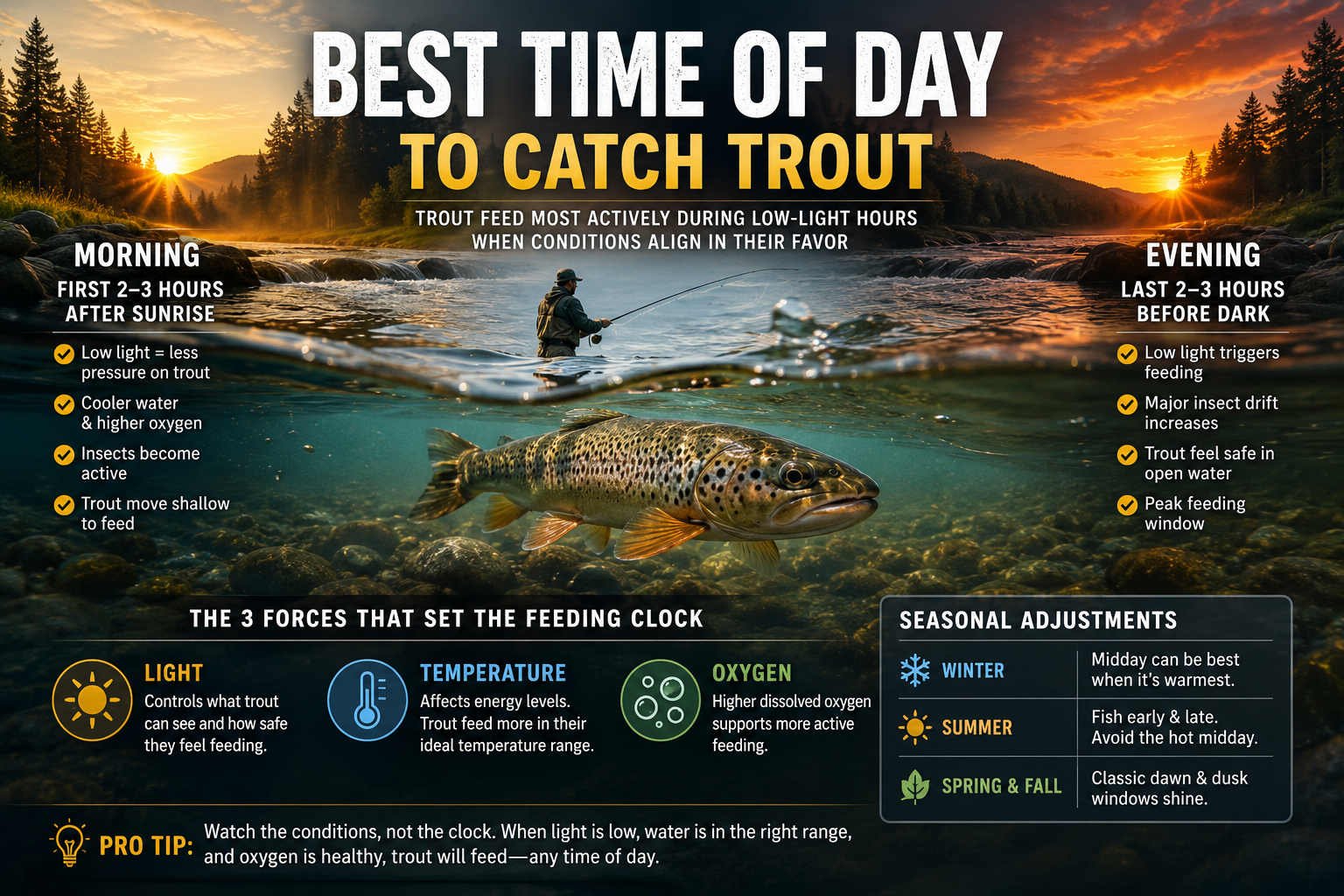
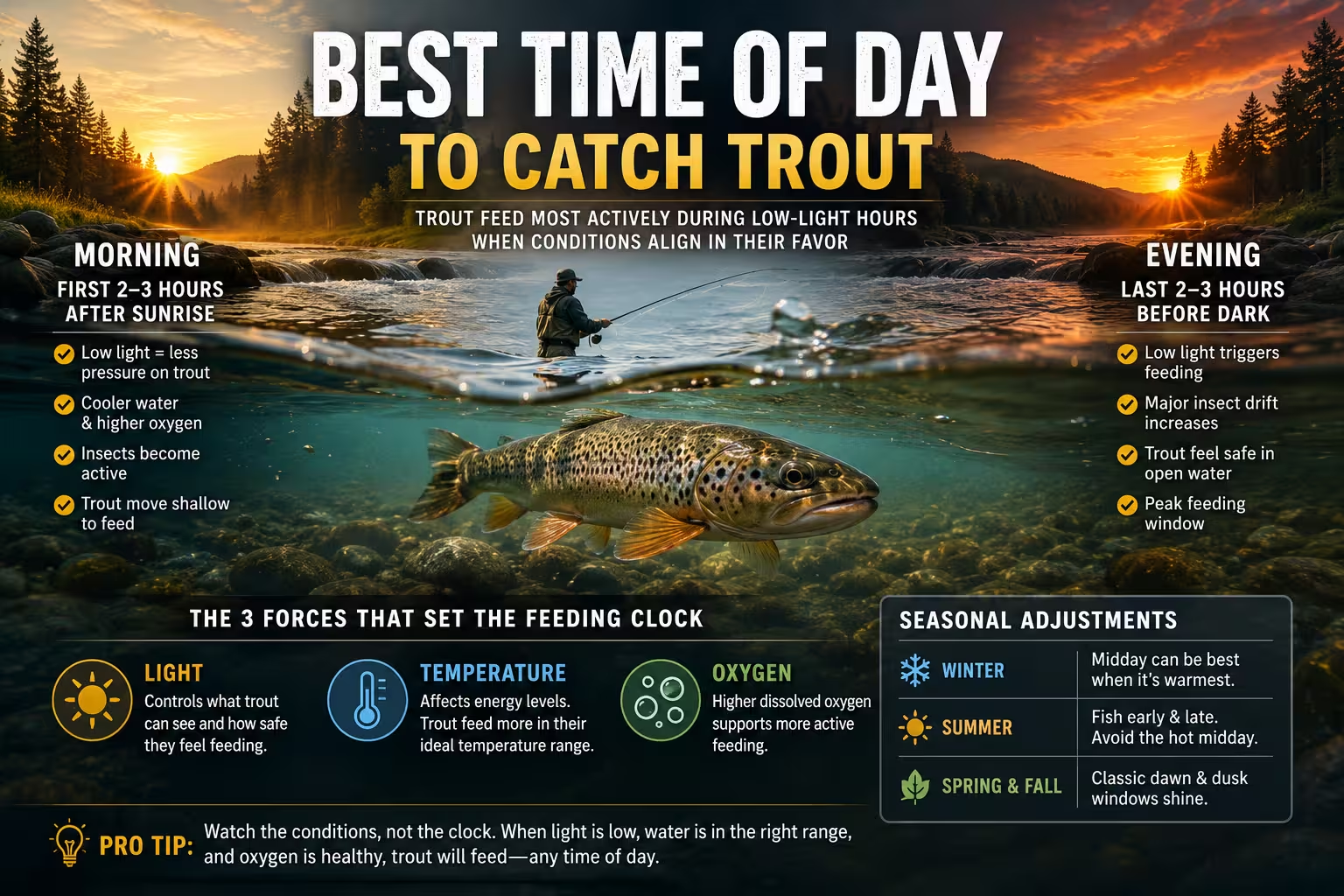
The best time of day to catch trout is typically the first two to three hours after sunrise and the last two to three hours before dark. These low-light feeding windows align with how trout see, when aquatic insects become active, and when water temperature and dissolved oxygen create ideal feeding conditions. Understanding these three factors lets you predict trout feeding activity instead of relying on guesswork.
This is a longer read, but by the end you’ll stop guessing at “magic hours” and start reading the actual conditions in front of you. That’s the difference between an angler who gets lucky and one who catches fish on purpose.
Best Time of Day to Catch Trout: The Three Forces That Control Feeding
Anglers love to argue about the best time of day, but trout don’t own a watch. They respond to their environment, and three environmental factors do almost all the work:
- Light — how bright it is, which controls both what the trout can see and what it’s willing to expose itself to.
- Temperature — which controls how much energy a cold-blooded trout has to spend chasing food.
- Dissolved oxygen — how much breathable oxygen the water actually holds, which sets a hard ceiling on activity.
Time of day matters only because it moves all three of these at once. Morning and evening are usually best because that’s when light, temperature, and oxygen tend to line up in the trout’s favor. When they don’t line up — a frozen January dawn, a 78-degree July afternoon — the “best time” moves. Let’s take them one at a time.
Force One: Light and the Trout’s Eye
The single most reliable rule in trout fishing is this: low light beats bright light. Dawn, dusk, and heavily overcast days consistently out-fish the middle of a bright, sunny day. There’s real biology behind that, not just superstition.
How a trout sees
A trout’s eye, like yours, is lined with two kinds of light-sensing cells: rods and cones. Cones handle color and fine detail but need bright light to work. Rods see only in shades of gray, but they are exquisitely sensitive in dim light. Humans have three cone types (red, green, blue). Trout actually have four — red, green, blue, and ultraviolet — so in good light they see color at least as well as we do, and into the UV range we can’t.
Here’s the part most anglers never hear about. A trout’s retina physically rearranges itself as the light changes. In bright daylight, the rods retract and the cones move into position to catch light. As it gets dark, the cones withdraw and the rods migrate forward to take over. Fisheries scientists call this the retinomotor response, and it’s controlled by the trout’s internal body clock as well as by the light itself. It’s the fish-eye version of your own eyes adjusting when you walk from sunshine into a dark room.
Two things matter for the angler. First, this switch is gradual, not instant — it takes time for the eye to shift gears. During the transition periods at dawn and dusk, a trout is in a sweet spot: there’s enough light to see prey, but not enough for the trout to be seen clearly from above by ospreys, herons, and other predators. That’s exactly when a feeding trout feels safe enough to move into open, shallow water and hunt. Second, harsh midday sun does the opposite. It floods the trout’s sensitive eyes, pushes fish deep and tight to cover, and makes them cautious. Bright light is not a feeding trigger. Dim light is.
This is why an overcast day can fish well from morning to night — the cloud cover holds that low-light advantage across the whole day instead of just at the edges. A gray drizzle that keeps people off the water is often a gift. (For a deeper look at how trout sense their world, see our trout behavior and biology guide.)
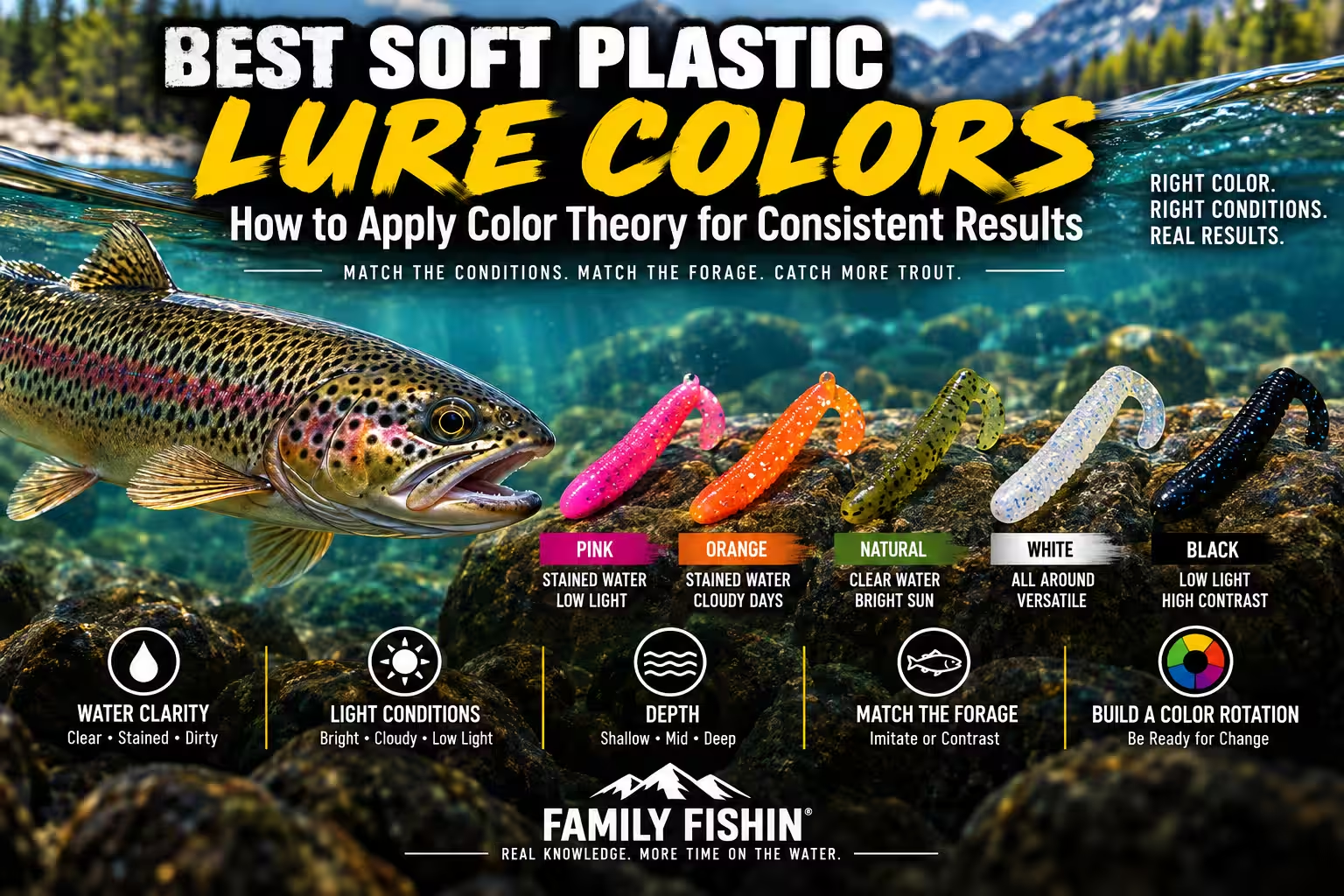
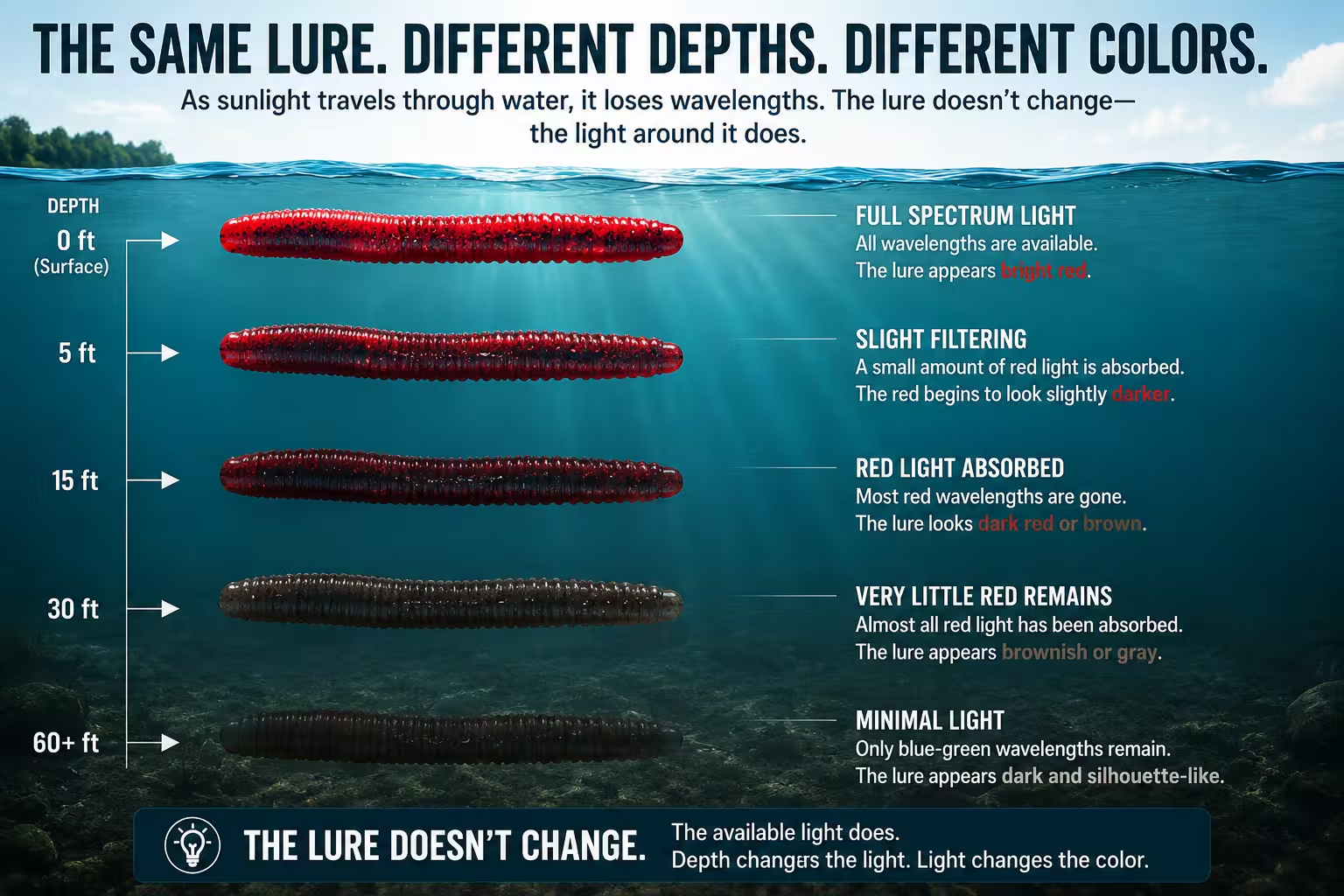
In that same low, stained light, a dark, high-contrast profile shows up better than a subtle natural one — one reason a black soft-plastic minnow earns its keep at first and last light.
Why the trout’s food agrees
Light doesn’t just control the trout. It controls the trout’s dinner, and the two are locked together.
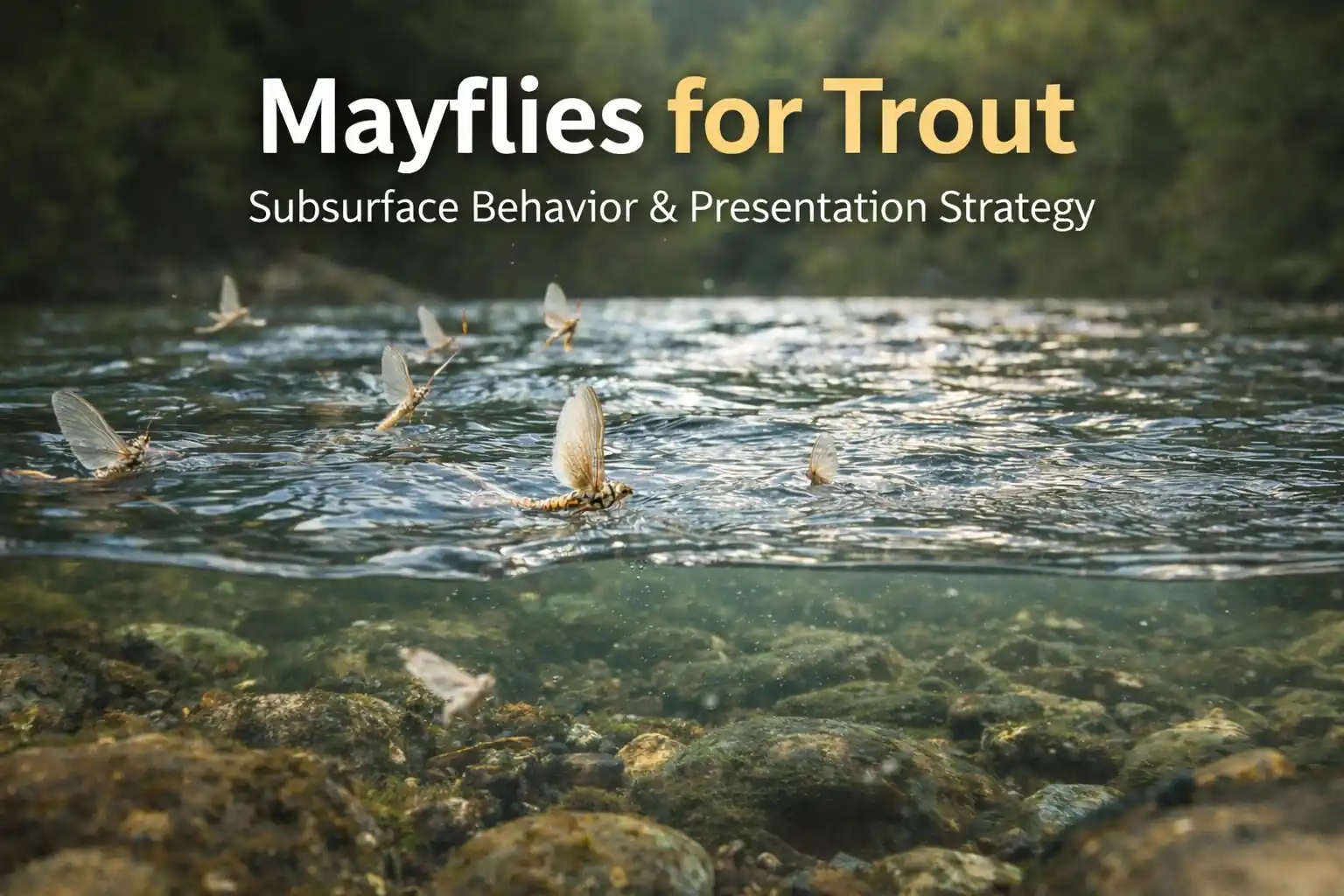
Most stream trout feed heavily on drift — aquatic insects like mayfly, caddis, and stonefly nymphs that let go of the streambed and tumble downstream in the current. Decades of research show that this drift increases dramatically after dark. In many streams the majority of the day’s insect drift happens at night.
Why? Because the insects are trying not to get eaten. Trout hunt by sight, so drifting in daylight is dangerous for a bug. Studies comparing streams with and without trout found that where trout are present, insects shift almost all their drifting to nighttime — in one study, 85% of daily drift occurred at night in trout streams, versus about 50% in streams without them. The prey evolved to move under cover of darkness specifically to avoid visual predators.
The result is a beautiful bit of natural timing. At dusk and into the night, more food is in the water column than at any other time, and the low light lets the trout ambush it safely. Peak food supply meets peak trout confidence. That’s the biological engine driving the classic evening bite, and it’s why the last hour before dark is so often the best hour of the day. When trout are drift-feeding on subsurface bugs, a natural-drifting soft-plastic mayfly nymph or stonefly nymph fished dead-drift through the seams is exactly what they’re looking for.
Force Two: Temperature and the Trout’s Engine
If light decides whether a trout feels like feeding, temperature decides how hard it can. This is the force most casual anglers underestimate, and understanding it will teach you more than any other single thing.
Trout run on water temperature
Trout are ectotherms — cold-blooded. They can’t generate their own body heat, so their internal temperature, and their entire metabolism, matches the water around them. Think of a trout as an engine with no thermostat of its own; the water sets the idle speed.
Cold water means a slow metabolism. The fish needs little food, digests slowly, and won’t burn precious energy chasing a lure it isn’t sure about. Warm water speeds the metabolism up — to a point. Push past that point and things go wrong fast.
Scientists measure this with something called aerobic scope: the gap between a trout’s resting energy use and its maximum energy use. That gap is the trout’s “spending money” — the energy available for swimming, chasing food, digesting, and fighting your hook. Aerobic scope is what you’re really fishing for.
Here’s the key finding from the lab work on rainbow trout. Aerobic scope is largest in a fairly narrow band and peaks around 59–61°F (15–16°C). Below that, the whole engine is just running slow. Above it, something sneaky happens: the trout’s resting energy demand keeps climbing with the heat, but its maximum capacity stops rising and then falls. The spending money shrinks. By the time water hits the upper 60s and into the 70s°F, a trout may be burning most of its energy just existing, with almost nothing left over to hunt. It isn’t lazy — it’s broke.
The practical temperature bands
Translate the biology into numbers you can use on the water:
- Below ~40°F (4°C): Metabolism is crawling. Trout hold tight, feed briefly, and won’t chase. Winter fishing is a game of slow presentations right in their face.
- ~50–65°F (10–18°C): The strike zone. This is where aerobic scope is high, digestion is efficient, and trout will move to eat. When your water is in this range, feeding windows open up and last longer.
- ~65–68°F (18–20°C): The warning zone. Trout are stressed, feeding drops off, and the fish start seeking cooler refuges.
- Above ~70°F (21°C): The danger zone. Feeding largely shuts down, and — critically — trout hooked and fought in this water often die even after a careful release, because they can’t recover. If you’re a catch-and-release angler, the ethical move in warm water is to stop fishing, not to fish harder.
Notice that the “best time of day” falls right out of these bands. In summer, the water is only in the strike zone early and late. In winter, it may only crawl into the low end of activity for a few hours in the afternoon. Fish the hours when the temperature is right, and the clock will take care of itself.
Force Three: Dissolved Oxygen, the Hidden Ceiling
Temperature has a partner that makes warm water even worse for trout: oxygen.
Trout breathe oxygen dissolved in the water, and they need a lot of it — healthy trout streams generally need to stay above roughly 6–7 milligrams of oxygen per liter, far more than warmwater fish like bass tolerate. The problem is basic chemistry: cold water holds more dissolved oxygen than warm water. As water heats up, its capacity to hold oxygen drops.
Now stack that on top of the metabolism problem and you get a genuine double-whammy in warm water:
- Warm water holds less oxygen.
- The warm trout’s body demands more oxygen.
Supply falls exactly as demand rises. This is why summer afternoons are so deadly for trout activity — and why summer is when fish kills happen in marginal water. It’s also why moving, broken water fishes better in the heat: riffles, rapids, and waterfalls churn air into the water and keep oxygen levels up, while slow, sun-baked pools go stagnant. In hot weather, the oxygen-rich pocket water and the mouths of cold spring seeps and feeder creeks become trout magnets.
One nuance worth knowing for lakes and slow ponds: in still water, oxygen is produced by aquatic plants during the day through photosynthesis and consumed all night by respiration, so dissolved oxygen is typically at its lowest just before dawn. In a healthy, moving stream this barely matters. But in a warm, weedy stillwater during a summer heat wave, that pre-dawn oxygen dip can mute the classic early-morning bite. It’s a small factor, but it’s the kind of detail that explains an otherwise confusing slow morning.
Putting It Together: The Best Time of Day, Season by Season
Now combine light, temperature, and oxygen. When you overlay all three, the “best time of day” stops being a fixed rule and becomes a moving target you can predict. Here’s how it plays out across the year.
Spring and Fall — the golden windows
In spring and fall, water temperatures spend much of the day parked in that ideal 50–65°F strike zone, and oxygen levels are comfortable. This is when the textbook rule holds cleanest: dawn and dusk are prime, and midday often stays productive too. Because the water isn’t dangerously warm or bitterly cold at any point, trout can afford to feed across a longer stretch of the day. If you get to choose your season, these are the most forgiving and productive months on the calendar. Fall adds a bonus — brown trout become aggressive ahead of their autumn spawn, and low light brings out the biggest fish.
Summer — early and late, skip the middle
In summer, the midday sun drives shallow water past 70°F, collapsing both the temperature and the oxygen budget at once. The bite reflects it. Fish the first few hours after first light, when the water is at its overnight coolest and best-oxygenated. Get a second window in the last hour or two before dark as the water starts to shed heat. Skip the midday furnace entirely — you’ll stress fish for little reward.
In a real heat wave, push even earlier and consider the true low-light option: night fishing. After dark the water cools, oxygen recovers, insect drift peaks, and the largest, most cautious trout in the system — especially brown trout — do their heaviest feeding. Big trout are largely nocturnal in warm weather. If you want the fish of the season in July, you may need a headlamp and some nerve. (Night fishing carries real hazards — wading in the dark magnifies every danger. Know the water in daylight first.)
Winter — sleep in and fish the warm middle
Winter flips the whole pattern on its head. A frozen dawn is the worst time to fish, because the water is at its coldest and the trout’s engine is barely idling. Instead, fish the middle of the day, roughly 11 a.m. to 3 p.m., when a few hours of weak winter sun have nudged the water to its daily peak. On a stream running at 38°F all night, an afternoon bump to 41 or 42°F is small in absolute terms but large in trout terms — it can be the difference between locked-jaw fish and feeding fish. Slow your presentations way down; a cold trout won’t chase, so put the lure or fly right on its nose and give it time. This is where a small, subtle finesse bait like a soft-plastic wax worm under a float shines — it produces natural movement while sitting almost still.
The universal overrides
Two conditions override the seasonal script:
- Overcast, stable weather: Clouds spread the low-light advantage across the entire day. A mild, gray day in any season can produce good fishing at times the sun would normally shut down.
- A hatch: When insects are emerging and trout key on them, the feeding window is whenever the hatch is happening — even high noon. That’s important enough to get its own section.
When the Hatch Beats the Clock
Every rule above bows to an active insect hatch. When a wave of mayflies, caddis, or midges emerges and the trout lock onto them, the “best time” becomes that hatch window, period. Rising fish, telltale rings spreading on the surface, and clouds of bugs in the air are the signal to ignore your watch and start casting.
The catch is that hatch timing is intensely local and seasonal. A caddis hatch might fire at dusk on your river and at midday on another stream just a few miles away, depending on water temperature, sunlight, and the specific insects present. Cold months tend to push hatches toward the warm midday hours; hot months push them toward the cool edges of the day and into the evening. This is exactly why a call to a local fly shop, or ten quiet minutes of watching the water before you tie anything on, outperforms any generic timing chart.
When trout are locked onto a hatch, they get selective — they want something that matches the size, silhouette, and drift speed of the natural insect they’re eating. A presentation that drifts naturally and looks like the real thing gets eaten; one that’s the wrong size or drags unnaturally across the current gets refused, no matter how good the “timing” is. During a hatch, matching the food matters more than the hour. (Water clarity and light change what “matching” means — our guide to choosing trout worm colors breaks down natural, bright, and high-contrast choices.)
The Honest Truth About Moon Phase and Barometric Pressure
No trout-timing article is complete without the two topics anglers argue about hardest: the moon and the barometer. Here’s a straight, no-hype look at what the evidence actually supports, because you deserve facts, not folklore dressed up as science.
Solunar (moon) theory
Solunar tables trace back to John Alden Knight, who published them in 1936. The idea is that fish and game feed most during “major” periods (moon overhead or underfoot) and “minor” periods (moonrise and moonset). The tables are popular and widely sold.
Here’s the honest part: no controlled scientific study has established a direct, consistent link between the moon’s position and trout feeding, once you separate out other variables. The trouble is that moon phase always travels alongside things that genuinely do drive fishing — temperature, weather, insect activity, and light levels — and those are nearly impossible to untangle from moon effects in the field. Much of solunar theory’s reputation is likely confirmation bias: we vividly remember the times a prediction hit and quietly forget the times it missed.
There’s an even simpler reason to be skeptical for our purposes: the moon’s biggest physical effect is on tides, and there are no meaningful tides in a river, stream, or trout lake. Whatever influence the moon really has on freshwater trout comes through light, not gravity — a bright full moon lets fish feed more at night (sometimes making the following dawn slower), while a dark new moon concentrates feeding into the dawn and dusk windows. That light effect is real and modest. Use solunar tables, if at all, as a tie-breaker between two otherwise-equal days — never as a substitute for reading actual conditions.
Barometric pressure
The common claim is that a falling barometer ahead of a storm triggers a feeding frenzy, while high, “bluebird” pressure shuts fish down. You’ll hear a swim-bladder mechanism cited to explain it.
The reality is murkier than the confident blog posts suggest. Evidence that the pressure number itself drives trout feeding is weak and inconsistent — some sources even report trout feeding well under stable high pressure, the opposite of the usual story. What’s almost certainly happening is that pressure is a proxy for weather, and the weather is what matters. A falling barometer means an approaching front: increasing cloud cover, softer light, often a bump in insect activity — all of which genuinely help fishing. A rising barometer behind a cold front means clearing skies, harsh sun, and often a temperature drop — conditions that genuinely hurt it.
So watch the sky, not just the gauge. The practical, defensible takeaway: the hours just before a front arrives, under building clouds, are frequently excellent. The bright, calm, high-pressure day right after a front passes is usually tough. You don’t need to believe in barometric magic to use that pattern — you just need to understand that a changing barometer is really telling you the light and weather are about to change.
A Note for Ozark and Tailwater Anglers
Much of the best trout water in the Missouri Ozarks — and in tailwaters across the country — plays by slightly different rules, because the water is fed by cold springs or released cold from the bottom of a dam. This water stays cold and remarkably stable year-round.
That’s a huge advantage in summer: while freestone streams are overheating by midday, a spring branch or tailwater may hold in the 50s°F all afternoon, keeping the trout in their strike zone long after other water has shut down. It also means the extreme summer-heat and winter-freeze swings above matter less here. On tailwaters, the timing variable that often outranks the sun is water generation — when the dam releases, flows and food surge and the fish respond. On stable spring water, the low-light and hatch rules still apply, but you’ll frequently find you can fish productively through hours that would be dead on a sun-baked freestone creek. Know your specific water: cold, stable water buys you time on both ends of the day.
Quick Reference: Species Differences
Not all trout keep the same schedule. A few useful tendencies (explored in more depth in our trout behavior guides):
- Rainbow trout: The most willing daytime feeders of the group, and the most forgiving for a beginner fishing dawn-to-dusk. Optimal water around 55–60°F.
- Brown trout: The most strongly twilight- and night-oriented, and it gets more so as fish grow larger and water warms. The biggest browns are largely nocturnal in summer. If you’re hunting a trophy brown, the last light of the day and after dark are your best odds.
- Brook trout: The coldest-water specialists of the common trout. They tolerate heat the least and push hardest into cold, well-oxygenated headwaters. In summer, follow the cold.
- Cutthroat trout: Broadly similar to rainbows in their willingness to feed in daylight, often a bit more tolerant of slightly warmer water.
- Lake trout: A deep, cold-water fish that follows temperature and oxygen down into the depths in summer, holding near the thermocline. Time of day matters less than fishing the right depth.
The Bottom-Line Game Plan
Put the whole article on a single index card:
- Default: Fish the first 2–3 hours after sunrise and the last 2–3 hours before dark. Low light wins.
- Spring/Fall: Dawn and dusk are prime; midday stays workable. The easiest fishing of the year.
- Summer: Early morning and last light only. Skip midday. Night for trophies. Stop fishing if the water tops 70°F.
- Winter: Fish the warm middle of the day, roughly 11 a.m.–3 p.m. Slow everything down.
- Any overcast day: Fish whenever you can — the low-light edge lasts all day.
- Any hatch: Fish the hatch, whatever the hour, and match the bug.
- Cold, stable spring water or tailwaters: You can fish productive hours the sun would normally shut down; mind the generation schedule.
- Moon and barometer: Tie-breakers at most. Read the sky and the water, not the gauge.
Timing Tips the Odds — It Doesn’t Guarantee the Day
Everything here shifts the probabilities in your favor. None of it is a lock, and none of it should keep you home. Some of the best days come at the “wrong” time because a hatch popped or a front rolled in and rewrote the plan. If the only hour you have is noon in July, go fish it — a few casts always beat none, and time on the water is how you learn to read all of this by feel.
But when you can choose, choose the low light, choose the right water temperature for the season, watch the sky, and match your presentation to what the trout are actually eating. Stack those in your favor and you’ll put more fish in the net than any single “magic hour” ever could — because you’ll finally understand why the fish are biting, not just when. And when you hit those windows and the fish still won’t commit, the problem is usually fishing pressure — our pressured-trout finesse system is built for exactly that.
Frequently Asked Questions
What is the single best time of day to catch trout?
The last two to three hours before dark are, on balance, the most productive across the year. That window pairs falling light with the daily peak in insect drift, so the trout can feed heavily while staying hidden from predators. Early morning is a close second.
When are trout most active?
Trout are most active during the low-light windows at dawn and dusk, when light, water temperature, and dissolved oxygen tend to line up in their favor. On overcast days that activity can stretch across the whole day, and during an active insect hatch trout will feed even at high noon.
Is it better to fish for trout in the morning or the evening?
Both are strong low-light windows. Morning tends to be more reliable in hot summer conditions because the water is at its overnight coolest and best-oxygenated. Evening often produces the heavier feed and the larger fish, especially in spring and fall. If you can only pick one in summer, choose early morning; the rest of the year, favor the evening.
When is the best time to catch trout in winter?
The middle of the day, roughly 11 a.m. to 3 p.m. In cold water, trout feed when the water is warmest, and a few hours of weak winter sun can nudge the temperature just enough to switch the bite on. Skip the frozen dawn, slow your presentation down, and put the bait right on the fish’s nose.
Why won’t trout bite in the middle of a hot summer day?
Two reasons stack up. Warm water holds less dissolved oxygen, and a warm trout’s body demands more of it — so supply falls exactly as demand rises. On top of that, the trout’s usable energy (its aerobic scope) shrinks above about 68°F. The fish isn’t being stubborn; it physically can’t afford to chase. Once water tops 70°F, it’s best to stop fishing entirely so you don’t kill fish you release.
Does water temperature really matter more than time of day?
Yes. Time of day matters mostly because it moves water temperature, light, and oxygen. If you carry a small stream thermometer and find water in the 50–65°F range, you’ve found the strike zone regardless of what the clock says. Cold, stable spring creeks and tailwaters can fish well at hours that would be dead on a sun-baked freestone stream.
Do moon phase and solunar tables actually work for trout?
There’s no controlled scientific evidence that the moon’s position drives trout feeding once you account for weather, temperature, and light. And rivers and trout lakes have no meaningful tides, so the moon’s only real freshwater influence is through nighttime light. Use solunar tables as a tie-breaker between two otherwise-equal days, not as a primary plan.
Does barometric pressure affect trout fishing?
Indirectly. The evidence that the pressure number itself drives feeding is weak and mixed. What matters is that a falling barometer signals an incoming front — building clouds, softer light, more insect activity — and those genuinely help. Watch the sky rather than the gauge: the hours before a front are often excellent, and the bright, calm day right after one is usually tough.
What’s the best time of day to catch stocked or pressured trout?
The same low-light windows apply, but pressure changes the game more than timing does. Heavily fished trout get conditioned to reject aggressive lures, so a subtle, natural finesse presentation matters most — see how to rig a trout worm for pressured fish.
Related Reading from Family Fishin
- Trout Behavior & Biology — how trout feed, position, and respond to conditions
- How to Rig a Trout Worm for Stocked & Pressured Trout
- Best Trout Worm Colors for Any Water & Light
- Pressured Trout: The Simple Finesse System That Works
- Family Fishin Learning Center — fish behavior, techniques, and tackle-making guides
Gear These Windows
Match the presentation to the conditions above with handcrafted soft plastics built for pressured, finesse trout fishing:
- Ribbed Trout Worm — garlic-scented finesse worm for slow bites and cold water
- 1″ Mayfly Soft Plastic — nymph imitation for hatch-matching and natural drift
- Soft Plastic Stonefly — subsurface drift bait for technical water
- Wax Worm Soft Plastic — subtle cold-water finesse bait for winter windows
- 1″ Black Minnow Swimbait — high-contrast profile for low light and stained water
- Pressured Trout Starter Kit — a proven finesse setup with rigging guidance
Shop all Family Fishin trout tackle →
Family Fishin builds handcrafted soft plastic trout lures for anglers who care about getting the details right — the same attention to how trout actually see, feed, and hold that this article is built on. Explore the lineup and put these windows to work on your home water.