Understanding Trout Behavior
Environmental Sensitivity
Trout behavior is heavily influenced by environmental conditions and biological adaptation. Forage availability, habitat structure, seasonal transitions, and fishing pressure also play major roles. Unlike many warm-water species, trout are highly sensitive to environmental change. Water temperature, oxygen levels, current flow, light penetration, and water quality all influence trout behavior.
Most trout species are cold-water fish that rely on stable, oxygen-rich environments to remain active and maintain efficient metabolic function. Because of this, trout are commonly associated with rivers, streams, spring-fed systems, tailwaters, and deep lakes where water temperatures remain relatively cool throughout the year. Different trout species often display major behavioral differences. Habitat conditions, forage systems, genetics, fishing pressure, and environmental adaptation all influence behavior.
Feeding Behavior & Predatory Adaptation
Trout are highly efficient opportunistic predators. Although insects make up a major portion of many trout diets, trout regularly feed on baitfish, crustaceans, amphibians, zooplankton, fish eggs, and even small mammals when conditions allow. Feeding behavior often changes throughout the day. Light conditions, water temperatures, oxygen levels, and prey movement patterns all influence trout activity.
As a result, trout positioning and feeding activity can become highly dynamic under changing environmental conditions. Some trout may aggressively pursue prey and actively feed throughout the water column, while others may conserve energy and feed selectively during short feeding windows.
Current Flow & Habitat Positioning
Current flow plays a major role in trout behavior and energy conservation. In rivers and streams, trout frequently position themselves in areas that provide access to moving food while minimizing unnecessary energy expenditure. Structure, seams, undercut banks, current breaks, and depth transitions all influence trout positioning. Oxygen-rich holding water also plays a major role during changing conditions.
Habitat structure also influences trout security and feeding confidence. Boulder fields, submerged wood, overhanging cover, aquatic vegetation, depth changes, and shaded water frequently provide trout with protection from predators while improving feeding opportunities.
Seasonal Movement & Behavioral Change
Trout behavior changes significantly throughout the year. Seasonal transitions influence spawning behavior, migration patterns, forage availability, water temperatures, oxygen distribution, and overall feeding activity. During some periods trout may aggressively pursue prey and cover large feeding zones. During other conditions they may become extremely selective, pressure-sensitive, and energy conservative.
Water temperature plays a particularly important role in seasonal trout behavior. As temperatures rise or fall, trout often reposition within a river, stream, or lake system to remain within favorable environmental conditions.
Understanding Trout Behavior for Fishing
Understanding trout behavior helps anglers move beyond simple lure selection and begin interpreting how trout respond to changing environmental conditions in real time. Water temperature, oxygen levels, current flow, forage activity, fishing pressure, habitat structure, and seasonal timing all work together to influence where trout position, when they feed, and how they react to different presentations.
This section explores trout behavior and biology across multiple trout species, subspecies, environments, and habitat systems while translating behavioral science into practical fishing application.
Explore Trout Species Profiles
Different trout species display unique behavioral patterns based on genetics, habitat type, forage systems, environmental conditions, seasonal adaptation, and fishing pressure. Some trout are highly opportunistic and aggressive predators, while others become selective, energy conservative, and pressure-sensitive under changing conditions.
Explore detailed trout species profiles covering feeding behavior, environmental adaptation, habitat positioning, movement patterns, sensory biology, seasonal behavior, and practical fishing application across a wide range of freshwater environments.
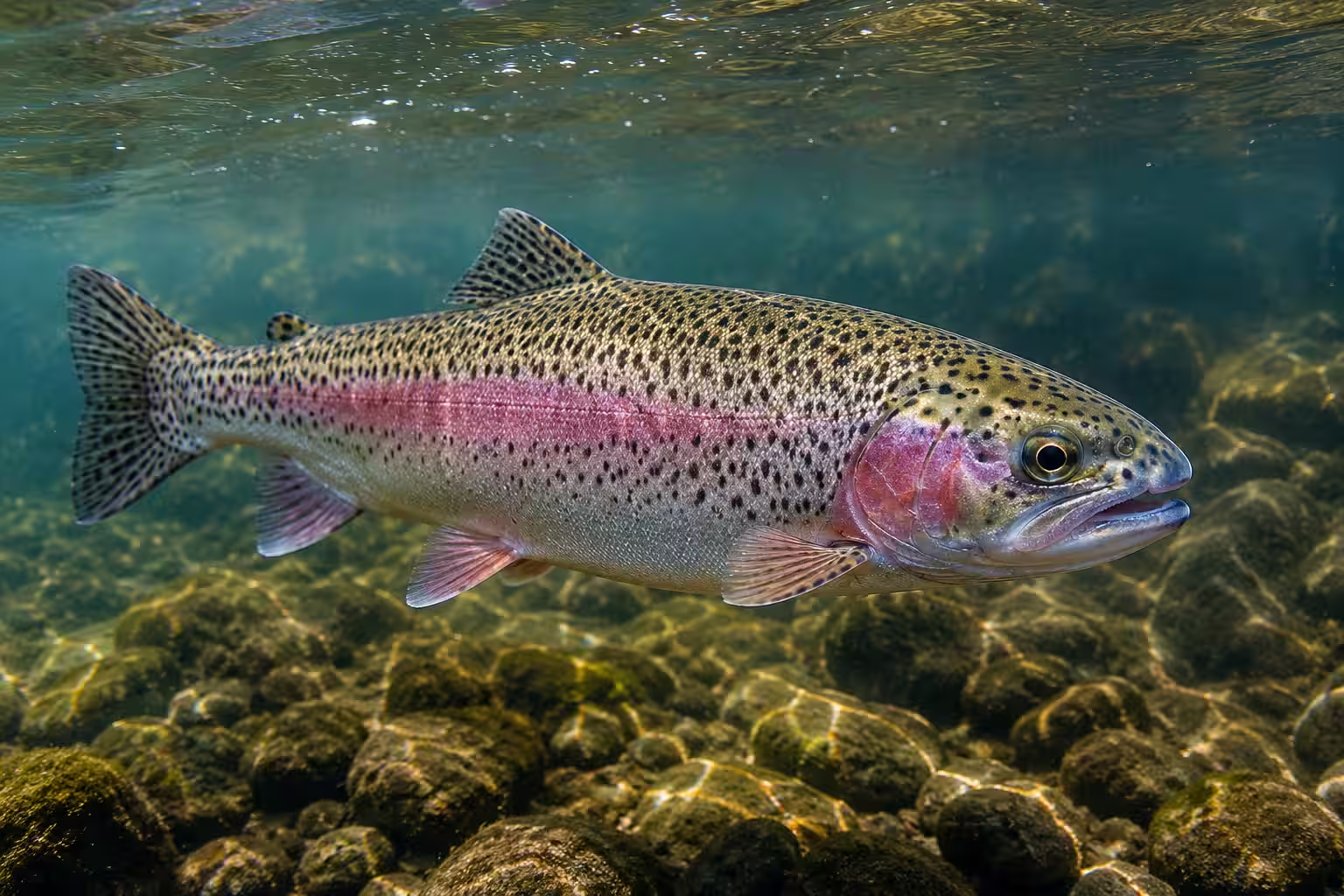
Stocked Rainbow Trout
Behavioral analysis of hatchery-conditioned rainbow trout including feeding adaptation, environmental response, pressure effects, post-stocking movement behavior, and practical fishing application.
Stocked Rainbow Trout
Explore Profile
Wild Rainbow Trout
Oncorhynchus mykiss — naturally reproducing, stream-bred rainbow trout
A wild rainbow trout is a different animal from the hatchery fish that shares its name. Where a stocked rainbow spends its early life eating pellets at the surface in a concrete raceway, a wild rainbow is born in the gravel and spends every day of its life earning a living against the current — avoiding predators, defending a feeding lie, and reading the water for drifting food. That upbringing produces a fish that is faster, warier, more selective, and far better at survival. Understanding those differences is the key to catching them.
Feeding Behavior & Activity Timing
Wild rainbows are primarily drift feeders. They hold in the current and intercept aquatic insects — mayfly, caddis, and stonefly nymphs, plus midges and scuds — as those insects tumble downstream in the flow. This is a numbers game played on tiny margins: the fish must take in more energy from the drift than it burns holding its position, so wild rainbows are ruthless about efficiency.
That efficiency shapes everything. A wild rainbow keys on the size, silhouette, and drift speed of the natural food in front of it, and it will refuse a presentation that behaves unnaturally — one that drags across the current, sits at the wrong depth, or is the wrong size for what’s hatching. Unlike a freshly stocked fish that will chase almost anything out of naïve hunger, a wild rainbow has been fooled before and won’t repeat the mistake. In gin-clear water it becomes leader-shy and drag-shy, refusing anything that looks off.
Like most trout, wild rainbows feed hardest in low light — the first hours after dawn and the last hours before dark — when falling light lets them feed while staying hidden from ospreys and herons, and when insect drift naturally peaks. Bright midday sun pushes them deep and tight to cover.
Habitat & Positioning
Wild rainbows position themselves where maximum food meets minimum effort. Look for them holding in the current cushions just ahead of and behind boulders, in the soft water along seams where fast and slow current meet, at the heads and tailouts of pools, and in oxygen-rich riffles and pocket water. These “cushions” let a fish sit in slower water while the conveyor belt of drifting food streams by just inches away.
Wild fish are also far more distributed than stocked fish. Hatchery trout pod up in slow pools after release; wild rainbows spread out and each claims the best lie it can defend, with the dominant fish taking the prime feeding stations. They are strongly tied to cover and easily spooked — a clumsy approach or a shadow on the water shuts them down instantly.
Metabolism, Temperature & Oxygen
As cold-blooded fish, wild rainbows run entirely on water temperature. Their usable energy — the aerobic scope that fuels chasing, feeding, and fighting — peaks in a fairly narrow band around 59–61°F (15–16°C), and they thrive in cool, clean, well-oxygenated water. As temperatures climb past the upper 60s°F, dissolved oxygen falls at the same time the fish’s oxygen demand rises, and feeding drops off sharply. Above roughly 70°F, wild rainbows seek thermal refuge — moving to riffles, spring seeps, cold tributary mouths, and deeper water — and stressed fish should not be targeted.
Unlike brown and brook trout, wild rainbows are spring spawners, cutting gravel redds as water warms in late winter and spring. That timing means their most aggressive pre-spawn feeding and territorial behavior comes in the spring, not the fall.
The Ozark Wild Rainbow: Crane Creek
Missouri anglers have a living example of just how different wild rainbows are. The rainbows in the Ozarks’ Crane Creek descend from California McCloud River strain fish stocked from railcars in the late 1800s, and the stream hasn’t been stocked in roughly a century — these fish have reproduced on their own for generations. They are famous for being some of the spookiest, most challenging trout in the state, persisting in gin-clear, sometimes marginally warm water precisely because they flee at the first sign of a predator. It’s catch-and-release only, and landing one is considered a genuine accomplishment. Crane Creek is a perfect illustration of the wild-rainbow personality: skittish, selective, and demanding of a careful, natural approach.
Fishing Application
Catch wild rainbows by fishing like their food behaves:
Match color to water and light. Natural, translucent tones for clear water and bright sun; brighter or higher-contrast profiles for stained water and low light. Our trout worm color guide breaks down the choices.nbow trout populations.
Approach with stealth. Wear drab colors, keep a low profile, and fish upstream so you’re behind the fish’s field of view. In clear water, the first cast is often the only good one.
Present a natural dead-drift. Match the size and profile of the natural drift and let the bait travel at current speed with no drag. A soft-plastic mayfly nymph or stonefly drifted through the seams imitates exactly what a wild rainbow expects to see.
Downsize and go finesse in pressured or clear water. A trimmed, subtle profile like the ribbed trout worm on a light jig head fools fish that reject aggressive lures. See our pressured-trout finesse system for the full approach.
Brown Trout
Salmo trutta — the wary, predatory, low-light specialist
The brown trout is the trout that humbles anglers. Introduced to North America from Europe in the 1880s, it is the most adaptable, most temperature-tolerant, and by reputation the wariest of the common trout — and the big ones are apex predators that behave more like a bass than a bug-sipping trout. Browns have thrived so completely that in many waters they’ve outcompeted or replaced native brook, cutthroat, and golden trout entirely. If you want to understand a brown, stop thinking “insects” and start thinking “ambush predator.”
Feeding Behavior & Activity Timing
Brown trout undergo one of the most important behavioral shifts in freshwater fishing: an ontogenetic diet shift. Small browns under about 12 inches feed mostly on drifting insects, like any trout. But as they grow past roughly a foot, they transition to piscivory — a fish-eating diet — and browns make this switch at a younger age and smaller size than rainbows do. A large brown’s menu becomes baitfish, sculpins, crayfish, other trout, plus the occasional salamander, frog, or small mammal. Big browns favor large, infrequent, high-calorie meals, maximizing energy gained while minimizing energy spent. This is why a trophy brown will ignore a tiny nymph a small rainbow would eat — it isn’t worth the effort.
Browns are also the most crepuscular and nocturnal of the group. Studies tracking their activity show a bimodal pattern with peaks at dawn and, especially, dusk — and the larger the fish and the warmer the water, the more strictly nocturnal it becomes. The biggest browns in a system often do the majority of their feeding after dark, tucking under cover through the daylight hours. Dominant fish claim the prime feeding times at dusk and into the night, forcing subordinate fish to feed at less favorable hours.
Habitat & Positioning
Browns are intensely cover-oriented. By day they hold tight to structure — undercut banks, log jams, deep slow pools, boulder pockets, and shaded water — often wedged into spots that leave abrasion marks on their tails. They are primarily sight feeders and prefer clearer water, but they exploit low light and the cover of darkness to hunt. At night and in the low-light windows, they slide out of that cover and move into shallower, more open feeding lanes to ambush prey. Larger browns frequently hold in the coldest, most oxygenated water available, which is why big fish concentrate below dam outflows and in tailwaters.
Metabolism, Temperature & Oxygen
Brown trout have the widest thermal tolerance of the common trout. Their optimal range runs about 54–66°F (12–19°C), but they can survive in water up to roughly 68–72°F if it’s well oxygenated — several degrees more than a brook trout will tolerate — though they grow sluggish at the top of that range. This heat tolerance, combined with their aggression and adaptability, is a big part of why browns have spread so successfully and displaced more sensitive natives.
Browns are fall spawners. As days shorten and water cools in autumn, mature browns go on the move, often running upstream into tributaries to cut redds in gravel. Males turn aggressive and color up in warm autumn tones, competing for females. This pre-spawn aggression is a gift to anglers: normally cagey big browns become territorial and far more willing to attack a large, fish-imitating presentation.
Fishing Application
Fish for browns by matching their predatory, low-light nature:
- Fish the edges of the day and after dark. Dawn, dusk, and night are prime — especially for the largest fish. Overcast days extend the window.
- Think baitfish and crayfish for big fish. A soft-plastic minnow swimbait or a soft-plastic crawfish targets the piscivorous diet that big browns key on. Dark, high-contrast profiles show up best in the low light browns prefer to hunt in.
- Use the fall pre-spawn window. Autumn’s aggressive, territorial browns are the best odds all year at a genuine trophy.
- Stay stealthy for smaller and pressured browns. Sub-12-inch browns still feed on drift, and pressured fish demand a natural presentation — a finesse ribbed trout worm fished dead-drift is a reliable answer.
Brook Trout
Salvelinus fontinalis — the native cold-water char
The brook trout isn’t technically a trout at all — it’s a char, a close cousin, and North America’s own native cold-water salmonid across the eastern part of the continent, from the southern Appalachians up into eastern Canada. It’s the most beautiful and, sadly, the most fragile member of the group: the least tolerant of heat and the most demanding of clean, cold, oxygen-rich water. Because it collapses so quickly when a watershed degrades, the brook trout is treated by biologists as a living indicator of stream health. Where you find wild brookies, you’ve found genuinely pristine water.
Feeding Behavior & Activity Timing
Brook trout are opportunistic, aggressive feeders — the least selective of the common salmonids. In the small, food-poor headwater streams they call home, a brookie can’t afford to be picky, so it will readily attack drifting insects, nymphs, scuds, small baitfish, terrestrials that fall in, and just about anything edible that passes. This willingness makes them, in many ways, the most beginner-friendly trout to fool. The catch is that in the tiny, gin-clear streams brookies inhabit, they are extremely spooky — you’ll get the eat if you can get close without being seen, and the approach matters more than fly selection.
Like all trout they feed best in low light, but their aggression means they’ll often come up throughout the day in the shaded, cold water they prefer.
Habitat & Positioning
Brook trout are specialists of high-quality cold water: high-altitude and headwater streams, spring-fed creeks, and the coldest reaches of the systems they share with other species. They want stable flows, silt-free rocky bottoms, alternating pools and riffles, and abundant cover — undercut banks, logs, and boulders. Cover directly determines how many brook trout a stretch can hold. In summer they migrate, sometimes for miles, to find thermal refuge in groundwater seeps and spring upwellings, packing into the few cold pockets available.
Metabolism, Temperature & Oxygen
This is where the brook trout’s fragility is written in numbers. Its ideal temperature is around 53°F (12°C), with an optimal growth-and-activity range of about 54–66°F (12–19°C) — but it cannot survive extended periods above 68°F (20°C), and sustained temperatures in the mid-70s°F are lethal. That’s a markedly lower ceiling than brown or rainbow trout. Brook trout also demand the highest dissolved oxygen of the group, which is why they’re confined to cold, turbulent, well-aerated water — cold water holds more oxygen, and brookies need every bit of it. When brown or rainbow trout are introduced to a brook trout stream, the more heat-tolerant newcomers often push the natives into ever-smaller cold-water refuges.
Brook trout are fall spawners, building gravel redds from October into December with peak activity around mid-November. They favor spots fed by cold groundwater upwelling, which keeps eggs supplied with clean, oxygenated water through the winter. Brookies are short-lived and slow-growing — often just a few inches in their first year and rarely exceeding a foot in most streams, which makes a large wild brook trout a true prize.
Fishing Application
Fish for brook trout by respecting the small, cold, fragile water they live in:
- Go small and light. Brookies eat small food. Compact finesse baits — a soft-plastic wax worm, a 1″ mayfly nymph, or a small stonefly — match their forage in tight headwater streams.
- Approach like a heron is watching. In small clear water, stealth beats everything. Stay low, move slowly, and fish upstream. Your presentation matters less than not being seen.
- Follow the cold in summer. Target spring seeps, headwaters, and shaded, oxygenated riffles where brookies concentrate when the rest of the stream warms.
- Handle with care. Brook trout live on the edge of their thermal limits. Land them quickly, keep them wet, and release them fast — especially as water warms. Don’t target them at all once water climbs toward their limit.
Stocked Rainbow TroutRelated Resources from Family Fishin
- Trout Behavior & Biology — the main hub for how trout feed, position, and respond to conditions
- Stocked Rainbow Trout Profile — how hatchery fish differ and how to catch them
- How to Rig a Trout Worm for Stocked & Pressured Trout
- Best Trout Worm Colors for Any Water & Light
- Pressured Trout: The Simple Finesse System That Works
- Family Fishin Learning Center
- · Shop Trout Tackle