Why Big Trout Feed at Different Times
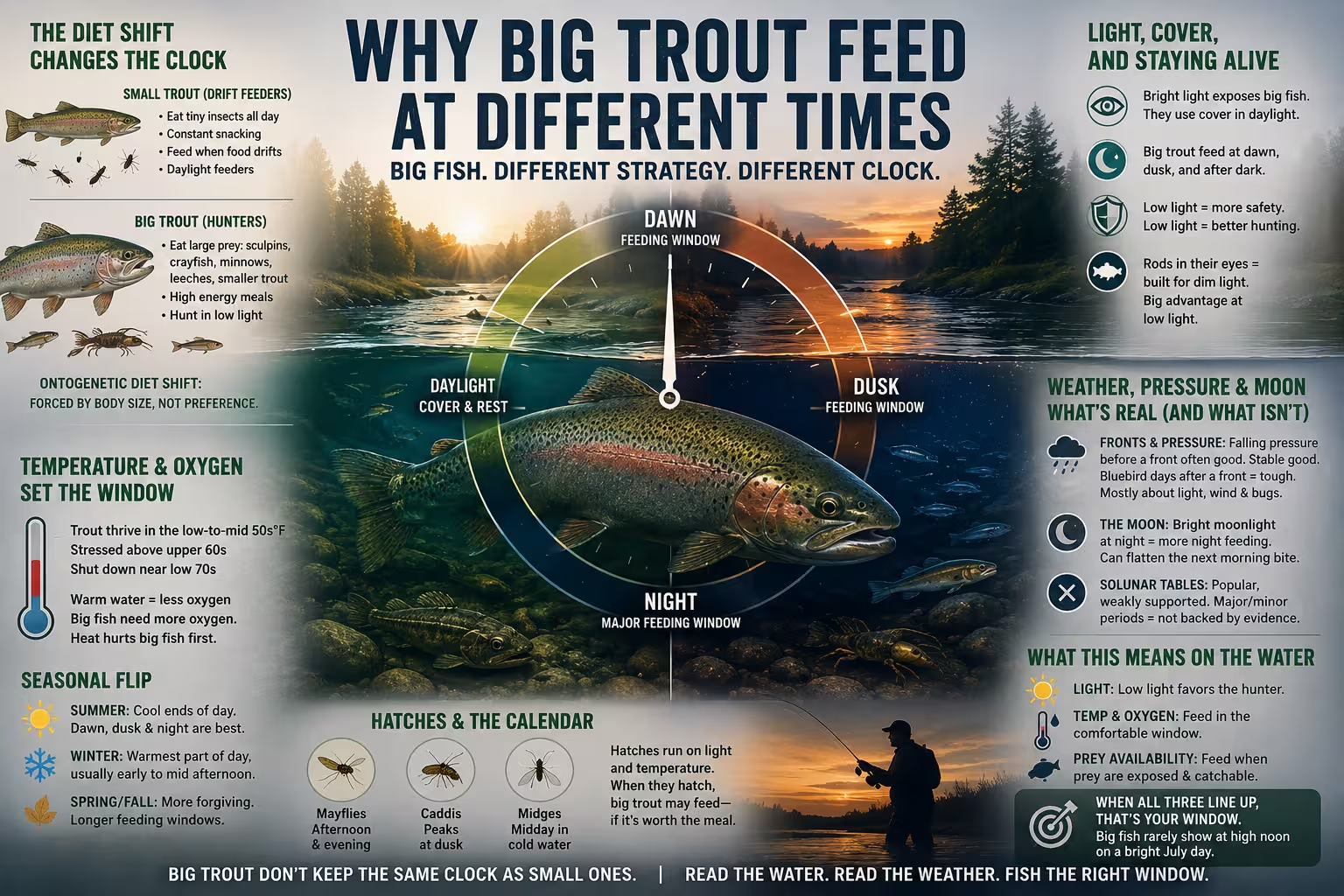
Big trout feeding times are very different from those of smaller trout. Small trout and big trout are not the same animal living two lives. They are the same species living two different survival strategies. The clock a nine-inch rainbow keeps has almost nothing to do with the clock a five-pound rainbow keeps, and the reason is biology, energy economics, and risk.
This is the part of trout fishing that separates people who catch numbers of small fish from people who catch a few large ones. Numbers come from being on the water when average fish are active, which is most of the day. Size comes from being on the water in the narrow windows when a large, cautious, well-fed predator decides the risk is worth it. Those windows are predictable if you know what sets them.
Why Big Trout Feeding Times Change
The single largest reason big trout feed on a different schedule is that they eat different food, and different food is available at different times.
A small trout is a drift feeder. It holds a station in the current and picks nymphs, midges, scuds, and small drifting insects out of the water column. That food is tiny, individually worth very little energy, so a small fish has to eat almost constantly to stay ahead of its metabolism. It feeds whenever food is drifting, which in a healthy stream is most of the daylight hours. A small trout’s feeding “schedule” is really just the availability of drift, and drift is more or less continuous during the day.
Past roughly twelve to sixteen inches, the arithmetic breaks down. A large body has a large maintenance cost, and it cannot pay that cost one size-18 mayfly nymph at a time. The energy spent holding in current and intercepting tiny insects stops covering the energy those insects return. Biologists call the resulting change an ontogenetic diet shift — a shift that comes with age and size — and it is one of the best-documented patterns in salmonid ecology. It is not a preference the fish develops. It is forced on it by the physics of being big.
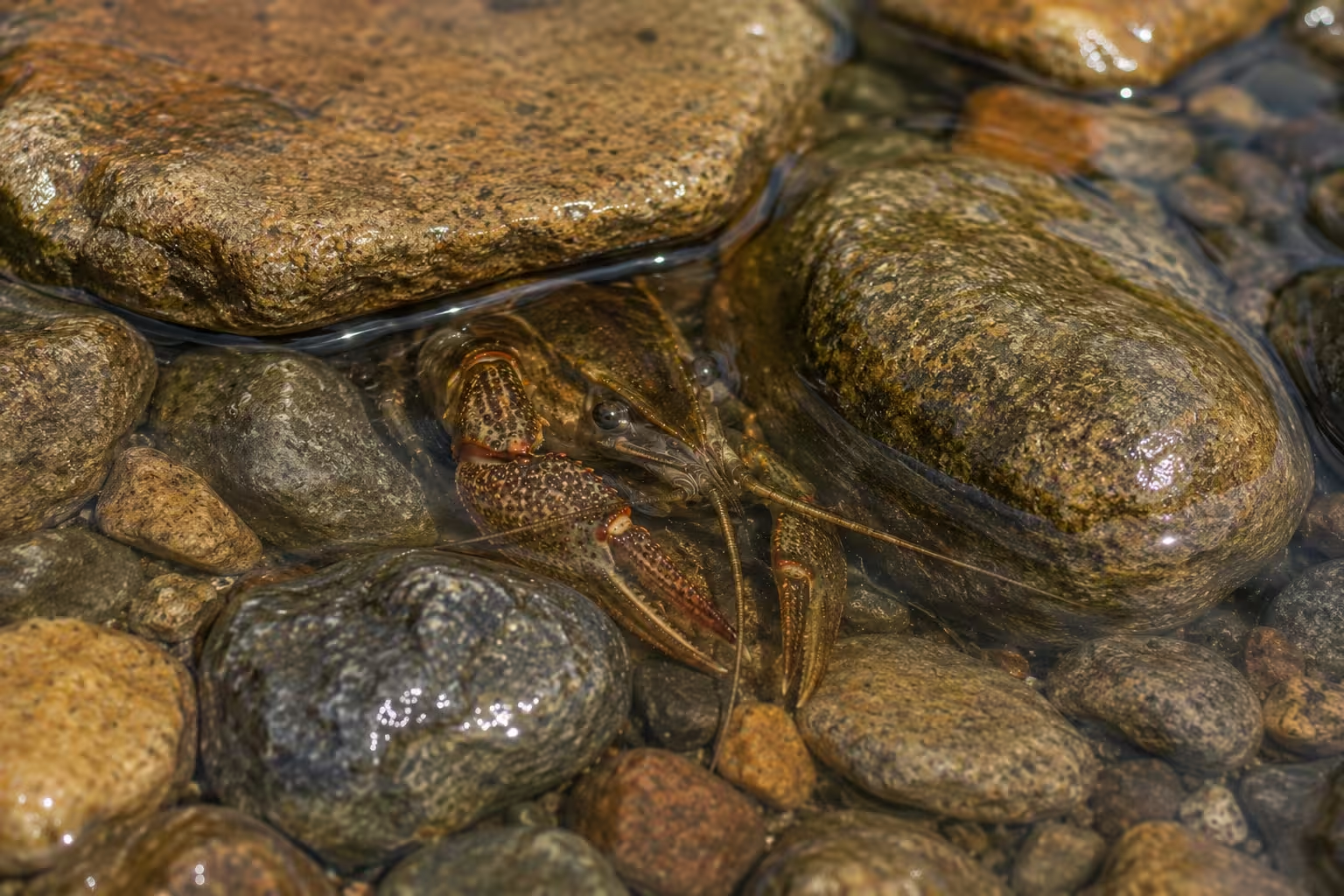
So large trout move toward large prey: sculpins, crayfish, minnows, leeches, large nymphs, and smaller trout. A single sculpin or crayfish returns more energy than hundreds of drifting midges, which means a big fish can take in a full day’s worth of calories in one or two successful strikes. That single fact reshapes everything about when it feeds. A drift feeder must feed continuously and therefore feeds in daylight when drift is highest. A meal feeder can feed in one decisive burst and then spend the rest of the day digesting in cover. It is free to choose its moment — and it chooses the moment that favors the hunter.
That moment is low light, because large prey is most catchable in low light. A big trout that has become a hunter of baitfish and sculpins is now tied to when those prey are exposed and vulnerable, not to when insects happen to be drifting. Its clock is set by its dinner, and its dinner keeps night hours.
There is also a hard mechanical limit worth understanding: gape. A trout can only eat what fits in its mouth, and mouth size scales with body size. A small trout physically cannot eat a four-inch sculpin; a large trout can, and increasingly prefers to, because large prey is where the energy is. As gape increases with growth, the profitable prey list expands toward exactly the nocturnal, bottom-dwelling, cover-loving animals that a fish can only catch when the lights go down.
Light, cover, and staying alive
Big trout are old trout, and old trout are alive because they are cautious. A large fish did not reach that size by accident. It survived herons, ospreys, kingfishers, cormorants, mergansers, otters, mink, larger fish, and every angler who worked that water before you. Caution is not a personality trait in a big trout. It is the reason it exists.
Bright overhead light exposes a large fish in a way it does not expose a small one. A big trout in shallow, well-lit water is a large, high-contrast target to every predator that hunts from above, and it knows it. So big fish spend the bright hours in deep water, undercut banks, log jams, boulder pockets, and shade, and they move to feeding lies at dawn, at dusk, and after full dark. The shift from daytime to low-light activity is not subtle, and it is size-dependent: the larger the fish, the more strongly it favors dim conditions. In many waters the truly large trout are effectively nocturnal for much of the year, feeding in a window most anglers never fish.
Low light is not only safer for the big fish. It is also when the big fish hunts best. A trout’s retina is rod-dominated and well adapted to dim conditions, which means that at dawn, dusk, and under moonlight a large trout can often see and track prey better than the prey can see the predator. The fish is not merely hiding from daylight out of nervousness. It is timing its feeding to the moment when its own sensory advantage over its prey is greatest and its own exposure to predators is least. Those two things happen at the same time — low light — which is why low light is such a reliable trigger for large-fish activity.
There is a behavioral consequence for the angler here. Because a big fish moves from its daytime holding lie to a separate feeding lie as the light drops, the water you should fish at last light is often not the water that held the fish at noon. The fish leaves deep cover and slides up onto shallower flats, tailouts, shoreline shelves, and the heads of pools to hunt. Fishing the deep midday lie at dusk is fishing an empty apartment. The fish has gone to the kitchen.
Temperature and oxygen set the window
Trout are cold-water animals with a real, measurable metabolic optimum, and that optimum, more than any other single physical factor, controls how long and when the feeding window stays open.
Rainbows feed and grow most efficiently in roughly the low-to-mid 50s Fahrenheit. They remain active across a wider band than that, but as water climbs into the upper 60s they become progressively stressed, and as it approaches the low 70s they stop feeding and begin simply trying to survive. Warm water compounds the problem because it holds less dissolved oxygen exactly when the fish’s oxygen demand is rising with temperature. And a large fish has a higher absolute oxygen requirement than a small one, so heat and low oxygen punish big fish first and hardest. The same water that a ten-inch trout tolerates can drive a five-pound trout into sluggish inactivity state.
This is why the feeding window does not sit still through the year. It slides to wherever the water is closest to comfortable — and for stocked fish adjusting to a new environment, the timing is even more specific. See When Stocked Trout Actually Eat: Feeding Windows, Timing, and Trigger Conditions for a full breakdown of how that window shifts in the days after stocking.
Summer. Midday water is warmest and lowest in oxygen. The comfortable window collapses to the cool ends of the day and to the night, so feeding compresses into early morning, last light, and the hours of darkness. Big fish, being the most sensitive to warm, oxygen-poor midday water, become the most nocturnal of all in summer. On a hot tailwater or a low, clear freestone stream in July, the large-fish bite may be almost entirely a dawn, dusk, and after-dark event. Fishing the middle of the day is fishing the closed hours.
Winter. The pattern reverses completely. Cold water slows metabolism, and the warmest part of a cold day — usually early to mid afternoon, after the sun has had hours to work — is when metabolism and feeding pick up. Dawn in winter is often dead; the water is at its coldest and the fish at their most sluggish. The productive window is the afternoon, and it can be a narrow one. In deep winter, a big trout may feed meaningfully for only an hour or two around the daily temperature peak.
Spring and fall. These are the forgiving seasons. Water temperatures sit closer to the optimum for more of the day, the comfortable window is wide, and big fish will move and feed in daylight far more readily than they will in the heat of summer. This is when a large trout is most catchable in the open, in reasonable light, at civilized hours — which is exactly why the spring and fall shoulders produce so many of the year’s best fish for anglers who are not willing to fish at midnight.
Layer onto this the meal-feeding pattern from the diet shift, and the picture sharpens. A big trout that has swallowed a sculpin or a crayfish has taken in a large block of energy and does not need to feed again soon. It can afford to feed only inside the comfortable temperature-and-oxygen window, take one good meal, and spend the balance of the day motionless in cool, oxygenated cover, digesting. The small trout has no such luxury; it must keep picking drift regardless. So temperature does not just move the big fish’s window — it lets the big fish get everything it needs inside that window and ignore the rest of the day entirely. Understanding big trout feeding times means understanding how light, temperature, and prey availability work together rather than relying on a fixed hour of the day.
Behavioral drift: why night works even for bug eaters
There is a second, less familiar reason low-light feeding pays, and it applies even when a large trout is still eating insects rather than baitfish.
Aquatic invertebrates — mayfly, stonefly, and caddis nymphs, scuds, and the rest of the drift community — do not enter the current evenly around the clock. Their drift is strongly rhythmic, and in most streams it peaks sharply at night, particularly in the hours just after dark. This is called behavioral drift, and it is one of the most consistent patterns in stream ecology. The invertebrates move under cover of darkness for the same reason big trout hunt then: to avoid being seen and eaten by daytime, sight-feeding fish.
The irony for the prey is that it delivers them straight to the predators best equipped to feed in the dark. A large trout holding on a feeding lie after nightfall is sitting in a current that is now carrying far more food than the same current carried at noon. So even a big fish that has not fully committed to piscivory has a reason to feed at night: that is when the drift is richest. Behavioral drift is a large part of why the classic trophy-trout tactic of fishing big nymphs and streamers in the dark works as well as it does. You are fishing the hour when both the predator’s advantage and the food supply are at their maximum.
Hatches and the seasonal calendar
When insects are still on the menu — and even large trout will key on a heavy emergence when the food is dense enough to be worth the effort — feeding tracks the hatch, and hatches keep their own schedule that shifts through the year.
Many mayflies emerge in the afternoon and evening, and a heavy evening spinner fall can pull even cautious fish up into the film at last light. A great deal of caddis activity concentrates at dusk and into darkness. In cold winter water, midges are often the main show, and they hatch in the warmer midday hours — which lines up neatly with the winter temperature window, so the winter bug hatch and the winter feeding window reinforce each other. Terrestrials — hoppers, ants, beetles — become a warm-season, sunny-afternoon food source, one of the few things that can pull a good fish up in bright daylight during summer, because a big hopper is a meal-sized item worth the exposure.
Photoperiod and water temperature drive all of this. As day length and temperature change through the season, emergence windows move, and the feeding window moves with them. A hatch chart for your water is, in effect, a partial feeding-time chart — it tells you which hours the insect food will be concentrated, and therefore which hours even a large fish may be willing to feed in the open.
Weather, pressure, and the moon — what’s real and what isn’t
Two forces get talked about far more than the evidence justifies, so here is the honest version rather than the campfire version.
Weather and barometric pressure. Stable weather and the falling pressure ahead of an approaching front often coincide with good feeding, while the bright, high-pressure “bluebird” days that follow a front through are usually tough. Part of this is unquestionably real, but the mechanism is mostly indirect. An approaching front brings cloud cover, wind, and often changing insect activity, and those things genuinely affect trout and their prey — clouds lower the light and let cautious fish feed longer into the day, wind breaks up the surface and hides the fish, and many insects respond to the falling pressure and rising humidity by becoming active. Whether trout sense the pressure change directly, through their swim bladder or otherwise, is far less certain than most fishing articles claim. Fish the fronts, because the fishing really is often better — but understand that you are mostly reading the light, the wind, and the insects the weather brings, not a barometer inside the fish’s head. The practical rule stands even though the folk explanation is shaky.
Solunar tables and the moon. Solunar theory — the idea that fixed lunar “major and minor periods” predict feeding activity — is popular and weakly supported. I won’t sell it to you as science, because it isn’t. The one piece with a genuine mechanism is bright moonlight at night. A big trout can hunt after dark far more effectively under a full moon than under a new moon, simply because there is more light to see prey by. That has two consequences you can actually use: strong moonlit nights can produce excellent after-dark fishing for large fish, and a fish that fed heavily under a bright moon overnight may show a flat, disappointing dawn bite the next morning because it is already full. That is worth knowing and worth planning around. The rest of solunar theory — the daily major/minor windows printed in tables — does not hold up to scrutiny, and betting your fishing time on it is guesswork dressed as a formula.
Water clarity is a light control you can’t set but must read
Everything said above about light assumes clear water, and clear water is only one of the conditions you will fish. Turbidity — stain, color, suspended sediment — changes how much light actually reaches a fish’s eye, and because light is the master control on big-fish feeding, water clarity can override the clock entirely.
Stained or rising water after a rain reduces effective light penetration. To a big trout, muddy midday water can feel like the low-light conditions it normally waits for after dark. The cover that bright, clear water provides through darkness is now provided through turbidity, and a large fish will move up and feed in broad daylight in conditions it would never risk in gin-clear flows. This is why the hours right after a stream begins to rise and color — but before it blows out completely — are among the best a trophy hunter gets. The fish feel hidden, the current is delivering dislodged food and disoriented prey, and the whole thing happens at a convenient hour of the day.
The reverse is just as important. In very clear, low water — late summer on a spring creek or a drought-shrunk freestone — the big fish become extraordinarily nocturnal and spooky, because there is nowhere to hide from the light. The clearer and shallower the water, the more tightly the big-fish window closes down to full dark. When you find yourself on water you can see the bottom of in four feet, assume the large fish have retreated to the strictest low-light schedule the season allows, and plan to fish the very edges of the day or the night itself.
Read clarity as a light control you cannot set but must respect. Rising color opens the daytime window. Falling, clarifying, low water slams it shut and pushes everything into the dark. Clarity also drives color selection — the same conditions that move the feeding window change what the fish can see. Best Trout Worm Colors for Each Season covers how to match color to clarity and light for every season.
Putting the day together
It helps to walk one summer day the way a big fish experiences it, because the pieces only make sense stacked in sequence.
Before dawn the water is at its coolest and most oxygenated of the twenty-four hours, the light is minimal, and the nighttime drift and the night-active sculpins and crayfish are still moving. A big trout that hunted through the dark is often still on its shallow feeding lie, and the first gray light is prime time — arguably the single best window of the summer day for a large fish. As the sun climbs, the light grows dangerous, the shallows begin to warm, and the fish slides back to deep cover. By mid-morning on a hot, clear day the big-fish window has effectively closed. Through midday the water warms toward its daily peak, oxygen falls, and the large fish sits motionless in the coolest, most sheltered water it can find, digesting and waiting. This is the hour the folklore calls “off,” and it is off for good physical reasons. As the sun drops through the afternoon and the light softens, the window begins to reopen; the last hour of light, especially if it coincides with an evening hatch or spinner fall, can rival dawn. Then full dark arrives, the drift peaks, the prey emerges, the fish’s sensory advantage is at its maximum, and the true nocturnal feeding of summer begins.
Now change the season and the whole cycle shifts. In winter, delete the dawn and dark windows almost entirely and move the action to the warm middle of the day. In spring and fall, widen every window and let the fish feed in daylight it would never touch in July. The structure is always the same three forces — light, temperature and oxygen, and prey — but the hour hand moves.
What this means on the water
Strip away the folklore and a big trout’s feeding time is set by three forces stacked together. Light: low light favors the hunter, both by protecting the big fish from what hunts it and by giving it a sensory edge over its prey. Temperature and oxygen: the fish feeds inside its comfortable thermal window, and that window slides through the season — night and the cool ends of the day in summer, the warm middle of the day in winter, and a wide, forgiving band in spring and fall. Prey availability: the fish feeds when its food is catchable, which for a large piscivore means when sculpins, crayfish, and baitfish are exposed in the dark, and which even for an insect eater means the nighttime drift peak.
When all three line up — a summer dawn, a warm winter afternoon, the last twenty minutes of a hatch at dusk, a mild moonlit night in early fall — that is your window. It is also exactly why the largest fish in a piece of water so rarely shows itself at high noon on a bright July day. At that hour, all three forces are working against feeding at once: the light is maximal, the water is warmest and lowest in oxygen, and the prey is buried in cover.
You do not fish for big trout at the same times you fish for small ones because the two are not keeping the same clock and never were. The small fish answers to a nearly continuous daytime drift. The big fish answers to light, temperature, and the movements of large prey, and it feeds in short, deliberate windows built around all three. Learn to read which of the three forces is running the show on a given day and season, and you will stop waiting for the wrong hour — and start being on the water for the right one. And when you do find that window, presentation matters as much as timing — especially on water that sees pressure. Pressured Trout Fishing: The Simple System That Works covers exactly how to close the deal when a big, cautious fish finally decides to feed.
Frequently Asked Questions
What time of day do big trout feed?
Big trout feed primarily at dawn, dusk, and after dark. During summer, midday water is too warm and too bright for large fish to feed safely or comfortably, so the window compresses to the cool, low-light ends of the day. In winter the pattern reverses — the best feeding window is typically early to mid afternoon when water temperature peaks.
Why don’t big trout feed during the day?
Two reasons: light and temperature. Bright daylight exposes a large fish to predators — herons, ospreys, otters — so big trout stay in deep cover during the day. In warm months, midday water is also warmest and lowest in dissolved oxygen, which shuts down feeding in large fish before it affects smaller ones. Low light removes both problems at once.
What do big trout eat compared to small trout?
Small trout are drift feeders, picking nymphs and tiny insects from the current all day. Past roughly 12–16 inches, trout shift to large prey — sculpins, crayfish, minnows, leeches, and smaller trout. This is called an ontogenetic diet shift and it is driven by body size, not preference. Large prey is most catchable in low light, which is a primary reason big trout feed at different times than small ones.
Is night fishing good for big trout?
Yes, especially in summer. After dark the water is coolest, dissolved oxygen is highest, and aquatic invertebrate drift peaks — studies consistently show nighttime drift is far higher than daytime drift. Big trout have rod-dominated retinas well suited to low light, giving them a sensory advantage over prey after dark. Summer nights are among the most productive windows of the year for large fish.
Does barometric pressure affect trout feeding?
The effect is real but mostly indirect. Falling pressure ahead of a front often coincides with cloud cover, wind, and increased insect activity — all of which genuinely improve feeding conditions. Whether trout sense pressure change directly through their swim bladder is unproven. Fish the fronts, but you are mostly responding to light and insect changes, not the barometer itself.
What is the best season to catch big trout?
Spring and fall. Water temperatures sit close to the optimal range for more hours of the day, feeding windows are longer, and large fish will move and feed in daylight they would avoid in summer. The biggest trout of the year for most anglers come from the spring and fall shoulder seasons, when all three feeding triggers — comfortable temperature, favorable light, and active prey — align for the longest windows of the year.