Part 4 — Soft Plastic Lure Visibility: Transparency, Opacity, and Light Behavior in Clear Water
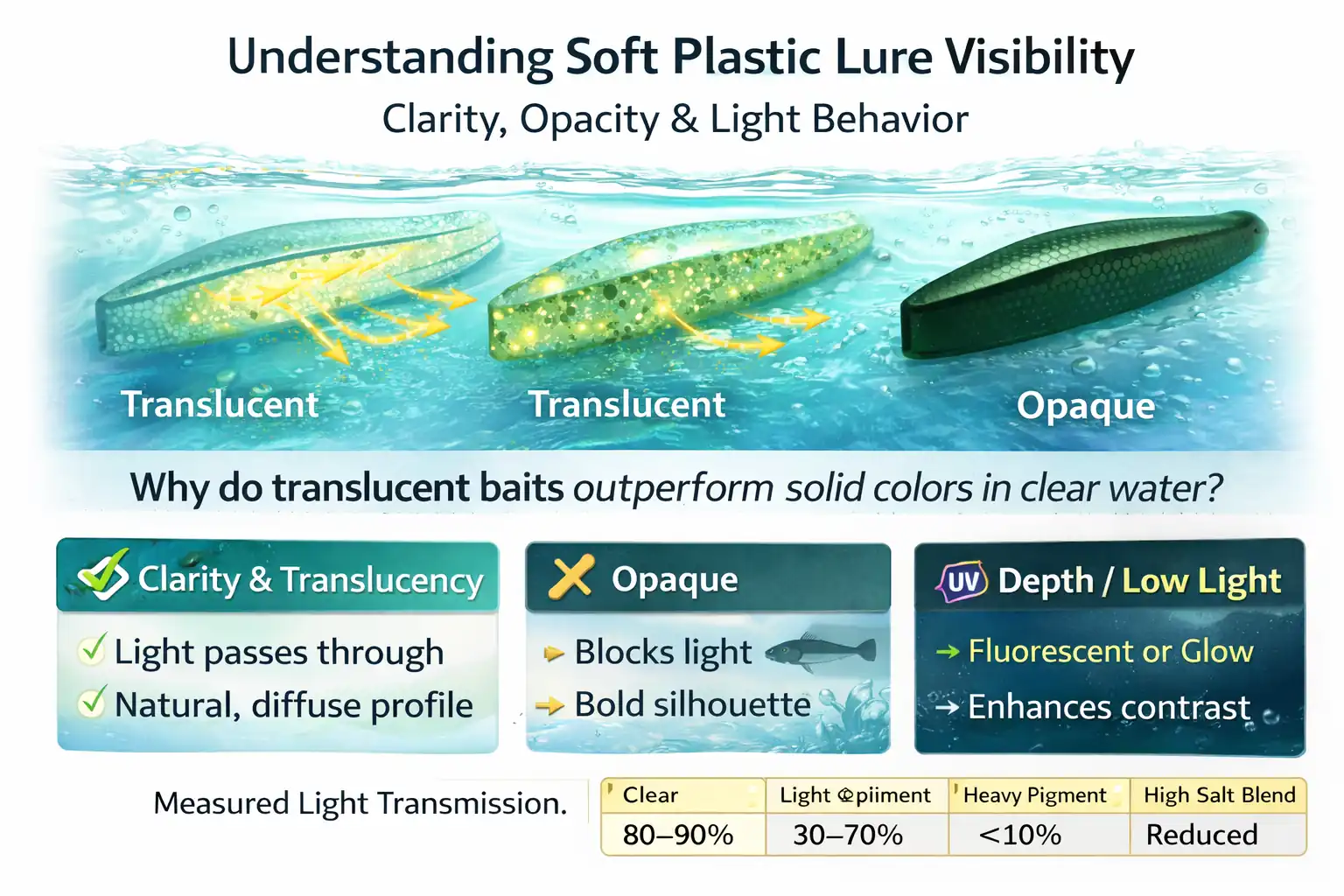
Soft plastic lure visibility is controlled by light transmission, scattering, and absorption inside the material. Translucent plastics allow partial light penetration, reducing hard silhouette edges and improving realism in clear water. Opacity increases contrast, but excessive pigment loading can create unnatural edge definition in high-visibility conditions.
Why Translucent Soft Plastics Outperform Solid Colors in Clear Water
In clear water, fish detect contrast gradients and edge transitions. Translucent soft plastics allow light to enter and diffuse through the body, reducing sharp silhouette boundaries. Solid opaque plastics block light at the surface, producing high-contrast outlines. In pressured fisheries, overly defined edges can reduce realism. Soft plastic lure visibility is not about brighter color — it is about controlled light transmission.
The Physics of Light in Soft Plastics
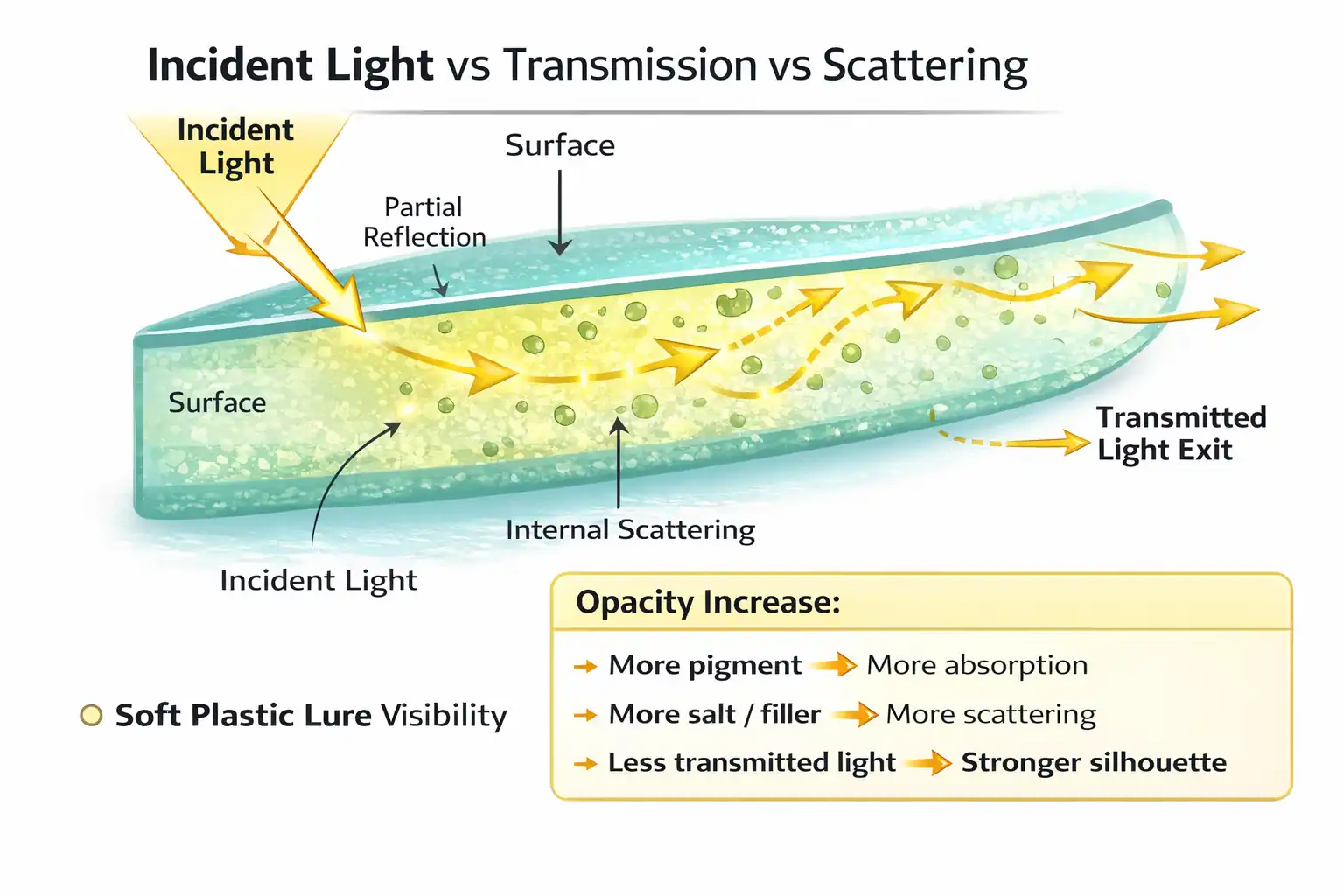
When light strikes a lure: Reflection (surface light bounce), Transmission (light entering the material), Absorption (pigment converting light to heat). PVC plastisol has a refractive index of approximately 1.52, allowing internal light bending and diffusion when pigment load is controlled.
Measured Clarity — % Haze vs Pigment Load
| Pigment Load | Light Transmission | Haze | Visual Effect |
|---|---|---|---|
| 0% (clear) | 85–90% | <10% | Transparent |
| 1–2% light tint | 60–75% | 15–25% | Translucent |
| 3–5% moderate | 30–50% | 30–45% | Semi-opaque |
| 6%+ heavy | <15% | >60% | Opaque |
Small pigment increases dramatically raise haze. This explains why two “same color” baits from different brands perform differently. Salt increases internal scattering, reducing clarity and increasing opacity.
Water Clarity Performance Matrix
- Ultra-Clear: High translucency, subtle flake, low haze %
- Clear: Balanced pigment, controlled diffusion, moderate haze %
- Stained: Opaque, high silhouette contrast
- Low Light / Depth: Opaque + UV-reactive, strong edge visibility
FAQ
Why do translucent soft plastics work better in clear water?
They allow light to enter and scatter internally, reducing harsh silhouette edges. Fish detect contrast gradients, so softened transitions often outperform fully opaque colors.
Does adding salt reduce lure clarity?
Yes. Salt crystals increase internal light scattering, raising haze percentage and reducing light transmission.
Are opaque lures better in stained water?
Yes. Opaque plastics create stronger silhouettes, improving visibility in low-clarity conditions.