Do Trout Learn to Avoid Lures?
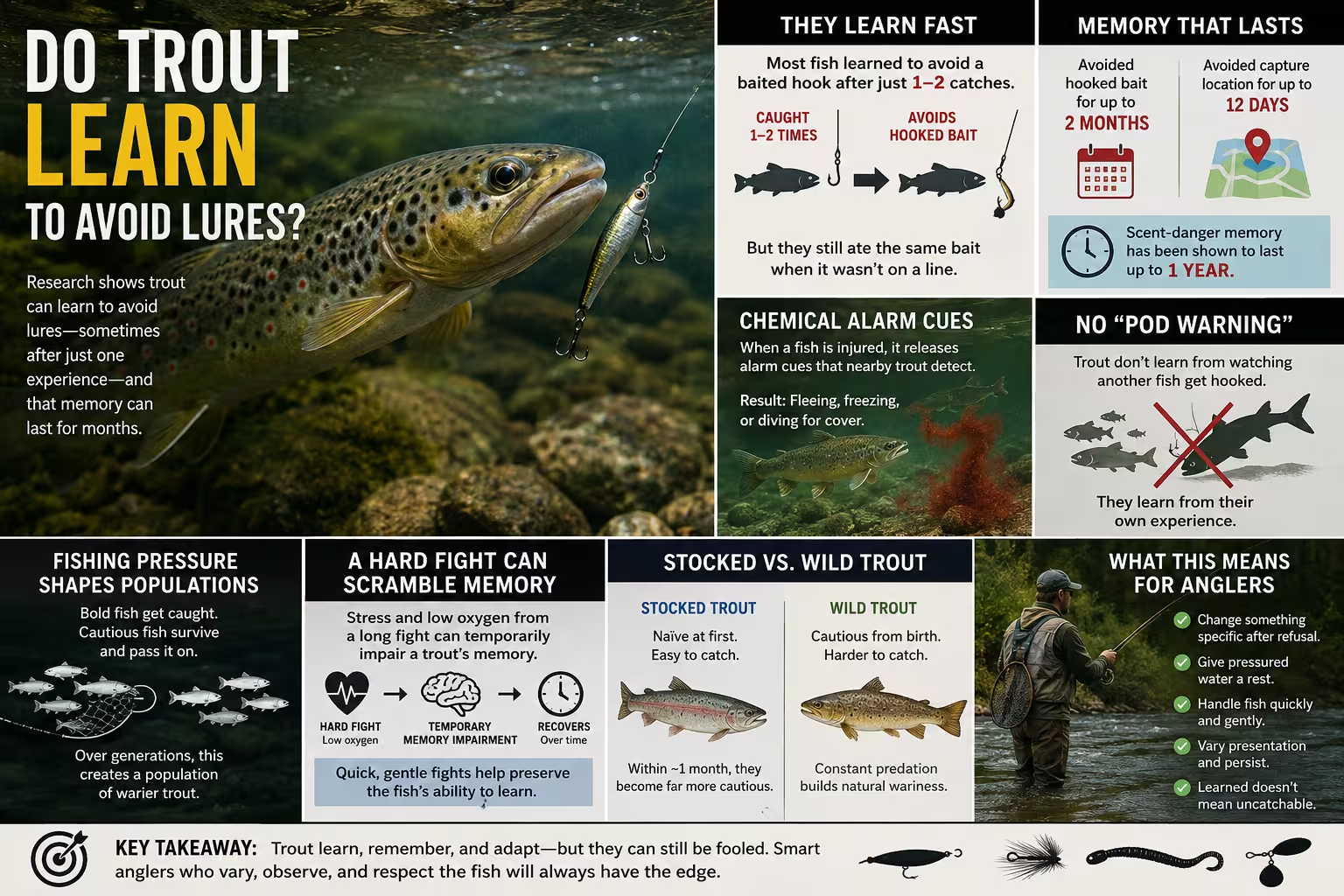
Do trout learn to avoid lures? Yes, trout can learn from fishing pressure, missed strikes, hooked experiences, and danger cues in the water. They do not become impossible to catch, but they can become more cautious around certain lures, presentations, and areas.
Do Trout Learn to Avoid Lures Over Time?
You cast into the same run three times. First cast, a solid strike. Second cast, a follow and a refusal. Third cast, nothing — the water might as well be empty. Every angler has lived this, and most explain it away with something vague like “they got spooked.” But there’s a more specific, more interesting explanation backed by real fisheries research: trout are learning, in real time, to recognize and avoid the exact thing you just showed them. This isn’t folk wisdom. It’s been measured in laboratories and rivers, with electric shocks, dye-marked fish, GPS-tagged populations, and controlled angling trials. The short answer is yes — trout learn to avoid lures, sometimes after a single encounter, and that learning can last over a year. The longer answer is more useful, because it tells you how they learn, how fast, how long it sticks, and what that means for the next cast you make.
Forget the “Three-Second Memory” Myth
The idea that fish forget everything within seconds comes from goldfish jokes, not biology. It’s wrong for goldfish, and it’s especially wrong for trout, which have a comparatively large, well-developed forebrain for a fish and rely on memory constantly — to relocate feeding lanes, remember predator ambush points, and return to specific holding lies session after session.
Fish memory researchers distinguish between associative learning (linking two things together, like a scent and a shock) and spatial memory (remembering a place). Trout do both. In one widely cited experiment, researchers trained trout to associate a particular scent with a mild electric shock — classic associative conditioning, the same mechanism behind Pavlov’s dogs. A year later, most of the trout were still avoiding that scent. That’s not a three-second memory. That’s long-term memory on a timescale most anglers would never guess a fish could hold.
The mechanism matters here because it tells you learning isn’t mystical — it’s a fish’s nervous system doing exactly what it evolved to do: flag anything associated with pain or danger and store it for future reference, cheaply and durably.
Yes, They Learn to Avoid Hooks — Often After One Bite
The clearest experimental evidence doesn’t come from trout alone, but from a controlled study on a close angling analog: juvenile red sea bream. Researchers ran individual fish through repeated angling trials and found something striking — most fish learned to avoid a baited hook after just one or two catches, while continuing to happily eat identical bait that wasn’t rigged to a line. The fish weren’t avoiding the food. They were avoiding the specific combination of food plus line plus hook resistance. When researchers offered krill with no line attached, the “experienced” fish ate it normally. Attach it to a hook, and most refused.
That’s a critical distinction for anglers: fish don’t generally learn “food is dangerous.” They learn “this specific presentation is dangerous” — a particular resistance, flash, or hook-set feeling tied to a particular bait or lure profile. That’s why a fish that’s refusing a jointed minnow-pattern jerkbait will often eat a soft plastic worked completely differently ten minutes later off the same rock. It hasn’t learned to fear your presence or fear eating — it’s pattern-matching against one specific bad experience.
The same study found this memory isn’t fleeting. Two months after the initial angling trial, roughly half the fish still showed reduced willingness to strike gear on a line. And even with functioning avoidance learning, the “experienced” fish were still caught an average of 6.4 times out of 28 angling attempts — meaning learning reduces catchability, it doesn’t make fish uncatchable. That single number is probably the most useful stat in this whole topic: even a fish that has “learned,” and is actively avoiding, still gets fooled roughly a quarter of the time when anglers keep varying their approach.
Being Caught Changes Where a Fish Lives, Not Just What It Eats
Trout research has gone a step further than lab tanks and looked at real river behavior after catch-and-release. When rainbow trout were caught, tagged, and released, then tracked, researchers found they were roughly five times more likely to avoid the specific stretch of stream where they’d been caught, compared to a control species (common carp) that had never been caught there before. That avoidance of the capture site persisted for up to 12 days in some fish.
Put together with the sea bream data, this paints a fuller picture: a caught-and-released trout doesn’t just get pickier about lures — it may temporarily relocate. This is one reason the “the fish are here, but they’ve stopped biting” feeling after a productive morning session is often literally true. You haven’t necessarily fished out the hole. You may have taught its residents, one at a time, to either avoid your lure or avoid that eight feet of river for a week and a half.
Do Other Fish “Warn” Each Other? Two Different Mechanisms, One Confusing Answer
Anglers often ask whether hooking one trout spooks the whole pool — as if fish pass along a warning. The research splits this into two separate systems, and conflating them causes most of the confusion.
Social learning from watching a hookup: this is the fish equivalent of a buddy seeing you touch a hot stove and learning not to touch it themselves, without being burned. When researchers tested this directly in rainbow trout, they found no evidence of social learning for hook avoidance — a trout watching a neighbor get hooked and fought didn’t subsequently become warier of the same lure itself. Individually, trout learn from their own negative experience; they don’t reliably learn by observing someone else’s.
Chemical alarm cues, on the other hand, are real and fast. Many fish — trout included — have specialized cells in their skin that, when physically damaged (say, by a hook, a predator bite, or rough handling), release a chemical alarm cue into the water. Nearby fish detect this compound through smell and respond immediately with defensive behavior: fleeing, freezing, or diving for cover. This isn’t the fish “telling” its friends it got hooked in any cognitive sense — it’s closer to a chemical smoke alarm triggered automatically by injury. Researchers studying juvenile rainbow trout found their sensitivity to this cue is measurable and threshold-based, and — interestingly — that faster-growing juveniles tend to forget the association between the alarm cue and danger sooner than slower-growing ones, suggesting growth rate and cognitive retention are physiologically linked.
The upshot: a hooked fish thrashing nearby can absolutely put other trout on edge for a few minutes through chemistry, even though the lure-specific learning is not something they pick up just by watching.
Fishing Pressure Doesn’t Just Teach Trout — Over Time, It Breeds Warier Ones
Individual learning happens within a single fish’s lifetime. But there’s a second, slower process layered on top: fishing-induced selection. If bold, easily-caught fish get removed from a population generation after generation, the fish left to breed are disproportionately the cautious, hard-to-catch ones. Over enough generations, that shifts the population’s average temperament.
This has been studied directly. Experiments selectively “fishing” populations for as little as 20 days found that boldness was the primary trait under selection — bolder individuals got caught at a much higher rate than shy ones, more so than any physical trait like body size or shape. A large-scale modeling study published in PNAS described this dynamic bluntly: the tug-of-war between harvest selection (removing bold fish) and natural selection tends to produce populations of smaller, shyer fish over time in heavily fished waters. Research specifically on brown trout has found these angling-selected behavioral effects can even carry over to the next generation — offspring of frequently-caught parents showing different risk-taking tendencies before ever being hooked themselves.
This is the deeper reason a heavily pressured public stretch of river fishes differently than a remote, lightly-fished one, even with similar stocking and food. It’s not only that individual fish there have personally learned caution — the population itself has been quietly bred toward caution by anglers removing its boldest members, year after year.
The Catch-and-Release Paradox: A Hard Fight Can Temporarily Scramble a Trout’s Memory
Here’s a genuinely counterintuitive finding. You’d expect a traumatic capture to sharpen a fish’s memory of what to avoid. But a 2024 study on rainbow trout found the opposite effect in the short term. Researchers tested 238 rainbow trout for working memory using a maze-based method at three points after a simulated catch-and-release event: 3–4 hours, one week, and one month later.
The stress of a hard fight followed by air exposure drops blood oxygen (hypoxia), and that hypoxia produces measurable, transient cognitive impairment — memory was worse in the hours right after the fight than it was a month later, once the fish had fully recovered. The physiological toll of the fight itself can briefly interfere with the exact cognitive machinery a trout needs to form a strong memory of the event.
This adds useful nuance: a quick, low-stress release likely preserves a trout’s ability to actually learn from the encounter, while a prolonged, exhausting fight may — perversely — leave it too physiologically scrambled in the short term to encode the lesson as sharply. Good release handling isn’t only an ethical issue for fish survival; it may be the difference between a fish that “remembers” your rig for months and one that recovers and forgets faster.
Stocked Trout vs. Wild Trout: Two Very Different Starting Points
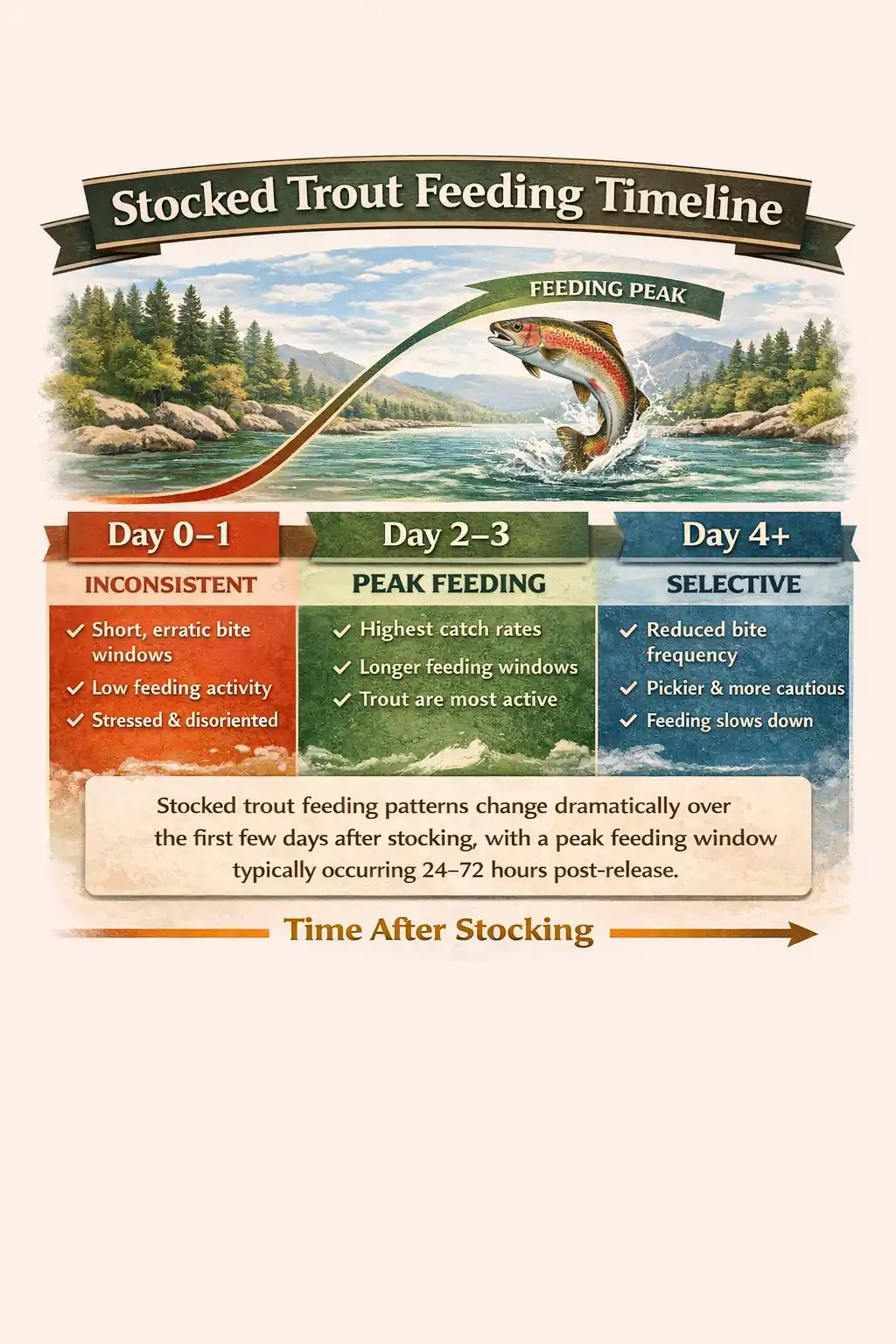
Hatchery-raised trout enter a river with none of the wariness a wild fish accumulates from birth. They’ve spent their lives being fed pellets in a raceway with no need to evaluate risk before eating. Freshly stocked trout are consequently far easier to catch, commonly hitting obvious, flashy, unnatural presentations a wild fish would refuse outright.
That advantage doesn’t last. Within roughly a month of being stocked, surviving hatchery trout begin behaving much more like wild fish: settling into defensible lies, becoming more selective, and showing sharply reduced catchability compared to their first days in the river. Some of that shift is individual learning from close calls and hookups; some is natural selection working fast, since the boldest, least cautious stocked fish are simply removed from the population first.
Wild trout never get that naive grace period — they’ve been dodging herons, otters, and larger fish since they were fry, so baseline caution is present before an angler ever makes a cast. This is the practical reason wild-trout water demands finer tippet and better drift than a put-and-take pond: it reflects a real, measurable difference in starting wariness between the two populations.
What This Actually Means for Your Next Trip
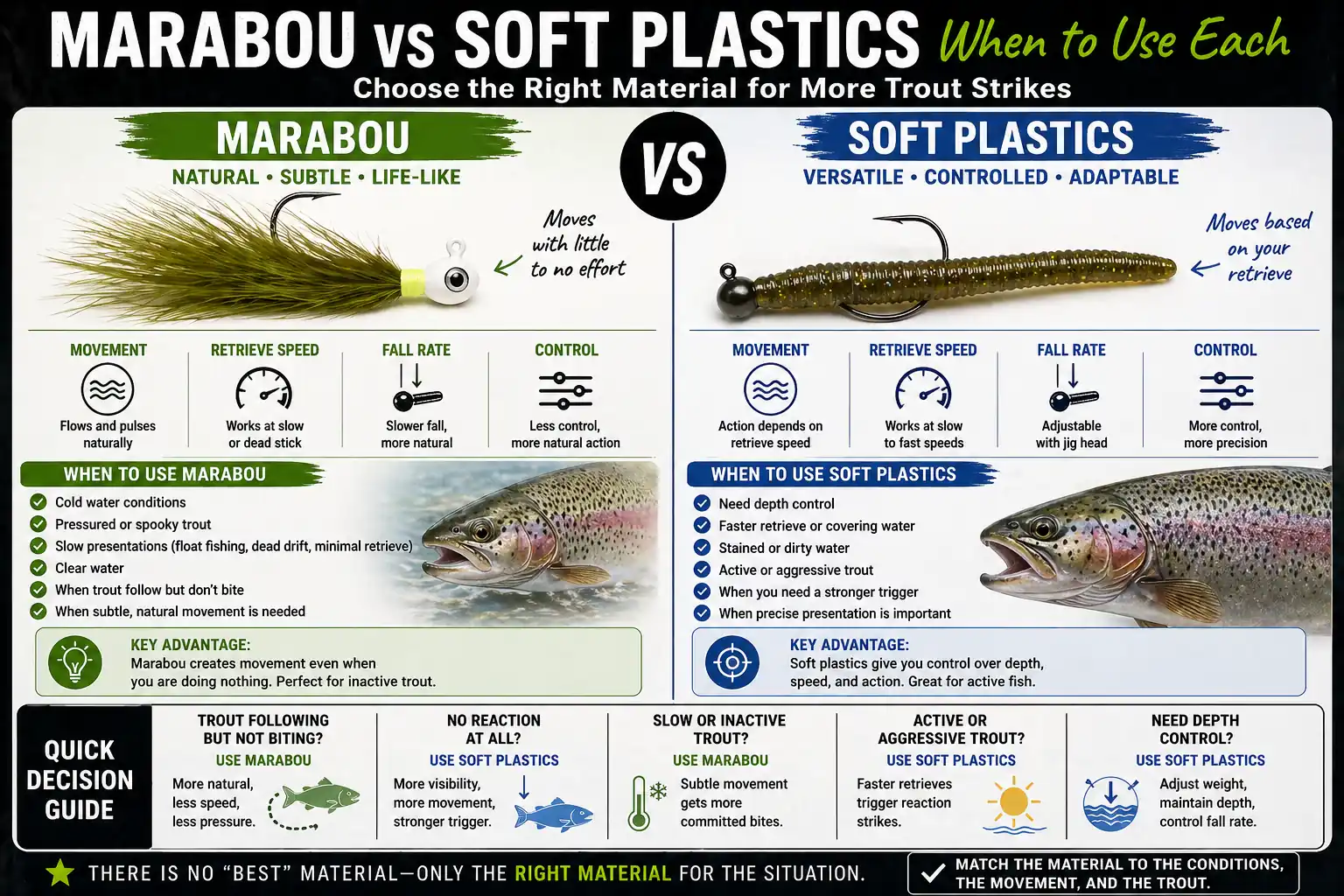
Change something specific after a refusal, not everything. Since fish associate a specific presentation rather than food in general, swapping color, size, or retrieve — rather than abandoning the spot — often gets a bite from a fish that just refused you.
Give pressured water a rest. With site avoidance lasting up to 12 days, a spot that goes quiet after a few hookups may fully recover with a week or two off, rather than being genuinely fished out.
Don’t expect a “pod warning” from one hookup — but expect a brief chemical one. A thrashing, injured fish can put nearby trout on edge for a few minutes via alarm cues, even without any lure-specific learning involved.
Handle released fish quickly and gently. Beyond ethics and survival, a shorter, lower-stress fight likely leaves the fish’s memory-forming ability intact.
Expect wild trout to demand more precision than stocked trout, and expect that gap to shrink fast over a stocked fish’s first month in the river.
“Learned” doesn’t mean “uncatchable.” Even fish that demonstrably learn to avoid angling gear in controlled studies still get caught roughly a quarter of the time. Persistence and variation beat giving up on a spot.
FAQ
Do trout really have good memories, or is this exaggerated?
Trout memory is well documented and far better than the “three-second memory” myth suggests. Conditioning experiments have shown trout retaining a learned scent-danger association for a full year, and tracked wild trout have avoided their exact capture spot for up to 12 days after release.
How fast can a trout learn to avoid a lure?
Very fast. In controlled trials on a closely related species, most fish learned to avoid a baited hook after just one or two catches, while still readily eating identical unhooked bait.
If I catch a trout, will it warn the other fish in the pool?
Not through learning — but possibly through chemistry. Direct tests found no evidence that watching another fish get hooked makes a trout warier of the lure itself. But an injured fish can release a chemical alarm cue that nearby trout smell, triggering short-term defensive behavior unrelated to any specific lure.
Does catch-and-release actually work, or do trout just get caught again immediately?
It works, with a nuance: the stress and oxygen deprivation from a hard fight can temporarily impair a trout’s memory-forming ability for hours after release, so a rough fight might paradoxically leave a weaker impression than a quick one. Tracked trout still show real avoidance behavior — of both location and lure — in the days and weeks that follow.
Are stocked trout really easier to catch than wild trout?
Yes, especially in the first few weeks after stocking. That advantage fades within about a month, as surviving stocked fish grow cautious through both learning and selective removal of the boldest individuals. Wild trout are cautious from birth due to constant natural predation pressure.
Can fishing pressure change a trout population over time, not just individual fish?
Yes. Studies selectively “fishing” experimental populations found boldness was the single strongest trait determining which fish got caught. Over generations, this shifts a population’s average temperament toward caution, and effects have been shown to pass to offspring in brown trout. Pressured public water fishes harder partly because the population itself has been bred toward wariness.
Does this mean pressured trout become truly uncatchable?
No. Even in studies designed to demonstrate hook-avoidance learning, fish that had clearly learned to avoid angling gear were still caught in roughly a quarter of subsequent attempts. Varying presentation, resting spots, and careful handling all shift the odds back in your favor.