Stocked Trout Fishing Tips for the First 72 Hours
Part 1 — Stocked Trout Are Not Wild Fish Understanding the First 72 Hours After Stocking Stocked trout fishing tips become much more effective when you understand how fish behave immediately after stocking…
How to Catch Stocked Trout (First 72 Hours)
Stocked trout fishing tips during the first 72 hours are not random—it follows predictable behavioral patterns.
Immediately after stocking, trout are:
- disoriented
- surface-oriented
- conditioned to feed on falling food
Because of this, the most effective approach is simple:
- fish close to the stocking area
- keep bait within 10–30 feet of shore
- present bait at mid-depth, not on the bottom
- minimize movement early
- rely on scent and visibility over action
As time passes, trout begin adjusting:
- they spread out
- they become more selective
- they respond more to subtle movement
The key to consistent success is matching your presentation to how trout behave at each stage—not fishing the same way the entire time.
Stocked Trout Fishing Tips for the First 72 Hours
The most effective stocked trout fishing tips are based on behavior—not guesswork.
Follow this system:
- 0–24 hours: use stationary, scent-based bait
- 24–48 hours: introduce slight movement
- 48–72 hours: begin using slow-moving lures or soft plastics
- stay near the stocking point early, then expand outward
- adjust depth before changing bait
Most anglers fail because they move too fast, fish too deep, or change lures before fixing presentation.
Start Here: The Complete Trout System
If you want the full breakdown of how color, depth, fall rate, and presentation all work together, read the complete system here:→ Best Soft Plastics for Trout: Complete Guide
1. What “Stocked Trout” Actually Are
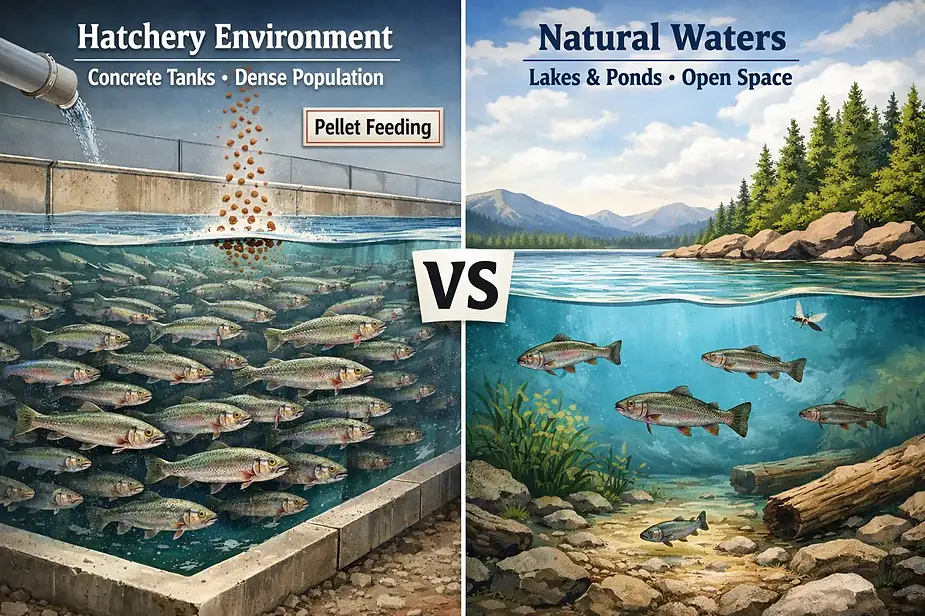
Stocked rainbow trout are not functionally equivalent to wild trout. Their feeding behavior, movement patterns, and decision-making are shaped by artificial conditions.
Hatchery Conditioning Defines Behavior
Before stocking, trout are raised in:
- Concrete raceways or tanks
- High-density populations
- Controlled feeding schedules
They are trained—unintentionally—to:
- Eat at specific times
- Recognize one type of food (pellets)
- Compete aggressively in tight groups
They are not trained to:
- Identify natural prey
- Avoid predators effectively
- Navigate complex environments
Feeding Conditioning (Critical Point)
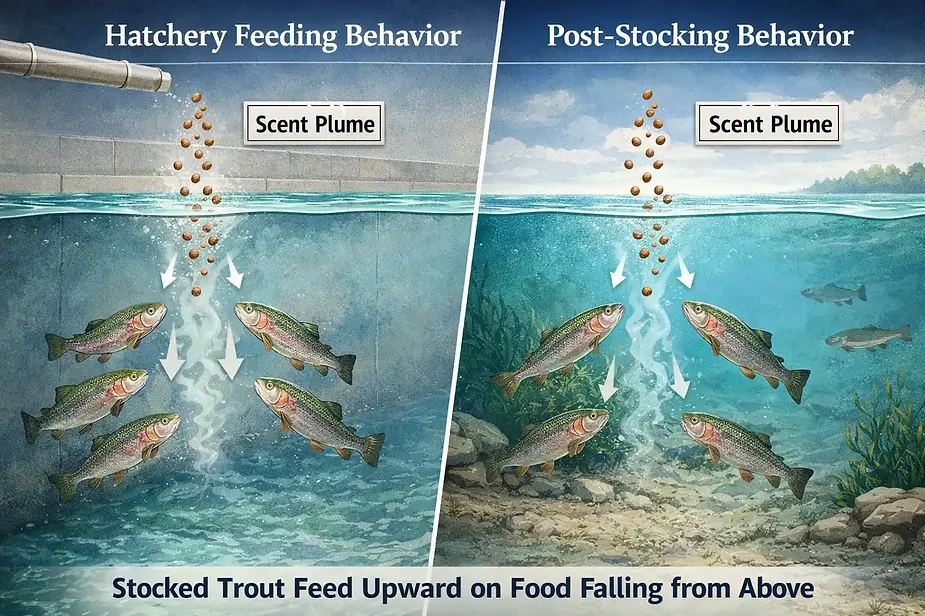
Hatchery trout learn a simple rule:
Food appears from above, falls downward, and requires minimal effort to consume.
This creates three immediate consequences after stocking:
- Vertical feeding bias
- Low selectivity early on
- Strong scent dependence
Practical Meaning
This is why:
- Floating or suspended baits outperform bottom-dragging lures early
- Dough baits work better than most artificial lures in the first 24–48 hours
- Movement is often less important than presence
2. The Stocking Event: Shock and Disorientation
When trout are stocked, they experience a rapid environmental transition:
- Transport stress (low oxygen, crowding)
- Sudden release into unfamiliar water
- Exposure to predators and open space
Behavioral State: Survival Mode
Immediately after stocking, trout are not actively hunting. They are:
- Disoriented
- Energy-conserving
- Reacting rather than pursuing
Key Behavior Pattern
They do not spread out immediately.
Instead, they:
- Remain near the stocking point
- Hold in shallow or mid-depth water
- Move slowly or suspend
Practical Application
Where to Fish (First 24 Hours)
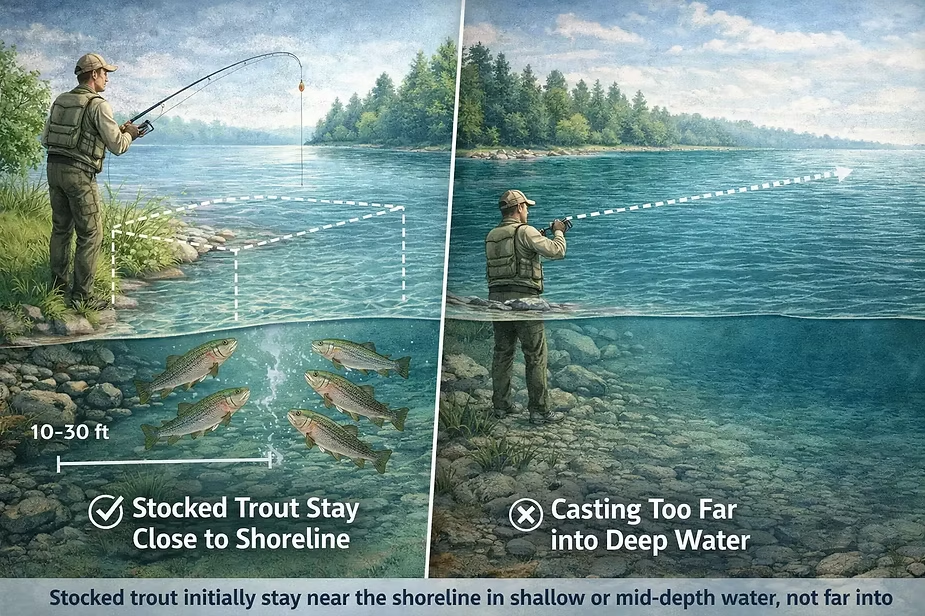
Where to Cast for Stocked Trout (First 72 Hours)
Stocked trout positioning is predictable in the early stages.
Most fish will:
- stay within 10–30 feet of shore
- hold near the stocking point
- suspend in shallow to mid-depth water
Effective casting strategy:
- fish parallel to the shoreline
- target visible cruising fish
- focus on calm water zones near release areas
Avoid:
- casting long distances into deep water
- targeting structure too early
- fishing below the level where trout are holding
Early success comes from fishing where trout actually are—not where anglers assume they are.
Focus on:
- Stocking locations (visible or known)
- Shoreline areas within casting distance
- Calm water zones near release points
Avoid:
- Deep water immediately after stocking
- Structure far from the release area
Common Mistake
Mistake: Casting as far as possible into deep water
Reality: Most stocked trout are within 10–30 feet of shore during the initial period
Adjustment:
- Shorten casting distance
- Fish parallel to the bank
- Target visible cruising fish
3. The First Feeding Response (0–24 Hours)
Feeding behavior in the first 24 hours is inconsistent but predictable in pattern.
Most stocked trout stay within 10–30 feet of shore after release. Casting too far often places your bait outside the active zone.
Trigger Type: Reaction Feeding
Stocked trout are not actively searching for food. Instead, they respond to:
- Familiar shapes
- Strong scent signals
- Easy opportunities
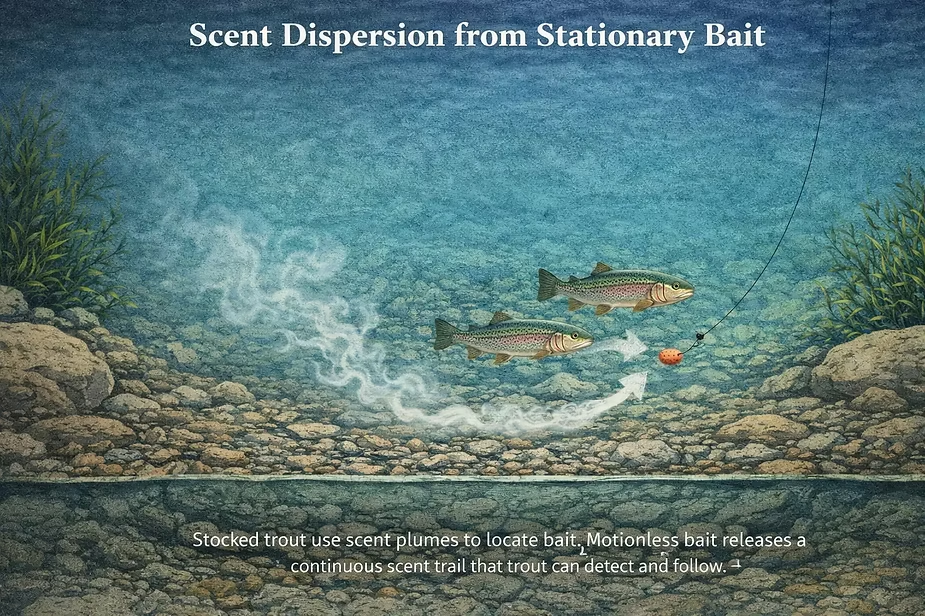
Why Dough Bait Works Immediately
Dough bait aligns with hatchery conditioning:
| Factor | Dough Bait | Matches Pellet Behavior |
| Shape | Yes | Rounded |
| Texture | Yes | Soft |
| Scent | Strong | Highly detectable |
| Movement needed | None | Minimal |
Cause → Effect Chain
Pellet feeding history → recognition of soft, round objects → scent confirmation → low-effort feeding → high bite probability
Practical Setup
Rig Type
- Slip sinker rig (Carolina-style)
Presentation
- Bait suspended slightly off bottom
- Minimal movement
Retrieval
- None or extremely slow
Common Mistake
Mistake: Constantly moving bait
Reality: Early-stage trout respond better to stationary presentations
Adjustment:
- Cast
- Let bait sit
- Wait for trout to approach
4. Depth and Positioning Behavior
Stocked trout do not immediately occupy optimal feeding zones.
Initial Depth Preference
Most fish will:
- Suspend in the upper to mid water column
- Avoid extreme depths initially
Reasons:
- Oxygen familiarity (surface-oriented hatchery tanks)
- Light adaptation
- Reduced pressure at shallow depth
Practical Application
Depth Control
If using bait:
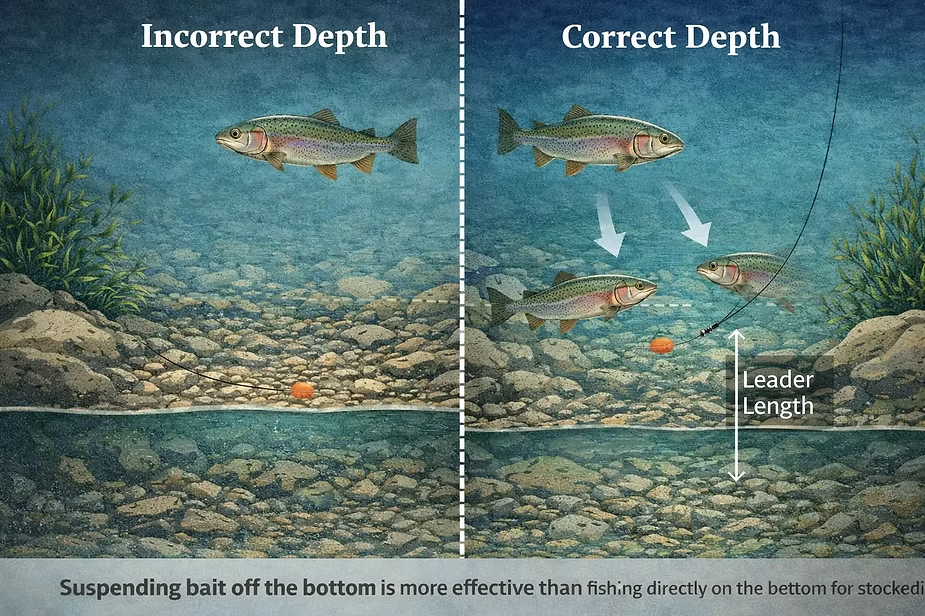
- Keep bait slightly elevated off bottom
If using floats:
- Set depth between 1–4 feet initially
Common Mistake
Mistake: Fishing directly on the bottom
Reality:Trout are often suspended above the bottom in early stages
Adjustment:
- Use floating bait or adjust leader length
- Experiment upward before going deeper
5. Movement vs Stillness
Understanding when trout respond to movement is critical.
Early Behavior (First 24–48 Hours)
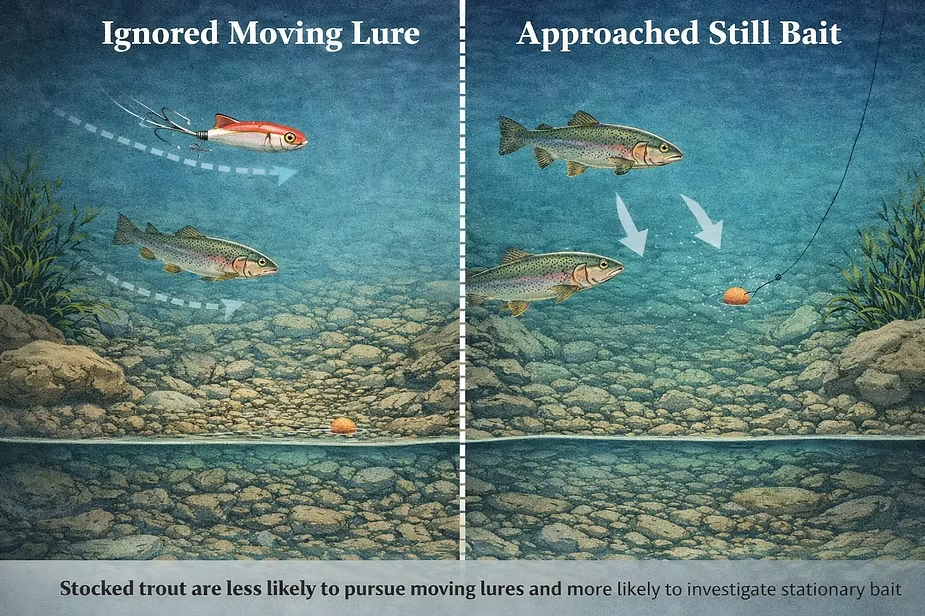
Trout show:
- Low chase behavior
- Limited aggression toward fast-moving lures
Why Lures Often Fail Early
Lures depend on:
- Instinctive predation
- Chase response
Stocked trout initially lack:
- Strong prey recognition
- Confidence in chasing unfamiliar objects
Practical Application
When to Use Lures (Early Stage)
Only effective if:
- Retrieved very slowly
- Kept within visible range of fish
- Paused frequently
Better Approach
Use:
- Static bait
- Scent-driven presentations
· Transition to lures later
6. The 24–72 Hour Transition Phase
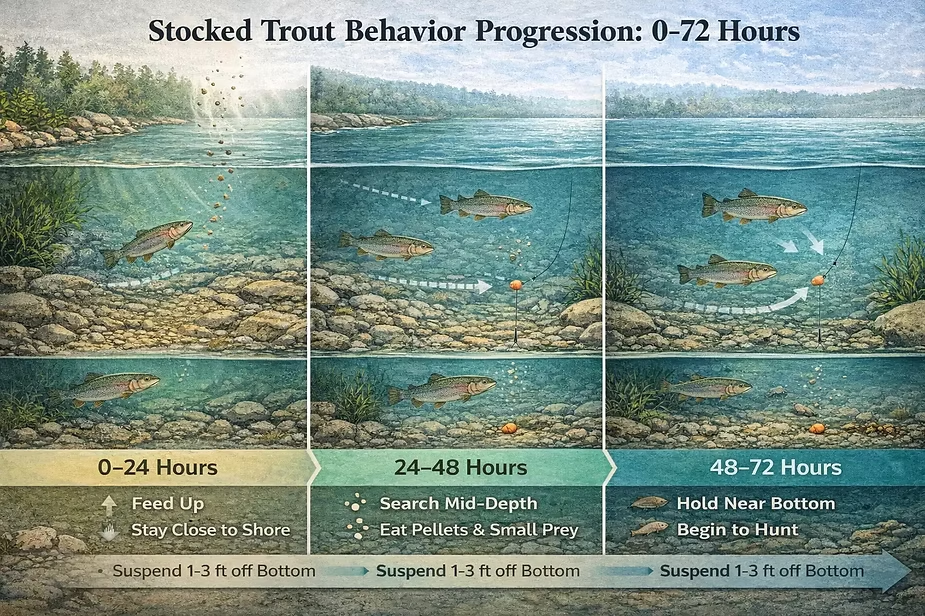
After the initial shock period, trout begin adjusting.
Behavioral Changes
Between 24–72 hours:
- Fish begin to spread out
- Feeding becomes more consistent
- Curiosity increases
Feeding Shift
Trout begin:
- Exploring new food sources
- Responding to subtle movement
- Competing more actively
Practical Application
Adjust Strategy Gradually
Start introducing:
- Slow-moving lures
- Small spoons or spinners
- Soft plastics with slight action
Key Adjustment
Shift from:
- Pure scent-based fishing
To:
- Scent + movement combination
7. Pressure Effects Begin Immediately
Fishing pressure alters feeding behavior quickly.

What Happens Under Pressure
After repeated catches and releases:
Trout begin to:
- Avoid heavily fished areas
- Become more selective
- Reduce surface activity
Timeline
- Day 1: High catch rates
- Day 2–3: Noticeable decline
- After: Behavior becomes more cautious
Practical Application
To Maintain Catch Rates
- Move away from high-traffic areas
- Downsize bait
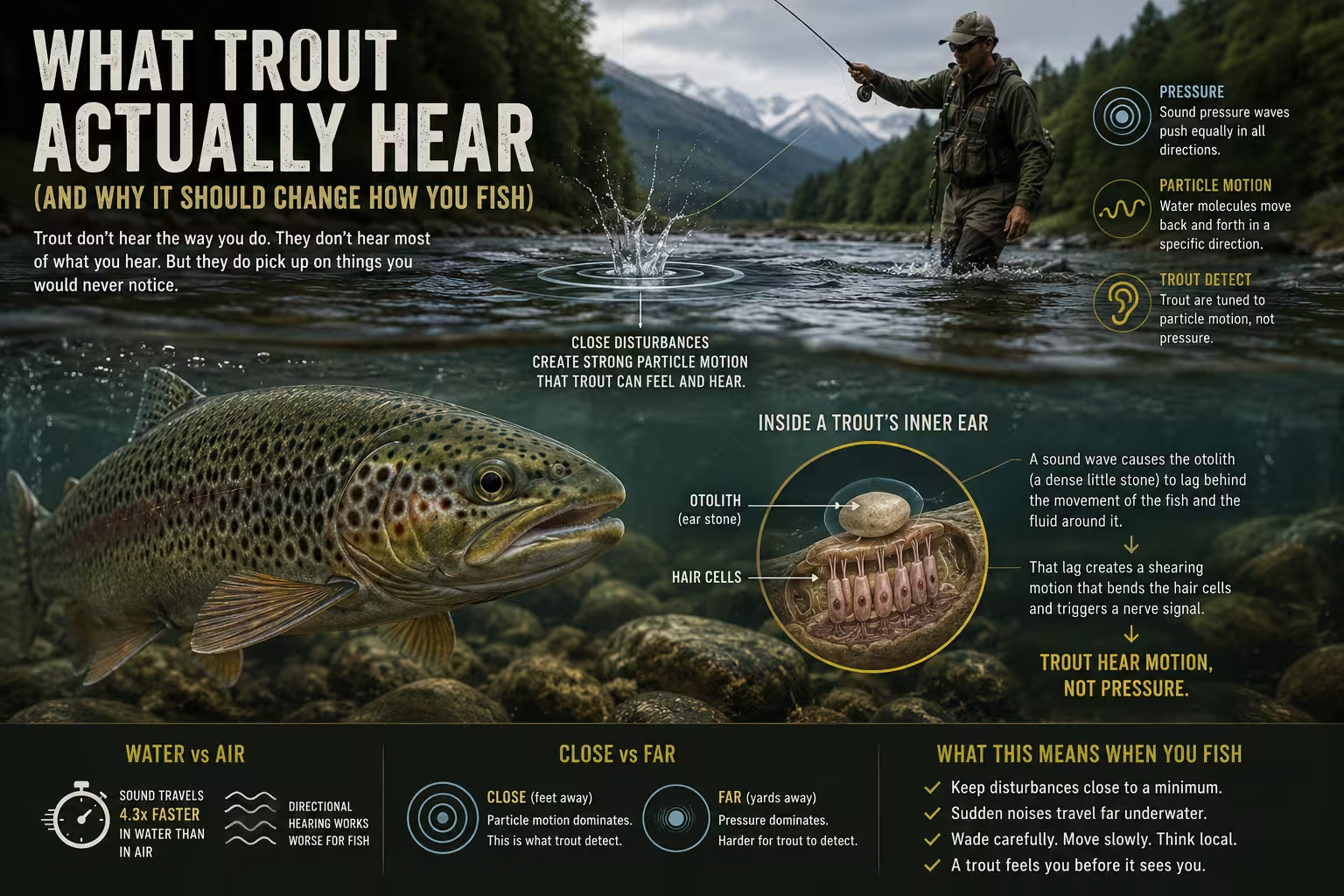
- Reduce noise and disturbance
Common Mistake
Mistake: Fishing the exact stocking point days later
Reality:Fish disperse and become less predictable
Adjustment:
- Target transition zones
- Look for less pressured water
8. Environmental Factors That Override Everything
Even in early stages, conditions matter.
Key Variables
1. Water Temperature
- Cold water → slower metabolism → less movement
- Moderate temperature → increased feeding
2. Light Conditions
- Bright light → reduced activity near surface
- Low light → increased movement
3. Water Clarity
- Clear → visual feeding improves
- Murky → scent becomes dominant
Practical Application
Adjust based on conditions:
| Condition | Strategy Adjustment |
| Clear water | Natural colors, subtle presentation |
| Murky water | Strong scent, bright colors |
| Cold water | Slow everything down |
| Warm water | Increase movement slightly |
Stocked Trout Behavior Timeline (First 72 Hours)
Understanding how behavior changes over time allows you to adjust before fishing slows down.
| Time After Stocking | Behavior | Best Strategy |
| 0–24 Hours | Disoriented, reactive | Stationary bait, strong scent |
| 24–48 Hours | Curious, adjusting | Slight movement, controlled drift |
| 48–72 Hours | Spreading out, selective | Slow lures, soft plastics |
Trout do not stop feeding—they change how they respond. Adjust your approach as behavior shifts.
9. System Summary (First 72 Hours)
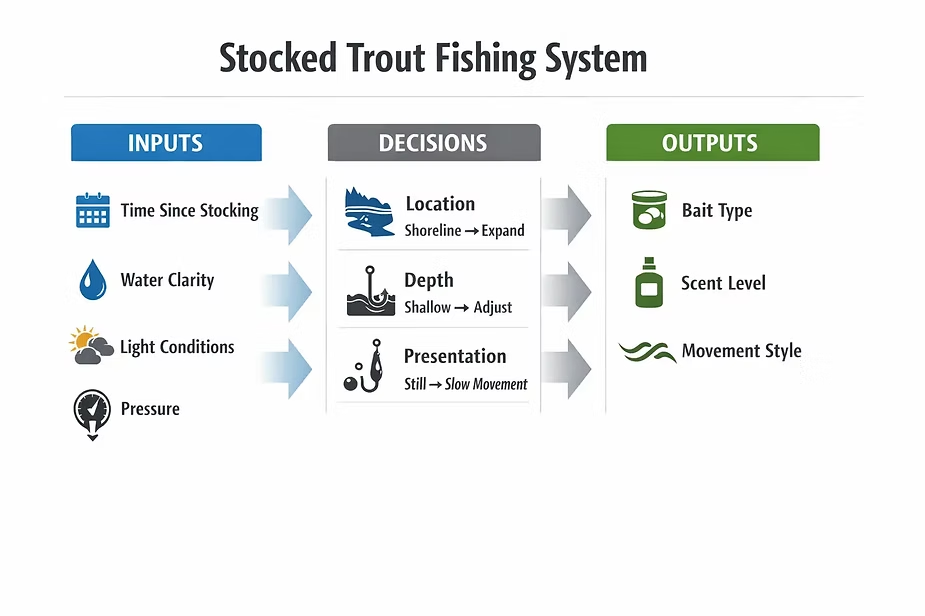
Decision Framework
Step 1 — Time Since Stocking
- 0–24 hrs → stationary bait
- 24–72 hrs → introduce slight movement
Step 2 — Location
- Start near stocking point
- Expand outward over time
Step 3 — Depth
- Begin shallow to mid-depth
- Adjust deeper only if needed
Step 4 — Presentation
- Early: scent + stillness
- Later: scent + slow movement
10. Key Takeaways
- Stocked trout are conditioned, not instinct-driven early
- Feeding behavior is based on recognition, not hunting
- First 24 hours favor simple, stationary, scent-based approaches
- Movement becomes effective only after adjustment period
- Most anglers fail by:
- Fishing too deep
- Moving bait too much
- Casting too far
This is why presentation, depth control, and material behavior matter more than most anglers realize. If you want a complete breakdown of how these variables work together across all trout conditions, read the full system here:→ Best Soft Plastics for Trout: Complete Guide
Build a Predictable Stocked Trout System
Stocked trout fishing becomes consistent when you stop guessing and start adjusting based on behavior.
Every stage after stocking follows a pattern:
- location changes
- feeding response changes
- movement tolerance changes
If you understand these patterns, you can adjust before most anglers realize anything has changed.
The best stocked trout fishing tips focus on understanding trout behavior rather than constantly changing bait or location.
This is the difference between random success and consistent results.
What This Means Going Forward
This first phase explains why bait dominates stocked trout fishing early.
The next step is understanding exactly what trout recognize as food, and how to exploit that consistently.
Frequently Asked Questions About Stocked Trout Fishing
1. What is the best bait for stocked trout during the first 24 hours?
The best bait is usually a stationary, scent-based bait that resembles hatchery pellets. Floating dough baits, PowerBait-style products, salmon eggs, and scented soft baits often outperform moving lures immediately after stocking because trout are still conditioned to recognize food that drifts or remains suspended in the water.
2. How far from shore are stocked trout after stocking?
Most stocked trout remain surprisingly close to shore during the first 24 to 72 hours. Many fish stay within 10 to 30 feet of the bank, especially near stocking locations. This is why short, accurate casts often catch more fish than long casts into deep water.
3. Should I fish on the bottom for stocked trout?
Not usually during the first few days after stocking. Recently stocked trout often suspend above the bottom in shallow or mid-depth water. Suspending bait 1 to 3 feet above the bottom generally produces better results than placing bait directly on the lake floor.
4. Why aren’t stocked trout hitting my lures?
Freshly stocked trout often have limited prey recognition and weak chase instincts. They are conditioned to feed on pellets rather than hunt baitfish. Fast-moving lures may be ignored until trout have had time to adjust to their new environment.
5. When do lures become more effective for stocked trout?
Lures typically become more productive between 24 and 72 hours after stocking as trout begin exploring, feeding more consistently, and responding to movement. Slow retrieves, small spoons, inline spinners, and soft plastics often work best during this transition period.
6. Why does scent matter so much for stocked trout?
Hatchery trout rely heavily on scent because they are raised in environments where food creates a strong scent plume. Scented baits help trout locate food and often trigger strikes even when fish are not actively feeding.
Next Article
Part 2 — “What Stocked Trout Actually Think Food Is” Focus: Pellet conditioning, scent logic, and bait design principles that directly influence strike rates.
About Family Fishin
Family Fishin is a family-owned fishing tackle company dedicated to designing, testing, and producing high-quality fishing lures — inspired by generations of fishing tradition and driven by a passion for innovation. Every product is developed with one goal in mind: helping anglers spend more time doing what they love, catching fish and creating memories on the water.